REVIEW 3 major objections 4 minor 1 cited by
LLM Cannot Discover Causality, and Should Be Restricted to Non-Decisional Support in Causal Discovery
T0 review · 3 major / 4 minor · reviewed 2026-08-07 · deepseek-v4-flash
Pith's one-line read Autoregressive language models cannot discover causality, the paper argues; their outputs must never decide the existence or direction of causal edges, and should only guide the search that statistical criteria adjudicate.
desk verdict The impossibility thesis doesn't hold, but the reliability critique and the non-decisional role are worth a serious look. read the letter →
The pith
A machine-rendered reading of the paper's core claim, the machinery that carries it, and where it could break.
The reading
What carries the argument
The load-bearing object is the contrast between two probability factorizations: the autoregressive chain rule of Eq. (1), $P(x) = P(x_1)P(x_2 \mid x_1)\cdots P(x_T \mid x_1,\ldots,x_{T-1})$, which is what an LLM implements, and the causal factorization of Eq. (2), $P(X_1,\ldots,X_n) = \prod_i P(X_i \mid \mathrm{pa}(X_i))$, which defines a structural causal model. The paper argues that because the first conditions on every preceding token rather than on causal parents, it tracks correlations, not causal structure, so LLM outputs have no theoretical warrant for causal assertions. A second mechanism is the modified score $\sigma(G;D,\lambda) = \sigma(G;D) + \sigma(G;\lambda)$ through which LLM priors enter score-based discovery; the paper argues this addition is dimensionally incoherent and strips the scoring function of decomposability and score local consistency, and that the analogous adjustment $G^2(X,Y \mid Z) - p > \chi^2_{\alpha,f}$ breaks the independence test's distributional guarantee.
What would settle it
A targeted experiment would settle the impossibility claim: present an LLM with raw simulated data from a known small causal graph (for instance, the five-node Cancer network) as plain tokenized numbers, with causally uninformative variable names and no background knowledge or edge hints in the prompt, and ask for the inferred graph. The paper's analysis predicts orientations near chance that do not improve with numerical precision or sample size; the opposite pattern, accuracy that scales with data quality, would refute the claim. A second check isolates the manipulability argument: if cause-first and effect-first rewrites of identical content yield statistically identical accuracy across several models, the word-order sensitivity asserted in Position 3.1 would be contradicted.
Extended reading notes
Core claim
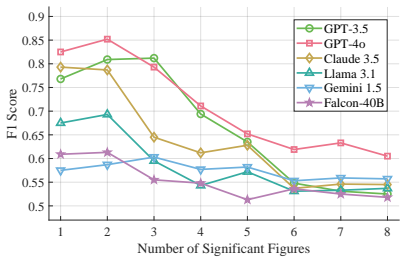
The paper's central claim is stated as Position 5.1: in any collaboration between causal discovery algorithms and LLMs, the LLM must not participate in determining the existence or directionality of causal relationships, but may influence the search procedure. The justification has two prongs. First, LLMs are theoretically ungrounded as causal reasoners: the autoregressive decomposition $P(x) = P(x_1)P(x_2 \mid x_1)\cdots P(x_T \mid x_1,\ldots,x_{T-1})$ conditions every prediction on all preceding tokens, so it cannot enforce the conditional independences encoded by the causal factorization $P(X_1,\ldots,X_n) = \prod_i P(X_i \mid \mathrm{pa}(X_i))$; empirically, causal judgments shift with word order, redundant entities, entity distance, and numerical precision, collapsing toward chance at high precision. Second, using LLM outputs as priors corrupts the algorithms that embed them: adding a data-independent LLM term $\sigma(G;\lambda)$ to a data score $\sigma(G;D)$ mixes incompatible probability spaces and breaks decomposability and score local consistency, and subtracting a prior term from a $G^2$ statistic destroys the chi-squared asymptotics that license the test. The paper also documents that favorable results in the literature can be manufactured by injecting ground-truth causal statements into prompts. It closes with a case study in which LLMs are used only for search-space initialization, mutation guidance, and cycle repair, while BIC/BDeu scoring retains final authority, and reports that this confined role matches or beats both classical and LLM-prior methods.
Load-bearing premise
The whole prohibition rests on the premise that an LLM's next-token prediction, however large or well-trained, can never genuinely implement the cause-and-effect structure among variables, making LLM causal judgment unreliable in principle rather than merely in practice.
Editorial extensions
If this is right
- Existing LLM-based discovery pipelines that accept LLM judgments as answers or as priors have no theoretical guarantee, so their reported successes should be re-examined with prompts that cannot leak ground-truth relationships.
- Soft-constraint scores formed by directly adding an LLM prior term to BIC, BDeu, or MDL mix incompatible scales and break decomposability and local consistency, so the optimization algorithms built on those properties no longer apply.
- LLMs confined to search assistance can accelerate convergence and match or beat both classical CDAs and LLM-prior methods on bnlearn benchmarks.
- Evaluation of LLM-based causal discovery should blind prompts to known causal links and vary textual form, since manual prompt refinement alone can lower error rates without any improvement in the algorithm.
Reading between the lines
- The paper argues from the autoregressive architecture itself, which means its prohibition, if it holds, applies to current and near-future LLMs; a model trained with an objective that explicitly scores causal factorizations, or equipped with a separate causal module, would escape the argument's scope rather than refute it.
- The proposed division of labor suggests a cheap diagnostic the paper does not report: rerun an LLM-guided search with the LLM replaced by a random graph proposer, and the gap between the two measures how much of the speed-up is real world knowledge versus lucky exploration.
- The critique of adding an uncalibrated prior term to a data score generalizes beyond causality: any pipeline that folds pretrained-model opinions into a statistical objective as a penalty inherits the same scale-mismatch and guarantee-breaking problem, so blinded validation should be the norm there too.
- If the position is accepted, LLM-based causal discovery takes the shape of an ask-and-verify loop, where language models propose hypotheses and design interventions while statistical tests hold final authority, a workflow close to how expert-guided causal discovery already operates.
Editorial analysis
A structured set of objections, weighed in public.
Referee Report
Summary. The paper argues that large language models (LLMs) cannot identify causal relationships and that their outputs should not be used, directly or indirectly, to determine the existence or directionality of causal edges in causal discovery. The authors critique both the intrinsic autoregressive modeling of LLMs and the practice of injecting LLM judgments as priors into score-based or constraint-based causal discovery algorithms. They propose a restricted 'non-decisional' role in which LLMs only guide heuristic search (initialization, mutation, crossover, cycle resolution), with the final structure still determined by classical scoring functions. Empirical sections probe the sensitivity of LLMs to word order, redundancy, entity distance, and numerical precision, and a case study claims that LLM-guided heuristic search outperforms baselines.
Significance. If the central impossibility claim were established, the paper would have substantial implications for a growing literature on LLM-based causal discovery. The manuscript is useful as a broad survey and as a set of cautionary empirical demonstrations: the sensitivity analyses in Appendices B and C, the literature tables in Appendix A, and the prompt-leakage experiment in Section 6 are valuable contributions. The proposed heuristic-search framework is a constructive alternative that deserves attention, and the paper is honest in isolating LLM influence from final causal decisions. However, the paper's headline claim that LLMs 'cannot discover causality' is not supported by the theoretical argument as written, and the proposed boundary in Section 5.2 is internally inconsistent. The empirical sections, while suggestive, lack error bars and significance tests, so the comparative claims about the new method are not yet convincing at the level required for the paper's strong conclusions.
major comments (3)
- [Section 3.1, Eqs. (1)-(2)] The load-bearing theoretical argument is invalid. Eq. (1) is the chain rule, a mathematical identity satisfied by every joint distribution; it is not a restriction to 'correlation-driven' modeling. For any DAG with topological order v1,...,vn, one can define autoregressive conditionals Q(v_t | v_1,...,v_{t-1}) = P(v_t | pa(v_t)) and obtain exactly the causal factorization of Eq. (2). Thus Eqs. (1) and (2) are not incompatible, and the rain/ground/walk example demonstrates only that a particular prompt can make an LLM attend to an irrelevant variable, not that the autoregressive architecture must do so. Consequently, Position 3.1 and the abstract's categorical 'cannot' are not established by the stated reasoning; at most the argument supports a claim that current LLMs are unreliable and sensitive to surface features.
- [Section 5.2, item (1)] The proposed LLM-based initialization violates the paper's own boundary. The text states that variable pairs 'deemed highly unlikely to have causal relationships by the LLM are pruned from the search space at the initialization stage.' This action directly removes the possibility of an edge and thus determines the non-existence of a causal relationship, which Position 5.1 explicitly prohibits ('LLM outputs must not serve as the final criterion for causal structures, such as directly deciding whether an edge exists'). The paper needs either to revise the boundary to allow provisional pruning with a mechanism for re-adding pruned edges, or to modify the case study so that LLM outputs do not exclude edges from the search space.
- [Appendices B-D, Figures 2-9] The empirical comparisons are presented without error bars, confidence intervals, or significance tests, even where the text claims that one method 'significantly outperforms' another (e.g., Appendix D on LLM-based initialization and evolutionary operators) and where Section 6 asserts that soft-constrained scoring functions 'consistently struggle' to filter errors. Many plots show differences of a few points in F1, and Table 3 reports single values with occasional 'Fail' entries. The reader cannot assess whether the reported advantages are stable across the 30 runs mentioned in Appendix D or merely prompt- and seed-dependent. Reporting mean±std or paired significance tests would be needed to support the strong comparative conclusions.
minor comments (4)
- [Abstract] The phrase 'training method that respect' should be 'training methods that respect'.
- [Section 4, Eq. (8)] The notation p is used both for the prior-adjustment term in Eq. (8) and for probability values elsewhere; this is confusing and should be renamed, e.g., to δ.
- [Section 6 and Appendix E] Section 6 refers the reader to 'Figure 7' for low-quality prompts, but Figure 7 in Appendix D shows initialization F1 scores; the relevant figure is Figure 9 in Appendix E. The cross-reference should be corrected.
- [Section 4, 'Analysis of Score-based Methods'] The phrase 'Decomposablity' contains a typo; it should read 'Decomposability'.
Circularity Check
No significant circularity: the paper's central position rests on an independent (though contestable) theoretical premise and on external benchmark evaluations, and its self-citations are not load-bearing.
full rationale
The paper's central claim that LLMs 'cannot identify causality' is not derived from fitted parameters, from a definition that presupposes the conclusion, or from a self-citation chain. Section 3.1 grounds the impossibility in a comparison between autoregressive factorization (Eq. 1) and SCM factorization (Eq. 2); that argument is mathematically debatable, since Eq. (1) is the chain rule and can in principle represent the factorization in Eq. (2), but the issue is whether the premise is correct, not whether the conclusion was assumed as an input. The empirical studies in Appendices B and C use external bnlearn benchmarks and standard F1/SHD metrics, so the performance claims are independently checkable. The prompt-manipulation experiments in Section 6 deliberately inject known answers to demonstrate leakage; they are demonstrations of manipulability, not fitted-input predictions. The self-citations [38, 39] appear in Section 4 only to describe an existing G2-prior construction that the paper then criticizes; the critique does not depend on the correctness of those prior papers, so the self-citations are not load-bearing. The case study in Section 5.2 does create an internal tension, because LLM pruning of variable pairs 'deemed highly unlikely to have causal relationships' removes edges from the search space and thereby resembles indirect existence determination, but this is a consistency or scope objection rather than a circular reduction of the paper's stated conclusion to its inputs. Overall, no step in the paper's derivation chain is equivalent to its own inputs by construction.
Assumptions & free parameters
assumptions (5)
- domain assumption An autoregressive LLM models only P(x) = product_i P(x_i | x_<i), which cannot represent conditional independencies of a causal DAG factorization.
- domain assumption Reliable prior knowledge in causal discovery must come from rigorous sources, and LLM outputs are 'unreliable' by default.
- standard math The G2 statistic has a fixed asymptotic chi-square distribution, and subtracting a prior term destroys that distribution and invalidates the test.
- domain assumption Decomposability and score local consistency are required for the correctness of CDA search algorithms, so breaking them invalidates LLM-prior scoring.
- domain assumption The bnlearn benchmarks with variable names and background knowledge are representative of genuine causal discovery tasks.
Cite this review
Pith. "Pith review of LLM Cannot Discover Causality, and Should Be Restricted to Non-Decisional Support in Causal Discovery." pith.science (2026). https://pith.science/paper/NTLRENTE
@misc{pith2026250600844,
  author       = {Pith},
  title        = {Pith review of: LLM Cannot Discover Causality, and Should Be Restricted to Non-Decisional Support in Causal Discovery},
  year         = {2026},
  howpublished = {\url{https://pith.science/paper/NTLRENTE}},
  note         = {Machine review of arXiv:2506.00844}
}
read the original abstract
This paper critically re-evaluates LLMs' role in causal discovery and argues against their direct involvement in determining causal relationships. We demonstrate that LLMs' autoregressive, correlation-driven modeling inherently lacks the theoretical grounding for causal reasoning and introduces unreliability when used as priors in causal discovery algorithms. Through empirical studies, we expose the limitations of existing LLM-based methods and reveal that deliberate prompt engineering (e.g., injecting ground-truth knowledge) could overstate their performance, helping to explain the consistently favorable results reported in much of the current literature. Based on these findings, we strictly confined LLMs' role to a non-decisional auxiliary capacity: LLMs should not participate in determining the existence or directionality of causal relationships, but can assist the search process for causal graphs (e.g., LLM-based heuristic search). Experiments across various settings confirm that, by strictly isolating LLMs from causal decision-making, LLM-guided heuristic search can accelerate the convergence and outperform both traditional and LLM-based methods in causal structure learning. We conclude with a call for the community to shift focus from naively applying LLMs to developing specialized models and training method that respect the core principles of causal discovery.
Figures


Figures from the paper (6 more)




Forward citations
Cited by 1 Pith paper
-
When Large Language Models Meet Law: Dual-Lens Taxonomy, Technical Advances, and Ethical Governance
A literature review that classifies LLM-for-law research using a dual-lens taxonomy of Toulmin argumentation components and legal practitioner roles.
Reference graph
Works this paper leans on
-
[1]
Review of causal discovery methods based on graphical models
Clark Glymour, Kun Zhang, and Peter Spirtes. Review of causal discovery methods based on graphical models. Frontiers in genetics, 10:524, 2019
2019
-
[2]
A survey on causal discovery: theory and practice
Alessio Zanga, Elif Ozkirimli, and Fabio Stella. A survey on causal discovery: theory and practice. International Journal of Approximate Reasoning, 151:101–129, 2022
2022
-
[3]
Causal reasoning and large language models: Opening a new frontier for causality
Emre Kıcıman, Robert Ness, Amit Sharma, and Chenhao Tan. Causal reasoning and large language models: Opening a new frontier for causality. arXiv preprint arXiv:2305.00050, 2023
arXiv 2023
-
[4]
Can large language models infer causation from correlation? In Proceedings of the 12th International Conference on Learning Representations, 2024
Zhijing Jin, Jiarui Liu, LYU Zhiheng, Spencer Poff, Mrinmaya Sachan, Rada Mihalcea, Mona T Diab, and Bernhard Schölkopf. Can large language models infer causation from correlation? In Proceedings of the 12th International Conference on Learning Representations, 2024
2024
-
[5]
Taiyu Ban, Lyvzhou Chen, Xiangyu Wang, and Huanhuan Chen. From query tools to causal architects: Harnessing large language models for advanced causal discovery from data. arXiv preprint arXiv:2306.16902, 2023
arXiv 2023
-
[6]
Using gpt-4 to guide causal machine learning
Anthony C Constantinou, Neville K Kitson, and Alessio Zanga. Using gpt-4 to guide causal machine learning. Expert Systems with Applications, page 126120, 2024
2024
-
[7]
Understanding causality with large language models: Feasibility and opportunities
Cheng Zhang, Stefan Bauer, Paul Bennett, Jiangfeng Gao, Wenbo Gong, Agrin Hilmkil, Joel Jennings, Chao Ma, Tom Minka, Nick Pawlowski, et al. Understanding causality with large language models: Feasibility and opportunities. arXiv preprint arXiv:2304.05524, 2023
arXiv 2023
-
[8]
Causal discovery with language models as imperfect experts
Stephanie Long, Alexandre Piché, Valentina Zantedeschi, Tibor Schuster, and Alexandre Drouin. Causal discovery with language models as imperfect experts. In ICML 2023 Workshop on Structured Probabilistic Inference {\&} Generative Modeling, 2023
2023
Show all 112 references
-
[9]
Applying large language models for causal structure learning in non small cell lung cancer
Narmada Naik, Ayush Khandelwal, Mohit Joshi, Madhusudan Atre, Hollis Wright, Kavya Kannan, Scott Hill, Giridhar Mamidipudi, Ganapati Srinivasa, Carlo Bifulco, et al. Applying large language models for causal structure learning in non small cell lung cancer. In 2024 IEEE 12th I...
2024
-
[10]
Alcm: Autonomous llm-augmented causal discovery framework
Elahe Khatibi, Mahyar Abbasian, Zhongqi Yang, Iman Azimi, and Amir M Rahmani. Alcm: Autonomous llm-augmented causal discovery framework. arXiv preprint arXiv:2405.01744, 2024
2024 arXiv
-
[11]
Causal parrots: Large language models may talk causality but are not causal.Transactions on Machine Learning Research, 2023
Matej Zeˇcevi´c, Moritz Willig, Devendra Singh Dhami, and Kristian Kersting. Causal parrots: Large language models may talk causality but are not causal.Transactions on Machine Learning Research, 2023
2023
-
[12]
Is knowledge all large language models needed for causal reasoning? arXiv preprint arXiv:2401.00139, 2024
Hengrui Cai, Shengjie Liu, and Rui Song. Is knowledge all large language models needed for causal reasoning? arXiv preprint arXiv:2401.00139, 2024
2024 arXiv
-
[13]
Causal graph dis- covery with retrieval-augmented generation based large language models
Yuzhe Zhang, Yipeng Zhang, Yidong Gan, Lina Yao, and Chen Wang. Causal graph dis- covery with retrieval-augmented generation based large language models. arXiv preprint arXiv:2402.15301, 2024
2024 arXiv
-
[14]
A survey of large language models
Wayne Xin Zhao, Kun Zhou, Junyi Li, Tianyi Tang, Xiaolei Wang, Yupeng Hou, Yingqian Min, Beichen Zhang, Junjie Zhang, Zican Dong, et al. A survey of large language models. arXiv preprint arXiv:2303.18223, 2023
2023 arXiv
-
[15]
Foundations of structural causal models with cycles and latent variables
Stephan Bongers, Patrick Forré, Jonas Peters, and Joris M Mooij. Foundations of structural causal models with cycles and latent variables. The Annals of Statistics, 49(5):2885–2915, 2021
2021
-
[16]
Evolutionary com- putation in the era of large language model: Survey and roadmap
Xingyu Wu, Sheng-hao Wu, Jibin Wu, Liang Feng, and Kay Chen Tan. Evolutionary com- putation in the era of large language model: Survey and roadmap. IEEE Transactions on Evolutionary Computation, 2024
2024
-
[17]
D’ya like dags? a survey on structure learning and causal discovery
Matthew J V owels, Necati Cihan Camgoz, and Richard Bowden. D’ya like dags? a survey on structure learning and causal discovery. ACM Computing Surveys, 55(4):1–36, 2022. 10
2022
-
[18]
Unveiling causal reasoning in large language models: Reality or mirage? In Proceedings of the 38th Annual Conference on Neural Information Processing Systems, 2024
Haoang Chi, He Li, Wenjing Yang, Feng Liu, Long Lan, Xiaoguang Ren, Tongliang Liu, and Bo Han. Unveiling causal reasoning in large language models: Reality or mirage? In Proceedings of the 38th Annual Conference on Neural Information Processing Systems, 2024
2024
-
[19]
Causal structure learning supervised by large language model
Taiyu Ban, Lyuzhou Chen, Derui Lyu, Xiangyu Wang, and Huanhuan Chen. Causal structure learning supervised by large language model. arXiv preprint arXiv:2311.11689, 2023
2023 arXiv
-
[20]
Causal modelling agents: Causal graph dis- covery through synergising metadata-and data-driven reasoning
Ahmed Abdulaal, Nina Montana-Brown, Tiantian He, Ayodeji Ijishakin, Ivana Drobnjak, Daniel C Castro, Daniel C Alexander, et al. Causal modelling agents: Causal graph dis- covery through synergising metadata-and data-driven reasoning. In Proceedings of the 12th International Co...
2024
-
[21]
Large language models are effective priors for causal graph discovery
Victor-Alexandru Darvariu, Stephen Hailes, and Mirco Musolesi. Large language models are effective priors for causal graph discovery. arXiv preprint arXiv:2405.13551, 2024
2024 arXiv
-
[22]
Marrying llms with domain expert validation for causal graph generation
Alessandro Castelnovo, Riccardo Crupi, Fabio Mercorio, Mario Mezzanzanica, Daniele Potertì, Daniele Regoli, et al. Marrying llms with domain expert validation for causal graph generation. In Proceedings of the 3rd Italian Workshop on Artificial Intelligence and Applications fo...
2023
-
[23]
Integrating large language models in causal discovery: A statistical causal approach
Masayuki Takayama, Tadahisa Okuda, Thong Pham, Tatsuyoshi Ikenoue, Shingo Fukuma, Shohei Shimizu, and Akiyoshi Sannai. Integrating large language models in causal discovery: A statistical causal approach. arXiv preprint arXiv:2402.01454, 2024
2024 arXiv
-
[24]
Large language models for constrained-based causal discovery
Kai-Hendrik Cohrs, Gherardo Varando, Emiliano Diaz, Vasileios Sitokonstantinou, and Gustau Camps-Valls. Large language models for constrained-based causal discovery. arXiv preprint arXiv:2406.07378, 2024
2024 arXiv
-
[25]
Comprehensive review and empirical evaluation of causal discovery algorithms for numerical data
Wenjin Niu, Zijun Gao, Liyan Song, and Lingbo Li. Comprehensive review and empirical evaluation of causal discovery algorithms for numerical data. arXiv preprint arXiv:2407.13054, 2024
2024 arXiv
-
[26]
Toward a theory of tokenization in llms
Nived Rajaraman, Jiantao Jiao, and Kannan Ramchandran. Toward a theory of tokenization in llms. arXiv preprint arXiv:2404.08335, 2024
2024 arXiv
-
[27]
Llm- driven causal discovery via harmonized prior
Taiyu Ban, Lyuzhou Chen, Derui Lyu, Xiangyu Wang, Qinrui Zhu, and Huanhuan Chen. Llm- driven causal discovery via harmonized prior. IEEE Transactions on Knowledge and Data Engineering, 2025
2025
-
[28]
Causal inference and causal explanation with background knowledge
Christopher Meek. Causal inference and causal explanation with background knowledge. In Proceedings of the Eleventh conference on Uncertainty in artificial intelligence, pages 403–410, 1995
1995
-
[29]
On the completeness of causal discovery in the presence of latent confounding with tiered background knowledge
B Andrews, P Spirtes, and GF Cooper. On the completeness of causal discovery in the presence of latent confounding with tiered background knowledge. In Proeedings of the International Workshop on Artificial Intelligence and Statistics, 2020
2020
-
[30]
Sound and complete causal identification with latent variables given local background knowledge
Tian-Zuo Wang, Tian Qin, and Zhi-Hua Zhou. Sound and complete causal identification with latent variables given local background knowledge. Artificial Intelligence, 322:103964, 2023
2023
-
[31]
New rules for causal identification with back- ground knowledge
Tian-Zuo Wang, Lue Tao, and Zhi-Hua Zhou. New rules for causal identification with back- ground knowledge. arXiv preprint arXiv:2407.15259, 2024
2024 arXiv
-
[32]
Mitigating prior errors in causal structure learning: Towards llm driven prior knowledge
Lyuzhou Chen, Taiyu Ban, Xiangyu Wang, Derui Lyu, and Huanhuan Chen. Mitigating prior errors in causal structure learning: Towards llm driven prior knowledge. arXiv preprint arXiv:2306.07032, 2023
2023
-
[33]
Generalized score functions for causal discovery
Biwei Huang, Kun Zhang, Yizhu Lin, Bernhard Schölkopf, and Clark Glymour. Generalized score functions for causal discovery. In Proceedings of the 24th ACM SIGKDD international conference on knowledge discovery & data mining, pages 1551–1560, 2018
2018
-
[34]
Entropy-based pruning for learning bayesian networks using bic
Cassio P de Campos, Mauro Scanagatta, Giorgio Corani, and Marco Zaffalon. Entropy-based pruning for learning bayesian networks using bic. Artificial Intelligence, 260:42–50, 2018. 11
2018
-
[35]
A theoretical analysis of the bdeu scores in bayesian network structure learning
Joe Suzuki. A theoretical analysis of the bdeu scores in bayesian network structure learning. Behaviormetrika, 44:97–116, 2017
2017
-
[36]
Optimal structure identification with greedy search
David Maxwell Chickering. Optimal structure identification with greedy search. Journal of machine learning research, 3(11):507–554, 2002
2002
-
[37]
Informative priors for markov blanket discovery
Adam Pocock, Mikel Lujan, and Gavin Brown. Informative priors for markov blanket discovery. In Proceedings of the Fifteenth International Conference on Artificial Intelligence and Statistics, pages 905–913. PMLR, 2012
2012
-
[38]
Domain knowledge-enhanced variable selection for biomedical data analysis
Xingyu Wu, Zhenchao Tao, Bingbing Jiang, Tianhao Wu, Xin Wang, and Huanhuan Chen. Domain knowledge-enhanced variable selection for biomedical data analysis. Information Sciences, 606:469–488, 2022
2022
-
[39]
Feature selection in the data stream based on incremental markov boundary learning
Xingyu Wu, Bingbing Jiang, Xiangyu Wang, Taiyu Ban, and Huanhuan Chen. Feature selection in the data stream based on incremental markov boundary learning. IEEE Transactions on Neural Networks and Learning Systems, 34(10):6740–6754, 2023
2023
-
[40]
Probabilistic reasoning in intelligent systems: networks of plausible inference
Judea Pearl. Probabilistic reasoning in intelligent systems: networks of plausible inference . Elsevier, 2014
2014
-
[41]
A review on evolutionary algorithms in bayesian network learning and inference tasks
Pedro Larranaga, Hossein Karshenas, Concha Bielza, and Roberto Santana. A review on evolutionary algorithms in bayesian network learning and inference tasks. Information Sciences, 233:109–125, 2013
2013
-
[42]
A genetic algorithm for causal discovery based on structural causal model
Zhengyin Chen, Kun Liu, and Wenpin Jiao. A genetic algorithm for causal discovery based on structural causal model. In Proceedings of the CAAI International Conference on Artificial Intelligence, pages 39–54. Springer, 2022
2022
-
[43]
Cladder: assessing causal reasoning in language models
Zhijing Jin, Yuen Chen, Felix Leeb, Luigi Gresele, Ojasv Kamal, Zhiheng Lyu, Kevin Blin, Fernando Gonzalez, Max Kleiman-Weiner, Mrinmaya Sachan, et al. Cladder: assessing causal reasoning in language models. In Proceedings of the 37th International Conference on Neural Informa...
2023
-
[44]
Can large language models distinguish cause from effect? In UAI 2022 Workshop on Causal Representation Learning, 2022
LYU Zhiheng, Zhijing Jin, Rada Mihalcea, Mrinmaya Sachan, and Bernhard Schölkopf. Can large language models distinguish cause from effect? In UAI 2022 Workshop on Causal Representation Learning, 2022
2022
-
[45]
Can large language models build causal graphs? In NeurIPS 2022 Workshop on Causality for Real-world Impact, 2022
Stephanie Long, Tibor Schuster, and Alexandre Piché. Can large language models build causal graphs? In NeurIPS 2022 Workshop on Causality for Real-world Impact, 2022
2022
-
[46]
Probing for correlations of causal facts: Large language models and causality
Moritz Willig, Matej Ze ˇcevi´c, Devendra Singh Dhami, and Kristian Kersting. Probing for correlations of causal facts: Large language models and causality. 2023
2023
-
[47]
Is chatgpt a good causal reasoner? a comprehensive evaluation
Jinglong Gao, Xiao Ding, Bing Qin, and Ting Liu. Is chatgpt a good causal reasoner? a comprehensive evaluation. In Findings of the Association for Computational Linguistics: EMNLP 2023, pages 11111–11126, 2023
2023
-
[48]
Efficient causal graph discovery using large language models
Thomas Jiralerspong, Xiaoyin Chen, Yash More, Vedant Shah, and Yoshua Bengio. Efficient causal graph discovery using large language models. In ICLR 2024 Workshop: How Far Are We From AGI, 2024. URL https://openreview.net/forum?id=5RBUTx75yr
2024
-
[49]
Automating psychological hypothesis generation with ai: Large language models meet causal graph
Song Tong, Kai Mao, Zhen Huang, Yukun Zhao, and Kaiping Peng. Automating psychological hypothesis generation with ai: Large language models meet causal graph. arXiv preprint arXiv:2402.14424, 2024
2024 arXiv
-
[50]
Are llms capable of data-based statistical and causal reasoning? benchmarking advanced quantitative reasoning with data
Xiao Liu, Zirui Wu, Xueqing Wu, Pan Lu, Kai-Wei Chang, and Yansong Feng. Are llms capable of data-based statistical and causal reasoning? benchmarking advanced quantitative reasoning with data. In Findings of the 62nd Annual Meeting of the Association for Computational Linguis...
2024
-
[51]
Multi-agent causal discovery using large language models
Hao Duong Le, Xin Xia, and Zhang Chen. Multi-agent causal discovery using large language models. arXiv preprint arXiv:2407.15073, 2024. 12
2024 arXiv
-
[52]
Causal evaluation of language models
Sirui Chen, Bo Peng, Meiqi Chen, Ruiqi Wang, Mengying Xu, Xingyu Zeng, Rui Zhao, Shengjie Zhao, Yu Qiao, and Chaochao Lu. Causal evaluation of language models. arXiv preprint arXiv:2405.00622, 2024
2024 arXiv
-
[53]
Realtcd: Temporal causal discovery from interventional data with large language model
Peiwen Li, Xin Wang, Zeyang Zhang, Yuan Meng, Fang Shen, Yue Li, Jialong Wang, Yang Li, and Wenwu Zhu. Realtcd: Temporal causal discovery from interventional data with large language model. In Proceedings of the 33rd ACM International Conference on Information and Knowledge Ma...
2024
-
[54]
Causalchat: Interac- tive causal model development and refinement using large language models
Yanming Zhang, Akshith Kota, Eric Papenhausen, and Klaus Mueller. Causalchat: Interac- tive causal model development and refinement using large language models. arXiv preprint arXiv:2410.14146, 2024
2024 arXiv
-
[55]
Llm-initialized differentiable causal discovery
Shiv Kampani, David Hidary, Constantijn van der Poel, Martin Ganahl, and Brenda Miao. Llm-initialized differentiable causal discovery. arXiv preprint arXiv:2410.21141, 2024
2024 arXiv
-
[56]
Structured knowledge-based causal discovery: Agentic streams of thought
Sven Meier, Pratik Narendra Raut, Felix Mahr, Nils Thielen, Jörg Franke, and Florian Risch. Structured knowledge-based causal discovery: Agentic streams of thought. Information Pro- cessing & Management, 62(5):104202, 2025
2025
-
[57]
Large- scale hierarchical causal discovery via weak prior knowledge.IEEE Transactions on Knowledge and Data Engineering, 2025
Xiangyu Wang, Taiyu Ban, Lyuzhou Chen, Derui Lyu, Qinrui Zhu, and Huanhuan Chen. Large- scale hierarchical causal discovery via weak prior knowledge.IEEE Transactions on Knowledge and Data Engineering, 2025
2025
-
[58]
Causal order: The key to leveraging imperfect experts in causal inference
Aniket Vashishtha, Gowtham Reddy Abbavaram, Abhinav Kumar, Saketh Bachu, Vineeth N Balasubramanian, and Amit Sharma. Causal order: The key to leveraging imperfect experts in causal inference. 2025
2025
-
[59]
Ruichu Cai, Shengyin Yu, Jiahao Zhang, Wei Chen, Boyan Xu, and Keli Zhang. Dr. eci: Infusing large language models with causal knowledge for decomposed reasoning in event causality identification. In Proceedings of the 31st International Conference on Computational Linguistics...
2025
-
[60]
Causaleval: Towards better causal reasoning in language models
Longxuan Yu, Delin Chen, Siheng Xiong, Qingyang Wu, Dawei Li, Zhikai Chen, Xiaoze Liu, and Liangming Pan. Causaleval: Towards better causal reasoning in language models. In Proceedings of the 2025 Conference of the Nations of the Americas Chapter of the Association for Computa...
2025
-
[61]
Can large language models help experimental design for causal discovery? arXiv preprint arXiv:2503.01139, 2025
Junyi Li, Yongqiang Chen, Chenxi Liu, Qianyi Cai, Tongliang Liu, Bo Han, Kun Zhang, and Hui Xiong. Can large language models help experimental design for causal discovery? arXiv preprint arXiv:2503.01139, 2025
2025 arXiv
-
[62]
Integrating large language model for improved causal discovery
Taiyu Ban, Lyuzhou Chen, Derui Lyu, Xiangyu Wang, Qinrui Zhu, Qiang Tu, and Huanhuan Chen. Integrating large language model for improved causal discovery. IEEE Transactions on Artificial Intelligence, 2025
2025
-
[63]
Kulfi framework: Knowledge utilization for optimizing large language models for financial causal reasoning
Neelesh Kumar Shukla, Sandeep Singh, Prabhat Kumar Prabhakar, Sakthivel Thangaraj, Weiyi Sun, C Prasanna Venkatesan, and Viji Krishnamurthy. Kulfi framework: Knowledge utilization for optimizing large language models for financial causal reasoning. In Proceedings of the Joint ...
2025
-
[64]
Fairness-driven llm-based causal discovery with active learning and dynamic scoring
Khadija Zanna and Akane Sano. Fairness-driven llm-based causal discovery with active learning and dynamic scoring. arXiv preprint arXiv:2503.17569, 2025
2025 arXiv
-
[65]
Large language models for causal hypothesis generation in science
Kai-Hendrik Cohrs, Emiliano Diaz, Vasileios Sitokonstantinou, Gherardo Varando, and Gustau Camps-Valls. Large language models for causal hypothesis generation in science. Machine Learning: Science and Technology, 6(1):013001, 2025
2025
-
[66]
Can llms leverage observational data? towards data-driven causal discovery with llms
Yuni Susanti and Michael Färber. Can llms leverage observational data? towards data-driven causal discovery with llms. arXiv preprint arXiv:2504.10936, 2025. 13
2025 arXiv
-
[67]
Large language models for zero-shot inference of causal structures in biology
Izzy Newsham, Luka Kovaˇcevi´c, Richard Moulange, Nan Rosemary Ke, and Sach Mukherjee. Large language models for zero-shot inference of causal structures in biology. arXiv preprint arXiv:2503.04347, 2025
2025 arXiv
-
[68]
Beyond llms: A linguistic approach to causal graph generation from narrative texts
Zehan Li, Ruhua Pan, and Xinyu Pi. Beyond llms: A linguistic approach to causal graph generation from narrative texts. arXiv preprint arXiv:2504.07459, 2025
2025 arXiv
-
[69]
On comparing llm-generated causal networks with a rule- based approach
Solat J Sheikh and Sajjad Haider. On comparing llm-generated causal networks with a rule- based approach. In Asian Conference on Intelligent Information and Database Systems, pages 60–71. Springer, 2025
2025
-
[70]
Learning bayesian networks with the bnlearn r package
Marco Scutari. Learning bayesian networks with the bnlearn r package. Journal of Statistical Software, 35(i03), 2010
2010
-
[71]
Hamming distance metric learning
Mohammad Norouzi, David J Fleet, and Ruslan Salakhutdinov. Hamming distance metric learning. In Proceedings of the 25th International Conference on Neural Information Processing Systems-Volume 1, pages 1061–1069, 2012. 14 A Summary of Existing Studies for LLM-based Causal Disc...
2012
-
[76]
Global DAG Variable Information N/A 12
-
[77]
Global DAG Variable Information Use CDA to find Markov equiva- lence classes and use LLM to obtain the DAG 37
-
[78]
Global DAG Variable Information Take the LLM’s results as prior and incorporate into a score-based CDA 48
-
[79]
Global DAG Variable Information Take the LLM’s results as prior and incorporate into a score-based CDA 37
-
[80]
Pairwise Variable Information, Background Knowledge N/A 6
-
[81]
Global DAG Variable Information, Background Knowledge, CDA Results Initialize with LLM, then obtain a DAG using CDA, and finally refine the DAG using LLM 15
-
[82]
Pairwise Variable Information, Causal Statement among Variables N/A N/A
-
[83]
Global DAG Variable Information Use CDA to obtain an initial DAG and use LLM to refine the DAG N/A
-
[84]
Global DAG Variable Information, Background Knowledge Iteratively use the CDA and LLM 84
-
[85]
Pairwise Variable Information, Causal Statement among Variables N/A 4
-
[86]
Pairwise Variable Correlation N/A 6
-
[87]
Pairwise Variable Information, Observation Data N/A 12
-
[88]
Global DAG Variable Information, Variable Correlation N/A 221
-
[89]
Global DAG Variable Information, CDA Results Iteratively use the CDA and LLM 11
-
[90]
Pairwise Variable Information, Background Knowledge (Scientific Publication) N/A N/A
-
[91]
Global DAG Variable Information, Background Knowledge (Scientific Publication) Use a constraint-based CDA and leverages LLMs to perform condi- tional independence queries 11
-
[92]
Pairwise Variable Information, Observation Data, Back- ground Knowledge N/A 25
-
[93]
Pairwise Variable Information, Background Knowledge N/A 2
-
[94]
Global DAG Initial DAG, Variable In- formation, Background Knowledge Use CDA to obtain an initial DAG and use LLM to refine the DAG 221 16 Table 2: Overview of Causal Discovery Research Based on LLM (Part 2) Research Form of Identified Causality Prompt Content How to Combine w...
-
[95]
Global DAG Initial DAG, Variable In- formation Take the LLM’s results as prior and incorporate into a score-based CDA 27
-
[96]
Global DAG Variable Information, Background Knowledge Take the LLM’s results as prior and then use CDA 18
-
[98]
Global DAG Variable Information, Background Knowledge, Observation Data N/A N/A
-
[99]
Global DAG Variable Information N/A 56
-
[100]
Global DAG Variable Information N/A 9
-
[101]
Global DAG Variable Information, Background Knowledge Use LLM to obtain an initial DAG and use a score-based CDA to refine the DAG 38
-
[102]
Pairwise Variable Information, Background Knowledge, CDA Results N/A 9
-
[103]
Global DAG Variable Information, CDA Results Take the LLM’s results as prior and then use a CDA 70
-
[104]
Global DAG Variable Information, Background Knowledge Take the LLM’s results as prior and then use a CDA 37
-
[105]
Global DAG Variable Information, Background Knowledge N/A 100
-
[106]
Global DAG Variable Information Take the LLM’s results as prior and incorporate into a score-based CDA 413
-
[107]
Global DAG Variable Information, Background Knowledge Take the LLM’s results as prior and then use CDA 22
-
[109]
Global DAG Variable Information, Background Knowledge, Structured Data Take the LLM’s results as prior and then use CDA 5
-
[110]
Global DAG Variable Information, Background Knowledge Use LLM to guide the selection of intervention targets in active CDA. 37
-
[111]
Global DAG Variable Information, Background Knowledge Take the LLM’s results as prior and incorporate into a score-based CDA 48
-
[112]
Pairwise Variable Information, Background Knowledge N/A N/A
-
[113]
Global DAG Variable Information, Background Knowledge N/A 221
-
[114]
Global DAG Variable Information, Background Knowledge Use a constraint-based CDA and leverages LLMs to perform condi- tional independence queries 11
-
[115]
Pairwise and Global DAG Variable Information, Observation Data, Back- ground Knowledge N/A 8
-
[116]
Global DAG Variable Information, Background Knowledge (Scientific Publication) N/A 100
-
[117]
Global DAG Textual Data N/A 40
-
[118]
there is a causal relationship
Global DAG Variable Information, Background Knowledge N/A N/A B Analysis and Empirical Studies of Position 3.1 This appendix provides a systematic analysis and empirical studies of the causality identification capabilities of LLMs, further validating and quantifying the key in...
Reviewed August 7, 2026 · model on record in the stance chip above.
Discussion (0). Sign in to comment.