REVIEW 4 major objections 5 minor 1 cited by
On the Robustness of Medical Vision-Language Models: Are they Truly Generalizable?
T0 review · 4 major / 5 minor · reviewed 2026-08-07 · deepseek-v4-flash
Pith's one-line read This paper claims that medical vision-language models degrade sharply under common image corruptions and that few-shot LoRA tuning of a pretrained MVLM substantially lowers corruption error while preserving clean-data generalization.
desk verdict A useful new high-resolution medical corruption benchmark, but the paper's central method claim is undermined because RobustMedCLIP is fine-tuned on clean labeled target data while all baselines are zero-shot. read the letter →
The pith
A machine-rendered reading of the paper's core claim, the machinery that carries it, and where it could break.
The reading
What carries the argument
The load-bearing object is the pair of MediMeta-C and RobustMedCLIP. MediMeta-C is a corruption benchmark that applies seven corruption types (Gaussian and impulse noise, motion and zoom blur, brightness and contrast shifts, pixelation) at five severity levels across five MediMeta datasets, yielding 175 corrupted test sets, with an explicit constraint that models train only on clean data. RobustMedCLIP is a few-shot adaptation method: it freezes the text encoder, adds LoRA low-rank matrices to the Q/K/V attention projections of the visual encoder, and optimizes a cross-entropy loss between predicted zero-shot labels and clean training labels on 1–10% of the training set.
What would settle it
Fine-tune BioMedCLIP on the same 10% clean samples using standard full fine-tuning or a linear head, evaluate on MediMeta-C and MedMNIST-C, and compare mCE with RMC; if that baseline matches or beats RMC, the paper's attribution of the gain to LoRA is not supported.
Extended reading notes
Core claim
The paper's central claim is that existing MVLMs are not robust to realistic medical-image corruptions: mean corruption error is high, grows with corruption severity, and does not track clean accuracy. Its proposed RobustMedCLIP, which updates only low-rank query/key/value projections in the image encoder and is tuned on 10% clean samples, achieves lower clean error and lower mean corruption error than the same base models used zero-shot across most of the evaluated modality–benchmark combinations. The authors read this as evidence that data-modality diversity during few-shot adaptation matters more than raw data volume for robustness.
Load-bearing premise
The comparison assumes that RMC's lower corruption error comes from its LoRA and few-shot recipe, but RMC is fine-tuned on labeled clean training images from the target datasets while the other MVLMs are evaluated zero-shot, so the recipe and the extra supervision are entangled.
Editorial extensions
If this is right
- Deploying current MVLMs zero-shot in clinical settings without corruption testing risks large accuracy losses on routine imaging artifacts.
- Few-shot LoRA adaptation on clean data is a parameter-efficient way to reduce mean corruption error without full retraining, using roughly 1% of backbone parameters.
- Comparing corruption error alongside clean accuracy is necessary, because the results show that clean-accuracy gains alone do not predict corruption resistance.
- ViT-based MVLMs respond better to this few-shot LoRA adaptation than ResNet-based ones, so backbone choice matters for robustness.
- Corruption severity degrades MVLMs in modality-specific ways, implying that robustness reports should be disaggregated by modality and corruption type.
Reading between the lines
- Beyond the paper's stated results, a standard full fine-tuning or linear-probe baseline trained on the same clean few-shot samples would be needed to know whether the benefit comes specifically from LoRA rather than from seeing labeled target-domain data.
- The paper's clean-only training constraint makes MediMeta-C usable as a public evaluation standard, but future models could game it by training on corrupted versions; a sequestered test set would close that gap.
- The same corruption protocol could plausibly extend to segmentation, retrieval, or report-generation tasks, where the interaction between corruption and language grounding may differ from classification.
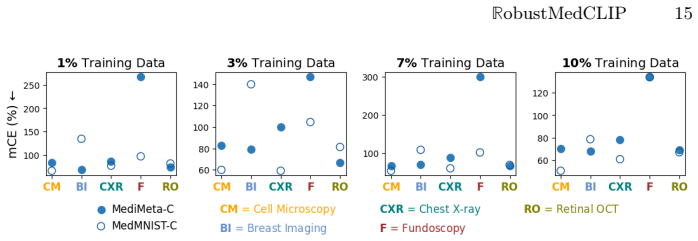
- Because few-shot gains are modality-dependent (Fundoscopy is nearly flat while Chest X-ray and OCT improve sharply), adaptive sample selection rather than simply more samples may be a worthwhile next step.
Editorial analysis
A structured set of objections, weighed in public.
Referee Report
Summary. The paper introduces MediMeta-C, a corruption benchmark that applies seven common corruptions at five severity levels to five medical imaging datasets from MediMeta, and combines it with MedMNIST-C to evaluate five medical vision-language models (MVLMs) across several modalities. The authors report that existing MVLMs, including OpenAI CLIP, MedCLIP, BioMedCLIP, and UniMedCLIP, degrade substantially under corruption and exhibit modality-dependent tradeoffs. They then propose RobustMedCLIP (RMC), which applies LoRA-based low-rank adaptation to the visual encoder of a pretrained MVLM using few-shot clean training samples from the target datasets, and report reduced clean error and mean Corruption Error (mCE) relative to the zero-shot baselines. The central claims are that current MVLMs are not robust under realistic corruptions and that efficient low-rank few-shot adaptation improves robustness while preserving cross-modality generalization.
Significance. The MediMeta-C benchmark is a potentially useful contribution: it extends corruption evaluation to higher-resolution, clinically varied medical images, provides a standardized protocol, and the authors state that data and code will be released. The raw accuracy tables (Table 3) contain informative per-corruption measurements, and the few-shot ablation (Fig. 9) gives some practical signal about data efficiency. However, the paper's central method claim that RMC's LoRA-based few-shot tuning is responsible for the robustness gains is not supported by the current experimental design, because RMC receives supervised clean target-domain training data while all baselines are evaluated zero-shot. As presented, the comparison does not isolate the effect of the adaptation method, and several reported numbers reveal degenerate baseline behavior (e.g., UniMedCLIP predicting a constant class on Breast datasets). The benchmark is therefore a solid starting point, but the method evaluation and some of the broad conclusions require substantial revision before the robustness claim can be accepted.
major comments (4)
- [Section 4B/C, Table 2] The central comparison is confounded: RMC is fine-tuned on up to 10% of the clean labeled training images from each target dataset using cross-entropy and LoRA updates, whereas OpenAI CLIP, MedCLIP, BioMedCLIP, and UniMedCLIP are evaluated zero-shot with no access to target labels. The reported reductions in clean error and mCE therefore conflate the benefit of supervised adaptation to the target domain with the benefit of the specific low-rank few-shot strategy. The paper needs a control that receives the same clean training samples and is adapted with standard full fine-tuning, a linear probe, or matched-rank LoRA; without such a control, the title-level claim that LoRA plus few-shot tuning 'improves robustness' is not established.
- [Section 4A, Eq. (7), Table 3] The mCE metric is normalized by OpenAI CLIP, and in several modalities CLIP performs at or below chance (e.g., Cell Microscopy clean accuracy 17.81% with an 8-class random baseline of 12.5%, and 100% clean error in Table 2). Under these conditions, the CE ratio is not a meaningful robustness measure because the baseline error is near random guessing. Additionally, UniMedCLIP reports constant accuracy values in Table 3 for Breast Img (39.57 on MediMeta-C and 73.08 on MedMNIST-C across all corruptions), indicating a degenerate constant predictor; such baselines should be flagged or excluded from the robustness comparison, or the accuracy table should be the primary reporting vehicle.
- [Section 5.1, Table 2, Fundoscopy row] The claim that RMC 'consistently achieves lower mCE' is contradicted by the Fundoscopy/MedMNIST-C results: RMC has mCE 133.7, which is worse than MedCLIP (122.7), BioMedCLIP (122.3), and UniMedCLIP (126.8). Similarly, RMC is not uniformly best per-corruption (e.g., Breast MedMNIST-C Impulse: RMC CE 99.5 versus BioMedCLIP 58.4). The manuscript should either temper the claim to 'often improves mCE in several modalities' or analyze where and why RMC fails, rather than making an unqualified consistency claim.
- [Section 6A and Section 3.2 Rationale, Fig. 9] The conclusion that 'data-modality diversity is paramount over dataset volume' is not supported by the experiments. The few-shot ablation in Fig. 9 varies the total fraction of clean training data drawn jointly from all modalities, so it does not compare diverse multi-modality sampling against an equal-volume single-modality or low-diversity sampling scheme. No experiment varies modality diversity while holding data volume fixed. This claim should be removed or rephrased as a hypothesis, or supported by a dedicated ablation.
minor comments (5)
- [Section 3.2, Eq. (3)] Equation (3) writes Q = Q + A_Q B_Q, which is notationally ambiguous; it should be stated that the updated weight matrix is W_Q + A_Q B_Q, where W_Q is the pretrained query projection, and similarly for K and V.
- [Section 4C] The abbreviation 'RMedCLIP' is used in Section 4C while the rest of the paper uses 'RMC' or 'RobustMedCLIP'; please standardize the name consistently.
- [Abstract and Section 1] The phrase 'par excellence generalization' is informal for a journal-style paper; consider replacing with 'strong generalization' or 'high-quality generalization.'
- [Table 2 and Table 3] The tables would benefit from a note explaining that values are relative errors (CE) in Table 2 and absolute accuracies in Table 3; currently the reader must infer this from the main text, and the constant rows for UniMedCLIP are visually striking but unexplained.
- [Section 3.1C] The statement that clean samples represent 'instances the model has encountered during training' is inaccurate for zero-shot baselines, which have not seen any samples from these datasets during training; please clarify that clean samples are in-distribution relative to the benchmark protocol, not that all models have trained on them.
Circularity Check
Benchmark and mCE metric are self-contained and non-circular; the only mild circularity is that RMC is the sole model fine-tuned on labeled target-domain clean data, so its mCE gains are attributed to LoRA/few-shot tuning without an equally adapted control.
-
fitted input called prediction
[Section 3.2A-B, Section 4B-C, Table 2, Fig. 4]
"RMC’s few-shot fine-tuning was performed on both Vision Transformer (ViT) and ResNet (RN) backbones. ... using few-shot 1%, 3%, 7%, and 10% of the train set for tuning ... We initialize the RMC-ViT and RMC-RN models using BioMedCLIP and MedCLIP pretrained weights, respectively. ... clean samples represent In-Distribution data seen by RMC, while corrupted samples correspond to Out-Distribution shifts."
RMC is fitted with cross-entropy (Eq. 2) via LoRA (Eq. 3) on labeled clean training images from the same target datasets whose corrupted test sets define the benchmark, while CLIP, MedCLIP, BioMedCLIP, and UniMedCLIP are evaluated zero-shot. The mCE reduction in Table 2 therefore bundles supervised target-domain adaptation together with the LoRA/few-shot mechanism; no equally fine-tuned control (full fine-tuning, linear probe, or matched LoRA on the same 10% clean samples) is reported. The central claim that 'efficient low-rank adaptation when paired with few-shot tuning, improves robustness' is thus an attribution of a confounded comparison rather than an isolated prediction. The benchmark construction and Eqs.
full rationale
The paper's corruption benchmark and metric are self-contained: MediMeta-C is generated by applying seven standard corruption types to MediMeta test images, mCE is normalized by an external OpenAI CLIP baseline (Eq. 7), and the test corruptions are not used in RMC's tuning. The benchmark constraint even forbids training on corrupted samples, so there is no equation-level circularity in the robustness measurement. The cited references by the same authors ([12], [13]) are not load-bearing: LoRA is attributed to the original Hu et al. work, and the noise-based learning citation appears only as background motivation. The main weakness is experimental attribution rather than derivation: RMC is the only model fine-tuned on labeled clean images from the target datasets, so the reported mCE advantage over zero-shot baselines cannot isolate the contribution of LoRA or few-shot tuning. This is a real confound in the central method claim, but it is not a definitional or equation-level circularity, so the appropriate score is low.
Assumptions & free parameters
free parameters (4)
- LoRA rank r =
16
- Few-shot tuning fraction =
1%, 3%, 7%, 10%
- Fine-tuning hyperparameters =
Adam, lr=1e-4, 20 epochs
- CE baseline choice =
OpenAI CLIP ViT-B/16
assumptions (4)
- domain assumption Synthetic corruptions (Gaussian/impulse noise, motion/zoom blur, brightness/contrast shifts, pixelation) faithfully emulate real clinical acquisition artifacts.
- domain assumption The clean train/test splits of MediMeta and MedMNIST are correctly labeled and representative of clinical populations.
- domain assumption Zero-shot CLIP-style inference with text prompts is a meaningful evaluation protocol for all compared MVLMs.
- standard math Low-rank updates to Q/K/V preserve pretrained representations while allowing task adaptation.
Cite this review
Pith. "Pith review of On the Robustness of Medical Vision-Language Models: Are they Truly Generalizable?." pith.science (2026). https://pith.science/paper/NTNP4L2X
@misc{pith2026250515425,
  author       = {Pith},
  title        = {Pith review of: On the Robustness of Medical Vision-Language Models: Are they Truly Generalizable?},
  year         = {2026},
  howpublished = {\url{https://pith.science/paper/NTNP4L2X}},
  note         = {Machine review of arXiv:2505.15425}
}
read the original abstract
Medical Vision-Language Models (MVLMs) have achieved par excellence generalization in medical image analysis, yet their performance under noisy, corrupted conditions remains largely untested. Clinical imaging is inherently susceptible to acquisition artifacts and noise; however, existing evaluations predominantly assess generally clean datasets, overlooking robustness -- i.e., the model's ability to perform under real-world distortions. To address this gap, we first introduce MediMeta-C, a corruption benchmark that systematically applies several perturbations across multiple medical imaging datasets. Combined with MedMNIST-C, this establishes a comprehensive robustness evaluation framework for MVLMs. We further propose RobustMedCLIP, a visual encoder adaptation of a pretrained MVLM that incorporates few-shot tuning to enhance resilience against corruptions. Through extensive experiments, we benchmark 5 major MVLMs across 5 medical imaging modalities, revealing that existing models exhibit severe degradation under corruption and struggle with domain-modality tradeoffs. Our findings highlight the necessity of diverse training and robust adaptation strategies, demonstrating that efficient low-rank adaptation when paired with few-shot tuning, improves robustness while preserving generalization across modalities.
Figures


Figures from the paper (11 more)




Forward citations
Cited by 1 Pith paper
-
Decoupling Clinical and Class-Agnostic Features for Reliable Few-Shot Adaptation under Shift
DRiFt explicitly decouples clinical from class-agnostic features in medical vision-language models and reports improved few-shot accuracy, but robustness under domain shift is not consistently supported.
Reference graph
Works this paper leans on
-
[1]
https://pmc.ncbi.nlm.nih.gov/, accessed: 2025-04-05 9
Pubmed central. https://pmc.ncbi.nlm.nih.gov/, accessed: 2025-04-05 9
work page 2025
-
[2]
arXiv preprint arXiv:2411.12195 (2024) 2
Chen, Q., Zhao, R., Wang, S., Phan, V.M.H., Hengel, A.v.d., Verjans, J., Liao, Z., To, M.S., Xia, Y., Chen, J., et al.: A survey of medical vision-and-language applications and their techniques. arXiv preprint arXiv:2411.12195 (2024) 2
arXiv 2024
-
[3]
In: ICML Workshop on Computational Biology (2021) 2, 9, 20
Chen, X., et al.: Medmnist: A collection of benchmarking datasets for biomedical image analysis. In: ICML Workshop on Computational Biology (2021) 2, 9, 20
work page 2021
-
[4]
Benchmarking Robustness of Contrastive Learning Models for Medical Image-Report Retrieval
Deanda, D., Masupalli, Y.P., Yang, J., Lee, Y., Cao, Z., Liang, G.: Benchmarking robustness of contrastive learning models for medical image-report retrieval. arXiv preprint arXiv:2501.09134 (2025) 2
work page Pith review arXiv 2025
-
[5]
arXiv preprint arXiv:2406.17536 (2024) 2, 3, 5, 21
Di Salvo, F., Doerrich, S., Ledig, C.: Medmnist-c: Comprehensive benchmark and improved classifier robustness by simulating realistic image corruptions. arXiv preprint arXiv:2406.17536 (2024) 2, 3, 5, 21
arXiv 2024
-
[6]
In: 2025 IEEE 22nd In- ternational Symposium on Biomedical Imaging (ISBI)
Hanif, A., Naseer, M., Khan, S., Khan, F.S.: On frequency domain adversarial vulnerabilities of volumetric medical image segmentation. In: 2025 IEEE 22nd In- ternational Symposium on Biomedical Imaging (ISBI). pp. 01–05. IEEE (2025) 4
work page 2025
-
[7]
In: International Conference on Medical Image Computing and Computer-Assisted Intervention
Hanif, A., Naseer, M., Khan, S., Shah, M., Khan, F.S.: Frequency domain ad- versarial training for robust volumetric medical segmentation. In: International Conference on Medical Image Computing and Computer-Assisted Intervention. pp. 457–467. Springer (2023) 4
work page 2023
-
[8]
In: International Conference on Medical Image Computing and Computer-Assisted Intervention
Hanif, A., Shamshad, F., Awais, M., Naseer, M., Khan, F.S., Nandakumar, K., Khan, S., Anwer, R.M.: Baple: Backdoor attacks on medical foundational models using prompt learning. In: International Conference on Medical Image Computing and Computer-Assisted Intervention. pp. 443–453. Springer (2024) 4
work page 2024
Show all 30 references
-
[9]
arXiv preprint arXiv:2207.07027 (2022) 4
Hayat, N., Geras, K.J., Shamout, F.E.: Medfuse: Multi-modal fusion with clinical time-series data and chest x-ray images. arXiv preprint arXiv:2207.07027 (2022) 4
2022 arXiv
-
[10]
In: ICLR (2019) 2
Hendrycks,D.,Dietterich,T.:Benchmarkingneuralnetworkrobustnesstocommon corruptions and perturbations. In: ICLR (2019) 2
2019
-
[11]
ICLR1(2), 3 (2022) 8
Hu, E.J., Shen, Y., Wallis, P., Allen-Zhu, Z., Li, Y., Wang, S., Wang, L., Chen, W., et al.: Lora: Low-rank adaptation of large language models. ICLR1(2), 3 (2022) 8
2022
-
[12]
arXiv preprint arXiv:2407.15913 (2024) 8
Imam, R., Gani, H., Huzaifa, M., Nandakumar, K.: Test-time low rank adaptation via confidence maximization for zero-shot generalization of vision-language models. arXiv preprint arXiv:2407.15913 (2024) 8
2024 arXiv
-
[13]
arXiv preprint arXiv:2502.06019 (2025) 4
Imam, R., Hanif, A., Zhang, J., Dawoud, K.W., Kementchedjhieva, Y., Yaqub, M.: Noise is an efficient learner for zero-shot vision-language models. arXiv preprint arXiv:2502.06019 (2025) 4
2025 arXiv
-
[14]
Proceedings of the AAAI Conference on Artificial Intelligence (2019) 2
Irvin, J., et al.: Chexpert: A large chest radiograph dataset with uncertainty la- bels and expert comparison. Proceedings of the AAAI Conference on Artificial Intelligence (2019) 2
2019
-
[15]
arXiv preprint arXiv:1901.07042 (2019) 9
Johnson, A.E., Pollard, T.J., Greenbaum, N.R., Lungren, M.P., Deng, C.y., Peng, Y., Lu, Z., Mark, R.G., Berkowitz, S.J., Horng, S.: Mimic-cxr-jpg, a large publicly available database of labeled chest radiographs. arXiv preprint arXiv:1901.07042 (2019) 9
2019 arXiv
-
[16]
Radiology p
Khader, F., Müller-Franzes, G., Wang, T., Han, T., Arasteh, S.T., Haarburger, C., Stegmaier,J.,Bressem,K.,Kuhl,C.,Nebelung,S.,etal.:Multimodaldeeplearning for integrating chest radiographs and clinical parameters: A case for transformers. Radiology p. 230806 (2023) 4 RobustMedCLIP 17
2023
-
[17]
IEEE Reviews in Biomedical Engineering (2025) 2
Khan, W., Leem, S., See, K.B., Wong, J.K., Zhang, S., Fang, R.: A comprehensive survey of foundation models in medicine. IEEE Reviews in Biomedical Engineering (2025) 2
2025
-
[18]
Khattak, M.U., Kunhimon, S., Naseer, M., Khan, S., Khan, F.S.: Unimed-clip: Towards a unified image-text pretraining paradigm for diverse medical imaging modalities (2024), https://arxiv.org/abs/2412.10372 1, 9
2024 arXiv
-
[19]
Journal of Biomedical Informatics135, 104234 (2022) 4
Khoshnevisan, F., Chi, M.: A scoping review of robustness concepts for machine learning in healthcare. Journal of Biomedical Informatics135, 104234 (2022) 4
2022
-
[20]
In: International Conference on Medical Image Computing and Computer-Assisted Intervention
Lin,W.,Zhao,Z.,Zhang,X.,Wu,C.,Zhang,Y.,Wang,Y.,Xie,W.:Pmc-clip:Con- trastive language-image pre-training using biomedical documents. In: International Conference on Medical Image Computing and Computer-Assisted Intervention. pp. 525–536. Springer (2023) 9
2023
-
[21]
Medical Image Analysis 58, 101562 (2019)
Maicas, G., Bradley, A.P., Nascimento, J.C., Reid, I., Carneiro, G.: Pre and post-hoc diagnosis and interpretation of malignancy from breast dce- mri. Medical Image Analysis 58, 101562 (2019). https://doi.org/https: //doi.org/10.1016/j.media.2019.101562, https://www.sciencedir...
2019
-
[22]
arXiv preprint arXiv:2406.08486 (2024) 4
Malik, H.S., Saeed, N., Hanif, A., Naseer, M., Yaqub, M., Khan, S., Khan, F.S.: On evaluating adversarial robustness of volumetric medical segmentation models. arXiv preprint arXiv:2406.08486 (2024) 4
2024 arXiv
-
[23]
In: ICML (2021) 4, 9, 19
Radford, A., et al.: Learning transferable visual models from natural language supervision. In: ICML (2021) 4, 9, 19
2021
-
[24]
Seco de Herrera, A., et al.: Rocov2: Radiol- ogy objects in context version 2, an updated multimodal image dataset
Rückert, J., Bloch, L., Brüngel, R., Idrissi-Yaghir, A., Schäfer, H., Schmidt, C.S., Koitka, S., Pelka, O., Abacha, A.B., G. Seco de Herrera, A., et al.: Rocov2: Radiol- ogy objects in context version 2, an updated multimodal image dataset. Scientific Data 11(1), 688 (2024) 9
2024
-
[25]
In: Proceedings of the IEEE/CVF conference on computer vision and pattern recognition
Shen, X., Yang, J., Wei, C., Deng, B., Huang, J., Hua, X.S., Cheng, X., Liang, K.: Dct-mask: Discrete cosine transform mask representation for instance segmenta- tion. In: Proceedings of the IEEE/CVF conference on computer vision and pattern recognition. pp. 8720–8729 (2021) 5
2021
-
[26]
Wang, Z., Wu, Z., Agarwal, D., Sun, J.: Medclip: Contrastive learning from un- paired medical images and text (2022),https://arxiv.org/abs/2210.10163 1, 3, 4, 9
2022 arXiv
-
[27]
Woerner, S., Jaques, A., Baumgartner, C.F.: A comprehensive and easy-to-use multi-domainmulti-taskmedicalimagingmeta-dataset(medimeta).arXivpreprint arXiv:2404.16000 (2024) 2, 5, 20
2024
-
[28]
Frontiers in neuroinformatics13, 46 (2019) 2, 4, 5
Xu, Y., Raj, A., Victor, J.D.: Systematic differences between perceptually relevant image statistics of brain mri and natural images. Frontiers in neuroinformatics13, 46 (2019) 2, 4, 5
2019
-
[29]
org/abs/2303.00915 1, 3, 4, 9
Zhang, S., Xu, Y., Usuyama, N., Xu, H., Bagga, J., Tinn, R., Preston, S., Rao, R., Wei, M., Valluri, N., Wong, C., Tupini, A., Wang, Y., Mazzola, M., Shukla, S., Liden, L., Gao, J., Crabtree, A., Piening, B., Bifulco, C., Lungren, M.P., Naumann, T., Wang, S., Poon, H.: Biomedc...
2025 arXiv
-
[30]
In-Distribution
Zhao, Z., Liu, Y., Wu, H., Wang, M., Li, Y., Wang, S., Teng, L., Liu, D., Cui, Z., Wang, Q., et al.: Clip in medical imaging: A survey. Medical Image Analysis p. 103551 (2025) 2 18 Imam et al. Appendix Table 3: Clean Accuracy, Accuracy against Corruptions, and Average Accuracy...
2025
Reviewed August 7, 2026 · model on record in the stance chip above.
Discussion (0). Continue with ORCID to comment.