REVIEW 3 major objections 4 minor 2 cited by
Systematic search for stellar pulsators in the eclipsing binaries observed by Kepler
T0 review · 3 major / 4 minor · reviewed 2026-08-14 · deepseek-v4-flash
Pith's one-line read This paper reports a complete visual census of stellar pulsators in the Kepler eclipsing-binary catalog, identifying 303 systems with oscillations, 163 of them new discoveries.
desk verdict A useful candidate catalog that roughly doubles the known pulsator-plus-eclipsing-binary overlap; the detection is visually screened and the DIT is not public, so treat the counts as candidates rather than confirmed systems. read the letter →
The pith
A machine-rendered reading of the paper's core claim, the machinery that carries it, and where it could break.
The reading
What carries the argument
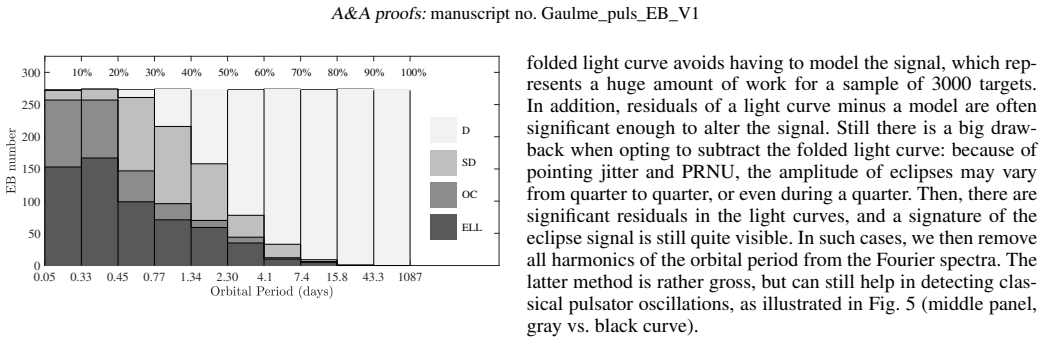
The carrying mechanism is the Data Inspection Tool (DIT), a set of ten automatically generated plots per system. It concatenates and normalizes the Kepler SAP and PDCSAP light curves, removes eclipses by clipping or by subtracting the folded orbital signal, and removes harmonics of the orbital period from the Fourier spectra. It then displays the power spectrum, an autocorrelation envelope (EACF) to catch solar-like oscillations, and an echelle diagram. Classification is made by eye from these plots; the tool does not compute a quantitative detection threshold or signal-to-noise criterion.
What would settle it
Re-run the same light curves through an automated pipeline with a strict significance criterion, such as requiring the highest oscillation peak to exceed five times the local noise after all orbital harmonics are removed, and count how many of the 303 systems survive; if most of the 163 new systems disappear, the census is dominated by processing artifacts. A faster check is to analyze the 13 sub-half-day-period candidates without any harmonic subtraction and see whether the oscillation peaks remain stable and coherent.
Extended reading notes
Core claim
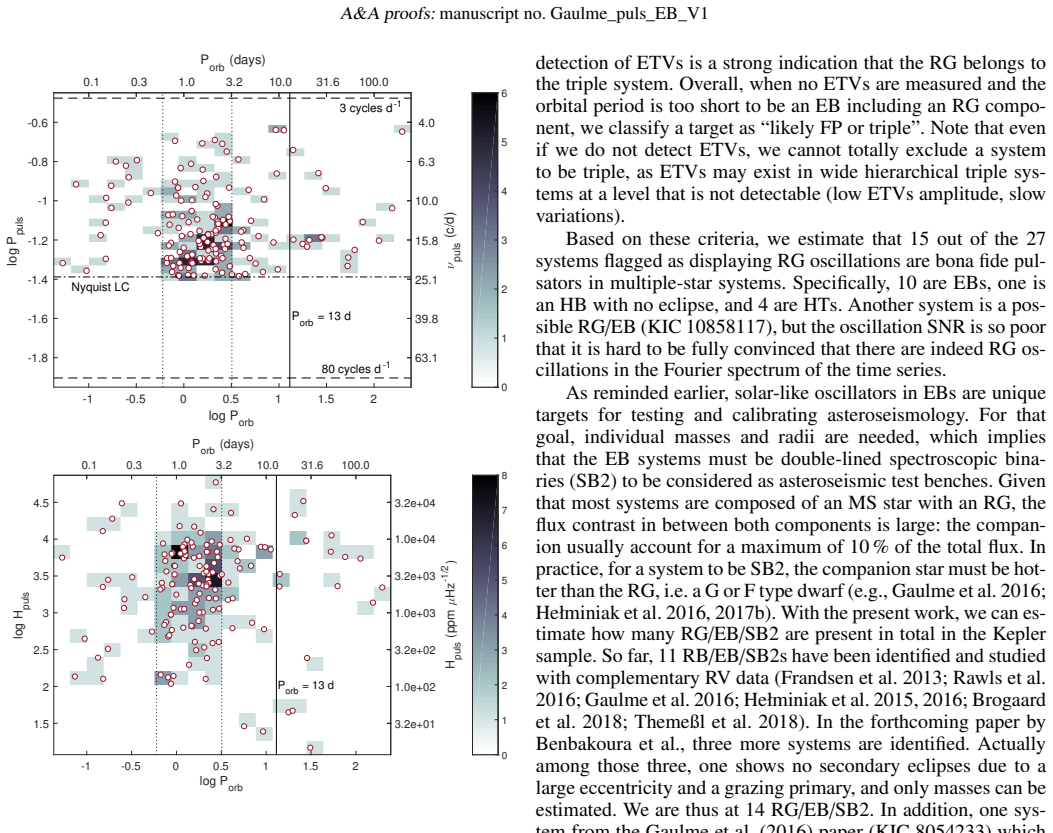
The central claim is that a uniform, complete scan of the Kepler eclipsing-binary catalog reveals 303 systems with detectable stellar oscillations, 163 of which were not previously known to contain both a binary and a pulsator. The breakdown is 149 delta Scuti candidates (100 new), 115 gamma Doradus candidates (69 new), 85 red-giant oscillators (27 new), and 59 tidally excited oscillators (29 new), with overlap between classes. The authors stress that many systems are likely false positives, such as a pulsator whose light is blended with an unrelated eclipsing binary. What is new is the completeness of the search: one consistent method applied to the whole catalog, roughly doubling the known inventory of pulsating eclipsing binaries in the Kepler field.
Load-bearing premise
The screening rests on the assumption that a human eye looking at the DIT plots can reliably distinguish genuine stellar oscillations from residual artifacts of eclipse and activity removal, since the paper reports no quantitative detection threshold and describes its harmonic-removal step as 'rather gross.'
Editorial extensions
If this is right
- The catalog roughly doubles the known number of pulsators in Kepler eclipsing binaries, from about 140 to 303 systems.
- If confirmed, the 13 systems with orbital periods under 0.5 days that show delta Scuti or gamma Doradus oscillations would include the shortest-orbit pulsating binaries known.
- Only about 15 to 19 red-giant/eclipsing-binary/double-lined spectroscopic systems are expected in the whole Kepler sample, setting a hard limit on the benchmark systems available to calibrate asteroseismic mass and radius scaling.
- The sample shows no strong global correlation between dominant delta Scuti pulsation period and orbital period, contrary to earlier claims, though a weak trend appears for orbital periods between 0.6 and 3.2 days.
- Several systems that look like tidally excited pulsators are actually blended binaries or other configurations; distinguishing these requires radial-velocity and imaging follow-up.
Reading between the lines
- If the 163 new detections survive radial-velocity or pixel-level centroid checks, the true incidence of pulsation among Kepler eclipsing binaries is near 10 percent; if they do not, the census mainly measures the fraction of blended background pulsators.
- The short-period systems with P<0.5 days are the sharpest test: if they are real and not blends, tidal locking and contact geometry do not suppress pulsation as strongly as assumed, which would challenge current binary-evolution models.
- The absence of a strong Porb-Ppuls correlation in this large sample suggests that the earlier correlation may have been an artifact of selection effects in small, well-characterized samples rather than a physical relation.
- Cross-matching the 303 candidates against Gaia astrometry would separate chance alignments from genuine companions, converting this candidate catalog into a clean benchmark sample without new spectroscopy.
Signed reviews
Editorial analysis
A structured set of objections, weighed in public.
Referee Report
Summary. The paper presents the first systematic search for stellar pulsators in the full Kepler eclipsing-binary catalog. The authors developed a data inspection tool (DIT) that detrends eclipse and activity signals, computes power spectra, and produces a set of diagnostic plots. After visually inspecting 2875 of 2925 systems, they report 303 systems showing oscillations, of which 163 are claimed as new discoveries, broken down into δ Scuti, γ Doradus, red-giant, tidally excited, and other pulsators. The catalog, given in Table A.1, is intended to motivate follow-up studies and to identify benchmark systems for asteroseismology in binaries.
Significance. If the detections are reliable, this is a valuable community resource: it roughly doubles the number of known pulsators in Kepler eclipsing binaries and provides a first census against which future searches and models can be compared. The paper is honest about its main weakness—the dependence on visual inspection and the likely presence of false positives from blends—and it gives a detailed, searchable table with notes on individual systems. The authors also deserve credit for explicitly attempting to separate genuine oscillations from light-curve cleaning artifacts and for discussing borderline cases in the text, even though the lack of a quantitative detection criterion limits the reproducibility of the headline numbers.
major comments (3)
- [Section 3] The central claim of 303 detections (163 new) rests entirely on visual inspection of DIT plots, with no quantitative detection statistic, signal-to-noise threshold, or false-alarm rate. The authors themselves state in Section 3 that 'it can sometimes be difficult to distinguish the detection of oscillations from imperfect light curve cleaning' and in Section 2.2 that the harmonic-removal method 'is rather gross.' Entries in Table A.1 with notes such as 'low SNR osc.', 'sparse spectrum', and 'likely FP or triple' are counted equally with unambiguous detections in the totals. To make the 303/163 numbers reproducible and auditable, the authors should provide a per-system detection significance or a clear decision rule (e.g., minimum peak height in the amplitude spectrum, required number of independent peaks, or consistency between SAP and PDCSAP), and ideally a re-analysis of a random subset by an independent person. Without this, the catalog's headline counts cannot be independently verified.
- [Section 4.1] The classification boundary between γ Dor and δ Sct at ~50 μHz is heuristic and, for short-period binaries, lies directly in the range of orbital harmonics. Since the harmonic-removal procedure is described as 'rather gross' and can leave significant residuals, some of the low-frequency 'γ Dor' classifications could instead be residuals of imperfect eclipse/activity cleaning. The paper would be strengthened by a sanity check: for a sample of clearly non-pulsating EBs of similar orbital period, how often does the same visual procedure yield a false 'γ Dor' detection? Such a control experiment would directly address the false-positive concern that the authors themselves acknowledge.
- [Table A.1] Table A.1 contains duplicated entries: KIC 4142768 appears twice with identical parameters, and KIC 5560831 appears twice with slightly different notes. If both rows are counted in the 303 systems, the headline number is inflated. The authors should verify that all KIC numbers in the table are unique and correct the table accordingly. There are also apparent formatting errors in the table, such as '21.1221.12' for KIC 9786821 and '5.425.421.25' for KIC 12645761, which should be corrected.
minor comments (4)
- [Section 2.3] The DIT is described as 'still under development' and not public. For a catalog paper whose reproducibility depends on this tool, the authors should either release the DIT or make available the diagnostic plots for all 303 detections so that readers can check the evidence.
- [Section 4.1] There is a numerical inconsistency: the abstract and Section 4.1 state 149 δ Sct stars, while the caption of Figure 6 says '148 δ Sct EB candidates.' Please reconcile.
- [Section 4.2] The text contains a typo: 'RB/EB/SB2s' should presumably be 'RG/EB/SB2s.' Minor language issues also appear elsewhere, e.g., 'is is 16 c/d' in Section 4.1 and 'sure be detected' in Section 4.2.
- [Section 3] The manual web-search method for identifying previously published systems is described as 'certainly not fully exhaustive.' It would be helpful to state how many of the 303 systems have no prior bibliographic identification at all, to clarify which systems are entirely new to the literature as opposed to newly identified as pulsators.
Circularity Check
No circularity: the 303/163 detection census is an observational result, not a fitted prediction.
full rationale
The paper's central claim ('we applied the DIT to the whole Kepler eclipsing binary database and identified 303 systems whose light curves display oscillations, including 163 new discoveries') is a catalog result produced by direct inspection of processed Kepler light curves. The load-bearing chain is: public Kepler SAP/PDCSAP light curves -> quarter normalization and gap-filling -> eclipse/activity removal (including subtraction of orbital harmonics) -> DIT plots -> two-author visual screening -> web/literature search -> Table A.1. No step fits a parameter and then re-predicts a quantity derived from that same fit. The only numerical classifications are heuristic frequency cuts (gamma Dor <~50 microHz, delta Sct >50 microHz); these are standard physical definitions used for labeling, not parameters fitted to the 303 systems, so they cannot make the census circular. The paper leans on the authors' own earlier papers for the preprocessing recipe ('The methods we use are described in Gaulme et al. (2013, 2014, 2016)'), but those citations supply data-reduction tools and previously characterized RG systems; the 163 'new' systems are defined by their absence from the prior literature, so the count logically cannot be an output of those citations. The paper itself concedes the detection boundary is uncertain ('it can sometimes be difficult to distinguish the detection of oscillations from imperfect light curve cleaning'; the harmonic-removal method 'is rather gross'), and no quantitative SNR threshold or false-alarm rate is reported. That is a reproducibility and verification risk, which belongs in a correctness assessment, not a circularity finding per the review rules. No equation or construction makes a claimed prediction equivalent to its input, and no uniqueness theorem or fitted value is imported through self-citation. Hence no significant circularity.
Assumptions & free parameters
assumptions (4)
- domain assumption The Villanova and Coughlin catalogs together provide a complete list of eclipsing binaries observed by the original Kepler mission.
- domain assumption Pulsation types can be assigned from frequency ranges and visual appearance of the Fourier spectrum without mode identification.
- domain assumption The light-curve cleaning and eclipse-subtraction procedures do not introduce artifacts that are systematically mistaken for stellar oscillations.
- domain assumption A web-engine-based literature search is sufficient to identify previously published pulsators in these systems.
Cite this review
Pith. "Pith review of Systematic search for stellar pulsators in the eclipsing binaries observed by Kepler." pith.science (2026). https://pith.science/paper/NTNZYK72
@misc{pith2026190806773,
  author       = {Pith},
  title        = {Pith review of: Systematic search for stellar pulsators in the eclipsing binaries observed by Kepler},
  year         = {2026},
  howpublished = {\url{https://pith.science/paper/NTNZYK72}},
  note         = {Machine review of arXiv:1908.06773}
}
abstract
Eclipsing binaries (EBs) are unique targets for measuring precise stellar properties and constrain stellar evolution models. In particular, it is possible to measure at the percent level masses and radii of both components of a double-lined spectroscopic EB. Since the advent of high-precision photometric space missions (MOST, CoRoT, Kepler, BRITE, TESS), the use of stellar pulsation properties to infer stellar interiors and dynamics constitutes a revolution for low-mass star studies. The Kepler mission has led to the discovery of thousands of classical pulsators such as $\delta$ Scuti and solar-like oscillators (main sequence and evolved), but also almost 3000 EBs with orbital periods shorter than 1100 days. We report the first systematic search for stellar pulsators in the entire Kepler eclipsing binary catalog. The focus is mainly aimed at discovering $\delta$ Scuti, $\gamma$ Doradus, red giant, and tidally excited pulsators. We developed a data inspection tool (DIT) that automatically produces a series of plots from the Kepler light-curves that allows us to visually identify whether stellar oscillations are present in a given time series. We applied the DIT to the whole Kepler eclipsing binary database and identified 303 systems whose light curves display oscillations, including 163 new discoveries. A total of 149 stars are flagged as $\delta$ Scuti (100 from this paper), 115 stars as $\gamma$ Doradus (69 new), 85 stars as red giants (27 new), 59 as tidally excited oscillators (29 new). There is some overlap among these groups, as some display several types of oscillations. Despite many of these systems are likely to be false positives, i. e., when an EB light curve is blended with a pulsator, this catalog gathers a vast sample of systems that are valuable for a better understanding of stellar evolution.
Figures


Figures from the paper (7 more)




Forward citations
Cited by 2 Pith papers
-
First and Comprehensive Study of V0757 Pup : $\gamma-$Doradus Pulsator in Detached Eclipsing Binary
The primary star in the detached eclipsing binary V0757 Pup is a gamma Doradus pulsator with persistent frequencies near 0.79 and 0.98 cycles per day.
-
Re-examining Super-Nyquist Frequencies of 68 $\delta$ Scuti Stars Utilizing the Kepler Long Cadence Photometry
Six frequencies in four delta Scuti stars are actually alias images of super-Nyquist signals, identified by re-analyzing Kepler long-cadence data with the sliding Lomb-Scargle periodogram.
Reference graph
Works this paper leans on
-
[1]
, " * write output.state after.block = add.period write newline
ENTRY address archiveprefix author booktitle chapter edition editor howpublished institution eprint journal key month note number organization pages publisher school series title type volume year label extra.label sort.label short.list INTEGERS output.state before.all mid.sentence after.sentence after.block FUNCTION init.state.consts #0 'before.all := #1 ...
-
[2]
write newline
" write newline "" before.all 'output.state := FUNCTION n.dashify 't := "" t empty not t #1 #1 substring "-" = t #1 #2 substring "--" = not "--" * t #2 global.max substring 't := t #1 #1 substring "-" = "-" * t #2 global.max substring 't := while if t #1 #1 substring * t #2 global.max substring 't := if while FUNCTION word.in bbl.in " " * FUNCTION format....
-
[3]
Aerts , C., Christensen-Dalsgaard , J., & Kurtz , D. W. 2010, Asteroseismology
2010
-
[4]
2002, , 333, L35
Aerts , C., Handler , G., Arentoft , T., et al. 2002, , 333, L35
2002
-
[5]
& Soydugan , F
Ali c avu s , F. & Soydugan , F. 2017, in American Institute of Physics Conference Series, Vol. 1815, Turkish Physical Society 32nd International Physics Congress, 080003
2017
-
[6]
J., Osborn , H
Armstrong , D. J., Osborn , H. P., Brown , D. J. A., et al. 2014, , 444, 1873
2014
-
[7]
2009, in IAU Symposium, Vol
Baglin , A., Auvergne , M., Barge , P., et al. 2009, in IAU Symposium, Vol. 253, IAU Symposium, ed. F. Pont , D. Sasselov , & M. J. Holman , 71--81
2009
-
[8]
1973, , 23, 221
Baglin , A., Breger , M., Chevalier , C., et al. 1973, , 23, 221
1973
Show all 144 references
-
[9]
M., & Rappaport , S
Balaji , B., Croll , B., Levine , A. M., & Rappaport , S. 2015, , 448, 429
2015
-
[10]
Balona , L. A. 2014, , 443, 1946
2014
-
[11]
Balona , L. A. 2015, , 447, 2714
2015
-
[12]
A., Daszy \'n ska-Daszkiewicz , J., & Pamyatnykh , A
Balona , L. A., Daszy \'n ska-Daszkiewicz , J., & Pamyatnykh , A. A. 2015, , 452, 3073
2015
-
[13]
A., Joshi , S., Joshi , Y
Balona , L. A., Joshi , S., Joshi , Y. C., & Sagar , R. 2013, , 429, 1466
2013
-
[14]
A., Pigulski , A., De Cat , P., et al
Balona , L. A., Pigulski , A., De Cat , P., et al. 2011, , 413, 2403
2011
-
[15]
G., Hambleton , K., Vos , J., et al
Beck , P. G., Hambleton , K., Vos , J., et al. 2014, , 564, A36
2014
-
[16]
G., Hambleton , K., Vos , J., et al
Beck , P. G., Hambleton , K., Vos , J., et al. 2015, in European Physical Journal Web of Conferences, Vol. 101, The Space Photometry Revolution - CoRoT Symposium 3, Kepler KASC-7 Joint Meeting, 06004
2015
-
[17]
R., Mosser , B., Huber , D., et al
Bedding , T. R., Mosser , B., Huber , D., et al. 2011, , 471, 608
2011
-
[18]
R., Murphy , S
Bedding , T. R., Murphy , S. J., Colman , I. L., & Kurtz , D. W. 2015, in European Physical Journal Web of Conferences, Vol. 101, European Physical Journal Web of Conferences, 01005
2015
-
[19]
J., Hekker , S., & Kuszlewicz , J
Bell , K. J., Hekker , S., & Kuszlewicz , J. S. 2019, , 482, 616
2019
-
[20]
& Schlichting , H
Biersteker , J. & Schlichting , H. 2017, , 154, 164
2017
-
[21]
2015, , 581, A77
Bogn \'a r , Z., Lampens , P., Fr \'e mat , Y., et al. 2015, , 581, A77
2015
-
[22]
2014, , 443, 3068
Borkovits , T., Derekas , A., Fuller , J., et al. 2014, , 443, 3068
2014
-
[23]
2016, , 455, 4136
Borkovits , T., Hajdu , T., Sztakovics , J., et al. 2016, , 455, 4136
2016
-
[24]
J., Koch , D., Basri , G., et al
Borucki , W. J., Koch , D., Basri , G., et al. 2010, Science, 327, 977
2010
-
[25]
J., Koch , D
Borucki , W. J., Koch , D. G., Basri , G., et al. 2011, , 736, 19
2011
-
[26]
M., Kurtz , D
Bowman , D. M., Kurtz , D. W., Breger , M., Murphy , S. J., & Holdsworth , D. L. 2016, , 460, 1970
2016
-
[27]
A., Guzik , J
Bradley , P. A., Guzik , J. A., Miles , L. F., et al. 2015, , 149, 68
2015
-
[28]
J., Miglio , A., et al
Brogaard , K., Hansen , C. J., Miglio , A., et al. 2018, , 476, 3729
2018
-
[29]
2011, VizieR Online Data Catalog, J/A+A/530/A138
Casagrande , L., Schoenrich , R., Asplund , M., et al. 2011, VizieR Online Data Catalog, J/A+A/530/A138
2011
-
[30]
2017, , 605, A111
Ceillier , T., Tayar , J., Mathur , S., et al. 2017, , 605, A111
2017
-
[31]
Chaplin , W. J. & Miglio , A. 2013, , 51, 353
2013
-
[32]
S., et al
Chiappini , C., Anders , F., Rodrigues , T. S., et al. 2015, , 576, L12
2015
-
[33]
E., Pr s a , A., Stassun , K
Conroy , K. E., Pr s a , A., Stassun , K. G., et al. 2014, , 147, 45
2014
-
[34]
L., L \'o pez-Morales , M., Harrison , T
Coughlin , J. L., L \'o pez-Morales , M., Harrison , T. E., Ule , N., & Hoffman , D. I. 2011, , 141, 78
2011
-
[35]
Dal , H. A. & Sipahi , E. 2013, , 30, e016
2013
-
[36]
2013, , 556, A56
Debosscher , J., Aerts , C., Tkachenko , A., et al. 2013, , 556, A56
2013
-
[37]
2011, , 529, A89
Debosscher , J., Blomme , J., Aerts , C., & De Ridder , J. 2011, , 529, A89
2011
-
[38]
& Bulut , \.I
Demircan , O. & Bulut , \.I . 2015, in Astronomical Society of the Pacific Conference Series, Vol. 496, Living Together: Planets, Host Stars and Binaries, ed. S. M. Rucinski , G. Torres , & M. Zejda , 395
2015
-
[39]
L., Borkovits , T., et al
Derekas , A., Kiss , L. L., Borkovits , T., et al. 2011, Science, 332, 216
2011
-
[40]
P., Kjurkchieva , D
Dimitrov , D. P., Kjurkchieva , D. P., & Iliev , I. K. 2017, , 469, 2089
2017
-
[41]
Dodson-Robinson , S. E. 2012, , 752, 72
2012
-
[42]
2013, , 763, L2
Dong , S., Katz , B., & Socrates , A. 2013, , 763, L2
2013
-
[43]
2015, , 815, 26
Faigler , S., Kull , I., Mazeh , T., et al. 2015, , 815, 26
2015
-
[44]
2013, , 556, A138
Frandsen , S., Lehmann , H., Hekker , S., et al. 2013, , 556, A138
2013
-
[45]
C., et al
Garc \' a Hern \'a ndez , A., Moya , A., Su \'a rez , J. C., et al. 2016, ArXiv e-prints [ [arXiv] 1601.07374 ]
2016 arXiv
-
[46]
& Guzik , J
Gaulme , P. & Guzik , J. A. 2014, in IAU Symposium, Vol. 301, IAU Symposium, ed. J. A. Guzik , W. J. Chaplin , G. Handler , & A. Pigulski , 413--414
2014
-
[47]
2014, , 785, 5
Gaulme , P., Jackiewicz , J., Appourchaux , T., & Mosser , B. 2014, , 785, 5
2014
-
[48]
2016, , 832, 121
Gaulme , P., McKeever , J., Jackiewicz , J., et al. 2016, , 832, 121
2016
-
[49]
L., et al
Gaulme , P., McKeever , J., Rawls , M. L., et al. 2013, , 767, 82
2013
-
[50]
V., Misra , R., & Ambika , G
George , S. V., Misra , R., & Ambika , G. 2018, arXiv e-prints, arXiv:1805.08351
2018 arXiv
-
[51]
R., Matson , R
Gies , D. R., Matson , R. A., Guo , Z., et al. 2015, , 150, 178
2015
-
[52]
R., & Matson , R
Guo , Z., Gies , D. R., & Matson , R. A. 2017 a , , 851, 39
2017
-
[53]
R., Matson , R
Guo , Z., Gies , D. R., Matson , R. A., & Garc \' a Hern \'a ndez , A. 2016, , 826, 69
2016
-
[54]
R., Matson , R
Guo , Z., Gies , D. R., Matson , R. A., et al. 2017 b , , 837, 114
2017
-
[55]
2018, , 473, 5165
Hambleton , K., Fuller , J., Thompson , S., et al. 2018, , 473, 5165
2018
-
[56]
W., Pr s a , A., et al
Hambleton , K., Kurtz , D. W., Pr s a , A., et al. 2016, , 463, 1199
2016
-
[57]
M., Kurtz , D
Hambleton , K. M., Kurtz , D. W., Pr s a , A., et al. 2013, , 434, 925
2013
-
[58]
2010, , 713, L187
Hekker , S., Debosscher , J., Huber , D., et al. 2010, , 713, L187
2010
-
[59]
G., Ukita , N., Kambe , E., & Konacki , M
He miniak , K. G., Ukita , N., Kambe , E., & Konacki , M. 2015, , 813, L25
2015
-
[60]
G., Ukita , N., Kambe , E., et al
He miniak , K. G., Ukita , N., Kambe , E., et al. 2017 a , , 602, A30
2017
-
[61]
G., Ukita , N., Kambe , E., et al
He miniak , K. G., Ukita , N., Kambe , E., et al. 2017 b , , 468, 1726
2017
-
[62]
G., Ukita , N., Kambe , E., et al
He miniak , K. G., Ukita , N., Kambe , E., et al. 2016, , 461, 2896
2016
-
[63]
& Soydugan , E
Kahraman Ali c avu s , F. & Soydugan , E. 2014, in IAU Symposium, Vol. 301, Precision Asteroseismology, ed. J. A. Guzik , W. J. Chaplin , G. Handler , & A. Pigulski , 433--434
2014
-
[64]
2017, , 470, 915
Kahraman Ali c avu s , F., Soydugan , E., Smalley , B., & Kub \'a t , J. 2017, , 470, 915
2017
-
[65]
2014, , 570, A41
Kallinger , T., De Ridder , J., Hekker , S., et al. 2014, , 570, A41
2014
-
[66]
Katsova , M. M. & Nizamov , B. A. 2018, Geomagnetism and Aeronomy, 58, 899
2018
-
[67]
2016, , 151, 68
Kirk , B., Conroy , K., Pr s a , A., et al. 2016, , 151, 68
2016
-
[68]
& Bedding , T
Kjeldsen , H. & Bedding , T. R. 1995, , 293, 87
1995
-
[69]
& Atanasova , T
Kjurkchieva , D. & Atanasova , T. 2016, , 49, 17
2016
-
[70]
2016, , 152, 189
Kjurkchieva , D., Vasileva , D., & Dimitrov , D. 2016, , 152, 189
2016
-
[71]
2018, Publications of the Astronomical Society of Japan, 70, 90
Kouzuma , S. 2018, Publications of the Astronomical Society of Japan, 70, 90
2018
-
[72]
W., Hambleton , K
Kurtz , D. W., Hambleton , K. M., Shibahashi , H., Murphy , S. J., & Pr s a , A. 2015 a , , 446, 1223
2015
-
[73]
W., Shibahashi , H., Murphy , S
Kurtz , D. W., Shibahashi , H., Murphy , S. J., Bedding , T. R., & Bowman , D. M. 2015 b , , 450, 3015
2015
-
[74]
S., North , T
Kuszlewicz , J. S., North , T. S. H., Chaplin , W. J., et al. 2019, , 487, 14
2019
-
[75]
W., Hong , K., & Hinse , T
Lee , J. W., Hong , K., & Hinse , T. C. 2015, , 149, 93
2015
-
[76]
W., Hong , K., Kim , S.-L., & Koo , J.-R
Lee , J. W., Hong , K., Kim , S.-L., & Koo , J.-R. 2016 a , , 460, 4220
2016
-
[77]
W., Hong , K., Kim , S.-L., & Koo , J.-R
Lee , J. W., Hong , K., Kim , S.-L., & Koo , J.-R. 2017, , 835, 189
2017
-
[78]
W., Kim , S.-L., Hong , K., et al
Lee , J. W., Kim , S.-L., Hong , K., et al. 2016 b , , 151, 25
2016
-
[79]
W., Kim , S.-L., Hong , K., Lee , C.-U., & Koo , J.-R
Lee , J. W., Kim , S.-L., Hong , K., Lee , C.-U., & Koo , J.-R. 2014, , 148, 37
2014
-
[80]
2013, , 557, A79
Lehmann , H., Southworth , J., Tkachenko , A., & Pavlovski , K. 2013, , 557, A79
2013
-
[81]
2017, , 607, A85
Liakos , A. 2017, , 607, A85
2017
-
[82]
2018, , 616, A130
Liakos , A. 2018, , 616, A130
2018
-
[83]
& Niarchos , P
Liakos , A. & Niarchos , P. 2017, , 465, 1181
2017
-
[84]
2014, , 562, A109
Lillo-Box , J., Barrado , D., Moya , A., et al. 2014, , 562, A109
2014
-
[85]
C., Vyhmeister , K., Hawley , S
Lurie , J. C., Vyhmeister , K., Hawley , S. L., et al. 2017, , 154, 250
2017
-
[86]
2014, , 563, A59
Maceroni , C., Lehmann , H., da Silva , R., et al. 2014, , 563, A59
2014
-
[87]
& Hambleton , K
Manuel , J. & Hambleton , K. 2018, in American Astronomical Society Meeting Abstracts, Vol. 231, American Astronomical Society Meeting Abstracts \#231, 146.01
2018
-
[88]
Marcadon , F., Appourchaux , T., & Marques , J. P. 2018, , 617, A2
2018
-
[89]
2017, , 154, 64
Masuda , K. 2017, , 154, 64
2017
-
[90]
A., et al
Matijevi c , G., Pr s a , A., Orosz , J. A., et al. 2012, , 143, 123
2012
-
[91]
A., Gies , D
Matson , R. A., Gies , D. R., Guo , Z., & Williams , S. J. 2017, , 154, 216
2017
-
[92]
J., Jackiewicz , J., & McKeever , J
McNamara , B. J., Jackiewicz , J., & McKeever , J. 2012, , 143, 101
2012
-
[93]
M., Angelou , G
Mirouh , G. M., Angelou , G. C., Reese , D. R., & Costa , G. 2019, , 483, L28
2019
-
[94]
& Appourchaux , T
Mosser , B. & Appourchaux , T. 2009, , 508, 877
2009
-
[95]
C., Garc \' a Hern \'a ndez , A., & Mendoza , M
Moya , A., Su \'a rez , J. C., Garc \' a Hern \'a ndez , A., & Mendoza , M. A. 2017, , 471, 2491
2017
-
[96]
J., Bedding , T
Murphy , S. J., Bedding , T. R., Niemczura , E., Kurtz , D. W., & Smalley , B. 2015, , 447, 3948
2015
-
[97]
J., Moe , M., Kurtz , D
Murphy , S. J., Moe , M., Kurtz , D. W., et al. 2018, , 474, 4322
2018
-
[98]
J., Smalley , B., et al
Niemczura , E., Murphy , S. J., Smalley , B., et al. 2015, , 450, 2764
2015
-
[99]
J., et al
Niemczura , E., Poli \'n ska , M., Murphy , S. J., et al. 2017, , 470, 2870
2017
-
[100]
Orosz , J. A. 2015, in Astronomical Society of the Pacific Conference Series, Vol. 496, Living Together: Planets, Host Stars and Binaries, ed. S. M. Rucinski , G. Torres , & M. Zejda , 55
2015
-
[101]
& Dal , H
\"O zdarcan , O. & Dal , H. A. 2017, Publications of the Astronomical Society of Australia, 34, e017
2017
-
[102]
D., Reed , M
Pablo , H., Kawaler , S. D., Reed , M. D., et al. 2012, , 422, 1343
2012
-
[103]
H., An , D., Molenda- \.Z akowicz , J., et al
Pinsonneault , M. H., An , D., Molenda- \.Z akowicz , J., et al. 2012, , 199, 30
2012
-
[104]
2018, Modeling and Analysis of Eclipsing Binary Stars; The theory and design principles of PHOEBE
Pr s a , A. 2018, Modeling and Analysis of Eclipsing Binary Stars; The theory and design principles of PHOEBE
2018
-
[105]
W., et al
Pr s a , A., Batalha , N., Slawson , R. W., et al. 2011, , 141, 83
2011
-
[106]
F., Devinney , E
Pr s a , A., Guinan , E. F., Devinney , E. J., et al. 2008, , 687, 542
2008
-
[107]
2014, , 437, 132
Ramsay , G., Brooks , A., Hakala , P., et al. 2014, , 437, 132
2014
-
[108]
2013, , 768, 33
Rappaport , S., Deck , K., Levine , A., et al. 2013, , 768, 33
2013
-
[109]
2015, , 803, 82
Rappaport , S., Nelson , L., Levine , A., et al. 2015, , 803, 82
2015
-
[110]
L., Gaulme , P., McKeever , J., et al
Rawls , M. L., Gaulme , P., McKeever , J., et al. 2016, , 818, 108
2016
-
[111]
R., Winn , J
Ricker , G. R., Winn , J. N., Vanderspek , R., et al. 2015, Journal of Astronomical Telescopes, Instruments, and Systems, 1, 014003
2015
-
[112]
F., Borucki , W
Rowe , J. F., Borucki , W. J., Koch , D., et al. 2010, , 713, L150
2010
-
[113]
F., Coughlin , J
Rowe , J. F., Coughlin , J. L., Antoci , V., et al. 2015, The Astrophysical Journal Supplement Series, 217, 16
2015
-
[114]
W., Murphy , S
Saio , H., Kurtz , D. W., Murphy , S. J., Antoci , V. L., & Lee , U. 2018, , 474, 2774
2018
-
[115]
L., Jessen-Hansen , J., Shetrone , M
Sandquist , E. L., Jessen-Hansen , J., Shetrone , M. D., et al. 2016, , 831, 11
2016
-
[116]
2016, , 587, A64
Santerne , A., Moutou , C., Tsantaki , M., et al. 2016, , 587, A64
2016
-
[117]
& Kurtz , D
Shibahashi , H. & Kurtz , D. W. 2012, , 422, 738
2012
-
[118]
2016, , 829, 34
Shporer , A., Fuller , J., Isaacson , H., et al. 2016, , 829, 34
2016
-
[119]
& Dal , H
Sipahi , E. & Dal , H. A. 2014, , 26, 62
2014
-
[120]
W., Pr s a , A., Welsh , W
Slawson , R. W., Pr s a , A., Welsh , W. F., et al. 2011, , 142, 160
2011
-
[121]
Smullen , R. A. & Kobulnicky , H. A. 2015, , 808, 166
2015
-
[122]
2013, , 557, A119
Southworth , J. 2013, , 557, A119
2013
-
[123]
2015, in European Physical Journal Web of Conferences, Vol
Southworth , J. 2015, in European Physical Journal Web of Conferences, Vol. 101, European Physical Journal Web of Conferences, 04001
2015
-
[124]
2011, , 414, 2413
Southworth , J., Zima , W., Aerts , C., et al. 2011, , 414, 2413
2011
-
[125]
2017, , 467, 4663
Sowicka , P., Handler , G., Debski , B., et al. 2017, , 467, 4663
2017
-
[126]
2006, , 370, 2013
Soydugan , E., Soydugan , F., Demircan , O., & \.I bano g lu , C. 2006, , 370, 2013
2006
-
[127]
1990, Journal of the American Association of Variable Star Observers (JAAVSO), 19, 52
Szatmary , K. 1990, Journal of the American Association of Variable Star Observers (JAAVSO), 19, 52
1990
-
[128]
2018, , 478, 4669
Theme l , N., Hekker , S., Southworth , J., et al. 2018, , 478, 4669
2018
-
[129]
E., Everett , M., Mullally , F., et al
Thompson , S. E., Everett , M., Mullally , F., et al. 2012, , 753, 86
2012
-
[130]
2019, , 67, 40
Turner , G. 2019, , 67, 40
2019
-
[131]
& Holaday , J
Turner , G. & Holaday , J. 2015, Journal of the American Association of Variable Star Observers (JAAVSO), 43, 40
2015
- [132]
-
[133]
D., Chandrasekaran , H., Jenkins , J
Twicken , J. D., Chandrasekaran , H., Jenkins , J. M., et al. 2010, in Society of Photo-Optical Instrumentation Engineers (SPIE) Conference Series, Vol. 7740, , 77401U
2010
-
[134]
2011, , 534, A125
Uytterhoeven , K., Moya , A., Grigahc \`e ne , A., et al. 2011, , 534, A125
2011
-
[135]
2015 a , , 574, A17
Van Reeth , T., Tkachenko , A., Aerts , C., et al. 2015 a , , 574, A17
2015
-
[136]
2015 b , , 218, 27
Van Reeth , T., Tkachenko , A., Aerts , C., et al. 2015 b , , 218, 27
2015
-
[137]
F., Orosz , J
Welsh , W. F., Orosz , J. A., Aerts , C., et al. 2011, , 197, 4
2011
-
[138]
2015, IAU General Assembly, 22, 2256344
Yakut , K. 2015, IAU General Assembly, 22, 2256344
2015
-
[139]
2017 a , Research in Astronomy and Astrophysics, 17, 22
Zhang , J., Qian , S.-B., & He , J.-D. 2017 a , Research in Astronomy and Astrophysics, 17, 22
2017
-
[140]
2017 b , Publications of the Astronomical Society of Japan, 69, 49
Zhang , J., Qian , S.-B., Wang , S.-M., Wu , Y., & Jiang , L.-Q. 2017 b , Publications of the Astronomical Society of Japan, 69, 49
2017
-
[141]
B., Fu , J
Zhang , X. B., Fu , J. N., Liu , N., Luo , C. Q., & Ren , A. B. 2017 c , , 850, 125
2017
-
[142]
B., Luo , Y
Zhang , X. B., Luo , Y. P., Wang , K., & Luo , C. Q. 2015, , 150, 37
2015
-
[143]
Zhou , A. Y. 2010, arXiv e-prints, arXiv:1002.2729
2010 arXiv
-
[144]
K., Thompson , S
Zimmerman , M. K., Thompson , S. E., Mullally , F., et al. 2017, , 846, 147
2017
Reviewed August 14, 2026 · model on record in the stance chip above.
Discussion (0). Continue with ORCID to comment.