REVIEW 4 major objections 5 minor 50 references
Text-Conditioned Background Generation for Editable Multi-Layer Documents
T0 review · 4 major / 5 minor · reviewed 2026-08-03 · deepseek-v4-flash
Pith's one-line read A training-free pipeline regenerates document backgrounds while keeping text readable and layout intact.
desk verdict The latent-masking mechanism as written is a no-op: Eq. 10 makes v'_t = v_raw_t, so the paper's central text-preservation trick cannot be doing the work attributed to it. read the letter →
The pith
A machine-rendered reading of the paper's core claim, the machinery that carries it, and where it could break.
The reading
What carries the argument
Latent masking, a smooth attenuation mask in the diffusion latent that is applied in a time-gated way so text regions receive weakened updates while boundaries stay natural. ARO, which solves for the minimal alpha such that at least a target fraction of pixels in each text box meets a WCAG contrast threshold, then draws rounded semi-transparent overlays. A recursive narrative bank, where page summaries and a running instruction history feed an instruction generator that carries color and motifs across pages. These three mechanisms carry the argument that readability and multi-page coherence can be guaranteed without retraining a diffusion model.
What would settle it
Run the pipeline on a corpus of dense real-world pages with multi-column articles, tables, sidebars, and irregular text wrapping, using ground-truth masks; if OCR character accuracy falls materially below the reported ~0.97 or WCAG coverage below ~99% when automatic detection is imperfect, the central preservation claim is not general.
Extended reading notes
Core claim
The central claim is that a training-free diffusion pipeline can regenerate backgrounds in existing documents while keeping foreground content intact and legible, by treating text preservation as a soft constraint in latent space and an explicit contrast objective in pixel space. Latent masking attenuates velocity updates in a time-gated window so the background evolves around text; ARO then solves for the minimal opacity per text box that satisfies WCAG contrast for a target coverage of pixels, and composites rounded semi-transparent overlays. A recursive memory of generated page instructions keeps motifs consistent across the document. Evaluation on synthetic academic PDFs and slides repor
Load-bearing premise
Everything rests on the layout-analysis step: if text-line detection misses or merges regions, latent masking and ARO cannot protect them, and the paper's own limitations note residual artifacts can appear around text boundaries in dense, irregular layouts.
Editorial extensions
If this is right
- Existing PDFs and slide decks can be restyled with new backgrounds while original text and embedded figures remain pixel-intact, because latent masking restricts diffusion updates in foreground regions.
- Accessibility checks become automatic: ARO guarantees a target WCAG contrast ratio over a coverage fraction of each text region without a designer manually tuning overlays.
- Multi-page documents can evolve a coherent visual motif instead of drifting page-by-page, since each page instruction is conditioned on a running summary of prior pages.
- User prompts can adjust background color and texture while the pipeline still protects readability, enabling interactive refinement without touching the text layer.
- Because the method is training-free, it can be deployed on top of existing text-to-image diffusion models without fine-tuning.
Reading between the lines
- Editorial inference: the approach's success hinges on layout-analysis quality; a natural stress test is to feed documents with irregular multi-column layouts, tables, or handwriting where text-line detection is unreliable and measure the readability falloff.
- Editorial inference: the same minimal-opacity-to-satisfy-a-standard principle could generalize to other accessibility constraints, such as color-blind-safe palettes or minimum type-size equivalents, not just WCAG luminance contrast.
- Editorial inference: the soft-attenuation idea of doing less in protected regions transfers to other diffusion editing tasks, such as logo or face preservation, where hard masks often create boundary artifacts.
- Editorial inference: although tested on three-page sequences, the recursive memory design suggests scalability to longer documents if the instruction window is managed; that extension is not demonstrated in the paper.
Editorial analysis
A structured set of objections, weighed in public.
Referee Report
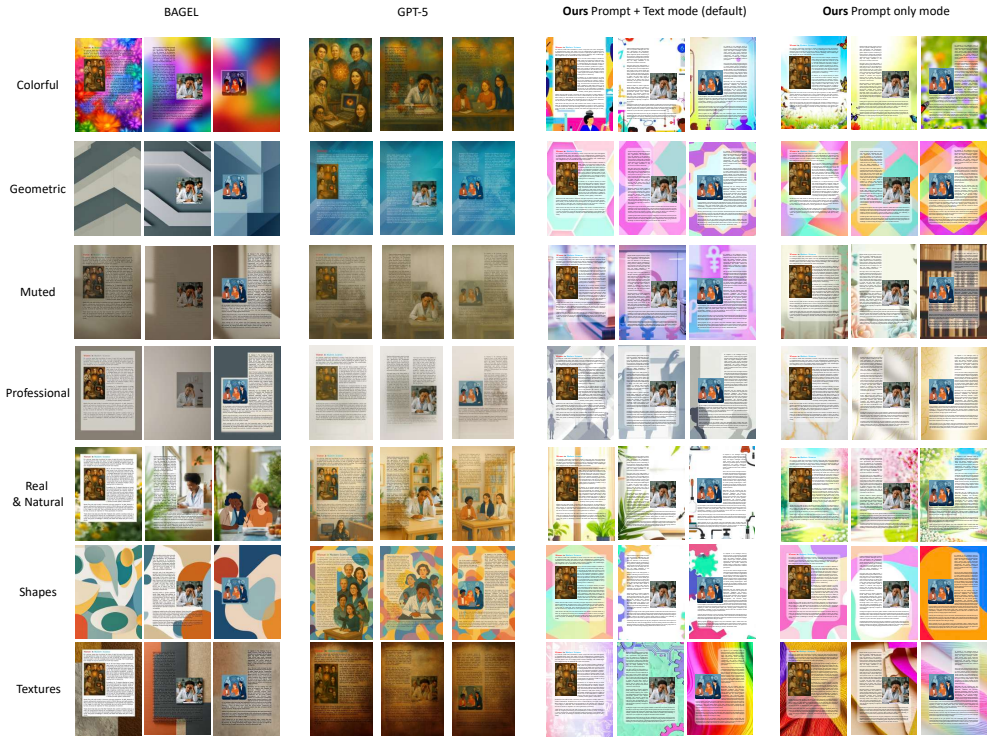
Summary. The paper proposes a training-free framework for text-conditioned background generation in multi-page documents. The pipeline detects foreground text/image regions, uses an LLM summarizer and a recursive instruction generator for cross-page style consistency, and employs two readability mechanisms: latent masking (LM), intended to softly attenuate diffusion updates in foreground regions, and Automated Readability Optimization (ARO), which places semi-transparent rounded backings with opacity computed to satisfy WCAG contrast ratios. Experiments are carried out on a self-constructed corpus of 7 PDF documents and 7 slide decks, with comparisons to BAGEL and GPT-5 using LLM-judged design scores, WCAG contrast coverage, OCR accuracy, CLIP consistency, and a 30-participant user study. The paper reports best performance across all metrics, including 99.75% WCAG compliance and 0.97 OCR accuracy.
Significance. If the mechanism worked as described, the paper would offer a practically useful training-free integration of layout-aware diffusion control, automated WCAG-driven readability overlays, and LLM-based cross-page consistency for document background editing. The authors provide detailed ablations, a user study, and clear equations. However, two load-bearing issues undermine the current claims: the central LM equation is mathematically inert as written, and the headline WCAG result is largely by construction because ARO optimizes the same contrast measure used for evaluation. The remaining experimental evidence lacks error bars and statistical tests on a small corpus, so the strength of the reported improvements is not yet established.
major comments (4)
- [Sec. 3.4, Eq. (10)-(11)] The latent masking mechanism is a forward-pass identity. Eq. (10) defines v'_t = m ⊙ v_raw_t + (1−m) ⊙ stopgrad(v_raw_t). Since stopgrad is the identity function in the forward pass, v'_t = m⊙v_raw_t + (1−m)⊙v_raw_t = v_raw_t for every mask m and every attenuation value λ. The framework is explicitly training-free, so the gradient-blocking semantics of stopgrad can never take effect. Consequently Eq. (11) is identical to the vanilla diffusion update and LM cannot 'softly attenuate' anything. This directly contradicts Table 1, where removing LM changes OCR accuracy from 0.97 to 0.91 and WCAG coverage from 99.75% to 99.67%; if Eq. (10) were the true algorithm those rows would be numerically identical. The authors must either correct the equation to match the implemented method (e.g., a true multiplicative attenuation or masked replacement) or the ablation results cannot be attributed to LM
- [Sec. 3.5, Eq. (16) and Sec. 4.4/A.5] The WCAG compliance claim is largely by construction. ARO in Eq. (16) searches for the minimal α such that at least a fraction ρ of text pixels satisfy CR ≥ τ, with τ = 7.0 and ρ = 0.98 in the implementation. The evaluation metric 'WCAG Contrast Coverage' (§4.4, Appendix A.5) then computes the percentage of text pixels whose contrast ratio exceeds 4.5 using the same CR formula. Since ARO already forces 98% of pixels above a stricter threshold, reporting 99.75% compliance is not an independent verification of readability; it is a direct consequence of the optimizer. The comparison against BAGEL and GPT-5 on this metric is therefore not evidence of superior readability. Please report readability with independent human or OCR-based measures, or at minimum present contrast distributions and error bars, and refrain from presenting the WCAG number as an outcome of the method rather than its op
- [Table 1 and Appendix A.7] The quantitative evaluation is not statistically supported. The corpus consists of 7 PDFs and 7 slide decks (3 pages each), and Table 1 reports single point estimates without error bars, confidence intervals, or significance tests. Some differences are tiny (e.g., WCAG 99.75 vs. 99.67 in the LM ablation) and could easily be sampling noise. The user study with 30 participants reports very large gaps (4.67–4.80 for Ours vs. 1.17–1.65 for baselines) that appear implausibly extreme; no confidence intervals, inter-rater agreement, or randomization details are given. At minimum, the authors should provide per-item variability, statistical tests, and clarify whether the user study tasks were fully balanced across topics and styles.
- [Sec. 3.5, Claim of guaranteed legibility] Eq. (16)-(17) do not actually guarantee legibility. The optimization searches over α for a fixed overlay color L_o, but if L_o is close to the text luminance L_t, no α in [0,1] can achieve the required contrast ratio; the final clamp α = min(1, max(α*+ϵ, α_min)) then silently returns 1, and the guarantee may fail. The paper states ARO 'guarantees legibility without manual tuning' (contribution 2) and 'ensures readability with minimal intervention', but neither the existence condition nor the choice of adaptive overlay color is specified. Please state the conditions under which the guarantee holds, or soften the claim.
minor comments (5)
- [Sec. 3.5 and Sec. 3.4] The symbol ρ is used both for the latent-mask window fraction in Eq. (9) and for the ARO coverage fraction in Eq. (16). This notation collision is confusing; rename one of them.
- [Abstract/Sec. 3.5/A.5] The paper refers to 'WCAG 2.2' in the abstract and Appendix A.5 but 'WCAG 2.1' in Sec. 3.5 and the reference list. Please standardize and cite the correct version.
- [Appendix A.5] The text states 'we evaluate... using eight quantitative metrics' but Table 1 has nine columns (including LLM Voting). Also, A.5 says the LLM judge is GPT-5, while Table 1's caption says LLM-judged metrics are evaluated by GPT-4o. Please reconcile.
- [References] Reference [13] is cited as BAGEL but the title given is 'Emerging properties in unified multimodal pretraining', which does not appear to be the BAGEL paper. Please verify the citation.
- [Sec. 3.5] Typo: 'readibability' should be 'readability'. There are also minor grammatical issues such as 'three-folded' in the introduction and 'Detailed analysis are shown' in Sec. 4.4.
Circularity Check
ARO's WCAG headline is its own optimization target, and Eq. 10's stop-grad mask is a forward-pass identity, leaving the central readability mechanisms circular/unsupported as written.
-
fitted input called prediction
[Sec. 3.5 Eq. (16); Sec. 4.2 implementation; Sec. 4.4 / App. A.5 WCAG metric]
"ARO computes the minimal opacity α∗ of semi-transparent backings that meets WCAG 2.1 [39] contrast. ... α∗ = min{ α | 1/N Σ_{i=1}^N 1[CR(L_blend(α), Lt) ≥ τ] ≥ ρ } ... WCAG Contrast Coverage computes the percentage of text regions whose luminance contrast ratio meets the WCAG 2.2 AA threshold of 4.5:1 ... Our framework achieves 99.75% WCAG compliance."
The parameter α is explicitly selected so that at least a fraction ρ of pixels in each text box pass a contrast criterion CR ≥ τ, and the evaluation headline then reports the percentage of text pixels meeting essentially the same contrast formula. With the stated implementation targets (τ=7.0, ρ=0.98, Sec. 4.2), the reported 99.75% coverage at the 4.5:1 threshold is the optimization objective being realized, not an independent prediction. The metric is the objective, so the near-perfect WCAG compliance is forced by construction rather than discovered by evaluation.
-
other
[Sec. 3.4, Eqs. (8)–(11); Table 1 ablation (w/o LM row)]
"The effective velocity becomes v′_t = m⊙v_raw_t + (1−m)⊙stopgrad(v_raw_t), (10) ... This softly attenuates generation in text regions while keeping background areas rich and variable."
In a forward pass, stopgrad is the identity function; the framework is explicitly training-free, so there is no backward pass in which gradient blocking could matter. Therefore Eq. (10) simplifies to v′_t = v_raw_t for every mask m, and Eq. (11) is identical to the vanilla update in Eq. (8). The claimed latent-masking attenuation is thus a mathematical no-op as written. Consequently, the ablation row 'w/o LM' cannot differ from the full method under this equation; the table's OCR/WCAG differences cannot be attributed to the mechanism, so the central text-preservation claim reduces to an inert identity.
full rationale
The paper's two headline readability mechanisms fail as independent derivations. ARO fits opacity to satisfy a WCAG contrast-coverage objective and then reports near-perfect WCAG coverage as an evaluation result; that number is the optimization target, not a prediction. Separately, Eq. (10)'s stop-gradient mask is the identity in the forward pass, and since the method is training-free, the mask cannot attenuate diffusion updates: the equation reduces to the vanilla velocity update. The user study, OCR accuracy, and design-quality metrics are genuinely independent and provide some empirical support, and the self-citations ([22], [23]) are not load-bearing. However, the paper's strongest quantitative claims—'near-perfect WCAG compliance' and the beneficial effect of latent masking—are either defined into existence or contradicted by the paper's own equations, so the central result is substantially circular/unsupported as written.
Assumptions & free parameters
free parameters (9)
- lambda (latent masking attenuation strength) =
0.2
- start step for time-gated masking =
0.29 of diffusion schedule
- mask window fraction rho =
not specified numerically
- ARO target contrast tau =
7.0
- ARO coverage fraction rho =
0.98
- ARO padding =
24
- ARO radius fraction =
0.12
- alpha_min and epsilon =
not reported
- memory window size N =
not reported
assumptions (5)
- standard math WCAG 2.x contrast formulas and sRGB transfer functions (Eqs. 12-14) are valid perceptual readability standards.
- domain assumption The pretrained diffusion model underlying BAGEL is competent enough to follow the generated background instructions.
- domain assumption Foreground layout analysis (PyMuPDF/OpenCV text-line detection and image-zone partitioning) reliably identifies every region that must be preserved.
- domain assumption LLM summary and instruction models (GPT-4o) produce semantically faithful compact labels and stable style instructions.
- standard math Alpha blending in Eq. 15 (L_blend = alpha L_o + (1-alpha) L_bg) accurately models perceived luminance of semi-transparent overlays.
Cite this review
Pith. "Pith review of Text-Conditioned Background Generation for Editable Multi-Layer Documents." pith.science (2026). https://pith.science/paper/NUADDB6M
@misc{pith2026251217151,
  author       = {Pith},
  title        = {Pith review of: Text-Conditioned Background Generation for Editable Multi-Layer Documents},
  year         = {2026},
  howpublished = {\url{https://pith.science/paper/NUADDB6M}},
  note         = {Machine review of arXiv:2512.17151}
}
read the original abstract
We present a framework for document-centric background generation with multi-page editing and thematic continuity. To ensure text regions remain readable, we employ a latent masking formulation that softly attenuates updates in the diffusion space, inspired by smooth barrier functions in physics and numerical optimization. In addition, we introduce Automated Readability Optimization (ARO), which automatically places semi-transparent, rounded backing shapes behind text regions. ARO determines the minimal opacity needed to satisfy perceptual contrast standards (WCAG 2.2) relative to the underlying background, ensuring readability while maintaining aesthetic harmony without human intervention. Multi-page consistency is maintained through a summarization-and-instruction process, where each page is distilled into a compact representation that recursively guides subsequent generations. This design reflects how humans build continuity by retaining prior context, ensuring that visual motifs evolve coherently across an entire document. Our method further treats a document as a structured composition in which text, figures, and backgrounds are preserved or regenerated as separate layers, allowing targeted background editing without compromising readability. Finally, user-provided prompts allow stylistic adjustments in color and texture, balancing automated consistency with flexible customization. Our training-free framework produces visually coherent, text-preserving, and thematically aligned documents, bridging generative modeling with natural design workflows.
Figures


Figures from the paper (36 more)




Reference graph
Works this paper leans on
-
[1]
Ames, Xiangru Xu, Jessy W
Aaron D. Ames, Xiangru Xu, Jessy W. Grizzle, and Paulo Tabuada. Control barrier function based quadratic programs for safety critical systems.IEEE Transactions on Automatic Control, 62(8):3861–3876, 2017. 3
2017
-
[2]
Blended diffusion for text-driven editing of natural images
Omri Avrahami, Dani Lischinski, and Ohad Fried. Blended diffusion for text-driven editing of natural images. InPro- ceedings of the IEEE/CVF conference on computer vision and pattern recognition, pages 18208–18218, 2022. 3
2022
-
[3]
In- structpix2pix: Learning to follow image editing instructions
Tim Brooks, Aleksander Holynski, and Alexei A Efros. In- structpix2pix: Learning to follow image editing instructions. InProceedings of the IEEE/CVF conference on computer vi- sion and pattern recognition, pages 18392–18402, 2023. 3
2023
-
[4]
Masactrl: Tuning-free mu- tual self-attention control for consistent image synthesis and editing
Mingdeng Cao, Xintao Wang, Zhongang Qi, Ying Shan, Xi- aohu Qie, and Yinqiang Zheng. Masactrl: Tuning-free mu- tual self-attention control for consistent image synthesis and editing. InProceedings of the IEEE/CVF international con- ference on computer vision, pages 22560–22570, 2023. 3
2023
-
[5]
Attend-and-excite: Attention-based se- mantic guidance for text-to-image diffusion models.ACM transactions on Graphics (TOG), 42(4):1–10, 2023
Hila Chefer, Yuval Alaluf, Yael Vinker, Lior Wolf, and Daniel Cohen-Or. Attend-and-excite: Attention-based se- mantic guidance for text-to-image diffusion models.ACM transactions on Graphics (TOG), 42(4):1–10, 2023. 3
2023
-
[6]
Posta: A go-to framework for customized artistic poster gen- eration
Haoyu Chen, Xiaojie Xu, Wenbo Li, Jingjing Ren, Tian Ye, Songhua Liu, Ying-Cong Chen, Lei Zhu, and Xinchao Wang. Posta: A go-to framework for customized artistic poster gen- eration. InProceedings of the Computer Vision and Pattern Recognition Conference, pages 28694–28704, 2025. 3, 7, 13, 15
2025
-
[7]
Textdiffuser: Diffusion models as text painters.Advances in Neural Information Processing Sys- tems, 36:9353–9387, 2023
Jingye Chen, Yupan Huang, Tengchao Lv, Lei Cui, Qifeng Chen, and Furu Wei. Textdiffuser: Diffusion models as text painters.Advances in Neural Information Processing Sys- tems, 36:9353–9387, 2023. 3
2023
-
[8]
Textdiffuser-2: Unleashing the power of language models for text rendering
Jingye Chen, Yupan Huang, Tengchao Lv, Lei Cui, Qifeng Chen, and Furu Wei. Textdiffuser-2: Unleashing the power of language models for text rendering. InEuropean Confer- ence on Computer Vision, pages 386–402. Springer, 2024. 3
2024
Show all 50 references
-
[9]
Training-free layout control with cross-attention guidance
Minghao Chen, Iro Laina, and Andrea Vedaldi. Training-free layout control with cross-attention guidance. InProceed- ings of the IEEE/CVF Winter Conference on Applications of Computer Vision (WACV), pages 5343–5353, 2024. 3
2024
-
[10]
Diffedit: Diffusion-based seman- tic image editing with mask guidance.arXiv preprint arXiv:2210.11427, 2022
Guillaume Couairon, Jakob Verbeek, Holger Schwenk, and Matthieu Cord. Diffedit: Diffusion-based seman- tic image editing with mask guidance.arXiv preprint arXiv:2210.11427, 2022. 3
2022 arXiv
-
[11]
Fbc-gan: Diverse and flexible image synthesis via foreground-background composition.arXiv preprint arXiv:2107.03166, 2021
Kaiwen Cui, Gongjie Zhang, Fangneng Zhan, Jiaxing Huang, and Shijian Lu. Fbc-gan: Diverse and flexible image synthesis via foreground-background composition.arXiv preprint arXiv:2107.03166, 2021. 4
2021 arXiv
-
[12]
Layerfusion: Harmo- nized multi-layer text-to-image generation with generative priors.arXiv preprint arXiv:2412.04460, 2024
Yusuf Dalva, Yijun Li, Qing Liu, Nanxuan Zhao, Jianming Zhang, Zhe Lin, and Pinar Yanardag. Layerfusion: Harmo- nized multi-layer text-to-image generation with generative priors.arXiv preprint arXiv:2412.04460, 2024. 3
2024 arXiv
-
[13]
Emerging properties in unified multimodal pretraining.arXiv preprint arXiv:2505.14683, 2025
Chaorui Deng, Deyao Zhu, Kunchang Li, Chenhui Gou, Feng Li, Zeyu Wang, Shu Zhong, Weihao Yu, Xiaonan Nie, Ziang Song, et al. Emerging properties in unified multimodal pretraining.arXiv preprint arXiv:2505.14683, 2025. 1, 3, 7, 13
2025 arXiv
-
[14]
Salient object-aware background genera- tion using text-guided diffusion models
Amir Erfan Eshratifar, Joao VB Soares, Kapil Thadani, Shaunak Mishra, Mikhail Kuznetsov, Yueh-Ning Ku, and Paloma De Juan. Salient object-aware background genera- tion using text-guided diffusion models. InProceedings of the IEEE/CVF Conference on Computer Vision and Pattern R...
2024
-
[15]
A barrier function method for the optimization of trajectory functionals with constraints
John Hauser and Alessandro Saccon. A barrier function method for the optimization of trajectory functionals with constraints. InProceedings of the 45th IEEE Conference on Decision and Control, pages 864–869, 2006. 3
2006
-
[16]
Prompt-to-prompt im- age editing with cross attention control.arXiv preprint arXiv:2208.01626, 2022
Amir Hertz, Ron Mokady, Jay Tenenbaum, Kfir Aberman, Yael Pritch, and Daniel Cohen-Or. Prompt-to-prompt im- age editing with cross attention control.arXiv preprint arXiv:2208.01626, 2022. 3
2022 arXiv
-
[17]
Ella: Equip diffusion models with llm for enhanced semantic alignment.arXiv preprint arXiv:2403.05135, 2024
Xiwei Hu, Rui Wang, Yixiao Fang, Bin Fu, Pei Cheng, and Gang Yu. Ella: Equip diffusion models with llm for enhanced semantic alignment.arXiv preprint arXiv:2403.05135, 2024. 3
2024 arXiv
-
[18]
Layerdiff: Exploring text-guided multi-layered composable image synthesis via layer-collaborative diffu- sion model
Runhui Huang, Kaixin Cai, Jianhua Han, Xiaodan Liang, Renjing Pei, Guansong Lu, Songcen Xu, Wei Zhang, and Hang Xu. Layerdiff: Exploring text-guided multi-layered composable image synthesis via layer-collaborative diffu- sion model. InEuropean Conference on Computer Vision, pa...
2024
-
[19]
Diffusion model-based image editing: A survey.IEEE Transactions on Pattern Analysis and Machine Intelligence, 47(6):4409–4437, 2025
Yi Huang, Jiancheng Huang, Yifan Liu, Mingfu Yan, Jiaxi Lv, Jianzhuang Liu, Wei Xiong, He Zhang, Liangliang Cao, and Shifeng Chen. Diffusion model-based image editing: A survey.IEEE Transactions on Pattern Analysis and Machine Intelligence, 47(6):4409–4437, 2025. 3
2025
-
[20]
Opencole: Towards reproducible automatic graphic design generation
Naoto Inoue, Kento Masui, Wataru Shimoda, and Kota Yam- aguchi. Opencole: Towards reproducible automatic graphic design generation. InProceedings of the IEEE/CVF Con- ference on Computer Vision and Pattern Recognition, pages 8131–8135, 2024. 3
2024
-
[21]
Brushnet: A plug-and-play image inpainting model with decomposed dual-branch diffusion
Xuan Ju, Xian Liu, Xintao Wang, Yuxuan Bian, Ying Shan, and Qiang Xu. Brushnet: A plug-and-play image inpainting model with decomposed dual-branch diffusion. InEuropean Conference on Computer Vision, pages 150–168. Springer,
-
[22]
Multiple gan inversion for exemplar-based image-to-image translation
Taewon Kang. Multiple gan inversion for exemplar-based image-to-image translation. InProceedings of the IEEE/CVF International Conference on Computer Vision, pages 3515– 3522, 2021. 2
2021
-
[23]
Action2dialogue: Generating character-centric narratives from scene-level prompts.arXiv preprint arXiv:2505.16819, 2025
Taewon Kang and Ming C Lin. Action2dialogue: Generating character-centric narratives from scene-level prompts.arXiv preprint arXiv:2505.16819, 2025. 1, 4
2025 arXiv
-
[24]
Automatic determination of text readability over textured backgrounds for augmented reality systems
Alex Leykin and Mihran Tuceryan. Automatic determination of text readability over textured backgrounds for augmented reality systems. InThird IEEE and ACM International Sym- posium on Mixed and Augmented Reality, pages 224–230. IEEE, 2004. 3
2004
-
[25]
Relation-aware diffusion model for controllable poster layout generation
Fengheng Li, An Liu, Wei Feng, Honghe Zhu, Yaoyu Li, Zheng Zhang, Jingjing Lv, Xin Zhu, Junjie Shen, Zhangang Lin, et al. Relation-aware diffusion model for controllable poster layout generation. InProceedings of the 32nd ACM International Conference on Information and Knowled...
2023
-
[26]
Layerdiffusion: Layered controlled image editing with dif- fusion models
Pengzhi Li, Qinxuan Huang, Yikang Ding, and Zhiheng Li. Layerdiffusion: Layered controlled image editing with dif- fusion models. InSIGGRAPH Asia 2023 Technical Commu- nications, pages 1–4. 2023. 3
2023
-
[27]
Gligen: Open-set grounded text-to-image generation
Yuheng Li, Haotian Liu, Qingyang Wu, Fangzhou Mu, Jian- wei Yang, Jianfeng Gao, Chunyuan Li, and Yong Jae Lee. Gligen: Open-set grounded text-to-image generation. InPro- ceedings of the IEEE/CVF conference on computer vision and pattern recognition, pages 22511–22521, 2023. 3
2023
-
[28]
Planning and rendering: Towards prod- uct poster generation with diffusion models.arXiv preprint arXiv:2312.08822, 2023
Zhaochen Li, Fengheng Li, Wei Feng, Honghe Zhu, Yaoyu Li, Zheng Zhang, Jingjing Lv, Junjie Shen, Zhangang Lin, Jingping Shao, et al. Planning and rendering: Towards prod- uct poster generation with diffusion models.arXiv preprint arXiv:2312.08822, 2023. 3
2023 arXiv
-
[29]
Repaint: Inpainting using denoising diffusion probabilistic models
Andreas Lugmayr, Martin Danelljan, Andres Romero, Fisher Yu, Radu Timofte, and Luc Van Gool. Repaint: Inpainting using denoising diffusion probabilistic models. InProceed- ings of the IEEE/CVF conference on computer vision and pattern recognition, pages 11461–11471, 2022. 3
2022
-
[30]
Layoutllm: Layout instruction tuning with large language models for document understanding
Chuwei Luo, Yufan Shen, Zhaoqing Zhu, Qi Zheng, Zhi Yu, and Cong Yao. Layoutllm: Layout instruction tuning with large language models for document understanding. InPro- ceedings of the IEEE/CVF conference on computer vision and pattern recognition, pages 15630–15640, 2024. 3
2024
-
[31]
Hico: Hierarchical controllable diffu- sion model for layout-to-image generation.Advances in Neu- ral Information Processing Systems, 37:128886–128910,
Yuhang Ma, Shanyuan Liu, Ao Ma, Xiaoyu Wu, Dawei Leng, and Yuhui Yin. Hico: Hierarchical controllable diffu- sion model for layout-to-image generation.Advances in Neu- ral Information Processing Systems, 37:128886–128910,
-
[32]
Sawna: Space-aware text to image generation
Ryugo Morita, Sho Kuno, Ryunosuke Tanaka, Rongzhi Li, Hoang Dai Dinh, and Issey Sukeda. Sawna: Space-aware text to image generation. InProceedings of the Special Inter- est Group on Computer Graphics and Interactive Techniques Conference Posters, New York, NY , USA, 2025. Asso...
2025
-
[33]
Gpt-4o: Openai’s most advanced generative text and vision model.https://openai.com/index/ hello-gpt-4o/, 2024
OpenAI. Gpt-4o: Openai’s most advanced generative text and vision model.https://openai.com/index/ hello-gpt-4o/, 2024. 2024-05-13. 1, 3
2024
-
[34]
Introducing gpt-5.https://openai.com/ index/introducing-gpt-5/, 2025
OpenAI. Introducing gpt-5.https://openai.com/ index/introducing-gpt-5/, 2025. 2025-08-07. 1, 3, 7, 13
2025
-
[35]
Pedram Rabiee and Jesse B. Hoagg. Soft-minimum barrier functions for safety-critical control subject to actuation con- straints.2023 American Control Conference (ACC), pages 2646–2651, 2023. 3
2023
-
[36]
Contrast mea- sures for predicting text readability
Lauren FV Scharff and Albert J Ahumada Jr. Contrast mea- sures for predicting text readability. InHuman Vision and Electronic Imaging VIII, pages 463–472. SPIE, 2003. 3
2003
-
[37]
Discriminability measures for predicting readability of text on textured backgrounds.Optics express, 6(4):81–91, 2000
Lauren FV Scharff, Alyson L Hill, and Albert J Ahumada Jr. Discriminability measures for predicting readability of text on textured backgrounds.Optics express, 6(4):81–91, 2000. 3
2000
-
[38]
Spatial-aware latent initialization for controllable image gen- eration.arXiv preprint arXiv:2401.16157, 2024
Wenqiang Sun, Teng Li, Zehong Lin, and Jun Zhang. Spatial-aware latent initialization for controllable image gen- eration.arXiv preprint arXiv:2401.16157, 2024. 3
2024 arXiv
-
[39]
Web content accessi- bility guidelines 2.1
W3C World Wide Web Consortium. Web content accessi- bility guidelines 2.1. W3C Recommendation, 6 May 2025,
2025
-
[40]
Enforcing hard constraints with soft barriers: Safe reinforcement learning in unknown stochastic environments.ArXiv, abs/2209.15090, 2022
Yixuan Wang, Simon Sinong Zhan, Ruochen Jiao, Zhilu Wang, Wanxin Jin, Zhuoran Yang, Zhaoran Wang, Chao Huang, and Qi Zhu. Enforcing hard constraints with soft barriers: Safe reinforcement learning in unknown stochastic environments.ArXiv, abs/2209.15090, 2022. 3
2022 arXiv
-
[41]
Designdiffusion: High- quality text-to-design image generation with diffusion mod- els
Zhendong Wang, Jianmin Bao, Shuyang Gu, Dong Chen, Wengang Zhou, and Houqiang Li. Designdiffusion: High- quality text-to-design image generation with diffusion mod- els. InProceedings of the Computer Vision and Pattern Recognition Conference, pages 20906–20915, 2025. 3
2025
-
[42]
Desigen: A pipeline for controllable design template generation
Haohan Weng, Danqing Huang, Yu Qiao, Zheng Hu, Chin- Yew Lin, Tong Zhang, and CL Chen. Desigen: A pipeline for controllable design template generation. InProceedings of the IEEE/CVF Conference on Computer Vision and Pattern Recognition, pages 12721–12732, 2024. 3, 4
2024
-
[43]
Boxdiff: Text-to-image synthesis with training-free box-constrained diffusion
Jinheng Xie, Yuexiang Li, Yawen Huang, Haozhe Liu, Wen- tian Zhang, Yefeng Zheng, and Mike Zheng Shou. Boxdiff: Text-to-image synthesis with training-free box-constrained diffusion. InProceedings of the IEEE/CVF International Conference on Computer Vision (ICCV), pages 7452–7461,
-
[44]
Mastering text-to-image diffu- sion: Recaptioning, planning, and generating with multi- modal llms
Ling Yang, Zhaochen Yu, Chenlin Meng, Minkai Xu, Ste- fano Ermon, and Bin Cui. Mastering text-to-image diffu- sion: Recaptioning, planning, and generating with multi- modal llms. InForty-first International Conference on Ma- chine Learning, 2024. 3
2024
-
[45]
Transparent image layer diffusion using latent transparency.arXiv preprint arXiv:2402.17113, 2024
Lvmin Zhang and Maneesh Agrawala. Transparent image layer diffusion using latent transparency.arXiv preprint arXiv:2402.17113, 2024. 3
2024 arXiv
-
[46]
Creatiposter: Towards editable and control- lable multi-layer graphic design generation.arXiv preprint arXiv:2506.10890, 2025
Zhao Zhang, Yutao Cheng, Dexiang Hong, Maoke Yang, Gonglei Shi, Lei Ma, Hui Zhang, Jie Shao, and Xing- long Wu. Creatiposter: Towards editable and control- lable multi-layer graphic design generation.arXiv preprint arXiv:2506.10890, 2025. 3, 7, 13, 14
2025 arXiv
-
[47]
Layoutdiffusion: Controllable diffu- sion model for layout-to-image generation
Guangcong Zheng, Xianpan Zhou, Xuewei Li, Zhongang Qi, Ying Shan, and Xi Li. Layoutdiffusion: Controllable diffu- sion model for layout-to-image generation. InProceedings of the IEEE/CVF Conference on Computer Vision and Pat- tern Recognition, pages 22490–22499, 2023. 3
2023
-
[48]
Human computer interaction: Legibility and contrast
Silvia Zuffi, Carla Brambilla, Giordano Beretta, and Paolo Scala. Human computer interaction: Legibility and contrast. In14th international conference on image analysis and pro- cessing (ICIAP 2007), pages 241–246. IEEE, 2007. 3
2007
-
[49]
Add a cream background with snowflakes
Silvia Zuffi, Carla Brambilla, Giordano B Beretta, and Paolo Scala. Understanding the readability of colored text by crowd-sourcing on the web.HP Laboratories, 2009. 3 A. Appendix A.1. Ethics Statement Ethics Statement All documents and slides (textual content and images) used...
2009
-
[2025]
Confirmed update date via W3C: see ”Status of This Document” section. 3, 6
Reviewed August 3, 2026 · model on record in the stance chip above.
Discussion (0). Sign in to comment.