REVIEW 2 minor 35 references
Fundamental Limits of Random Downlink Integrated Sensing and Communication over Rician Channels
T0 review · 0 major / 2 minor · reviewed 2026-07-02 · grok-4.3
Pith's one-line read Rician channels require new analysis for ISAC outage probabilities because deterministic LoS components create angle-dependent non-i.i.d. random vectors.
desk verdict This paper derives outage probabilities and scaling laws for two ISAC beamforming schemes over Rician channels, handling the non-i.i.d. vectors from LoS components. read the letter →
The pith
A machine-rendered reading of the paper's core claim, the machinery that carries it, and where it could break.
The reading
What carries the argument
Subspace joint beamforming (SJB) optimal for shared waveform structure and linear beamforming (LB) using separate sensing and communication beamformers, applied to Rician channels whose LoS components produce angle-dependent terms and independent but non-identically distributed random vectors.
What would settle it
An experiment that measures communication and sensing outage probabilities in a controlled Rician channel with a known K-factor and known angle distributions, then checks whether the measured values match the paper's closed-form expressions or scaling laws within the stated approximations.
Extended reading notes
Core claim
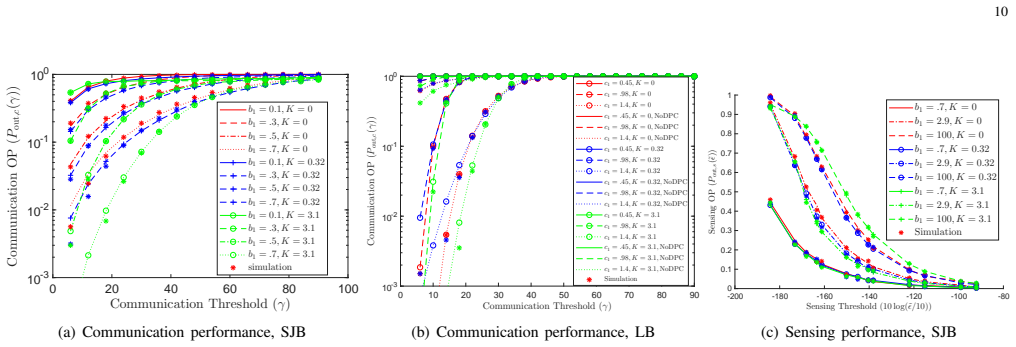
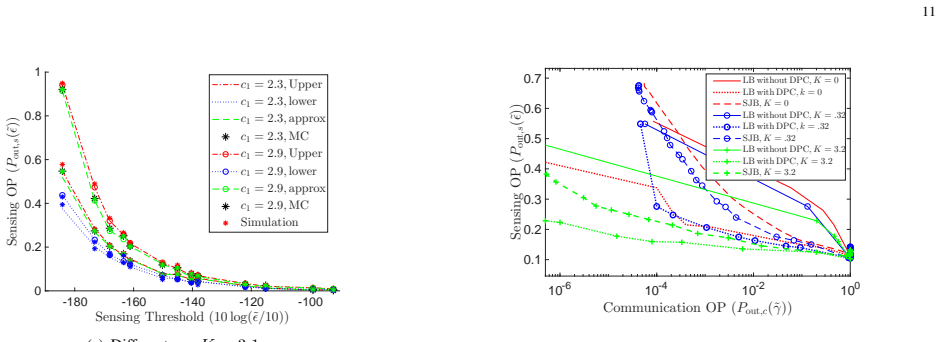
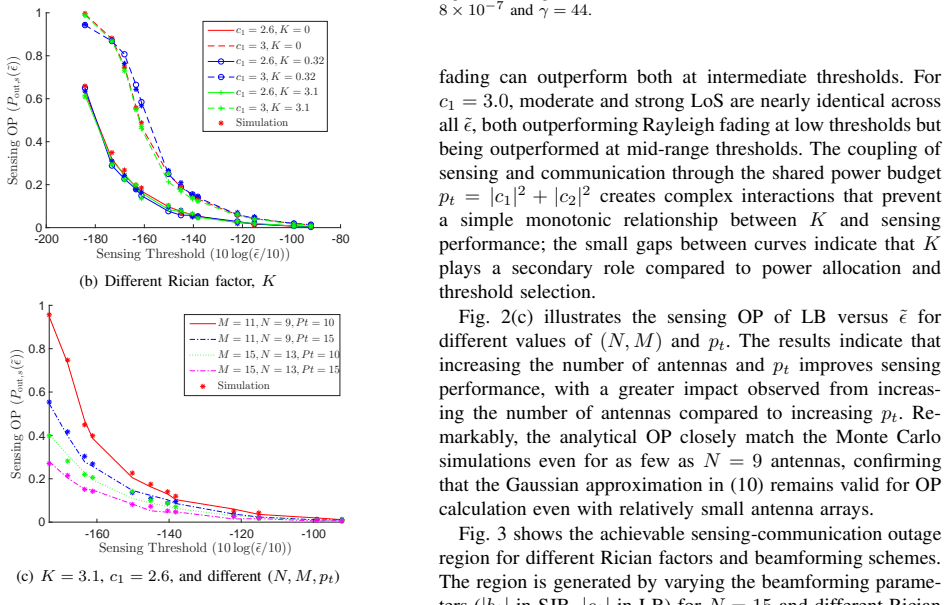
For both SJB and LB schemes, communication outage probability and sensing outage probability are derived based on the Cramer-Rao bound, with special cases having simpler expressions; for LB, upper and lower bounds on sensing outage probability and a tractable approximation are obtained; large-system and high-power scaling laws are characterized, showing LB without DPC is interference-limited at high power due to radar self-interference, LB with DPC achieves the best overall performance in strong LoS environments and is the only scheme achieving ultra-high communication reliability in Rayleigh fading, while SJB provides a robust lower-complexity alternative.
Load-bearing premise
The base station to user channel contains both line-of-sight and non-line-of-sight components, with the user line-of-sight angle fixed or random and the target angle following an arbitrary distribution that may be correlated with the user angle.
Editorial extensions
If this is right
- LB without DPC is interference-limited at high power due to radar self-interference.
- LB with DPC achieves the best overall performance in strong LoS environments.
- SJB provides a robust lower-complexity alternative across operating conditions.
- LB with DPC is the only scheme achieving ultra-high communication reliability in Rayleigh fading.
- The Rician K-factor affects communication more strongly than sensing, with non-monotonic behavior across regimes.
Reading between the lines
- The scaling laws could be used to predict how performance changes when the number of antennas grows without bound.
- The non-monotonic K-factor dependence suggests there may exist an optimal K-factor value that minimizes outage for a given power level.
Signed reviews
Editorial analysis
A structured set of objections, weighed in public.
Referee Report
Summary. The paper studies downlink MIMO ISAC over Rician channels with possibly correlated user/target LoS angles, yielding i.n.i.d. random vectors. It analyzes subspace joint beamforming (SJB) and linear beamforming (LB) schemes, deriving communication and sensing outage probabilities (OP) based on the CRB, special-case simplifications, upper/lower bounds and approximations for LB sensing OP, and large-system/high-power scaling laws. It reports that the Rician K-factor affects communication more than sensing, LB without DPC is interference-limited at high SNR, and LB with DPC performs best in strong LoS while SJB offers a lower-complexity robust alternative.
Significance. If the derivations hold, the work supplies explicit fundamental limits and scaling laws for ISAC under realistic Rician conditions, including the technical step of handling angle-dependent i.n.i.d. vectors. Credit is due for the closed-form/bounded expressions, identification of special cases, and the scaling-law characterizations that quantify regime-dependent behavior and scheme trade-offs.
minor comments (2)
- The abstract and introduction would benefit from a brief statement of the main technical novelty (the i.n.i.d. vector analysis) being placed in a dedicated subsection or theorem statement for easier reference.
- [§2] Notation for the angle distributions and correlation model could be clarified with an explicit table or diagram in §2 to distinguish fixed vs. random user LoS and arbitrary target distributions.
Simulated Author's Rebuttal
We thank the referee for the positive summary and recommendation of minor revision. No specific major comments were listed in the report, so there are no individual points requiring point-by-point rebuttal or manuscript changes at this stage.
Circularity Check
No significant circularity; derivations are self-contained from channel model and CRB
full rationale
The paper performs direct derivations of communication and sensing outage probabilities (plus large-system/high-power scaling laws) for SJB and LB schemes starting from the stated Rician channel model with possible angle correlation. The i.n.i.d. vector analysis, CRB-based sensing metric, and closed-form/bounded expressions are obtained by explicit calculation rather than by fitting parameters, renaming known results, or load-bearing self-citation chains. No step reduces by construction to its own inputs; the central claims remain independent of the paper's own fitted values or prior author results.
Assumptions & free parameters
Cite this review
Pith. "Pith review of Fundamental Limits of Random Downlink Integrated Sensing and Communication over Rician Channels." pith.science (2026). https://pith.science/paper/NUIT2URV
@misc{pith2026260700912,
  author       = {Pith},
  title        = {Pith review of: Fundamental Limits of Random Downlink Integrated Sensing and Communication over Rician Channels},
  year         = {2026},
  howpublished = {\url{https://pith.science/paper/NUIT2URV}},
  note         = {Machine review of arXiv:2607.00912}
}
read the original abstract
This paper studies the stochastic performance of a downlink multiple-input multiple-output integrated sensing and communication (ISAC) system over Rician fading channels. Rician fading is important in line-of-sight (LoS)-dominated deployments, where a deterministic propagation component can strongly affect sensing and communication reliability. The base station (BS) simultaneously serves a user and senses a target. The BS-user channel contains LoS and non-line-of-sight components. The user LoS angle may be fixed or random, and the target angle may follow an arbitrary distribution potentially correlated with the user angle. Compared with Rayleigh fading, the deterministic LoS component introduces angle-dependent terms and leads to generally independent but non-identically distributed random vectors, requiring new analysis. We analyze two beamforming strategies: subspace joint beamforming (SJB), optimal for the shared waveform structure, and linear beamforming (LB), a practical alternative using separate sensing and communication beamformers. For both schemes, we derive communication outage probability (OP) and sensing OP based on the Cramer--Rao bound (CRB). We also identify special cases with simpler expressions. For LB, we derive upper and lower bounds on sensing OP and a tractable approximation. We characterize large-system and high-power scaling laws. LB without dirty paper coding (DPC) is interference-limited at high power due to radar self-interference. Results show the Rician K-factor affects communication more strongly than sensing, with non-monotonic behavior across regimes. LB with DPC achieves the best overall performance in strong LoS environments and is the only scheme achieving ultra-high communication reliability in Rayleigh fading, while SJB provides a robust lower-complexity alternative across operating conditions.
Figures
Reference graph
Works this paper leans on
-
[1]
Seventy years of radar and communications: The road from separation to integration,
F. Liu, L. Zheng, Y . Cui, C. Masouros, A. P . Petropulu, H. G riffiths, and Y . C. Eldar, “Seventy years of radar and communications: The road from separation to integration,” IEEE Signal Process. Magazine , vol. 40, no. 5, pp. 106–121, 2023
work page 2023
-
[2]
F. Liu, Y . Cui, C. Masouros, J. Xu, T. X. Han, Y . C. Eldar, an d S. Buzzi, “Integrated sensing and communications: Toward dual-func tional wire- less networks for 6g and beyond,” IEEE J. Sel. Areas Commun. , vol. 40, no. 6, pp. 1728–1767, 2022
work page 2022
-
[3]
A survey on fundamental limits of integrated sensing and communicat ion,
A. Liu, Z. Huang, M. Li, Y . Wan, W. Li, T. X. Han, C. Liu, R. Du , D. K. P . Tan, J. Lu, Y . Shen, F. Colone, and K. Chetty, “A survey on fundamental limits of integrated sensing and communicat ion,” IEEE Commun. Surv. Tutor ., vol. 24, no. 2, pp. 994–1034, 2022
work page 2022
-
[4]
Joint state sensi ng and communication: Optimal tradeoff for a memoryless case,
M. Kobayashi, G. Caire, and G. Kramer, “Joint state sensi ng and communication: Optimal tradeoff for a memoryless case,” in Proc. 2018 IEEE Int. Symp. Inf. Theory (ISIT) , 2018, pp. 111–115
work page 2018
-
[5]
An information-theoretic approach to joint sensing and commu nication,
M. Ahmadipour, M. Kobayashi, M. Wigger, and G. Caire, “An information-theoretic approach to joint sensing and commu nication,” IEEE Trans. Inf. Theory , vol. 70, no. 2, pp. 1124–1146, 2024
work page 2024
-
[6]
To- ward dual-functional radar-communication systems: Optim al waveform design,
F. Liu, L. Zhou, C. Masouros, A. Li, W. Luo, and A. Petropul u, “To- ward dual-functional radar-communication systems: Optim al waveform design,” IEEE Trans. Signal Process. , vol. 66, no. 16, pp. 4264–4279, 2018
work page 2018
-
[7]
MU-MIMO c ommu- nications with MIMO radar: From co-existence to joint trans mission,
F. Liu, C. Masouros, A. Li, H. Sun, and L. Hanzo, “MU-MIMO c ommu- nications with MIMO radar: From co-existence to joint trans mission,” IEEE Trans. Wireless Commun. , vol. 17, no. 4, pp. 2755–2770, 2018
work page 2018
-
[8]
Joint transmit beam forming for multiuser MIMO communication and MIMO radar,
X. Liu, T. Huang, Y . Liu, and J. Zhou, “Joint transmit beam forming for multiuser MIMO communication and MIMO radar,” in Proc. 2019 IEEE Int. Conf. Signal, Inf. Data Process. (ICSIDP) , 2019, pp. 1–6
work page 2019
Show all 35 references
-
[9]
Optimal transmit beamformin g for integrated sensing and communication,
H. Hua, J. Xu, and T. X. Han, “Optimal transmit beamformin g for integrated sensing and communication,” IEEE Trans. V eh. Technol. , vol. 72, no. 8, pp. 10 588–10 603, 2023
2023
-
[10]
Cr am´ er-rao bound optimization for joint radar-communication beamfor ming,
F. Liu, Y .-F. Liu, A. Li, C. Masouros, and Y . C. Eldar, “Cr am´ er-rao bound optimization for joint radar-communication beamfor ming,” IEEE Trans. Signal Process. , vol. 70, pp. 240–253, 2022
2022
-
[11]
From torch to projector: Fundamental tradeoff of integrated sen sing and communications,
Y . Xiong, F. Liu, K. Wan, W. Y uan, C. Y uanhao, and G. Caire , “From torch to projector: Fundamental tradeoff of integrated sen sing and communications,” IEEE BITS Inf. Theory Mag. , vol. PP , pp. 1–13, 01 2024
2024
-
[12]
MIMO integrated sensing and communication: CRB-rate tradeoff,
H. Hua, T. X. Han, and J. Xu, “MIMO integrated sensing and communication: CRB-rate tradeoff,” 2022. [Online]. Av ailable: https://arxiv.org/abs/2209.12721
2022
-
[13]
Fundamental CRB-rate tradeoff in multi-antenna ISA C systems with information multicasting and multi-target sensing,
Z. Ren, Y . Peng, X. Song, Y . Fang, L. Qiu, L. Liu, D. W. K. Ng , and J. Xu, “Fundamental CRB-rate tradeoff in multi-antenna ISA C systems with information multicasting and multi-target sensing,” IEEE Trans. Wireless Commun., vol. 23, no. 4, pp. 3870–3885, 2024
2024
-
[14]
On the performance of uplink and downlink integrated sensing and communication systems ,
M. Liu, M. Y ang, and A. Nallanathan, “On the performance of uplink and downlink integrated sensing and communication systems ,” in Proc. 2022 IEEE Globecom W orkshops (GC Wkshps) , 2022, pp. 1236–1241
2022
-
[15]
Performance analysis and power allocation fo r coop- erative ISAC networks,
M. Liu, M. Y ang, H. Li, K. Zeng, Z. Zhang, A. Nallanathan, G. Wang, and L. Hanzo, “Performance analysis and power allocation fo r coop- erative ISAC networks,” IEEE Internet Things J. , vol. 10, no. 7, pp. 6336–6351, 2023
2023
-
[16]
A unified perf or- mance framework for integrated sensing-communications ba sed on kl- divergence,
M. Al-Jarrah, E. Alsusa, and C. Masouros, “A unified perf or- mance framework for integrated sensing-communications ba sed on kl- divergence,” IEEE Trans. Wireless Commun. , vol. 22, no. 12, pp. 9390– 9411, 2023
2023
-
[17]
NOMA-ISAC: Performance analysis and rate region characterization,
C. Ouyang, Y . Liu, and H. Y ang, “NOMA-ISAC: Performance analysis and rate region characterization,” 2022. [Online ]. Available: https://arxiv.org/abs/2205.13756
2022
-
[18]
MIMO-ISAC: Performance analysis and rate region c haracteri- zation,
——, “MIMO-ISAC: Performance analysis and rate region c haracteri- zation,” 2023. [Online]. Available: https://arxiv.org/a bs/2209.01028
2023
-
[19]
Performance a nalysis of the full-duplex joint radar and communication system,
Y . Guo, C. Li, C. Zhang, Y . Y ao, and B. Xia, “Performance a nalysis of the full-duplex joint radar and communication system,” in Proc. 2021 IEEE/CIC Int. Conf. Commun. China (ICCC) , 2021, pp. 505–510
2021
-
[20]
Performance of downlink and uplink integrated sensing and communications (ISAC) systems,
C. Ouyang, Y . Liu, and H. Y ang, “Performance of downlink and uplink integrated sensing and communications (ISAC) systems,” IEEE Wireless Commun. Lett. , vol. 11, no. 9, pp. 1850–1854, 2022
2022
-
[21]
On the fundamental tradeoff of integrated sensing and communicat ions under Gaussian channels,
Y . Xiong, F. Liu, Y . Cui, W. Y uan, T. X. Han, and G. Caire, “ On the fundamental tradeoff of integrated sensing and communicat ions under Gaussian channels,” IEEE Trans. Inf. Theory , vol. 69, no. 9, pp. 5723– 5751, 2023
2023
-
[22]
Network-lev el isac: An analytical study of antenna topologies ranging from massiv e to cell-free mimo,
K. Meng, K. Han, C. Masouros, and L. Hanzo, “Network-lev el isac: An analytical study of antenna topologies ranging from massiv e to cell-free mimo,” IEEE Transactions on Wireless Communications , pp. 1–1, 2025
2025
-
[23]
Coverage and rate of joint communication and parameter estimation in wireless n etworks,
N. R. Olson, J. G. Andrews, and R. W. Heath, “Coverage and rate of joint communication and parameter estimation in wireless n etworks,” IEEE Trans. Inf. Theory , vol. 70, no. 1, pp. 206–243, 2024
2024
-
[24]
Performance analysis of cooperative integrated s ensing and communications for 6g networks,
D. Sui, C. Pan, H. Ren, J. Wan, L. Zhuo, J. Jin, Q. Wang, and J. Wang, “Performance analysis of cooperative integrated s ensing and communications for 6g networks,” 2025. [Online]. Avail able: https://arxiv.org/abs/2505.08221
2025
-
[25]
Network-leve l integrated sensing and communication: Interference management and BS coordina- tion using stochastic geometry,
K. Meng, C. Masouros, G. Chen, and F. Liu, “Network-leve l integrated sensing and communication: Interference management and BS coordina- tion using stochastic geometry,” IEEE Trans. Wireless Commun., vol. 23, no. 12, pp. 19 365–19 381, 2024
2024
-
[26]
Performance analysis of isac with active multi-functi onal riss in ri- cian fading channels,
A. Singh Parihar, K. Singh, G. C. Alexandropoulos, Z. Di ng, and C.-P . Li, “Performance analysis of isac with active multi-functi onal riss in ri- cian fading channels,” IEEE Transactions on Cognitive Communications and Networking , vol. 12, pp. 355–369, 2026
2026
-
[27]
On stocha stic fundamen- tal limits in a downlink integrated sensing and communicati on network,
M. Soltani, M. Mirmohseni, and R. Tafazolli, “On stocha stic fundamen- tal limits in a downlink integrated sensing and communicati on network,” IEEE Transactions on Communications , pp. 1–1, 2025
2025
-
[28]
Fundamental channel coupling effec ts for integrated sensing and communication systems,
X. Gan, H. Chongwen, Z. Y ang, X. Chen, F. Liu, Z. Zhang, C. Y uen, Y . Guan, and m. Debbah, “Fundamental channel coupling effec ts for integrated sensing and communication systems,” Science China Infor- mation Sciences , vol. 68, 07 2025
2025
-
[29]
Outage tr adeoff analysis in a downlink integrated sensing and communication network ,
M. Soltani, M. Mirmohseni, and R. Tafazolli, “Outage tr adeoff analysis in a downlink integrated sensing and communication network ,” in 2023 IEEE Globecom W orkshops (GC Wkshps) , 2023, pp. 951–956
2023
-
[30]
Writing on dirty paper (corresp.),
M. Costa, “Writing on dirty paper (corresp.),” IEEE Trans. Inf. Theory , vol. 29, no. 3, pp. 439–441, 1983
1983
-
[31]
Physical layer security optimi zation with cram´ er–rao bound metric in ISAC systems under sensing-spe cific im- perfect CSI model,
H. Jia, X. Li, and L. Ma, “Physical layer security optimi zation with cram´ er–rao bound metric in ISAC systems under sensing-spe cific im- perfect CSI model,” IEEE Trans. V eh. Technol., vol. 73, no. 5, 2024
2024
-
[32]
On stocha stic performance analysis of secure integrated sensing and comm unication networks,
M. Soltani, M. Mirmohseni, and R. Tafazolli, “On stocha stic performance analysis of secure integrated sensing and comm unication networks,” 2025. [Online]. Available: https://arxiv.org /abs/2504.09674
2025
-
[33]
A method to integrate and class ify normal distributions,
A. Das and W. S. Geisler, “A method to integrate and class ify normal distributions,” Journal of Vision , vol. 21, no. 10, pp. 1–1, 09 2021. [Online]. Available: https://doi.org/10.1167/jov.21.10.1
2021 doi
-
[34]
Target detection and lo calization using MIMO radars and sonars,
I. Bekkerman and J. Tabrikian, “Target detection and lo calization using MIMO radars and sonars,” IEEE Trans. Signal Process. , vol. 54, no. 10, pp. 3873–3883, 2006
2006
-
[35]
El Gamal and Y .-H
A. El Gamal and Y .-H. Kim, Network Information Theory . Cambridge University Press, 2011
2011
Reviewed July 2, 2026 · model on record in the stance chip above.
Discussion (0). Continue with ORCID to comment.