REVIEW 3 major objections 5 minor 1 cited by
ReF-LLE: Personalized Low-Light Enhancement via Reference-Guided Deep Reinforcement Learning
T0 review · 3 major / 5 minor · reviewed 2026-08-06 · deepseek-v4-flash
Pith's one-line read This paper claims that low-light images can be enhanced by a reinforcement-learning agent that repeatedly scales the Fourier amplitude of the image by a scalar gain while keeping the phase fixed, and that this simple mechanism beats…
desk verdict ReF-LLE's iterative amplitude scaling with a scalar action is mathematically a global brightness change, so the claimed SOTA superiority is unsupported unless the implementation secretly uses a spatially varying action. read the letter →
The pith
A machine-rendered reading of the paper's core claim, the machinery that carries it, and where it could break.
The reading
What carries the argument
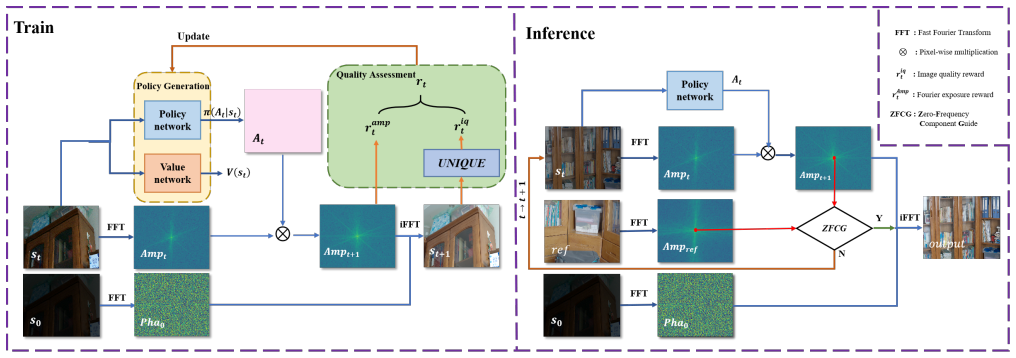
The load-bearing object is the zero-frequency component (ZFC) of the Fourier transform, the DC term representing average light intensity, used as a global illumination prior. Around it, the only control signal is the scalar amplitude gain $A = e^{\alpha}$: Eq. (1)--(2) define enhancement as iterated scalar multiplication of the amplitude spectrum with the phase held fixed. The A3C reinforcement-learning loop with two rewards (UNIQUE image-quality reward and amplitude-exposure reward) supplies the training signal, while inference swaps the training ZFC target for the reference image's ZFC, letting the same mechanism produce personalized outputs.
What would settle it
Take a low-light image with visible sensor noise and a strong color cast and run ReF-LLE against a normal-light reference; because the action is scalar and the phase is frozen, the output must equal the input multiplied by one global constant, so the noise and color cast survive at the same relative strength. If a benchmark image of this kind exists where the ground truth contains local contrast or color correction that no global rescale can produce, and ReF-LLE still fails to recover it, the claim of general superiority over methods that perform local and spectral adjustments is falsified for that regime.
Extended reading notes
Core claim
The central claim is that repairing a low-light image reduces to optimizing its Fourier amplitude component while freezing its phase. At each step the amplitude is multiplied by $A = e^{\alpha}$ with $\alpha$ in $[-0.1, 0.2]$, and the image is rebuilt by the inverse Fourier transform, so the agent's only control is a global brightness multiplier. An A3C policy network selects $\alpha$ from the current state, rewarded by the UNIQUE no-reference quality difference between the current and initial image and by the closeness of the zero-frequency component to a target value. During inference, the fixed training target is replaced by the user reference's zero-frequency component, making the iteration count and final brightness adaptive to the user's choice. The paper asserts that this scheme outperforms existing unsupervised and reinforcement-learning low-light enhancement methods on paired and unpaired benchmarks while offering controllable personalization.
Load-bearing premise
The load-bearing premise is that a low-light photo can be repaired to look natural by repeatedly multiplying its overall brightness by constants while leaving phase, color relations, and noise exactly as they were.
Editorial extensions
If this is right
- If correct, ReF-LLE is the best unsupervised low-light enhancement method reported on LOL, LOL-v2-Real, and LSRW-Huawei across PSNR, SSIM, and LPIPS.
- Users can personalize the output simply by providing a reference image, setting a global-illumination parameter, or choosing the number of iterations, without retraining.
- The zero-reference training scheme means the method can be trained on unpaired low-light images, avoiding the need for ground-truth normal-light pairs.
- The scalar Fourier-gain mechanism gives a transparent, interpretable enhancement process: each step is a controllable brightness adjustment rather than a black-box image transformation.
Reading between the lines
- Because the action $A = e^{\alpha}$ is scalar and the phase is frozen, the output is mathematically a globally rescaled version of the input, so the personalization offered here is brightness personalization only; a reference image's local contrast, tone curve, or color distribution would not transfer.
- A direct testable extension is to replace the scalar gain with per-frequency-band gains: if that variant improves results on noisy or color-cast low-light images, it would confirm that the scalar restriction, not the Fourier decomposition itself, is the binding constraint.
- The zero-frequency target could be exposed as a plain brightness slider, in which case the method reduces to iterative auto-exposure, which may explain the reported gains on exposure-dominated metrics such as PSNR.
- A fair benchmark for the personalized claim would ask users to pick between ReF-LLE outputs and simple global brightness matching of the same reference; if users cannot tell them apart, the reinforcement-learning component adds little beyond target-brightness selection.
Editorial analysis
A structured set of objections, weighed in public.
Referee Report
Summary. The paper proposes ReF-LLE, an unsupervised low-light image enhancement method that combines deep reinforcement learning (A3C) with Fourier-domain amplitude manipulation. At each iteration the policy outputs a scalar gain A=e^α, the Fourier amplitude is multiplied by this gain while phase is held fixed, and the inverse DFT produces the enhanced image. A reward combining a no-reference quality score (UNIQUE) and an amplitude exposure term based on the zero-frequency component (ZFC) trains the agent; at inference, a reference image's ZFC guides the adaptive iteration. Experiments on LOL, LOL-v2-Real, LSRW-Huawei, and five unpaired datasets report state-of-the-art PSNR/SSIM/LPIPS/NIQE against unsupervised and RL baselines.
Significance. If the mechanism worked as claimed, combining RL with Fourier-domain amplitude optimization for user-controllable low-light enhancement would be interesting, and the paper does provide broad benchmarks and ablations. However, the action is a scalar gain, which makes the iterative procedure mathematically equivalent to multiplying the input image by a single positive constant; the ZFC target is a scalar mean-brightness constraint. Under this reduction, ReF-LLE is a brightness-level selector, not a pixel-level or frequency-shaped enhancement method, so the claimed novelty and superiority over methods performing local corrections are not supported. The central claim is therefore not well-founded as written.
major comments (3)
- [Section II, Eq. (1); Section III-B] The action is defined as A = e^α with α a scalar in [−0.1, 0.2]. Under Eq. (1), the Fourier amplitude at every frequency is multiplied by the same scalar A_t, and Eq. (2) reconstructs the image from this spectrum. Because the inverse DFT is linear, each iteration is exactly x_t = A_t x_{t−1}, so after T iterations x_T = (∏_{t=1}^{T} e^{α_t}) x_0. The entire enhancement is a single global brightness scaling. The claim in Section II that the optimal mapping A_t is determined 'on a pixel-by-pixel basis for the amplitude information' and the phrase 'pixel-level linear enhancement' in Section III-B are therefore not supported by the stated equations. No local contrast recovery, color-cast correction, or noise removal is possible with this action, and the method cannot implement the Fourier-domain enhancement mechanism the paper advertises unless a spatially varying A_t is used but never described.
- [Section III-D; Section IV-C; Table III] The zero-frequency component is a scalar proportional to the sum (or mean) of pixel values. Matching zfc_t to zfc_ref (or to the hyperparameter zfc_bar) can only constrain the global mean brightness; it cannot 'align with the illumination distribution' as stated in the Abstract and Section III-D. The ablation in Table III confirms that the method is dominated by this scalar target: with only the amplitude exposure reward ramp, PSNR is 19.60, close to the full method's 19.88, whereas the quality reward alone yields 7.31. Thus the outputs of ReF-LLE are essentially the input image rescaled to a target mean brightness, and the personalization in Figs. 1, 5, and 6 is a brightness-level choice rather than a distribution-aligned enhancement.
- [Section V; Table I] The conclusion that the results 'consistently demonstrate the clear superiority of ReF-LLE' is not supported by Table I. On LSRW-Huawei, ReF-LLE's SSIM (0.529) is below ReLLIE (0.549) and ALL-E (0.557), and its LPIPS (0.381) is worse than FourierDiff (0.366). More importantly, because the method reduces to global rescaling, favorable PSNR values primarily reflect hitting a target average brightness, not a better enhancement mechanism; a proper comparison should include a simple brightness-matching baseline with the same ZFC target.
minor comments (5)
- [Section III-C] The text refers to 'the total discounted reward Rt in Eq.(8)', but there is no Eq. (8) in the manuscript; the discounted-return definition is missing.
- [Sections III-B and IV-A] The hyperparameter zfc_bar = 2.5×10^5 is given without specifying whether images are scaled to [0,1] or [0,255] and without a formula relating ZFC to image size; this makes the training target not reproducible.
- [Section II] The notation in Eqs. (1)–(2), such as Amp_t(x) and 'Amp_t(x)×cos(Ph a0(x))', treats a frequency-domain function as if it were a scalar; please use explicit (u,v)-dependence and elementwise multiplication.
- [Sections III-D and V] The method name is spelled inconsistently: 'ReF-LLE' in most places but 'Ref-LLE' in Section III-D and Section V.
- [Section III-A] The A3C policy and value network details are deferred to a 'supplementary material' that is not attached; please include them or summarize the architecture in the paper.
Circularity Check
ReF-LLE reduces to global scalar brightness adjustment: the scalar action A=e^α and zero-frequency-component guidance force the output to match a user-supplied scalar, so the claimed personalized Fourier-domain enhancement is equivalent by construction to rescaling the input to a target mean brightness.
-
self definitional
[Section II (Eq. (1)-(2)) and Section III-B (Action Space Setting)]
"At each iteration, the optimal parameter mapping At(x) is determined on a pixel-by-pixel basis for the amplitude information. ... we define the action A as follows: A = eα. ... we set the parameter α to range between [−0.1, 0.2] with a step size of 0.01 for discretization."
The action A = e^α is a scalar (α is a single scalar in [−0.1, 0.2]), not a per-pixel map. By linearity of the DFT, multiplying the Fourier amplitude by a real scalar c while preserving phase is exactly equivalent to multiplying the spatial image by c. Iterating Eq. (1) gives x_T = (∏_t e^{α_t}) · x_0. Thus the 'pixel-by-pixel' enhancement claimed in Eq. (1)-(2) is, by construction, a single global brightness gain. The entire Fourier-domain mechanism reduces to a scalar multiplier, and the claimed pixel-level processing is defined in a way that makes it identical to global scaling.
-
fitted input called prediction
[Section III-D (Zero-frequency component Guide) and Section IV-C (Visualization of Personalized LLIE)]
"Consequently, we adopt the ZFC as a prior for global illumination. Ref-LLE adaptively iterates to progressively align the ZFC of the enhanced image ( zf ct ) with the ZFC of the reference image ( zf cref ) provided by the user."
The ZFC is the zero-frequency (DC) component, equal to the sum or mean of pixel values. The iterative loop is designed to drive zf c_t to zf c_ref, a scalar supplied by the user's reference image. Because each action is a global scalar multiplier (step 1), the output is forced to be x_T = (zf c_ref / zf c_0) · x_0. Hence the 'personalized enhancement' and 'alignment with illumination distribution' reduce, by construction, to rescaling the input to match the reference image's mean brightness—a scalar target given in advance. No spatial, color, or local-contrast information from the reference is used; the enhancement result is determined entirely by the reference's DC value, making the 'prediction' of the personalized output equivalent to fitting a user-specified scalar.
full rationale
The paper's own equations and action definition show that ReF-LLE performs global scalar multiplication: A = e^α is scalar, and the DFT linearity makes amplitude scaling with fixed phase equivalent to spatial-domain scaling. The inference loop then aligns the output's ZFC (the DC component, i.e., mean brightness) with the reference ZFC, which is a single scalar. Consequently, the claimed 'pixel-level linear enhancement' and 'personalized alignment with the illumination distribution' reduce by construction to matching a scalar target brightness provided by the user or by the hyperparameter ¯zfc. This is a genuine circularity in the central mechanism: the output is defined as the input rescaled to a target mean, and the target is an input. The paper does not rely on load-bearing self-citation or imported uniqueness theorems; the issue is internal to the method. Empirical comparisons against other methods may still be informative, but the claim of a novel Fourier-domain RL enhancement mechanism and of personalized adaptation to a reference image is undermined because the only degree of freedom is a global brightness gain controlled by a scalar input. Score is 6: the central claim partially reduces to fitting a scalar, though the paper includes learned policy components and extensive experiments that are not themselves circular.
Assumptions & free parameters
free parameters (4)
- Action range [alpha_min, alpha_max] =
[-0.1, 0.2], step 0.01
- zfc_bar (target zero-frequency component) =
2.5e5
- Reward weights w_iq, w_amp =
1000 and 60
- Inference stopping criterion =
Not specified
assumptions (5)
- standard math Fourier transform linearity and amplitude-phase decomposition
- domain assumption Amplitude scaling with fixed phase is sufficient for low-light enhancement
- domain assumption ZFC (mean pixel value) is a valid and sufficient proxy for user illumination preference
- ad hoc to paper UNIQUE no-reference quality score is a reliable reward for low-light enhancement
- domain assumption The discrete action set over alpha is sufficient
Cite this review
Pith. "Pith review of ReF-LLE: Personalized Low-Light Enhancement via Reference-Guided Deep Reinforcement Learning." pith.science (2026). https://pith.science/paper/NUO3R3PV
@misc{pith2026250622216,
  author       = {Pith},
  title        = {Pith review of: ReF-LLE: Personalized Low-Light Enhancement via Reference-Guided Deep Reinforcement Learning},
  year         = {2026},
  howpublished = {\url{https://pith.science/paper/NUO3R3PV}},
  note         = {Machine review of arXiv:2506.22216}
}
read the original abstract
Low-light image enhancement presents two primary challenges: 1) Significant variations in low-light images across different conditions, and 2) Enhancement levels influenced by subjective preferences and user intent. To address these issues, we propose ReF-LLE, a novel personalized low-light image enhancement method that operates in the Fourier frequency domain and incorporates deep reinforcement learning. ReF-LLE is the first to integrate deep reinforcement learning into this domain. During training, a zero-reference image evaluation strategy is introduced to score enhanced images, providing reward signals that guide the model to handle varying degrees of low-light conditions effectively. In the inference phase, ReF-LLE employs a personalized adaptive iterative strategy, guided by the zero-frequency component in the Fourier domain, which represents the overall illumination level. This strategy enables the model to adaptively adjust low-light images to align with the illumination distribution of a user-provided reference image, ensuring personalized enhancement results. Extensive experiments on benchmark datasets demonstrate that ReF-LLE outperforms state-of-the-art methods, achieving superior perceptual quality and adaptability in personalized low-light image enhancement.
Figures


Figures from the paper (4 more)


Forward citations
Cited by 1 Pith paper
-
RL-AWB: Deep Reinforcement Learning for Auto White Balance Correction in Low-Light Night-time Scenes
RL-AWB uses reinforcement learning to optimize parameters of a statistical white-balance estimator for nighttime scenes and reports better generalization on a new multi-sensor dataset.
Reference graph
Works this paper leans on
-
[1]
Lime: Low-light image enhancement via illumination map estimation,
Xiaojie Guo, Yu Li, and Haibin Ling, “Lime: Low-light image enhancement via illumination map estimation,” IEEE Transactions on image processing, vol. 26, no. 2, pp. 982–993, 2016
work page 2016
-
[2]
Dual illumination estimation for robust exposure correction,
Qing Zhang, Yongwei Nie, and Wei-Shi Zheng, “Dual illumination estimation for robust exposure correction,” in Computer graphics forum. Wiley Online Library, 2019, vol. 38, pp. 243–252
work page 2019
-
[3]
Toward fast, flexible, and robust low-light image enhancement,
Long Ma, Tengyu Ma, Risheng Liu, Xin Fan, and Zhongxuan Luo, “Toward fast, flexible, and robust low-light image enhancement,” in Proceedings of the IEEE/CVF conference on computer vision and pattern recognition, 2022, pp. 5637–5646
work page 2022
-
[4]
Implicit neural representation for cooperative low-light image enhance- ment,
Shuzhou Yang, Moxuan Ding, Yanmin Wu, Zihan Li, and Jian Zhang, “Implicit neural representation for cooperative low-light image enhance- ment,” in Proceedings of the IEEE/CVF international conference on computer vision, 2023, pp. 12918–12927
work page 2023
-
[5]
Low-light image enhancement with normalizing flow,
Yufei Wang, Renjie Wan, Wenhan Yang, Haoliang Li, Lap-Pui Chau, and Alex Kot, “Low-light image enhancement with normalizing flow,” in Proceedings of the AAAI conference on artificial intelligence , 2022, vol. 36, pp. 2604–2612
work page 2022
-
[6]
Learning a simple low-light image enhancer from paired low-light instances,
Zhenqi Fu, Yan Yang, Xiaotong Tu, Yue Huang, Xinghao Ding, and Kai- Kuang Ma, “Learning a simple low-light image enhancer from paired low-light instances,” in Proceedings of the IEEE/CVF conference on computer vision and pattern recognition , 2023, pp. 22252–22261
work page 2023
-
[7]
Retinexformer: One-stage retinex-based transformer for low-light image enhancement,
Yuanhao Cai, Hao Bian, Jing Lin, Haoqian Wang, Radu Timofte, and Yulun Zhang, “Retinexformer: One-stage retinex-based transformer for low-light image enhancement,” in Proceedings of the IEEE/CVF International Conference on Computer Vision , 2023, pp. 12504–12513
work page 2023
-
[8]
Uretinex-net: Retinex-based deep unfolding network for low-light image enhancement,
Wenhui Wu, Jian Weng, Pingping Zhang, Xu Wang, Wenhan Yang, and Jianmin Jiang, “Uretinex-net: Retinex-based deep unfolding network for low-light image enhancement,” in Proceedings of the IEEE/CVF conference on computer vision and pattern recognition, 2022, pp. 5901– 5910
work page 2022
Show all 33 references
-
[9]
Deep fourier-based exposure correction network with spatial-frequency interaction,
Jie Huang, Yajing Liu, Feng Zhao, Keyu Yan, Jinghao Zhang, Yukun Huang, Man Zhou, and Zhiwei Xiong, “Deep fourier-based exposure correction network with spatial-frequency interaction,” in European Conference on Computer Vision . Springer, 2022, pp. 163–180
2022
-
[10]
Embedding fourier for ultra-high-definition low-light image enhancement,
Chongyi Li, Chun-Le Guo, Man Zhou, Zhexin Liang, Shangchen Zhou, Ruicheng Feng, and Chen Change Loy, “Embedding fourier for ultra-high-definition low-light image enhancement,” arXiv preprint arXiv:2302.11831, 2023
2023 arXiv
-
[11]
Fourllie: Boosting low-light image enhancement by fourier frequency information,
Chenxi Wang, Hongjun Wu, and Zhi Jin, “Fourllie: Boosting low-light image enhancement by fourier frequency information,” in Proceedings of the 31st ACM International Conference on Multimedia , 2023, pp. 7459–7469
2023
-
[12]
Rellie: Deep reinforcement learning for customized low-light image enhance- ment,
Rongkai Zhang, Lanqing Guo, Siyu Huang, and Bihan Wen, “Rellie: Deep reinforcement learning for customized low-light image enhance- ment,” in Proceedings of the 29th ACM international conference on multimedia, 2021, pp. 2429–2437
2021
-
[13]
All-e: aesthetics-guided low-light image enhancement,
Ling Li, Dong Liang, Yuanhang Gao, Sheng-Jun Huang, and Songcan Chen, “All-e: aesthetics-guided low-light image enhancement,” arXiv preprint arXiv:2304.14610, 2023
2023 arXiv
-
[14]
DM- FourLLIE: Dual-stage and multi-branch fourier network for low-light image enhancement,
Tongshun Zhang, Pingping Liu, Ming Zhao, and Haotian Lv, “DM- FourLLIE: Dual-stage and multi-branch fourier network for low-light image enhancement,” in ACM Multimedia 2024 , 2024
2024
-
[15]
Asynchronous methods for deep reinforcement learning,
V olodymyr Mnih, Adria Puigdomenech Badia, Mehdi Mirza, Alex Graves, Timothy Lillicrap, Tim Harley, David Silver, and Koray Kavukcuoglu, “Asynchronous methods for deep reinforcement learning,” in International conference on machine learning . PMLR, 2016, pp. 1928–1937
2016
-
[16]
Uncertainty-aware blind image quality assessment in the laboratory and wild,
Weixia Zhang, Kede Ma, Guangtao Zhai, and Xiaokang Yang, “Uncertainty-aware blind image quality assessment in the laboratory and wild,” IEEE Transactions on Image Processing, vol. 30, pp. 3474–3486, Mar. 2021
2021
-
[17]
Low- light image enhancement with semi-decoupled decomposition,
Shijie Hao, Xu Han, Yanrong Guo, Xin Xu, and Meng Wang, “Low- light image enhancement with semi-decoupled decomposition,” IEEE transactions on multimedia , vol. 22, no. 12, pp. 3025–3038, 2020
2020
-
[18]
Zero-reference deep curve estimation for low-light image enhancement,
Chunle Guo, Chongyi Li, Jichang Guo, Chen Change Loy, Junhui Hou, Sam Kwong, and Runmin Cong, “Zero-reference deep curve estimation for low-light image enhancement,” in Proceedings of the IEEE/CVF conference on computer vision and pattern recognition, 2020, pp. 1780– 1789
2020
-
[19]
Semantically contrastive learning for low-light image enhancement,
Dong Liang, Ling Li, Mingqiang Wei, Shuo Yang, Liyan Zhang, Wenhan Yang, Yun Du, and Huiyu Zhou, “Semantically contrastive learning for low-light image enhancement,” in Proceedings of the AAAI conference on artificial intelligence , 2022, vol. 36, pp. 1555–1563
2022
-
[20]
Iterative prompt learning for unsupervised backlit image enhancement,
Zhexin Liang, Chongyi Li, Shangchen Zhou, Ruicheng Feng, and Chen Change Loy, “Iterative prompt learning for unsupervised backlit image enhancement,” in Proceedings of the IEEE/CVF International Conference on Computer Vision , 2023, pp. 8094–8103
2023
-
[21]
Fourier priors-guided diffusion for zero-shot joint low-light enhancement and deblurring,
Xiaoqian Lv, Shengping Zhang, Chenyang Wang, Yichen Zheng, Bineng Zhong, Chongyi Li, and Liqiang Nie, “Fourier priors-guided diffusion for zero-shot joint low-light enhancement and deblurring,” in Proceed- ings of the IEEE/CVF Conference on Computer Vision and Pattern Recognit...
2024
-
[22]
Specularity factorization for low- light enhancement,
Saurabh Saini and PJ Narayanan, “Specularity factorization for low- light enhancement,” in Proceedings of the IEEE/CVF Conference on Computer Vision and Pattern Recognition , 2024, pp. 1–12
2024
-
[23]
Bernd J ¨ahne, Digital image processing , Springer Science & Business Media, 2005
2005
-
[24]
Deep retinex decomposition for low-light enhancement,
Chen Wei, Wenjing Wang, Wenhan Yang, and Jiaying Liu, “Deep retinex decomposition for low-light enhancement,” arXiv preprint arXiv:1808.04560, 2018
2018 arXiv
-
[25]
Sparse gradient regularized deep retinex network for robust low- light image enhancement,
Wenhan Yang, Wenjing Wang, Haofeng Huang, Shiqi Wang, and Jiaying Liu, “Sparse gradient regularized deep retinex network for robust low- light image enhancement,” IEEE Transactions on Image Processing , vol. 30, pp. 2072–2086, 2021
2021
-
[26]
R2rnet: Low-light image enhancement via real-low to real-normal network,
Jiang Hai, Zhu Xuan, Ren Yang, Yutong Hao, Fengzhu Zou, Fang Lin, and Songchen Han, “R2rnet: Low-light image enhancement via real-low to real-normal network,” Journal of Visual Communication and Image Representation, vol. 90, pp. 103712, 2023
2023
-
[27]
Advancing image understanding in poor visibility environ- ments: A collective benchmark study,
Wenhan Yang, Ye Yuan, Wenqi Ren, Jiaying Liu, Walter J Scheirer, Zhangyang Wang, Taiheng Zhang, Qiaoyong Zhong, Di Xie, Shiliang Pu, et al., “Advancing image understanding in poor visibility environ- ments: A collective benchmark study,” IEEE Transactions on Image Processing, ...
2020
-
[28]
Contrast enhancement based on layered difference representation of 2d histograms,
Chulwoo Lee, Chul Lee, and Chang-Su Kim, “Contrast enhancement based on layered difference representation of 2d histograms,” IEEE transactions on image processing, vol. 22, no. 12, pp. 5372–5384, 2013
2013
-
[29]
Naturalness preserved enhancement algorithm for non-uniform illumination images,
Shuhang Wang, Jin Zheng, Hai-Miao Hu, and Bo Li, “Naturalness preserved enhancement algorithm for non-uniform illumination images,” IEEE transactions on image processing , vol. 22, no. 9, pp. 3538–3548, 2013
2013
-
[30]
Perceptual quality assessment for multi-exposure image fusion,
Kede Ma, Kai Zeng, and Zhou Wang, “Perceptual quality assessment for multi-exposure image fusion,” IEEE Transactions on Image Processing, vol. 24, no. 11, pp. 3345–3356, 2015
2015
-
[31]
Image quality assessment: from error visibility to structural similarity,
Zhou Wang, Alan C Bovik, Hamid R Sheikh, and Eero P Simoncelli, “Image quality assessment: from error visibility to structural similarity,” IEEE transactions on image processing , vol. 13, no. 4, pp. 600–612, 2004
2004
-
[32]
The unreasonable effectiveness of deep features as a perceptual metric,
Richard Zhang, Phillip Isola, Alexei A Efros, Eli Shechtman, and Oliver Wang, “The unreasonable effectiveness of deep features as a perceptual metric,” in Proceedings of the IEEE conference on computer vision and pattern recognition, 2018, pp. 586–595
2018
-
[33]
Making a “completely blind
Anish Mittal, Rajiv Soundararajan, and Alan C Bovik, “Making a “completely blind” image quality analyzer,” IEEE Signal processing letters, vol. 20, no. 3, pp. 209–212, 2012
2012
Reviewed August 6, 2026 · model on record in the stance chip above.
Discussion (0). Continue with ORCID to comment.