REVIEW 3 major objections 4 minor 58 references
Configuration-interaction calculations with density-functional theory molecular orbitals for modeling valence- and core-excited states in molecules
T0 review · 3 major / 4 minor · reviewed 2026-08-04 · deepseek-v4-flash
Pith's one-line read Configuration-interaction calculations built on DFT molecular orbitals rival multireference methods for core- and valence-excited states of molecules with strong dynamic electron correlation.
desk verdict Careful CI/DFT paper with solid valence benchmarks; the CO2 core-excitation win rests on an under-diagnosed active-space plateau. read the letter →
The pith
A machine-rendered reading of the paper's core claim, the machinery that carries it, and where it could break.
The reading
What carries the argument
The central object is the CI/DFT Hamiltonian: a configuration-interaction matrix built with Slater-Condon rules in a basis of molecular orbitals from a preliminary DFT calculation instead of Hartree-Fock orbitals. The DFT orbitals carry a portion of dynamic electron correlation into the reference space, so a truncated CI recovers more correlation energy per configuration. Two supporting devices carry the argument: restricted active spaces that control where singles, doubles, and triples are allowed, and a fractional-charge relaxation step that places a partial positive charge on core orbitals to mimic the core hole while preserving spin symmetry.
What would settle it
Perform the CO2 carbon core-excitation calculation with an active space that explicitly includes the diffuse (Rydberg-like) orbitals but separates them, e.g., by projection or by a core-specific multireference method that treats them on equal footing. If the converged excitation energy is about 291.9 eV, the 290.2 eV plateau reading is an artifact of active-space truncation; if it stays near 290.2 eV, the plateau interpretation is correct.
Extended reading notes
Core claim
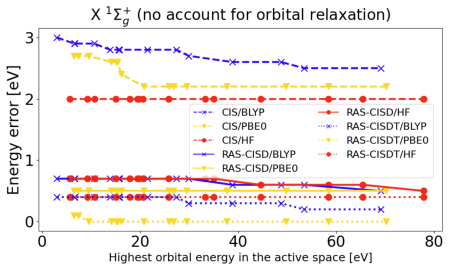
The paper establishes that switching the CI one-electron basis from Hartree-Fock to DFT orbitals improves how much correlation a truncated CI expansion captures. For CO2, RAS-CISD/DFT gives a valence excitation of 8.31 eV versus MRCI references of 8.27–8.29 eV, and the carbon K-edge excitation reaches 290.22 eV at its first plateau against experimental values of 290.61–290.74 eV. For N2, the valence state agrees with MRCI and spectroscopy within 0.1 eV once doubles are included, but the 1σu→1πg core excitation stays 2.3 eV above experiment. Core-excited states require orbital relaxation (fractional positive charge on the core orbitals); without it, CH4 core energies miss by about 10 eV.
Load-bearing premise
The CO2 core-excitation conclusion rests on the assumption that high-lying virtual orbitals mix in diffuse Rydberg-like states, so that the physically meaningful excitation energy is the first flat region of the convergence curve rather than the largest-active-space value.
Editorial extensions
If this is right
- RAS-CISD/DFT matches MRCI/MCSCF valence excitation energies within about 0.1 eV for CO2 and N2, suggesting a cheaper single-reference route to such states.
- Core-excited states require orbital relaxation via a fractional core charge; without it even weakly correlated CH4 is off by about 10 eV.
- Double excitations are essential for core-hole states in CO2 and N2; the DFT basis does not eliminate the need for doubles.
- For states with strong multi-reference character, such as the N2 core excitation, CI/DFT stays about 2.3 eV above experiment, so the method's reach is limited to dynamic-correlation-dominated states.
- In the full-CI limit, HF and DFT orbital bases produce identical energies, confirming that the advantage of CI/DFT is strictly a truncation effect.
Reading between the lines
- The first-plateau criterion used for the CO2 core excitation suggests a practical protocol: scan the active-space size and read the core excitation at the plateau before high-lying virtuals mix in Rydberg-like states; if this protocol generalizes, it would give a cheaper route to core binding energies. (Our inference, not stated as a general rule in the paper.)
- The near-equivalence of RAS-CISD/DFT and RAS-CISDT/HF for the CO2 valence state hints that a DFT basis may substitute for one excitation level in the CI hierarchy; a systematic test across more molecules would show how general this substitution is.
- Because CI/DFT produces explicit wavefunctions, not just energies, the same orbitals and Hamiltonian could be carried into time-dependent simulations of core-hole dynamics; the paper does not explore this, but its implementation is compatible with such extensions.
- For the N2 core state, the systematic overestimation may indicate that delocalized core orbitals plus DFT cannot reproduce the static correlation of the hole; a symmetry-broken fractional-charge localization might improve the energy without full CASSCF optimization, but this remains an untested variant.
Signed reviews
Editorial analysis
A structured set of objections, weighed in public.
Referee Report
Summary. The paper proposes a CI/DFT method in which configuration-interaction expansions are built from molecular orbitals generated by preliminary DFT calculations (BLYP, PBE0, B3LYP), using the full many-electron Hamiltonian and Slater–Condon matrix elements. After a LiH ground-state convergence test, the method is benchmarked on vertical excitation energies for CH4, CO2, and N2, covering both valence and core (C 1s, N 1s) excited states, with orbital relaxation modeled by fractional positive charges on core orbitals. The reported successes include valence states of CO2 (RAS-CISD/DFT: 8.31 eV vs MRCI 8.27–8.29 eV) and N2 (8.52 eV vs 8.45–8.48 eV), the CH4 core state with relaxed orbitals (287.04 eV vs 287.05–287.4 eV experiment), and the CO2 core state (290.22 eV vs 290.61–290.74 eV experiment, at a selected active-space plateau). The paper concludes that CI/DFT competes with MRCI/MCSCF for states with strong dynamic correlation but weak multireference character, while failing for the strongly multireference N2 core-hole state.
Significance. The valence-state benchmarks are a useful, reproducible demonstration that DFT orbitals can accelerate single-reference CI convergence: the CO2 and N2 valence results are within ~0.04–0.07 eV of high-level MRCI references, and the code is made available on GitHub. The core-excitation picture is more fragile. The paper's headline quantitative support for 'competing with MRCI' on core-excited CO2 rests on selecting a plateau in the active-space convergence (virtuals 15–30 eV) and discarding larger-active-space values that are ~1.3 eV higher. No diagnostic evidence is provided that the selected plateau state is the target 2σg→2πu state and that the discarded region is Rydberg-contaminated. The same Rydberg explanation is invoked for N2, where no plateau is found and the method fails by 2.3 eV. Without either diagnostics to confirm the plateau interpretation or a narrowing of the central claim, the core-excitation portion of the abstract is not yet established.
major comments (3)
- [§4.2, Fig. 7, Table 2] The reported CO2 core-excitation energy of 290.22 eV (RAS-CISD/DFT) is taken from the first active-space plateau (virtuals 15–30 eV). The largest-AS value is 291.92 eV, ~1.3 eV higher, and the paper rejects it as 'Rydberg-state contamination.' No diagnostic—⟨r²⟩, natural-orbital occupancies, state overlap, or oscillator strength—is provided to show the plateau state is the target 2σg→2πu state and the larger-AS state is a Rydberg admixture. Because the abstract's headline claim that CI/DFT 'competes with MRCI' for CO2 rests on this plateau value, the claim is currently an artifact of active-space truncation unless the attribution is substantiated. Please add diagnostics and, if they do not support the plateau, revise the claim.
- [§4.3, Fig. 9, Table 3] For N2 core excitation, the same Rydberg-mixing explanation is invoked after the energy rises with AS, but no plateau is selected and the best result is 2.3 eV above experiment. The different treatment of the two systems is not justified. In addition, the +2 fractional K-shell charge is selected as the minimum of a scan over +0 to +4; the physical one-hole state would be +1. This makes the N2 core result dependent on a target-informed parameter. Provide an a priori criterion for choosing the fractional charge and for identifying Rydberg contamination, or treat these results as indicative rather than benchmark.
- [Supporting Information, Table 5 and §4.2] The functional dependence of the CO2 plateau is not addressed. Table 5 reports a plateau value for RAS-CISD/PBE0 (290.346 eV) while the text states the plateau is absent for PBE0; and it reports a plateau for RAS-CISDT/HF (290.819 eV) although the main text says no plateau is observed in any CI/HF calculation. These inconsistencies, plus the fact that only some functionals/excitation levels show the plateau, make 'Rydberg contamination' look like a post hoc selection rule rather than a physical diagnostic. Please reconcile and test the plateau with state-character diagnostics.
minor comments (4)
- [Eq. (6)] The notation Vee(r−r′) should be Vee(|r−r′|) or the symbol should be defined; as written it is ambiguous.
- [References] References 35/36 and 38/39 are duplicate entries (Becke 1988; Lee–Yang–Parr 1988).
- [§4.3/Fig. 9] The acronym is written inconsistently as IS-GMPCT in the text and IS-GMCPT in the Fig. 9 caption.
- [Throughout] There are several typographical and spacing errors ('Inquantumchemistry', 'eigen-value', 'electronelectron'); a language pass would help.
Circularity Check
No significant circularity: all reported excitation energies are computed from the full Schrödinger Hamiltonian; the CO2 plateau and N2 +2-charge choices are documented convergence/scan decisions, not fitted predictions.
full rationale
The paper's derivation chain is self-contained in the relevant sense. CI/DFT builds a Hamiltonian matrix from Slater-Condon rules using DFT molecular orbitals, diagonalizes it, and compares the resulting excitation energies against literature MRCI and experimental data. No target quantity is defined in terms of an input, and no fitted parameter is renamed as a prediction. The central methodological choices that might look circular are the fractional core charges and the active-space truncations. For CH4 and CO2, the +1 fractional charge is a fixed physical modeling choice for core-hole relaxation; for N2, the +2 charge is selected as the minimum of an energy scan and still leaves a 2.3 eV error, so it cannot be a fit to experiment. The CO2 core excitation is reported both at the largest active space and at the first plateau; the plateau is a stated convergence feature, and the subsequent rise is attributed to Rydberg contamination. Whether that attribution is correct is a physical validity question, not a circularity: the plateau value is computed from the Hamiltonian, not imposed by the experimental target. There are no load-bearing self-citations, no imported uniqueness theorems, and no ansatz smuggled in via self-citation. The implementation is validated against closed-form CI/HF matrix elements, which is an independent check. Thus, despite the active-space-selection concerns, no step in the paper reduces by construction to its own inputs.
Assumptions & free parameters
free parameters (1)
- fractional K-shell charge for N2 core basis =
+2 (minimum of scan over 0 to +4)
assumptions (4)
- standard math Slater-Condon rules and the full Schrödinger Hamiltonian give the CI matrix elements for any orthonormal spin-orbital basis.
- domain assumption Kohn-Sham orbitals from BLYP/PBE0/B3LYP functionals form a valid orthonormal one-particle basis for the CI expansion.
- ad hoc to paper A fractionally charged SCF on the core orbitals reproduces the orbital relaxation of the core-hole state.
- ad hoc to paper In CO2 core-active-space convergence, the first plateau is the physical result and virtuals above 40 eV are Rydberg contamination.
Cite this review
Pith. "Pith review of Configuration-interaction calculations with density-functional theory molecular orbitals for modeling valence- and core-excited states in molecules." pith.science (2026). https://pith.science/paper/NV24K6YW
@misc{pith2026250908245,
  author       = {Pith},
  title        = {Pith review of: Configuration-interaction calculations with density-functional theory molecular orbitals for modeling valence- and core-excited states in molecules},
  year         = {2026},
  howpublished = {\url{https://pith.science/paper/NV24K6YW}},
  note         = {Machine review of arXiv:2509.08245}
}
read the original abstract
We investigate configuration-interaction (CI) calculations on a basis of molecular orbitals generated by preliminary density-functional theory (DFT) calculations. We use this CI/DFT framework to improve the modeling of core-excited states by exploiting the flexibility and account for electron correlation of DFT orbitals compared to the canonical Hartree-Fock analogs. We assess the performance of our approach on the valence- and core-excited electronic states of three molecules with increasing levels of electron-correlation complexity: the singly bonded CH4, doubly bonded CO2, and triply bonded N2. For molecules with strong electron correlation effects, such as CO2 and N2, the inclusion of double excitations is important to model the core-hole excited states with reasonable accuracy. CI/DFT outperforms standard single-reference CI on Hartree-Fock molecular orbitals and competes with multi-reference CI calculations with multi-configuration self-consistent field orbitals in the modeling of molecules with strong electron-correlation effects, but weak multi-reference nature of their wave function such as CO2. In contrast, the choice of the molecular-orbital basis is irrelevant when modeling systems with negligible electron-correlation effects like CH4 or important multi-reference nature of their wave function like N2.
Figures


Figures from the paper (12 more)



Reference graph
Works this paper leans on
-
[1]
Progress and Challenges in the Calculation of Electronic Excited States
Gonz\' a lez, L.; Escudero, D.; Serrano-Andr\' e s, L. Progress and Challenges in the Calculation of Electronic Excited States. ChemPhysChem 2012, 13, 28--51
work page 2012
-
[2]
Hermann, G.; Pohl, V.; Tremblay, J. C. An open-source framework for analyzing N-electron dynamics. II. Hybrid density functional theory/configuration interaction methodology. Journal of Computational Chemistry 2017, 38, 2378--2387
work page 2017
-
[3]
Klinker, M.; Marante, C.; Argenti, L.; González-Vázquez, J.; Martín, F. Electron Correlation in the Ionization Continuum of Molecules: Photoionization of N2 in the Vicinity of the Hopfield Series of Autoionizing States. The Journal of Physical Chemistry Letters 2018, 9, 756--762
work page 2018
-
[4]
Giri, S.; Dixit, G.; Tremblay, J. C. Attosecond charge migration in heterocyclic five-membered rings. The European Physical Journal Special Topics 2023, 232, 1935--1943
work page 2023
-
[5]
Travnikova, O. et al. Neutral Sulfur Atom Formation in Decay of Deep Core Holes in SF _ 6 . Phys. Rev. Lett. 2025, 134, 063003
work page 2025
-
[6]
Unger, I.; Seidel, R.; Thürmer, S.; Pohl, M. N.; Aziz, E. F.; Cederbaum, L. S.; Muchov\'a, E.; Slav\'i c ek, P.; Winter, B.; Kryzhevoi, N. V. Observation of electron-transfer-mediated decay in aqueous solution. Nature Chemistry 2017, 9, 708--714
work page 2017
-
[7]
Schlegel, H. B. Charge Migration in HCCI Cations Probed by Strong Field Ionization: Time-Dependent Configuration Interaction and Vibrational Wavepacket Simulations. The Journal of Physical Chemistry A 2023, 127, 6040--6050
work page 2023
-
[8]
Hamer, K. A.; Folorunso, A. S.; Lopata, K.; Schafer, K. J.; Gaarde, M. B.; Mauger, F. Tracking Charge Migration with Frequency-Matched Strobo-Spectroscopy. The Journal of Physical Chemistry A 2024, 128, 20--27
work page 2024
Show all 58 references
-
[9]
S.; Mauger, F.; Hamer, K
Folorunso, A. S.; Mauger, F.; Hamer, K. A.; Jayasinghe, D. D.; Wahyutama, I. S.; Ragains, J. R.; Jones, R. R.; DiMauro, L. F.; Gaarde, M. B.; Schafer, K. J.; Lopata, K. Attochemistry Regulation of Charge Migration. The Journal of Physical Chemistry A 2023, 127, 1894--1900
2023
-
[10]
A.; Mauger, F.; Lopata, K.; Schafer, K
Hamer, K. A.; Mauger, F.; Lopata, K.; Schafer, K. J.; Gaarde, M. B. Strong-field ionization with few-cycle, midinfrared laser pulses inducing a localized ionization followed by long-lasting charge migration in halogenated organic molecules. Phys. Rev. A 2025, 111, L011101
2025
-
[11]
S.; Hamer, K
Mauger, F.; Giri, S.; Folorunso, A. S.; Hamer, K. A.; Jayasinghe, D. D.; Lopata, K.; Schafer, K. J.; Gaarde, M. B. In Chapter One - Attosecond charge migration in organic molecules: Initiating and probing localized electron holes; Dimauro, L. F., Perrin, H., Yelin, S., Eds.; A...
2025
-
[12]
R.; Rousseau, P.; Maclot, S
Ganguly, S.; Gisselbrecht, M.; Eng-Johnsson, P.; Feifel, R.; D\'iaz-Tendero, S.; Muchov\'a, E.; Milosavljevi\'c, A. R.; Rousseau, P.; Maclot, S. Resonant Inner-Shell Photofragmentation of Adamantane (C10H16). Molecules 2023, 28, 5510
2023
-
[13]
C.; Muchov\'a, E.; Belina, M.; Buttersack, T.; Stemer, D.; Seidel, R.; Thürmer, S.; Slav\'i c ek, P.; Winter, B
Schewe, H. C.; Muchov\'a, E.; Belina, M.; Buttersack, T.; Stemer, D.; Seidel, R.; Thürmer, S.; Slav\'i c ek, P.; Winter, B. Observation of intermolecular Coulombic decay and shake-up satellites in liquid ammonia. Structural Dynamics 2022, 9, 044901
2022
-
[14]
Barletta, W. et al. Free electron lasers: Present status and future challenges. Nuclear Instruments and Methods in Physics Research Section A: Accelerators, Spectrometers, Detectors and Associated Equipment 2010, 618, 69--96
2010
-
[15]
Simulating X-ray Spectroscopies and Calculating Core-Excited States of Molecules
Norman, P.; Dreuw, A. Simulating X-ray Spectroscopies and Calculating Core-Excited States of Molecules. Chemical Reviews 2018, 118, 7208--7248
2018
-
[16]
X-Ray Photon Correlation Spectroscopy at the European X-Ray Free-Electron Laser (XFEL) facility
Grübel, G. X-Ray Photon Correlation Spectroscopy at the European X-Ray Free-Electron Laser (XFEL) facility. Comptes Rendus Physique 2008, 9, 668--680
2008
-
[17]
A.; Gilbert, A
Besley, N. A.; Gilbert, A. T. B.; Gill, P. M. W. Self-consistent-field calculations of core excited states. The Journal of Chemical Physics 2009, 130, 124308
2009
-
[18]
Analysis of self-interaction correction for describing core excited states
Imamura, Y.; Nakai, H. Analysis of self-interaction correction for describing core excited states. International Journal of Quantum Chemistry 2007, 107, 23--29
2007
-
[19]
S.; Schaefer, I., Henry F
Bagus, P. S.; Schaefer, I., Henry F. Direct Near‐Hartree–Fock Calculations on the 1s Hole States of NO+. The Journal of Chemical Physics 1971, 55, 1474--1475
1971
-
[20]
Gilbert, A. T. B.; Besley, N. A.; Gill, P. M. W. Self-Consistent Field Calculations of Excited States Using the Maximum Overlap Method (MOM). The Journal of Physical Chemistry A 2008, 112, 13164--13171
2008
-
[21]
D.; Li Manni, G.; Stoneburner, S
Vogiatzis, K. D.; Li Manni, G.; Stoneburner, S. J.; Ma, D.; Gagliardi, L. Systematic Expansion of Active Spaces beyond the CASSCF Limit: A GASSCF/SplitGAS Benchmark Study. Journal of Chemical Theory and Computation 2015, 11, 3010--3021
2015
-
[22]
Density functional calculations with configuration interaction for the excited states of molecules
Grimme, S. Density functional calculations with configuration interaction for the excited states of molecules. Chemical Physics Letters 1996, 259, 128--137
1996
-
[23]
S.; Schlegel, H
Durden, A. S.; Schlegel, H. B. Reducing the Cost of TD-CI Simulations of Strong Field Ionization. The Journal of Physical Chemistry A 2024, 128, 7440--7450
2024
-
[24]
I.; Olsen, J.; Argenti, L.; Chang, Z.; Itatani, J
Saito, N.; Douguet, N.; Sannohe, H.; Ishii, N.; Kanai, T.; Wu, Y.; Chew, A.; Han, S.; Schneider, B. I.; Olsen, J.; Argenti, L.; Chang, Z.; Itatani, J. Attosecond electronic dynamics of core-excited states of N _ 2 O in the soft x-ray region. Phys. Rev. Res. 2021, 3, 043222
2021
-
[25]
Configuration interaction method: the past and future perspectives
Duch, W. Configuration interaction method: the past and future perspectives. Journal of Molecular Structure: THEOCHEM 1991, 234, 27--49
1991
-
[26]
Parrish, R. M. et al. Psi4 1.1: An Open-Source Electronic Structure Program Emphasizing Automation, Advanced Libraries, and Interoperability. Journal of Chemical Theory and Computation 2017, 13, 3185--3197
2017
-
[27]
G.; M \"u ller, T.; Gidofalvi, G.; Lischka, H.; Shepard, R
Szalay, P. G.; M \"u ller, T.; Gidofalvi, G.; Lischka, H.; Shepard, R. Multiconfiguration Self-Consistent Field and Multireference Configuration Interaction Methods and Applications. Chemical Reviews 2012, 112, 108--181
2012
-
[28]
Szabo, A.; Ostlund, N. S. Modern Quantum Chemistry: Introduction to Advanced Electronic Structure Theory, 1st ed.; Dover Publications, Inc.: Mineola, 1996
1996
-
[29]
Slater, J. C. The Theory of Complex Spectra. Phys. Rev. 1929, 34, 1293--1322
1929
-
[30]
Condon, E. U. The Theory of Complex Spectra. Phys. Rev. 1930, 36, 1121--1133
1930
-
[31]
B.; Frisch,
Foresman, J. B.; Frisch, . Exploring Chemistry with Electronic Structure Methods, 2nd ed.; Gaussian, Inc.: Pittsburgh, PA, 1996
1996
-
[32]
Restricted active space configuration interaction methods for strong correlation: Recent developments
Casanova, D. Restricted active space configuration interaction methods for strong correlation: Recent developments. WIREs Computational Molecular Science 2022, 12, e1561
2022
-
[33]
GitHub repository for psiCI
Visentin, G.; Mauger, F. GitHub repository for psiCI. 2025; https://github.com/fmauger1/psiCI
2025
-
[34]
Becke, A. D. Density-functional exchange-energy approximation with correct asymptotic behavior. Phys. Rev. A 1988, 38, 3098--3100
1988
-
[35]
Lee, C.; Yang, W.; Parr, R. G. Development of the Colle-Salvetti correlation-energy formula into a functional of the electron density. Phys. Rev. B 1988, 37, 785--789
1988
-
[36]
Toward reliable density functional methods without adjustable parameters: The PBE0 model
Adamo, C.; Barone, V. Toward reliable density functional methods without adjustable parameters: The PBE0 model. The Journal of Chemical Physics 1999, 110, 6158--6170
1999
-
[37]
J.; Pople, J
Ditchfield, R.; Hehre, W. J.; Pople, J. A. Self‐Consistent Molecular‐Orbital Methods. IX. An Extended Gaussian‐Type Basis for Molecular‐Orbital Studies of Organic Molecules. The Journal of Chemical Physics 1971, 54, 724--728
1971
-
[38]
Dunning, T. H. Gaussian basis sets for use in correlated molecular calculations. I. The atoms boron through neon and hydrogen. J. Chem. Phys. 1989, 90, 1007--1023
1989
-
[39]
A.; Dunning, T
Kendall, R. A.; Dunning, T. H.; Harrison, R. J. Electron affinities of the first-row atoms revisited. Systematic basis sets and wave functions. J. Chem. Phys. 1992, 96, 6796--6806
1992
-
[40]
Winstead, C.; Sun, Q.; McKoy, V.; Lino, J. L. S.; Lima, M. A. P. Electronic excitation of CH4 by low‐energy electron impact. The Journal of Chemical Physics 1993, 98, 2132--2137
1993
-
[41]
J.; Lengsfield, B
Gil, T. J.; Lengsfield, B. H.; McCurdy, C. W.; Rescigno, T. N. Ab initio complex Kohn calculations of dissociative excitation of methane: Close-coupling convergence studies. Phys. Rev. A 1994, 49, 2551--2560
1994
-
[42]
L.; Bencsura, A.; Lendvay, G.; Schatz, G
Zi\'o kowski, M.; Vik\' a r, A.; Mayes, M. L.; Bencsura, A.; Lendvay, G.; Schatz, G. C. Modeling the electron-impact dissociation of methane. The Journal of Chemical Physics 2012, 137, 22A510
2012
-
[43]
Rydberg—valence mixing in the C 1s excited states of CH4 probed by electron spectroscopy
Ueda, K.; Okunishi, M.; Chiba, H.; Shimizu, Y.; Ohmori, K.; Sato, Y.; Shigemasa, E.; Kosugi, N. Rydberg—valence mixing in the C 1s excited states of CH4 probed by electron spectroscopy. Chemical Physics Letters 1995, 236, 311--317
1995
-
[44]
a ki, A.; Neeb, M.; Kempgens, B.; K\
Kivim\" a ki, A.; Neeb, M.; Kempgens, B.; K\" o ppe, H. M.; Bradshaw, A. M. The C 1s Auger decay spectrum of the molecule: the effects of vibrational fine structure, double excitations and shake-up transitions. Journal of Physics B: Atomic, Molecular and Optical Physics 1996, 29, 2701
1996
-
[45]
F.; Goddard, W
Winter, W.; Bender, C. F.; Goddard, W. A. Theoretical assignments of the low-lying electronic states of carbon dioxide. Chemical Physics Letters 1973, 20, 489--492
1973
-
[46]
J.; Rosmus, P.; Werner, H.-J
Knowles, P. J.; Rosmus, P.; Werner, H.-J. On the assignment of the electronically excited singlet states in linear CO2. Chemical Physics Letters 1988, 146, 230--235
1988
-
[47]
G.; Tyliszczak, T.; Hitchcock, A
Eustatiu, I. G.; Tyliszczak, T.; Hitchcock, A. P.; Turci, C. C.; Rocha, A. B.; Bielschowsky, C. E. Experimental and theoretical study of generalized oscillator strengths for C 1s and O 1s excitations in CO _ 2 . Phys. Rev. A 2000, 61, 042505
2000
-
[48]
J.; Sukhorukov, V
Antonsson, E.; Patanen, M.; Nicolas, C.; Benkoula, S.; Neville, J. J.; Sukhorukov, V. L.; Bozek, J. D.; Demekhin, P. V.; Miron, C. Dynamics of the C 1s ^ * excitation and decay in CO _ 2 probed by vibrationally and angularly resolved Auger spectroscopy. Phys. Rev. A 2015, 92, 042506
2015
-
[49]
M\" u ller, T.; Dallos, M.; Lischka, H.; Dubrovay, Z.; Szalay, P. G. A systematic theoretical investigation of the valence excited states of the diatomic molecules B2, C2, N2 and O2. Theoretical Chemistry Accounts 2001, 105, 227--243
2001
-
[50]
Lofthus, A.; Krupenie, P. H. The spectrum of molecular nitrogen. Journal of Physical and Chemical Reference Data 1977, 6, 113--307
1977
-
[51]
C.; Read, F
Tronc, M.; King, G. C.; Read, F. H. Nitrogen K-shell excitation in N2, NO and N2O by high-resolution electron energy-loss spectroscopy. Journal of Physics B: Atomic and Molecular Physics 1980, 13, 999
1980
-
[52]
C.; Read, F
King, G. C.; Read, F. H.; Tronc, M. Investigation of the energy and vibrational structure of the inner shell (1s)-1 ( 2 ) ^1 state of the nitrogen molecule by electron impact with high resolution. Chemical Physics Letters 1977, 52, 50--54
1977
-
[53]
N.; Orel, A
Rescigno, T. N.; Orel, A. E. Theoretical study of the 400 eV core‐excited valence states of N2. The Journal of Chemical Physics 1979, 70, 3390--3394
1979
-
[54]
Role of localization in the prediction of core ESCA lineshapes of N2, O2 and NO
Müller, J.; Ågren, H.; Goscinski, O. Role of localization in the prediction of core ESCA lineshapes of N2, O2 and NO. Chemical Physics 1979, 38, 349--359
1979
-
[55]
V.; Dobrodey, N
Kryzhevoi, N. V.; Dobrodey, N. V.; Cederbaum, L. S. Core-hole Hamiltonians and corrected equivalent core model for systems with equivalent atoms. The Journal of Chemical Physics 2003, 119, 12138--12152
2003
-
[56]
B.; de Moura, C
Rocha, A. B.; de Moura, C. E. V. The problem of hole localization in inner-shell states of N2 and CO2 revisited with complete active space self-consistent field approach. The Journal of Chemical Physics 2011, 135, 224112
2011
-
[57]
Sodhi, R. N. S.; Brion, C. E. Reference energies for inner shell electron energy-loss spectroscopy. Journal of Electron Spectroscopy and Related Phenomena 1984, 34, 363--372
1984
-
[58]
^"Bh FMLb Qјx- ر X VPP X y =;|>\> villl 5+ S\ (. r@q9 Q\ (. r@q9 Q\ (. r@q9 Q\ (. r@q9 Q\ (. r@q9 Q\ (. r@q9 Q\ (. r@q9 Q\ (. (3g- sN7^ )8cK +U ͚5+z ? |c3gN @ [))3ʟr>ל9s>SR>k֬R/
Ukai, T.; Nakata, K.; Yamanaka, S.; Takada, T.; and, K. Y. A CAS-DFT study of fundamental degenerate and nearly degenerate systems. Molecular Physics 2007, 105, 2667--2679 mcitethebibliography document ConvAS_A1Sigma_u_CO2_Err_MS.png00006640000000000000000002501122150601637130...
2007
Reviewed August 4, 2026 · model on record in the stance chip above.
Discussion (0). Continue with ORCID to comment.