REVIEW 3 major objections 4 minor 55 references
MML 48 is a young single-lined eclipsing binary with the most extreme mass ratio known among pre-main-sequence eclipsing binaries, and its primary is caught in the fusion bump.
Reviewed by Pith at T0; open to challenge. T0 means a machine referee read the full paper against a public rubric. the ladder, T0–T4 →
MML 48 is a newly characterized young eclipsing binary in Upper Centaurus Lupus with extreme mass ratio 0.209, whose primary is likely caught in the 3He fusion bump.
T0 review reviewed 2026-08-05 challenge →
load-bearing objection New extreme-ratio pre-main-sequence EB with careful observations, but the fusion-bump claim outruns the data. the 3 major comments →
Discovery of the pre-main-sequence eclipsing binary MML 48
The pith
A machine-rendered reading of the paper's core claim, the machinery that carries it, and where it could break.
The reading
Core claim
MML 48 is a single-lined eclipsing binary in Upper Centaurus Lupus, period 2.0171068 d. With only the primary visible, its mass is inferred by matching the measured temperature and temperature ratio to pre-main-sequence tracks at the cluster age of 16 ± 2 Myr, giving M1 = 1.2 ± 0.07 M☉; the mass function then yields M2 = 0.2509 ± 0.0078 M☉ and the most extreme mass ratio among young EBs, q = 0.209 ± 0.014. Eclipse modeling gives radii 1.574 and 0.587 R☉. The paper's discovery claim: the primary is in the 'fusion bump', its radius inflated by temporary energy over-production as 3He builds toward p-p I chain equilibrium.
What carries the argument
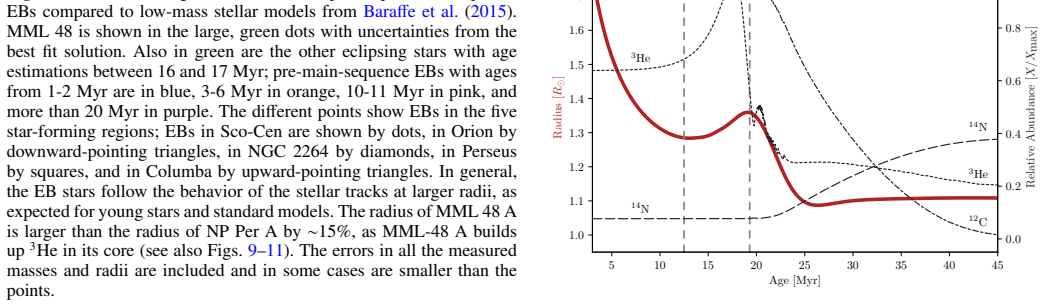
The load-bearing mechanism is the 'fusion bump' in pre-main-sequence evolution: 3He accumulates toward its equilibrium abundance in the proton-proton I chain, so nuclear energy production temporarily exceeds the rate the contracting core can absorb, and the envelope expands before the star settles on the main sequence. It is invoked to explain why MML 48 A's radius is ~15% larger than a same-age, similar-mass star like NP Per A and larger than 15-25 Myr isochrones. The analysis is carried by a single-lined eclipsing-binary model that turns the measured radial-velocity semi-amplitude, a model-dependent primary mass, and the eclipse light-curve geometry into the secondary mass, radii, inclinat
Load-bearing premise
The primary mass is not measured; it is inferred by matching temperature and temperature ratio to stellar-evolution tracks at the adopted cluster age of 16 ± 2 Myr, so any error in the models, the age, or the metallicity would shift the masses and the fusion-bump interpretation.
What would settle it
Take high-resolution infrared spectra during both quadratures and measure the secondary's absorption lines to get K2; combining K2 with the measured K1 gives both masses and the mass ratio directly, without stellar models. If those masses disagree with 1.2 + 0.25 M☉, the fusion-bump identification and the inferred age would need revision.
If this is right
- The inflated radius of MML 48 A makes the system a direct, age-sensitive test of the fusion-bump phase in pre-main-sequence models.
- With q = 0.209, the two stars sit on very different parts of the same isochrone, so the measured radii and temperatures jointly constrain the age of Upper Centaurus Lupus more tightly than a near-equal-mass binary could.
- MML 48 joins a short list of intermediate-age (15-25 Myr) low-mass pre-main-sequence eclipsing binaries, filling the mass-radius gap between 1-10 Myr and >20 Myr systems.
- The paper's comparison with magnetic models implies that standard models at the 16 Myr age cannot reproduce the primary's radius; direct, model-independent masses are needed before the physics can be settled.
Where Pith is reading between the lines
- Infrared spectroscopy could detect the secondary's absorption lines and yield a model-independent K2; one measurement would test the 1.2 + 0.25 M☉ solution and the fusion-bump claim.
- Because the bump's timing depends on initial helium abundance, other uneven-mass young binaries could map where the bump occurs in mass-age space and separate it from magnetic radius inflation.
- The spot-induced scatter in eclipse timings—larger than the formal errors and behind an eight-minute drift between WASP and TESS epochs—suggests active young binaries have a practical floor on orbital-period precision independent of photometric accuracy.
- If the bump interpretation is right, the radius excess over standard models around 15-25 Myr should peak near 1.0-1.2 M☉ and vanish by about 30 Myr, a pattern a broader sample of young eclipsing binaries could test.
Editorial analysis
A structured set of objections, weighed in public.
Referee Report
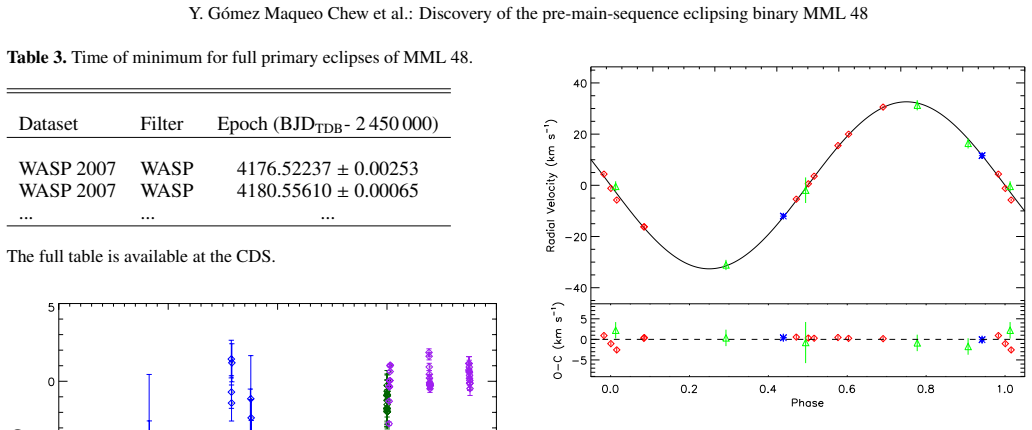
Summary. The paper reports the discovery and initial characterization of MML 48, a 2.017 day single-lined eclipsing binary in Upper Centaurus Lupus. Combining WASP, LCOGT, CTIO/SMARTS, CASLEO and TESS photometry with FEROS, CHIRON and SOAR spectroscopy, the authors derive an ephemeris, Teff1 = 5386 +/- 100 K, K1 = 32.86 +/- 0.33 km/s, and use Baraffe et al. (2015) tracks at the adopted UCL age of 16 +/- 2 Myr to obtain M1 = 1.2 +/- 0.07 Msun and hence M2 = 0.2509 +/- 0.0078 Msun and q = 0.209 +/- 0.014. A Phoebe light-curve fit gives R1 = 1.574 +/- 0.026 +/- 0.050 Rsun and R2 = 0.587 +/- 0.0095 +/- 0.050 Rsun. The authors conclude that MML 48 A is currently in the 'fusion bump' caused by 3He overproduction, the first such object found in an eclipsing system.
Significance. MML 48 is a potentially valuable addition to the sparse sample of intermediate-age pre-main-sequence eclipsing binaries: its extreme mass ratio and young age make it a useful anchor for isochrone tests, and the photometric and spectroscopic reductions are careful and well documented. The paper is honest about the SB1 limitation in the text and provides public light-curve tables. However, the headline mass and evolutionary-phase results are not direct measurements: M1 is a model-inferred quantity, and the fusion-bump classification is conditional on the same model family, age, and composition assumptions. These caveats must be reflected in the abstract and conclusions before the discovery claim is accepted at face value.
major comments (3)
- [Sect. 3.5, Fig. 7] M1 is not measured directly. It is the primary mass whose Baraffe et al. (2015) track reproduces the measured Teff1 and the EB temperature ratio at the adopted UCL age of 16 +/- 2 Myr. The quoted M1 = 1.2 +/- 0.07 Msun contains no term for the systematic uncertainty in the adopted cluster age, metallicity, or model family; Sect. 4 later shows that magnetic Dartmouth models require 20-22 Myr. Since M2 and q are propagated from M1 through the mass function (Sect. 3.4), the headline mass ratio 0.209 +/- 0.014 is not a purely empirical value. The paper should quote a model/age systematic term or explicitly label M1, M2, and q as model-dependent.
- [Abstract and Sect. 4, Figs. 9-11] The fusion-bump claim is not independently supported. The paper itself states that standard models at 17 Myr place the first bump at a higher mass than MML 48 A and that the magnetic models that reproduce the primary radius require ages of 20-22 Myr (Fig. 11). Thus whether MML 48 A is caught in the fusion bump depends on choosing non-magnetic standard tracks and the cluster age. The abstract's statement that MML 48 A is the first young star in an eclipsing system found during its fusion bump is stronger than the current evidence. Please reframe as a model-dependent interpretation and discuss sensitivity to age and model choice.
- [Sect. 3.6, Table 4] The radius systematic of +/-0.050 Rsun is introduced ad hoc so that all estimates of the primary star radius are consistent within their 1-sigma uncertainties. Since the enlarged primary radius is central to the fusion-bump interpretation, the source and derivation of this systematic should be justified quantitatively rather than presented as a reconciliation constant.
minor comments (4)
- [Table 1] The printed table header appears corrupted: the units row repeats the RV-table units (kms-1) under the BJD and delta-mag columns. Please correct the caption and the machine-readable version.
- [References] The Mamajek et al. (2002) entry has a typographical 'Aj' instead of 'AJ'.
- [Sect. 2.1.5 and 3.6] TESS light curves were excluded from the EB fit, and Johnson I was used as a proxy for the TESS passband. This is a reasonable choice, but the passband-mismatch and third-light systematics should be mentioned in the ephemeris error budget.
- [Sect. 4] The phrase 'higher mass stars in Sco-Cen suggest an age closer to 16 Myr' is not quantified in this paper; please add a reference or an explicit uncertainty so the age comparison is reproducible.
Circularity Check
No significant circularity; model dependence is acknowledged and the fusion-bump claim is a model-based interpretation tested against independent radius data, not a fitted quantity.
full rationale
The paper's derivation chain is not circular. M1 is not measured directly but is estimated in Sect. 3.5 by matching Teff,1 and the EB temperature ratio to Baraffe et al. (2015) tracks at the adopted UCL age; this is a model-dependent inference, not a tautology. The mass ratio and M2 then follow from the SB1 mass function (Sect. 3.4), and R1, R2, i, and Teff,2/Teff,1 come from independent Phoebe light-curve fits (Sect. 3.6). The 'fusion bump' claim is made in Sect. 4 by comparing the measured radius to model mass-radius tracks, i.e., an independent observable (radius) against a model prediction; it is not constructed from the same fitted value. The paper explicitly acknowledges the tension: standard 17 Myr models place the first bump at higher mass than MML 48 A, magnetic Dartmouth models require 20–22 Myr, and the authors state that model-independent masses are needed before further conclusions. That is model/age degeneracy and overstatement risk, not circular reduction. The self-citations used (Gómez Maqueo Chew et al. 2019 for MML 53; Feiden 2016 for magnetic models; Stassun et al. 2014 for the bump concept) are supported by independent published measurements or external physics, and they are not used to forbid alternatives. No fitted parameter is renamed as a prediction; no equation reduces to its input by construction.
Axiom & Free-Parameter Ledger
free parameters (4)
- Primary mass M1 =
1.2 ± 0.07 Msun
- Assumed UCL age =
16 ± 2 Myr
- TESS third-light values =
0.077, 0.064, 0.091
- Radius systematic uncertainty =
0.05 Rsun
axioms (4)
- domain assumption Baraffe et al. (2015) and Dartmouth/Feiden magnetic stellar models correctly predict PMS mass-temperature-radius-age relations.
- domain assumption Upper Centaurus Lupus has an age of 16 ± 2 Myr.
- domain assumption The secondary contributes negligible light, so a single-lined treatment is sufficient.
- domain assumption The orbit is circular.
Cite this review
Pith. "Pith review of Discovery of the pre-main-sequence eclipsing binary MML 48." pith.science (2026). https://pith.science/paper/NVDKKDR2
@misc{pith2026250903831,
  author       = {Pith},
  title        = {Pith review of: Discovery of the pre-main-sequence eclipsing binary MML 48},
  year         = {2026},
  howpublished = {\url{https://pith.science/paper/NVDKKDR2}},
  note         = {Machine review of arXiv:2509.03831}
}
read the original abstract
We present the discovery of the eclipsing binary MML 48, which is a member of Upper Centaurus Lupus, has an associated age of 16 Myr, and is composed of two young, low-mass stars. We used space- and ground-based observations to characterize the system with both time-series photometry and spectroscopy. Given the extreme mass ratio between the stars, q_EB = 0.209 +- 0.014, we modeled a single-lined spectroscopic and eclipsing binary system. The orbital period, 2.0171068 +- 0.0000004 d, is measured from the highest precision light curves. We derive a primary mass of 1.2 +- 0.07 Msun using stellar models, and with radial velocities we measured a secondary mass of 0.2509 +- 0.0078 Msun. The radii are large, as expected for pre-main-sequence stars, and are measured as 1.574 +- 0.026 +- 0.050 Rsun and 0.587 +- 0.0095 +- 0.050 Rsun, for the primary and secondary stars, respectively. MML 48 joins the short list of known low-mass, pre-main-sequence eclipsing binaries (EBs), being one of only five systems with intermediate ages (15-25 Myr), and the system with the most extreme mass ratio. The primary star is currently at the "fusion bump", undergoing an over-production of energy in the core due to the build-up of 3He before reaching its equilibrium abundance set by the proton-proton (p-p) I chain. MML 48 A is the first young star in an eclipsing system that has been found during its fusion bump. MML 48 is thus an important benchmark for low-mass stellar evolution at a time when the stars are rapidly changing, which allows for a tight constraint on the corresponding isochrone given the uneven mass ratio.
Figures





Reference graph
Works this paper leans on
-
[1]
Alonso, R., Deeg, H. J., Hoyer, S., et al. 2015, Astronomy & Astrophysics, 584, L8
work page 2015
- [2]
- [3]
-
[4]
2015, A&A, 577, A42
Baraffe, I., Homeier, D., Allard, F., & Chabrier, G. 2015, A&A, 577, A42
2015
-
[5]
& Baraffe, I
Chabrier, G. & Baraffe, I. 1997, A&A, 327, 1039
1997
- [6]
-
[7]
Clayton, D. D. 1968, Principles of stellar evolution and nucleosynthesis
work page 1968
-
[8]
Clemens, J. C., Crain, J. A., & Anderson, R. 2004, in Society of Photo-Optical Instrumentation Engineers (SPIE) Conference Series, V ol. 5492, Ground- based Instrumentation for Astronomy, ed. A. F. M. Moorwood & M. Iye, 331–340 Collier Cameron, A., Pollacco, D., Street, R. A., et al. 2006, MNRAS, 373, 799
work page 2004
-
[9]
A., Kielkopf, J
Collins, K. A., Kielkopf, J. F., Stassun, K. G., & Hessman, F. V . 2017, AJ, 153, 77
2017
-
[10]
M., Paladino, R., & Sterzik, M
Covino, E., Frasca, A., Alcalá, J. M., Paladino, R., & Sterzik, M. F. 2004, As- tronomy, 649, 637
work page 2004
-
[11]
Davenport, J. R. A., Hebb, L., & Hawley, S. L. 2015, ApJ, 806, 212
work page 2015
-
[12]
David, T. J., Hillenbrand, L. A., Cody, A. M., Carpenter, J. M., & Howard, A. W. 2016, ApJ, 816, 21
work page 2016
-
[13]
David, T. J., Hillenbrand, L. A., Gillen, E., et al. 2019, ApJ, 872, 161
work page 2019
-
[14]
D., Rees, D
Donati, J.-F., Semel, M., Carter, B. D., Rees, D. E., & Collier Cameron, A. 1997, MNRAS, 291, 658
1997
-
[15]
2008, ApJS, 178, 89
Dotter, A., Chaboyer, B., Jevremovi´c, D., et al. 2008, ApJS, 178, 89
2008
-
[16]
Enoch, B., Collier Cameron, A., Parley, N. R., & Hebb, L. 2010, A&A, 516, A33
work page 2010
-
[17]
Feiden, G. A. 2016, A&A, 593, A99
work page 2016
-
[18]
Fulton, B. J., Petigura, E. A., Blunt, S., & Sinukoff, E. 2018, PASP, 130, 044504 Gaia Collaboration, Prusti, T., de Bruijne, J. H. J., et al. 2016, A&A, 595, A1 Gaia Collaboration, Vallenari, A., Brown, A. G. A., et al. 2023, A&A, 674, A1
work page 2018
-
[19]
Gillen, E., Aigrain, S., McQuillan, A., et al. 2014, A&A, 562, A50
work page 2014
-
[20]
Gillen, E., Hillenbrand, L. A., Stauffer, J., et al. 2020, MNRAS, 495, 1531 Gómez Maqueo Chew, Y ., Hebb, L., Stempels, H. C., et al. 2019, A&A, 623, A23 Gómez Maqueo Chew, Y ., Stassun, K. G., Prša, A., & Mathieu, R. D. 2009, The Astrophysical Journal, 699, 1196 Gómez Maqueo Chew, Y ., Stassun, K. G., Prša, A., et al. 2012, The Astrophysi- cal Journal, 745, 58
work page 2020
-
[21]
Hebb, L., Collier-Cameron, A., Loeillet, B., et al. 2009, ApJ, 693, 1920
work page 2009
-
[22]
Hebb, L., Collier-Cameron, A., Triaud, A. H. M. J., et al. 2010, ApJ, 708, 224
work page 2010
-
[23]
J., Jao, W.-C., Winters, J
Henry, T. J., Jao, W.-C., Winters, J. G., et al. 2018, AJ, 155, 265
2018
-
[24]
Howell, S. B. 1989, PASP, 101, 616
work page 1989
-
[25]
Irwin, J., Aigrain, S., Hodgkin, S., et al. 2007, MNRAS, 380, 541
work page 2007
- [26]
-
[27]
Kallrath, J. & Milone, E. F. 2009, Eclipsing Binary Stars: Modeling and Analysis
work page 2009
-
[28]
Kounkel, M. & Stassun, K. 2024, AJ, 168, 134 Kovács, G., Zucker, S., & Mazeh, T. 2002, A&A, 391, 369
work page 2024
-
[29]
Lacy, C. H. S., Fekel, F. C., Pavlovski, K., Torres, G., & Muterspaugh, M. W. 2016, AJ, 152, 2 Lightkurve Collaboration, Cardoso, J. V . d. M., Hedges, C., et al. 2018, Lightkurve: Kepler and TESS time series analysis in Python, Astrophysics Source Code Library
work page 2016
-
[30]
Lucy, L. B. & Sweeney, M. A. 1971, AJ, 76, 544
work page 1971
- [31]
-
[32]
Murphy, S. J., Lawson, W. A., Onken, C. A., et al. 2020, MNRAS, 491, 4902
work page 2020
-
[33]
Paegert, M., Stassun, K. G., Collins, K. A., et al. 2021, arXiv e-prints, arXiv:2108.04778
Pith/arXiv arXiv 2021
-
[34]
Pecaut, M. J. & Mamajek, E. E. 2016, MNRAS, 461, 794
work page 2016
-
[35]
Pecaut, M. J., Mamajek, E. E., & Bubar, E. J. 2012, The Astrophysical Journal, 746, 154
work page 2012
-
[36]
Petrucci, R. & Jofré, J. E. 2016, Boletin de la Asociacion Argentina de Astrono- mia La Plata Argentina, 58, 298
work page 2016
-
[37]
Piskunov, N. E. & Valenti, J. A. 2002, A&A, 385, 1095
2002
-
[38]
L., Skillen, I., Collier Cameron, A., et al
Pollacco, D. L., Skillen, I., Collier Cameron, A., et al. 2006, PASP, 118, 1407 Prša, A., Harmanec, P., Torres, G., et al. 2016, AJ, 152, 41 Prša, A. & Zwitter, T. 2005, ApJ, 628, 426 Ruci´nski, S. M. 1969, Acta Astron., 19, 245 Article number, page 12 of 13 Y . Gómez Maqueo Chew et al.: Discovery of the pre-main-sequence eclipsing binary MML 48
work page 2006
-
[39]
Schwab, C., Spronck, J. F. P., Tokovinin, A., et al. 2012, in Society of Photo- Optical Instrumentation Engineers (SPIE) Conference Series, V ol. 8446, Ground-based and Airborne Instrumentation for Astronomy IV , 84460B
work page 2012
-
[40]
Southworth, J., Bruntt, H., & Buzasi, D. L. 2007, A&A, 467, 1215
work page 2007
- [41]
-
[42]
Stassun, K. G., Mathieu, R. D., Vaz, L. P. R., Stroud, N., & Vrba, F. J. 2004, ApJS, 151, 357
work page 2004
-
[43]
G., Torres, G., Kounkel, M., et al
Stassun, K. G., Torres, G., Kounkel, M., et al. 2022, ApJ, 941, 125
work page 2022
-
[44]
Stempels, H. C., Hebb, L., Stassun, K. G., et al. 2008, A&A, 481, 747
work page 2008
-
[45]
Stetson, P. B. 1990, PASP, 102, 932
work page 1990
-
[46]
2008, in Astronomical Society of the Pacific Conference Series, V ol
Stoehr, F., White, R., Smith, M., et al. 2008, in Astronomical Society of the Pacific Conference Series, V ol. 394, Astronomical Data Analysis Software and Systems XVII, ed. R. W. Argyle, P. S. Bunclark, & J. R. Lewis, 505
work page 2008
-
[47]
Tofflemire, B. M., Kraus, A. L., Mann, A. W., et al. 2022, arXiv e-prints, arXiv:2210.10789
work page internal anchor Pith review Pith/arXiv arXiv 2022
-
[48]
Tokovinin, A., Fischer, D. A., Bonati, M., et al. 2013, PASP, 125, 1336
work page 2013
-
[49]
2021, Research Notes of the American Astronomical Society, 5, 256
Torres, G. 2021, Research Notes of the American Astronomical Society, 5, 256
work page 2021
-
[50]
Torres, G., Andersen, J., & Giménez, A. 2010, A&A Rev., 18, 67
work page 2010
-
[51]
Valenti, J. A. & Piskunov, N. 1996, A&AS, 118, 595 Walter. 2018, An Alternative Scheme for Chiron Fiber and Slicer Mode Data Reductions, http://www.astro.sunysb.edu/fwalter/SMARTS/ CHIRON/ch_reduce.pdf, accessed: 2024-03-29
work page 1996
-
[52]
Watson, C. A. & Dhillon, V . S. 2004, MNRAS, 351, 110
work page 2004
-
[53]
Wright, N. J. & Mamajek, E. E. 2018, MNRAS, 476, 381
work page 2018
-
[54]
1977, A&A, 57, 383
Zahn, J.-P. 1977, A&A, 57, 383
1977
-
[55]
Zahn, J. P. & Bouchet, L. 1989, A&A, 223, 112 Article number, page 13 of 13
work page 1989
This paper was first reviewed by deepseek-v4-flash on August 5, 2026.
discussion (0)
Sign in with ORCID, Apple, or X to comment. Anyone can read and Pith papers without signing in.