Shallow Unitary Circuits for Kramers-Wannier Dualities
Pith reviewed 2026-07-03 12:59 UTC · model grok-4.3
The pith
Logarithmic depth nonlocal unitary circuits realize exact Z2 Kramers-Wannier dualities in one and two dimensions.
A machine-rendered reading of the paper's core claim, the machinery that carries it, and where it could break.
Core claim
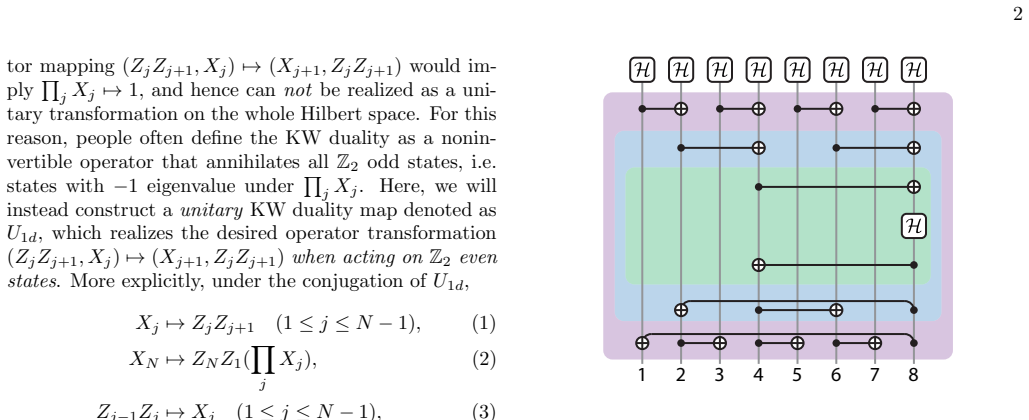
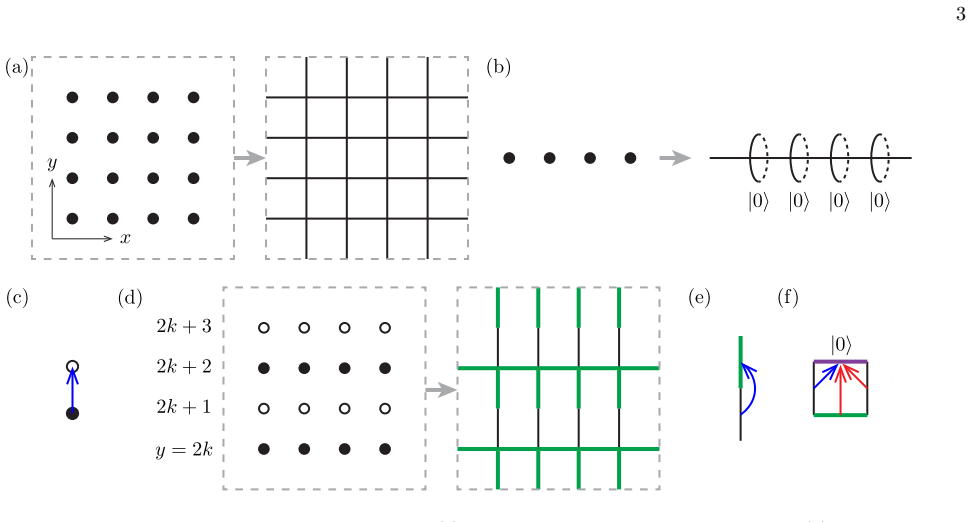
Explicit constructions of logarithmic-depth, spatially nonlocal unitary circuits realize the exact Z2 KW dualities in both one and two spatial dimensions and generalize to arbitrary Zn. Within the symmetric sector these circuits map arbitrary non-fixed-point short-range entangled states to their corresponding long-range entangled duals, implementing complete duality transformations rather than preparing specific states.
What carries the argument
Spatially nonlocal unitary circuits of logarithmic depth that implement the complete KW duality maps.
If this is right
- The duality transformation can be performed in logarithmic rather than linear depth.
- Arbitrary non-fixed-point SRE states are mapped exactly to LRE duals inside the symmetric sector.
- A coherent pathway exists for exploring phase transitions and topological dualities on quantum hardware.
- The same circuit style extends directly to Zn KW dualities.
Where Pith is reading between the lines
- Platforms supporting native long-range gates could run duality-based simulations in much shorter time than local circuits allow.
- Analogous log-depth constructions may exist for other symmetry or duality maps in many-body systems.
- Small-system experiments could directly test the mapping by preparing an SRE state and measuring entanglement growth after circuit execution.
Load-bearing premise
Nonlocal connectivity is available on the platform and the circuits remain exact when restricted to the symmetric sector for arbitrary SRE inputs.
What would settle it
Apply the constructed circuit to a product state (an SRE input) and verify whether the output exhibits the long-range entanglement signature required by the dual LRE state.
Figures
read the original abstract
The quantum Kramers-Wannier (KW) duality is a fundamental transformation mapping short-range entangled (SRE) states to long-range entangled (LRE) states. While spatially local unitary circuits require linear-in-system-size depth to implement this duality, the ultimate speed limit for purely unitary circuits equipped with nonlocal connectivity remains an open question. Here, we explicitly construct logarithmic depth, spatially nonlocal unitary circuits that realize the exact $\mathbb{Z}_2$ KW dualities in both one and two spatial dimensions. We further generalize the construction to arbitrary $\mathbb{Z}_n$ KW dualities. Unlike algorithms tailored to prepare specific target states, our circuits implement complete duality maps. Within the symmetric (charge-neutral) sector, these dualities exactly transform arbitrary non-fixed-point SRE states into their corresponding LRE duals. Consequently, our results establish an efficient, purely coherent pathway for exploring phase transitions and topological dualities on modern quantum platforms.
Editorial analysis
A structured set of objections, weighed in public.
Referee Report
Summary. The manuscript claims to explicitly construct logarithmic-depth, spatially nonlocal unitary circuits realizing the exact Z_2 Kramers-Wannier dualities in one and two spatial dimensions, with a generalization to arbitrary Z_n. These circuits are asserted to implement complete duality maps that, restricted to the symmetric (charge-neutral) sector, exactly transform arbitrary non-fixed-point short-range entangled (SRE) states into their long-range entangled (LRE) duals.
Significance. If the constructions and exactness claims hold, the work establishes an efficient, purely unitary and coherent route to duality maps beyond fixed-point states, which could enable direct exploration of phase transitions and topological dualities on quantum hardware supporting nonlocal connectivity. The log-depth scaling and complete-map property (as opposed to state-preparation algorithms) represent a clear technical advance over linear-depth local-circuit approaches.
minor comments (3)
- The abstract and introduction would benefit from a brief statement of the assumed gate set (e.g., whether arbitrary two-qubit gates or a specific universal set is used) and the precise notion of 'spatially nonlocal' (e.g., all-to-all vs. limited-range long-range interactions).
- Figure captions and circuit diagrams (presumably in §§3–4) should explicitly label the depth scaling and confirm that the circuits remain exact when restricted to the symmetric subspace for generic SRE inputs, not merely for fixed-point states.
- A short discussion of the overhead in the symmetric-sector projection (if any) and how the construction avoids leakage outside the charge-neutral sector would improve clarity for experimental implementation.
Simulated Author's Rebuttal
We thank the referee for the positive assessment of our work and the recommendation of minor revision. The provided summary correctly captures the central claims regarding the construction of logarithmic-depth nonlocal unitary circuits for exact Z_2 and Z_n Kramers-Wannier dualities.
Circularity Check
Explicit construction; no circularity detected
full rationale
The paper's central claim is an explicit construction of log-depth nonlocal unitary circuits realizing exact Z2 (and Zn) KW dualities on the symmetric sector. No fitted parameters, no predictions derived from data subsets, and no load-bearing self-citations or ansatzes imported from prior author work appear in the provided abstract or description. The derivation is self-contained as a direct circuit design rather than a reduction to its own inputs or external self-referential theorems.
Axiom & Free-Parameter Ledger
Reference graph
Works this paper leans on
-
[1]
Fracton Topological Order, Generalized Lattice Gauge Theory and Duality
S. Vijay, J. Haah, and L. Fu, Fracton topological order, generalized lattice gauge theory, and duality, Phys. Rev. B94, 235157 (2016), arXiv:1603.04442 [cond-mat.str-el]
work page internal anchor Pith review Pith/arXiv arXiv 2016
-
[2]
J. B. Kogut, An introduction to lattice gauge theory and spin systems, Rev. Mod. Phys.51, 659 (1979)
1979
-
[3]
Bravyi, M
S. Bravyi, M. B. Hastings, and F. Verstraete, Lieb- robinson bounds and the generation of correlations and topological quantum order, Phys. Rev. Lett.97, 050401 (2006)
2006
- [4]
-
[5]
N. Tantivasadakarn, R. Thorngren, A. Vishwanath, and R. Verresen, Long-range entanglement from mea- suring symmetry-protected topological phases, arXiv e-prints , arXiv:2112.01519 (2021), arXiv:2112.01519 [cond-mat.str-el]
- [6]
-
[7]
N. Tantivasadakarn, A. Vishwanath, and R. Verresen, Hierarchy of Topological Order From Finite-Depth Uni- taries, Measurement, and Feedforward, PRX Quantum 4, 020339 (2023), arXiv:2209.06202 [quant-ph]
-
[8]
L. Lootens, C. Delcamp, D. Williamson, and F. Ver- straete, Low-Depth Unitary Quantum Circuits for Duali- ties in One-Dimensional Quantum Lattice Models, Phys. Rev. Lett.134, 130403 (2025), arXiv:2311.01439 [quant- ph]
-
[9]
Barredo, S
D. Barredo, S. de L´ es´ eleuc, V. Lienhard, T. Lahaye, and A. Browaeys, An atom-by-atom assembler of defect-free arbitrary two-dimensional atomic arrays, Science354, 1021 (2016)
2016
-
[10]
Labuhn, D
H. Labuhn, D. Barredo, S. Ravets, S. de L´ es´ eleuc, T. Macr` ı, T. Lahaye, and A. Browaeys, Tunable two- dimensional arrays of single rydberg atoms for realizing quantum ising models, Nature534, 667 (2016)
2016
-
[11]
Bernien, S
H. Bernien, S. Schwartz, A. Keesling, H. Levine, A. Om- ran, H. Pichler, S. Choi, A. S. Zibrov, M. Endres, M. Greiner, V. Vuleti´ c, and M. D. Lukin, Probing many- body dynamics on a 51-atom quantum simulator, Nature 551, 579 (2017)
2017
-
[12]
S. J. Evered, D. Bluvstein, M. Kalinowski, S. Ebadi, T. Manovitz, H. Zhou, S. H. Li, A. A. Geim, T. T. Wang, N. Maskara, H. Levine, G. Semeghini, M. Greiner, V. Vuleti´ c, and M. D. Lukin, High-fidelity parallel entan- gling gates on a neutral-atom quantum computer, Nature 622, 268 (2023)
2023
-
[13]
Pichard, D
G. Pichard, D. Lim, E. Bloch, J. Vaneecloo, L. Boura- chot, G.-J. Both, G. M´ eriaux, S. Dutartre, R. Hostein, J. Paris, B. Ximenez, A. Signoles, A. Browaeys, T. La- haye, and D. Dreon, Rearrangement of individual atoms in a 2000-site optical-tweezer array at cryogenic temper- atures, Phys. Rev. Appl.22, 024073 (2024)
2000
-
[14]
Bluvstein, S
D. Bluvstein, S. J. Evered, A. A. Geim, S. H. Li, H. Zhou, T. Manovitz, S. Ebadi, M. Cain, M. Kali- nowski, D. Hangleiter, J. P. Bonilla Ataides, N. Maskara, I. Cong, X. Gao, P. Sales Rodriguez, T. Karolyshyn, G. Semeghini, M. J. Gullans, M. Greiner, V. Vuleti´ c, and M. D. Lukin, Logical quantum processor based on reconfigurable atom arrays, Nature626, 58 (2024)
2024
-
[15]
Q. Xu, J. P. Bonilla Ataides, C. A. Pattison, N. Raveen- dran, D. Bluvstein, J. Wurtz, B. Vasi´ c, M. D. Lukin, L. Jiang, and H. Zhou, Constant-overhead fault-tolerant quantum computation with reconfigurable atom arrays, Nature Physics20, 1084 (2024)
2024
-
[16]
Bluvstein, A
D. Bluvstein, A. A. Geim, S. H. Li, S. J. Evered, J. P. Bonilla Ataides, G. Baranes, A. Gu, T. Manovitz, M. Xu, M. Kalinowski, S. Majidy, C. Kokail, N. Maskara, E. C. Trapp, L. M. Stewart, S. Hollerith, H. Zhou, M. J. Gullans, S. F. Yelin, M. Greiner, V. Vuleti´ c, M. Cain, and M. D. Lukin, A fault-tolerant neutral-atom architec- ture for universal quantu...
2026
-
[17]
J. M. Pino, J. M. Dreiling, C. Figgatt, J. P. Gaebler, S. A. Moses, M. S. Allman, C. H. Baldwin, M. Foss-Feig, D. Hayes, K. Mayer, C. Ryan-Anderson, and B. Neyen- huis, Demonstration of the trapped-ion quantum ccd computer architecture, Nature592, 209 (2021)
2021
-
[18]
S. A. Moses, C. H. Baldwin, M. S. Allman, R. An- cona, L. Ascarrunz, C. Barnes, J. Bartolotta, B. Bjork, P. Blanchard, M. Bohn, J. G. Bohnet, N. C. Brown, N. Q. Burdick, W. C. Burton, S. L. Campbell, J. P. Campora, C. Carron, J. Chambers, J. W. Chan, Y. H. Chen, A. Chernoguzov, E. Chertkov, J. Colina, J. P. Curtis, R. Daniel, M. DeCross, D. Deen, C. Delan...
2023
-
[19]
Quantum Circuits with Mixed States
D. Aharonov, A. Kitaev, and N. Nisan, Quantum Circuits with Mixed States, arXiv e-prints , quant-ph/9806029 (1998), arXiv:quant-ph/9806029 [quant-ph]
work page internal anchor Pith review Pith/arXiv arXiv 1998
- [20]
-
[21]
Quantum Circuit Depth Lower Bounds For Homological Codes
D. Aharonov and Y. Touati, Quantum Circuit Depth Lower Bounds For Homological Codes, arXiv e-prints , arXiv:1810.03912 (2018), arXiv:1810.03912 [quant-ph]
work page internal anchor Pith review Pith/arXiv arXiv 2018
-
[22]
D. Cruz, R. Fournier, F. Gremion, A. Jeannerot, K. Komagata, T. Tosic, J. Thiesbrummel, C. L. Chan, N. Macris, M.-A. Dupertuis, and C. Javerzac-Galy, Ef- ficient quantum algorithms forGHZandWstates, and implementation on the IBM quantum computer, arXiv e-prints , arXiv:1807.05572 (2018), arXiv:1807.05572 [quant-ph]
work page internal anchor Pith review Pith/arXiv arXiv 2018
-
[23]
C. Moore and M. Nilsson, Parallel Quantum Compu- tation and Quantum Codes, arXiv e-prints , quant- ph/9808027 (1998), arXiv:quant-ph/9808027 [quant-ph]
-
[24]
A class of quantum many-body states that can be efficiently simulated
G. Vidal, Class of Quantum Many-Body States That Can Be Efficiently Simulated, Phys. Rev. Lett.101, 110501 (2008), arXiv:quant-ph/0610099 [quant-ph]
work page internal anchor Pith review Pith/arXiv arXiv 2008
-
[25]
Entanglement renormalization and topological order
M. Aguado and G. Vidal, Entanglement Renormaliza- tion and Topological Order, Phys. Rev. Lett.100, 070404 (2008), arXiv:0712.0348 [cond-mat.str-el]
work page internal anchor Pith review Pith/arXiv arXiv 2008
-
[26]
Exact entanglement renormalization for string-net models
R. K¨ onig, B. W. Reichardt, and G. Vidal, Exact entangle- ment renormalization for string-net models, Phys. Rev. B79, 195123 (2009), arXiv:0806.4583 [cond-mat.str-el]
work page internal anchor Pith review Pith/arXiv arXiv 2009
-
[27]
Entanglement renormalization and wavelets
G. Evenbly and S. R. White, Entanglement Renormaliza- tion and Wavelets, Phys. Rev. Lett.116, 140403 (2016), arXiv:1602.01166 [cond-mat.str-el]
work page internal anchor Pith review Pith/arXiv arXiv 2016
-
[28]
Rigorous free fermion entanglement renormalization from wavelet theory
J. Haegeman, B. Swingle, M. Walter, J. Cotler, G. Even- bly, and V. B. Scholz, Rigorous Free-Fermion Entan- glement Renormalization from Wavelet Theory, Physical Review X8, 011003 (2018), arXiv:1707.06243 [quant-ph]
work page internal anchor Pith review Pith/arXiv arXiv 2018
-
[29]
We say that an operatorOtransforms asO7→O ′ under a linear mapfiff O=O ′f
- [30]
-
[31]
Coupled-Layer Construction of Quantum Product Codes
S. Zhang, T.-C. Wei, and N. Tantivasadakarn, Coupled- Layer Construction of Quantum Product Codes, arXiv e-prints , arXiv:2603.08711 (2026), arXiv:2603.08711 [quant-ph]
work page internal anchor Pith review Pith/arXiv arXiv 2026
-
[32]
Constructing Bulk Topological Orders via Layered Gauging
S. Liu, Constructing Bulk Topological Orders via Lay- ered Gauging, arXiv e-prints , arXiv:2604.27363 (2026), arXiv:2604.27363 [cond-mat.str-el]
work page internal anchor Pith review Pith/arXiv arXiv 2026
discussion (0)
Sign in with ORCID, Apple, or X to comment. Anyone can read and Pith papers without signing in.