REVIEW 6 minor 48 references
Synthesis imaging with a lunar orbit array: I. global sky map and its systematics
T0 review · 0 major / 6 minor · reviewed 2026-08-03 · deepseek-v4-flash
Pith's one-line read This paper establishes that a lunar-orbit radio interferometer can reconstruct an all-sky map at 0.1–30 MHz, provided the beam matrix is built by pixel-averaging instead of point sampling, and that with Tikhonov regularization tuned by a tr
desk verdict Pixel-averaging fix for lunar-array aliasing is credible; the paper's own idealized-array caveats mean 'well reconstructed' should be read narrowly. read the letter →
The pith
A machine-rendered reading of the paper's core claim, the machinery that carries it, and where it could break.
The reading
What carries the argument
The beam matrix B, whose entry B_{αβ} is the response of baseline-time sample α to sky pixel β (shading, beam, fringe phase, and pixel area). The paper's key move is computing B at high resolution (Nside=1024) and downgrading to Nside=64 by averaging, which is equivalent to convolving the sky with a pixel-shape window. The inversion then uses Tikhonov regularization, adding εI to the dirty beam B^T N^{-1}B; error is quantified by the effective beam B_eff = (B^T N^{-1}B+εI)^{-1} B^T N^{-1}B, with traces giving thermal-noise and beam-imperfection estimators, and by the scale-dependent correlation coefficient ρ_l and SNR_l.
What would settle it
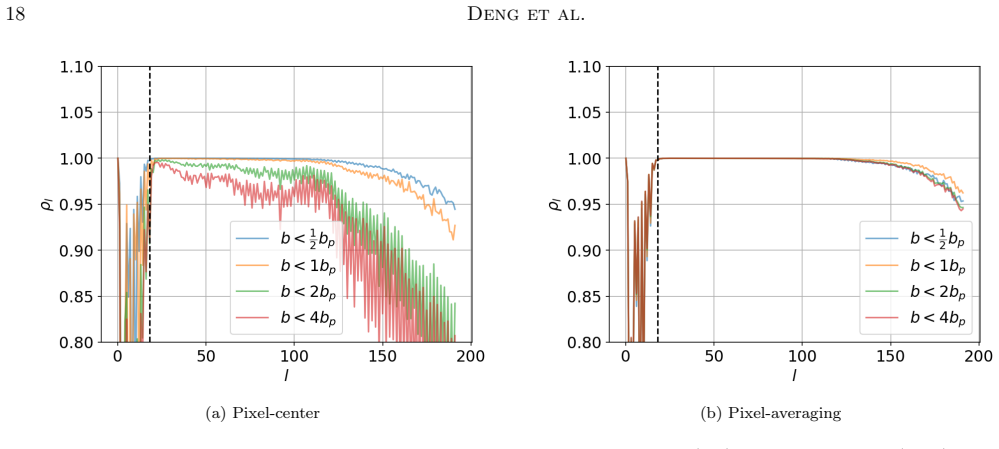
Take a mock observation with a high-resolution sky model (Nside=1024) and reconstruct at Nside=64 using both pixel-center and pixel-averaging beam matrices. If the pixel-averaged ρ_l drops well below 1 for l between 18 and 130 when including baselines b<4bp, the claimed mitigation is false. In flight, the equivalent test is whether known point sources appear at correct positions and fluxes in the reconstructed all-sky map.
Extended reading notes
Core claim
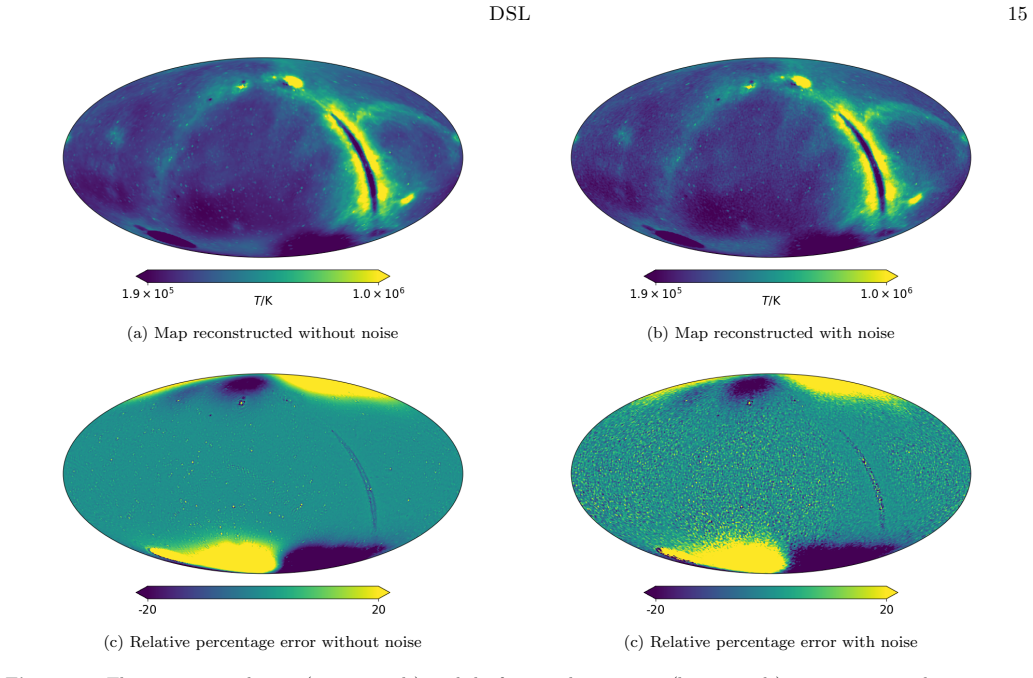
The central claim is that the linear inversion from visibilities V=BT to sky T works for the DSL array if B is computed by pixel-averaging. Naively evaluating B at pixel centers creates strong aliasing—the correlation coefficient ρ_l between input and reconstructed maps drops well below 1—when baselines b>bp≈λ/θ_p are included. The pixel-averaging method keeps ρ_l close to 1 for l≲130 even with b up to 4bp, and the authors adopt b<2bp as sufficient. With this method, a 10 MHz map reconstructed with ε=10^-4 shows small errors outside the polar regions; at 3 MHz the reconstruction is better because more baselines satisfy b<2bp. The polar regions are systematically darkened because the shortest
Load-bearing premise
The reconstruction assumes the beam matrix B is a known, accurate linear description of how the sky maps to visibilities; the paper explicitly defers primary-beam modeling, calibration, baseline determination, clock synchronization, and lunar reflection, so if the real instrument deviates from this model, neither the reconstruction nor the pixel-averaging correction will transfer from simulation to flight data.
Editorial extensions
If this is right
- Baselines longer than twice the pixel scale add no information for a fixed Nside=64 map; b<2bp is the working limit.
- Point sampling of the beam matrix is not a viable option beyond Nyquist baselines; pixel-averaging is the recommended default.
- A single ε value balances thermal noise against beam error; the crossover (ε~2×10^-3 in the 10 MHz case) is a starting point but not universal.
- The polar regions will be biased low unless a prior map supplies large-scale power; a prior with correlation 0.8 is enough to fix most of the bias.
- Point-source sensitivity is roughly flat from 5 to 30 MHz and improves sharply below 5 MHz under sky-dominated noise.
Reading between the lines
- If the real beam—antenna pattern, satellite attitude, baseline geometry—is not known to the accuracy assumed, the same aliasing or a related bias could reappear; the pixel-averaging fix does not remove the need for calibration.
- The pixel-averaging method could extend to other wide-field interferometers or be formulated as an optimal pixel-window choice, where the window is matched to the baseline distribution rather than to the HEALPix pixel shape.
- The polar darkening suggests a design lever: adding shorter baselines or including autocorrelation visibilities would directly recover the lost l≲18 modes, possibly making the prior map unnecessary.
Editorial analysis
A structured set of objections, weighed in public.
Referee Report
Summary. The paper presents an end-to-end simulation of all-sky synthesis imaging for the DSL lunar-orbit array. It constructs a mock sky with small-scale fluctuations, generates visibilities from an Nside=1024 model including Moon shading, finite bandwidth, and thermal noise, and reconstructs Nside=64 maps by Tikhonov regularization. The central result is that evaluating the beam matrix at pixel centers causes severe aliasing when baselines exceed the pixel Nyquist limit, whereas averaging the beam over the pixel area restores stable reconstruction. The authors compare pixel-center and pixel-averaging methods, study baseline cutoffs up to b<2b_p, and discuss the regularization trade-off using a scale-dependent correlation coefficient and a signal-to-noise ratio.
Significance. The paper's principal contribution is a clear, quantitative demonstration that pixel-averaged beam construction is a simple and effective anti-aliasing measure for interferometric map-making on a curved sky with finite pixelization. The simulation is unusually complete: it includes a realistic diffuse plus point-source sky with small-scale power, the orbital and breathing baseline distribution, finite bandwidth and time averaging, and thermal noise. The comparison of baseline cutoffs and the regularization discussion provide practical guidance for the DSL mission. The main limitation is that all results assume a perfectly known beam matrix; primary-beam, calibration, baseline-determination, and clock-synchronization errors are explicitly deferred. This does not invalidate the relative pixel-center versus pixel-averaging comparison, but it tempers the absolute 'well reconstructed' claim made in the abstract.
minor comments (6)
- [Abstract and Sec. 6] The phrase 'the sky can be well reconstructed' overstates the demonstrated result. The paper itself shows >20% relative errors in polar regions (Sec. 4.3, Figs. 9–11) and that faint structures are swamped by noise (Sec. 4.4). Moreover, the reconstruction assumes a perfectly known beam matrix, with the primary beam neglected in Sec. 3.2 and calibration/baseline/clock errors deferred in Sec. 1. Please qualify the claim, e.g., 'in the idealized simulation with a known beam,' both in the abstract and conclusion.
- [Appendix A, Eq. (A5)] The derivation of the map-space sub-pixel covariance uses B^T N^{-1/2} = Q W^{1/2}, which is not true in general; an orthogonal matrix from the SVD of B^T N^{-1/2} is missing. As written, Eq. (A5) is only valid if N_b is proportional to N. Since this formalism is not used in the main analysis, please correct the derivation or state explicitly that it is a heuristic approximation.
- [Sec. 5.2 and Figs. 16–18] The paper does not state how many thermal noise realizations are used for rho_l and SNR_l. If these curves are from a single realization, error bars or a multi-realization average should be provided, especially at low l where sample variance is large and the conclusions about the low-l behavior rely on the exact shape of the curves.
- [Sec. 5.1, Fig. 15] The two estimators bar{T}Tr(Sigma_s) and Tr(Sigma_n) have different units (K and K^2, respectively) but appear on the same plot. Please clarify the normalization and units, or plot dimensionless quantities, so that the claimed 'intersection' is meaningful.
- [Sec. 4.4] The statement that the noiseless reconstruction 'may even appear a little sharper than the original' is confusing, since the reconstruction is convolved with a 1-degree Gaussian. Please clarify whether this is an artifact of the 5-degree-smoothed input used for display, or explain the effect quantitatively.
- [Secs. 1–4] The term 'sub-pixel noise' is used for small-scale sky signal rather than instrumental noise. Consider defining this explicitly at first use (e.g., in Sec. 1 or Sec. 4.2) to avoid confusion with thermal noise.
Circularity Check
No circular derivation: the aliasing/pixel-averaging result is an independent sampling-theory effect tested against a high-resolution forward model, and the regularization choice is heuristic with demonstrated insensitivity; acknowledged idealizations are limitations, not circularity.
full rationale
The central chain is V = BT + eta (Eq. 9) with B defined by Eq. 10 from geometry and shading; the Tikhonov solution (Eq. 15) and the effective beam B_eff (Eq. 18) are algebraic manipulations, not definitions of the target result. The aliasing effect is justified by a Nyquist argument in Sec. 4.2 and is independently demonstrated by comparing the pixel-center and pixel-averaged B rows and mock visibilities against the Nside=1024 forward model (Figs. 7 and 8); the pixel-averaging method is a standard anti-aliasing convolution, and its advantage is measured against that high-resolution reference, so it is not fitted to the low-resolution reconstruction it is meant to validate. The success metrics rho_l and SNR_l (Eqs. 23-24) do use the same simulated input map that generated the visibilities, and epsilon is chosen by inspecting those same curves, but this is in-sample simulation validation rather than a fitted parameter renamed as a prediction; moreover, Sec. 5.3 and Fig. 18 show the results are insensitive to epsilon for epsilon < 1e-2, so the 'well reconstructed' claim does not reduce to tuning epsilon. The statements in Sec. 1 that 'we neglect these systematic errors' and 'the conclusions presented here will be robust... provided the performance of the satellite array attains the design parameters', together with the Sec. 3.2 statement that 'we simply ignore the primary beam of the tripole antenna here', are limitations on transfer to flight data; they are acknowledged in Sec. 6 as an idealized model, and they do not make the internal derivation circular. Self-citations (Huang et al. 2018; Shi et al. 2022; Cong et al. 2021) supply context, simulation inputs, and the linear-inversion convention, but no uniqueness theorem or load-bearing conclusion is imported from them. No specific equation or fitted parameter can be exhibited that reduces a prediction to its own input by construction.
Assumptions & free parameters
free parameters (5)
- Tikhonov regularization parameter epsilon =
1e-4 (fiducial), 1e-6 (3 MHz), 1e-3 (sensitivity)
- Baseline cutoff b < 2 b_p =
2 x b_p, with b_p = lambda/theta_p ~ 1.87 km at 10 MHz, Nside=64
- Pixel resolution and post-processing smoothing =
Nside=64 final map, Nside=1024/256 intermediate, Gaussian FWHM=1 deg
- Array compression ratios R2=6, R=3 =
R2=6, R=3 (fiducial)
- Point-source flux cutoff =
4.36 Jy at 154 MHz
assumptions (6)
- standard math Visibility is a known linear function of sky brightness: V = BT + eta (Eq 9-10).
- domain assumption The Moon is an opaque sphere with negligible radio emission and negligible reflection; reflected power (~7%) is incoherent and ignored (Sec 3.2, 3.4).
- domain assumption Thermal noise is Gaussian, uncorrelated between baselines, with standard deviation from Eq (7); receiver noise is subdominant to sky noise (Sec 3.2).
- domain assumption All satellites follow the same circular orbit without deviation; breathing is idealized as instantaneous velocity changes (Sec 3.1).
- ad hoc to paper The constructed mock sky (ULSA diffuse emission plus GLEAM-derived point sources with added small-scale fluctuations) is representative of the true sub-pixel sky power (Sec 2).
- ad hoc to paper After pixel averaging, beam entries for baselines b>2b_p are damped to ~0 and contribute negligibly to the final map (Sec 5.2).
Cite this review
Pith. "Pith review of Synthesis imaging with a lunar orbit array: I. global sky map and its systematics." pith.science (2026). https://pith.science/paper/NVMH4UVT
@misc{pith2026251118494,
  author       = {Pith},
  title        = {Pith review of: Synthesis imaging with a lunar orbit array: I. global sky map and its systematics},
  year         = {2026},
  howpublished = {\url{https://pith.science/paper/NVMH4UVT}},
  note         = {Machine review of arXiv:2511.18494}
}
read the original abstract
Ground-based radio astronomical observation at frequencies below 30 MHz is hampered by the Ionosphere and radio frequency interference (RFI). The Discovering Sky at the Longest wavelength (DSL) mission, also known as the Hongmeng mission, employs a linear array of satellites on a circular orbit around the Moon to make interferometric observations in this band. Though vastly different from the usual ground-based arrays, the interferometric visibility data collected by such an array is linearly related to the sky map, and the reconstruction is in principle an inversion problem of linear mapping. In this paper, we investigate a number of issues in the algorithm of global map reconstruction, focusing on the impact of sub-pixel noise induced by the finite pixelization of the sky, and errors due to regularization. We find that in the reconstruction process, if one builds up the beam matrix, which relates the sky pixels to the visibilities, by naively evaluating its elements at each of the pixel centers, then the sub-pixel noise can give rise to a significant aliasing effect. However, this effect can be effectively mitigated by a simple pixel-averaging method. Based on evaluation of the image quality using the correlation coefficient between the input and reconstructed map, and the signal-to-noise ratio, we discuss the selection strategy of the regularization parameter, and show that the sky can be well reconstructed with a reasonable choice of the regularization parameter.
Figures


Figures from the paper (16 more)






Reference graph
Works this paper leans on
-
[1]
, " * write output.state after.block = add.period write newline
ENTRY address archivePrefix author booktitle chapter doi edition editor eprint howpublished institution journal key month number organization pages publisher school series title misctitle type volume year version url label extra.label sort.label short.list INTEGERS output.state before.all mid.sentence after.sentence after.block FUNCTION init.state.consts ...
-
[2]
write newline
" write newline "" before.all 'output.state := FUNCTION format.url url empty "" new.block "" url * "" * if FUNCTION format.eprint eprint empty "" archivePrefix empty "" archivePrefix "arXiv" = new.block " " eprint * " " * new.block " " eprint * " " * if if if FUNCTION format.doi doi empty "" " " doi * " " * if FUNCTION format.pid doi empty eprint empty ur...
-
[3]
r o[eٲu! dND|<d lG 躮# B !
thebibliography [1] 20pt to REFERENCES 6pt =0pt -12pt 10pt plus 3pt =0pt =0pt =1pt plus 1pt =0pt =0pt -12pt =13pt plus 1pt =20pt =13pt plus 1pt \@M =10000 =-1.0em =0pt =0pt 0pt =0pt =1.0em @enumiv\@empty 10000 10000 `\.\@m \@noitemerr \@latex@warning Empty `thebibliography' environment \@ifnextchar \@reference \@latexerr Missing key on reference command E...
2021
-
[4]
2025, RAS Techniques and Instruments, 4, rzae061, 10.1093/rasti/rzae061
Artuc , K., & de Lera Acedo , E. 2025, RAS Techniques and Instruments, 4, rzae061, 10.1093/rasti/rzae061
-
[5]
Bale , S. D., Bassett , N., Burns , J. O., et al. 2023, arXiv e-prints, arXiv:2301.10345, 10.48550/arXiv.2301.10345
-
[6]
2021, in 2021 IEEE Aerospace Conference (50100), 1--25, 10.1109/AERO50100.2021.9438165
Bandyopadhyay, S., Mcgarey, P., Goel, A., et al. 2021, in 2021 IEEE Aerospace Conference (50100), 1--25, 10.1109/AERO50100.2021.9438165
arXiv 2021
-
[7]
Burns , J. O. 2021, Philosophical Transactions of the Royal Society of London Series A, 379, 20190564, 10.1098/rsta.2019.0564
arXiv 2021
-
[8]
I., et al
Chen, L., Aminaei, A., Gurvits, L. I., et al. 2018, Experimental Astronomy, 45, 231
2018
Show all 48 references
-
[9]
2020, Phil
Chen, X., Yan, J., Deng, L., et al. 2020, Phil. Trans. Roy. Soc. Lond. A, 379, 20190566, 10.1098/rsta.2019.0566
2020
-
[10]
2019, arXiv e-prints, arXiv:1907.10853
Chen , X., Burns , J., Koopmans , L., et al. 2019, arXiv e-prints, arXiv:1907.10853. 1907.10853
2019 arXiv
-
[11]
2023, Chinese Journal of Space Science, 43, 43
Chen, X., Yan, J., Xu, Y., et al. 2023, Chinese Journal of Space Science, 43, 43
2023
-
[12]
2024, Philosophical Transactions of the Royal Society A, 382, 20230094
Chen, X., Gao, F., Wu, F., et al. 2024, Philosophical Transactions of the Royal Society A, 382, 20230094
2024
-
[13]
2024, arXiv preprint arXiv:2501.00431
Cong, Y., Yue, B., Xu, Y., et al. 2024, arXiv preprint arXiv:2501.00431
2024 arXiv
-
[14]
2021, , 914, 128, 10.3847/1538-4357/abf55c
Cong , Y., Yue , B., Xu , Y., et al. 2021, , 914, 128, 10.3847/1538-4357/abf55c
2021 doi
-
[15]
2022, , 940, 180, 10.3847/1538-4357/ac9df7
Cong , Y., Yue , B., Xu , Y., Shi , Y., & Chen , X. 2022, , 940, 180, 10.3847/1538-4357/ac9df7
2022 doi
-
[16]
J., Golap , K., & Bhatnagar , S
Cornwell , T. J., Golap , K., & Bhatnagar , S. 2008, IEEE Journal of Selected Topics in Signal Processing, 2, 647, 10.1109/JSTSP.2008.2005290
2008
-
[17]
J., & Perley , R
Cornwell , T. J., & Perley , R. A. 1992, , 261, 353
1992
-
[18]
J., Voronkov , M
Cornwell , T. J., Voronkov , M. A., & Humphreys , B. 2012, in Society of Photo-Optical Instrumentation Engineers (SPIE) Conference Series, Vol. 8500, Image Reconstruction from Incomplete Data VII, ed. P. J. Bones , M. A. Fiddy , & R. P. Millane , 85000L, 10.1117/12.929336
2012 doi
-
[19]
M., et al
de Oliveira-Costa, A., Tegmark, M., Gaensler, B. M., et al. 2008, Mon. Not. Roy. Astron. Soc., 388, 247, 10.1111/j.1365-2966.2008.13376.x
2008
-
[20]
W., Anderson , M
Eastwood , M. W., Anderson , M. M., Monroe , R. M., et al. 2018, , 156, 32, 10.3847/1538-3881/aac721
2018 doi
-
[21]
Evans , J. V. 1969, , 7, 201, 10.1146/annurev.aa.07.090169.001221
1969
-
[22]
Franzen , T. M. O., Vernstrom , T., Jackson , C. A., et al. 2019, , 36, e004, 10.1017/pasa.2018.52
2019 doi
-
[23]
H., Heath, M., & Wahba, G
Golub, G. H., Heath, M., & Wahba, G. 1979, Technometrics, 21, 215. http://www.jstor.org/stable/1268518
1979
-
[24]
M., Hivon , E., Banday , A
G \'o rski , K. M., Hivon , E., Banday , A. J., et al. 2005, , 622, 759, 10.1086/427976
2005 doi
- [25]
-
[26]
2018, , 156, 43, 10.3847/1538-3881/aac6c6
Huang , Q., Sun , S., Zuo , S., et al. 2018, , 156, 43, 10.3847/1538-3881/aac6c6
2018 doi
-
[27]
2019, Science China Physics, Mechanics, and Astronomy, 62, 989511, 10.1007/s11433-018-9333-1
Huang , Q., Wu , F., & Chen , X. 2019, Science China Physics, Mechanics, and Astronomy, 62, 989511, 10.1007/s11433-018-9333-1
2019 doi
-
[28]
2024, in American Astronomical Society Meeting Abstracts, Vol
Klein Wolt , M., Falcke , H., & Koopmans , L. 2024, in American Astronomical Society Meeting Abstracts, Vol. 243, American Astronomical Society Meeting Abstracts \#243, 264.01
2024
-
[29]
A., Wayth , R
Kriele , M. A., Wayth , R. B., Bentum , M. J., Juswardy , B., & Trott , C. M. 2022, , 39, e017, 10.1017/pasa.2022.2
2022 doi
-
[30]
2023, Nature Astronomy, 7, 1025, 10.1038/s41550-023-02057-y
Mondal , R., & Barkana , R. 2023, Nature Astronomy, 7, 1025, 10.1038/s41550-023-02057-y
2023 doi
- [31]
-
[32]
J., Bigot-Sazy , M
Remazeilles , M., Dickinson , C., Banday , A. J., Bigot-Sazy , M. A., & Ghosh , T. 2015, , 451, 4311, 10.1093/mnras/stv1274
2015 doi
-
[33]
Sathyanarayana Rao , M., Singh , S., K. S. , S., et al. 2023, Experimental Astronomy, 56, 741, 10.1007/s10686-023-09909-5
2023 doi
-
[34]
R., Sigurdson , K., Pen , U.-L., Stebbins , A., & Sitwell , M
Shaw , J. R., Sigurdson , K., Pen , U.-L., Stebbins , A., & Sitwell , M. 2014, , 781, 57, 10.1088/0004-637X/781/2/57
2014 doi
-
[35]
2022, Astrophys
Shi, Y., Deng, F., Xu, Y., et al. 2022, Astrophys. J., 929, 32, 10.3847/1538-4357/ac5965
2022 doi
-
[36]
2022, , 510, 3046, 10.1093/mnras/stab3623
Shi , Y., Xu , Y., Deng , L., et al. 2022, , 510, 3046, 10.1093/mnras/stab3623
2022 doi
-
[37]
M., Callingham , J
Slob , M. M., Callingham , J. R., R \"o ttgering , H. J. A., et al. 2022, , 668, A186, 10.1051/0004-6361/202244651
2022 doi
-
[38]
A., & Datta, A
Tanti, H. A., & Datta, A. 2021, in 2021 IEEE Indian Conference on Antennas and Propagation (InCAP), 312--315, 10.1109/InCAP52216.2021.9726500
2021
-
[39]
2021, in 43rd COSPAR Scientific Assembly
Vecchio , A., Bentum , M., Falcke , H., et al. 2021, in 43rd COSPAR Scientific Assembly. Held 28 January - 4 February, Vol. 43, 1525
2021
-
[40]
2024, Chinese journal of radio science, 39, 589
Wu, F., Xu, j., Zhu, J., et al. 2024, Chinese journal of radio science, 39, 589
2024
-
[41]
I., et al
Yan , J., Wu , J., Gurvits , L. I., et al. 2023, Experimental Astronomy, 56, 333, 10.1007/s10686-022-09887-0
2023 doi
-
[42]
2024, Res
Yu, K., Zuo, S., Wu, F., Wang, Y., & Chen, X. 2024, Res. Astron. Astrophys., 24, 025002, 10.1088/1674-4527/ad1223
2024 doi
-
[43]
2016, Mon
Zhang, J., Ansari, R., Chen, X., et al. 2016, Mon. Not. Roy. Astron. Soc., 461, 1950, 10.1093/mnras/stw1458
2016 doi
-
[44]
2012, Research in Astronomy and Astrophysics, 12, 1297, 10.1088/1674-4527/12/9/010
Zhang , X.-Z., Gray , A., Su , Y., et al. 2012, Research in Astronomy and Astrophysics, 12, 1297, 10.1088/1674-4527/12/9/010
2012 doi
-
[46]
2017 b , , 465, 2901, 10.1093/mnras/stw2910
---. 2017 b , , 465, 2901, 10.1093/mnras/stw2910
2017 doi
-
[47]
Zhu, J., Acedo, E. d. L., Artuc, K., & Chen, X. 2025, RAS Techniques and Instruments, 4, rzae064
2025
-
[48]
2021, Research in Astronomy and Astrophysics, 21, 116, 10.1088/1674-4527/21/5/116
Zhu , X.-Y., Su , Y., Ji , Y.-C., et al. 2021, Research in Astronomy and Astrophysics, 21, 116, 10.1088/1674-4527/21/5/116
2021 doi
-
[49]
2019, Journal of Open Source Software, 4, 1298, 10.21105/joss.01298
Zonca, A., Singer, L., Lenz, D., et al. 2019, Journal of Open Source Software, 4, 1298, 10.21105/joss.01298
2019 doi
Reviewed August 3, 2026 · model on record in the stance chip above.
Discussion (0). Sign in to comment.