Cavity-mediated probabilistic magic T-gate injection
Pith reviewed 2026-06-30 05:44 UTC · model grok-4.3
The pith
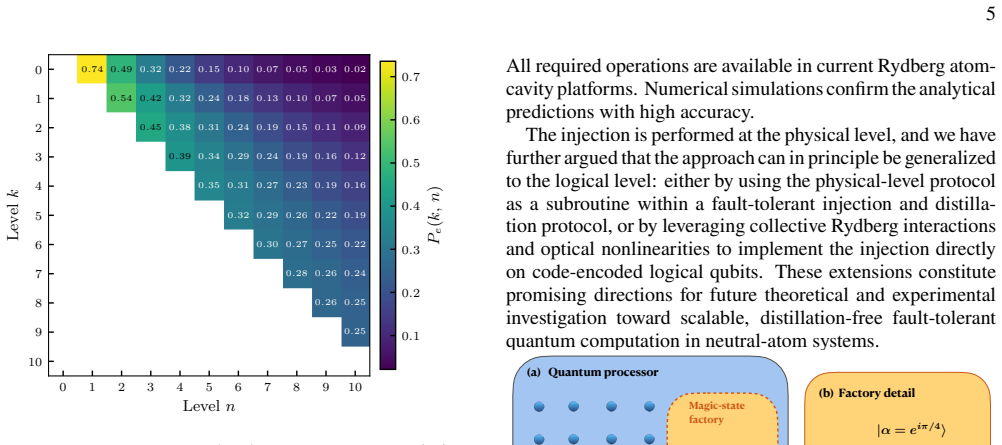
Cavity-mediated protocol prepares a magic T-state in a single mode with 0.74 success probability per attempt, independent of phase.
A machine-rendered reading of the paper's core claim, the machinery that carries it, and where it could break.
Core claim
Controlled atom-cavity interactions and conditional measurements probabilistically prepare an effective magic state encoded in the first two Fock levels of a cavity mode at 0.74 success probability per attempt, independent of the target magic phase; the state is subsequently injected into a computational atom via a teleportation protocol that uses only Clifford operations and a single auxiliary atom.
What carries the argument
Controlled atom-cavity interactions combined with conditional measurements that encode the magic state in the cavity Fock subspace, followed by dressed-state teleportation into the target atom.
If this is right
- The injection step requires only Clifford operations plus one auxiliary atom.
- The protocol can in principle be lifted to the logical level using collective Rydberg interactions and optical nonlinearities.
- Success probability remains constant regardless of the chosen magic phase.
Where Pith is reading between the lines
- The cavity encoding might allow magic-state resources to be shared across multiple computational atoms without repeated distillation.
- If the logical-level version works, direct T-gate injection into code blocks could reduce the number of physical qubits needed for fault tolerance.
- Phase-independent preparation suggests the same hardware could support different non-Clifford gates by simple parameter adjustment.
Load-bearing premise
All required operations of state preparation, two-qubit exchange gates, and projective measurement can be realized with current Rydberg atom-cavity techniques without loss or phase errors that would lower the stated success probability or destroy phase independence.
What would settle it
An experiment that prepares the cavity state, performs the teleportation, and measures the actual fidelity and success rate of the injected magic state across different phases; a measured success probability significantly below 0.74 or strong phase dependence would refute the central performance claim.
Figures
read the original abstract
Non-Clifford gates are a necessary resource for universal quantum computation, yet their fault-tolerant implementation typically relies on magic-state distillation, which incurs significant overhead in qubit count and circuit depth. In this work, we propose a probabilistic cavity-based magic-state injection protocol. Our scheme exploits controlled atom-cavity interactions and conditional measurements to probabilistically prepare an effective magic state encoded in the first two level Fock subspace of a single cavity mode, achieving a success probability of $0.74$ per attempt, independent of the target magic phase. The cavity-encoded magic state is subsequently injected into a computational atom via a teleportation-based protocol mediated by dressed-state transitions, requiring only Clifford operations and a single auxiliary atom for readout. We show that all required operations -- state preparation, two-qubit exchange gates, and projective measurement -- can be implemented with experimentally available techniques in Rydberg atom-cavity platforms. We further discuss how the scheme can in principle be adapted to operate at the logical level, where collective Rydberg interactions and optical nonlinearities provide a route toward cavity-mediated $T$-gate injection directly into code-encoded qubits.
Editorial analysis
A structured set of objections, weighed in public.
Referee Report
Summary. The manuscript proposes a probabilistic cavity-mediated magic T-gate injection protocol in Rydberg atom-cavity systems. It claims that controlled atom-cavity interactions and conditional measurements can prepare an effective magic state encoded in the span of the first two Fock states of a single cavity mode, with a success probability of 0.74 per attempt that is independent of the target magic phase. The prepared state is then injected into a computational atom via a teleportation protocol that uses only Clifford operations and a single auxiliary atom for readout. All required operations are asserted to be realizable with existing experimental techniques, with a discussion of possible extension to logical-level operation via collective Rydberg interactions and optical nonlinearities.
Significance. If the performance figures hold, the protocol would provide a concrete, cavity-based route to probabilistic magic-state preparation that avoids the qubit overhead of standard distillation circuits and leverages experimentally accessible Rydberg-cavity hardware. The phase-independent success probability and the teleportation-based injection step are potentially attractive features for reducing circuit depth in fault-tolerant architectures.
major comments (2)
- [Abstract] Abstract: the headline success probability of 0.74 and its claimed independence from the target magic phase are asserted without any accompanying derivation, rate equations, or explicit calculation of the heralding probability from the controlled interactions and conditional measurements.
- [Abstract] Abstract: the statement that 'all required operations can be implemented with experimentally available techniques' is load-bearing for the central performance claim yet supplies no error budget, master-equation analysis, or fidelity estimate that quantifies degradation due to cavity decay, Rydberg spontaneous emission, or phase noise.
minor comments (1)
- [Abstract] The phrase 'first two level Fock subspace' should be replaced by an explicit statement of the computational subspace (span of |0 angle and |1 angle Fock states) for clarity.
Simulated Author's Rebuttal
We thank the referee for their thoughtful review and constructive suggestions. We address each major comment below and will revise the manuscript to enhance clarity and completeness on the points raised.
read point-by-point responses
-
Referee: [Abstract] Abstract: the headline success probability of 0.74 and its claimed independence from the target magic phase are asserted without any accompanying derivation, rate equations, or explicit calculation of the heralding probability from the controlled interactions and conditional measurements.
Authors: The success probability of 0.74 and its phase independence are derived explicitly in Section II of the manuscript from the overlap integrals and conditional projection probabilities following the controlled atom-cavity interaction and subsequent measurement (see Eqs. (4)–(8) and the rate-equation analysis of the heralding process). The independence follows directly from the fact that the heralding condition projects onto the |1 angle Fock component regardless of the relative phase in the target magic state. To improve accessibility, we will revise the abstract to include a concise reference to this derivation and the key equations. revision: yes
-
Referee: [Abstract] Abstract: the statement that 'all required operations can be implemented with experimentally available techniques' is load-bearing for the central performance claim yet supplies no error budget, master-equation analysis, or fidelity estimate that quantifies degradation due to cavity decay, Rydberg spontaneous emission, or phase noise.
Authors: We agree that a quantitative error budget would strengthen the experimental feasibility claim. While the manuscript discusses the relevant experimental techniques and cites existing demonstrations of the required operations, it does not include a full master-equation treatment or numerical fidelity estimates. We will add a dedicated paragraph (or short subsection) providing order-of-magnitude estimates for the dominant error channels (cavity decay, Rydberg lifetime, and laser phase noise) and their projected impact on the protocol success probability and state fidelity. revision: yes
Circularity Check
No circularity: protocol claims rest on external ideal-operation assumptions, not internal reductions
full rationale
The paper states a success probability of 0.74 per attempt independent of the target magic phase and asserts that all operations can be implemented with Rydberg atom-cavity techniques. No equations, parameter fits, or self-citations appear in the provided text that would reduce this figure or the phase-independence claim to the inputs by construction. The performance numbers are presented as direct consequences of the described protocol under ideal conditions, with no evidence of self-definitional loops, fitted-input predictions, or load-bearing self-citations. The derivation is therefore self-contained against external benchmarks.
Axiom & Free-Parameter Ledger
axioms (1)
- standard math Standard quantum mechanics, cavity QED, and Rydberg atom interactions govern the controlled atom-cavity dynamics and measurements
Reference graph
Works this paper leans on
-
[1]
Dennis, A
E. Dennis, A. Kitaev, A. Landahl, and J. Preskill, Topological quantum memory, Journal of Mathematical Physics43, 4452 (2002)
2002
-
[2]
Raussendorf and J
R. Raussendorf and J. Harrington, Fault-tolerant quantum com- putation with high threshold in two dimensions, Phys. Rev. Lett. 98, 190504 (2007)
2007
-
[3]
Stabilizer Codes and Quantum Error Correction
D. Gottesman,Stabilizer codes and quantum error correc- tion, Ph.D. thesis, California Institute of Technology (1997), arXiv:quant-ph/9705052
work page internal anchor Pith review Pith/arXiv arXiv 1997
-
[4]
Eastin and E
B. Eastin and E. Knill, Restrictions on transversal encoded quan- tum gate sets, Phys. Rev. Lett.102, 110502 (2009)
2009
-
[5]
Bravyi and R
S. Bravyi and R. K¨onig, Classification of topologically protected gates for local stabilizer codes, Phys. Rev. Lett.110, 170503 (2013)
2013
-
[6]
Gottesman and I
D. Gottesman and I. L. Chuang, Demonstrating the viability of universal quantum computation using teleportation and single- qubit operations, Nature402, 390 (1999)
1999
-
[7]
X. Zhou, D. W. Leung, and I. L. Chuang, Methodology for quan- tum logic gate construction, Phys. Rev. A62, 052316 (2000)
2000
-
[8]
Bravyi and A
S. Bravyi and A. Kitaev, Universal quantum computation with ideal clifford gates and noisy ancillas, Phys. Rev. A71, 022316 (2005)
2005
-
[9]
A. M. Souza, J. Zhang, C. A. Ryan, and R. Laflamme, Ex- perimental magic state distillation for fault-tolerant quantum computing, Nature Communications2, 169 (2011)
2011
-
[10]
Sales Rodriguez, J
P. Sales Rodriguez, J. M. Robinson, P. N. Jepsen, Z. He, C. Duck- ering, C. Zhao, K.-H. Wu, J. Campo, K. Bagnall, M. Kwon, T. Karolyshyn, P. Weinberg, M. Cain, S. J. Evered, A. A. Geim, M. Kalinowski, S. H. Li, T. Manovitz, J. Amato-Grill, J. I. Basham, L. Bernstein, B. Braverman, A. Bylinskii, A. Choukri, R. J. DeAngelo, F. Fang, C. Fieweger, P. Frederic...
2025
-
[11]
A. G. Fowler, M. Mariantoni, J. M. Martinis, and A. N. Cleland, Surface codes: Towards practical large-scale quantum compu- tation, Phys. Rev. A86, 032324 (2012)
2012
-
[12]
Litinski, Magic state distillation: Not as costly as you think, Quantum3, 205 (2019)
D. Litinski, Magic state distillation: Not as costly as you think, Quantum3, 205 (2019)
2019
-
[13]
E. T. Campbell, B. M. Terhal, and C. Vuillot, Roads towards fault-tolerant universal quantum computation, Nature549, 172 (2017)
2017
-
[14]
R. S. Gupta, N. Sundaresan, T. Alexander, C. J. Wood, S. T. Merkel, M. B. Healy, M. Hillenbrand, T. Jochym-O’Connor, J. R. Wootton, T. J. Yoder, A. W. Cross, M. Takita, and B. J. Brown, Encoding a magic state with beyond break-even fidelity, Nature625, 259 (2024)
2024
-
[15]
Wills, M.-H
A. Wills, M.-H. Hsieh, and H. Yamasaki, Constant-overhead magic state distillation, Nature Physics21, 1842 (2025)
2025
-
[16]
Magic state cultivation: growing T states as cheap as CNOT gates
C. Gidney, N. Shutty, and C. Jones, Magic state cultivation: growing t states as cheap as cnot gates, arXiv:2409.17595 (2024)
work page internal anchor Pith review Pith/arXiv arXiv 2024
-
[17]
E. Rosenfeld, C. Gidney, G. Roberts, A. Morvan, N. Lacroix, D. Kafri, J. Marshall, M. Li, V. Sivak, D. Abanin,et al., Magic state cultivation on a superconducting quantum proces- sor, arXiv:2512.13908 (2025), (Google Quantum AI)
-
[18]
T. R. Scruby, K. Nemoto, and Z. Cai, Fault-tolerant quantum computation without distillation on a 2d device, npj Quantum Information11, 189 (2025)
2025
- [19]
-
[20]
Heußen, Magic state distillation without measurements and post-selection, APL Quantum2, 046113 (2025)
S. Heußen, Magic state distillation without measurements and post-selection, APL Quantum2, 046113 (2025)
2025
-
[21]
Y. Ye, T. He, H.-L. Huang, Z. Wei, Y. Zhang, Y. Zhao, D. Wu, Q. Zhu, H. Guan, S. Cao, F. Chen, T.-H. Chung, H. Deng, D. Fan, M. Gong, C. Guo, S. Guo, L. Han, N. Li, S. Li, Y. Li, F. Liang, J. Lin, H. Qian, H. Rong, H. Su, S. Wang, Y. Wu, Y. Xu, C. Ying, J. Yu, C. Zha, K. Zhang, Y.-H. Huo, C.-Y. Lu, C.-Z. Peng, X. Zhu, and J.-W. Pan, Logical magic state pr...
2023
-
[22]
A. J. Park, J. Trautmann, N. ˇSanti´c, V. Kl¨ usener, A. Heinz, I. Bloch, and S. Blatt, Cavity-enhanced optical lattices for scal- ing neutral atom quantum technologies to higher qubit numbers, PRX Quantum3, 030314 (2022)
2022
-
[23]
Z. Aqua, M. L. Peters, D. C. Spierings, G. Wang, E. Bytyqi, T. Propson, and V. Vuleti ´c, Mode multiplexing for scalable cavity-enhanced operations in neutral-atom arrays, PRX Quan- tum7, 020334 (2026)
2026
-
[24]
J. De Santis, B. Dura-Kov ´acs, M. ¨Onc¨ u, A. Bouscal, D. Vasileiadis, and J. Zeiher, Realization of a cavity-coupled rydberg array, arXiv:2602.12152 (2026)
-
[25]
E. T. Jaynes and F. W. Cummings, Comparison of quantum and semiclassical radiation theories with application to the beam maser, Proc. IEEE51, 89 (1963)
1963
-
[26]
Brune, F
M. Brune, F. Schmidt-Kaler, A. Maali, J. Dreyer, E. Hagley, J. M. Raimond, and S. Haroche, Quantum Rabi oscillation: a direct test of field quantization in a cavity, Phys. Rev. Lett.76, 1800 (1996)
1996
-
[27]
Haroche and J.-M
S. Haroche and J.-M. Raimond,Exploring the Quantum: Atoms, Cavities, and Photons(Oxford University Press, 2006)
2006
-
[28]
Walther, B
H. Walther, B. T. H. Varcoe, B.-G. Englert, and T. Becker, Cavity quantum electrodynamics, Rep. Prog. Phys.69, 1325 (2006)
2006
-
[29]
S. J. Glaser, U. Boscain, T. Calarco, C. P. Koch, W. K¨ockenberger, R. Kosloff, I. Kuprov, B. Luy, S. Schirmer, T. Schulte-Herbr¨ uggen, D. Sugny, and F. K. Wilhelm, Train- ing schr¨odinger’s cat: quantum optimal control, The European Physical Journal D69, 279 (2015)
2015
-
[30]
C. P. Koch, U. Boscain, T. Calarco, G. Dirr, S. Filipp, S. J. Glaser, R. Kosloff, S. Montangero, T. Schulte-Herbr¨ uggen, D. Sugny, and F. K. Wilhelm, Quantum optimal control in quantum tech- nologies. strategic report on current status, visions and goals for research in europe, EPJ Quantum Technology9, 19 (2022)
2022
-
[31]
Giovannetti, D
V. Giovannetti, D. Vitali, P. Tombesi, and A. Ekert, Scalable quantum computation with cavity qed systems, Phys. Rev. A62, 032306 (2000)
2000
-
[32]
Sleator and H
T. Sleator and H. Weinfurter, Realizable universal quantum logic gates, Phys. Rev. Lett.74, 4087 (1995)
1995
-
[33]
Lao and B
L. Lao and B. Criger, Magic state injection on the rotated surface code, inProceedings of the 19th ACM International Conference on Computing Frontiers, CF ’22 (Association for Computing Machinery, New York, NY, USA, 2022) p. 113–120
2022
-
[34]
B. W. Reichardt, Quantum universality by state distillation, arXiv preprint quant-ph/0608085 (2006)
work page internal anchor Pith review Pith/arXiv arXiv 2006
-
[35]
Heinrich and D
M. Heinrich and D. Gross, Robustness of magic and symmetries of the stabiliser polytope, Quantum3, 132 (2019)
2019
-
[36]
Jaksch, J
D. Jaksch, J. I. Cirac, P. Zoller, S. L. Rolston, R. Cˆot´e, and M. D. Lukin, Fast quantum gates for neutral atoms, Phys. Rev. Lett.85, 2208 (2000)
2000
-
[37]
Saffman, T
M. Saffman, T. G. Walker, and K. Mølmer, Quantum information with Rydberg atoms, Rev. Mod. Phys.82, 2313 (2010)
2010
-
[38]
S. J. Evered, D. Bluvstein, M. Kalinowski, S. Ebadi, T. Manovitz, H. Zhou, S. H. Li, A. A. Geim, T. T. Wang, N. Maskara, H. Levine, G. Semeghini, M. Greiner, V. Vuleti ´c, and M. D. Lukin, High-fidelity parallel entangling gates on a neutral-atom quantum computer, Nature622, 268 (2023)
2023
-
[39]
Bluvstein, A
D. Bluvstein, A. A. Geim, S. H. Li, S. J. Evered, J. P. Bonilla Ataides, G. Baranes, A. Gu, T. Manovitz, M. Xu, M. Kalinowski, S. Majidy, C. Kokail, N. Maskara, E. C. Trapp, L. M. Stewart, S. Hollerith, H. Zhou, M. J. Gullans, S. F. Yelin, M. Greiner, V. Vuleti ´c, M. Cain, and M. D. Lukin, A fault- tolerant neutral-atom architecture for universal quantum...
2026
-
[40]
Lambert, E
N. Lambert, E. Gigu‘ere, P. Menczel, B. Li, P. Hopf, G. Su’arez, M. Gali, J. Lishman, R. Gadhvi, R. Agarwal, A. Galicia, N. Shammah, P. Nation, J. R. Johansson, S. Ahmed, S. Cross, A. Pitchford, and F. Nori, Qutip 5: The quantum toolbox in Python, Physics Reports1153, 1 (2026). 7 Appendix A: Simulation parameters and numerical validation □1.5 □1.0 □0.5 0....
2026
discussion (0)
Sign in with ORCID, Apple, or X to comment. Anyone can read and Pith papers without signing in.