REVIEW 2 major objections 5 minor 70 references
Coherence of Microwave and Optical Qubit Levels in Neutral Thulium
T0 review · 2 major / 5 minor · reviewed 2026-08-15 · deepseek-v4-flash
Pith's one-line read Neutral thulium atoms keep a microwave qubit coherent for tens of seconds.
desk verdict A credible first characterization of thulium as a hyperfine-qubit platform: the direct 22 s Ramsey coherence is the solid result, while the 55 s dynamical-decoupling number is an indirect estimate that the abstract promotes more strongly than the methods support. read the letter →
The pith
A machine-rendered reading of the paper's core claim, the machinery that carries it, and where it could break.
The reading
What carries the argument
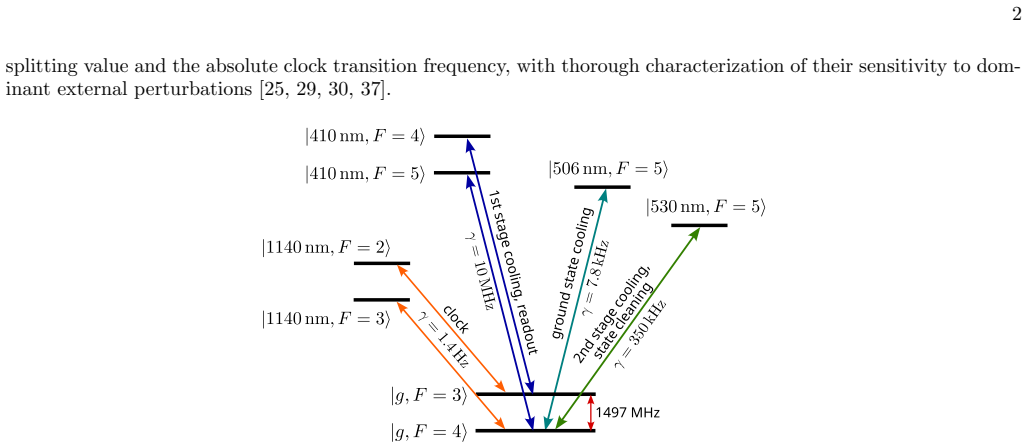
The machinery that carries the argument is the 1497 MHz hyperfine qubit: the $m_F=0$ sublevels of the $F=3$ and $F=4$ ground-state hyperfine levels, which are first-order insensitive to magnetic field and shift only quadratically (852 Hz/G²). Ramsey spectroscopy measures the free-induction coherence, Carr-Purcell dynamical decoupling removes slow magnetic-field noise, and the 1063.5 nm optical lattice at a near-magic wavelength holds the atoms during tens-of-second interrogation. On the optical side, the 1140 nm inner-shell clock transition provides the metastable levels; the bicolor, dual-transition excitation inherited from the thulium optical clock cancels laser phase noise, making the 112 ms metastable lifetime the operative limit for optical operations.
What would settle it
Run the eight-pulse Carr-Purcell sequence with full phase control of the final microwave pulse and scan that phase to record the complete fringe at each evolution time; if the directly measured contrast at $T=20$ s falls below $\exp[-(20/55)^2]\approx 0.88$, or if the fringe baseline drifts away from one half, the symmetric-decay reconstruction has overestimated $T_2$.
Extended reading notes
Core claim
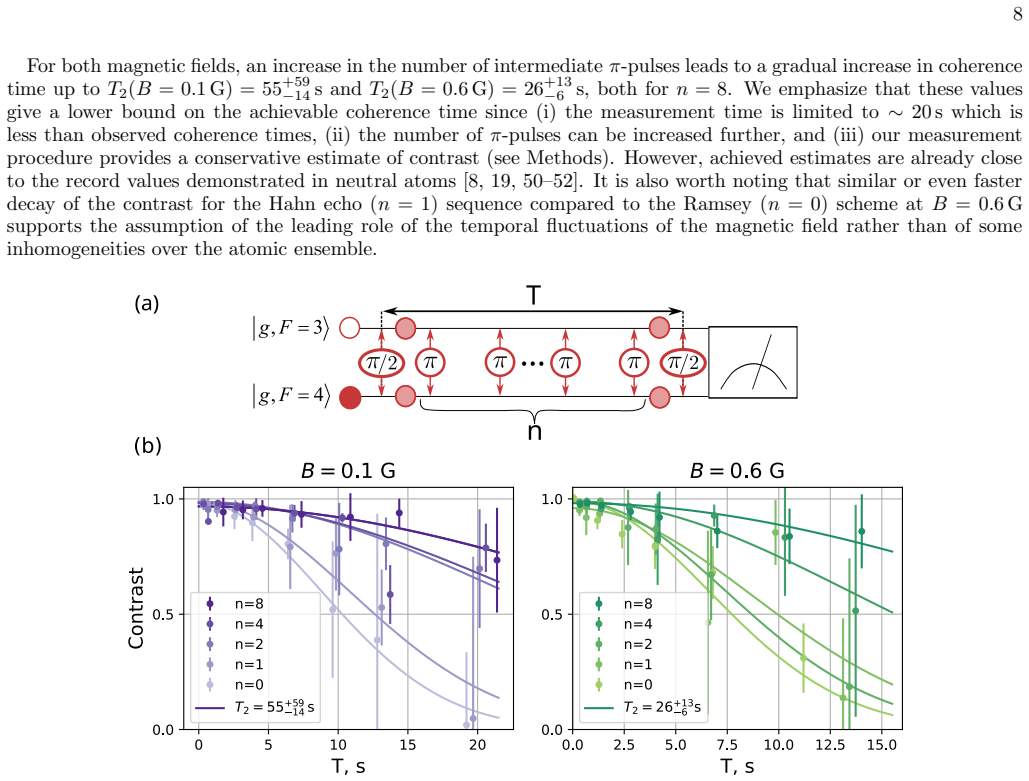
The paper's central claim is that neutral thulium ($^{169}$Tm) can serve as a quantum computing platform with a qubit encoded in the $m_F=0$ magnetic sublevels of the ground-state hyperfine doublet, split by 1497 MHz. The authors report Ramsey coherence time $T_2^* = 22^{+2}_{-2}$ s at a 0.1 G bias field and, after eight Carr-Purcell decoupling pulses, an extended coherence time $T_2 = 55^{+59}_{-14}$ s, stating that these are record-scale for neutral-atom systems. They demonstrate single-qubit operations with microwave π-pulse fidelity above 99(1)% and visibility above 0.8 after 250 Rabi oscillations. Using the 1140 nm clock transition, they shelve both qubit states in the metastable levels for state-selective readout and transfer the qubit coherently into and out of these states; in the dual-transition, bicolor configuration, laser phase noise is cancelled and the coherence time is set by the 112 ms natural lifetime of the metastable state.
Load-bearing premise
The longest coherence result assumes the decay is symmetric around a baseline of exactly one half, so that contrast can be reconstructed from the maximum detected population; if the baseline or symmetry is wrong, the inferred coherence time would be too long.
Editorial extensions
If this is right
- Thulium can support a neutral-atom quantum computer in which the 1497 MHz transition performs hyperfine single-qubit gates and the 1140 nm transition provides shelving, mid-circuit storage, and qudit or optical-metastable-ground (omg) architecture protocols.
- The shelving readout detects population that has left the qubit subspace, so the same hardware can flag erasure errors during computation.
- Because the measured $T_2^*$ is limited by magnetic-field fluctuations rather than by an intrinsic atomic lifetime, passive magnetic shielding or active field stabilization should extend the coherence time beyond the reported 22 s.
- Coherent transfer to the 1140 nm metastable states with sub-112 ms duration gives thulium qubits an optical interface that can be used for quantum memory, clock-based operations, or conversion between microwave and optical domains.
- The very small differential polarizability of the qubit levels at the 1063.5 nm trapping wavelength supports the path from an ensemble in an optical lattice to single atoms in optical tweezers, where the observed two-body loss and depolarization should be strongly suppressed.
Reading between the lines
- Beyond the paper: if slow magnetic-field noise is indeed the dominant decoherence channel, the intrinsic Ramsey coherence of the $m_F=0$ hyperfine qubit could be substantially longer than the reported 22 s; the paper's own peak-to-peak estimate of $T_2^{*m}=46(2)$ s hints at this floor.
- Beyond the paper: the bicolor metastable-state transfer is effectively an optical-clock interrogation of the qubit, so the same apparatus could function as a microwave-optical transducer linking hyperfine qubits to 1140 nm photons for quantum networking.
- Beyond the paper: in single-atom optical tweezers the ensemble two-body loss and depolarization that truncate the current measurements should largely disappear, so the 55 s coherence time is more plausibly a lower bound than a ceiling for a future thulium array.
- Beyond the paper: the open interval between 41 s and 114 s in the dynamical-decoupling fit is a direct invitation to repeat the measurement with phase-controlled pulses; a full fringe scan at each evolution time would confirm or revise the symmetric-decay assumption used to extract $T_2$.
Signed reviews
Editorial analysis
A structured set of objections, weighed in public.
Referee Report
Summary. The manuscript reports experiments with neutral thulium atoms in an optical lattice, demonstrating microwave state preparation and state-selective readout, single-qubit rotations on the 1497 MHz hyperfine transition, Ramsey and Carr-Purcell dynamical-decoupling coherence measurements, and coherent population transfer between the ground hyperfine qubit and the 1140 nm metastable states. The headline results are a Ramsey coherence time T2* = 22(+2/-2) s at B = 0.1 G and a dynamical-decoupling coherence time T2 = 55(+59/-14) s with n = 8 intermediate pi-pulses, together with coherent optical transfer whose duration is limited by the 112 ms metastable lifetime. The paper argues that thulium combines the robust hyperfine encoding of alkali atoms with the optical-metastable toolbox of alkaline-earth-like atoms.
Significance. If the results hold, this is a useful experimental advance: thulium is a relatively underexplored neutral atom, and the combination of a 1497 MHz hyperfine qubit with the 1140 nm clock/metastable transition is distinctive. The state-preparation and shelving-based readout protocols are carefully described, and the direct Ramsey T2* = 22(2) s measurement at B = 0.1 G is credible: it is fitted from interference fringes with quoted 1 s.d. statistical errors and supported by an independent peak-to-peak analysis. The coherent bicolor transfer through the metastable state, with the contrast following the 112 ms lifetime limit, is also a clean result. The principal weakness is that the abstract's T2 = 55 s record-scale claim rests on an indirect contrast reconstruction (Methods G) that assumes a symmetric fringe offset of 1/2 without phase-resolved dynamical-decoupling data; this part of the paper needs strengthening or explicit qualification.
major comments (2)
- [Methods G / Abstract] The headline T2 = 55 s is not obtained from a directly measured Ramsey or dynamical-decoupling fringe. As stated in Methods G, the phase of the final microwave pulse could not be adjusted, so the contrast is reconstructed from the maximum detected population via Eq. (10), C = 2*eta_max - 1, using Eq. (9) with the assumptions that the fringe offset A = 1/2 and that the decay is symmetric about 1/2. The supporting evidence for A = 1/2 comes from Ramsey fits at short times, but Methods F shows that at long free-evolution times the shot-to-shot scatter of eta_4 reaches about 50%, attributed to slow magnetic-field fluctuations, and Methods E documents depolarization of the F = 4 level that could shift the effective offset. A deviation of A from 1/2 biases the inferred contrast and therefore T2, and the quoted asymmetric errors (+59, -14 s) do not include this model uncertainty. Please either provide phase-resolved data for the dynamical-decoupling sequence or reword the abstract and Section IV.C so that T2 = 55 s is presented as a model-estimated quantity rather than a directly measured coherence time.
- [Section IV.C / Fig. 6] The dynamical-decoupling data extend to about T = 20 s, while the fitted T2 = 55 s lies well beyond the measurement window; the Gaussian decay in Eq. (4) is therefore extrapolated. Because the inferred contrast is still well above zero at the longest measured times, the data do not strongly constrain either the decay time or the decay shape. The chi-square-based errors in Fig. 14(c) reflect statistical uncertainty in the reconstructed contrast under the assumed model, not the systematic sensitivity to the offset assumption or to the choice of decay functional form. A conservative lower bound on T2, or the contrast value at the longest measured time, would be a more defensible headline than a fitted 55 s with asymmetric errors.
minor comments (5)
- [Section IV.A] In the sentence reporting two-body loss coefficients, the second coefficient is written as beta(mF = -4, B = 0.1 G) = 6.6(3.3)e-11 cm3/s; from the context and Fig. 4 this should be B = 0.6 G.
- [Methods G, Eq. (9)] The symbol T is used both for the free evolution time and for the decay constant in Eq. (9); please use distinct notation, for example T_2 or tau, to avoid ambiguity.
- [Methods F / Fig. 13] For the B = 0.6 G peak-to-peak estimates, the text says that no significant decay is observed, yet a dashed curve with T2m = 46(2) s is drawn and said to describe the data well. Please clarify whether the B = 0.6 G empty-marker data actually constrain the decay model or merely are consistent with it.
- [References] Reference [55] is incomplete: it lists 'Review of Scientific Instruments 96 (2025)' without an article number or page range.
- [Section II / Fig. 2] The manuscript says that more than 99% of atoms are in the ground vibrational state after 506 nm cooling, but the state-preparation efficiency is later given as about 40% after cleaning. Please state explicitly whether the 40% includes the ground-vibrational-state fraction or refers only to the total atom number retained.
Circularity Check
No circularity: the coherence times are measured quantities fit with stated models; self-citations supply external constants, not the target results.
full rationale
I walked the paper's derivation chain and found no load-bearing step that reduces to its own inputs by construction. The Ramsey coherence time T2* = 22(2) s is obtained from directly measured Ramsey fringes fit with the standard fringe model Eq. (3) and a Gaussian decay Eq. (4); this is a conventional measurement, not a prediction derived from an assumed answer. The dynamical-decoupling T2 = 55 s is not measured from phase-resolved fringes; instead, Eq. (9) assumes a 1/2 offset and symmetric Gaussian decay, and Eq. (10) infers contrast from the maximum detected population. This is a stated model-dependent estimate and is acknowledged in the paper as a lower-bound-style reconstruction, but it is not circular: the Gaussian time constant is a free fit parameter, and the offset 1/2 is tested against Ramsey data rather than being defined to equal the reported T2. The cited prior work by the same group supplies external physical inputs (the 1497 MHz hyperfine splitting, the 112 ms metastable lifetime, susceptibility coefficients, and magic wavelengths) that are prerequisites for the experiment, not the coherence-time result itself. No fitted parameter is renamed as a prediction, no uniqueness theorem is imported to force a choice, and no empirically known result is repackaged as a derivation. The main honest limitation is that the 55 s dynamical-decoupling number depends on an unverified phase-control assumption and could be overestimated if the offset or decay symmetry deviates; that is a data-analysis and verification concern, not a circularity. Under the required standard of exhibiting a specific reduction such as Eq. X = Eq. Y by construction, I find no circular step.
Assumptions & free parameters
assumptions (4)
- domain assumption Metastable clock-state lifetime tau_c = 112 ms, taken from prior work [29].
- domain assumption Magnetic field fluctuations are the dominant decoherence mechanism for the hyperfine qubit.
- domain assumption Two-body loss model Eq. (1) describes atom loss dynamics.
- ad hoc to paper Ramsey fringe offset A equals 0.5 and the decay is symmetric for contrast estimation in dynamical decoupling.
Cite this review
Pith. "Pith review of Coherence of Microwave and Optical Qubit Levels in Neutral Thulium." pith.science (2026). https://pith.science/paper/NX35GDFA
@misc{pith2026250812887,
  author       = {Pith},
  title        = {Pith review of: Coherence of Microwave and Optical Qubit Levels in Neutral Thulium},
  year         = {2026},
  howpublished = {\url{https://pith.science/paper/NX35GDFA}},
  note         = {Machine review of arXiv:2508.12887}
}
abstract
Hyperfine-encoded qubits in alkali atoms have established themselves as robust platforms for quantum computing, while alkaline-earth-like elements expand the state manipulation toolbox through their rich spectrum of optical transitions and metastable states. In this work, we demonstrate that thulium is a viable candidate for quantum computing, combining advantages of hyperfine qubit encoding with a rich energy-level structure of alkaline-earth-like atoms. We describe protocols for the initial state preparation and state-selective readout, and show single-qubit operations on the microwave transition at $1 497$ MHz. We demonstrate ground state hyperfine qubit coherence times up to $T_2^* = 22^{+2}_{-2}$ s and $T_2 = 55^{+59}_{-14}$ s, representing record-scale performance for neutral-atom systems. Furthermore, we show operations involving metastable optical states, including shelving for the state-selective readout as well as coherent population transfer of the ground state qubit with coherence time primarily limited by the metastable level natural lifetime of $112$ ms. These results mark the first step toward using thulium for quantum computing applications and highlight its promising characteristics.
Figures


Figures from the paper (11 more)






Reference graph
Works this paper leans on
-
[1]
After the final stage of deep laser cooling at a wavelength of 506 nm, more than 99% of atoms are in the ground vibrational state in the optical lattice and occupy the |g,F = 4,mF =−4⟩ state [35]
-
[2]
In the current experimental configuration, pumping of atoms to the central magnetic sublevel is performed using 5 ms radio-frequency pulse. The RF frequency is swiped from 800 kHz to 785 kHz (for an applied magnetic field B = 0.6 G) to sequentially transfer atoms between adjacent mF sublevels from mF =−4 to mF = 0 (see Fig. 2(b)). After this, about 40 % a...
-
[3]
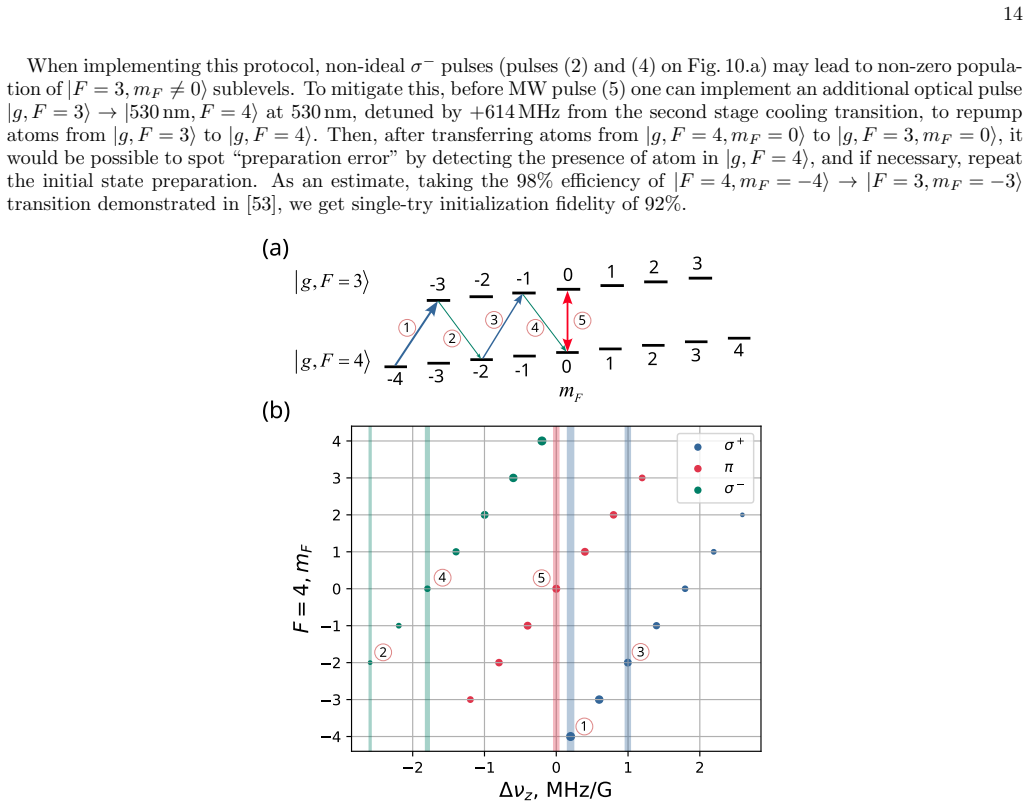
Using a 2-ms microwave π-pulse, we transfer atoms from |g,F = 4,mF = 0⟩ to|g,F = 3,mF = 0⟩. This tran- sition is isolated from other |g,F = 4,mF⟩ to|g,F = 3,m′ F⟩ transitions (the closest one is shifted by at least 60 kHz) due to the bias magnetic field of B0 = 0.6 G applied in the experiment, Fig. 2(d,2). 4
-
[4]
We remove atoms remaining in the ground |g,F = 4⟩ state using a 3 ms pulse of 530 nm radiation resonant with the second-stage laser cooling transition with a natural linewidth of 350 kHz. Since the difference in the hyperfine splittings of the upper and ground levels of this transition is 614 MHz, atoms in the|g,F = 3,mF = 0⟩ state are not excited, and th...
-
[5]
Now, we can prepare any desired population distribution between the|g,F = 4,mF = 0⟩ and|g,F = 3,mF = 0⟩ sublevels by selecting the appropriate length of the second microwave pulse. The Fig. 2(e) illustrates the prob- ability of detecting atoms in the |g,F = 3,mF = 0⟩ state as a function of microwave pulse duration. Over 250 periods of coherent oscillation...
work page 2000
-
[6]
Hyperfine states readout crosstalk Beyond the constraints associated with the camera’s sensitivity, the present readout scheme necessitates calibration to account for the effects of the readout pulses on the collected data. As we discussed in the main text, we first detect the number of atoms on|g,F = 4⟩ level using resonant radiation on|g,F = 4⟩→| 410 nm...
-
[7]
1140 nm transition calibration To calibrate the readout scheme with 1140 nm pulses, it is necessary to account for the non-ideality of the transition excitation, as well as the lifetime of the metastable levels. The latter was done using modeling via QuTiP and allows calculating the fractions of atoms that decayed from each of the metastable states into e...
-
[8]
For a 2-ms π−pulse, the Rabi frequency is Ω = 2π× 250 Hz
Microwave excitation of|g,F = 3,mF̸= 0⟩ states. For a 2-ms π−pulse, the Rabi frequency is Ω = 2π× 250 Hz. Since any other microwave transition is detuned by at least ∆νmw = 60 kHz, its maximum excitation probability is p = Ω2 Ω2+(2∗π∗∆νmw)2∼ 2× 10⁻⁵
Show all 70 references
-
[9]
We measure number of atoms remaining in |g,F = 4⟩ state as a function of cleaning pulse length, see Fig
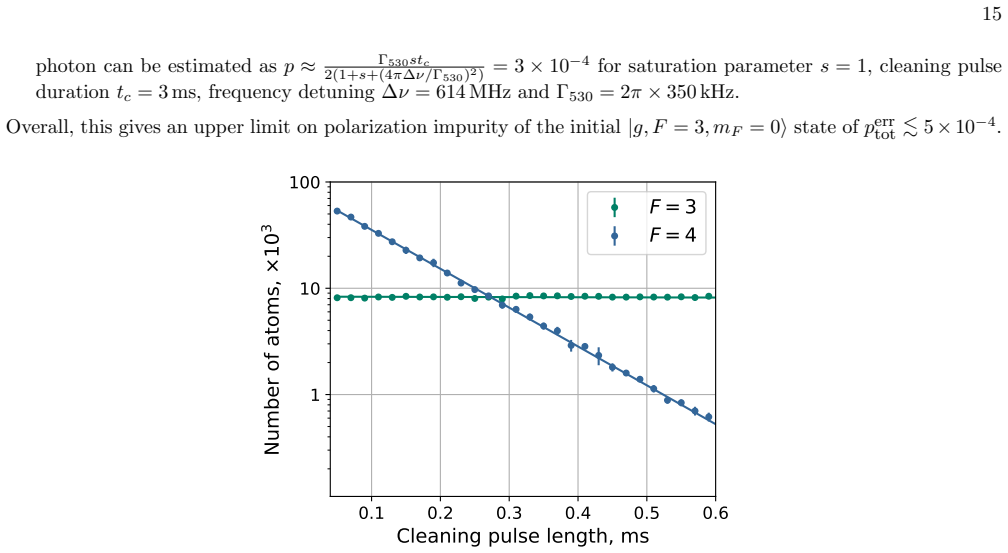
Some atoms are present in|g,F = 4⟩ state after cleaning pulse of resonant 530 nm radiation. We measure number of atoms remaining in |g,F = 4⟩ state as a function of cleaning pulse length, see Fig. 11. The exponential fit gives time constant τcl = 0.119(1) ms. In the experiment...
-
[10]
Depolarization of atoms in|g,F = 3,mF = 0⟩ due to scattering of cleaning pulse photons. Probability to scatter 15 photon can be estimated as p≈ Γ530stc 2(1+s+(4π∆ν/Γ530)2) = 3× 10⁻⁴ for saturation parameter s = 1, cleaning pulse duration tc = 3 ms, frequency detuning ∆ν = 614 ...
-
[11]
As a result, the contrast of the oscillations will tend to zero, while the probability of finding the system in either the F = 3 or F = 4 state will approach 1/2
Since the developed readout scheme allows us to separately address atoms in the central magnetic sublevels, and the decay from F = 3 to F = 4 level leads to loss of an atom, we expect the oscillations (if scanning the phase of the last microwave pulse) to decay symmetrically o...
-
[12]
The obtained values will represent a lower bound estimate, since magnetic field fluctuations and a number of other effects can disrupt the phase, causing the system to deviate from the excitation peak, while pure decoherence leads to a uniform decay of oscillations and should ...
-
[13]
J. F. Kam, H. Kang, C. D. Hill, G. J. Mooney, and L. C. Hollenberg, Characterization of entanglement on superconducting quantum computers of up to 414 qubits, Physical Review Research 6, 033155 (2024)
2024
-
[14]
B. T. Edman, A hardware-focused tour of ibm’s 127-qubit eagle processor, Vanderbilt Undergraduate Research Journal 14 (2024)
2024
-
[15]
Anferov, S
A. Anferov, S. P. Harvey, F. Wan, J. Simon, and D. I. Schuster, Superconducting qubits above 20 ghz operating over 200 mk, PRX Quantum 5, 030347 (2024)
2024
-
[16]
Howard, A
J. Howard, A. Lidiak, C. Jameson, B. Basyildiz, K. Clark, T. Zhao, M. Bal, J. Long, D. P. Pappas, M. Singh, et al. , Implementing two-qubit gates at the quantum speed limit, Physical Review Research 5, 043194 (2023)
2023
-
[17]
Wang, C.-Y
P. Wang, C.-Y. Luan, M. Qiao, M. Um, J. Zhang, Y. Wang, X. Yuan, M. Gu, J. Zhang, and K. Kim, Single ion qubit with estimated coherence time exceeding one hour, Nature communications 12, 233 (2021)
2021
-
[18]
L¨ oschnauer, J
C. L¨ oschnauer, J. M. Toba, A. Hughes, S. King, M. Weber, R. Srinivas, R. Matt, R. Nourshargh, D. Allcock, C. Ballance, et al., Scalable, high-fidelity all-electronic control of trapped-ion qubits, arXiv preprint arXiv:2407.07694 (2024)
2024
-
[19]
Srinivas, S
R. Srinivas, S. Burd, H. Knaack, R. Sutherland, A. Kwiatkowski, S. Glancy, E. Knill, D. Wineland, D. Leibfried, A. C. Wilson, et al., High-fidelity laser-free universal control of trapped ion qubits, Nature 597, 209 (2021)
2021
-
[20]
H. J. Manetsch, G. Nomura, E. Bataille, K. H. Leung, X. Lv, and M. Endres, A tweezer array with 6100 highly coherent atomic qubits, arXiv preprint arXiv:2403.12021 (2024). 19
2024 arXiv
-
[21]
Bluvstein, S
D. Bluvstein, S. J. Evered, A. A. Geim, S. H. Li, H. Zhou, T. Manovitz, S. Ebadi, M. Cain, M. Kalinowski, D. Hangleiter, et al., Logical quantum processor based on reconfigurable atom arrays, Nature 626, 58 (2024)
2024
-
[22]
S. J. Evered, D. Bluvstein, M. Kalinowski, S. Ebadi, T. Manovitz, H. Zhou, S. H. Li, A. A. Geim, T. T. Wang, N. Maskara, et al., High-fidelity parallel entangling gates on a neutral-atom quantum computer, Nature 622, 268 (2023)
2023
-
[23]
S. Ma, G. Liu, P. Peng, B. Zhang, S. Jandura, J. Claes, A. P. Burgers, G. Pupillo, S. Puri, and J. D. Thompson, High-fidelity gates and mid-circuit erasure conversion in an atomic qubit, Nature 622, 279 (2023)
2023
-
[24]
Sheng, J
C. Sheng, J. Hou, X. He, K. Wang, R. Guo, J. Zhuang, B. Mamat, P. Xu, M. Liu, J. Wang, et al., Defect-free arbitrary- geometry assembly of mixed-species atom arrays, Physical Review Letters 128, 083202 (2022)
2022
-
[25]
Singh, S
K. Singh, S. Anand, A. Pocklington, J. T. Kemp, and H. Bernien, Dual-element, two-dimensional atom array with continuous-mode operation, Physical Review X 12, 011040 (2022)
2022
-
[26]
Anand, C
S. Anand, C. E. Bradley, R. White, V. Ramesh, K. Singh, and H. Bernien, A dual-species rydberg array, Nature Physics 20, 1744 (2024)
2024
-
[27]
C. Fang, J. Miles, J. Goldwin, M. Lichtman, M. Gillette, M. Bergdolt, S. Deshpande, S. A. Norrell, P. Huft, M. A. Kats, et al., Interleaved dual-species arrays of single atoms using a passive optical element and one trapping laser, Science Advances 11, eadw4166 (2025)
2025
-
[28]
Norcia, W
M. Norcia, W. Cairncross, K. Barnes, P. Battaglino, A. Brown, M. Brown, K. Cassella, C.-A. Chen, R. Coxe, D. Crow, et al., Midcircuit qubit measurement and rearrangement in a yb 171 atomic array, Physical Review X 13, 041034 (2023)
2023
-
[29]
Saskin, J
S. Saskin, J. Wilson, B. Grinkemeyer, and J. Thompson, Narrow-line cooling and imaging of ytterbium atoms in an optical tweezer array, Physical review letters 122, 143002 (2019)
2019
-
[30]
Urech, I
A. Urech, I. H. Knottnerus, R. J. Spreeuw, and F. Schreck, Narrow-line imaging of single strontium atoms in shallow optical tweezers, Physical Review Research 4, 023245 (2022)
2022
-
[31]
Barnes, P
K. Barnes, P. Battaglino, B. J. Bloom, K. Cassella, R. Coxe, N. Crisosto, J. P. King, S. S. Kondov, K. Kotru, S. C. Larsen, et al., Assembly and coherent control of a register of nuclear spin qubits, Nature Communications 13, 2779 (2022)
2022
-
[32]
Z. Jia, W. Huie, L. Li, W. K. C. Sun, X. Hu, Aakash, H. Kogan, A. Karve, J. Y. Lee, and J. P. Covey, An architecture for two-qubit encoding in neutral ytterbium-171 atoms, npj Quantum Information 10, 106 (2024)
2024
-
[33]
W. Huie, C. Conefrey-Shinozaki, Z. Jia, P. Draper, and J. P. Covey, Three-qubit encoding in ytterbium-171 atoms for simulating 1+ 1d qcd, arXiv preprint arXiv:2507.18426 (2025)
2025
-
[34]
A. S. Nikolaeva, I. V. Zalivako, A. S. Borisenko, N. V. Semenin, K. P. Galstyan, A. E. Korolkov, E. O. Kiktenko, K. Y. Khabarova, I. A. Semerikov, A. K. Fedorov, et al., Scalable improvement of the generalized toffoli gate realization using trapped-ion-based qutrits, Physical ...
2025
-
[35]
A. L. Shaw, P. Scholl, R. Finkelstein, R. B.-S. Tsai, J. Choi, and M. Endres, Erasure cooling, control, and hyperentangle- ment of motion in optical tweezers, Science 388, 845 (2025)
2025
-
[36]
Wilson, S
J. Wilson, S. Saskin, Y. Meng, S. Ma, R. Dilip, A. Burgers, and J. Thompson, Trapping alkaline earth rydberg atoms optical tweezer arrays, Physical review letters 128, 033201 (2022)
2022
-
[37]
Mishin, D
D. Mishin, D. Tregubov, N. Kolachevsky, and A. Golovizin, Combined microwave and optical spectroscopy for hyperfine structure analysis in thulium atoms, Physical Review A 110, 032817 (2024)
2024
-
[38]
V. A. Khlebnikov, D. A. Pershin, V. V. Tsyganok, E. T. Davletov, I. S. Cojocaru, E. S. Fedorova, A. A. Buchachenko, and A. V. Akimov, Random to chaotic statistic transformation in low-field fano-feshbach resonances of cold thulium atoms, Physical Review Letters 123, 213402 (2019)
2019
-
[39]
Khlebnikov, V
V. Khlebnikov, V. Tsyganok, D. Pershin, E. Davletov, E. Kuznetsova, and A. Akimov, Characterizing the temperature dependence of fano-feshbach resonances of ultracold polarized thulium, Physical Review A 103, 023306 (2021)
2021
-
[40]
E. T. Davletov, V. V. Tsyganok, V. A. Khlebnikov, D. A. Pershin, D. V. Shaykin, and A. V. Akimov, Machine learning for achieving bose-einstein condensation of thulium atoms, Physical Review A 102, 011302(R) (2020)
2020
-
[41]
Golovizin, E
A. Golovizin, E. Fedorova, D. Tregubov, D. Sukachev, K. Khabarova, V. Sorokin, and N. Kolachevsky, Inner-shell clock transition in atomic thulium with a small blackbody radiation shift, Nature communications 10, 1724 (2019)
2019
-
[42]
A. A. Golovizin, D. O. Tregubov, E. S. Fedorova, D. A. Mishin, D. I. Provorchenko, K. Y. Khabarova, V. N. Sorokin, and N. N. Kolachevsky, Simultaneous bicolor interrogation in thulium optical clock providing very low systematic frequency shifts, Nature communications 12, 5171 (2021)
2021
-
[43]
Golovizin, D
A. Golovizin, D. Tregubov, D. Mishin, D. Provorchenko, and N. Kolachevsky, Compact magneto-optical trap of thulium atoms for a transportable optical clock, Optics Express 29, 36734 (2021)
2021
-
[44]
Sukachev, A
D. Sukachev, A. Sokolov, K. Chebakov, A. Akimov, N. Kolachevsky, and V. Sorokin, Sub-doppler laser cooling of thulium atoms in a magneto-optical trap, JETP letters 92, 703 (2010)
2010
-
[45]
Vishnyakova, E
G. Vishnyakova, E. Kalganova, D. Sukachev, S. Fedorov, A. Sokolov, A. Akimov, N. Kolachevsky, and V. Sorokin, Two- stage laser cooling and optical trapping of thulium atoms, Laser Physics 24, 074018 (2014)
2014
-
[46]
Provorchenko, D
D. Provorchenko, D. Tregubov, D. Mishin, M. Yaushev, D. Kryuchkov, V. Sorokin, K. Khabarova, A. Golovizin, and N. Kolachevsky, Deep laser cooling of thulium atoms to sub- µk temperatures in magneto-optical trap, Atoms 11, 30 (2023)
2023
-
[47]
D. I. Provorchenko, D. O. Tregubov, A. A. Golovizin, and N. N. Kolachevsky, Laser cooling of thulium atoms to ground vibrational state in an optical lattice, Uspekhi Fizicheskikh Nauk 194, 1185 (2024)
2024
-
[48]
D. A. Mishin, D. I. Provorchenko, D. O. Tregubov, A. A. Golovizin, K. Y. Khabarova, V. N. Sorokin, and N. N. Kolachevsky, Effect of optical lattice field on characteristics of a clock transition in thulium atoms, Quantum Electronics 52, 505 (2022)
2022
-
[49]
Sukachev, S
D. Sukachev, S. Fedorov, I. Tolstikhina, D. Tregubov, E. Kalganova, G. Vishnyakova, A. Golovizin, N. Kolachevsky, K. Khabarova, and V. Sorokin, Inner-shell magnetic dipole transition in tm atoms: A candidate for optical lattice clocks, Physical Review A 94, 022512 (2016). 20
2016
-
[50]
Ryan-Anderson, J
C. Ryan-Anderson, J. G. Bohnet, K. Lee, D. Gresh, A. Hankin, J. Gaebler, D. Francois, A. Chernoguzov, D. Lucchetti, N. C. Brown, et al., Realization of real-time fault-tolerant quantum error correction, Physical Review X 11, 041058 (2021)
2021
-
[51]
Jayakumar, S
A. Jayakumar, S. Chessa, C. Coffrin, A. Y. Lokhov, M. Vuffray, and S. Misra, Universal framework for simultaneous tomography of quantum states and spam noise, Quantum 8, 1426 (2024)
2024
-
[52]
Fedorova, D
E. Fedorova, D. O. Tregubov, A. A. Golovizin, G. A. Vishnyakova, D. A. Mishin, D. I. Provorchenko, K. Y. Khabarova, V. N. Sorokin, and N. N. Kolachevsky, Optical pumping of ultracold thulium atoms to a lower level of the clock transition and study of their depolarisation, Quan...
2019
-
[53]
Fedorova, A
E. Fedorova, A. Golovizin, D. Tregubov, D. Mishin, D. Provorchenko, V. Sorokin, K. Khabarova, and N. Kolachevsky, Simultaneous preparation of two initial clock states in a thulium optical clock, Physical Review A 102, 063114 (2020)
2020
-
[54]
G. A. Sinuco-Leon, B. M. Garraway, H. Mas, S. Pandey, G. Vasilakis, V. Bolpasi, W. von Klitzing, B. Foxon, S. Jammi, K. Poulios, and T. Fernholz, Microwave spectroscopy of radio-frequency-dressed rb 87, Physical Review A 100, 053416 (2019)
2019
-
[55]
Wynands and S
R. Wynands and S. Weyers, Atomic fountain clocks, Metrologia 42, S64 (2005)
2005
-
[56]
Y. Wu, S. Kolkowitz, S. Puri, and J. D. Thompson, Erasure conversion for fault-tolerant quantum computing in alkaline earth rydberg atom arrays, Nature communications 13, 4657 (2022)
2022
-
[57]
Weiner, V
J. Weiner, V. S. Bagnato, S. Zilio, and P. S. Julienne, Experiments and theory in cold and ultracold collisions, Reviews of Modern Physics 71, 1 (1999)
1999
-
[58]
A. M. Souza, G. A. ´Alvarez, and D. Suter, Robust dynamical decoupling, Philosophical Transactions of the Royal Society A: Mathematical, Physical and Engineering Sciences 370, 4748 (2012)
2012
-
[59]
M. J. Biercuk, H. Uys, A. P. VanDevender, N. Shiga, W. M. Itano, and J. J. Bollinger, Optimized dynamical decoupling in a model quantum memory, Nature 458, 996 (2009)
2009
-
[60]
Khodjasteh and D
K. Khodjasteh and D. A. Lidar, Fault-tolerant quantum dynamical decoupling, Physical review letters 95, 180501 (2005)
2005
-
[61]
H. Y. Carr and E. M. Purcell, Effects of diffusion on free precession in nuclear magnetic resonance experiments, Physical review 94, 630 (1954)
1954
-
[62]
A. W. Young, W. J. Eckner, W. R. Milner, D. Kedar, M. A. Norcia, E. Oelker, N. Schine, J. Ye, and A. M. Kaufman, Half-minute-scale atomic coherence and high relative stability in a tweezer clock, Nature 588, 408 (2020)
2020
-
[63]
M. A. Norcia, A. W. Young, W. J. Eckner, E. Oelker, J. Ye, and A. M. Kaufman, Seconds-scale coherence on an optical clock transition in a tweezer array, Science 366, 93 (2019)
2019
-
[64]
Z. Tian, H. Chang, X. Lv, M. Yang, Z. Wang, P. Yang, P. Zhang, G. Li, and T. Zhang, Extending the coherence time limit of a single-alkali-atom qubit by suppressing phonon-jumping-induced decoherence, Optica 11, 1391 (2024)
2024
-
[65]
D. A. Pershin, V. V. Yaroshenko, V. V. Tsyganok, V. A. Khlebnikov, E. T. Davletov, D. V. Shaykin, E. R. Gadylshin, I. S. Cojocaru, E. L. Svechnikov, P. V. Kapitanova, and A. V. Akimov, Microwave coherent spectroscopy of ultracold thulium atoms, Physical Review A 102, 043114 (2020)
2020
-
[66]
Golovizin, V
A. Golovizin, V. Soshenko, D. Tregubov, M. Yaushev, E. Agapov, D. Mishin, D. Provorchenko, and N. Kolachevsky, A control unit for the thulium optical clock, Instruments and Experimental Techniques 65, 896 (2022)
2022
-
[67]
Yaushev, D
M. Yaushev, D. Mishin, D. Tregubov, N. Kolachevsky, and A. Golovizin, Loading of the narrow line tm mot from a pulsed cold atomic beam, Review of Scientific Instruments 96 (2025)
2025
-
[68]
Camparo and R
J. Camparo and R. Frueholz, Parameters of adiabatic rapid passage in the 0-0 hyperfine transition of rb 87, Physical Review A 30, 803 (1984)
1984
-
[69]
Martin, B
J. Martin, B. Shore, and K. Bergmann, Coherent population transfer in multilevel systems with magnetic sublevels. iii. experimental results, Physical Review A 54, 1556 (1996)
1996
-
[70]
Kleine B¨ uning, J
G. Kleine B¨ uning, J. Will, W. Ertmer, E. Rasel, J. Arlt, C. Klempt, F. Ram´ ırez-Mart´ ınez, F. Pi´ echon, and P. Rosenbusch, Extended coherence time on the clock transition of optically trapped rubidium, Physical review letters 106, 240801 (2011)
2011
Reviewed August 15, 2026 · model on record in the stance chip above.
Discussion (0). Continue with ORCID to comment.