REVIEW 4 minor 40 references
Lattice QCD study of the $\chi_{c1}\to J/\psi \, \gamma$ decay
T0 review · 0 major / 4 minor · reviewed 2026-08-15 · deepseek-v4-flash
Pith's one-line read Lattice QCD fixes the chi_c1 to J/psi gamma decay width at 2.4 percent.
desk verdict First physical-mass multi-spacing lattice QCD determination of the chi_c1 -> J/psi gamma form factors; the central numbers are credible, and the main caveat is the unquantified size of the omitted disconnected contractions. read the letter →
The pith
A machine-rendered reading of the paper's core claim, the machinery that carries it, and where it could break.
The reading
What carries the argument
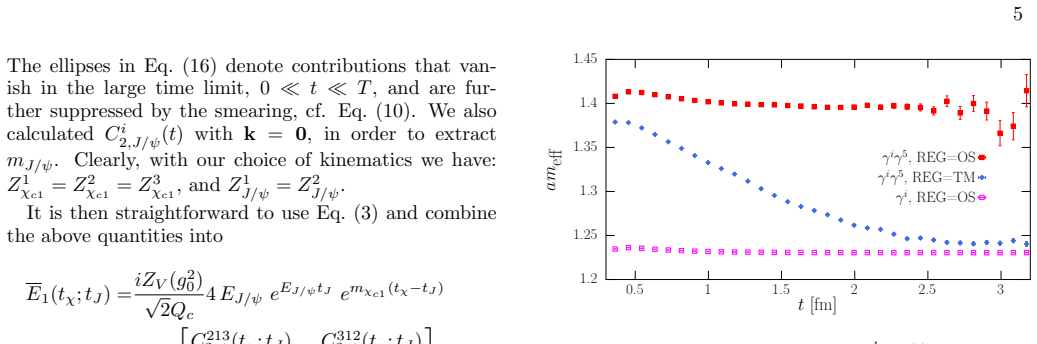
The argument rests on a decomposition of the transition matrix element $\langle J/\psi(k,\varepsilon)|J^\mu_{\rm em}|\chi_{c1}(p,\eta)\rangle$ into dimensionless form factors $E_1(q^2)$, $M_2(q^2)$, and a $C_1(q^2)$ that does not contribute to the physical amplitude. The photon is put on shell by giving the $J/\psi$ a three-momentum $|\mathbf{k}|\simeq389.4$~MeV through twisted boundary conditions on one charm propagator. A second load-bearing element is the use of the OS regularization, a valence-quark discretization that preserves exact charge conjugation, which forbids the $\chi_{c1}$ interpolating operator from mixing with the lighter $J/\psi$ ($1^{--}$) state and with $1^{+-}$ states. The form factors are extracted from long plateaus of three-point correlation functions at two source-sink separations, and the continuum limit is taken with a linear fit in $a^2$, with the coarsest-lattice-excluded fit used to set the extrapolation systematic.
What would settle it
Evaluate the disconnected three-point diagrams on the same four ensembles and compare the resulting $E_1$ and $M_2/E_1$ with the connected-only values; a shift in $E_1$ larger than about 0.01 or in $M_2/E_1$ larger than about 0.003 would mean the quoted continuum results are not the full QCD answer. A second decisive check is a new high-precision measurement of the $\chi_{c1}\to J/\psi\,\gamma$ width, which would settle whether the one-to-two-$\sigma$ excess over the current average is real.
Extended reading notes
Core claim
The central claim is that the continuum limit of lattice QCD, with $N_f=2+1+1$ dynamical quarks at physical masses, determines the on-shell transition form factors $E_1(0)$ and $M_2(0)$ for $\chi_{c1}\to J/\psi\,\gamma$ to be $E_1=0.879(11)$ and $M_2/E_1=-0.0668(22)$. From these the decay width is $\Gamma(\chi_{c1}\to J/\psi\,\gamma)=0.3265(79)$~MeV and the magnetic quadrupole fractional amplitude is $a_2=-0.0666(22)$. The paper presents this as the first full QCD computation of both form factors at physical quark masses: it matches the experimental $a_2$ and is compatible with the measured width at one to two $\sigma$, while differing from the only previous unquenched lattice result, a discrepancy the authors trace to the earlier work's interpolating operator overlapping spuriously with the $J/\psi$.
Load-bearing premise
The calculation includes only the dominant connected Feynman diagram, and the sea-quark pair-creation ('disconnected') loops are set to zero rather than computed, so if those omitted loops shift $E_1$ or $M_2/E_1$ by more than about one to three percent, the quoted width and $a_2$ change by more than the stated errors.
Editorial extensions
If this is right
- If the central values are right, $\Gamma(\chi_{c1}\to J/\psi\,\gamma)=0.3265(79)$~MeV becomes the first-principles reference for this charmonium transition, and the one-to-two-sigma excess over the experimental average marks a real tension that a new width measurement could sharpen or resolve.
- The ratio $M_2/E_1=-0.0668(22)$ gives $a_2=-0.0666(22)$, a precision lattice result competitive with the best angular analyses; it confirms that the magnetic quadrupole component is small and negative.
- The paper's way of isolating the $1^{++}$ state, by choosing the OS valence regularization so that charge conjugation stays exact, should carry over directly to other charmonium radiative transitions computed with twisted-mass ensembles.
- Because the quoted uncertainties are 1.2% on $E_1$ and 3% on $M_2/E_1$, the next decisive step is a direct evaluation of the omitted disconnected diagrams; if they fall inside the quoted errors, these results are the complete QCD answer.
Reading between the lines
- The close agreement of $a_2$ with experiment while the width runs one to two sigma high suggests that any missing contribution would have to affect $E_1$ more strongly than the $M_2/E_1$ ratio; a targeted computation of the charm-quark disconnected contribution to the electric form factor would test this directly.
- The same ensembles and valence regularization could be used to predict the radiative transition $\Upsilon\to\eta_b\gamma$, whose width is not known to comparable precision, giving a few-percent first-principles target for bottomonium physics.
- A new independent measurement of the branching fraction in a channel less entangled with the $\chi_{c1}$ total width would discriminate between the two experimental width assignments currently used to interpret the one-to-two-sigma tension.
Signed reviews
Editorial analysis
A structured set of objections, weighed in public.
Referee Report
Summary. The paper presents a lattice QCD determination of the E1 and M2 form factors for the radiative transition chi_c1 -> J/psi gamma at q^2=0. The calculation uses four ETMC Nf=2+1+1 twisted-mass ensembles with lattice spacings from about 0.057 to 0.091 fm, with physical light, strange, and charm sea quark masses except for the coarsest ensemble (m_pi ~ 175 MeV). The charm valence mass is tuned through m_Ds, twisted boundary conditions impose the on-shell photon momentum, and the chi_c1 interpolating operator is built in the OS regularization to avoid the parity/C mixing that would otherwise contaminate the J^PC=1++ channel. Three-point functions are computed from quark-connected Wick contractions only; two values of t_J on one ensemble are used to assign a systematic error via Eq. (21). Linear-in-a^2 continuum extrapolations, with a stability check excluding the coarsest lattice and a BAIC average, give E1=0.879(11), M2/E1=-0.0668(22), and hence Gamma(chi_c1->J/psi gamma)=0.3265(79) MeV and a2=-0.0666(22). The results are compared with the existing Fermilab measurement, with the CLEO and BES-III angular analyses, and with earlier quenched and Nf=2 lattice determinations.
Significance. If correct, this is the first unquenched, physical-quark-mass lattice determination of both transition form factors for this decay, and the quoted M2/E1 accuracy improves on the only existing quenched lattice result by about a factor of 30. The agreement of a2 with experiment is a nontrivial check of the lattice approach. The paper has several concrete strengths: four lattice spacings with good control of the continuum extrapolation, an explicit OS-regularization solution to the spurious-mixing problem, the use of twisted boundary conditions to reach q^2=0, an explicit treatment of the t_J systematic through Eq. (21), a BAIC-based fit averaging, and transparent reporting of the connected-only approximation. The main caveat is that disconnected Wick contractions are not computed; the authors argue they are OZI/SU(3)-suppressed and support this with the good continuum-limit agreement of the charmonium masses in Eq. (20) with experiment, but no direct numerical bound is provided. This is an acknowledged limitation that should be kept in mind when quoting Eqs. (22)-(24), but I do not regard it as invalidating the central results.
minor comments (4)
- [Section V] The phrase 'first full QCD computation' should be qualified, since only quark-connected diagrams are evaluated and the coarsest ensemble has m_pi ~ 175 MeV rather than the physical pion mass. I suggest rewording to something like 'first computation with Nf=2+1+1 dynamical quarks at physical light-quark masses for the quark-connected contribution' or an equivalent explicit definition of what 'full QCD' means here.
- [Section II and Table II] It is not completely clear how the systematic uncertainties Delta E1 and Delta M2 defined in Eq. (21) from the single B64 ensemble are propagated into the final errors. The text says they are included before the continuum extrapolation, but it does not state whether they are added in quadrature to the statistical errors in Table II or applied as a global shift to all ensembles. Please make this propagation explicit.
- [Eq. (16)] There is a typographical error in the J/psi two-point function: 'e^{-E_J/Psi (T-t)}' should be e^{-E_{J/psi}(T-t)}.
- [Section III and Fig. 4] In Fig. 4, the data points at t_J ~ 2.4 fm are 'slightly shifted horizontally for easier comparison', but the shift is not specified in the caption. A brief statement of the shift would make the comparison more transparent.
Circularity Check
No circularity: the form factors are computed from lattice three-point functions with standard external inputs; the target decay rate and a2 are not used as inputs.
full rationale
The derivation chain is self-contained. The central outputs E1=0.879(11) and M2/E1=-0.0668(22) (Eq. 22) are obtained by (i) computing the connected three-point functions of Eq. (14) at four lattice spacings, (ii) combining them with the two-point amplitudes via Eq. (18), and (iii) linear-in-a^2 continuum extrapolation (Fig. 6), with a BAIC average over fits with and without the coarsest ensemble. The only external tunings are standard QCD inputs: the charm mass fixed by m_Ds=1968 MeV, the lattice spacing from ETMC scale setting, Z_V from Ref. [15], and the experimental J/psi and chi_c1 masses used only to set the on-shell momentum k in Eq. (7); the latter is argued to be an O(a^2) redefinition and is not fitted to the decay rate or a2. No equation for Gamma or a2 enters the analysis; Eq. (5) and Eq. (1) are applied after the form factors are fixed. The paper explicitly acknowledges the omission of disconnected Wick contractions in Section V and notes the resulting few-percent uncertainty ('Being either Zweig or SU(3) suppressed, these contributions are expected to be tiny. However, this should be verified through direct computation'), but this is a correctness/limitation concern, not circularity: the omitted diagrams are not replaced by an equivalent fitted term. Methodological self-citations (OS regularization, smearing, BAIC from Ref. [18]) are standard practices and are not used to define the target form factors. Thus no step reduces, by construction or by self-citation, to the claimed prediction.
Assumptions & free parameters
free parameters (1)
- Bare charm quark mass am_c =
0.2620 (A48), 0.23157 (B64), 0.19840 (C80), 0.16490 (D96)
assumptions (6)
- domain assumption The Lorentz decomposition of Eq. (3) into E1, M2, C1 is the complete parametrization of the chi_c1 to J/psi gamma* matrix element.
- domain assumption Disconnected (Zweig- and SU(3)-suppressed) diagrams contribute negligibly to the three-point functions.
- domain assumption Linear extrapolation in a^2 is the correct continuum-limit form for E1 and M2/E1.
- domain assumption Ground-state dominance is achieved in the two- and three-point function plateaus with the chosen tJ and tchi ranges.
- standard math The OS regularization preserves an exact charge-conjugation symmetry that forbids mixing of the 1++ operator with 1-- and 1+- states.
- domain assumption Using experimental m_J/psi and m_chi_c1 in the on-shell momentum condition Eq. (7) instead of the per-ensemble lattice masses only reshuffles O(a^2) effects.
Cite this review
Pith. "Pith review of Lattice QCD study of the $\chi_{c1}\to J/\psi \, \gamma$ decay." pith.science (2026). https://pith.science/paper/NX3WZNLP
@misc{pith2026250617030,
  author       = {Pith},
  title        = {Pith review of: Lattice QCD study of the $\chi_c1\to J/\psi \, \gamma$ decay},
  year         = {2026},
  howpublished = {\url{https://pith.science/paper/NX3WZNLP}},
  note         = {Machine review of arXiv:2506.17030}
}
abstract
We present the results of our lattice QCD computation of the electric ($E_{1}$) and magnetic $(M_{2})$ form factors relevant to the $\chi_{c1}\to J/\psi\,\gamma$ decay by using the gauge field configurations produced by the Extended Twisted Mass Collaboration with $N_{f}=2+1+1$ dynamical Wilson-Clover twisted mass fermions at four different lattice spacings with physical dynamical $u$ , $d$, $s$ and $c$ quark masses (except for the coarsest lattice for which the lightest sea quark corresponds to a pion with $m_{\pi}\simeq 175~\mathrm{MeV}$). In the continuum limit, we obtain $\Gamma( \chi_{c1}\to J/\psi\ \gamma ) = 0.3265(79)~\mathrm{MeV}$, which agrees to $(1\div 2) \sigma$ with the experimental results and disagrees with a previous (unquenched) lattice QCD calculation. Our result for the magnetic quadrupole fractional transition amplitude, $a_{2} =M_{2}/\sqrt{E_{1}^{2}+M_{2}^{2}} = -0.0666(22)$, is in agreement with the experiment and represents an improvement by a factor of about $30$ with respect to the only existing (quenched) lattice QCD result.
Figures


Figures from the paper (3 more)


Reference graph
Works this paper leans on
-
[1]
G. T. Bodwin, E. Braaten, and G. P. Lepage, Phys. Rev. D51, 1125 (1995), [Erratum: Phys.Rev.D 55, 5853 (1997)], arXiv:hep-ph/9407339
arXiv 1995
-
[2]
N. Brambilla, A. Pineda, J. Soto, and A. Vairo, Nucl. Phys. B566, 275 (2000), arXiv:hep-ph/9907240
arXiv 2000
-
[3]
S. Fleming, I. Z. Rothstein, and A. K. Leibovich, Phys. Rev. D64, 036002 (2001), arXiv:hep-ph/0012062
arXiv 2001
-
[4]
N. Brambilla, A. Pineda, J. Soto, and A. Vairo, Rev. Mod. Phys.77, 1423 (2005), arXiv:hep-ph/0410047
arXiv 2005
-
[5]
T. A. Armstronget al.(E760), Nucl. Phys. B373, 35 (1992)
work page 1992
-
[6]
M. Andreottiet al., Nucl. Phys. B717, 34 (2005), 10 arXiv:hep-ex/0503022
arXiv 2005
-
[7]
Navaset al.(Particle Data Group), Phys
S. Navaset al.(Particle Data Group), Phys. Rev. D110, 030001 (2024)
2024
-
[8]
Higher-order multipole amplitudes in charmonium radiative transitions
M. Artusoet al.(CLEO), Phys. Rev. D80, 112003 (2009), arXiv:0910.0046 [hep-ex]
work page Pith review arXiv 2009
Show all 40 references
-
[9]
Ablikimet al.(BESIII), Phys
M. Ablikimet al.(BESIII), Phys. Rev. D95, 072004 (2017), arXiv:1701.01197 [hep-ex]
2017 arXiv
-
[10]
J. J. Dudek, R. G. Edwards, and D. G. Richards, Phys. Rev. D73, 074507 (2006), arXiv:hep-ph/0601137
2006 arXiv
-
[11]
J. J. Dudek, R. Edwards, and C. E. Thomas, Phys. Rev. D79, 094504 (2009), arXiv:0902.2241 [hep-ph]
2009 arXiv
-
[12]
N. Li, H. Su, and Y.-J. Wu, Eur. Phys. J. A58, 122 (2022)
2022
- [13]
- [14]
-
[15]
Alexandrouet al.(Extended Twisted Mass Collabo- ration (ETMC)), (2024), arXiv:2411.08852 [hep-lat]
C. Alexandrouet al.(Extended Twisted Mass Collabo- ration (ETMC)), (2024), arXiv:2411.08852 [hep-lat]
2024 arXiv
-
[16]
Sheikholeslami and R
B. Sheikholeslami and R. Wohlert, Nucl. Phys. B259, 572 (1985)
1985
-
[17]
Becirevic and F
D. Becirevic and F. Sanfilippo, JHEP01, 028 (2013), arXiv:1206.1445 [hep-lat]
2013 arXiv
-
[18]
Beˇ cirevi´ c, R
D. Beˇ cirevi´ c, R. Di Palma, R. Frezzotti, G. Gagliardi, V. Lubicz, F. Sanfilippo, and N. Tantalo, (2025), arXiv:2504.16807 [hep-lat]
2025 arXiv
-
[19]
Di Palma, G
R. Di Palma, G. Gagliardi, and F. Sanfilippo, PoSLA T- TICE2023, 152 (2024)
2024
-
[20]
G. M. de Divitiis, R. Petronzio, and N. Tantalo, Phys. Lett. B595, 408 (2004), arXiv:hep-lat/0405002
2004 arXiv
-
[21]
P. F. Bedaque, Phys. Lett. B593, 82 (2004), arXiv:nucl- th/0402051
2004
-
[22]
C. T. Sachrajda and G. Villadoro, Phys. Lett. B609, 73 (2005), arXiv:hep-lat/0411033
2005 arXiv
-
[23]
R. G. Petry, D. Harnett, R. Lewis, and R. M. Woloshyn, Phys. Rev. D78, 074502 (2008), arXiv:0803.4141 [hep- lat]
2008 arXiv
-
[24]
J. L. Rosner, Phys. Rev. D78, 114011 (2008), arXiv:0809.0471 [hep-ph]
2008 arXiv
-
[25]
K. J. Sebastian, H. Grotch, and F. L. Ridener, Phys. Rev. D45, 3163 (1992)
1992
-
[26]
G. Karl, S. Meshkov, and J. L. Rosner, Phys. Rev. Lett. 45, 215 (1980)
1980
-
[27]
Jansen and C
K. Jansen and C. Urbach, Comput. Phys. Commun.180, 2717 (2009), arXiv:0905.3331 [hep-lat]
2009 arXiv
-
[28]
Abdel-Rehim, F
A. Abdel-Rehim, F. Burger, A. Deuzeman, K. Jansen, B. Kostrzewa, L. Scorzato, and C. Urbach, PoSLA T- TICE2013, 414 (2014), arXiv:1311.5495 [hep-lat]
2014 arXiv
-
[29]
Deuzeman, K
A. Deuzeman, K. Jansen, B. Kostrzewa, and C. Urbach, PoSLA TTICE2013, 416 (2014), arXiv:1311.4521 [hep- lat]
2014 arXiv
-
[30]
Kostrzewa, S
B. Kostrzewa, S. Bacchio, J. Finkenrath, M. Garofalo, F. Pittler, S. Romiti, and C. Urbach (ETM), PoSLA T- TICE2022, 340 (2023), arXiv:2212.06635 [hep-lat]
2023 arXiv
-
[31]
Deuzeman, S
A. Deuzeman, S. Reker, and C. Urbach (ETM), Comput. Phys. Commun.183, 1321 (2012), arXiv:1106.4177 [hep- lat]
2012 arXiv
-
[32]
Frommer, K
A. Frommer, K. Kahl, S. Krieg, B. Leder, and M. Rottmann, SIAM J. Sci. Comput.36, A1581 (2014), arXiv:1303.1377 [hep-lat]
2014 arXiv
-
[33]
Alexandrou, S
C. Alexandrou, S. Bacchio, J. Finkenrath, A. Frommer, K. Kahl, and M. Rottmann, Phys. Rev. D94, 114509 (2016), arXiv:1610.02370 [hep-lat]
2016 arXiv
-
[34]
Bacchio, C
S. Bacchio, C. Alexandrou, and J. Finkerath, EPJ Web Conf.175, 02002 (2018), arXiv:1710.06198 [hep-lat]
2018 arXiv
-
[35]
Alexandrou, S
C. Alexandrou, S. Bacchio, and J. Finkenrath, Comput. Phys. Commun.236, 51 (2019), arXiv:1805.09584 [hep- lat]
2019 arXiv
-
[36]
Jo´ o, D
B. Jo´ o, D. D. Kalamkar, T. Kurth, K. Vaidyanathan, and A. Walden, inHigh Performance Computing: ISC High Performance 2016 International Workshops, Exa- Comm, E-MuCoCoS, HPC-IODC, IXPUG, IWOPH, Pˆ 3MA, VHPC, WOPSSS, Frankfurt, Germany, June 19– 23, 2016, Revised Selected Pape...
2016
-
[37]
Schr¨ ock, S
M. Schr¨ ock, S. Simula, and A. Strelchenko, PoSLA T- TICE2015, 030 (2016), arXiv:1510.08879 [hep-lat]
2016 arXiv
-
[38]
M. A. Clark, R. Babich, K. Barros, R. C. Brower, and C. Rebbi, Comput. Phys. Commun.181, 1517 (2010), arXiv:0911.3191 [hep-lat]
2010 arXiv
-
[39]
Babich, M
R. Babich, M. A. Clark, B. Joo, G. Shi, R. C. Brower, and S. Gottlieb, inSC11 International Conference for High Performance Computing, Networking, Storage and Analysis Seattle, Washington, November 12-18, 2011 (2011) arXiv:1109.2935 [hep-lat]
2011 arXiv
-
[40]
M. A. Clark, B. Jo´ o, A. Strelchenko, M. Cheng, A. Gamb- hir, and R. C. Brower, inSC ’16: Proceedings of the In- ternational Conference for High Performance Comput- ing, Networking, Storage and Analysis(2016) pp. 795– 806, arXiv:1612.07873 [hep-lat]
2016 arXiv
Reviewed August 15, 2026 · model on record in the stance chip above.
Discussion (0). Continue with ORCID to comment.