REVIEW 4 major objections 5 minor 54 references
Boolean-network simplification and rule fitting to unravel chemotherapy resistance in non-small cell lung cancer
T0 review · 4 major / 5 minor · reviewed 2026-08-07 · deepseek-v4-flash
Pith's one-line read This paper claims that a 31-node Boolean model of cisplatin- and pemetrexed-resistance in non-small cell lung cancer reduces to a 9-node core that preserves exactly the three clinically relevant steady states and their basins, shrinking…
desk verdict Useful 9-node reduction, but the exact-reproduction claim is contradicted by the paper's own tables. read the letter →
The pith
A machine-rendered reading of the paper's core claim, the machinery that carries it, and where it could break.
The reading
What carries the argument
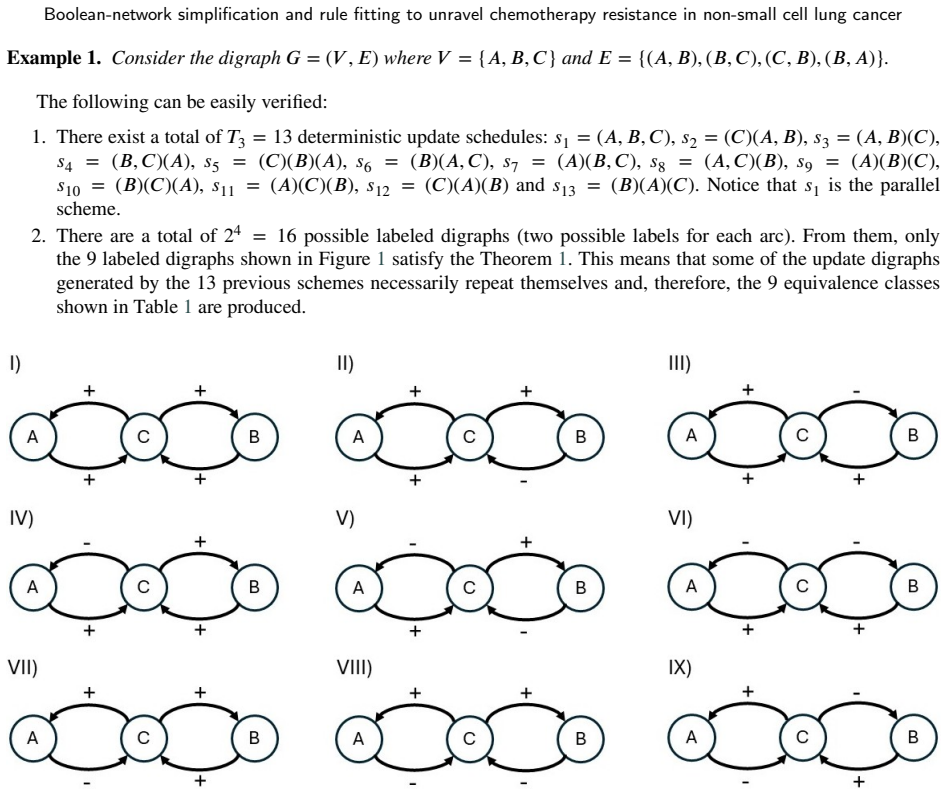
The machinery that carries the argument is threefold. First, the update digraph: a labeled directed graph encoding, for each interaction, whether the source node is updated before or after its target; two update schedules with the same update digraph provably produce identical dynamics, so exhaustive analysis of all deterministic update schemes reduces to analyzing one representative per equivalence class. Second, the reduction logic itself: nodes that sustain negative-feedback circuits (the structural source of oscillation, per Thomas conditions) and nodes whose values are fixed or deducible under the DNA_Damage=1 context are removed while the remaining rules are rewritten, preserving the fixed-point landscape. Third, the Boolean Rule-Fitting Algorithm, which enumerates candidate replacements (up to three regulators combined with AND, OR, and NOT), keeps those that match the node's value on every original attractor, and then simulates the full network to require the new rule to leave the attractor set exactly unchanged.
What would settle it
Enumerate all attractors of the original 31-node network and of the 9-node core: the exact-reproduction claim is false if the core is missing any attractor of the original other than the three limit cycles and the DNA_Damage=0 proliferation state that the paper explicitly sets aside, or if any basin changes size. A wet-lab check: measure BMI1 levels in NSCLC cells under the four combinations of E2F1, p53_A, and p53_K states; the fitted rule predicts BMI1 is ON exactly when E2F1 is ON or both p53 forms are OFF.
Extended reading notes
Core claim
The central discovery, stated in the paper's own terms, is that aggressive down-scaling of a biologically grounded Boolean network is possible without sacrificing dynamical fidelity. Working from a reconstructed 31-node model, the authors remove nodes in three stages—first the redundant regulators Sirt_1 and p53_INP1 (whose removal dismantles negative-feedback loops and eliminates spurious period-4 cycles, following Thomas conditions), then every node whose state is fixed or deducible once DNA_Damage equals 1, then terminal-node groups—obtaining a 9-node core (miR-145, Sp1, MALAT1, BMI1, KLF4, p53, p53_A, p53_K, E2F1) that reproduces the three clinically relevant steady states and their basins exactly. Synchronous simulation of the core gives basins of 98.44% (drug resistance), 0.39% (senescence), and 0.39% (apoptosis), matching the 31-, 29-, and 14-node versions, and across 10,632 representative asynchronous update schemes the same three steady states always remain. Finally, an exhaustive Boolean rule-fitting algorithm, restricted to update rules of at most three regulators, returns five rules that preserve exactly the target attractor set; the only biologically coherent one, BMI1 = (!p53_A & !p53_K) | E2F1, is validated against recent experimental evidence, eliminates the length-2 limit cycle, and pushes the share of asynchronous schemes with only the three steady states from 69.19% to 94.59%.
Load-bearing premise
The reduction rests on treating the original model's three limit cycles as biologically spurious and on assuming the DNA_Damage=1 context covers every clinically relevant outcome, so that the proliferation steady state can be discarded.
Editorial extensions
If this is right
- If the reduction is exact, the 9-node core makes exhaustive perturbation screens (every node knockout or overexpression) trivial, because only 512 states need to be enumerated.
- The conserved basin proportions become a quantitative prediction: interventions that in the model shrink the drug-resistance basin or enlarge the senescence and apoptosis basins are candidates for restoring cisplatin-pemetrexed sensitivity.
- The fitted BMI1 rule—BMI1 active when E2F1 is active and both phosphorylated p53 forms are off—gives a concrete molecular hypothesis about how resistance is maintained, testable by measuring BMI1 expression under those conditions.
- The rule-fitting algorithm generalizes: any Boolean model with unwanted spurious attractors can be scanned for rewritten rules that preserve the desired attractor set exactly, provided the search keeps the connectivity bounded.
- Because the three steady states persist across all representative asynchronous update schemes, the phenotype-level conclusions are not artifacts of the synchronous update schedule.
Reading between the lines
- The 'exact reproduction' claim is narrower than a first reading of the abstract suggests: the 9-node core excludes the proliferation steady state and presumes the original limit cycles are spurious, so the core cannot be used to study proliferation or any oscillation-driven biology.
- The model's dominant drug-resistance basin (98.44% synchronously) is larger than the 70–80% clinical non-response range the paper cites; mapping basin fractions directly to patient response rates would need a calibration step rather than qualitative agreement.
- The reduction recipe—excise negative-feedback structures that only produce cycling, then freeze nodes that are determined in a fixed input context—looks like a general heuristic for simplifying other cell-fate Boolean models.
- The rule-fitting result is conditioned on the K≤3 connectivity limit; allowing up to four regulators might yield other (or simpler) rules that also preserve the attractors, so the fitted BMI1 rule is not shown to be unique.
Editorial analysis
A structured set of objections, weighed in public.
Referee Report
Summary. The paper reconstructs a 31-node Boolean network model of cisplatin/pemetrexed resistance in non-small-cell lung cancer, reduces it successively to 29, 14, and 9 nodes, analyzes the dynamics under all equivalence classes of deterministic update schemes, and proposes a rule-fitting algorithm to replace the BMI1 rule. The central claim is that the 9-node core 'exactly reproduces the original attractor landscape' while shrinking the state space by four orders of magnitude, and that the three clinically relevant steady states and their basins are conserved and close to clinical resistance frequencies. The paper provides detailed tables of steady states and basins, pseudocode for the fitting algorithm, and links to GitHub repositories for the simulation and fitting tools.
Significance. If the exact-reproduction claim were correct, the 9-node model would be a valuable fast proxy for the original 31-node model and a credible in-silico screening tool. The paper has real strengths: it makes the update-scheme equivalence-class machinery concrete, performs an exhaustive enumeration of representative deterministic schemes, reports attractor basins explicitly, and ships code for reproducibility. However, the central claim is not supported by the paper's own tables: the reduction is conditional on DNA_Damage=1 and discards the proliferation steady state and most limit cycles. Once the claims are corrected to a conditional preservation statement, the contribution is a moderately useful case study in Boolean-network reduction under a fixed input context, but the advertised exactness is a substantial overclaim. The rule-fitting algorithm also does not, as written, enforce the stated cycle-elimination target.
major comments (4)
- [Abstract; §3.3–3.4; Tables A.3 and 3] The statement that the 9-node core 'exactly reproduces the original attractor landscape' is contradicted by the paper's own results. Table A.3 reports four fixed points, including a proliferation steady state with DNA_Damage=0, and three limit cycles for the reconstructed 31-node network, whereas Table 3 reports three fixed points and one limit cycle for the 9-node network. Section 3.3 and the caption of Figure A.3 state that the 14- and 9-node reductions are performed for the case where DNA_Damage equals 1, so the proliferation fixed point and the DNA_Damage=0 context are removed by construction. The exact-reproduction claim should be replaced by a statement about preservation of the three clinically relevant steady states in the DNA_Damage=1 projection, with the discarded attractors explicitly listed.
- [§4.5; Tables 2 and 3] The clinical comparison of the 98.44% drug-resistance basin with clinical non-response rates is not supported. The 98.44% figure is computed after restricting the state space to DNA_Damage=1 and after dropping the proliferation attractor. In the 29-node network (Table 2), the synchronous basins are 50.00% for proliferation and 49.89% for drug resistance; conditioning on DNA_Damage=1 removes the proliferation basin and inflates the drug-resistance percentage by construction. The comparison with the 70–80% clinical non-response rate should either use the full landscape or be explicitly labeled as a conditional projection, not presented as a validation of the reduction.
- [§3.6; Algorithm 1; §4.4] The fitting procedure does not implement the stated goal of retaining only the three steady states and eliminating the limit cycle. In Algorithm 1, A_original is computed as the fixed-point set (lines 2–6), and a candidate rule is accepted only if A_new equals A_original (lines 18–25); no check is made for the presence or absence of limit cycles. The assertion in Section 4.4 that the algorithm selects rules 'reproducing exactly the same set of desired attractors' is therefore not guaranteed by the method as written. The cycle-elimination property of the selected BMI1 rule must be either added as an explicit filter in the algorithm or reported as a separately verified empirical result, with the pseudocode updated accordingly.
- [§3.1; §4.1; Table A.3] The reduction discards the original three limit cycles on the assumption that they are 'spurious cycles' because the original article does not indicate a biological function for them. This is a biological assumption, not a dynamical equivalence, and it is load-bearing for the exact-reproduction claim. The manuscript should state this assumption as a limitation and discuss whether any of the discarded cycles, including the DNA_Damage=0 cycles in Table A.3, could carry biological function; otherwise the reduction cannot be described as exact even within its conditional scope.
minor comments (5)
- [§3.6; §4.4] The word 'spuriou' appears twice and should be corrected to 'spurious'.
- [§3.3; Figure A.3] The conditional nature of the 14- and 9-node reductions should be stated in the main text at the point of first use, not only in the figure caption, so that readers do not infer that the full attractor landscape is preserved.
- [Table A.3] The columns for the three limit cycles are difficult to read because the cycle configurations are not clearly separated from the steady-state columns; formatting them as distinct sub-tables or with explicit cycle-number labels would improve clarity.
- [Algorithm 1] The global consistency check uses synchronous evaluation (EvaluateNetwork with all nodes updated at once); because the paper emphasizes asynchronous update schemes, the pseudocode should state the update scheme used for this check and justify why a synchronous check suffices for the asynchronous claim.
- [References] Reference [53] appears truncated in the reference list, with the year shown as '202' instead of the complete publication year.
Circularity Check
The 'exact reproduction' claim is defined into a DNA_Damage=1 projection and the rule-fitting 'validation' restates the fitting objective; the central reduction claim is therefore substantially circular.
-
self definitional
[Abstract; Section 3.1; Section 3.3; Figure A.3 caption; Section 3.4 / Table 3]
"'we present a systematic reduction of a 31-node Boolean model ... to a compact 9-node core that exactly reproduces the original attractor landscape.' (Abstract) The 29-node network was simplified 'for the case where DNA_Damage equals 1' (Figure A.3 caption), while Section 3.1 reports the 31-node model has 'four terminal phenotypes or stable states: proliferation, drug resistance, senescence, and apoptosis, along with three limit cycles' and the cycles 'are assumed to be spurious cycles.'"
The original attractor landscape, as defined by the paper's own Table A.3, includes four steady states (including a proliferation state with DNA_Damage=0) and three limit cycles. The reduction to 9 nodes is explicitly performed only for DNA_Damage=1 and removes the proliferation state and the cycles (Table 3 shows three steady states plus one length-2 cycle). The claim of exact reproduction therefore holds only after redefining the 'original landscape' as the DNA_Damage=1 projection of the three clinically relevant steady states; the reduction's output is an input assumption, not an equivalence result.
-
fitted input called prediction
[Section 3.6; Algorithm 1 (lines 15, 24-25); Section 4.4]
"Each candidate rule is evaluated in two stages: ... its global consistency is assessed by simulating the complete network dynamics under the new rule to confirm that the resulting attractors match exactly those desired' (Section 3.6). Algorithm 1 accepts a rule only 'if A_new = A_original' (line 24). The paper then reports 'five candidate rules that produced the target dynamics (that is, only the three steady states)' and, after fitting, that 'the original steady states remained unchanged.'"
The statement that the fitted network preserves the three steady states is not an independent prediction: every candidate that altered the fixed-point set was rejected by the algorithm's own acceptance test (A_new = A_original). The later report of 99.22% basin convergence to the drug-resistance state and of unchanged steady states restates the search objective. The only non-tautological part—whether the chosen BMI1 rule also removes the length-2 cycle—is a post-selection observation about one of five fitted rules, not a test of the fitting method. The robustness percentages (69.19% vs 94.59%) describe models chosen to match target attractors, so they are not out-of-sample evidence.
full rationale
The strongest circularity is in the abstract's central claim. Section 3.1 defines the original attractor landscape as four steady states plus three limit cycles; Table A.3 shows the proliferation fixed point has DNA_Damage=0. The 14- and 9-node reductions are expressly performed for the DNA_Damage=1 case (Figure A.3 caption), discarding the proliferation state and the cycles as 'spurious'. The 9-node network (Table 3) has three steady states and one cycle, so 'exactly reproduces the original attractor landscape' only if the landscape is redefined in advance as the projection onto the three clinically relevant states. The rule-fitting section then treats preservation of those three states as a validation result, although Algorithm 1 accepts only rules with A_new=A_original, making the preservation a search constraint. The update-digraph citations to the authors' earlier work are standard mathematical tools and are not the load-bearing circular step; the circularity is in the exact-reproduction and rule-fitting claims. The basin-frequency comparison to clinical numbers is an external but weak validation, not circularity.
Assumptions & free parameters
free parameters (1)
- BMI1 update rule (discrete fitted parameter) =
(!p53_A & !p53_K) | E2F1
assumptions (5)
- ad hoc to paper The original 31-node model's three limit cycles are spurious and can be discarded.
- domain assumption Reduction can be performed in the context DNA_Damage=1, and the resulting 9-node network is sufficient to represent the clinically relevant steady states.
- domain assumption Uniform random sampling of initial Boolean states is a valid proxy for clinical patient frequencies of phenotypes.
- standard math Update digraph equivalence classes from Aracena et al. correctly enumerate all distinct deterministic update-scheme dynamics.
- domain assumption Thomas conditions (negative circuits necessary for oscillation, positive circuits for multistability) justify the removal of Sirt_1 and p53_INP1.
Cite this review
Pith. "Pith review of Boolean-network simplification and rule fitting to unravel chemotherapy resistance in non-small cell lung cancer." pith.science (2026). https://pith.science/paper/NXISLU2Y
@misc{pith2026250602525,
  author       = {Pith},
  title        = {Pith review of: Boolean-network simplification and rule fitting to unravel chemotherapy resistance in non-small cell lung cancer},
  year         = {2026},
  howpublished = {\url{https://pith.science/paper/NXISLU2Y}},
  note         = {Machine review of arXiv:2506.02525}
}
read the original abstract
Boolean networks are powerful frameworks for capturing the logic of gene-regulatory circuits, yet their combinatorial explosion hampers exhaustive analyses. Here, we present a systematic reduction of a 31-node Boolean model that describes cisplatin- and pemetrexed-resistance in non-small-cell lung cancer to a compact 9-node core that exactly reproduces the original attractor landscape. The streamlined network shrinks the state space by four orders of magnitude, enabling rapid exploration of critical control points, rules fitting and candidate therapeutic targets. Extensive synchronous and asynchronous simulations confirm that the three clinically relevant steady states and their basins of attraction are conserved and reflect resistance frequencies close to those reported in clinical studies. The reduced model provides an accessible scaffold for future mechanistic and drug-discovery studies.
Figures


Reference graph
Works this paper leans on
-
[1]
Non-small-cell lung cancer.NaturereviewsDisease primers, 1(1):1–16, 2015
Cesare Gridelli, Antonio Rossi, David P Carbone, Juliana Guarize, Niki Karachaliou, Tony Mok, Francesco Petrella, Lorenzo Spaggiari, and Rafael Rosell. Non-small-cell lung cancer.NaturereviewsDisease primers, 1(1):1–16, 2015
work page 2015
-
[2]
ShantanuGupta,DanerASilveira,GabrielPSPiedade,MiguelPOstrowski,JoséCarlosMMombach,andRonaldoFHashimoto. Adynamic booleannetworkrevealsthatthebmi1andmalat1axisisassociatedwithdrugresistancebylimitingmir-145-5pinnon-smallcelllungcancer. Non-codingRNAResearch, 9(1):185–193, 2024
work page 2024
-
[3]
Harri Lähdesmäki, Ilya Shmulevich, and Olli Yli-Harja. On learning gene regulatory networks under the boolean network model.Machine learning, 52:147–167, 2003
work page 2003
-
[4]
Combinatoricsonupdatedigraphsinbooleannetworks
JulioAracena,EricFanchon,MarcoMontalva,andMathildeNoual. Combinatoricsonupdatedigraphsinbooleannetworks. DiscreteApplied Mathematics, 159(6):401–409, 2011
work page 2011
-
[5]
Eric Goles, Marco Montalva, and Gonzalo A Ruz. Deconstruction and dynamical robustness of regulatory networks: application to the yeast cell cycle networks.Bulletinof mathematical biology, 75:939–966, 2013
work page 2013
-
[6]
Julio Aracena, Jacques Demongeot, Eric Fanchon, and Marco Montalva. On the number of different dynamics in boolean networks with deterministic update schedules.Mathematical biosciences, 242(2):188–194, 2013
work page 2013
-
[7]
R Foundation for Statistical Computing, Vienna, Austria, 2021
R Core Team.R:A LanguageandEnvironmentforStatisticalComputing. R Foundation for Statistical Computing, Vienna, Austria, 2021
work page 2021
-
[8]
Boolnet—an r package for generation, reconstruction and analysis of boolean networks
Christoph Müssel, Martin Hopfensitz, and Hans A Kestler. Boolnet—an r package for generation, reconstruction and analysis of boolean networks. Bioinformatics, 26(10):1378–1380, 2010
work page 2010
Show all 54 references
-
[9]
Versión 3.10.5, consultado el 4 de noviembre de 2024
Python Software Foundation.Python Documentation, 2024. Versión 3.10.5, consultado el 4 de noviembre de 2024
2024
-
[10]
Metabolic stability and epigenesis in randomly constructed genetic nets.Journal of theoretical biology, 22(3):437–467, 1969
Stuart A Kauffman. Metabolic stability and epigenesis in randomly constructed genetic nets.Journal of theoretical biology, 22(3):437–467, 1969. Espinoza et al. 2025:Preprint submitted to Elsevier Page 13 of 28 Boolean-network simplification and rule fitting to unravel chemothe...
1969
-
[11]
Réka Albert and Hans G Othmer. The topology of the regulatory interactions predicts the expression pattern of the segment polarity genes in drosophila melanogaster.Journal of theoreticalbiology, 223(1):1–18, 2003
2003
-
[12]
Dynamicalandtopologicalrobustnessofthemammaliancellcyclenetwork: A reverse engineering approach.Biosystems, 115:23–32, 2014
GonzaloARuz,EricGoles,MarcoMontalva,andGaryBFogel. Dynamicalandtopologicalrobustnessofthemammaliancellcyclenetwork: A reverse engineering approach.Biosystems, 115:23–32, 2014
2014
-
[13]
Lacoperonbooleanmodels:Dynamicalrobustnessandalternative improvements
MarcoMontalva-Medel,ThomasLedger,GonzaloARuz,andEricGoles. Lacoperonbooleanmodels:Dynamicalrobustnessandalternative improvements. Mathematics, 9(6):600, 2021
2021
-
[14]
Dynamical robustness of a boolean model for the human gonadal sex determination.Computational BiologyandChemistry, 113:108225, 2024
Erika Vivanco, Eric Goles, Marco Montalva-Medel, and María J Poupin. Dynamical robustness of a boolean model for the human gonadal sex determination.Computational BiologyandChemistry, 113:108225, 2024
2024
-
[15]
On the preservation of limit cycles in boolean networks under different updating schemes
Gonzalo A Ruz, Marco Montalva, and Eric Goles Chacc. On the preservation of limit cycles in boolean networks under different updating schemes. InECAL, pages 1085–1090, 2013
2013
-
[16]
Blockinvarianceinafamilyofelementarycellularautomata
EricGoles,MarcoMontalva-Medel,StéphanieMaclean,andHenningMortveit. Blockinvarianceinafamilyofelementarycellularautomata. Journal ofCellularAutomata, 13, 2018
2018
-
[17]
Maximum sensitivity to update schedules of elementary cellular automata over periodic configurations.NaturalComputing, 19(1):51–90, 2020
Kévin Perrot, Marco Montalva-Medel, Pedro PB De Oliveira, and Eurico LP Ruivo. Maximum sensitivity to update schedules of elementary cellular automata over periodic configurations.NaturalComputing, 19(1):51–90, 2020
2020
-
[18]
On the robustness of update schedules in boolean networks.Biosystems, 97(1):1–8, 2009
Julio Aracena, Eric Goles, Andrés Moreira, and Luis Salinas. On the robustness of update schedules in boolean networks.Biosystems, 97(1):1–8, 2009
2009
-
[19]
Onthe numberofupdatedigraphsand itsrelationwiththefeedback arc sets and tournaments.DiscreteApplied Mathematics, 161(10-11):1345–1355, 2013
JulioAracena,Jacques Demongeot,EricFanchon,andMarco Montalva. Onthe numberofupdatedigraphsand itsrelationwiththefeedback arc sets and tournaments.DiscreteApplied Mathematics, 161(10-11):1345–1355, 2013
2013
-
[20]
Time out of joint: Attractors in asynchronous random boolean networks
Inman Harvey and Terry Bossomaier. Time out of joint: Attractors in asynchronous random boolean networks. InProceedings of the fourth Europeanconferenceonartificial life, pages 67–75. Citeseer, 1997
1997
-
[21]
Block invariance in elementary cellular automata.J Cell Autom, 10(1-2):119–135, 2015
Eric Goles, Marco Montalva-Medel, Henning Mortveit, and Salvador Ramirez-Flandes. Block invariance in elementary cellular automata.J Cell Autom, 10(1-2):119–135, 2015
2015
-
[22]
Maximum sensitivity to update schedules of elementary cellular automata over infinite configurations.Informationand Computation, 274:104538, 2020
Eurico LP Ruivo, Pedro Paulo Balbi, Marco Montalva-Medel, and Kevin Perrot. Maximum sensitivity to update schedules of elementary cellular automata over infinite configurations.Informationand Computation, 274:104538, 2020
2020
-
[23]
Regulatorynetworksseenasasynchronousautomata:alogicaldescription
RenéThomas. Regulatorynetworksseenasasynchronousautomata:alogicaldescription. JournalofTheoreticalBiology,153(1):1–23,1991
1991
-
[24]
Janus-facedroleofsirt1intumorigenesis
Na-YoungSongandYoung-JoonSurh. Janus-facedroleofsirt1intumorigenesis. AnnalsoftheNewYorkAcademyofSciences,1271(1):10– 19, 2012
2012
-
[25]
The critical role of the class iii histone deacetylase sirt1 in cancer.Cancerresearch, 69(5):1702– 1705, 2009
Tao Liu, Pei Y Liu, and Glenn M Marshall. The critical role of the class iii histone deacetylase sirt1 in cancer.Cancerresearch, 69(5):1702– 1705, 2009
2009
-
[26]
Tumorprotein53-inducednuclearprotein1enhancesp53functionandrepressestumorigenesis
JeyranShahbazi,RichardLock,andTaoLiu. Tumorprotein53-inducednuclearprotein1enhancesp53functionandrepressestumorigenesis. Frontiersingenetics, 4:80, 2013
2013
-
[27]
Theroleofepigeneticsinresistancetocisplatinchemotherapyinlungcancer
KennethJO’Byrne,MartinPBarr,andStevenGGray. Theroleofepigeneticsinresistancetocisplatinchemotherapyinlungcancer. Cancers, 3(1):1426–1453, 2011
2011
-
[28]
Inference of asynchronous boolean network from biological pathways
Haimabati Das and Ritwik Kumar Layek. Inference of asynchronous boolean network from biological pathways. In2015 37th Annual International Conferenceof the IEEEEngineering in Medicineand BiologySociety(EMBC), pages 3270–3274. IEEE, 2015
2015
-
[29]
Attractor analysis of asynchronous boolean models of signal transduction networks
Assieh Saadatpour, István Albert, and Réka Albert. Attractor analysis of asynchronous boolean models of signal transduction networks. Journal oftheoreticalbiology, 266(4):641–656, 2010
2010
-
[30]
Wen-WeiChang,Bing-YenWang,Shih-HongChen,Peng-JuChien,Gwo-TarngSheu,andChing-HsiungLin. mir-145-5ptargetssp1innon- small cell lung cancer cells and links to bmi1 induced pemetrexed resistance and epithelial–mesenchymal transition.International Journal of Molecular Sciences, 23(...
2022
-
[31]
Low mir-145 expression level is associated withpoorpathologicaldifferentiationandpoorprognosisinnon-smallcelllungcancer
Hua Shen, Jianxin Shen, Lin Wang, Zhumei Shi, Min Wang, Bing-hua Jiang, and Yongqian Shu. Low mir-145 expression level is associated withpoorpathologicaldifferentiationandpoorprognosisinnon-smallcelllungcancer. Biomedicine&Pharmacotherapy,69:301–305,2015
2015
-
[32]
Shijie Zhang, Xiaoyun Zhang, Qianqian Sun, Chunbo Zhuang, Guanlin Li, Li Sun, and Huaqi Wang. Lncrna nr2f2-as1 promotes tumourigenesis through modulating bmi1 expression by targeting mir-320b in non-small cell lung cancer.Journal of Cellular and Molecular Medicine, 23(3):2001–...
2001
-
[33]
Shouzhong Wang, Tao Wang, Darui Liu, and Haiyan Kong. Lncrna malat1 aggravates the progression of non-small cell lung cancer by stimulating the expression of commd8 via targeting mir-613.CancerManagementand Research, pages 10735–10747, 2020
2020
-
[34]
Microrna-128-2 targets the transcriptional repressor e2f5 enhancing mutant p53 gain of function.CellDeath &Differentiation, 19(6):1038–1048, 2012
S Donzelli, G Fontemaggi, Francesco Fazi, S Di Agostino, F Padula, F Biagioni, P Muti, S Strano, and G Blandino. Microrna-128-2 targets the transcriptional repressor e2f5 enhancing mutant p53 gain of function.CellDeath &Differentiation, 19(6):1038–1048, 2012
2012
-
[35]
p53/mir-30a-5p/sox4 feedback loop mediates cellular proliferation, apoptosis, and migration of non-small-cell lung cancer.Journal of CellularPhysiology, 234(12):22884–22895, 2019
Xiaowei Quan, Xuelian Li, Zhihua Yin, Yangwu Ren, and Baosen Zhou. p53/mir-30a-5p/sox4 feedback loop mediates cellular proliferation, apoptosis, and migration of non-small-cell lung cancer.Journal of CellularPhysiology, 234(12):22884–22895, 2019
2019
-
[36]
mir-150, p53 protein and relevant mirnas consist of a regulatory network in nsclc tumorigenesis.Oncology reports, 30(1):492–498, 2013
De-Tao Wang, Zhong-Liang Ma, Yan-Li Li, Yue-Qing Wang, Bo-Tao Zhao, Jia-Li Wei, Xiang Qi, Xin-Tai Zhao, and You-Xin Jin. mir-150, p53 protein and relevant mirnas consist of a regulatory network in nsclc tumorigenesis.Oncology reports, 30(1):492–498, 2013
2013
-
[37]
Atm mediates phosphorylation at multiple p53 sites, including ser46, in response to ionizing radiation
Shin’ichi Saito, Aaron A Goodarzi, Yuichiro Higashimoto, Yuka Noda, Susan P Lees-Miller, Ettore Appella, and Carl W Anderson. Atm mediates phosphorylation at multiple p53 sites, including ser46, in response to ionizing radiation. Journal of Biological Chemistry, 277(15):12491–...
2002
-
[38]
Cell cycle-specific phosphorylation of p53 protein in a549 cells exposed to cisplatin and standardized air pollutants.FrontiersinPhysiology, 14:1238150, 2023
Agata Niechoda, Katarzyna Milewska, Joanna Roslan, Karolina Ejsmont, and Adam Holownia. Cell cycle-specific phosphorylation of p53 protein in a549 cells exposed to cisplatin and standardized air pollutants.FrontiersinPhysiology, 14:1238150, 2023
2023
-
[39]
Rapamycin prevents strong phosphorylation of p53 on serine 46andattenuatesactivationofthep53pathwayina549lungcancercellsexposedtoactinomycind
Małgorzata Krześniak, Artur Zajkowicz, Iwona Matuszczyk, and Marek Rusin. Rapamycin prevents strong phosphorylation of p53 on serine 46andattenuatesactivationofthep53pathwayina549lungcancercellsexposedtoactinomycind. Mechanismsofageinganddevelopment, 139:11–21, 2014
2014
-
[40]
Hongwei Xu and Quan Wen. mir-3120-5p acts as a diagnostic biomarker in non-small cell lung cancer and promotes cancer cell proliferation and invasion by targeting klf4.Molecular medicine reports, 18(5):4621–4628, 2018. Espinoza et al. 2025:Preprint submitted to Elsevier Page 1...
2018
-
[41]
Klf4𝛼 up-regulation promotes cell cycle progression and reduces survival time of patients with pancreatic cancer.Gastroenterology, 139(6):2135–2145, 2010
Daoyan Wei, Liwei Wang, Masashi Kanai, Zhiliang Jia, Xiangdong Le, Qiang Li, Huamin Wang, and Keping Xie. Klf4𝛼 up-regulation promotes cell cycle progression and reduces survival time of patients with pancreatic cancer.Gastroenterology, 139(6):2135–2145, 2010
2010
-
[42]
Klf4, p21 and context-dependent opposing forces in cancer.NatureReviewsCancer, 6(1):11–23, 2006
Benjamin D Rowland and Daniel S Peeper. Klf4, p21 and context-dependent opposing forces in cancer.NatureReviewsCancer, 6(1):11–23, 2006
2006
-
[43]
Boolean formalization of genetic control circuits.Journal oftheoreticalbiology, 42(3):563–585, 1973
René Thomas. Boolean formalization of genetic control circuits.Journal oftheoreticalbiology, 42(3):563–585, 1973
1973
-
[44]
Dynamical modeling of the cholesterol regulatory pathway with Boolean networks.BMC systems biology, 2:1–14, 2008
Gwenael Kervizic and Laurent Corcos. Dynamical modeling of the cholesterol regulatory pathway with Boolean networks.BMC systems biology, 2:1–14, 2008
2008
-
[45]
Anovelconstrainedgeneticalgorithm-basedBooleannetworkinferencemethodfromsteady-state gene expression data.Bioinformatics, 37(Supplement_1):i383–i391, 2021
Hung-CuongTrinhandYung-KeunKwon. Anovelconstrainedgeneticalgorithm-basedBooleannetworkinferencemethodfromsteady-state gene expression data.Bioinformatics, 37(Supplement_1):i383–i391, 2021
2021
-
[46]
Random networks of automata: a simple annealed approximation.Europhysicsletters, 1(2):45, 1986
Bernard Derrida and Yves Pomeau. Random networks of automata: a simple annealed approximation.Europhysicsletters, 1(2):45, 1986
1986
-
[47]
PhasetransitioninNK-KauffmannetworksanditscorrectionforBooleanirreducibility
FedericoZertuche. PhasetransitioninNK-KauffmannetworksanditscorrectionforBooleanirreducibility. PhysicaD:NonlinearPhenomena, 275:35–42, 2014
2014
-
[48]
Rugged fitness landscapes of Kauffman models with a scale-free network
Kazumoto Iguchi and Shuichi Kinoshita and Hiroaki Yamada. Rugged fitness landscapes of Kauffman models with a scale-free network. PhysicalReviewE—Statistical,Nonlinear,andSoft Matter Physics, 72(6):061901, 2005
2005
-
[49]
Phase transitions and antichaos in generalized Kauffman networks.PhysicsLettersA, 196(5-6):331–334, 1995
Ricard V Solé and Bartolo Luque. Phase transitions and antichaos in generalized Kauffman networks.PhysicsLettersA, 196(5-6):331–334, 1995
1995
-
[50]
Yung-Lun Ni, Peng-Ju Chien, Hung-Chia Hsieh, Huan-Ting Shen, Hsueh-Te Lee, Shih-Ming Chen, and Wen-Wei Chang. Disulfiram/copper suppresses cancer stem cell activity in differentiated thyroid cancer cells by inhibiting BMI1 expression.International journal of molecular sciences...
2022
-
[51]
Angiogenesis and EMT regulators in the tumor microenvironment in lung cancer and immunotherapy.Frontiers inImmunology, 15:1509195, 2024
Taotao Yan and Jiahai Shi. Angiogenesis and EMT regulators in the tumor microenvironment in lung cancer and immunotherapy.Frontiers inImmunology, 15:1509195, 2024
2024
-
[52]
Interplay between p53 and non-coding RNAs in the regulation of EMT in breast cancer.Cell death &disease, 12(1):17, 202
Sergey Parfenyev, Aastha Singh, Olga Fedorova, Alexandra Daks, Ritu Kulshreshtha, and Nickolai A Barlev. Interplay between p53 and non-coding RNAs in the regulation of EMT in breast cancer.Cell death &disease, 12(1):17, 202
-
[53]
MicroRNA-200cinCancerGeneration,Invasion,andMetastasis
HonghaoGuo,NingZhang,TaoHuang,andNaShen. MicroRNA-200cinCancerGeneration,Invasion,andMetastasis. InternationalJournal of MolecularSciences, 26(2):710, 2025. Espinoza et al. 2025:Preprint submitted to Elsevier Page 15 of 28 Boolean-network simplification and rule fitting to unr...
2025
-
[54]
DNA_Damage
Appendices Table A.1 All the distinct dynamics (seen as transition tables) that a BN with the digraph𝐺 and the Boolean local functions given in the Example 1 can have by using the (representative) schemes𝑠1, ...,𝑠9. State Sched. 1 Sched. 2 Sched. 3 Sched. 4 Sched. 5 Sched. 6 S...
2025
Reviewed August 7, 2026 · model on record in the stance chip above.
Discussion (0). Sign in to comment.