Nanohertz gravitational waves from domain walls nucleated during inflation
Pith reviewed 2026-06-25 23:21 UTC · model grok-4.3
The pith
Domain walls nucleated over finite time during inflation generate a radius distribution that enhances curvature perturbations, allowing scalar-induced gravitational waves to peak at nanohertz frequencies with amplitudes detectable by pulsar
A machine-rendered reading of the paper's core claim, the machinery that carries it, and where it could break.
Core claim
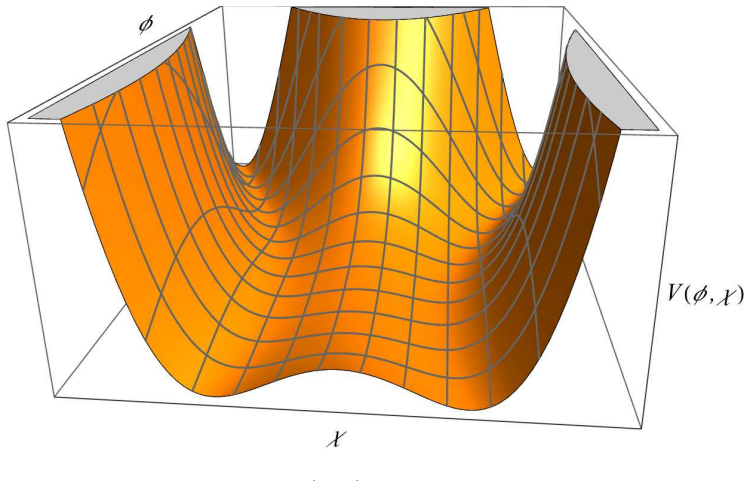
A finite nucleation duration leads to a distribution of DW radii characterized by γ≡R̄⁴/(R̄²)²>1, which enhances the resulting curvature perturbations, enabling the SIGW peak to be placed in the nanohertz frequency band with detectable amplitude in a two-field inflation model with an inflaton φ and spectator χ coupled through V(φ,χ), where the DW tension σ(t) evolves smoothly.
What carries the argument
The enhancement factor γ from the distribution of domain wall radii due to extended nucleation time, which amplifies curvature perturbations in the two-field potential model.
If this is right
- The SIGW spectrum matches the NANOGrav and EPTA signals for three representative parameter sets.
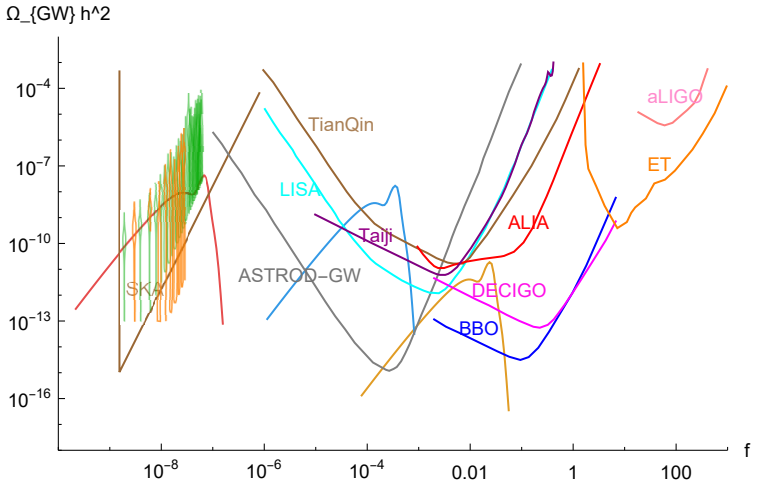
- Selecting different parameters simultaneously predicts potentially observable signals at other gravitational-wave detectors.
- The finite nucleation framework overcomes the weakness of small-period nucleation models that produce curvature power spectra too weak for nanohertz SGWB.
- The characteristic width of the potential transition determines k_cut and thus the frequency location of the SIGW peak.
Where Pith is reading between the lines
- Similar radius distributions from finite nucleation could enhance gravitational wave signals in other inflationary defect scenarios beyond domain walls.
- Multi-frequency gravitational wave observations could test whether nucleation duration is required to explain observed backgrounds.
- The model implies that instantaneous nucleation approximations systematically underestimate amplitudes for defects formed during inflation.
Load-bearing premise
The characteristic width of the transition in the two-field potential can be chosen so that the cutoff scale k_cut of the curvature power spectrum places the SIGW peak inside the nanohertz band while still satisfying the slow-roll conditions during inflation.
What would settle it
A pulsar timing array measurement showing a nanohertz stochastic gravitational wave background with amplitude or spectral shape inconsistent with the gamma-enhanced curvature perturbations from finite nucleation would falsify the central claim.
Figures
read the original abstract
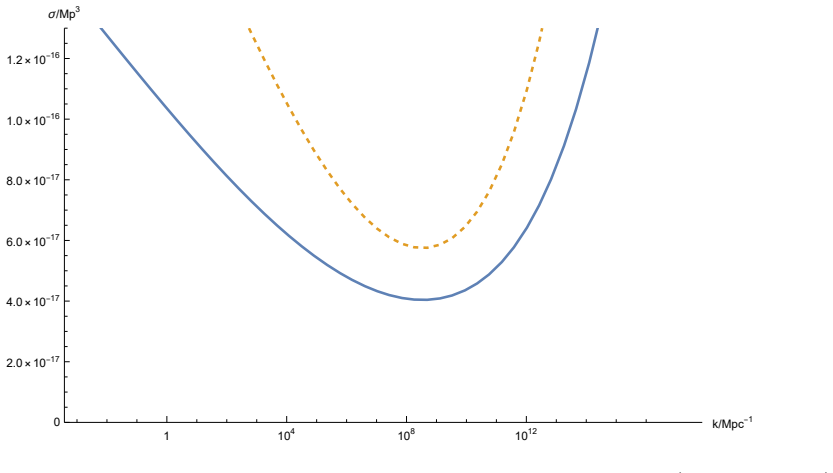
We investigate scalar-induced gravitational waves (SIGWs) produced by domain walls (DWs) nucleated via quantum tunneling during inflation with an extended nucleation time. In contrast to the small-period nucleation framework, where DWs form instantaneously and produce a curvature power spectrum too weak to account for the nanohertz stochastic gravitational-wave background (SGWB) reported by pulsar timing array (PTA) collaborations, we show that a finite nucleation duration leads to a distribution of DW radii characterized by $\gamma\equiv\overline{R^4}/(\overline{R^2})^2>1$, which enhances the resulting curvature perturbations. We construct a two-field inflation model with an inflaton $\phi$ and a spectator field $\chi$ coupled through the potential $V(\phi,\chi)$, where the DW tension $\sigma(t)$ evolves smoothly as the inflaton rolls past a critical value. The characteristic width of this transition determines the cutoff scale $k_{\text{cut}}$ of the curvature power spectrum, enabling the SIGW peak to be placed in the nanohertz frequency band with detectable amplitude. For three representative parameter sets, we compute the SIGW spectra and find that the nanohertz-peaked spectrum matching the NANOGrav and EPTA signals. By selecting different parameters, our model simultaneously predicts potentially observable signals at other gravitational-wave detectors.
Editorial analysis
A structured set of objections, weighed in public.
Referee Report
Summary. The manuscript investigates scalar-induced gravitational waves (SIGWs) from domain walls (DWs) nucleated via quantum tunneling during inflation, but with a finite nucleation duration rather than instantaneously. In a two-field model with inflaton φ and spectator χ coupled by potential V(φ,χ), the DW tension σ(t) evolves smoothly over a transition whose width sets the cutoff k_cut in the curvature power spectrum. The finite duration produces a DW radius distribution with γ ≡ R̄⁴/(R̄²)² >1 that enhances the curvature perturbations relative to the instantaneous case, allowing the SIGW spectrum to peak in the nanohertz band. For three representative parameter sets the computed SIGW spectra are stated to match the NANOGrav and EPTA signals while also predicting observable signals at other detectors.
Significance. If the background evolution and perturbation calculations hold, the work supplies a concrete mechanism by which an extended DW nucleation epoch during inflation can generate a detectable nHz SGWB, addressing the weakness of instantaneous-nucleation models. The explicit construction of a two-field potential whose transition width controls k_cut, together with the γ>1 enhancement factor, constitutes a falsifiable prediction that can be tested against PTA data and future GW observatories. The approach is internally consistent with the slow-roll framework provided the chosen widths preserve the required number of e-folds.
major comments (2)
- [Two-field potential and background evolution] The section describing the two-field potential V(φ,χ) and the background evolution must explicitly verify that the three representative parameter sets keep the slow-roll parameters ε and |η| sufficiently small throughout the interval in which the transition width is adjusted to place k_cut at nanohertz scales. A wider transition (needed for smaller k_cut) flattens the effective potential over a larger φ range; without tabulated values or plots of ε(φ) and η(φ) for these sets it is impossible to confirm that the assumed inflationary background remains valid.
- [Curvature power spectrum and SIGW calculation] The derivation of the curvature power spectrum from the γ>1 radius distribution (leading to the cutoff at k_cut) is load-bearing for the central claim that the SIGW peak reaches detectable nHz amplitude. The manuscript should provide the explicit integral or transfer function that converts the radius distribution into P_ζ(k) and demonstrate that the resulting spectrum is insensitive to the precise form of the transition once γ is fixed.
minor comments (2)
- [Abstract] The abstract states that the spectra 'match' NANOGrav and EPTA but does not quote the precise frequency range or amplitude agreement; a short quantitative statement would improve clarity.
- [Introduction or model section] Notation for the averaged radii (R̄) and the definition of γ should be introduced once in the main text with an explicit formula rather than only in the abstract.
Simulated Author's Rebuttal
We thank the referee for the constructive and detailed report. The comments identify areas where additional explicit verification and derivation details will strengthen the manuscript. We address each major comment below and will revise the paper to incorporate the requested elements.
read point-by-point responses
-
Referee: [Two-field potential and background evolution] The section describing the two-field potential V(φ,χ) and the background evolution must explicitly verify that the three representative parameter sets keep the slow-roll parameters ε and |η| sufficiently small throughout the interval in which the transition width is adjusted to place k_cut at nanohertz scales. A wider transition (needed for smaller k_cut) flattens the effective potential over a larger φ range; without tabulated values or plots of ε(φ) and η(φ) for these sets it is impossible to confirm that the assumed inflationary background remains valid.
Authors: We agree that explicit confirmation of the slow-roll regime is required, particularly when varying the transition width. In the revised manuscript we will add plots of ε(φ) and η(φ) (or |η(φ)|) for all three representative parameter sets, covering the full range of φ traversed during the transition. These plots will demonstrate that ε remains ≪1 and |η| remains ≪1 even for the widest transitions needed to place k_cut at nanohertz scales, thereby confirming that the assumed inflationary background remains valid. revision: yes
-
Referee: [Curvature power spectrum and SIGW calculation] The derivation of the curvature power spectrum from the γ>1 radius distribution (leading to the cutoff at k_cut) is load-bearing for the central claim that the SIGW peak reaches detectable nHz amplitude. The manuscript should provide the explicit integral or transfer function that converts the radius distribution into P_ζ(k) and demonstrate that the resulting spectrum is insensitive to the precise form of the transition once γ is fixed.
Authors: The central role of the γ>1 enhancement is already emphasized in the manuscript, but we accept that the explicit mapping from the radius distribution to P_ζ(k) should be written out in full. In the revision we will insert the explicit integral expression (or transfer function) that converts the DW radius distribution into the curvature power spectrum, together with a short analytic or numerical argument showing that the resulting P_ζ(k) depends on the distribution only through the moment ratio γ and is therefore insensitive to the detailed shape of the transition once γ is held fixed. revision: yes
Circularity Check
Parameter sets selected to match NANOGrav/EPTA presented as model success
specific steps
-
fitted input called prediction
[Abstract]
"For three representative parameter sets, we compute the SIGW spectra and find that the nanohertz-peaked spectrum matching the NANOGrav and EPTA signals. By selecting different parameters, our model simultaneously predicts potentially observable signals at other gravitational-wave detectors."
The parameter sets are chosen such that the SIGW spectrum matches the target PTA data; the reported match is therefore enforced by the selection of the free inputs (transition width, etc.) rather than derived from the model equations without reference to the observed signal.
full rationale
The derivation chain introduces finite nucleation to obtain γ>1 and enhanced perturbations, then uses the transition width in V(φ,χ) to set k_cut. The explicit selection of three parameter sets so that the resulting SIGW spectrum matches the PTA signals makes the central observational claim a direct consequence of that input choice rather than an independent output. This matches the fitted-input-called-prediction pattern. No self-citation chains, self-definitional steps, or ansatz smuggling are present in the given text; the remainder of the construction (slow-roll background, curvature spectrum from DW distribution) retains independent content once the parameters are fixed.
Axiom & Free-Parameter Ledger
free parameters (1)
- transition width of V(φ,χ)
axioms (1)
- domain assumption The two-field potential allows smooth evolution of DW tension σ(t) as the inflaton rolls past a critical value.
Reference graph
Works this paper leans on
-
[1]
The Friedmann equation and the equations of motion for φ and χ are H 2 = 1 3M 2 p (1 2 ˙φ 2 + 1 2 ˙χ 2 + V (φ, χ ) ) , ¨φ + 3H ˙φ + ∂V ∂φ = 0, ¨χ + 3H ˙χ + ∂V ∂χ = 0
0319. The Friedmann equation and the equations of motion for φ and χ are H 2 = 1 3M 2 p (1 2 ˙φ 2 + 1 2 ˙χ 2 + V (φ, χ ) ) , ¨φ + 3H ˙φ + ∂V ∂φ = 0, ¨χ + 3H ˙χ + ∂V ∂χ = 0. (40) The three parameter sets used in our computation are listed in Table I. Set φ c/M p λ χ ∆ /M p m/M p Λ /M p 1 4.3 0.007 1.1 0 . 8 × 10− 5 1. 5800 × 10− 5 2 4.3 0.007 0.8 0 . 9 × 1...
2023
-
[2]
The NANOGrav 15 yr Data Set: Evidence for a Grav itational- wave Background,
G. Agazie et al. [NANOGrav], “The NANOGrav 15 yr Data Set: Evidence for a Grav itational- wave Background,” Astrophys. J. Lett. 951, L8 (2023) [arXiv:2306.16213 [astro-ph.HE]]
Pith/arXiv arXiv 2023
-
[3]
J. Antoniadis et al. [EPTA and InPTA], “The second data release from the European Pulsar Timing Array. III. Search for gravitational wave signals,” Astron. Astrophys. 678, A50 (2023) [arXiv:2306.16214 [astro-ph.HE]]
Pith/arXiv arXiv 2023
-
[4]
Search for an Isotropic Gravitational-wave Background w ith the Parkes Pulsar Timing Array,
D. J. Reardon et al. , “Search for an Isotropic Gravitational-wave Background w ith the Parkes Pulsar Timing Array,” Astrophys. J. Lett. 951, L6 (2023) [arXiv:2306.16215 [astro-ph.HE]]
Pith/arXiv arXiv 2023
-
[5]
H. Xu et al. [CPTA], “Searching for the nano-hertz stochastic gravitat ional wave background with the Chinese Pulsar Timing Array Data Release I,” Res. As tron. Astrophys. 23, 075024 (2023) [arXiv:2306.16216 [astro-ph.HE]]
Pith/arXiv arXiv 2023
-
[6]
Gravitational waves from binary supermassive black hole s missing in pulsar observations,
R. M. Shannon et al. , “Gravitational waves from binary supermassive black hole s missing in pulsar observations,” Science 349, 1522 (2015) [arXiv:1509.07320 [astro-ph.CO]]
Pith/arXiv arXiv 2015
-
[7]
European Pulsar Timing Array limits on an isotropic stoch as- tic gravitational-wave background,
L. Lentati et al. , “European Pulsar Timing Array limits on an isotropic stoch as- tic gravitational-wave background,” Mon. Not. Roy. Astron . Soc. 453, 2576 (2015) [arXiv:1504.03692 [astro-ph.CO]]
Pith/arXiv arXiv 2015
-
[8]
Z. Arzoumanian et al. [NANOGrav], “The NANOGrav 11 Year Data Set: Pulsar-timing 18 Constraints on the Stochastic Gravitational-wave Backgro und,” Astrophys. J. 859, 47 (2018) [arXiv:1801.02617 [astro-ph.HE]]
Pith/arXiv arXiv 2018
-
[9]
The second data release from the European Pulsar Ti ming Array. I. The dataset and timing analysis,
J. Antoniadis et al. [EPTA], “The second data release from the European Pulsar Ti ming Array. I. The dataset and timing analysis,” Astron. Astrophys. 678, A48 (2023) [arXiv:2306.16224 [astro-ph.HE]]
arXiv 2023
-
[10]
Upper limits on the isotro pic gravitational radiation back- ground from pulsar timing analysis,
R. W. Hellings and G. S. Downs, “Upper limits on the isotro pic gravitational radiation back- ground from pulsar timing analysis,” Astrophys. J. 265, L39 (1983)
1983
-
[11]
The astrophysics of nanohertz gravitational waves,
S. Burke-Spolaor et al. , “The astrophysics of nanohertz gravitational waves,” Ast ron. Astro- phys. Rev. 27, 5 (2019) [arXiv:1811.08826 [astro-ph.HE]]
Pith/arXiv arXiv 2019
-
[12]
F. A. Jenet et al. , “Upper bounds on the low-frequency stochastic gravitatio nal wave back- ground from pulsar timing observations: Current limits and future prospects,” Astrophys. J. 653, 1571 (2006) [arXiv:astro-ph/0609013]
Pith/arXiv arXiv 2006
-
[13]
The International Pulsar Timing Array: First data releas e,
J. P. W. Verbiest et al. , “The International Pulsar Timing Array: First data releas e,” Mon. Not. Roy. Astron. Soc. 458, 1267 (2016) [arXiv:1602.03640 [astro-ph.IM]]
Pith/arXiv arXiv 2016
-
[14]
The NANOGrav 15 yr Data Set: Search for Anisotr opy in the Gravitational-wave Background,
A. Afzal et al. [NANOGrav], “The NANOGrav 15 yr Data Set: Search for Anisotr opy in the Gravitational-wave Background,” Astrophys. J. Lett. 951, L11 (2023) [arXiv:2306.16219 [astro-ph.HE]]
Pith/arXiv arXiv 2023
-
[15]
Gravitational waves from do- main walls in Pulsar Timing Array data,
R. Z. Ferreira, A. Notari, O. Pujol` as, and F. Rompineve , “Gravitational waves from do- main walls in Pulsar Timing Array data,” J. Cosmol. Astropar t. Phys. 02, 001 (2024) [arXiv:2307.04746 [astro-ph.CO]]
arXiv 2024
-
[16]
Cosmo logical consequences of a sponta- neous breakdown of a discrete symmetry,
Ya. B. Zeldovich, I. Yu. Kobzarev, and L. B. Okun, “Cosmo logical consequences of a sponta- neous breakdown of a discrete symmetry,” Zh. Eksp. Teor. Fiz . 67, 3 (1974) [Sov. Phys. JETP 40, 1 (1975)]
1974
-
[17]
Topology of cosmic domains and strings ,
T. W. B. Kibble, “Topology of cosmic domains and strings ,” J. Phys. A 9, 1387 (1976)
1976
-
[18]
Cosmic strings and domain walls,
A. Vilenkin, “Cosmic strings and domain walls,” Phys. R ept. 121, 263 (1985)
1985
-
[19]
A review of gravitational waves from cosmi c domain walls,
K. Saikawa, “A review of gravitational waves from cosmi c domain walls,” Universe 3, 40 (2017) [arXiv:1703.02576 [hep-ph]]
Pith/arXiv arXiv 2017
-
[20]
Gravitatio nal waves from collapsing domain walls,
T. Hiramatsu, M. Kawasaki, and K. Saikawa, “Gravitatio nal waves from collapsing domain walls,” J. Cosmol. Astropart. Phys. 05, 032 (2014) [arXiv:1309.5001 [astro-ph.CO]]. 19
Pith/arXiv arXiv 2014
-
[21]
Gravitational field of vacuum domain wall s and strings,
A. Vilenkin, “Gravitational field of vacuum domain wall s and strings,” Phys. Rev. D 23, 852 (1981)
1981
-
[22]
Radiati on from vacuum strings and domain walls,
T. Vachaspati, A. E. Everett, and A. Vilenkin, “Radiati on from vacuum strings and domain walls,” Phys. Rev. D 30, 2046 (1984)
2046
-
[23]
Domain wall annihilatio n: a QFT perspective,
O. Pujol` as and G. Zahariade, “Domain wall annihilatio n: a QFT perspective,” Phys. Rev. D 107, 123527 (2023) [arXiv:2212.11204 [hep-th]]
arXiv 2023
-
[24]
Friction on ALP domain walls and gravitational waves,
S. Blasi, A. Mariotti, A. Rase, A. Sevrin, and K. Turbang , “Friction on ALP domain walls and gravitational waves,” J. Cosmol. Astropart. Phys. 04, 008 (2023) [arXiv:2210.14246 [hep-ph]]
arXiv 2023
-
[25]
Quantum creation o f topological defects during inflation,
R. Basu, A. H. Guth, and A. Vilenkin, “Quantum creation o f topological defects during inflation,” Phys. Rev. D 44, 340 (1991)
1991
-
[26]
Primordial black hole and wormhole formation by domain walls,
H. Deng, J. Garriga, and A. Vilenkin, “Primordial black hole and wormhole formation by domain walls,” J. Cosmol. Astropart. Phys. 04, 050 (2017) [arXiv:1612.03753 [gr-qc]]
Pith/arXiv arXiv 2017
-
[27]
Nucleation rates in flat and curved space,
J. Garriga, “Nucleation rates in flat and curved space,” Phys. Rev. D 49, 6327 (1994) [arXiv:hep-ph/9308280]
Pith/arXiv arXiv 1994
-
[28]
Enhanced curvature p erturbations from spherical domain walls nucleated during inflation,
Z.-M. Zeng, J. Liu, and Z.-K. Guo, “Enhanced curvature p erturbations from spherical domain walls nucleated during inflation,” Phys. Rev. D 108, 063005 (2023) [arXiv:2301.07230 [astro- ph.CO]]
arXiv 2023
-
[29]
Primordial black hole s from cosmic domain walls,
J. Liu, Z.-K. Guo, and R.-G. Cai, “Primordial black hole s from cosmic domain walls,” Phys. Rev. D 101, 023513 (2020) [arXiv:1908.02662 [astro-ph.CO]]
arXiv 2020
-
[30]
Th e statistics of peaks of Gaussian random fields,
J. M. Bardeen, J. R. Bond, N. Kaiser, and A. S. Szalay, “Th e statistics of peaks of Gaussian random fields,” Astrophys. J. 304, 15 (1986)
1986
-
[31]
A new type of isotropic cosmologica l models without singularity,
A. A. Starobinsky, “A new type of isotropic cosmologica l models without singularity,” Phys. Lett. B 91, 99 (1980)
1980
-
[32]
Cosmological perturbation th eory,
H. Kodama and M. Sasaki, “Cosmological perturbation th eory,” Prog. Theor. Phys. Suppl. 78, 1 (1984)
1984
-
[33]
Theory of cosmological pertur- bations,
V. F. Mukhanov, H. A. Feldman, and R. H. Brandenberger, “ Theory of cosmological pertur- bations,” Phys. Rep. 215, 203 (1992)
1992
-
[34]
Gravitational wave spectrum induced by primordial scalar perturbations,
D. Baumann, P. J. Steinhardt, K. Takahashi, and K. Ichik i, “Gravitational wave spectrum induced by primordial scalar perturbations,” Phys. Rev. D 76, 084019 (2007) [arXiv:hep- 20 th/0703290]
arXiv 2007
-
[35]
The cosmologic al gravitational wave back- ground from primordial density perturbations,
K. N. Ananda, C. Clarkson, and D. Wands, “The cosmologic al gravitational wave back- ground from primordial density perturbations,” Phys. Rev. D 75, 123518 (2007) [arXiv:gr- qc/0612013]
arXiv 2007
-
[36]
Second-order cosmological pertur- bations produced by scalar–scalar coupling in the radiatio n era,
V. Acquaviva, N. Bartolo, S. Matarrese, and A. Riotto, “ Second-order cosmological pertur- bations produced by scalar–scalar coupling in the radiatio n era,” Phys. Rev. D 67, 123506 (2003) [arXiv:astro-ph/0302003]
Pith/arXiv arXiv 2003
-
[37]
CMB polariz ation from secondary vector and tensor modes,
S. Mollerach, D. Harari, and S. Matarrese, “CMB polariz ation from secondary vector and tensor modes,” Phys. Rev. D 69, 063002 (2004) [arXiv:astro-ph/0310713]
Pith/arXiv arXiv 2004
-
[38]
Gravitational wave backgrou nd as a probe of the primordial black hole abundance,
R. Saito and J. Yokoyama, “Gravitational wave backgrou nd as a probe of the primordial black hole abundance,” Phys. Rev. Lett. 102, 161101 (2009) [arXiv:0812.4339 [astro-ph]]
Pith/arXiv arXiv 2009
-
[39]
Induced gravitational wave ba ckground and primordial black holes,
E. Bugaev and P. Klimai, “Induced gravitational wave ba ckground and primordial black holes,” Phys. Rev. D 81, 023517 (2010) [arXiv:0908.0664 [astro-ph.CO]]
Pith/arXiv arXiv 2010
-
[40]
K. Kohri and T. Terada, “Semianalytic calculation of gr avitational wave spectrum nonlin- early induced from primordial curvature perturbations,” P hys. Rev. D 97, 123532 (2018) [arXiv:1804.08577 [gr-qc]]
Pith/arXiv arXiv 2018
-
[41]
Low-frequen cy gravitational waves from double- inflection-point inflation,
W.-T. Xu, J. Liu, T.-J. Gao, and Z.-K. Guo, “Low-frequen cy gravitational waves from double- inflection-point inflation,” Phys. Rev. D 101, 023505 (2020) [arXiv:1907.05213 [astro-ph.CO]]
arXiv 2020
-
[42]
Double peaks of gravitationa l wave spectrum induced from in- flection point inflation,
T.-J. Gao and X.-Y. Yang, “Double peaks of gravitationa l wave spectrum induced from in- flection point inflation,” Eur. Phys. J. C 81, 463 (2021) [arXiv:2101.07616 [astro-ph.CO]]
arXiv 2021
-
[43]
A cosmological signature of the SM Higgs instability: gravitational waves,
J. R. Espinosa, D. Racco, and A. Riotto, “A cosmological signature of the SM Higgs instability: gravitational waves,” J. Cosmol. Astropart. Phys. 09, 012 (2018) [arXiv:1804.07732 [hep-ph]]
Pith/arXiv arXiv 2018
-
[44]
Scalar induced gravitational waves rev iew,
G. Dom` enech, “Scalar induced gravitational waves rev iew,” Universe 7, 398 (2021) [arXiv:2109.01398 [gr-qc]]
Pith/arXiv arXiv 2021
-
[45]
Cosmological backgroun ds of gravitational waves,
C. Caprini and D. G. Figueroa, “Cosmological backgroun ds of gravitational waves,” Class. Quantum Grav. 35, 163001 (2018) [arXiv:1801.04268 [astro-ph.CO]]
Pith/arXiv arXiv 2018
-
[46]
Improved calculation of th e primordial gravitational wave spectrum in the standard big bang model,
Y. Watanabe and E. Komatsu, “Improved calculation of th e primordial gravitational wave spectrum in the standard big bang model,” Phys. Rev. D 73, 123515 (2006) [arXiv:astro- ph/0604176]. 21
arXiv 2006
-
[47]
Planck 2018 results. X. Constrai nts on inflation,
Y. Akrami et al. [Planck Collaboration], “Planck 2018 results. X. Constrai nts on inflation,” Astron. Astrophys. 641, A10 (2020) [arXiv:1807.06211 [astro-ph.CO]]
Pith/arXiv arXiv 2018
-
[48]
Fundamental physics with the Square Kilometre Array,
A. Weltman et al. , “Fundamental physics with the Square Kilometre Array,” Pu bl. Astron. Soc. Austral. 37, e002 (2020) [arXiv:1810.02680 [astro-ph.CO]]
arXiv 2020
-
[49]
ASTROD-GW: Overview and progress,
W.-T. Ni, “ASTROD-GW: Overview and progress,” Int. J. M od. Phys. D 22, 1341004 (2013) [arXiv:1212.2816 [gr-qc]]
Pith/arXiv arXiv 2013
-
[50]
Laser Interferometer Space Antenn a,
P. Amaro-Seoane et al. [LISA Collaboration], “Laser Interferometer Space Antenn a,” arXiv:1702.00786 [astro-ph.IM] (2017)
Pith/arXiv arXiv 2017
-
[51]
The construction a nd use of LISA sensitivity curves,
T. Robson, N. J. Cornish, and C. Liu, “The construction a nd use of LISA sensitivity curves,” Class. Quantum Grav. 36, 105011 (2019) [arXiv:1803.01944 [astro-ph.HE]]
Pith/arXiv arXiv 2019
-
[52]
Astrophysics with the Laser Interferometer Space Antenn a,
P. Amaro-Seoane et al. , “Astrophysics with the Laser Interferometer Space Antenn a,” Living Rev. Rel. 26, 2 (2023) [arXiv:2203.06016 [gr-qc]]
Pith/arXiv arXiv 2023
-
[53]
Taij i Program: Gravitational-wave sources,
W.-H. Ruan, Z.-K. Guo, R.-G. Cai, and Y.-Z. Zhang, “Taij i Program: Gravitational-wave sources,” Int. J. Mod. Phys. A 35, 2050075 (2020) [arXiv:1807.09495 [gr-qc]]
arXiv 2020
-
[54]
TianQin: A space-borne gravita tional wave detector,
J. Luo et al. [TianQin Collaboration], “TianQin: A space-borne gravita tional wave detector,” Class. Quantum Grav. 33, 035010 (2016) [arXiv:1512.02076 [astro-ph.IM]]
Pith/arXiv arXiv 2016
-
[55]
The Japanese space gravitational wave antenna: DECIGO,
S. Kawamura et al. , “The Japanese space gravitational wave antenna: DECIGO,” Class. Quantum Grav. 28, 094011 (2011)
2011
-
[56]
Possibility of d irect measurement of the accel- eration of the universe using 0.1 Hz band laser interferomet er gravitational wave antenna in space,
N. Seto, S. Kawamura, and T. Nakamura, “Possibility of d irect measurement of the accel- eration of the universe using 0.1 Hz band laser interferomet er gravitational wave antenna in space,” Phys. Rev. Lett. 87, 221103 (2001)
2001
-
[57]
Detector configuration of DECIGO/B BO and identification of cosmolog- ical neutron-star binaries,
K. Yagi and N. Seto, “Detector configuration of DECIGO/B BO and identification of cosmolog- ical neutron-star binaries,” Phys. Rev. D 83, 044011 (2011) [arXiv:1101.3940 [astro-ph.CO]]
Pith/arXiv arXiv 2011
-
[58]
Laser interfer- ometry for the Big Bang Observer,
G. M. Harry, P. Fritschel, D. A. Shaddock, W. Folkner, an d E. S. Phinney, “Laser interfer- ometry for the Big Bang Observer,” Class. Quantum Grav. 23, 4887 (2006)
2006
-
[59]
A scientific case study of an advanced LISA mission,
X.-F. Gong et al. , “A scientific case study of an advanced LISA mission,” Class . Quantum Grav. 28, 094012 (2011)
2011
-
[60]
J. Aasi et al. [LIGO Scientific Collaboration], “Advanced LIGO,” Class. Q uantum Grav. 32, 074001 (2015) [arXiv:1411.4547 [gr-qc]]. 22
Pith/arXiv arXiv 2015
-
[61]
The Einstein Telescope: a third-generation gravitation al wave observa- tory,
M. Punturo et al. , “The Einstein Telescope: a third-generation gravitation al wave observa- tory,” Class. Quantum Grav. 27, 194002 (2010)
2010
-
[62]
The NANOGrav 15 yr Data Set: Observations and T iming Analysis,
G. Agazie et al. [NANOGrav], “The NANOGrav 15 yr Data Set: Observations and T iming Analysis,” Astrophys. J. Lett. 951, L9 (2023) [arXiv:2306.16217 [astro-ph.HE]]
arXiv 2023
-
[63]
Gravitationa l-wave sensitivity curves,
C. J. Moore, R. H. Cole, and C. P. L. Berry, “Gravitationa l-wave sensitivity curves,” Class. Quantum Grav. 32, 015014 (2015) [arXiv:1408.0740 [gr-qc]]
Pith/arXiv arXiv 2015
-
[64]
Gravitational wave s: Classification, methods of detec- tion, sensitivities, and sources,
K. Kuroda, W.-T. Ni, and W.-P. Pan, “Gravitational wave s: Classification, methods of detec- tion, sensitivities, and sources,” Int. J. Mod. Phys. D 24, 1530031 (2015) [arXiv:1511.00231 [gr-qc]]
Pith/arXiv arXiv 2015
-
[65]
New sensitivity curves for gravitational -wave signals from cosmological phase transitions,
K. Schmitz, “New sensitivity curves for gravitational -wave signals from cosmological phase transitions,” J. High Energy Phys. 01, 097 (2021) [arXiv:2002.04615 [hep-ph]]
Pith/arXiv arXiv 2021
-
[66]
Primordial black holes fro m domain walls,
N. Tanahashi and C.-M. Yoo, “Primordial black holes fro m domain walls,” Class. Quantum Grav. 32, 155003 (2015) [arXiv:1412.7478 [gr-qc]]
Pith/arXiv arXiv 2015
-
[67]
Formation of galaxies and clusters of galaxies by self-similar gravitational condensation,
W. H. Press and P. Schechter, “Formation of galaxies and clusters of galaxies by self-similar gravitational condensation,” Astrophys. J. 187, 425 (1974)
1974
-
[68]
The primordial black hole mass spectrum,
B. J. Carr, “The primordial black hole mass spectrum,” A strophys. J. 201, 1 (1975)
1975
-
[69]
Primordial black holes as dark m atter: Recent developments,
B. Carr and F. K¨ uhnel, “Primordial black holes as dark m atter: Recent developments,” Ann. Rev. Nucl. Part. Sci. 70, 355 (2020) [arXiv:2006.02838 [astro-ph.CO]]. 23
Pith/arXiv arXiv 2020
discussion (0)
Sign in with ORCID, Apple, or X to comment. Anyone can read and Pith papers without signing in.