REVIEW 5 major objections 6 minor 42 references
Efficient Weak-Entropy PINN for Solving Hyperbolic Conservation Laws
T0 review · 5 major / 6 minor · reviewed 2026-08-12 · deepseek-v4-flash
Pith's one-line read The paper claims that a weak-form physics-informed neural network with an entropy-inequality penalty can reproduce moving shock and rarefaction waves without knowing shock locations in advance or smoothing the solution artificially.
desk verdict WEPINN is a useful, experiment-heavy engineering contribution to weak-form PINNs, but the paper's claim to 'rigorously' enforce the entropy condition overstates what a finite test-function set and one unspecified scalar entropy pair actually guarantee. read the letter →
The pith
A machine-rendered reading of the paper's core claim, the machinery that carries it, and where it could break.
The reading
What carries the argument
The load-bearing object is the weak-entropy loss defined by equations (8)–(11): the residual of the integral weak formulation (4) plus the penalized violation of the integral entropy inequality (5), evaluated on a pre-selected set of tensor-product trigonometric test functions and trapezoidal quadrature on a uniform grid. For the weak form the basis consists of sine-cosine pairs with a temporal window forcing $\varphi(T,x)=0$; for the entropy inequality the basis uses nonnegative combinations $1\pm\sin(2\pi m x)$ and $1\pm\cos(2\pi m x)$ so that all test functions satisfy the sign requirement of Definition 1. The tensor-product trigonometric structure converts the loss sums into discrete Fourier coefficients, so the DFFT reduces the cost from $O(N_t^2 N_x^{2d})$ to $O(N_t N_x^{d}\log N_t \log^{d} N_x)$, and the fixed dictionary replaces WPINN's adversarial test-function network with a stable least-squares minimization over all test functions at once.
What would settle it
Train WEPINN on the Burgers Riemann problem with $u_L<u_R$ and then evaluate the entropy residual (10)–(11) for a nonnegative trigonometric test function whose frequency exceeds $N_q/4$ and for a convex entropy not used in training, such as $\eta(u)=u^4$. If the penalty is nonzero while the training loss is near machine precision, the trained network is not entropy-admissible, showing that the finite dictionary does not certify the full entropy inequality.
Extended reading notes
Core claim
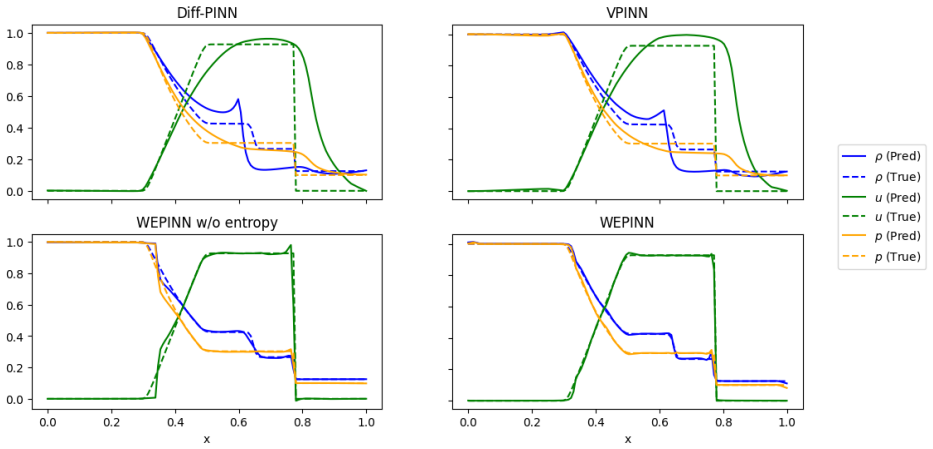
The central claim is that a neural network trained by minimizing discretized weak-form residuals and entropy-inequality residuals yields a weak entropy solution of a hyperbolic conservation law without any shock-location prior or artificial smoothing. The paper's evidence is numerical: across 30 random initial conditions per scalar problem class, WEPINN reports the best relative $L^2$ errors and shock metrics among Diff-PINN, VPINN, and WPINN; on the Sod shock tube it is the only method whose solution contains the rarefaction, contact discontinuity, and shock simultaneously; and in two dimensions the entropy loss becomes decisive, since dropping it makes the model fail to form shocks from smooth data.
Load-bearing premise
The load-bearing premise is that the finite set of trigonometric test functions and, for scalar problems, the single chosen entropy pair are rich enough to certify the full entropy inequality, so a network that passes this finite loss is treated as a weak entropy solution although violations on unseen test functions are not bounded.
Editorial extensions
If this is right
- For scalar conservation laws, WEPINN can be trained directly on discontinuous data: the weak-form integrals transfer differentiation onto smooth test functions, so no shock-location prior or artificial viscosity is needed to obtain sharp fronts.
- The entropy penalty is the component that selects the physical wave: on a Burgers Riemann problem with $u_L<u_R$, the same weak-form network without entropy loss returns a propagating shock instead of the admissible rarefaction.
- The trigonometric test functions on a uniform grid let all loss integrals be computed by the DFFT, lowering the cost from direct summation $O(N_t^2 N_x^{2d})$ to $O(N_t N_x^d\log N_t \log^d N_x)$, which makes fine grids and high-frequency test functions practical.
- The formulation carries over to systems: on the Sod shock tube for the compressible Euler equations, WEPINN reports the lowest relative $L^2$ errors on density, velocity, and pressure while detecting the shock at the highest rate.
- In two spatial dimensions the entropy loss becomes more decisive: on 2D Burgers with smooth trigonometric data, WEPINN without entropy loss fails to form shocks, while the full WEPINN tracks the circular discontinuity.
Reading between the lines
- Editorial extension: the finite dictionary of trigonometric test functions means the trained network is certified only against that dictionary; adding adaptive test-function generation or an a posteriori entropy-residual check on unseen test functions would close the gap between the finite loss and the full Definition 1.
- Editorial extension: because the loss integrals are evaluated as Fourier coefficients of the network output, the same weak-entropy loss should transfer naturally to spectral surrogate models and neural operators for whole families of initial data, a direction the paper lists as future work.
- Editorial extension: the proposed shock detection rate and position accuracy use a 10%-of-domain matching tolerance, so a smeared front centered near the true location can score well; a transition-width or sharpness metric would more directly penalize the artificial smoothing WEPINN claims to avoid.
Editorial analysis
A structured set of objections, weighed in public.
Referee Report
Summary. The paper proposes WEPINN, a physics-informed neural network method for hyperbolic conservation laws that replaces strong-form PDE residuals with residuals of the weak formulation and the entropy inequality, evaluated against a finite set of trigonometric test functions and accelerated by the discrete fast Fourier transform. The method is tested on one-dimensional scalar laws (linear advection, Burgers, and LWR traffic flow), the one-dimensional compressible Euler equations, and a two-dimensional Burgers equation, under periodic and Dirichlet boundary conditions, and is compared with Diff-PINN, VPINN, and WPINN using relative L2 error and two newly proposed shock-aware metrics. The paper claims that WEPINN accurately resolves discontinuities and wave interactions and is the most accurate method among those compared for nonlinear shock problems.
Significance. If the claims held, WEPINN would be a practically valuable extension of weak-form PINNs: it avoids the adversarial training of WPINN, exploits DFFT for efficient quadrature, and reports an unusually broad benchmark suite with explicit shock-resolution metrics. The main strengths are the DFFT-based implementation, the ablation isolating the role of the entropy loss, and the systematic coverage of scalar and system cases in one and two dimensions. However, the current version is primarily empirical and does not connect the finite-dimensional loss to the infinite-dimensional definition of a weak entropy solution; several comparison and reproducibility details also prevent the stated superiority from being fully established.
major comments (5)
- [Section 2.3, Eqs. (8)-(11) and (13)-(18)] The loss replaces the test space T in Definition 1 by a finite trigonometric span and the entropy family E by a single pair (eta,q), but the paper provides no consistency, quadrature-error, or a posteriori bound showing that a small L_Weak-Entropy implies an approximate weak entropy solution. This is load-bearing because the entropy loss is the only mechanism selecting the physical rarefaction in the ablation of Section 4.1. In particular, the scalar entropy pair is never specified, and for the nonconvex LWR flux f(u)=u(1-u) a single convex entropy is not argued to imply the full Kruzhkov family; the abstract's claim that the physically admissible solution is selected is therefore not established by the presented mathematical framework.
- [Section 3.1 and Tables 2-4] The comparison does not isolate the proposed loss formulation. Diff-PINN and VPINN are trained with Tanh activations while WEPINN uses ReLU residual networks, so part of the observed gap may be architectural rather than due to the weak-entropy formulation. Additionally, WPINN is absent from the periodic-boundary experiments in Table 3, and the Euler WPINN row in Table 4 uses numbers from a different implementation and paper; the statement in Section 3.2 that WEPINN is 'the most accurate ... under the periodic boundary condition' is thus not supported by the evidence presented.
- [Section 4.2, Table 6] The maximum test-function degree is selected by an ablation on the same benchmark suite used to support the main claims, which introduces selection on the test data; Nq and the grid sizes Nt and Nx are not reported anywhere, so the degree of tuning and the exact discretization cannot be assessed. A separate validation set or a sensitivity analysis is needed before the reported superiority can be regarded as predictive rather than as a consequence of test-set hyperparameter choice.
- [Appendix A, Algorithm 1] The shock-aware metrics are not reproducible because the threshold h for peak detection, the tolerance dmax, and the hard-coded factor 128 in the distance computation are undefined, despite the text defining S-Rate via a 10% tolerance band in Section 3.1. Since S-Rate and S-Acc are central to the claimed advantage over baselines, these quantities need precise specification and their values must be reported.
- [Tables 2-5] All metrics are reported as averages over 30 trials without standard deviations or confidence intervals, so the observed improvements over baselines (for example, WEPINN versus VPINN on Burgers' equation with Riemann initial data in Table 2) cannot be separated from random fluctuation. Variance information or a statistical significance test should be provided for the main comparisons.
minor comments (6)
- [Section 2.4] In the displayed entropy boundary condition, the boundary flux terms are written with F(U0(a)) and F(U0(b)); if this formula is meant to be the entropy inequality, these should be q(U0(a)) and q(U0(b)) as in the subsequent definition of J_BC.
- [Section 4.2, Table 7] The caption of Table 7 says the Chebyshev comparison is made under the periodic boundary condition, while the text states that the comparison is performed under the Dirichlet boundary condition; this contradiction should be corrected.
- [Section 1] The phrase 'The the test function network may require frequent re-initialization' contains a duplicated article.
- [Throughout] The abbreviation for the traffic model appears as 'L WR' with spaces in several places and as 'LWR' elsewhere; the notation should be unified.
- [Section 2.2/References] The citation 'Ryck and Mishra (2024)' appears in the text but the bibliography entry is listed as 'De Ryck and Mishra'; the citation should match the reference.
- [Section 2.3 and Appendix E] The DFFT complexity claim is stated as O(Nt Nx^d log Nt log^d Nx), but the efficiency ablation in Figure 7 compares only WEPINN with and without DFFT and Diff-PINN, not VPINN or WPINN; the scope of the empirical efficiency comparison should be clarified.
Circularity Check
Mild in-sample tuning: the test-function degree (32) used in all Section 3 runs was chosen from the same benchmark tables later cited as proof that WEPINN is most accurate; the core weak-entropy loss itself is not circular.
-
fitted input called prediction
[Section 4.2, 'Test function selection', and Section 3.2]
"To determine the optimal maximum degree (i.e., maximum frequency) of the trigonometric test functions chosen in Section 2.3, we conduct an ablation study by varying the degree from 4 to 32. ... degree 32, which is used in the WEPINN implementation for the numerical experiments in Section 3, yields better results in scenarios with sharp discontinuities."
The maximum test-function degree Np=32 is not chosen a priori or on a separate validation set; it is selected because it 'yields better results' on the exact benchmark suite (Burgers and LWR over Trig/Fourier/Bell/PWC initial conditions, Table 6) that is later reported in Tables 2-5 as evidence that 'the proposed WEPINN is the most accurate.' The comparison is therefore partly in-sample: the configuration was optimized against the same L2/S-Rate/S-Acc numbers used to claim superiority. This is mild and does not affect the derivation of the weak-entropy loss, but it means the headline performance comparison is not an independent prediction.
full rationale
The core derivation is self-contained: LWeak−Entropy is defined directly from the weak formulation (4) and entropy inequality (5), with no fitted reference data; the DFFT is an exact reorganization of the quadrature sums for trigonometric test functions; reported L2 errors are measured against an external Lax-Friedrichs reference. The gap between the finite test-function/entropy set and Definition 1 is real but is a consistency and convergence limitation, not a circularity: a small loss is not certified to imply a weak entropy solution, and the entropy pair used in experiments is never specified, but the loss is not secretly defined as the evaluation metric. There are no load-bearing self-citations or imported uniqueness theorems. The only circularity-adjacent element is test-set hyperparameter selection in Section 4.2, namely the choice of degree 32 and of trigonometric functions over Chebyshev polynomials based on the same benchmark results later used to claim superiority. Score 2 reflects this mild in-sample tuning while recognizing that the central weak-entropy formulation itself is not circular.
Assumptions & free parameters
free parameters (4)
- Test function maximum degree Np =
32
- Entropy-entropy flux pair for scalar experiments =
Unspecified
- Equal loss weights for LWeak, LEntropy, LIC =
1, 1, 1
- Grid sizes Nt, Nx =
Not reported
assumptions (5)
- standard math Weak entropy solutions are characterized by the weak formulation (4) and entropy condition (5); for scalar laws Kruzhkov's theorem gives existence and uniqueness.
- domain assumption Solutions are of bounded variation and can be approximated by a finite ReLU network of width 128 and 9 residual layers.
- ad hoc to paper A finite trigonometric basis (Np=32, Nq not specified) adequately represents the test-function space for the weak and entropy residuals.
- ad hoc to paper For scalar problems, one convex entropy pair (unspecified) is sufficient to select the physical solution in the tested cases.
- domain assumption Dirichlet boundaries are handled by constant extension, valid when all waves remain inside [a,b] on [0,T].
Cite this review
Pith. "Pith review of Efficient Weak-Entropy PINN for Solving Hyperbolic Conservation Laws." pith.science (2026). https://pith.science/paper/NXSC4A7B
@misc{pith2026260810389,
  author       = {Pith},
  title        = {Pith review of: Efficient Weak-Entropy PINN for Solving Hyperbolic Conservation Laws},
  year         = {2026},
  howpublished = {\url{https://pith.science/paper/NXSC4A7B}},
  note         = {Machine review of arXiv:2608.10389}
}
read the original abstract
In recent years, neural networks have significantly advanced numerical solutions of partial differential equations (PDEs). However, solving PDEs with discontinuous solutions, such as hyperbolic conservation laws, remains challenging for neural network-based methods such as physics-informed neural networks (PINNs). Existing methods often rely on strong prior assumptions such as knowledge of discontinuity locations, or they introduce artificial smoothing terms that degrade accuracy. However, accurately solving these conservation laws and predicting the formation and propagation of discontinuities in solutions is crucial in many practical applications, including gas dynamics and traffic flow modeling. In this paper, we introduce a novel Weak-Entropy PINN (WEPINN) framework for hyperbolic conservation laws with discontinuous solutions. The method enforces the governing equations in their weak (integral) formulation and incorporates the entropy condition to select the physically admissible solution, while employing the discrete fast Fourier transform (DFFT) for efficient numerical integration. Our method is tested through extensive numerical experiments on a variety of scalar conservation laws and systems of conservation laws in one and two dimensional spaces. These experiments demonstrate that our method can accurately resolve sharp discontinuities while effectively capturing interactions between multiple shock and rarefaction waves.
Figures


Figures from the paper (4 more)


Reference graph
Works this paper leans on
-
[1]
SIAM Journal on Numerical Analysis , volume=
wPINNs: Weak physics informed neural networks for approximating entropy solutions of hyperbolic conservation laws , author=. SIAM Journal on Numerical Analysis , volume=. 2024 , publisher=
work page 2024
-
[2]
Weak Physics Informed Neural Networks for Geometry Compatible Hyperbolic Conservation Laws on Manifolds , author=. arXiv preprint arXiv:2505.19036 , year=
-
[3]
Journal of Computational physics , volume=
Physics-informed neural networks: A deep learning framework for solving forward and inverse problems involving nonlinear partial differential equations , author=. Journal of Computational physics , volume=. 2019 , publisher=
2019
-
[4]
arXiv preprint arXiv:1912.00873 , year=
Variational physics-informed neural networks for solving partial differential equations , author=. arXiv preprint arXiv:1912.00873 , year=
arXiv 1912
-
[5]
Computer Methods in Applied Mechanics and Engineering , volume=
hp-VPINNs: Variational physics-informed neural networks with domain decomposition , author=. Computer Methods in Applied Mechanics and Engineering , volume=. 2021 , publisher=
2021
-
[6]
Communications in Computational Physics , volume=
Extended physics-informed neural networks (XPINNs): A generalized space-time domain decomposition based deep learning framework for nonlinear partial differential equations , author=. Communications in Computational Physics , volume=. 2020 , publisher=
work page 2020
-
[7]
Computer Methods in Applied Mechanics and Engineering , volume=
Conservative physics-informed neural networks on discrete domains for conservation laws: Applications to forward and inverse problems , author=. Computer Methods in Applied Mechanics and Engineering , volume=. 2020 , publisher=
2020
-
[8]
arXiv preprint arXiv:2211.12393 , year=
Improving weak pinns for hyperbolic conservation laws: Dual norm computation, boundary conditions and systems , author=. arXiv preprint arXiv:2211.12393 , year=
Show all 42 references
-
[9]
arXiv preprint arXiv:2504.05367 , year=
Physics-Informed Neural Networks for One-Dimensional Quantum Well Problems , author=. arXiv preprint arXiv:2504.05367 , year=
-
[10]
Journal of Engineering Mechanics , volume=
Physics-informed deep learning for computational elastodynamics without labeled data , author=. Journal of Engineering Mechanics , volume=. 2021 , publisher=
2021
-
[11]
Acta Mechanica Sinica , volume=
Physics-informed neural networks (PINNs) for fluid mechanics: A review , author=. Acta Mechanica Sinica , volume=. 2021 , publisher=
2021
-
[12]
2023 , publisher=
Boundary-safe PINNs extension: Application to non-linear parabolic PDEs in counterparty credit risk , author=. 2023 , publisher=
2023
-
[13]
Journal of Computational and Applied Mathematics , volume=
Boundary-safe PINNs extension: Application to non-linear parabolic PDEs in counterparty credit risk , author=. Journal of Computational and Applied Mathematics , volume=. 2023 , publisher=
2023
-
[14]
International Journal of Information Technology , volume=
Study of drug assimilation in human system using physics informed neural networks , author=. International Journal of Information Technology , volume=. 2023 , publisher=
2023
-
[15]
arXiv preprint arXiv:2408.01026 , year=
Pinns for medical image analysis: A survey , author=. arXiv preprint arXiv:2408.01026 , year=
-
[16]
2002 , publisher=
Finite volume methods for hyperbolic problems , author=. 2002 , publisher=
2002
-
[17]
Kuznecov, N. N. , TITLE =. 1976 , NUMBER =
1976
-
[18]
Mathematical and Scientific Machine Learning , pages=
Implicit form neural network for learning scalar hyperbolic conservation laws , author=. Mathematical and Scientific Machine Learning , pages=. 2022 , organization=
2022
-
[19]
arXiv preprint arXiv:2411.05382 , year=
Lift-and-Embed Learning Methods for Solving Scalar Hyperbolic Equations with Discontinuous Solutions , author=. arXiv preprint arXiv:2411.05382 , year=
-
[20]
arXiv preprint arXiv:2510.18266 , year=
SPIKE: Stable Physics-Informed Kernel Evolution Method for Solving Hyperbolic Conservation Laws , author=. arXiv preprint arXiv:2510.18266 , year=
-
[21]
Numerical Methods for Partial Differential Equations: An International Journal , volume=
Solution of two-dimensional Riemann problems for gas dynamics without Riemann problem solvers , author=. Numerical Methods for Partial Differential Equations: An International Journal , volume=. 2002 , publisher=
2002
-
[22]
Journal of Scientific Computing , volume=
Discontinuity computing using physics-informed neural networks , author=. Journal of Scientific Computing , volume=. 2024 , publisher=
2024
-
[23]
Scientific Reports , year=
Physics-informed neural network with weighted loss and hard constraints for hyperbolic conservation laws , author=. Scientific Reports , year=
-
[24]
Scientific Reports , volume=
Continuous and discontinuous compressible flows in a converging--diverging channel solved by physics-informed neural networks without exogenous data , author=. Scientific Reports , volume=. 2024 , publisher=
2024
-
[25]
arXiv preprint arXiv:2509.02091 , year=
CLINN: Conservation Law Informed Neural Network for Approximating Discontinuous Solutions , author=. arXiv preprint arXiv:2509.02091 , year=
-
[26]
arXiv preprint arXiv:2507.08338 , year=
Discontinuity-aware KAN-based physics-informed neural networks , author=. arXiv preprint arXiv:2507.08338 , year=
-
[27]
arXiv preprint arXiv:2511.23102 , year=
Discontinuity-aware physics-informed neural networks for phase-field method in three-phase flows , author=. arXiv preprint arXiv:2511.23102 , year=
-
[28]
arXiv preprint arXiv:2505.20361 , year=
Solving Euler equations with Multiple Discontinuities via Separation-Transfer Physics-Informed Neural Networks , author=. arXiv preprint arXiv:2505.20361 , year=
-
[29]
Systems of nonlinear partial differential equations , pages=
Hyperbolic systems of conservation laws , author=. Systems of nonlinear partial differential equations , pages=. 1983 , publisher=
1983
-
[30]
A theory of traffic flow on long crowded roads , author=
On kinematic waves II. A theory of traffic flow on long crowded roads , author=. Proceedings of the royal society of london. series a. mathematical and physical sciences , volume=. 1955 , publisher=
1955
-
[31]
Operations Res
Shock waves on the highway , author =. Operations Res. , volume = 4, pages =. doi:10.1287/opre.4.1.42 , issn =
-
[32]
Mathematics of the USSR-Sbornik , volume=
First order quasilinear equations in several independent variables , author=. Mathematics of the USSR-Sbornik , volume=
-
[33]
2025 , school=
ReLU Neural Network Approximation to Discontinuous Functions , author=. 2025 , school=
2025
-
[34]
Acta Numerica , year=
Numerical analysis of physics-informed neural networks and related models in physics-informed machine learning , author=. Acta Numerica , year=
-
[35]
Journal of Scientific Computing , year=
Variational Physics Informed Neural Networks: the Role of Quadratures and Test Functions , author=. Journal of Scientific Computing , year=
-
[36]
ArXiv , year=
Robust Variational Physics-Informed Neural Networks , author=. ArXiv , year=
-
[37]
Hyperbolic Conservation Laws: Past, Present, Future
Dafermos, Constantine M. Hyperbolic Conservation Laws: Past, Present, Future. Mathematics Going Forward: Collected Mathematical Brushstrokes. 2023. doi:10.1007/978-3-031-12244-6_33
2023 doi
-
[38]
IEEE Open Journal of Intelligent Transportation Systems , year=
On the Limitations of Physics-Informed Deep Learning: Illustrations Using First-Order Hyperbolic Conservation Law-Based Traffic Flow Models , author=. IEEE Open Journal of Intelligent Transportation Systems , year=
-
[39]
Transactions of the American Mathematical Society , volume=
Two-dimensional Riemann problem for a single conservation law , author=. Transactions of the American Mathematical Society , volume=
-
[40]
Journal of Computational Physics , volume=
Non-diffusive neural network method for hyperbolic conservation laws , author=. Journal of Computational Physics , volume=. 2024 , publisher=
2024
-
[41]
Journal of Computational and Applied Mathematics , volume=
Least-squares neural network (LSNN) method for scalar nonlinear hyperbolic conservation laws: Discrete divergence operator , author=. Journal of Computational and Applied Mathematics , volume=. 2023 , publisher=
2023
-
[42]
Applied Numerical Mathematics , volume=
Least-squares ReLU neural network (LSNN) method for scalar nonlinear hyperbolic conservation law , author=. Applied Numerical Mathematics , volume=. 2022 , publisher=
2022
Reviewed August 12, 2026 · model on record in the stance chip above.
Discussion (0). Continue with ORCID to comment.