REVIEW 3 major objections 5 minor 13 references
Muon Identification Using Deep Neural Networks with the Muon Telescope Detector at STAR
T0 review · 3 major / 5 minor · reviewed 2026-08-14 · deepseek-v4-flash
Pith's one-line read The paper argues that a deep neural network trained on ten measured track features identifies muons at STAR better than optimized one-dimensional cuts, raising the phi-meson significance and exposing the psi(2S) peak in the raw dimuon…
desk verdict A useful ML-for-PID application with a real phi/psi(2S) demonstration, but the headline comparison is weakened by an asymmetric tuning protocol and the purity fit has no systematics. read the letter →
The pith
A machine-rendered reading of the paper's core claim, the machinery that carries it, and where it could break.
The reading
What carries the argument
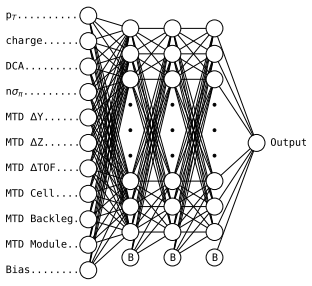
The central object is a dense multilayer perceptron used as a two-class classifier: signal is primary muons, background is every other track that reaches the MTD, including punch-through hadrons and decay-in-flight muons. Training examples come from a full detector simulation, and the architecture is chosen by a grid search over the number of hidden layers and neurons per layer, with the winning network preferred for classification power, simplicity, and a monotonically rising signal-to-background ratio as the network response increases. For pair selection the paper defines the combinatorial score r_pair = $\sqrt$($r_a^{2}$ + $r_b^{2}$), which places muon pairs near $\sqrt$(2) and allows a single tuned threshold. The same trained response becomes the observable in a four-template fit (muon, pion, kaon, proton) for data-driven purity, and the fit result is projected back onto the original track variables as an overtraining check. What makes the network a physics tool rather than a black box is that every component—the feature set, the hyperparameter choice, and the pair score—is tied to a measurable physics outcome.
What would settle it
Using data alone, select a high-purity sample of muons from J/psi decays via a tag-and-probe method that does not use the DNN score, then compare the predicted DNN response distribution from simulation with the observed distribution in bins of pT: if the disagreement exceeds the roughly 20 percent level seen in the K_S and phi closure tests, or if the template-fit muon yield conflicts with the tag-and-probe efficiency, the central claim would be refuted.
Extended reading notes
Core claim
On its own terms, the paper establishes that a dense multilayer-perceptron classifier with multiple hidden layers is a better muon classifier for the STAR Muon Telescope Detector than optimized one-dimensional cuts, one-dimensional likelihood ratios, boosted decision trees, and shallow neural networks. The classifier consumes ten track-level quantities (DeltaTOF, DeltaZ, DeltaY, MTD cell, module, backleg, n_sigma_pi, DCA, pT, and charge) and returns a score near 1 for primary muons and near 0 for punch-through hadrons and muons from pion and kaon decays. On simulated test data the deep network reaches an AUC of 0.969, above all comparison classifiers. In real dimuon-triggered p+p data, a cut on the pair score r_pair = $\sqrt$($r_a^{2}$ + $r_b^{2}$) at 1.36 gives phi-meson signal-to-background of 0.33 and significance about 8.3, simultaneously better than the 1D-cut baseline, and the raw dimuon mass spectrum shows a psi(2S) peak that the baseline does not. The paper additionally constructs a data-driven muon-purity measurement by fitting the DNN response with simulation-derived templates for muon, pion, kaon, and proton components, and checks the fit by projecting the yields back onto the input variables.
Load-bearing premise
The classifier boundary and the purity templates both depend on the assumption that the detector simulation, combined with data-extracted time-of-flight curves, reproduces the joint distribution of all input features for muons, pions, kaons, and protons; the paper demonstrates only single-variable agreement within about 20 percent, not the correlations a deep network exploits.
Editorial extensions
If this is right
- The DNN-based identification can be applied to other STAR dimuon analyses, improving the reach of phi, omega, J/psi, and psi(2S) measurements without any hardware change.
- The pair-response threshold r_pair > 1.36 gives one concrete operating point, and the same procedure can re-optimize the threshold for a different resonance or background composition.
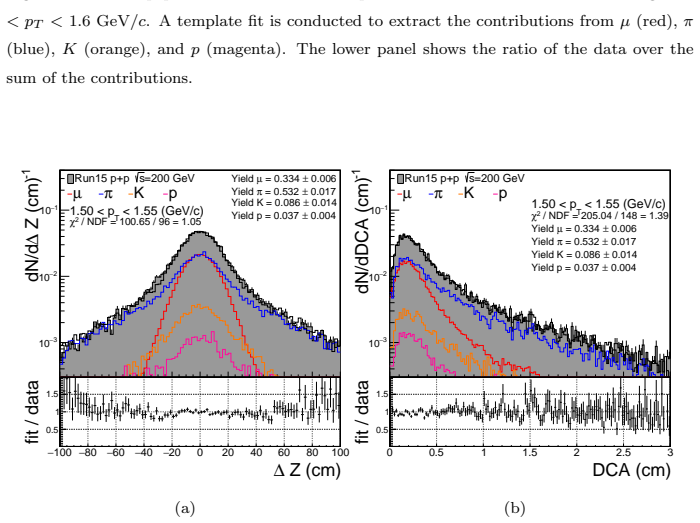
- Template fits to the DNN response yield pT-differential muon purities in data, and the projection check gives a built-in test of whether the classifier has generalized.
- Because the gains appear in the raw mass spectrum, the method reduces the reliance on background-subtraction models in resonance extraction.
- The approach is a template for treating a detector subsystem's multi-dimensional response with a trained classifier instead of a set of hand-optimized cuts.
Reading between the lines
- Inference: the decisive validation the paper does not report is a comparison of simulated and data joint distributions of DeltaTOF, DeltaZ, and DeltaY; single-variable closure to about 20 percent does not guarantee the correlations the network exploits are correct.
- Inference: the same training-plus-template-fit recipe could be transported to other MRPC-based muon systems, but only after re-simulating that detector's material and timing response; the classifier itself is not portable.
- Inference: binning the DNN purity fit in pT and eta would give differential muon fractions that could directly feed muon-triggered cross-section measurements with per-bin systematics.
- Inference: if the observed gains survive a full systematic treatment, earlier STAR dimuon results based on cut-based PID may be statistically underpowered and worth revisiting.
Signed reviews
Editorial analysis
A structured set of objections, weighed in public.
Referee Report
Summary. The paper reports a study of shallow and deep neural-network classifiers for muon identification using Muon Telescope Detector (MTD) and TPC information at STAR. The authors compare neural networks with likelihood ratios, boosted decision trees, and traditional cut-based PID, and then test the best DNN on real p+p collisions at sqrt(s)=200 GeV through the phi -> mu+mu- and psi(2S) -> mu+mu- channels. They report that the DNN-based PID gives a higher phi signal significance, signal-to-background ratio, and signal efficiency than the optimized 1D cut baseline, and that it makes the psi(2S) visible in the raw dimuon mass spectrum. The paper also presents a DNN-response template fit for measuring muon purity in data, with projections back onto the input variables as an overtraining check.
Significance. If the main comparison is accepted, the paper is a useful and concrete demonstration that a dense deep neural network improves muon identification at STAR relative to traditional 1D cuts, and it provides a practical method for data-driven purity estimation. The use of the phi and psi(2S) mass peaks in real data as an end-to-end performance test is a genuine strength, as is the data-driven extraction of the DeltaTOF templates and the closure checks using K0S and phi decays. The purity-fitting idea, with projections back to the PID features, is an appealing and potentially reusable overtraining diagnostic. However, the headline real-data comparison is weakened by an asymmetric evaluation protocol: the DNN pair-response cut is optimized on the same phi data used for the significance claim, while the 1D baseline was optimized on the J/psi. In addition, the Monte Carlo closure tests validate only single-variable distributions and therefore do not fully certify the joint feature correlations that the DNN exploits. These issues are fixable but are load-bearing for the central claim.
major comments (3)
- [Sec. 5.2, Eq. (1)] The comparison between DNN-based PID and traditional 1D PID is not symmetric. The DNN operating point is chosen by maximizing the phi significance on the same data: the text states that 'the optimal rpair cut... was determined by maximizing the phi significance... in steps of rpair=0.01', so the quoted value of ~8.3 is the maximum of a scan over many thresholds applied to the reported dataset. In contrast, the 1D cuts were optimized on the J/psi peak, not on the phi. Consequently, the reported improvement from 6.27 to 8.3 significance may partly reflect selection on the same data rather than genuine classifier superiority. To support the abstract's claim that the DNN 'simultaneously provides higher signal efficiency, S/B, and significance,' the authors should evaluate both methods under the same protocol: for example, optimize both on a training subset and quote results on a held-out subset, or fix the DNN threshold without reference to the phi data and report the effect of the threshold scan (e.g., a trials factor).
- [Sec. 3.4 and Figs. 6a-6b] The Monte Carlo closure test validates the simulated background distributions only through single-variable comparisons of DeltaY, DeltaZ, and MTD cell, and the data/simulation ratios agree only to about 20%. Since the DNN is designed to exploit correlations among all eight input features, and since the purity template fit in Sec. 5.3 uses the full DNN response, single-variable agreement is not sufficient to establish that the joint distribution is correctly modeled. A stronger validation would compare a multivariate quantity in data with MC predictions, such as the DNN response distribution itself, or the feature correlation matrices, for the pion- and kaon-enhanced samples. Without this, the MC-based ROC comparison in Fig. 9 and the purity yields in Fig. 13 carry an unquantified systematic risk.
- [Sec. 5.3, Fig. 13] The purity template fit reports only statistical uncertainties on the extracted muon, pion, kaon, and proton yields. No systematic uncertainties are given for the choice of templates, the pT bin width, the fit range, the signal/background definitions, or the simulation-based template shapes. The fit quality is also moderate (chi2/ndf = 2.31 for the DNN response and 1.39 for the DCA projection), and the lower panels show deviations up to roughly 20%. Since the authors present this as a new method for data-driven muon purity measurement, a discussion of systematic uncertainties is needed before the method can be relied upon quantitatively.
minor comments (5)
- [Sec. 5.2, Fig. 12] The claim that the DNN makes the psi(2S) 'significantly more visible' is supported only by a visual comparison of normalized histograms; providing a quantitative significance for the psi(2S) peak under each PID method would make the claim more robust.
- [Sec. 5.1] Please clarify how the 'traditional 1D cuts' classifier is converted into the ROC curve shown in Fig. 9, since fixed cuts normally define a single operating point rather than a curve. The reported AUC of 0.661 for the 1D cuts also deserves a brief explanation, as it seems to underperform the real-data 1D PID performance shown in Fig. 10.
- [Sec. 5.3] There is a sentence fragment in the text: 'Since the DNN combines all PID features In this setup, only a single distribution needs to be fit...' This should be rewritten for clarity.
- [Sec. 6 and elsewhere] There are several typographical errors: 'he DNN-based muon identification' in Sec. 6, 'TenserFlow' near Table 3, 'a random guess classifier has an should have' in Sec. 5.1, and inconsistent panel labels in the Fig. 6 captions. These should be corrected.
- [Fig. 12 caption] The caption states that the distributions are scaled in the region 1.5 < M_mumu < 2.5 GeV/c^2, but the normalization factor and the reason for this choice are not given; providing this information would help the reader interpret the comparison.
Circularity Check
φ-significance comparison uses an rpair cut tuned on the same data, making part of the DNN-vs-1D superiority claim a fitted result.
-
fitted input called prediction
[Sec. 5.2, Eq. (1), Figs. 10-11]
"The optimal rpair cut for selecting φ→µ+µ− decays was determined by maximizing the φ significance (S/√S+B) in steps of rpair = 0.01. ... The optimal cut was found to be rpair > 1.36 which provides a φ meson significance of ∼8.3 ... The cuts used in the 1D cut classifier were optimized on the Jψ peak in p+p collisions at√s = 200 GeV."
The reported φ significance is not the performance of a pre-specified DNN operating point; it is the maximum over the scanned rpair grid, with the cut chosen on the same data used for the comparison. The 1D baseline was optimized on J/ψ rather than φ, so the two methods are not evaluated symmetrically. Consequently, the claim that DNN-based PID simultaneously provides higher significance is partly an artifact of in-sample threshold selection: the metric being claimed was the objective used to choose the cut. The DNN weights themselves came from MC, so the circularity is partial, but the headline real-data significance comparison reduces to a fitted parameter.
full rationale
The DNN classifier itself is trained on GEANT3 Monte Carlo, and the AUC comparison in Fig. 9 is evaluated on a disjoint simulated test sample; that is a legitimate (simulation-quality-dependent) benchmark, not circular. The purity-template fit in Sec. 5.3 also has free yields and is not defined in terms of the quantities it reports. There is no load-bearing self-citation chain and no definitional identity such as a variable defined by the target result. The central circular step is confined to Sec. 5.2: the rpair pair-selection cut is tuned by maximizing φ significance on the same data whose φ significance is then quoted as evidence of DNN superiority, while the 1D baseline was optimized on J/ψ. This inflates the DNN's real-data φ significance relative to a fair fixed-threshold comparison. The raw-mass-spectrum visual improvements (including ψ(2S) visibility) and the MC ROC curves retain independent content, so the paper is not wholly circular; however the strongest quantitative real-data claim is partially a fitted-input-called-prediction.
Assumptions & free parameters
free parameters (3)
- DNN architecture and training hyperparameters =
3 hidden layers x 14 neurons; tanh activation; learning rate 0.02; decay 0.01; up to 500 epochs
- Pair response cut rpair =
rpair > 1.36
- Traditional 1D cut values =
DCA < 1.0 cm; -1 < nsigma_pi < 3; |deltaY|, |deltaZ| < 3 sigma (+0.5 for pT > 3 GeV/c); pT leading > 1.5 GeV/c
assumptions (3)
- domain assumption GEANT3 simulation of the full STAR geometry accurately models hadron punch-through, weak decays, energy loss, and MTD response for the training samples.
- domain assumption The data-driven deltaTOF PDFs extracted from J/psi data (signal) and TOF beta-1 bands (pions, kaons, protons) are representative for the applied kinematic range.
- domain assumption The DNN response template shapes computed from simulation can be fit to data with four free yields to measure muon purity.
Cite this review
Pith. "Pith review of Muon Identification Using Deep Neural Networks with the Muon Telescope Detector at STAR." pith.science (2026). https://pith.science/paper/NYVJEPB3
@misc{pith2026190805645,
  author       = {Pith},
  title        = {Pith review of: Muon Identification Using Deep Neural Networks with the Muon Telescope Detector at STAR},
  year         = {2026},
  howpublished = {\url{https://pith.science/paper/NYVJEPB3}},
  note         = {Machine review of arXiv:1908.05645}
}
abstract
The installation of the muon telescope detector opened new possibilities for studying dimuon production at STAR. However, backgrounds from hadron punch-through and weak decays of pions and kaons make the identification of primary muons challenging. In this paper we present a study of shallow and deep neural networks trained as classifiers for the purpose of muon identification using information from the muon telescope detector at STAR. The performance of shallow neural networks is presented as a function of the number of neurons in their hidden layer. A hyperparameter optimization for determining the optimal deep neural network classifier architecture is presented. The optimized deep neural network is compared with shallow neural networks, boosted decision trees, likelihood ratios, and traditional cut-based PID techniques. The superiority of the deep neural network based muon identification technique is demonstrated and compared with traditional PID through the measurement of the $\phi$ meson and the $\psi(2S)$ in p+p collisions at $\sqrt{s}$ = 200 GeV. The deep neural network based PID simultaneously provides higher signal efficiency, signal-to-background ratio, and significance of the $\phi$ peak compared to traditional PID techniques. Finally, a deep neural network assisted technique for measuring the muon purity in data is presented and discussed.
Figures


Figures from the paper (11 more)




Reference graph
Works this paper leans on
-
[1]
K. H. Ackermann et al. (STAR Collaboration) , Nucl. Instr. and Meth. A 499 (2003), 624
work page 2003
-
[2]
M. Anderson et al. (STAR Collaboration) , Nucl. Instr. and Meth. A 499 (2003) 659–678. 23
work page 2003
- [3]
- [4]
- [5]
-
[6]
C. Yang, X. J. Huang, C. M. Du et al. Nucl. Instr. and Meth. A 762 (2014) 1–6
work page 2014
-
[7]
R. Brun, a. C. McPherson, P. Zanarini, et al. CERN Program Library Long Writeup W5013
- [8]
Show all 13 references
-
[9]
Hornik, M
K. Hornik, M. Stinchcombe, H. White, Neural Networks 5 (1989) 359–366
1989
-
[10]
Therhaag AIP Conf
J. Therhaag AIP Conf. Proc., 1504, (2012), 1013–1016
2012
-
[11]
Efron, J
B. Efron, J. Am. Stat. Assoc. 397 (1987) 171–185
1987
-
[12]
Efron, Ann
B. Efron, Ann. Stat. 1 (1979) 1–26
1979
-
[13]
Abadi, A
M. Abadi, A. Agarwal, P. Barham, et al. TensorFlow: Large-Scale Machine Learning on Heterogeneous Distributed Systems (2015) 24
2015
Reviewed August 14, 2026 · model on record in the stance chip above.
Discussion (0). Continue with ORCID to comment.