REVIEW 3 major objections 5 minor 4 cited by
Loop Quantum Gravitational Signatures via Love Numbers
T0 review · 3 major / 5 minor · reviewed 2026-08-10 · deepseek-v4-flash
Pith's one-line read Static Love numbers of loop-quantized black holes are predicted to be nonzero and negative for every multipole.
desk verdict First TLN computation for the AOS loop black hole; scalar and vector results are clean, but the headline tensor result rests on an unproven axial-perturbation assumption. read the letter →
The pith
A machine-rendered reading of the paper's core claim, the machinery that carries it, and where it could break.
The reading
What carries the argument
The engine of the argument is the effective AOS metric for macroscopic black holes, $$f(r)=\Bigl(\frac{r}{r_H}\Bigr)^{2\epsilon}\Bigl(1-\Bigl(\frac{r_H}{r}\Bigr)^{1+\epsilon}\Bigr),\qquad g(r)=1-\Bigl(\frac{r_H}{r}\Bigr)^{1+\epsilon},$$ with $\epsilon\simeq \tfrac{1}{2}\gamma^2\delta_b^2\propto M^{-2/3}$, inserted into the master equation for static spin-$s$ perturbations. The paper changes the radial variable to $v=(r_H/r)^{1+\epsilon}$ and uses the field redefinition $\Psi=v^\ell v^p F$, choosing $p$ so that an unwanted term cancels; the perturbation equation then becomes a standard hypergeometric equation whose parameters are non-integer because of $\epsilon$. This non-integrality means the growing external-tide solution and the decaying induced-response solution do not overlap, so the Love number can be read off unambiguously as the ratio of their coefficients, yielding Eq. (4.15) and the leading scaling (5.1). The non-integer parameters are exactly the point where the classical four-dimensional symmetry that makes Love numbers vanish is broken.
What would settle it
Derive the axial tensor perturbation equation for the AOS effective metric directly from its polymerized Hamiltonian constraint and compare it with the classical master equation used in Eq. (4.1); any new term of order $\epsilon$ in the potential would change the tensor Love numbers in Eq. (4.15). Observationally, a measured quadrupole Love number near $\kappa_{\ell=2}\sim 2\times 10^{-5}$ from a black hole with $M<4.3\times 10^{4}M_{\rm Pl}$ would contradict the paper's consistency bound.
Extended reading notes
Core claim
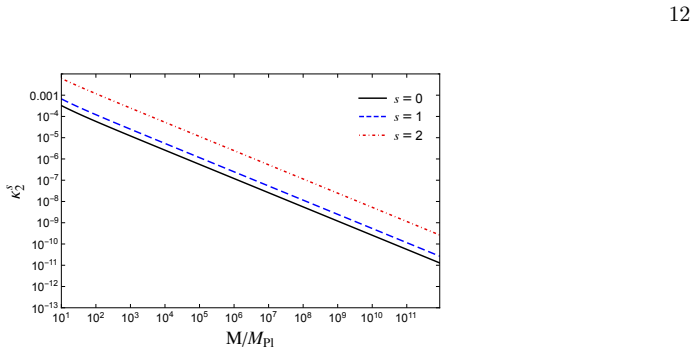
The central claim is that the AOS loop-quantized Schwarzschild black hole is not rigid: when subjected to a static external scalar, vector, or axial gravitational tidal field, it develops a nonzero induced multipole response. The static tidal Love numbers are all negative and nonvanishing for every multipole $\ell\ge s$ except the scalar monopole, and at leading order in the quantum parameter they scale as $\kappa_s^\ell = -C(s,\ell)(M_{\rm Pl}/M)^{2/3}$ with $C(s,\ell)>0$. In the infinite-mass limit the numbers vanish, recovering the classical four-dimensional Schwarzschild result; for finite mass the quantum parameter $\epsilon\simeq \tfrac{1}{2}\gamma^2\delta_b^2\propto M^{-2/3}$ breaks the symmetry that forces classical black holes to have zero Love numbers. The result is presented as a closed-form hypergeometric expression, Eq. (4.15), and the paper argues that nonvanishing tidal deformability constitutes a quantum hair accessible to external observers.
Load-bearing premise
The load-bearing assumption is that the loop-quantized black hole responds to twisting gravitational tides through the same perturbation equation as in classical general relativity, with quantum effects appearing only in the background metric; if the quantum theory changes the response equation itself, the paper's largest tensor Love number prediction would no longer follow.
Editorial extensions
If this is right
- If the AOS metric is the right effective description, static black hole Love numbers are no longer a no-hair diagnostic: they provide a Planck-suppressed quantum deformation parameter for every multipole.
- Gravitational-wave searches for nonzero quadrupole Love numbers can place a direct lower bound on masses of loop-quantized black holes: $M \gtrsim 4.3\times 10^{4}M_{\rm Pl}$ keeps the prediction below the $\sim 2\times 10^{-5}$ detection threshold.
- The tensor response is the strongest channel, with its Love number magnitude about an order of magnitude larger than the scalar or vector response, making the axial gravitational sector the most promising observational target.
- The absence of logarithmic running distinguishes the AOS prediction from some modified-gravity models, and the negative sign gives a possible way to tell loop-quantized black holes apart from other exotic compact objects.
Reading between the lines
- A direct derivation of the axial perturbation equation from the polymerized Hamiltonian constraint could change the tensor prediction; if so, the scalar and vector Love numbers would remain the more robust signatures because they depend only on the background metric.
- The same hypergeometric reduction should apply to other polymerized black hole metrics with $f(r)\neq g(r)$, so comparing Love numbers across quantization schemes could act as a quantum-ambiguity discriminator.
- If the static result extends to frequency-dependent tidal response, the quantum correction would enter gravitational-wave phase at high post-Newtonian order, and next-generation detectors might constrain the AOS quantization scale differently from current bounds.
- The mass bound suggests small-mass or primordial black holes as the natural observational targets, although the AOS model's own derivation of its polymerization parameters is made in the large-mass limit, making the low-mass regime the least trustworthy part of the prediction.
Formalized claims in Lean
-
Claim #1: The central claim is that the AOS loop-quantized Schwarzschild black hole is not rigid: when subjected to a static external scalar, vector, or axial gravitational tidal field, it develops a nonzero induced multipole response. The static tidal Love numbers are all negative and nonvanishing for every multipole $\ell\ge s$ except the scalar monopole, and at leading order in the quantum parameter they
/-- @claim 1 The central claim is that the AOS loop-quantized Schwarzschild black hole is not rigid: when subjected to a static external scalar, vector, or axial gravitational tidal field, it develops a nonzero induced multipole response. The static tidal Love numbers are all negative and nonvanishing for every multipole $\ell\ge s$ except the scalar monopole, and at leading order in the quantum parameter they -/
def central_claim : Prop :=
Signed reviews
Editorial analysis
A structured set of objections, weighed in public.
Referee Report
Summary. This paper studies the static tidal Love numbers (TLNs) of the Ashtekar-Olmedo-Singh (AOS) effective loop-quantum black hole. Starting from the static spin-s master equation with the effective potential (3.2), the authors reduce the radial problem to a hypergeometric equation in v=(rH/r)^{1+ϵ}, extract a closed-form TLN (4.15), and show it scales as -C(s,ℓ)(M_Pl/M)^{2/3}. They report nonvanishing negative TLNs for scalar, vector, and axial tensor perturbations, with the tensor TLN largest, and derive a mass bound M ≳ 4.3×10^4 M_Pl from comparison with a projected quadrupole sensitivity κ∼2×10^-5.
Significance. The result, if correct, would replace the classical vanishing of Schwarzschild TLNs by a mass-suppressed quantum deformability, giving a concrete, falsifiable prediction and providing a new discriminant among loop-quantum black hole models. The paper's strengths are the closed-form hypergeometric derivation, the explicit recovery of the GR limit as ϵ→0, the absence of fitted parameters in the TLN, and the clear mass scaling inherited from δ_b(M). The scalar and vector sectors are robust because they are test fields on a fixed background. However, the tensor sector and the observational interpretation rest on two unproven identifications (the axial perturbation equation and the TLN extraction in a non-asymptotically-flat coordinate frame), so the significance is conditional.
major comments (3)
- [Section IV, after Eq. (4.1)] The treatment of the s=2 axial sector is an assumption, not a derivation. The AOS background (2.9) is not a solution of Einstein's equations but an effective solution generated by the polymerized Hamiltonian (2.5), and the cited result [70] on anisotropic fluids is not shown to apply to the effective stress tensor of this model; no proof is given that the linearized polymerized constraint has vanishing axial source. Since Eq. (4.15) for s=2 is the largest TLN and underlies the mass bound in Sec. V, the central tensor prediction and the bound rest on this unverified assumption. The scalar and vector results, being test fields on a fixed background, are not affected by this comment.
- [Section III, Eq. (3.4), and Section IV, Eqs. (4.4)-(4.15)] The identification of the extracted coefficient κ_s^ℓ with the physical TLN of Eq. (3.4) is not established for the AOS metric, because f(r) in (2.9) diverges as r^{2ϵ} at infinity instead of tending to 1. The paper invokes Ref. [58] for asymptotic flatness but does not pass to the asymptotically flat coordinate frame before performing the large-r expansion; the hypergeometric exponents in v=(rH/r)^{1+ϵ} differ from those in Eq. (3.4), so the ratio computed by Eq. (4.15) is not shown to equal the response-to-source ratio an observer would define. This affects all spins, although the numerical effect is small for ϵ≪1.
- [Section V and Abstract] The bound M≳4.3×10^4 M_Pl is obtained by comparing the quadrupole tensor TLN with a detector sensitivity κ∼2×10^-5. Because 4.3×10^4 M_Pl is about 10^-3 kg, this is a statement about Planck-mass-scale black holes, not about astrophysical black holes; the conclusion that the AOS model is consistent with current and next-generation detection limits for all larger masses is true by default for any realistic source and does not provide the observational handle claimed in the abstract. This should be reframed as a constraint on the model's validity range, not as a prospect for detecting quantum hair.
minor comments (5)
- [Abstract] The statement that TLNs are nonvanishing and negative for all three responses and all multipoles should be qualified by the exception κ^{s=0}_{ℓ=0}=0 stated in Sec. IV.
- [Section IV, after Eq. (4.11)] The choice of the positive sign for p is justified only by the phrase 'in order to recover GR'; a more explicit argument showing that the negative root does not reduce to the GR solution as ϵ→0 would be helpful.
- [Section IV] The word 'hypergeoemtric' should read 'hypergeometric'.
- [Section IV, Eq. (4.12)] The shorthand a=1+ϵ is used in several equations without being restated; a short definition near Eq. (4.12) would improve readability.
- [Section V, Eq. (5.1)] The sentence about the only dimensionless quantity constructible from M and M_Pl should mention that δ_b is fixed as a function of M by Eq. (2.6); otherwise the reader may wonder why the Barbero-Immirzi parameter does not enter the scaling.
Circularity Check
No circularity: TLNs are computed from a fixed AOS background; the axial-sector assumption is a limitation, not a circular reduction.
full rationale
The paper does not fit any parameter to a Love number, nor does it define the background in terms of the target TLN. It inserts the previously derived AOS metric (2.9), with ε ∝ δ_b^2 and δ_b ∝ M^{-1/3} from Eq. (2.6), into the standard static perturbation equation (4.1), solves it in hypergeometric form, and reads off κ_s^ℓ from the asymptotic coefficient; the leading M^{-2/3} scaling in Eq. (5.1) follows algebraically from ε ∝ (M_Pl/M)^{2/3}. Scalar and vector cases are test fields on a fixed background, and the tensor case explicitly states its modeling assumption: 'our analysis assumes that the axial gravitational perturbations for the effective metric (2.9) are governed by the effective potential (3.2) with spin s = 2 as in classical GR' (Section IV, after Eq. (4.1)). That assumption is an unproven step and therefore a correctness risk, but it is not circular: no equation defining the TLN is used to construct the perturbation equation, and no fitted coefficient is relabeled as a prediction. Self-citations to the AOS model provide the background input from prior, externally studied work, not a substitute for the perturbation calculation. The derivation is self-contained once the AOS background and the quoted perturbation ansatz are granted.
Assumptions & free parameters
free parameters (2)
- gamma (Barbero-Immirzi) =
0.2375
- delta_b (polymerization parameter) =
(sqrt(Delta)/(sqrt(2 pi gamma) 2m))^(1/3)
assumptions (5)
- domain assumption The effective polymerized Hamiltonian constraint (2.5) captures the loop quantum dynamics of the Kantowski-Sachs/Schwarzschild interior.
- domain assumption The exterior AOS metric (2.9) with f and g as given is a valid static effective spacetime for macroscopic black holes, and is asymptotically flat in suitable coordinates.
- domain assumption Spin-s perturbations obey the master equation (3.1) with potential (3.2) on this effective background.
- standard math The TLN formula (4.14) from Ref. [5] applies to hypergeometric parameters with generic non-integer and non-half-integer values.
- domain assumption The AOS large-mass formulas for delta_b and delta_c (2.6) hold for all masses discussed.
Cite this review
Pith. "Pith review of Loop Quantum Gravitational Signatures via Love Numbers." pith.science (2026). https://pith.science/paper/NYXWW5HP
@misc{pith2026250109151,
  author       = {Pith},
  title        = {Pith review of: Loop Quantum Gravitational Signatures via Love Numbers},
  year         = {2026},
  howpublished = {\url{https://pith.science/paper/NYXWW5HP}},
  note         = {Machine review of arXiv:2501.09151}
}
abstract
Loop quantum gravitational effects can resolve the central singularity of black holes while potentially leaving tiny traces of quantization in the exterior spacetime. We show the way these residues can, in principle, be explored using tidal Love numbers (TLNs). We consider loop quantized Schwarzschild black hole, in particular the Ashtekar-Olmedo-Singh (AOS) model, and study the static response to external tidal fields of spin zero (scalar field), spin one (vector field), and spin two (axial gravitational field) types. We find that, in contrast to the classical theory, where TLNs vanish, they are non-vanishing and negative for all three responses and for all multipoles. Besides, the magnitude of TLNs decreases as the black hole mass increases, and TLNs, in response to the axial gravitational field, have the largest magnitude among these three responses. Our results show that for black holes of mass $M \gtrsim 4.3 \times 10^{4} M_{\textrm{Pl}}$, the AOS model is consistent with current and next-generation detection limits for TLNs. Our findings suggest that the quantum deformability of loop quantum black holes, arising from the inherent fuzziness of spacetime geometry, reveals a fundamentally distinct internal structure compared to their classical counterparts. This unique feature manifests as quantum hair, which, in principle, can be detected by future observations.
Figures


Forward citations
Cited by 4 Pith papers
-
Tidal Love Numbers of Neutron Stars in Horndeski Theories
In scalar-tensor theories, the 1/r^3 term used to extract neutron star tidal Love numbers contains a Love-number-independent contamination, computed here for minimally coupled and DEF scalar fields.
-
Love Numbers of Covariant Loop Quantum Black Holes
Tidal Love numbers of three covariant loop quantum black holes are shown to be generically nonzero, Planck-scale suppressed, and model-dependent in sign and logarithmic running.
-
Lessons from gauge fixing and polymerization of loop quantum black holes with a cosmological constant
Constant-polymerization loop quantization of Schwarzschild-de Sitter in Kantowski-Sachs gauge generates a spurious low-curvature black hole horizon, while Schwarzschild-anti-de Sitter does not.
-
Echoes of Love Beyond the Horizon: A Bridge to Recovering Information from Black Holes
Black holes may acquire Planck-suppressed tidal Love numbers from quantum gravity, which the authors argue could carry information about the initial collapse and help resolve the information loss paradox.
Reference graph
Works this paper leans on
-
[70]
Parametrized Love numbers of nonrotating black holes,
T. Katagiri, T. Ikeda and V. Cardoso, “Parametrized Love numbers of nonrotating black holes,” Phys. Rev. D 109, no.4, 044067 (2024)
work page 2024
-
[58]
Is loop quantization in cosmology unique?,
A. Corichi and P. Singh, “Is loop quantization in cosmology unique?,” Phys. Rev. D 78, 024034 (2008)
work page 2008
-
[1]
Event horizons in static vacuum space-times,
W. Israel, “Event horizons in static vacuum space-times,” Phys. Rev. 164, 1776-1779 (1967); B. Carter, “Axisymmetric Black Hole Has Only Two Degrees of Freedom,” Phys. Rev. Lett. 26, 331-333 (1971); S. W. Hawking, “Black holes in general relativity,” Commun. Math. Phys. 25, 152-166 (1972)
work page 1967
-
[2]
The yielding of the Earth to disturbing forces,
A. E. H. Love, “The yielding of the Earth to disturbing forces,” Monthly Notices of the Royal Astro- nomical Society 69, 476 (1909)
work page 1909
-
[3]
Tidal coupling of a Schwarzschild black hole and circularly orbiting moon,
H. Fang and G. Lovelace, “Tidal coupling of a Schwarzschild black hole and circularly orbiting moon,” Phys. Rev. D 72, 124016 (2005); T. Damour and A. Nagar, “Relativistic tidal properties of neutron stars,” Phys. Rev. D 80, 084035 (2009); T. Binnington and E. Poisson, “Relativistic theory of tidal Love numbers,” Phys. Rev. D 80, 084018 (2009); N. G¨ urle...
work page 2005
-
[4]
Black hole stereotyping: Induced gravito-static polarization,
B. Kol and M. Smolkin, “Black hole stereotyping: Induced gravito-static polarization,” JHEP 02, 010 (2012)
work page 2012
-
[5]
Static response and Love numbers of Schwarzschild black holes,
L. Hui, A. Joyce, R. Penco, L. Santoni and A. R. Solomon, “Static response and Love numbers of Schwarzschild black holes,” JCAP 04, 052 (2021)
work page 2021
-
[6]
Spinning Black Holes Fall in Love,
A. Le Tiec and M. Casals, “Spinning Black Holes Fall in Love,” Phys. Rev. Lett. 126, no.13, 131102 (2021)
work page 2021
Show all 74 references
-
[7]
Tidal Love Numbers of Kerr Black Holes,
A. Le Tiec, M. Casals and E. Franzin, “Tidal Love Numbers of Kerr Black Holes,” Phys. Rev. D 103, no.8, 084021 (2021); H. S. Chia, “Tidal deformation and dissipation of rotating black holes,” Phys. Rev. D 104, no.2, 024013 (2021); P. Charalambous, S. Dubovsky and M. M. Ivanov,...
2021
-
[8]
Testing strong-field gravity with tidal Love numbers,
V. Cardoso, E. Franzin, A. Maselli, P. Pani and G. Raposo, “Testing strong-field gravity with tidal Love numbers,” Phys. Rev. D 95, no.8, 084014 (2017)
2017
-
[9]
Love numbers and magnetic susceptibility of charged black holes,
D. Pere˜ niguez and V. Cardoso, “Love numbers and magnetic susceptibility of charged black holes,” Phys. Rev. D 105, no.4, 044026 (2022)
2022
-
[10]
Ladder symmetries and Love numbers of Reissner-Nordstr¨ om black holes,
M. Rai and L. Santoni, “Ladder symmetries and Love numbers of Reissner-Nordstr¨ om black holes,” JHEP 07, 098 (2024)
2024
-
[11]
Charging the Love numbers: Charged scalar response coefficients of Kerr-Newman black holes,
L. Ma, Z. H. Wu, Y. Pang and H. Lu, “Charging the Love numbers: Charged scalar response coefficients of Kerr-Newman black holes,” [arXiv:2408.10352 [gr-qc]]
-
[12]
Nonlinearities in the tidal Love numbers of black holes,
V. De Luca, J. Khoury and S. S. C. Wong, “Nonlinearities in the tidal Love numbers of black holes,” Phys. Rev. D 108, no.2, 024048 (2023); M. M. Riva, L. Santoni, N. Savi´ c and F. Vernizzi, “Vanish- ing of nonlinear tidal Love numbers of Schwarzschild black holes,” Phys. Lett...
2023 arXiv
-
[13]
Symmetries of Vanishing Nonlinear Love Numbers of Schwarzschild Black Holes,
O. Combaluzier-Szteinsznaider, L. Hui, L. Santoni, A. R. Solomon and S. S. C. Wong, “Symmetries of Vanishing Nonlinear Love Numbers of Schwarzschild Black Holes,” [arXiv:2410.10952 [gr-qc]]
-
[14]
The Vanishing of the Non-linear Static Love Number of Kerr Black Holes and the Role of Symmetries,
L. R. Gounis, A. Kehagias and A. Riotto, “The Vanishing of the Non-linear Static Love Number of Kerr Black Holes and the Role of Symmetries,” [arXiv:2412.08249 [gr-qc]]
-
[15]
for recent studies on dynamical TLNs). However, this peculiar property of vanishing TLNs is specific to four-dimensional GR, indicating the existence of hidden (or ladder) symmetries for spherically symmetric spacetimes in four-dimensions [13, 14, 16]. On the other hand, TLNs ...
2025 arXiv
-
[16]
Dynamical Love Numbers for Kerr Black Holes,
M. Perry and M. J. Rodriguez, “Dynamical Love Numbers for Kerr Black Holes,” [arXiv:2310.03660 [gr- qc]]; S. Chakraborty, E. Maggio, M. Silvestrini and P. Pani, “Dynamical tidal Love numbers of Kerr-like compact objects,” Phys. Rev. D 110, no.8, 084042 (2024); M. V. S. Saketh,...
2024 arXiv
-
[17]
Hidden Symmetry of Vanishing Love Numbers,
P. Charalambous, S. Dubovsky and M. M. Ivanov, “Hidden Symmetry of Vanishing Love Numbers,” Phys. Rev. Lett. 127, no.10, 101101 (2021); L. Hui, A. Joyce, R. Penco, L. Santoni and A. R. Solomon, “Ladder symmetries of black holes. Implications for love numbers and no-hair theore...
2021
-
[18]
Gravitational waves and higher dimensions: Love numbers and Kaluza-Klein excitations,
V. Cardoso, L. Gualtieri and C. J. Moore, “Gravitational waves and higher dimensions: Love numbers and Kaluza-Klein excitations,” Phys. Rev. D 100, no.12, 124037 (2019); M. J. Rodriguez, L. Santoni, A. R. Solomon and L. F. Temoche, “Love numbers for rotating black holes in hig...
2019
-
[19]
Asymptotically de Sitter black holes have nonzero tidal Love numbers,
S. Nair, S. Chakraborty and S. Sarkar, “Asymptotically de Sitter black holes have nonzero tidal Love numbers,” Phys. Rev. D 109, no.6, 6 (2024)
2024
-
[20]
Tidal Love numbers of static black holes in anti-de Sitter,
E. Franzin, A. M. Frassino and J. V. Rocha, “Tidal Love numbers of static black holes in anti-de Sitter,” [arXiv:2410.23545 [hep-th]]
-
[21]
Black Holes in an Effective Field Theory Extension of General Relativity,
V. Cardoso, M. Kimura, A. Maselli and L. Senatore, “Black Holes in an Effective Field Theory Extension of General Relativity,” Phys. Rev. Lett. 121, no.25, 251105 (2018) [erratum: Phys. Rev. Lett. 131, no.10, 109903 (2023)]
2018
-
[22]
Implications of the weak gravity conjecture for tidal Love numbers of black holes,
V. De Luca, J. Khoury and S. S. C. Wong, “Implications of the weak gravity conjecture for tidal Love numbers of black holes,” Phys. Rev. D 108, no.4, 4 (2023)
2023
-
[23]
Tidal Love numbers from EFT of black hole perturbations with timelike scalar profile,
C. G. A. Barura, H. Kobayashi, S. Mukohyama, N. Oshita, K. Takahashi and V. Yingcharoenrat, “Tidal Love numbers from EFT of black hole perturbations with timelike scalar profile,” JCAP 09, 001 (2024)
2024
-
[24]
Tidal response beyond vacuum General Relativity with a canonical definition,
T. Katagiri, V. Cardoso, T. Ikeda and K. Yagi, “Tidal response beyond vacuum General Relativity with a canonical definition,” [arXiv:2410.02531 [gr-qc]]
-
[25]
Environmental effects in gravitational-wave physics: Tidal deformability of black holes immersed in matter,
V. Cardoso and F. Duque, “Environmental effects in gravitational-wave physics: Tidal deformability of black holes immersed in matter,” Phys. Rev. D 101, no.6, 064028 (2020)
2020
-
[26]
Tidal deformability of dressed black holes and tests of ultralight bosons in extended mass ranges,
V. De Luca and P. Pani, “Tidal deformability of dressed black holes and tests of ultralight bosons in extended mass ranges,” JCAP 08, 032 (2021)
2021
-
[27]
Modeling frequency-dependent tidal deformability for environ- mental black hole mergers,
V. De Luca, A. Maselli and P. Pani, “Modeling frequency-dependent tidal deformability for environ- mental black hole mergers,” Phys. Rev. D 107, no.4, 044058 (2023)
2023
-
[28]
Stability of relativistic tidal response against small potential modification,
T. Katagiri, H. Nakano and K. Omukai, “Stability of relativistic tidal response against small potential modification,” Phys. Rev. D 108, no.8, 084049 (2023)
2023
-
[29]
Constraining neutron star tidal Love numbers with gravitational wave detectors,
E. E. Flanagan and T. Hinderer, “Constraining neutron star tidal Love numbers with gravitational wave detectors,” Phys. Rev. D 77, 021502 (2008)
2008
-
[30]
Post-1-Newtonian quadrupole tidal interactions in binary systems,
J. E. Vines and E. E. Flanagan, “Post-1-Newtonian quadrupole tidal interactions in binary systems,” Phys. Rev. D 88, 024046 (2013)
2013
-
[31]
Multipole tidal effects in the post-Newtonian gravitational-wave phase of compact binary coalescences,
T. Narikawa, “Multipole tidal effects in the post-Newtonian gravitational-wave phase of compact binary coalescences,” Phys. Rev. D 108, no.6, 063029 (2023)
2023
-
[32]
Gravitational-wave constraints on the GWTC-2 events by measuring the tidal deformability and the spin-induced quadrupole moment,
T. Narikawa, N. Uchikata and T. Tanaka, “Gravitational-wave constraints on the GWTC-2 events by measuring the tidal deformability and the spin-induced quadrupole moment,” Phys. Rev. D 104, no.8, 084056 (2021)
2021
-
[33]
In pursuit of Love numbers: First templated search for compact objects with large tidal deformabilities in the LIGO-Virgo data,
H. S. Chia, T. D. P. Edwards, D. Wadekar, A. Zimmerman, S. Olsen, J. Roulet, T. Venumadhav, B. Zackay and M. Zaldarriaga, “In pursuit of Love numbers: First templated search for compact objects with large tidal deformabilities in the LIGO-Virgo data,” Phys. Rev. D 110, no.6, 0...
2024
-
[34]
Measuring tidal effects with the Einstein Telescope: A design study,
A. Puecher, A. Samajdar and T. Dietrich, “Measuring tidal effects with the Einstein Telescope: A design study,” Phys. Rev. D 108, no.2, 023018 (2023)
2023
-
[35]
What is a singularity in general relativity?,
R. P. Geroch, “What is a singularity in general relativity?,” Annals Phys. 48, 526-540 (1968)
1968
-
[36]
The Singularities of gravitational collapse and cosmology,
S. W. Hawking and R. Penrose, “The Singularities of gravitational collapse and cosmology,” Proc. Roy. Soc. Lond. A 314, 529-548 (1970)
1970
-
[37]
Loop Quantum Cosmology: A Status Report,
A. Ashtekar and P. Singh, “Loop Quantum Cosmology: A Status Report,” Class. Quant. Grav. 28, 213001 (2011)
2011
-
[38]
Regular black holes from Loop Quantum Gravity,
A. Ashtekar, J. Olmedo and P. Singh, “Regular black holes from Loop Quantum Gravity,” [arXiv:2301.01309 [gr-qc]]
-
[39]
Quantum nature of the big bang,
A. Ashtekar, T. Pawlowski and P. Singh, “Quantum nature of the big bang,” Phys. Rev. Lett. 96, 141301 (2006)
2006
-
[40]
Quantum Nature of the Big Bang: Improved dynamics,
A. Ashtekar, T. Pawlowski and P. Singh, “Quantum Nature of the Big Bang: Improved dynamics,” Phys. Rev. D 74, 084003 (2006)
2006
-
[41]
Numerical simulations of a loop quantum cosmos: robustness of the quantum bounce and the validity of effective dynamics,
P. Diener, B. Gupt and P. Singh, “Numerical simulations of a loop quantum cosmos: robustness of the quantum bounce and the validity of effective dynamics,” Class. Quant. Grav. 31, 105015 (2014)
2014
-
[42]
Numerical simulations of loop quantum Bianchi-I spacetimes,
P. Diener, A. Joe, M. Megevand and P. Singh, “Numerical simulations of loop quantum Bianchi-I spacetimes,” Class. Quant. Grav. 34, 094004 (2017)
2017
-
[43]
Are loop quantum cosmos never singular?,
P. Singh, “Are loop quantum cosmos never singular?,” Class. Quant. Grav. 26, 125005 (2009); P. Singh, “Loop quantum cosmology and the fate of cosmological singularities,” Bull. Astron. Soc. India 42, 121 (2014); S. Saini and P. Singh, “Resolution of strong singularities and ge...
2009
-
[44]
Geodesic completeness and the lack of strong singularities in effective loop quantum Kantowski–Sachs spacetime,
S. Saini and P. Singh, “Geodesic completeness and the lack of strong singularities in effective loop quantum Kantowski–Sachs spacetime,” Class. Quant. Grav. 33, no.24, 245019 (2016)
2016
-
[45]
Quantum geometry and the Schwarzschild singularity,
A. Ashtekar and M. Bojowald, “Quantum geometry and the Schwarzschild singularity,” Class. Quant. Grav. 23, 391-411 (2006)
2006
-
[46]
Loop quantum black hole,
L. Modesto, “Loop quantum black hole,” Class. Quant. Grav. 23, 5587-5602 (2006)
2006
-
[47]
Phenomenological loop quantum geometry of the Schwarzschild black hole,
D. W. Chiou, “Phenomenological loop quantum geometry of the Schwarzschild black hole,” Phys. Rev. D 78, 064040 (2008)
2008
-
[48]
Loop quantization of the Schwarzschild interior revisited,
A. Corichi and P. Singh, “Loop quantization of the Schwarzschild interior revisited,” Class. Quant. Grav. 33, no.5, 055006 (2016)
2016
-
[49]
Emergence of the product of constant curvature spaces in loop quantum cosmology,
N. Dadhich, A. Joe and P. Singh, “Emergence of the product of constant curvature spaces in loop quantum cosmology,” Class. Quant. Grav. 32, no.18, 185006 (2015)
2015
-
[50]
From black holes to white holes: a quantum gravitational, symmetric bounce,
J. Olmedo, S. Saini and P. Singh, “From black holes to white holes: a quantum gravitational, symmetric bounce,” Class. Quant. Grav. 34, no.22, 225011 (2017)
2017
-
[51]
Quantum Transfiguration of Kruskal Black Holes,
A. Ashtekar, J. Olmedo and P. Singh, “Quantum Transfiguration of Kruskal Black Holes,” Phys. Rev. Lett. 121, no.24, 241301 (2018)
2018
-
[52]
Quantum extension of the Kruskal spacetime,
A. Ashtekar, J. Olmedo and P. Singh, “Quantum extension of the Kruskal spacetime,” Phys. Rev. D 98, no.12, 126003 (2018)
2018
-
[53]
(b,v)-type variables for black to white hole transitions in effective loop quantum gravity,
N. Bodendorfer, F. M. Mele and J. M¨ unch, “(b,v)-type variables for black to white hole transitions in effective loop quantum gravity,” Phys. Lett. B 819, 136390 (2021)
2021
-
[54]
Loop quantum Schwarzschild interior and black hole rem- nant,
C. Zhang, Y. Ma, S. Song and X. Zhang, “Loop quantum Schwarzschild interior and black hole rem- nant,” Phys. Rev. D 102, no.4, 041502
-
[55]
Hamiltonian formulation and loop quantization of a recent extension of the Kruskal spacetime,
B. Elizaga Navascu´ es, A. Garc ´ ıa-Quismondo and G. A. Mena Marug´ an, “Hamiltonian formulation and loop quantization of a recent extension of the Kruskal spacetime,” Phys. Rev. D 106, no.4, 043531 (2022)
2022
-
[56]
Loop quantization of the Schwarzschild black hole,
R. Gambini and J. Pullin, “Loop quantization of the Schwarzschild black hole,” Phys. Rev. Lett. 110, no.21, 211301 (2013); W. C. Gan, N. O. Santos, F. W. Shu and A. Wang, “Properties of the spherically symmetric polymer black holes,” Phys. Rev. D 102, 124030 (2020); R. Gambini...
2013
-
[57]
Planck stars, White Holes, Remnants and Planck-mass quasi-particles. The quantum gravity phase in black holes’ evolution and its manifestations,
C. Rovelli and F. Vidotto, “Planck stars, White Holes, Remnants and Planck-mass quasi-particles. The quantum gravity phase in black holes’ evolution and its manifestations,” [arXiv:2407.09584 [gr-qc]]
-
[59]
Properties of a recent quantum extension of the Kruskal geometry,
A. Ashtekar and J. Olmedo, “Properties of a recent quantum extension of the Kruskal geometry,” Int. J. Mod. Phys. D 29, no.10, 2050076 (2020)
2020
-
[60]
Scalar Perturbations and Stability of a Loop Quantum Corrected Kruskal Black Hole,
R. G. Daghigh, M. D. Green and G. Kunstatter, “Scalar Perturbations and Stability of a Loop Quantum Corrected Kruskal Black Hole,” Phys. Rev. D 103, no.8, 084031 (2021)
2021
-
[61]
Quasinormal modes of loop quantum black holes near the Planck scale,
D. M. Gingrich, “Quasinormal modes of loop quantum black holes near the Planck scale,” Phys. Rev. D 109, no.4, 044044 (2024)
2024
-
[62]
Shadow of quantum extended Kruskal black hole and its super-radiance property,
S. Devi, A. N. S., S. Chakrabarti and B. R. Majhi, “Shadow of quantum extended Kruskal black hole and its super-radiance property,” Phys. Dark Univ. 39, 101173 (2023)
2023
-
[63]
Revisiting quantum black holes from effective loop quantum gravity,
G. Ongole, P. Singh and A. Wang, “Revisiting quantum black holes from effective loop quantum gravity,” Phys. Rev. D 109, no.2, 026015 (2024)
2024
-
[64]
Symmetric black-to-white hole solutions with a cosmological constant,
Z. W. Feng, Q. Q. Jiang, Y. Ling, X. N. Wu and Z. Yu, “Symmetric black-to-white hole solutions with a cosmological constant,” [arXiv:2408.01780 [gr-qc]]
-
[65]
Quantum Love numbers,
R. Brustein and Y. Sherf, “Quantum Love numbers,” Phys. Rev. D 105, no.2, 024043 (2022)
2022
-
[66]
Quantum corrections to tidal Love number for Schwarzschild black holes,
J. W. Kim and M. Shim, “Quantum corrections to tidal Love number for Schwarzschild black holes,” Phys. Rev. D 104, no.4, 046022 (2021)
2021
-
[67]
Love in Extrema Ratio,
P. Pani and A. Maselli, “Love in Extrema Ratio,” Int. J. Mod. Phys. D 28, no.14, 1944001 (2019)
2019
-
[68]
Hawking radiation by spherically- symmetric static black holes for all spins: Teukolsky equations and potentials,
A. Arbey, J. Auffinger, M. Geiller, E. R. Livine and F. Sartini, “Hawking radiation by spherically- symmetric static black holes for all spins: Teukolsky equations and potentials,” Phys. Rev. D 103, no.10, 104010 (2021)
2021
-
[69]
Probing the Effective Quantum Gravity via Quasinormal Modes and Shadows of Black Holes,
R. A. Konoplya and O. S. Stashko, “Probing the Effective Quantum Gravity via Quasinormal Modes and Shadows of Black Holes,” [arXiv:2408.02578 [gr-qc]]
-
[71]
Gravitational perturbations of nonsingular black holes in conformal gravity,
C. Y. Chen and P. Chen, “Gravitational perturbations of nonsingular black holes in conformal gravity,” Phys. Rev. D 99, no.10, 104003 (2019)
2019
-
[72]
Motaharfar and P
M. Motaharfar and P. Singh, (In preparation)
-
[73]
Shadows of rotating black holes in effective quantum gravity,
Z. Ban, J. Chen and J. Yang, “Shadows of rotating black holes in effective quantum gravity,” [arXiv:2411.09374 [gr-qc]]
-
[74]
Constraining regularization ambiguities in loop quantum cosmology via CMB,
B. F. Li, M. Motaharfar and P. Singh, “Constraining regularization ambiguities in loop quantum cosmology via CMB,” Phys. Rev. D 110, no.6, 066005 (2024)
2024
Reviewed August 10, 2026 · model on record in the stance chip above.
Discussion (0). Continue with ORCID to comment.