REVIEW 5 major objections 5 minor 55 references
Geometry-Aware Texture Generation for 3D Head Modeling with Artist-driven Control
T0 review · 5 major / 5 minor · reviewed 2026-08-15 · deepseek-v4-flash
Pith's one-line read This paper claims a 3D-head pipeline that separates skin tone from fine detail, so a single slider adjusts color and one texture edit updates all rendering maps.
desk verdict A solid systems paper for artist-controlled 3D head texturing, but its central propagation claim is not actually demonstrated in the results. read the letter →
The pith
A machine-rendered reading of the paper's core claim, the machinery that carries it, and where it could break.
The reading
What carries the argument
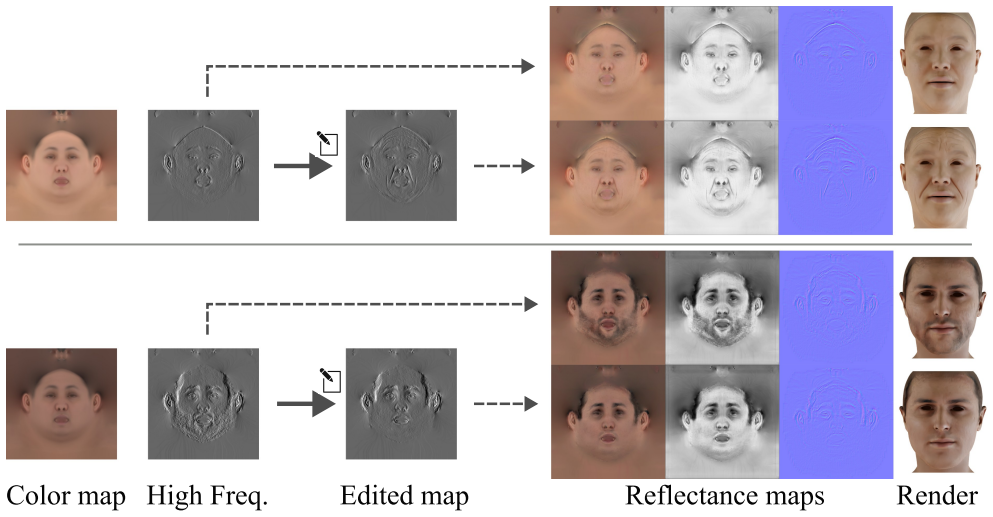
The load-bearing object is the decomposition of skin appearance into two artist-editable intermediates: M, a three-channel map encoding melanin/hemoglobin information for skin tone, and H, a single-channel map encoding high-frequency details such as wrinkles, pores, and facial hair. The pipeline chains four learned translators: GA turns M plus a scalar alpha into the low-frequency color map A; GC recombines A with H into the reflectance map C; and GEs/GEn turn C into specular and normal maps. Because all later maps are functions of A and H, an edit to either intermediate is carried through the whole chain. The texture generator is also conditioned on the geometry latent code zg, so the generated M and H correlate with the specific face shape they will be applied to.
What would settle it
Paint a well-defined scar into the H map of a generated head, render it under a directional light, and inspect the specular and normal maps before and after; if the normal-map change is absent or spreads beyond the painted region, the claimed coherent propagation is refuted.
Extended reading notes
Core claim
The paper's central claim is that 3D head generation can be structured so that the appearance of skin is produced through two artist-controllable intermediate representations rather than a monolithic texture. A geometry generator produces the mesh; a texture generator conditioned on that geometry emits a three-channel melanin/hemoglobin map M and a single-channel high-frequency detail map H. A learned translator maps M and a scalar alpha to a low-frequency skin color map A, a second network recombines A and H into the final reflectance map C, and two further networks decompose C into specular and normal maps. Because every downstream map is a function of the editable intermediates, an artist who paints wrinkles into H or deletes a beard from H automatically updates all maps needed for physically-based rendering, and an artist who moves the alpha slider changes skin tone while the high-frequency identity details stay fixed. The authors support the claim with a lower FID than a UV-space baseline, a quantitative lip-color test against HSV editing, and artist-made edits to wrinkles and beards.
Load-bearing premise
The skin-tone control rests on M maps and an alpha-to-color labeling produced by a commercial tool with an artist-curated mapping; if that labeling is inconsistent or not representative, the learned skin-tone slider will not deliver precise control.
Editorial extensions
If this is right
- An artist can add age-related wrinkles by painting a single-channel map, and the final physically-based rendering maps update together.
- Removing facial hair from a scanned model becomes a one-map cleanup instead of editing diffuse, specular, and normal maps separately.
- Skin-tone diversity passes over many generated heads can be done with one scalar per head while facial identity is preserved.
- Conditioning texture on geometry yields a better match between shape and appearance than a UV-space CNN generator, with fewer artifacts around eyes and mouth.
Reading between the lines
- The propagation chain is agnostic to the content of the detail map, so the same single-map workflow may extend to tattoos, scars, makeup, or dynamic expression wrinkles without retraining the downstream networks.
- A natural next test is calibrating the alpha slider against spectrophotometric melanin measurements; if the learned axis matches measured physiology, GA becomes a physiologically grounded skin appearance model rather than an artist convenience.
- The GNN-geometry-plus-CNN-texture split may transfer to other mesh domains, such as bodies or hands, where UV flattening creates similar adjacency artifacts.
Signed reviews
Editorial analysis
A structured set of objections, weighed in public.
Referee Report
Summary. The paper proposes a pipeline for generating 3D head assets with artist-controllable geometry, skin tone, and fine-grained detail. A part-based GNN variational autoencoder produces a geometry latent code, and a geometry-conditioned generator G produces two intermediate maps: a melanin/hemoglobin skin-tone control map M and a single-channel high-frequency detail map H. A network GA maps M plus a scalar melanin power alpha to a low-frequency color map A; a second network GC combines A and H to synthesize the reflectance map C; networks GEs and GEn estimate specular S and normal N maps from C. The authors claim that editing H with standard tools propagates coherently to all intrinsic maps, and that alpha gives precise skin-tone control. Experiments compare the geometry generator with a StyleGAN-based UV-space baseline, report FID for conditioned versus unconditioned texture generation, measure diversity via nearest-neighbor distances, and evaluate skin-tone editing against an HSV baseline using lip-region hue error. Qualitative examples show wrinkle addition and beard removal. The paper is clearly written and the system is well integrated, but several claims central to the contribution are not quantitatively or even visually validated, particularly the propagation of edits to specular and normal maps.
Significance. If the central claims hold, the system would give artists practical, single-map control over diffuse, specular, and normal textures for production head assets, which is a meaningful step beyond global text- or attribute-conditioned generation. The GNN-based geometry path is a reasonable alternative to UV-space GANs, and the data-driven skin-tone mapping is a sensible use of a commercial melanin/hemoglobin dataset. The paper includes a useful qualitative application to scan cleanup (beard removal). However, the manuscript currently does not demonstrate the headline propagation claim, the quantitative evidence for geometry conditioning is within noise, and the skin-tone evaluation covers only lip hue. These gaps are load-bearing because the abstract and introduction promise coherent propagation to 'the remaining texture maps needed for realistic rendering.' Strengths include the explicit artist-in-the-loop design and the use of multiple intrinsic maps in a single pipeline, but the experiments need to be extended before the contribution can be assessed as claimed.
major comments (5)
- [Abstract, §5.3, Figure 7] The headline claim—that edits to a single high-frequency map H propagate coherently to the specular S and normal N maps—is not validated anywhere. Figures 7 and 9 show only edited reflectance C; no edited S or N map, and no rendered comparison under lighting, is shown or measured. Because GEs and GEn are trained on paired C-to-S/N examples from a fixed distribution, an artist edit to H moves C out of that distribution, and the behavior of S and N is unknown. Please add qualitative and quantitative evaluation of S and N after edits to H, including renderings under novel lighting and a local correctness measure for normal maps (e.g., angular error against a reference normal edit).
- [§5.1, Table 1] The FID difference between the conditioned texture generator (11.44) and the unconditioned version (11.53) is 0.09, which is smaller than typical run-to-run variance for GAN-based models. No confidence intervals, multiple seeds, or statistical tests are reported, so the sentence 'conditioning texture generation on geometry leads to more correlated textures and geometry' is not supported by the table. Please report the variance across random seeds or a significance test before drawing this conclusion.
- [§5.2, Table 3] The skin-tone evaluation is limited to hue error on the lips region, with no significance test reported. The mean improvement over the HSV baseline is small (0.252 vs 0.295) and the claimed 'significantly lower variation' is asserted without a statistical comparison. Since the paper claims 'precise skin tone manipulation while preserving facial characteristics,' the evaluation should also measure identity preservation and full-face perceptual skin-tone accuracy, for example with a user study or with ITA error over the entire face rather than one region.
- [§3.3, §4.1, footnote 2] The melanin/hemoglobin maps M and the alpha axis are taken from a commercial tool with artist-curated tuples, but the paper provides no independent validation that these labels correspond to real melanin/hemoglobin concentrations or perceptual skin-tone scales. If the curation is inconsistent, the learned GA will not deliver the claimed precise control. Please describe the curation protocol in detail and validate the alpha axis against an independent skin-tone measure (e.g., ITA or a perceptual study) across the full range of alpha.
- [§3.4, §3.5] The decomposition underlying the editing workflow is derived directly from C: A is a PCA reconstruction of C and H is the Sobel-gradient magnitude of C, so GC reconstructs C from two deterministic functions of the same image. This makes propagation from H to C partly by construction, and the paper does not characterize how far H can deviate from its natural distribution before GC produces artifacts or fails to preserve skin tone. Please include a stress test of edit magnitude (brush size and contrast) and its effect on C and on the downstream S and N maps.
minor comments (5)
- [§3.2] There is a typographical error in the sentence describing the outputs of G: 'M andH' should read 'M and H', and the fragment 'H).' has an unbalanced parenthesis.
- [Figure 7 and Figure 9] The captions mention propagation to 'reflectance maps' but the figures show only C; please state explicitly that S and N are not shown, or add them to the figure.
- [Table 2] The table header 'data-data generated-data' is confusing, and the row 'Melanin-hemoglobin 0.43 0.45' lacks units and a clear explanation of how the normalization (mentioned in the text) affects the comparison.
- [§4.1] The footnote marker for the commercial tool is placed as 'commercial tool2'; please format the reference properly and give the tool name in the text.
- [§5.3] The sentence 'Figure 7 shows additional experiments conducted on edge editing' is unclear; Figure 9 appears to be the additional example, and the term 'edge editing' is not defined.
Circularity Check
No significant circularity; self-citations are architectural and not load-bearing.
full rationale
The paper is a systems/ML paper, not a formal derivation, and none of its stated results are obtained by fitting the target quantity into the inputs. The closest candidate is the fine-detail edit path: A is a PCA reconstruction of C and H is a Sobel-filtered version of C, and GC is trained to map (A,H) back to C. This is a closed loop, but the paper does not present it as a prediction of independently measured C; it is a learned reconstruction from a hand-designed decomposition, and the artist-edit demonstrations (Figs. 7, 9) are empirical checks that the learned inverse behaves sensibly on out-of-distribution H edits. A failure was possible (e.g., color bleeding, loss of identity), so the demonstration is not vacuous. The skin-tone path uses an artist-curated commercial M/alpha dataset and PCA-derived A; the physiological validity of the labels is unverified, but that is a data-quality limitation, not a circular reduction. The only overlapping-author citation is [9], used for the S/N estimation architecture and training scheme; that is architectural reuse and not load-bearing for any of the paper's central claims. FID and HSV-baseline comparisons provide external benchmarks. The overclaim that H edits propagate to S and N is a validation gap (no edited S/N maps are shown), not circularity. Therefore score 0.
Assumptions & free parameters
free parameters (1)
- PCA component count =
15
assumptions (4)
- ad hoc to paper The first 15 PCA eigenvectors of the reflectance dataset capture all artist-relevant skin color variation and are orthogonal to high-frequency detail.
- ad hoc to paper The Sobel operator on the reflectance map C produces a high-frequency map H that encodes all editable fine details (wrinkles, pores, beards) without also encoding skin color or shading.
- domain assumption The M maps from the commercial tool texturing.xyz faithfully represent melanin and hemoglobin distributions, and the artist-curated alpha labels are consistent.
- domain assumption The part-based GNN VAE from [2] is a valid geometry prior and can be reused for class-conditional sampling.
invented entities (3)
-
Skin tone control map M (three-channel melanin/hemoglobin encoding)
-
High-frequency details map H (single channel)
-
Melanin power scalar alpha
Cite this review
Pith. "Pith review of Geometry-Aware Texture Generation for 3D Head Modeling with Artist-driven Control." pith.science (2026). https://pith.science/paper/NZDWJ5LL
@misc{pith2026250504387,
  author       = {Pith},
  title        = {Pith review of: Geometry-Aware Texture Generation for 3D Head Modeling with Artist-driven Control},
  year         = {2026},
  howpublished = {\url{https://pith.science/paper/NZDWJ5LL}},
  note         = {Machine review of arXiv:2505.04387}
}
read the original abstract
Creating realistic 3D head assets for virtual characters that match a precise artistic vision remains labor-intensive. We present a novel framework that streamlines this process by providing artists with intuitive control over generated 3D heads. Our approach uses a geometry-aware texture synthesis pipeline that learns correlations between head geometry and skin texture maps across different demographics. The framework offers three levels of artistic control: manipulation of overall head geometry, adjustment of skin tone while preserving facial characteristics, and fine-grained editing of details such as wrinkles or facial hair. Our pipeline allows artists to make edits to a single texture map using familiar tools, with our system automatically propagating these changes coherently across the remaining texture maps needed for realistic rendering. Experiments demonstrate that our method produces diverse results with clean geometries. We showcase practical applications focusing on intuitive control for artists, including skin tone adjustments and simplified editing workflows for adding age-related details or removing unwanted features from scanned models. This integrated approach aims to streamline the artistic workflow in virtual character creation.
Figures


Figures from the paper (5 more)




Reference graph
Works this paper leans on
-
[1]
Rameen Abdal, Peihao Zhu, Niloy J Mitra, and Peter Wonka. Styleflow: Attribute-conditioned exploration of stylegan- generated images using conditional continuous normalizing flows. ACM Transactions on Graphics (ToG) , 40(3):1–21,
-
[2]
Face editing using part-based optimiza- tion of the latent space
Mohammad Amin Aliari, Andre Beauchamp, Tiberiu Popa, and Eric Paquette. Face editing using part-based optimiza- tion of the latent space. In Computer Graphics Forum, pages 269–279. Wiley Online Library, 2023. 2, 3, 5
work page 2023
-
[3]
R Rox Anderson and John A Parrish. The optics of hu- man skin. Journal of investigative dermatology , 77(1):13– 19, 1981. 2
work page 1981
-
[4]
A morphable model for the synthesis of 3D faces
V olker Blanz and Thomas Vetter. A morphable model for the synthesis of 3D faces. In Proceedings of the 26th an- nual conference on Computer graphics and interactive tech- niques, pages 187–194. ACM Press/Addison-Wesley Pub- lishing Co., 1999. 1, 2
work page 1999
-
[5]
Photoapp: Photorealistic appearance editing of head por- traits
Mallikarjun BR, Ayush Tewari, Abdallah Dib, Tim Weyrich, Bernd Bickel, Hans-Peter Seidel, Hanspeter Pfister, Woj- ciech Matusik, Louis Chevallier, Mohamed Elgharib, et al. Photoapp: Photorealistic appearance editing of head por- traits. ACM Transactions on Graphics , 40(4):1–16, 2021. 2
work page 2021
-
[6]
Realy: Rethinking the evaluation of 3d face reconstruction
Zenghao Chai, Haoxian Zhang, Jing Ren, Di Kang, Zhengzhuo Xu, Xuefei Zhe, Chun Yuan, and Linchao Bao. Realy: Rethinking the evaluation of 3d face reconstruction. In Proceedings of the European Conference on Computer Vi- sion (ECCV), 2022. 2
work page 2022
-
[7]
Skin colour typology and suntanning pathways
Alain Chardon, Isabelle Cretois, and Colette Hourseau. Skin colour typology and suntanning pathways. International journal of cosmetic science, 13(4):191–208, 1991. 7
work page 1991
-
[8]
Acquiring the reflectance field of a human face
Paul Debevec, Tim Hawkins, Chris Tchou, Haarm-Pieter Duiker, Westley Sarokin, and Mark Sagar. Acquiring the reflectance field of a human face. In Proceedings of the 27th annual conference on Computer graphics and interac- tive techniques, pages 145–156, 2000. 1
work page 2000
Show all 55 references
-
[9]
Abdallah Dib, Luiz Gustavo Hafemann, Emeline Got, Trevor Anderson, Amin Fadaeinejad, Rafael M. O. Cruz, and Marc- Andr´e Carbonneau. Mosar: Monocular semi-supervised model for avatar reconstruction using differentiable shading. In Proceedings of the IEEE/CVF Conference on Comp...
-
[10]
A layered, hetero- geneous reflectance model for acquiring and rendering hu- man skin
Craig Donner, Tim Weyrich, Eugene d’Eon, Ravi Ra- mamoorthi, and Szymon Rusinkiewicz. A layered, hetero- geneous reflectance model for acquiring and rendering hu- man skin. ACM transactions on graphics (TOG) , 27(5):1– 12, 2008. 3
2008
-
[11]
3d morphable face models-past, present, and future
Bernhard Egger, William AP Smith, Ayush Tewari, Stefanie Wuhrer, Michael Zollhoefer, Thabo Beeler, Florian Bernard, Timo Bolkart, Adam Kortylewski, Sami Romdhani, et al. 3d morphable face models-past, present, and future. ACM Transactions on Graphics (TOG), 39(5):1–38, 2020. 1
2020
-
[12]
Towards racially unbiased skin tone estimation via scene disambiguation
Haiwen Feng, Timo Bolkart, Joachim Tesch, Michael J Black, and Victoria Abrevaya. Towards racially unbiased skin tone estimation via scene disambiguation. In European Conference on Computer Vision , pages 72–90. Springer,
-
[13]
Synthesizing coupled 3d face modalities by trunk-branch generative adversarial networks
Baris Gecer, Alexandros Lattas, Stylianos Ploumpis, Jiankang Deng, Athanasios Papaioannou, Stylianos Moschoglou, and Stefanos Zafeiriou. Synthesizing coupled 3d face modalities by trunk-branch generative adversarial networks. In European conference on computer vision , pages 4...
2020
-
[14]
Morphable face models-an open framework
Thomas Gerig, Andreas Morel-Forster, Clemens Blumer, Bernhard Egger, Marcel Luthi, Sandro Sch ¨onborn, and Thomas Vetter. Morphable face models-an open framework. In 2018 13th IEEE International Conference on Automatic Face & Gesture Recognition (FG 2018), pages 75–82. IEEE,
2018
-
[15]
Practical measurement and reconstruction of spectral skin reflectance
Yuliya Gitlina, Giuseppe Claudio Guarnera, Daljit Singh Dhillon, Jan Hansen, Alexander Lattas, Dinesh Pai, and Ab- hijeet Ghosh. Practical measurement and reconstruction of spectral skin reflectance. In Computer graphics forum, pages 75–89. Wiley Online Library, 2020. 3
2020
-
[16]
Generative adversarial nets
Ian Goodfellow, Jean Pouget-Abadie, Mehdi Mirza, Bing Xu, David Warde-Farley, Sherjil Ozair, Aaron Courville, and Yoshua Bengio. Generative adversarial nets. Advances in neural information processing systems, 27, 2014. 1, 2
2014
-
[17]
Practical Dynamic Facial Appearance Modeling and Acquisition
P Gotardo, J Riviere, D Bradley, et al. Practical Dynamic Facial Appearance Modeling and Acquisition . ACM SIG- GRAPH Asia, 2018. 2
2018
-
[18]
Gans trained by a two time-scale update rule converge to a local nash equilib- rium
Martin Heusel, Hubert Ramsauer, Thomas Unterthiner, Bernhard Nessler, and Sepp Hochreiter. Gans trained by a two time-scale update rule converge to a local nash equilib- rium. Advances in neural information processing systems , 30, 2017. 6
2017
-
[19]
Ganspace: Discovering interpretable gan con- trols
Erik H ¨ark¨onen, Aaron Hertzmann, Jaakko Lehtinen, and Sylvain Paris. Ganspace: Discovering interpretable gan con- trols. In Proc. NeurIPS, 2020. 2
2020
-
[20]
Image-to-image translation with conditional adver- sarial networks
Phillip Isola, Jun-Yan Zhu, Tinghui Zhou, and Alexei A Efros. Image-to-image translation with conditional adver- sarial networks. In Proceedings of the IEEE conference on computer vision and pattern recognition, pages 1125–1134,
-
[21]
Design of an image edge detection filter using the sobel operator
Nick Kanopoulos, Nagesh Vasanthavada, and Robert L Baker. Design of an image edge detection filter using the sobel operator. IEEE Journal of solid-state circuits , 23(2): 358–367, 1988. 5
1988
-
[22]
A style-based generator architecture for generative adversarial networks
Tero Karras, Samuli Laine, and Timo Aila. A style-based generator architecture for generative adversarial networks. In Proceedings of the IEEE/CVF conference on computer vi- sion and pattern recognition, pages 4401–4410, 2019. 2
2019
-
[23]
Analyzing and improving the image quality of StyleGAN
Tero Karras, Samuli Laine, Miika Aittala, Janne Hellsten, Jaakko Lehtinen, and Timo Aila. Analyzing and improving the image quality of StyleGAN. In Proc. CVPR, 2020. 2, 5
2020
-
[24]
Alias-free generative adversarial networks
Tero Karras, Miika Aittala, Samuli Laine, Erik H ¨ark¨onen, Janne Hellsten, Jaakko Lehtinen, and Timo Aila. Alias-free generative adversarial networks. In Proc. NeurIPS, 2021. 2
2021
-
[25]
Avatarme++: Facial shape and brdf inference with photorealistic rendering-aware gans
Alexandros Lattas, Stylianos Moschoglou, Stylianos Ploumpis, Baris Gecer, Abhijeet Ghosh, and Stefanos Zafeiriou. Avatarme++: Facial shape and brdf inference with photorealistic rendering-aware gans. IEEE Transac- tions on Pattern Analysis and Machine Intelligence, 44(12): 926...
2021
-
[26]
Fitme: Deep photorealistic 3d morphable model avatars
Alexandros Lattas, Stylianos Moschoglou, Stylianos Ploumpis, Baris Gecer, Jiankang Deng, and Stefanos Zafeiriou. Fitme: Deep photorealistic 3d morphable model avatars. In Proceedings of the IEEE/CVF Confer- ence on Computer Vision and Pattern Recognition , pages 8629–8640, 2023. 1
2023
-
[27]
Learning forma- tion of physically-based face attributes
Ruilong Li, Karl Bladin, Yajie Zhao, Chinmay Chinara, Owen Ingraham, Pengda Xiang, Xinglei Ren, Pratusha Prasad, Bipin Kishore, Jun Xing, et al. Learning forma- tion of physically-based face attributes. In Proceedings of the IEEE/CVF Conference on Computer Vision and Pattern R...
2020
-
[28]
Tianye Li, Timo Bolkart, Michael. J. Black, Hao Li, and Javier Romero. Learning a model of facial shape and ex- pression from 4D scans. ACM Transactions on Graphics, (Proc. SIGGRAPH Asia), 36(6):194:1–194:17, 2017. 2
2017
-
[29]
Sketchfacenerf: Sketch-based facial generation and editing in neural radiance fields
Gao Lin, Liu Feng-Lin, Chen Shu-Yu, Jiang Kaiwen, Li Chunpeng, Yukun Lai, and Fu Hongbo. Sketchfacenerf: Sketch-based facial generation and editing in neural radiance fields. ACM Transactions on Graphics, 2023. 2
2023
-
[30]
Large-scale celebfaces attributes (celeba) dataset
Ziwei Liu, Ping Luo, Xiaogang Wang, and Xiaoou Tang. Large-scale celebfaces attributes (celeba) dataset. Retrieved August, 15:2018, 2018. 2
2018
-
[31]
Diversity in faces
Michele Merler, Nalini Ratha, Rogerio S Feris, and John R Smith. Diversity in faces. arXiv preprint arXiv:1901.10436,
1901 arXiv
-
[32]
Appearance controlled face texture generation for video game characters
Christian Murphy, Sudhir Mudur, Daniel Holden, Marc- Andr´e Carbonneau, Donya Ghafourzadeh, and Andre Beauchamp. Appearance controlled face texture generation for video game characters. In Proceedings of the 13th ACM SIGGRAPH Conference on Motion, Interaction and Games, New Yo...
2020
-
[33]
Artist guided generation of video game pro- duction quality face textures
Christian Murphy, Sudhir Mudur, Daniel Holden, Marc- Andr´e Carbonneau, Donya Ghafourzadeh, and Andre Beauchamp. Artist guided generation of video game pro- duction quality face textures. Computers & Graphics , 98: 268–279, 2021. 2
2021
-
[34]
Drag your gan: Interactive point-based manipulation on the generative image manifold
Xingang Pan, Ayush Tewari, Thomas Leimk ¨uhler, Lingjie Liu, Abhimitra Meka, and Christian Theobalt. Drag your gan: Interactive point-based manipulation on the generative image manifold. In ACM SIGGRAPH 2023 Conference Pro- ceedings, pages 1–11, 2023. 2
2023
-
[35]
The chroma-fit dataset: Characterizing human ranges of melanin for increased tone- awareness
Gabriella Pangelinan, Xavier Merino, Samuel Langborgh, Kushal Vangara, Joyce Annan, Audison Beaubrun, Troy Weekes, and Michael C King. The chroma-fit dataset: Characterizing human ranges of melanin for increased tone- awareness. In Proceedings of the IEEE/CVF Winter Confer- en...
-
[36]
Relightify: Re- lightable 3d faces from a single image via diffusion models
Foivos Paraperas Papantoniou, Alexandros Lattas, Stylianos Moschoglou, and Stefanos Zafeiriou. Relightify: Re- lightable 3d faces from a single image via diffusion models. In Proceedings of the IEEE/CVF International Conference on Computer Vision (ICCV), 2023. 1
2023
-
[37]
Semantic image synthesis with spatially-adaptive nor- malization
Taesung Park, Ming-Yu Liu, Ting-Chun Wang, and Jun-Yan Zhu. Semantic image synthesis with spatially-adaptive nor- malization. In Proceedings of the IEEE Conference on Com- puter Vision and Pattern Recognition, 2019. 4
2019
-
[38]
To- wards realistic generative 3d face models
Aashish Rai, Hiresh Gupta, Ayush Pandey, Francisco Vi- cente Carrasco, Shingo Jason Takagi, Amaury Aubel, Daeil Kim, Aayush Prakash, and Fernando De la Torre. To- wards realistic generative 3d face models. arXiv preprint arXiv:2304.12483, 2023. 1, 2
2023 arXiv
-
[39]
Anurag Ranjan, Timo Bolkart, Soubhik Sanyal, and Michael J. Black. Generating 3D faces using convolutional mesh autoencoders. In European Conference on Computer Vision (ECCV), pages 725–741, 2018. 2, 3
2018
-
[40]
U- net: Convolutional networks for biomedical image segmen- tation
Olaf Ronneberger, Philipp Fischer, and Thomas Brox. U- net: Convolutional networks for biomedical image segmen- tation. In Medical Image Computing and Computer-Assisted Intervention–MICCAI 2015: 18th International Conference, Munich, Germany, October 5-9, 2015, Proceedings, Pa...
2015
-
[41]
Inter- preting the latent space of gans for semantic face editing
Yujun Shen, Jinjin Gu, Xiaoou Tang, and Bolei Zhou. Inter- preting the latent space of gans for semantic face editing. In CVPR, 2020. 2
2020
-
[42]
In- terfacegan: Interpreting the disentangled face representation learned by gans
Yujun Shen, Ceyuan Yang, Xiaoou Tang, and Bolei Zhou. In- terfacegan: Interpreting the disentangled face representation learned by gans. TPAMI, 2020. 2
2020
-
[43]
A 3×3 isotropic gradient operator for image processing
Irwin Sobel and Gary Feldman. A 3×3 isotropic gradient operator for image processing. Pattern Classification and Scene Analysis, pages 271–272, 1973. 4
1973
-
[44]
Rethinking the inception archi- tecture for computer vision
Christian Szegedy, Vincent Vanhoucke, Sergey Ioffe, Jon Shlens, and Zbigniew Wojna. Rethinking the inception archi- tecture for computer vision. In Proceedings of the IEEE con- ference on computer vision and pattern recognition , pages 2818–2826, 2016. 6
2016
-
[45]
Stylerig: Rigging style- gan for 3d control over portrait images
Ayush Tewari, Mohamed Elgharib, Gaurav Bharaj, Florian Bernard, Hans-Peter Seidel, Patrick P ´erez, Michael Zoll- hofer, and Christian Theobalt. Stylerig: Rigging style- gan for 3d control over portrait images. In Proceedings of the IEEE/CVF Conference on Computer Vision and P...
2020
-
[46]
Be- yond skin tone: A multidimensional measure of apparent skin color
William Thong, Przemyslaw Joniak, and Alice Xiang. Be- yond skin tone: A multidimensional measure of apparent skin color. In Proceedings of the IEEE/CVF International Conference on Computer Vision, pages 4903–4913, 2023. 2
2023
-
[47]
Independent-component analysis of skin color image
Norimichi Tsumura, Hideaki Haneishi, and Yoichi Miyake. Independent-component analysis of skin color image. JOSA A, 16(9):2169–2176, 1999. 3
1999
-
[48]
Image- based skin color and texture analysis/synthesis by extracting hemoglobin and melanin information in the skin
Norimichi Tsumura, Nobutoshi Ojima, Kayoko Sato, Mit- suhiro Shiraishi, Hideto Shimizu, Hirohide Nabeshima, Syu- uichi Akazaki, Kimihiko Hori, and Yoichi Miyake. Image- based skin color and texture analysis/synthesis by extracting hemoglobin and melanin information in the skin...
2003
-
[49]
Rodin: A generative model for sculpting 3d digital avatars using diffusion
Tengfei Wang, Bo Zhang, Ting Zhang, Shuyang Gu, Jianmin Bao, Tadas Baltrusaitis, Jingjing Shen, Dong Chen, Fang Wen, Qifeng Chen, et al. Rodin: A generative model for sculpting 3d digital avatars using diffusion. In Proceedings of the IEEE/CVF Conference on Computer Vision and...
2023
-
[50]
Real-esrgan: Training real-world blind super-resolution with pure synthetic data
Xintao Wang, Liangbin Xie, Chao Dong, and Ying Shan. Real-esrgan: Training real-world blind super-resolution with pure synthetic data. In Proceedings of the IEEE/CVF inter- national conference on computer vision , pages 1905–1914,
1905
-
[51]
High-fidelity Facial Re- flectance and Geometry Inference from an Unconstrained Image
S Yamaguchi, S Saito, et al. High-fidelity Facial Re- flectance and Geometry Inference from an Unconstrained Image. ACM TOG, 2018. 4
2018
-
[52]
Styleganex: Stylegan-based manipulation beyond cropped aligned faces
Shuai Yang, Liming Jiang, Ziwei Liu, and Chen Change Loy. Styleganex: Stylegan-based manipulation beyond cropped aligned faces. arXiv preprint arXiv:2303.06146, 2023. 2
2023 arXiv
-
[53]
A latent transformer for disentangled face editing in im- ages and videos
Xu Yao, Alasdair Newson, Yann Gousseau, and Pierre Hel- lier. A latent transformer for disentangled face editing in im- ages and videos. In Proceedings of the IEEE/CVF interna- tional conference on computer vision , pages 13789–13798,
-
[54]
Dreamface: Progressive generation of ani- matable 3d faces under text guidance
Longwen Zhang, Qiwei Qiu, Hongyang Lin, Qixuan Zhang, Cheng Shi, Wei Yang, Ye Shi, Sibei Yang, Lan Xu, and Jingyi Yu. Dreamface: Progressive generation of ani- matable 3d faces under text guidance. arXiv preprint arXiv:2304.03117, 2023. 1, 2
2023 arXiv
-
[55]
Production-ready face re-aging for visual effects
Gaspard Zoss, Prashanth Chandran, Eftychios Sifakis, Markus Gross, Paulo Gotardo, and Derek Bradley. Production-ready face re-aging for visual effects. ACM Transactions on Graphics (TOG), 41(6):1–12, 2022. 2
2022
Reviewed August 15, 2026 · model on record in the stance chip above.
Discussion (0). Continue with ORCID to comment.