REVIEW 3 major objections 5 minor 77 references
Learning-Augmented Hierarchical Clustering
T0 review · 3 major / 5 minor · reviewed 2026-08-07 · deepseek-v4-flash
Pith's one-line read A splitting oracle that answers 90% of triplet queries correctly converts hierarchical clustering's approximation hard-walls into polynomial-time algorithms.
desk verdict A valuable partial-tree framework and solid Dasgupta results, but the Moseley-Wang (1-o(1)) guarantee rests on a lemma whose inductive step does not go through as written. read the letter →
The pith
A machine-rendered reading of the paper's core claim, the machinery that carries it, and where it could break.
The reading
What carries the argument
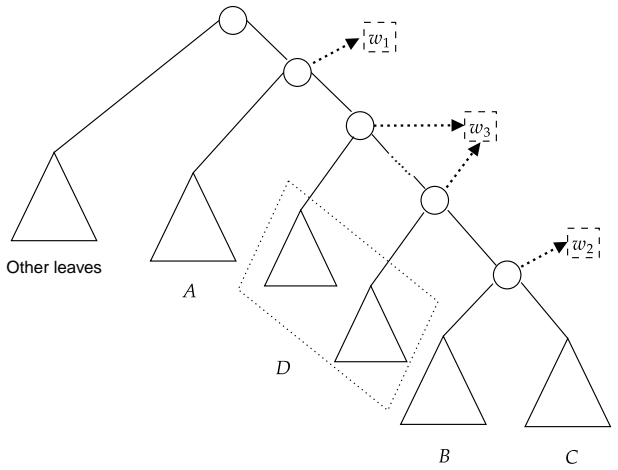
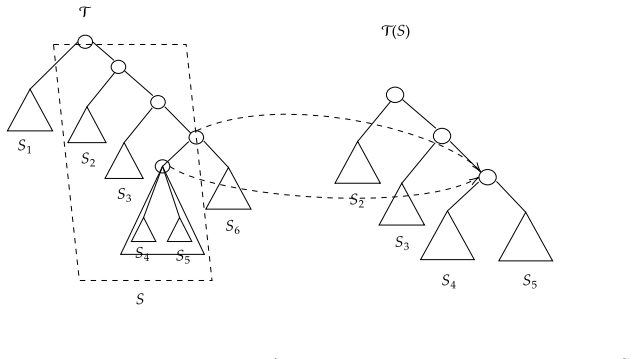
The load-bearing mechanism is the partial hierarchical clustering tree, a binary dendrogram whose leaves may be 'super-vertices'—sets of at most 50000 log n vertices whose internal arrangement is initially unresolved. A strongly consistent partial tree collapses exactly the maximal subtrees of T* that are small; a weakly consistent partial tree allows a contractible region whose connection to the rest of the tree has out-degree at most two. The algorithms build these partial trees using the small-tree splitting order, which lists vertices by recursively taking the smaller side of each split in the restricted optimal tree, plus majority-count testers (counterpart and predecessor tests) run against sampled or horizon vertex sets. Concentration inequalities turn the 90%-accurate triplets into reliable signals, and a horizon set keeps the weak-consistency invariant stable when the current vertex set encounters orphaned vertices. The partial trees do the heavy lifting: they reduce the problem, for both objectives, to resolving clusters of logarithmic size, at which point brute-force or approximate sparsest cuts and even arbitrary partitions become affordable.
What would settle it
For a graph whose optimal tree is known—for instance two equal-size cliques joined by a single edge—simulate the oracle at p=9/10 with errors adversarially biased to flip the smaller-side signal, and run the strong partial-tree split on this instance; a systematic failure to recover the true root cut with probability at least 1-1/$n^{2}$ would falsify the core lemma behind Theorem 1.
Extended reading notes
Core claim
The central claim is that a single natural oracle model suffices to bypass the approximation barriers for hierarchical clustering. The paper establishes that with an oracle O that, on a triplet (u,v,w), reports the vertex that splits away from the other two in an optimal tree T*, correctly with probability 9/10 and independently per triplet, there is an algorithm computing a tree T with cost_G(T) <= O(1) * OPT_Das(G) in polynomial time and O($n^{3}$) queries (Theorem 1), and an algorithm computing T with rev_G(T) >= (1-o(1)) * OPT_MW(G) in O($n^{2}$ polylog n) time and O($n^{2}$) queries (Theorem 3). The engine is a pair of data structures: partial HC trees strongly or weakly consistent with T*, constructible directly from the oracle and the vertex set without reading the edge weights, in O($n^{3}$ log n) time with O($n^{3}$) queries (Theorem 5) and in O($n^{2}$ polylog n) time with O($n^{2}$) queries (Theorem 6). If true, these results show that a triplet oracle correct at rate 9/10 circumvents the Small Set Expansion-based inapproximability for both the minimization and the maximization formulation.
Load-bearing premise
The argument assumes the splitting oracle is correct with probability 9/10 on each distinct triplet, that incorrect answers are adversarial but fixed per triplet, and that 'the vertex that splits away in the optimal tree' names a single well-defined ground truth—which requires a fixed choice among ties when several optimal trees exist.
Editorial extensions
If this is right
- If Theorem 1 is right, the splitting oracle yields a polynomial-time constant-factor approximation for Dasgupta's objective, a problem for which no constant-factor polynomial-time algorithm exists without the oracle under the Small Set Expansion hypothesis.
- If Theorem 3 is right, the same oracle yields a (1-o(1))-approximation for Moseley-Wang's objective in near-linear time, also escaping the SSE-based inapproximability for that objective.
- The strong partial tree construction supports a single-pass semi-streaming algorithm computing an O(1)-approximation to Dasgupta's objective in polynomial time using O(n log^3 n) bits of space (Theorem 8).
- The weak partial tree construction yields a PRAM algorithm with O(n^2 polylog n) work and polylogarithmic depth achieving (1-o(1))-approximation to Moseley-Wang's objective (Theorem 9).
- If the oracle is instead derived from an alpha-approximate tree, the Dasgupta-side guarantees degrade by an extra O(alpha) factor, while the Moseley-Wang argument is not shown to survive this weakening.
Reading between the lines
- Because partial HC trees are built only from the oracle and the vertex set, the same constructed tree could be reused for many different weightings of the same vertex set; the paper's streaming algorithm already exploits part of this separation, and offline re-weighting is a natural extension.
- The objective-free construction suggests the partial-tree machinery should transfer to other hierarchical-clustering objectives beyond Dasgupta and Moseley-Wang; the proofs would only need the relevant cost or revenue to be controllable by the structure of super-vertices.
- A practical pipeline implied by the paper's framework is to learn a triplet classifier on labeled instances using the PAC analysis of Appendix C, then run the near-linear Moseley-Wang algorithm; this is an end-to-end recipe the paper does not itself evaluate experimentally.
Editorial analysis
A structured set of objections, weighed in public.
Referee Report
Summary. The paper introduces a learning-augmented model for hierarchical clustering in which an oracle, given a triple of vertices, returns (with probability 9/10, adversarially on error) the vertex that splits away from the other two in an optimal tree T*. It defines partial hierarchical clustering trees that are strongly or weakly consistent with T*, gives constructions of these structures from the oracle, and uses them to obtain a polynomial-time O(1)-approximation for Dasgupta's objective (Theorem 1), an O(n^3 log n)-time O(sqrt(log log n))-approximation (Theorem 2), a near-linear O(n^2 polylog n)-time (1-o(1))-approximation for the Moseley-Wang objective (Theorem 3), and streaming/PRAM extensions (Theorems 4, 8, 9). The core claimed contribution is that a noisy triplet oracle can bypass known SSE-hardness barriers for both HC objectives.
Significance. If the results are correct, the paper makes a strong conceptual point: a natural triplet oracle, even with constant adversarial noise, can circumvent the strong approximation barriers for hierarchical clustering. The partial HC tree framework is a useful and potentially reusable abstraction, and the paper contains substantial technical machinery, including exchange arguments for optimal-tree structure and Chernoff-based concentration analyses. The algorithms are parameter-free in the sense that they do not fit parameters to the input, and the oracle is an external input rather than an assumed target of the algorithm. However, two load-bearing proof points are not established as written: Lemma 6.4, which underlies the (1-o(1)) Moseley-Wang guarantee, and Lemma 10.5, which underlies the O(log^3 n) recursion depth of the weak partial tree construction. These gaps affect the main theorems of the paper and need to be repaired before the claims can be accepted.
major comments (3)
- [§6, Lemma 6.4 (inductive step)] The inductive step asserts the inequality 1/2 * w(E1)/|X| <= (w(E1) - (50000 log n + 1) w(E3))/|X| and justifies it by the statement 'w(E3) = O(log^2 n / n) * w(E2)'. This requires a lower bound of the form w(E1) = Omega(log n * w(E3)), equivalently w(E1) = Omega(log n / (n - o(n)) * w(E2)). The displayed induction hypothesis and Claim 6.2 provide only upper bounds of the form w(E1) <= C log n * w(E2) / (n - 50000(log^2 n + log n)), which are the wrong direction. The claimed first inequality therefore does not follow. Since Lemma 6.4 is the only mechanism that discards the low-revenue edges Elow in the proof of Theorem 3, the central (1-o(1)) Moseley-Wang approximation is not established as written.
- [§6, Lemma 6.4 (cardinality bound)] The proof bounds |Elow| <= 50000(log^2 n + log n) with no counting argument. Condition (a) alone is insufficient: in a balanced optimal tree, all pairs crossing the root have zero non-leaves, so there can be Theta(n^2) such edges. The proof says that the inclusion relationship in (b) restricts the count, but for an arbitrary weakly consistent partial tree I the number of super-vertex pairs satisfying the inclusion and size conditions is not quantified anywhere. A valid counting argument for |Elow| is needed for the claimed O(log^4 n / n) revenue bound, and none is supplied.
- [§10.1, Lemma 10.5 (Item 4(b)ii)] The high-probability proof of the size upper bound is incorrect. With E[X] <= 1/(20 log n), the displayed equality Pr(X >= 1) = Pr(X >= 50 log n * E[X]) is false because 50 log n * E[X] = 2.5, not 1. The actual probability that 500 log n uniform samples hit a set of relative size 1/(10000 log^2 n) is about 1/(20 log n), which is not o(1). Thus Lemma 10.1's claim that |T* cap V| <= (1 - 1/(10000 log^2 n)) * n holds with high probability is not established. This upper bound is used in the O(log^3 n) depth argument in §10.3, so Theorem 6 and the near-linear time claim of Theorem 3 are affected. The fix may be to increase the sample size to O(log^3 n); the runtime analysis would then need to be redone, though it may still be O(n^2 polylog n).
minor comments (5)
- [§3.2, Definition 2] The oracle and all later consistency definitions refer to 'the optimal tree T*', but T* is not unique in general. Please fix an arbitrary optimal tree with an explicit deterministic tie-breaking rule as the ground truth; otherwise the split-away vertex and the guarantees of Theorems 5 and 6 are not well-defined.
- [§5.2, §5.3] There are several arithmetic/typographical slips: Lemma 5.4's derivation of O(n^50002) should be O(n^50001 log n) = O(n^50002) only after bounding log n by n; the proof of Lemma 5.6 writes O(n * log^3 n) = O(n^3 log n), which is not a valid equality; and the final paragraph of §5.3 says 'O(n^4) time efficiency' instead of 'O(n^3 log n)'.
- [§3.3, Problem 2] The sentence defining OPTMW says 'under Dasgupta's cost'; it should say 'under the Moseley-Wang objective'.
- [§4.1, Definition 3 and §6, Lemma 6.4] Definition 3 bounds super-vertex size by 50000 log n, but the proof of Lemma 6.4 uses |X| <= 5000 log n. The constants should be reconciled.
- [Figures 2 and 3] The figure captions contain un-filled placeholders such as 'Contains at most vertices'; the O(log n) bound should be filled in.
Circularity Check
No significant circularity: the splitting oracle is an external model input, and the approximation guarantees are proved against the same optimal tree via structural and exchange arguments, not by construction.
full rationale
The paper's central claims are not circular under the stated rubric. The splitting oracle in Definition 2 is part of the input model: it returns (possibly noisy) triplet split information about the optimal tree T*. The algorithms never fit a parameter to the Dasgupta or Moseley-Wang objective and then report that fitted value as a prediction; instead, they use oracle queries to construct partial HC trees (Theorems 5 and 6) and then prove approximation guarantees relative to OPT_Das(G) and OPT_MW(G). Those guarantees are derived from structural properties of optimal trees, such as the exchange arguments in Claims 6.2 and 6.3, and from established external results such as Proposition 5.1 cited to [CC17a, ACL+22]. The fact that the oracle is defined with respect to T* is a modeling assumption, not a self-definitional reduction: the oracle is an external information source, and the paper explicitly argues that simply following the noisy oracle does not recover T* (Section 2.1). The disputed inequality in Lemma 6.4, highlighted in the skeptic analysis, is a potential correctness gap (an unjustified bound relating w(E3) to w(E2) in the inductive step), but it is not a circularity: the lemma does not assume the theorem it proves. The self-citations that appear, e.g., [DGU+25], [AKL+24], and [ISZ21], are used for context, comparisons, or standard PAC tools and are not load-bearing for the main theorems. Overall, the derivation chain is independent of its conclusions, so the circularity score is minimal.
Assumptions & free parameters
assumptions (6)
- domain assumption The splitting oracle O answers each distinct triplet correctly with probability p=9/10, with errors adversarial and fixed per triplet.
- domain assumption A single well-defined optimal HC tree T* exists, i.e., unique or with fixed tie-breaking, and the oracle is consistent with it.
- domain assumption The HC tree is binary and n >= 200 log n (equivalently n >= 2500).
- standard math Chernoff-Hoeffding concentration bounds.
- domain assumption Recursive alpha-approximate sparsest cuts yield O(alpha)-approximation for Dasgupta's objective (Prop 5.3).
- domain assumption SSE hardness of constant approximation for Dasgupta and (1-C) for MW.
invented entities (2)
-
Splitting oracle O
-
Partial hierarchical clustering trees (strongly and weakly consistent)
Cite this review
Pith. "Pith review of Learning-Augmented Hierarchical Clustering." pith.science (2026). https://pith.science/paper/NZEAY7GS
@misc{pith2026250605495,
  author       = {Pith},
  title        = {Pith review of: Learning-Augmented Hierarchical Clustering},
  year         = {2026},
  howpublished = {\url{https://pith.science/paper/NZEAY7GS}},
  note         = {Machine review of arXiv:2506.05495}
}
abstract
Hierarchical clustering (HC) is an important data analysis technique in which the goal is to recursively partition a dataset into a tree-like structure while grouping together similar data points at each level of granularity. Unfortunately, for many of the proposed HC objectives, there exist strong barriers to approximation algorithms with the hardness of approximation. Thus, we consider the problem of hierarchical clustering given auxiliary information from natural oracles. Specifically, we focus on a *splitting oracle* which, when provided with a triplet of vertices $(u,v,w)$, answers (possibly erroneously) the pairs of vertices whose lowest common ancestor includes all three vertices in an optimal tree, i.e., identifying which vertex ``splits away'' from the others. Using such an oracle, we obtain the following results: - A polynomial-time algorithm that outputs a hierarchical clustering tree with $O(1)$-approximation to the Dasgupta objective (Dasgupta [STOC'16]). - A near-linear time algorithm that outputs a hierarchical clustering tree with $(1-o(1))$-approximation to the Moseley-Wang objective (Moseley and Wang [NeurIPS'17]). Under the plausible Small Set Expansion Hypothesis, no polynomial-time algorithm can achieve any constant approximation for Dasgupta's objective or $(1-C)$-approximation for the Moseley-Wang objective for some constant $C>0$. As such, our results demonstrate that the splitting oracle enables algorithms to outperform standard HC approaches and overcome hardness constraints. Furthermore, our approaches extend to sublinear settings, in which we show new streaming and PRAM algorithms for HC with improved guarantees.
Figures


Figures from the paper (7 more)





Reference graph
Works this paper leans on
-
[1]
Hierarchical clustering: A 0.585 revenue approximation
Noga Alon, Yossi Azar, and Danny Vainstein. Hierarchical clustering: A 0.585 revenue approximation. In Conference on Learning Theory, COLT , pages 153--162, 2020
work page 2020
- [2]
-
[3]
Online metric algorithms with untrusted predictions
Antonios Antoniadis, Christian Coester, Marek Eli \' a s, Adam Polak, and Bertrand Simon. Online metric algorithms with untrusted predictions. ACM Trans. Algorithms , 19(2):19:1--19:34, 2023
work page 2023
-
[4]
Anders Aamand, Justin Y. Chen, and Piotr Indyk. (optimal) online bipartite matching with degree information. In Advances in Neural Information Processing Systems 35: Annual Conference on Neural Information Processing Systems, NeurIPS , 2022
work page 2022
-
[5]
Hierarchical clustering in graph streams: Single-pass algorithms and space lower bounds
Sepehr Assadi, Vaggos Chatziafratis, Jakub Lacki, Vahab Mirrokni, and Chen Wang. Hierarchical clustering in graph streams: Single-pass algorithms and space lower bounds. In Conference on Learning Theory , pages 4643--4702, 2022
work page 2022
-
[6]
Online algorithms with multiple predictions
Keerti Anand, Rong Ge, Amit Kumar, and Debmalya Panigrahi. Online algorithms with multiple predictions. In International Conference on Machine Learning, ICML , pages 582--598, 2022
work page 2022
-
[7]
0(sqrt (log n)) approximation to SPARSEST CUT in \ o (n\( ^ 2 \)) time
Sanjeev Arora, Elad Hazan, and Satyen Kale. 0(sqrt (log n)) approximation to SPARSEST CUT in \ o (n\( ^ 2 \)) time. In 45th Symposium on Foundations of Computer Science (FOCS) , Proceedings , pages 238--247, 2004
work page 2004
-
[8]
Parallel approximate maximum flows in near-linear work and polylogarithmic depth
Arpit Agarwal, Sanjeev Khanna, Huan Li, Prathamesh Patil, Chen Wang, Nathan White, and Peilin Zhong. Parallel approximate maximum flows in near-linear work and polylogarithmic depth. In Proceedings of the 2024 Annual ACM-SIAM Symposium on Discrete Algorithms (SODA) , pages 3997--4061. SIAM, 2024
2024
Show all 77 references
-
[9]
Sublinear algorithms for hierarchical clustering
Arpit Agarwal, Sanjeev Khanna, Huan Li, and Prathamesh Patil. Sublinear algorithms for hierarchical clustering. In Sanmi Koyejo, S. Mohamed, A. Agarwal, Danielle Belgrave, K. Cho, and A. Oh, editors, Advances in Neural Information Processing Systems 35: Annual Conference on Ne...
2022
-
[10]
Online graph algorithms with predictions
Yossi Azar, Debmalya Panigrahi, and Noam Touitou. Online graph algorithms with predictions. In Proceedings of the 2022 ACM-SIAM Symposium on Discrete Algorithms, SODA , pages 35--66, 2022
2022
-
[11]
Aho, Yehoshua Sagiv, Thomas G
Alfred V. Aho, Yehoshua Sagiv, Thomas G. Szymanski, and Jeffrey D. Ullman. Inferring a tree from lowest common ancestors with an application to the optimization of relational expressions. SIAM Journal on Computing , 10(3):405--421, 1981
1981
-
[12]
On the compatibility of quartet trees
Noga Alon, Sagi Snir, and Raphael Yuster. On the compatibility of quartet trees. SIAM J. Discret. Math. , 28(3):1493--1507, 2014
2014
-
[13]
Jiang, Hoai-An Nguyen, Chen Wang, Yubo Zhang, and Samson Zhou
Vladimir Braverman, Prathamesh Dharangutte, Shaofeng H.-C. Jiang, Hoai-An Nguyen, Chen Wang, Yubo Zhang, and Samson Zhou. Relative error fair clustering in the weak-strong oracle model. In Proceedings of the 42nd International Conference on Machine Learning, ICML , 2025
2025
-
[14]
Learning-augmented maximum independent set
Vladimir Braverman, Prathamesh Dharangutte, Vihan Shah, and Chen Wang. Learning-augmented maximum independent set. In Approximation, Randomization, and Combinatorial Optimization. Algorithms and Techniques, APPROX/RANDOM , pages 24:1--24:18, 2024
2024
-
[15]
The primal-dual method for learning augmented algorithms
\' E tienne Bamas, Andreas Maggiori, and Ola Svensson. The primal-dual method for learning augmented algorithms. In Advances in Neural Information Processing Systems 33: Annual Conference on Neural Information Processing Systems, NeurIPS , 2020
2020
-
[16]
Advice querying under budget constraint for online algorithms
Ziyad Benomar and Vianney Perchet. Advice querying under budget constraint for online algorithms. In Alice Oh, Tristan Naumann, Amir Globerson, Kate Saenko, Moritz Hardt, and Sergey Levine, editors, Advances in Neural Information Processing Systems 36: Annual Conference on Neu...
2023
-
[17]
Approximate hierarchical clustering via sparsest cut and spreading metrics
Moses Charikar and Vaggos Chatziafratis. Approximate hierarchical clustering via sparsest cut and spreading metrics. In Proceedings of the Twenty-Eighth Annual ACM-SIAM Symposium on Discrete Algorithms , pages 841--854. SIAM, 2017
2017
-
[18]
Approximate hierarchical clustering via sparsest cut and spreading metrics
Moses Charikar and Vaggos Chatziafratis. Approximate hierarchical clustering via sparsest cut and spreading metrics. In Proceedings of the Twenty-Eighth Annual ACM-SIAM Symposium on Discrete Algorithms, SODA , pages 841--854, 2017
2017
-
[19]
Hierarchical clustering better than average-linkage
Moses Charikar, Vaggos Chatziafratis, and Rad Niazadeh. Hierarchical clustering better than average-linkage. In Proceedings of the Thirtieth Annual ACM-SIAM Symposium on Discrete Algorithms, SODA , pages 2291--2304. SIAM , 2019
2019
-
[20]
Hierarchical clustering for euclidean data
Moses Charikar, Vaggos Chatziafratis, Rad Niazadeh, and Grigory Yaroslavtsev. Hierarchical clustering for euclidean data. In The 22nd International Conference on Artificial Intelligence and Statistics, AISTATS , pages 2721--2730, 2019
2019
-
[21]
Learning-augmented approximation algorithms for maximum cut and related problems
Vincent Cohen - Addad, Tommaso d'Orsi, Anupam Gupta, Euiwoong Lee, and Debmalya Panigrahi. Learning-augmented approximation algorithms for maximum cut and related problems. In Advances in Neural Information Processing Systems 38: Annual Conference on Neural Information Process...
2024
-
[22]
Chen, Talya Eden, Piotr Indyk, Honghao Lin, Shyam Narayanan, Ronitt Rubinfeld, Sandeep Silwal, Tal Wagner, David P
Justin Y. Chen, Talya Eden, Piotr Indyk, Honghao Lin, Shyam Narayanan, Ronitt Rubinfeld, Sandeep Silwal, Tal Wagner, David P. Woodruff, and Michael Zhang. Triangle and four cycle counting with predictions in graph streams. In The Tenth International Conference on Learning Repr...
2022
-
[23]
Inapproximability for local correlation clustering and dissimilarity hierarchical clustering
Vaggos Chatziafratis, Neha Gupta, and Euiwoong Lee. Inapproximability for local correlation clustering and dissimilarity hierarchical clustering. CoRR , abs/2010.01459, 2020
2010 arXiv
-
[24]
Chen, Piotr Indyk, and Tal Wagner
Justin Y. Chen, Piotr Indyk, and Tal Wagner. Streaming algorithms for support-aware histograms. In International Conference on Machine Learning, ICML , pages 3184--3203, 2022
2022
-
[25]
Hierarchical clustering: Objective functions and algorithms
Vincent Cohen - Addad, Varun Kanade, Frederik Mallmann - Trenn, and Claire Mathieu. Hierarchical clustering: Objective functions and algorithms. Journal of the ACM (JACM) , 66(4):1--42, 2019
2019
-
[26]
Karthik C. S. , Euiwoong Lee, Yuval Rabani, Chris Schwiegelshohn, and Samson Zhou. On approximability of _2^2 min-sum clustering. CoRR , abs/2412.03332, 2024
2024 arXiv
-
[27]
Triplet reconstruction and all other phylogenetic csps are approximation resistant
Vaggos Chatziafratis and Konstantin Makarychev. Triplet reconstruction and all other phylogenetic csps are approximation resistant. In 64th IEEE Annual Symposium on Foundations of Computer Science, FOCS , pages 253--284, 2023
2023
-
[28]
Hierarchical clustering with structural constraints
Vaggos Chatziafratis, Rad Niazadeh, and Moses Charikar. Hierarchical clustering with structural constraints. In Proceedings of the 35th International Conference on Machine Learning, ICML , pages 773--782, 2018
2018
-
[29]
Chen, Sandeep Silwal, Ali Vakilian, and Fred Zhang
Justin Y. Chen, Sandeep Silwal, Ali Vakilian, and Fred Zhang. Faster fundamental graph algorithms via learned predictions. In International Conference on Machine Learning, ICML , pages 3583--3602, 2022
2022
-
[30]
Bisect and conquer: Hierarchical clustering via max-uncut bisection
Vaggos Chatziafratis, Grigory Yaroslavtsev, Euiwoong Lee, Konstantin Makarychev, Sara Ahmadian, Alessandro Epasto, and Mohammad Mahdian. Bisect and conquer: Hierarchical clustering via max-uncut bisection. In The 23rd International Conference on Artificial Intelligence and Sta...
2020
-
[31]
A cost function for similarity-based hierarchical clustering
Sanjoy Dasgupta. A cost function for similarity-based hierarchical clustering. In Daniel Wichs and Yishay Mansour, editors, Proceedings of the 48th Annual ACM SIGACT Symposium on Theory of Computing, STOC 2016, Cambridge, MA, USA, June 18-21, 2016 , pages 118--127. ACM , 2016
2016
-
[32]
On the price of differential privacy for hierarchical clustering
Chengyuan Deng, Jie Gao, Jalaj Upadhyay, Chen Wang, and Samson Zhou. On the price of differential privacy for hierarchical clustering. In The Thirteenth International Conference on Learning Representations, ICLR , 2025
2025
-
[33]
Faster matchings via learned duals
Michael Dinitz, Sungjin Im, Thomas Lavastida, Benjamin Moseley, and Sergei Vassilvitskii. Faster matchings via learned duals. In Advances in Neural Information Processing Systems 34: Annual Conference on Neural Information Processing Systems, NeurIPS , pages 10393--10406, 2021
2021
-
[34]
Predictive flows for faster ford-fulkerson
Sami Davies, Benjamin Moseley, Sergei Vassilvitskii, and Yuyan Wang. Predictive flows for faster ford-fulkerson. In International Conference on Machine Learning, ICML , volume 202, pages 7231--7248, 2023
2023
-
[35]
Learning-augmented streaming algorithms for approximating MAX-CUT
Yinhao Dong, Pan Peng, and Ali Vakilian. Learning-augmented streaming algorithms for approximating MAX-CUT . In 16th Innovations in Theoretical Computer Science Conference, ITCS , pages 44:1--44:24, 2025
2025
-
[36]
Ergun, Zhili Feng, Sandeep Silwal, David P
Jon C. Ergun, Zhili Feng, Sandeep Silwal, David P. Woodruff, and Samson Zhou. Learning-augmented k -means clustering. In The Tenth International Conference on Learning Representations, ICLR , 2022
2022
-
[37]
Adaptive hierarchical clustering using ordinal queries
Ehsan Emamjomeh - Zadeh and David Kempe. Adaptive hierarchical clustering using ordinal queries. In Proceedings of the Twenty-Ninth Annual ACM-SIAM Symposium on Discrete Algorithms, SODA , pages 415--429, 2018
2018
-
[38]
Nguyen, Jung Hoon Seo, Ryan S
Chunkai Fu, Brandon G. Nguyen, Jung Hoon Seo, Ryan S. Zesch, and Samson Zhou. Learning-augmented search data structures. In The Thirteenth International Conference on Learning Representations, ICLR , 2025
2025
-
[39]
Efficient algorithms for divisive hierarchical clustering with the diameter criterion
Alain Gu \'e noche, Pierre Hansen, and Brigitte Jaumard. Efficient algorithms for divisive hierarchical clustering with the diameter criterion. Journal of classification , 8:5--30, 1991
1991
-
[40]
Learning-augmented algorithms for online linear and semidefinite programming
Elena Grigorescu, Young - San Lin, Sandeep Silwal, Maoyuan Song, and Samson Zhou. Learning-augmented algorithms for online linear and semidefinite programming. In Advances in Neural Information Processing Systems 35: Annual Conference on Neural Information Processing Systems, ...
2022
-
[41]
Online algorithms for rent-or-buy with expert advice
Sreenivas Gollapudi and Debmalya Panigrahi. Online algorithms for rent-or-buy with expert advice. In Proceedings of the 36th International Conference on Machine Learning, ICML , pages 2319--2327, 2019
2019
-
[42]
Augmenting online algorithms with varepsilon -accurate predictions
Anupam Gupta, Debmalya Panigrahi, Bernardo Subercaseaux, and Kevin Sun. Augmenting online algorithms with varepsilon -accurate predictions. In Sanmi Koyejo, S. Mohamed, A. Agarwal, Danielle Belgrave, K. Cho, and A. Oh, editors, Advances in Neural Information Processing Systems...
2022
-
[43]
On dasgupta's hierarchical clustering objective and its relation to other graph parameters
Svein H gemo, Benjamin Bergougnoux, Ulrik Brandes, Christophe Paul, and Jan Arne Telle. On dasgupta's hierarchical clustering objective and its relation to other graph parameters. In Evripidis Bampis and Aris Pagourtzis, editors, Fundamentals of Computation Theory - 23rd Inter...
2021
-
[44]
Learning-based frequency estimation algorithms
Chen - Yu Hsu, Piotr Indyk, Dina Katabi, and Ali Vakilian. Learning-based frequency estimation algorithms. In 7th International Conference on Learning Representations, ICLR , 2019
2019
-
[45]
Online knapsack with frequency predictions
Sungjin Im, Ravi Kumar, Mahshid Montazer Qaem, and Manish Purohit. Online knapsack with frequency predictions. In Advances in Neural Information Processing Systems 34: Annual Conference on Neural Information Processing Systems, NeurIPS , pages 2733--2743, 2021
2021
-
[46]
Dimensionality reduction for wasserstein barycenter
Zachary Izzo, Sandeep Silwal, and Samson Zhou. Dimensionality reduction for wasserstein barycenter. In Advances in Neural Information Processing Systems 34: Annual Conference on Neural Information Processing Systems 2021, NeurIPS , 2021
2021
-
[47]
Learning-based low-rank approximations
Piotr Indyk, Ali Vakilian, and Yang Yuan. Learning-based low-rank approximations. In Advances in Neural Information Processing Systems 32: Annual Conference on Neural Information Processing Systems 2019, NeurIPS , pages 7400--7410, 2019
2019
-
[48]
Kearney, and Ming Li
Tao Jiang, Paul E. Kearney, and Ming Li. A polynomial time approximation scheme for inferring evolutionary trees from quartet topologies and its application. SIAM J. Comput. , 30(6):1942--1961, 2000
1942
-
[49]
Woodruff
Tanqiu Jiang, Yi Li, Honghao Lin, Yisong Ruan, and David P. Woodruff. Learning-augmented data stream algorithms. In 8th International Conference on Learning Representations, ICLR , 2020
2020
-
[50]
Shaofeng H. - C. Jiang, Erzhi Liu, You Lyu, Zhihao Gavin Tang, and Yubo Zhang. Online facility location with predictions. In The Tenth International Conference on Learning Representations, ICLR , 2022
2022
-
[51]
Chi, Jeffrey Dean, and Neoklis Polyzotis
Tim Kraska, Alex Beutel, Ed H. Chi, Jeffrey Dean, and Neoklis Polyzotis. The case for learned index structures. In Proceedings of the 2018 International Conference on Management of Data, SIGMOD Conference , pages 489--504, 2018
2018
-
[52]
Learning predictions for algorithms with predictions
Misha Khodak, Maria - Florina Balcan, Ameet Talwalkar, and Sergei Vassilvitskii. Learning predictions for algorithms with predictions. In Advances in Neural Information Processing Systems 35: Annual Conference on Neural Information Processing Systems, NeurIPS , 2022
2022
-
[53]
Training gaussian mixture models at scale via coresets
Mario Lucic, Matthew Faulkner, Andreas Krause, and Dan Feldman. Training gaussian mixture models at scale via coresets. J. Mach. Learn. Res. , 18:160:1--160:25, 2017
2017
-
[54]
Woodruff
Yi Li, Honghao Lin, Simin Liu, Ali Vakilian, and David P. Woodruff. Learning the positions in countsketch. In The Eleventh International Conference on Learning Representations, ICLR , 2023
2023
-
[55]
Online scheduling via learned weights
Silvio Lattanzi, Thomas Lavastida, Benjamin Moseley, and Sergei Vassilvitskii. Online scheduling via learned weights. In Proceedings of the 2020 ACM-SIAM Symposium on Discrete Algorithms, SODA , pages 1859--1877, 2020
2020
-
[56]
Woodruff
Honghao Lin, Tian Luo, and David P. Woodruff. Learning augmented binary search trees. In International Conference on Machine Learning, ICML , pages 13431--13440, 2022
2022
-
[57]
Mining of massive data sets
Jure Leskovec, Anand Rajaraman, and Jeffrey David Ullman. Mining of massive data sets . Cambridge university press, 2020
2020
-
[58]
Competitive caching with machine learned advice
Thodoris Lykouris and Sergei Vassilvitskii. Competitive caching with machine learned advice. J. ACM , 68(4):24:1--24:25, 2021
2021
-
[59]
A model for learned bloom filters and optimizing by sandwiching
Michael Mitzenmacher. A model for learned bloom filters and optimizing by sandwiching. In Advances in Neural Information Processing Systems 31: Annual Conference on Neural Information Processing Systems, NeurIPS , pages 462--471, 2018
2018
-
[60]
Hierarchical clustering: O(1)-approximation for well-clustered graphs
Bogdan - Adrian Manghiuc and He Sun. Hierarchical clustering: O(1)-approximation for well-clustered graphs. In Advances in Neural Information Processing Systems 34: Annual Conference on Neural Information Processing Systems, NeurIPS , pages 9278--9289, 2021
2021
-
[61]
Algorithms with predictions
Michael Mitzenmacher and Sergei Vassilvitskii. Algorithms with predictions. In Tim Roughgarden, editor, Beyond the Worst-Case Analysis of Algorithms , pages 646--662. Cambridge University Press, 2020
2020
-
[62]
Benjamin Moseley and Joshua R. Wang. Approximation bounds for hierarchical clustering: Average linkage, bisecting k-means, and local search. In Advances in Neural Information Processing Systems 30: Annual Conference on Neural Information Processing Systems , pages 3094--3103, 2017
2017
-
[63]
Thy Dinh Nguyen, Anamay Chaturvedi, and Huy L. Nguyen. Improved learning-augmented algorithms for k-means and k-medians clustering. In The Eleventh International Conference on Learning Representations, ICLR , 2023
2023
-
[64]
Improving online algorithms via ML predictions
Manish Purohit, Zoya Svitkina, and Ravi Kumar. Improving online algorithms via ML predictions. In Advances in Neural Information Processing Systems 31: Annual Conference on Neural Information Processing Systems 2018, NeurIPS , pages 9684--9693, 2018
2018
-
[65]
Hierarchical clustering via spreading metrics http://papers.nips.cc/paper/6325-hierarchical-clustering-via-spreading-metrics.pdf
Aurko Roy and Sebastian Pokutta. Hierarchical clustering via spreading metrics http://papers.nips.cc/paper/6325-hierarchical-clustering-via-spreading-metrics.pdf . In Advances in Neural Information Processing Systems , pages 2316--2324, 2016
2016
-
[66]
Hierarchical clustering via spreading metrics
Aurko Roy and Sebastian Pokutta. Hierarchical clustering via spreading metrics. J. Mach. Learn. Res. , 18:88:1--88:35, 2017
2017
-
[67]
Procopiuc, and Claudio Gentile
Anand Rajagopalan, Fabio Vitale, Danny Vainstein, Gui Citovsky, Cecilia M. Procopiuc, and Claudio Gentile. Hierarchical clustering of data streams: Scalable algorithms and approximation guarantees. In Marina Meila and Tong Zhang, editors, Proceedings of the 38th International ...
2021
-
[68]
A comparison of document clustering techniques
Michael Steinbach, George Karypis, and Vipin Kumar. A comparison of document clustering techniques. Technical report, University of Minnesota, 2000
2000
-
[69]
Improved learning-augmented algorithms for the multi-option ski rental problem via best-possible competitive analysis
Yongho Shin, Changyeol Lee, Gukryeol Lee, and Hyung - Chan An. Improved learning-augmented algorithms for the multi-option ski rental problem via best-possible competitive analysis. In International Conference on Machine Learning, ICML , pages 31539--31561, 2023
2023
-
[70]
Breast cancer classification and prognosis based on gene expression profiles from a population-based study
Christos Sotiriou, Soek-Ying Neo, Lisa M McShane, Edward L Korn, Philip M Long, Amir Jazaeri, Philippe Martiat, Steve B Fox, Adrian L Harris, and Edison T Liu. Breast cancer classification and prognosis based on gene expression profiles from a population-based study. Proceedin...
2003
-
[71]
Numerical taxonomy
Peter HA Sneath, Robert R Sokal, et al. Numerical taxonomy. the principles and practice of numerical classification., 1973
1973
-
[72]
A linear time approximation scheme for maximum quartet consistency on sparse sampled inputs
Sagi Snir and Raphael Yuster. A linear time approximation scheme for maximum quartet consistency on sparse sampled inputs. SIAM J. Discret. Math. , 25(4):1722--1736, 2011
2011
-
[73]
Goodfellow, and Rob Fergus
Christian Szegedy, Wojciech Zaremba, Ilya Sutskever, Joan Bruna, Dumitru Erhan, Ian J. Goodfellow, and Rob Fergus. Intriguing properties of neural networks. In 2nd International Conference on Learning Representations, ICLR , Conference Track Proceedings , 2014
2014
-
[74]
Who belongs in the family? Psychometrika , 18(4):267--276, 1953
Robert L Thorndike. Who belongs in the family? Psychometrika , 18(4):267--276, 1953
1953
-
[75]
Hierarchical grouping to optimize an objective function
Joe H Ward Jr. Hierarchical grouping to optimize an objective function. Journal of the American statistical association , 58(301):236--244, 1963
1963
-
[76]
Online algorithms for multi-shop ski rental with machine learned advice
Shufan Wang, Jian Li, and Shiqiang Wang. Online algorithms for multi-shop ski rental with machine learned advice. In Advances in Neural Information Processing Systems 33: Annual Conference on Neural Information Processing Systems, NeurIPS , 2020
2020
-
[77]
Optimal robustness-consistency trade-offs for learning-augmented online algorithms
Alexander Wei and Fred Zhang. Optimal robustness-consistency trade-offs for learning-augmented online algorithms. In Advances in Neural Information Processing Systems 33: Annual Conference on Neural Information Processing Systems, NeurIPS , 2020
2020
Reviewed August 7, 2026 · model on record in the stance chip above.
Discussion (0). Sign in to comment.