REVIEW 3 major objections 4 minor 1 cited by
The paper claims that a 100-MW GPU data center participating in 2-second frequency regulation can reduce more grid-side carbon—via 'exogenous carbon' savings—than the operational carbon it adds by running and modulating best-effort workload
Reviewed by Pith at T0; open to challenge. T0 means a machine referee read the full paper against a public rubric. the ladder, T0–T4 →
T0 review · deepseek-v4-flash
2026-08-03 06:32 UTC pith:NZIZM4BK
load-bearing objection Strong GPU regulation testbed and a useful new carbon metric, but the headline savings rest on an unreported MCE_resv from a same-group unit commitment model. the 3 major comments →
Coordinating GPU Data Centers and Power Grid Regulation Service for Exogenous Carbon Benefits
The pith
A machine-rendered reading of the paper's core claim, the machinery that carries it, and where it could break.
Core claim
The paper's central claim is that a modern GPU data center, co-locating latency-critical and best-effort workloads, can provide frequency regulation at 2-second granularity with a performance score above 80% (average 91.2%), and that the resulting grid-side 'exogenous carbon' savings—up to 433.2 kt CO2e/year under a grid model at 50% load—outweigh the extra operational emissions from running and modulating the best-effort workloads. By quantifying the previously hidden emissions of fossil-fueled regulation reserves, the paper argues that data center regulation service reduces both the amount of fossil reserves dispatched and the efficiency penalty those plants incur, so the carbon benefit is
What carries the argument
Exogenous Carbon (C_exogenous = R_DC × MCE_resv) is the central metric: it credits a data center with the grid-side emissions avoided when its regulation capacity R_DC displaces fossil-fueled regulation reserves. MCE_resv, the marginal carbon emission of regulation reserves, is obtained by running a unit commitment model of the CAISO/Western Interconnection grid with and without data center regulation. EcoCenter is the accompanying framework that maximizes R_DC by coordinating GPU power capping, GPU core (CU) allocation, and multi-GPU pause/resume of best-effort workloads to follow the 2-second regulation signal.
Load-bearing premise
The whole carbon ledger rests on a simulated number—the marginal carbon emission of regulation reserves—that the paper does not measure or validate against real grid emissions; if that simulation overstates how much fossil backup is displaced, the claimed net savings disappear.
What would settle it
Meter the actual carbon emissions of a grid region with and without a data center providing frequency regulation for a month, and compare the measured difference to Eq. 1's prediction; if measured grid-side savings fall below the operational carbon increase at 50% load, the central claim fails.
If this is right
- At low-to-medium utilization, a GPU data center can achieve net negative carbon emissions, because grid-side exogenous savings exceed both operational and embodied carbon.
- Existing carbon-intensity metrics undercount the true emissions impact of data centers; adding the exogenous-carbon term changes which workloads and locations appear green.
- GPU-based regulation provides roughly 3x more regulation capacity than CPU-based approaches, making modern AI/ML data centers the strongest candidates for this service.
- Grid operators can use data-center regulation to reduce fossil-fueled reserve requirements, supporting higher renewable penetration without building new backup plants.
- Even at 80% load, the paper reports that grid-side savings (34.2 kt CO2e/yr) outweigh the operational increase (21.3 kt CO2e/yr), yielding a net improvement of about 12 kt CO2e/yr.
Where Pith is reading between the lines
- Inference: If MCE_resv is validated against real ISO emissions, the exogenous-carbon ledger could become a standard addition to data-center carbon accounting, changing procurement and workload-scheduling decisions.
- Inference: The net-benefit result is strongest in the near term; as grids decarbonize and fossil regulation reserves become scarcer, the exogenous savings shrink, so the claim is time-sensitive.
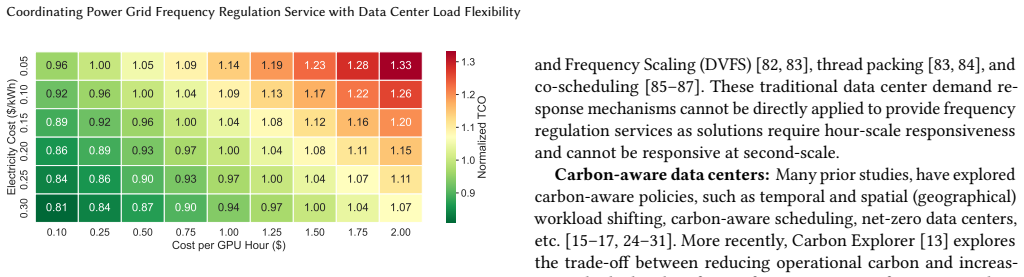
- Inference: The TCO model implies a practical dispatch rule—modulate low-cost, low-GPU-hour-price resources first—and a natural extension is joint optimization of carbon benefit and opportunity cost.
- Inference: A testable extension is to apply the same exogenous-carbon metric to other large flexible loads, such as electrolyzers or EV charging fleets, to see whether the carbon benefit generalizes beyond GPU data centers.
Editorial analysis
A structured set of objections, weighed in public.
Referee Report
Summary. The paper proposes a metric called Exogenous Carbon to quantify grid-side CO2 reductions when a GPU data center provides 2-second frequency regulation service, and an accompanying framework, EcoCenter, that modulates GPU power caps, core allocation, and multi-GPU coordination to maximize regulation provision. The authors evaluate EcoCenter on an 8-GPU AMD server with Facebook SWIM load traces and three regulation signals, reporting average performance scores above 91% and regulation provision 3-4x larger than CPU-only approaches. They then combine measured regulation provision with a marginal-carbon-emission factor for regulation reserves (MCE_resv) obtained from a unit commitment model of the CAISO/Western Interconnection grid, and claim that grid-side exogenous savings outweigh the operational carbon increase of running best-effort workloads in all scenarios, sometimes by a large margin.
Significance. If validated, the result would be significant: it identifies a new mechanism by which data centers with flexible GPU workloads can act as net carbon-reducing grid assets, and it quantifies hidden emissions from frequency regulation reserves that are absent from standard carbon-intensity metrics. The experimental work is a concrete strength: performance scores are directly measured at 2-second granularity, the LC-only baseline is explicitly described as conservative, and the comparison against CPU-only and UPS-only regulation services is useful. However, the headline carbon-savings claim rests almost entirely on MCE_resv, which is not measured, not reported, and not validated against empirical grid emissions. Since the margin at 80% load is only about 1.6x, the central conclusion is currently unsupported without additional evidence on MCE_resv.
major comments (3)
- [§3.1.2, Eq. (1)] MCE_resv is the single load-bearing multiplier in the Exogenous Carbon ledger, yet no numerical value for MCE_resv is reported anywhere in the paper, nor is a sensitivity analysis or validation against observed CAISO emissions provided. The model used to compute it is from the authors' own prior work [50]. At 80% load (Fig. 11D), the grid-model savings are 34.2 kt CO2eq vs. an operational increase of 21.3 kt CO2eq — a margin of only 1.6x — so an overestimate of MCE_resv by more than ~40% flips the “all scenarios” claim. The authors must report MCE_resv values (per scenario or per run), compare model outputs to historical ISO emission data, and provide sensitivity bounds.
- [§3.1.2] The unit commitment model's representation of regulation service is not described in enough detail to assess credibility. The paper simply cites Anderson et al. [50] and asserts a 770 MW regulation requirement (5.5% of 14 GW) without justification or sensitivity. Critical modeling choices — how 2-second AGC signals are represented in an hourly unit commitment, how part-load efficiency penalties are applied, and whether unit-commitment changes from data-center regulation are captured — are all absent. Without this detail, a reader cannot judge whether the grid-model MCE_resv is realistic or an artifact of the modeling assumptions.
- [§3.1.1, Eq. (1)] The exogenous-carbon formula C_exogenous = R_DC × MCE_resv assumes a constant linear multiplier, but MCE_resv is defined as a marginal emission and is computed in §3.1.2 as a difference between two unit commitment runs with and without data-center regulation. For a 100-MW data center providing regulation, R_DC is not infinitesimal; the marginal interpretation may not hold. The authors should either justify linearity, or compute C_exogenous directly from the UC model difference rather than through a single linearized coefficient. This is especially important because the 3x gap between grid-model savings and simple gas/battery bounds (433.2 vs. 132 kt at 50% load) is attributed entirely to H2/H3 effects that have not been independently verified.
minor comments (4)
- [§5.2, Table 2] The text states that at higher utilization traces performance scores observe “less than 80%”; however Table 2 reports scores of 84–86% for high-load traces, so the statement contradicts the table. Also, the claim that the Noisy signal yields the lowest score is not consistently supported by Table 2 (e.g., med-med Noisy 93.38 vs. HT 93.34).
- [§5.1.1 vs. §5.2 (footnote 4)] The baseline definition is inconsistent. §5.1.1 says the Baseline co-locates LC and BE workloads without regulation, while §5.2 and footnote 4 say the Baseline is LC-only. Clarify which baseline is used for the carbon computations; the current presentation makes it hard to verify the “conservative” claim.
- [Figure 11] Figure 11 uses a log scale but the axis labels and the exact values for each bar are difficult to read, especially for the small bars. A table of the numerical carbon components (operational, embodied, simple gas/battery, grid-model exogenous) would improve replicability and make the 34.2 vs. 21.3 comparison easier to verify.
- [Abstract and §5.2] Minor language issues: “oftentimes” in the abstract, “completely outweighed” in §5.2, and inconsistent hyphenation of “exogenous carbon.” These do not affect the technical content.
Circularity Check
Self-cited UC model provides the unvalidated MCE_resv multiplier; grid-model savings are the model's own output, though EcoCenter's measured R_DC is independent.
specific steps
-
self citation load bearing
[Section 3.1.2; Eq. (1); Section 5.2 / Fig. 11]
"We formulate and solve the unit commitment problem as laid out in Anderson [50] ... The difference of both values provides the 'hidden' grid-side carbon emission impact of data center frequency regulation, which we use to obtain the grid-detailed marginal carbon emission, MCEresv, for use in Eq. 1."
MCE_resv is the sole grid-side multiplier in Eq. (1): C_exogenous = R_DC x MCE_resv. The paper neither reports a numerical MCE_resv nor validates it against observed ISO emissions; instead it is taken from a unit-commitment model in Anderson et al. [50], whose co-authors (Anderson, Yu) are also co-authors of this paper. The model is run 'with' and 'without' data center regulation, and the difference is used to define MCE_resv. Consequently, the 'grid-model' Exogenous Carbon numbers in Fig. 11 (e.g., 433.2 kt vs 132 kt simple-gas at 50% load) are the self-cited model's own predicted emission difference, scaled by measured R_DC; the 3x amplification and the 'in all scenarios... completely outweighs' conclusion are outputs of that model, not independent empirical confirmations. The measured R
full rationale
The EcoCenter contribution is largely independent: R_DC, performance scores, throughput, and operational-carbon deltas are measured on real hardware. The circularity is confined to the grid-side 'Exogenous Carbon' numbers that carry the headline claim. Eq. (1) defines Exogenous Carbon as R_DC times MCE_resv, and Section 3.1.2 obtains MCE_resv from the difference of two runs of a unit-commitment model cited from the same research group [50]. The grid-model savings presented in Section 5.2 (e.g., 433.2 kt at 50% load) are therefore, by construction, the self-cited model's own output. No sensitivity analysis or ISO-emissions validation is provided, so the margin by which savings 'completely outweigh' operational increases (e.g., 34.2 kt vs 21.3 kt at 80% load) is an artifact of that model rather than an independent finding. This is a load-bearing self-citation, but because the paper also contains independent measurements, the circularity is partial rather than total.
Axiom & Free-Parameter Ledger
free parameters (2)
- MCE_resv (marginal carbon emission of regulation reserves) =
not reported
- Regulation requirement of 770 MW (5.5% of 14 GW) =
770 MW
axioms (5)
- domain assumption Frequency-regulation reserves are predominantly fossil-fueled and their emissions are omitted from grid-reported carbon intensity.
- domain assumption Unit commitment model of Anderson et al. [50] accurately replicates CAISO/Western Interconnection dispatch and emissions with/without data-center regulation.
- domain assumption Marginal carbon emission of regulation reserves is constant, so C_exo = R_DC x MCE_resv (Eq. 1) holds linearly over the data center's operating range.
- domain assumption Predicted hourly average load P_avg and variance P_var are accurate enough that the optimizer's feasible (R_up, R_down) bounds are respected.
- domain assumption 2-second performance score measured on 8xAMD MI50 with Resnet152+GPT2 generalizes to other GPUs and workloads.
invented entities (1)
-
Exogenous Carbon (C_exogenous)
no independent evidence
read the original abstract
The rapid growth of AI/ML data centers has led to higher energy consumption and carbon emissions. The shift to renewable energy and growing data center energy demands can destabilize the power grid. Power grids rely on frequency regulation reserves, typically fossil-fueled power plants, to stabilize and balance the supply and demand of electricity. This paper sheds light on the hidden carbon emissions of frequency regulation service. Our work explores how modern GPU data centers can coordinate with power grids to reduce the need for fossil-fueled frequency regulation reserves. We first introduce a novel metric, Exogenous Carbon, to quantify grid-side carbon emission reductions resulting from data center participation in regulation service. We additionally introduce EcoCenter, a framework to maximize the amount of frequency regulation provision that GPU data centers can provide, and thus, reduce the amount of frequency regulation reserves necessary. We demonstrate that data center participation in frequency regulation can result in Exogenous carbon savings that can outweigh operational carbon emissions
Figures


Forward citations
Cited by 1 Pith paper
-
Inter-Area Oscillation Damping in Data-Center-Integrated Power Systems
UPS-based demand response raises the critical inter-area mode's damping ratio from about 1.29% to 2.24% on the IEEE 39-bus system; the HVAC channel is too slow to contribute.
Reference graph
Works this paper leans on
-
[1]
Powering intelligence: Analyzing artificial intelligence and data center energy consumption,
J. Aljbour, T. Wilson, and P. Patel, “Powering intelligence: Analyzing artificial intelligence and data center energy consumption, ”EPRI White Paper, 2024
2024
-
[2]
Stanley, 2023
M. Stanley, 2023. [Online]. Available: https://www.datacenterdynamics.com/en/ news/morgan-stanley-data-center-industry-will-emit-25bn-tons-of-co2-by- 2030/
2023
-
[3]
Environmental report,
Google, “Environmental report, ” 2023. [Online]. Available: https://www.gstatic. com/gumdrop/sustainability/google-2023-environmental-report.pdf
2023
-
[4]
Powering sustainable transformation,
Microsoft, “Powering sustainable transformation, ” 2025. [On- line]. Available: https://datacenters.microsoft.com/globe/powering-sustainable- transformation/
2025
-
[5]
Electricity data browser,
U. E. I. A. (EIA), “Electricity data browser, ” https://www.eia.gov/electricity/data/ browser/, 2023
2023
-
[6]
Powermorph: Qos-aware server power reshaping for data center regulation service,
A. Jahanshahi, N. Yu, and D. Wong, “Powermorph: Qos-aware server power reshaping for data center regulation service, ”ACM Transactions on Architecture and Code Optimization (TACO), vol. 19, no. 3, pp. 1–27, 2022
2022
-
[7]
Supporting power grids with demand response at google data centers,
Google, “Supporting power grids with demand response at google data centers, ”
-
[8]
EnergyQARE: QoS-Aware Data Center Participation in Smart Grid Regulation Service Reserve Provision,
H. Chen, Y. Zhang, M. C. Caramanis, and A. K. Coskun, “EnergyQARE: QoS-Aware Data Center Participation in Smart Grid Regulation Service Reserve Provision, ”ACM Trans. Model. Perform. Eval. Comput. Syst., vol. 4, no. 1, pp. 2:1–2:31, Jan. 2019. [Online]. Available: http://doi.acm.org/10.1145/3243172
doi:10.1145/3243172 2019
-
[9]
Towards improved power management in cloud gpus,
P. Patel, Z. Gong, S. Rizvi, E. Choukse, P. Misra, T. Anderson, and A. Srira- man, “Towards improved power management in cloud gpus, ”IEEE Computer Architecture Letters, vol. 22, no. 2, pp. 141–144, 2023
2023
-
[10]
Clicking clean virginia the dirty energy powering data center alley,
G. Cook, E. Jardim, and C. Craighill, “Clicking clean virginia the dirty energy powering data center alley, ”Greenpeace A vailable from: https://www. greenpeace. org/usa/reports/click-clean-virginia/[Accessed 21 Mar 2020], 2019
2020
-
[11]
Ai is poised to drive 160% increase in data center power demand,
“Ai is poised to drive 160% increase in data center power demand, ” 2024. [Online]. Available: https://www.goldmansachs.com/insights/articles/AI-poised- to-drive-160-increase-in-power-demand
2024
-
[12]
Llama 2: Open foundation and fine-tuned chat models,
H. Touvron, L. Martin, K. Stone, P. Albert, A. Almahairi, Y. Babaei, N. Bashlykov, S. Batra, P. Bhargava, S. Bhosaleet al., “Llama 2: Open foundation and fine-tuned chat models, ”arXiv preprint arXiv:2307.09288, 2023
Pith/arXiv arXiv 2023
-
[13]
Carbon explorer: A holistic framework for designing carbon aware datacenters,
B. Acun, B. Lee, F. Kazhamiaka, K. Maeng, U. Gupta, M. Chakkaravarthy, D. Brooks, and C.-J. Wu, “Carbon explorer: A holistic framework for designing carbon aware datacenters, ” inProceedings of the 28th ACM International Confer- ence on Architectural Support for Programming Languages and Operating Systems, Volume 2, 2023, pp. 118–132
2023
-
[14]
Carbon responder: Coordinating demand response for the datacenter fleet,
J. Xing, B. Acun, A. Sundarrajan, D. Brooks, M. Chakkaravarthy, N. Avila, C.-J. Wu, and B. C. Lee, “Carbon responder: Coordinating demand response for the datacenter fleet, ” 2023. [Online]. Available: https://arxiv.org/abs/2311.08589
Pith/arXiv arXiv 2023
-
[15]
Carbon-aware electricity cost minimization for sustainable data centers,
H. Dou, Y. Qi, W. Wei, and H. Song, “Carbon-aware electricity cost minimization for sustainable data centers, ”IEEE Transactions on Sustainable Computing, vol. 2, no. 2, pp. 211–223, 2017
2017
-
[16]
Temporal load balancing with service delay guarantees for data center energy cost optimization,
J. Luo, L. Rao, and X. Liu, “Temporal load balancing with service delay guarantees for data center energy cost optimization, ”IEEE Transactions on Parallel and Distributed Systems, vol. 25, no. 3, pp. 775–784, 2013
2013
-
[17]
On the limitations of carbon-aware temporal and spatial workload shifting in the cloud,
T. Sukprasert, A. Souza, N. Bashir, D. Irwin, and P. Shenoy, “On the limitations of carbon-aware temporal and spatial workload shifting in the cloud, ” in Proceedings of the Nineteenth European Conference on Computer Systems, ser. EuroSys ’24. New York, NY, USA: Association for Computing Machinery, 2024, p. 924–941. [Online]. Available: https://doi.org/10...
arXiv 2024
-
[18]
Clover: Toward sustainable ai with carbon-aware machine learning inference service,
B. Li, S. Samsi, V. Gadepally, and D. Tiwari, “Clover: Toward sustainable ai with carbon-aware machine learning inference service, ” inProceedings of the International Conference for High Performance Computing, Networking, Storage and Analysis, 2023, pp. 1–15
2023
-
[19]
In california, solar and wind boost the price of frequency regulation,
GreenTechMedia, “In california, solar and wind boost the price of frequency regulation, ” 2022. [Online]. Available: http://www.greentechmedia.com/articles/ read/in-california-solar-and-wind-boosts-the-price-for-frequency-regulation
2022
-
[20]
2025 california demand response potential study-charting california’s demand response future. final report on phase 2 results,
P. Alstone, J. Potter, M. A. Piette, P. Schwartz, M. A. Berger, L. N. Dunn, S. J. Smith, M. D. Sohn, A. Aghajanzadeh, S. Stenssonet al., “2025 california demand response potential study-charting california’s demand response future. final report on phase 2 results, ” Lawrence Berkeley National Lab.(LBNL), Berkeley, CA (United States), Tech. Rep., 2017
2025
-
[21]
Data center participation in demand response programs with quality-of-service guarantees,
Y. Zhang, I. C. Paschalidis, and A. K. Coskun, “Data center participation in demand response programs with quality-of-service guarantees, ” inProceedings of the Tenth ACM International Conference on Future Energy Systems, 2019, pp. 285–302
2019
-
[22]
Hpc data center participation in demand response: An adaptive policy with qos assurance,
Y. Zhang, D. C. Wilson, I. C. Paschalidis, and A. K. Coskun, “Hpc data center participation in demand response: An adaptive policy with qos assurance, ”IEEE Transactions on Sustainable Computing, vol. 7, no. 1, pp. 157–171, 2022
2022
-
[23]
Opportunities and challenges for data center demand response,
A. Wierman, Z. Liu, I. Liu, and H. Mohsenian-Rad, “Opportunities and challenges for data center demand response, ” inInternational Green Computing Conference, 2014, pp. 1–10
2014
-
[24]
Iswitch: Coordinating and optimizing renewable energy powered server clusters,
C. Li, A. Qouneh, and T. Li, “Iswitch: Coordinating and optimizing renewable energy powered server clusters, ” inProceedings of the 39th Annual International Symposium on Computer Architecture, ser. ISCA ’12. USA: IEEE Computer Society, 2012, p. 512–523
2012
-
[25]
Greenslot: scheduling energy consumption in green datacenters,
Í. Goiri, K. Le, M. E. Haque, R. Beauchea, T. D. Nguyen, J. Guitart, J. Torres, and R. Bianchini, “Greenslot: scheduling energy consumption in green datacenters, ” inInternational Conference for High Performance Computing, Networking, Storage and Analysis, 2011
2011
-
[26]
Solarcore: Solar energy driven multi-core architecture power management,
C. Li, W. Zhang, C. Cho, and T. Li, “Solarcore: Solar energy driven multi-core architecture power management, ” in2011 IEEE 17th International Symposium on High Performance Computer Architecture, Feb 2011, pp. 205–216
2011
-
[27]
Chameleon: Adapting throughput server to time-varying green power budget using online learning,
C. Li, X. Li, R. Wang, T. Li, N. Goswami, and D. Qian, “Chameleon: Adapting throughput server to time-varying green power budget using online learning, ” inInternational Symposium on Low Power Electronics and Design (ISLPED), Sep. 2013, pp. 100–105
2013
-
[28]
Geographical load balancing with renewables,
Z. Liu, M. Lin, A. Wierman, S. H. Low, and L. L. Andrew, “Geographical load balancing with renewables, ”SIGMETRICS Perform. Eval. Rev., vol. 39, no. 3, p. 62–66, Dec. 2011. [Online]. Available: https://doi.org/10.1145/2160803.2160862
arXiv 2011
-
[29]
Adapting datacenter capacity for greener datacenters and grid,
L. Lin and A. A. Chien, “Adapting datacenter capacity for greener datacenters and grid, ” inProceedings of the 14th ACM International Conference on Future Energy Systems, 2023, pp. 200–213
2023
-
[30]
Carbonscaler: Leveraging cloud workload elasticity for optimizing carbon-efficiency,
W. A. Hanafy, Q. Liang, N. Bashir, D. Irwin, and P. Shenoy, “Carbonscaler: Leveraging cloud workload elasticity for optimizing carbon-efficiency, ”Proc. ACM Meas. Anal. Comput. Syst., vol. 7, no. 3, Dec. 2023. [Online]. Available: https://doi.org/10.1145/3626788
doi:10.1145/3626788 2023
-
[31]
The sunk carbon fallacy: Rethinking carbon footprint metrics for effective carbon-aware scheduling,
N. Bashir, V. Gohil, A. B. Subramanya, M. Shahrad, D. Irwin, E. Olivetti, and C. Delimitrou, “The sunk carbon fallacy: Rethinking carbon footprint metrics for effective carbon-aware scheduling, ” inProceedings of the 2024 ACM Symposium on Cloud Computing, ser. SoCC ’24. New York, NY, USA: Association for Computing Machinery, 2024, p. 542–551. [Online]. Av...
arXiv 2024
-
[32]
Greenhouse gas emission tracking methodology,
California ISO, “Greenhouse gas emission tracking methodology, ” Tech. Rep., 2016
2016
-
[33]
Greenhouse gas coordination stakeholder recommendations for policy development,
——, “Greenhouse gas coordination stakeholder recommendations for policy development, ” Tech. Rep., 2024
2024
-
[34]
PJM Manual 12: Balancing Operations,
PJM, “PJM Manual 12: Balancing Operations, ” https://www.pjm.com/-/media/ documents/manuals/m12.ashx, 2022
2022
-
[35]
Performance accuracy scores in caiso and miso regulation markets: A comparison based on real data and mathematical analysis,
A. Sadeghi-Mobarakeh and H. Mohsenian-Rad, “Performance accuracy scores in caiso and miso regulation markets: A comparison based on real data and mathematical analysis, ”IEEE Transactions on Power Systems, vol. 33, no. 3, pp. 3196–3198, 2018
2018
-
[36]
The data center as a grid load stabilizer,
H. Chen, M. C. Caramanis, and A. K. Coskun, “The data center as a grid load stabilizer, ” in19th Asia and South Pacific Design Automation Conference (ASP-DAC). Singapore: IEEE, Jan. 2014, pp. 105–112. [Online]. Available: http://ieeexplore.ieee.org/document/6742874/
arXiv 2014
-
[37]
Dynamic Server Power Capping for Enabling Data Center Participation in Power Markets,
H. Chen, C. Hankendi, M. C. Caramanis, and A. K. Coskun, “Dynamic Server Power Capping for Enabling Data Center Participation in Power Markets, ” in Proceedings of the International Conference on Computer-Aided Design, ser. ICCAD ’13. Piscataway, NJ, USA: IEEE Press, 2013, pp. 122–129
2013
-
[38]
Reducing the data center electric- ity costs through participation in smart grid programs,
H. Chen, M. C. Caramanis, and A. K. Coskun, “Reducing the data center electric- ity costs through participation in smart grid programs, ” inInternational Green Computing Conference, Nov. 2014, pp. 1–10
2014
-
[39]
Characterizing power management opportunities for llms in the cloud,
P. Patel, E. Choukse, C. Zhang, I. n. Goiri, B. Warrier, N. Mahalingam, and R. Bianchini, “Characterizing power management opportunities for llms in the cloud, ” inProceedings of the 29th ACM International Conference on Architectural Support for Programming Languages and Operating Systems, Volume 3, ser. ASPLOS ’24. New York, NY, USA: Association for Comp...
arXiv 2024
-
[40]
Toward sustainable hpc: Carbon footprint estimation and environmental implications of hpc systems,
B. Li, R. Basu Roy, D. Wang, S. Samsi, V. Gadepally, and D. Tiwari, “Toward sustainable hpc: Carbon footprint estimation and environmental implications of hpc systems, ” inProceedings of the International Conference for High Performance Computing, Networking, Storage and Analysis, 2023, pp. 1–15
2023
-
[41]
A guide to reducing carbon emissions through data center geographical load shifting,
J. Lindberg, Y. Abdennadher, J. Chen, B. C. Lesieutre, and L. Roald, “A guide to reducing carbon emissions through data center geographical load shifting, ” in Proceedings of the Twelfth ACM International Conference on Future Energy Systems, ser. e-Energy ’21, 2021
2021
-
[42]
Quantifying the carbon emissions of machine learning,
A. Lacoste, A. Luccioni, V. Schmidt, and T. Dandres, “Quantifying the carbon emissions of machine learning, ” 2019. [Online]. Available: https: //arxiv.org/abs/1910.09700
Pith/arXiv arXiv 2019
-
[43]
The leading api for granular electricity data reduce carbon emissions with actionable electricity data
“The leading api for granular electricity data reduce carbon emissions with actionable electricity data. ” 2024. [Online]. Available: https://www. electricitymaps.com
2024
-
[44]
Electricityemissions.jl: A framework for the comparison of carbon intensity signals,
J. Gorka, N. Rhodes, and L. Roald, “Electricityemissions.jl: A framework for the comparison of carbon intensity signals, ” 2024. [Online]. Available: https://arxiv.org/abs/2411.06560
Pith/arXiv arXiv 2024
-
[45]
On the limitations of carbon-aware temporal and spatial workload shifting in the cloud,
T. Sukprasert, A. Souza, N. Bashir, D. Irwin, and P. Shenoy, “On the limitations of carbon-aware temporal and spatial workload shifting in the cloud, ” inProceedings Coordinating Power Grid Frequency Regulation Service with Data Center Load Flexibility of the Nineteenth European Conference on Computer Systems, ser. EuroSys ’24, 2024
2024
-
[46]
Process control strategies for reducing the minimum load of fossil- fired plants,
S. Seachman, “Process control strategies for reducing the minimum load of fossil- fired plants, ” 2025. [Online]. Available: https://www.powermag.com/process- control-strategies-for-reducing-the-minimum-load-of-fossil-fired-plants/
2025
-
[47]
Evaluation of market rules using a multi-agent system method,
N.-P. Yu, C.-C. Liu, and J. Price, “Evaluation of market rules using a multi-agent system method, ”IEEE Transactions on Power Systems, vol. 25, no. 1, pp. 470–479, 2010
2010
-
[48]
Feasibility study of combined cycle gas turbine (ccgt) power plant integration with adiabatic compressed air energy storage (acaes),
J. D. Wojcik and J. Wang, “Feasibility study of combined cycle gas turbine (ccgt) power plant integration with adiabatic compressed air energy storage (acaes), ” Applied Energy, vol. 221, pp. 477–489, 2018
2018
-
[49]
Ge gas turbine performance characteristics,
F. J. Brooks, “Ge gas turbine performance characteristics, ” GE Power Systems, Tech. Rep., 2000
2000
-
[50]
Optimizing deep decarbonization path- ways in California with power system planning using surrogate level-based Lagrangian relaxation,
O. Anderson, M. A. Bragin, and N. Yu, “Optimizing deep decarbonization path- ways in California with power system planning using surrogate level-based Lagrangian relaxation, ”Applied Energy, vol. 377, 2025
2025
-
[51]
Nvidia a100 tensor core gpu architecture,
NVIDIA, “Nvidia a100 tensor core gpu architecture, ” https://images.nvidia. com/aem-dam/en-zz/Solutions/data-center/nvidia-ampere-architecture- whitepaper.pdf, 2020
2020
-
[52]
Nvidia h100 tensor core gpu architecture,
——, “Nvidia h100 tensor core gpu architecture, ” https://www.advancedclustering. com/wp-content/uploads/2022/03/gtc22-whitepaper-hopper.pdf, 2022
2022
-
[53]
Nvidia blackwell architecture technical brief,
——, “Nvidia blackwell architecture technical brief, ” https://cdn.prod.website- files.com/61dda201f29b7efc52c5fbaf/6602ea9d0ce8cb73fb6de87f_nvidia- blackwell-architecture-technical-brief.pdf, 2024
2024
-
[54]
Workload prediction using arima model and its impact on cloud applications’ qos,
R. N. Calheiros, E. Masoumi, R. Ranjan, and R. Buyya, “Workload prediction using arima model and its impact on cloud applications’ qos, ”IEEE Transactions on Cloud Computing, vol. 3, no. 4, pp. 449–458, 2015
2015
-
[55]
Ame-wpc: Advanced model for efficient workload prediction in the cloud,
K. Cetinski and M. B. Juric, “Ame-wpc: Advanced model for efficient workload prediction in the cloud, ”Journal of Network and Computer Applications, vol. 55, pp. 191–201, 2015
2015
-
[56]
Host load prediction in a google compute cloud with a bayesian model,
S. Di, D. Kondo, and W. Cirne, “Host load prediction in a google compute cloud with a bayesian model, ” inSC’12: Proceedings of the International Conference on High Performance Computing, Networking, Storage and Analysis. IEEE, 2012, pp. 1–11
2012
-
[57]
Rpps: A novel resource prediction and provisioning scheme in cloud data center,
W. Fang, Z. Lu, J. Wu, and Z. Cao, “Rpps: A novel resource prediction and provisioning scheme in cloud data center, ” in2012 IEEE Ninth International Conference on Services Computing, 2012, pp. 609–616
2012
-
[58]
An adaptive prediction approach based on workload pattern discrimination in the cloud,
C. Liu, C. Liu, Y. Shang, S. Chen, B. Cheng, and J. Chen, “An adaptive prediction approach based on workload pattern discrimination in the cloud, ”Journal of Network and Computer Applications, vol. 80, pp. 35–44, 2017
2017
-
[59]
Cloud workload prediction and generation models,
G. M. Wamba, Y. Li, A.-C. Orgerie, N. Beldiceanu, and J.-M. Menaud, “Cloud workload prediction and generation models, ” in2017 29th International Sympo- sium on Computer Architecture and High Performance Computing (SBAC-PAD), 2017, pp. 89–96
2017
-
[60]
An efficient deep learning model to predict cloud workload for industry informatics,
Q. Zhang, L. T. Yang, Z. Yan, Z. Chen, and P. Li, “An efficient deep learning model to predict cloud workload for industry informatics, ”IEEE Transactions on Industrial Informatics, vol. 14, no. 7, pp. 3170–3178, 2018
2018
-
[61]
Wattwiser: Power & resource-efficient scheduling for multi-model multi-gpu inference servers,
A. Jahanshahi, M. Rezvani, and D. Wong, “Wattwiser: Power & resource-efficient scheduling for multi-model multi-gpu inference servers, ” in2023 IEEE 14th Inter- national Green and Sustainable Computing Conference (IGSC), 2023
2023
-
[62]
Green contexts - cuda driver api,
NVIDIA, “Green contexts - cuda driver api, ” 2025, accessed: 2025-10-
2025
-
[63]
Hardware compute partitioning on nvidia gpus for composable systems,
J. Bakita and J. H. Anderson, “Hardware compute partitioning on nvidia gpus for composable systems, ” in37th Euromicro Conference on Real-Time Systems (ECRTS 2025), 2025. [Online]. Available: https://drops.dagstuhl.de/entities/document/10. 4230/LIPIcs.ECRTS.2025.21
2025
-
[64]
Available: https://docs.nvidia.com/cuda/cuda-driver-api/group_ _CUDA__GREEN__CONTEXTS.html
[Online]. Available: https://docs.nvidia.com/cuda/cuda-driver-api/group_ _CUDA__GREEN__CONTEXTS.html
-
[65]
Z3: An efficient smt solver,
L. De Moura and N. Bjørner, “Z3: An efficient smt solver, ” inInternational con- ference on Tools and Algorithms for the Construction and Analysis of Systems. Springer, 2008, pp. 337–340
2008
-
[66]
Beware of fragmentation: Scheduling{GPU-Sharing} workloads with fragmentation gradient descent,
Q. Weng, L. Yang, Y. Yu, W. Wang, X. Tang, G. Yang, and L. Zhang, “Beware of fragmentation: Scheduling{GPU-Sharing} workloads with fragmentation gradient descent, ” in2023 USENIX Annual Technical Conference (USENIX ATC 23), 2023, pp. 995–1008
2023
-
[67]
Scaleserve: A scalable multi-gpu machine learning inference system and benchmarking suite,
A. Jahanshahi, M. Chow, and D. Wong, “Scaleserve: A scalable multi-gpu machine learning inference system and benchmarking suite, ” inProceedings of the 14th Workshop on General Purpose Processing Using GPU, 2022, pp. 1–2
2022
-
[68]
Rocm system management interface (rocm smi) library,
AMD, “Rocm system management interface (rocm smi) library, ” https://github. com/ROCm/ROC-smi, 2024
2024
-
[69]
Elfen scheduling: Fine-grain principled borrowing from latency-critical workloads using simultaneous multi- threading,
X. Yang, S. M. Blackburn, and K. S. McKinley, “Elfen scheduling: Fine-grain principled borrowing from latency-critical workloads using simultaneous multi- threading, ” in2016 USENIX Annual Technical Conference (USENIX ATC 16), Jun. 2016
2016
-
[70]
𝜇DPM: Dynamic power management for the microsecond era,
C. Chou, L. N. Bhuyan, and D. Wong, “𝜇DPM: Dynamic power management for the microsecond era, ” in2019 IEEE International Symposium on High Performance Computer Architecture (HPCA), Feb. 2019, pp. 120–132
2019
-
[71]
Swim project,
SWIMProjectUCB, “Swim project, ” 2013. [Online]. Available: https://github.com/ SWIMProjectUCB/SWIM/wiki
2013
-
[72]
Language models are unsupervised multitask learners,
A. Radford, J. Wu, R. Child, D. Luan, D. Amodei, I. Sutskeveret al., “Language models are unsupervised multitask learners, ”OpenAI blog, vol. 1, no. 8, p. 9, 2019
2019
-
[73]
Overall data center costs,
J. Hamilton, “Overall data center costs, ” 2025. [Online]. Available: https: //perspectives.mvdirona.com/2010/09/overall-data-center-costs/
2025
-
[74]
Field Experience from Li-Ion BESS Delivering Primary Frequency Regulation in the Danish Energy Market,
M. Świerczyński, D. I. Stroe, R. Lærke, A. I. Stan, P. C. Kjær, R. Teodorescu, and S. K. Kær, “Field Experience from Li-Ion BESS Delivering Primary Frequency Regulation in the Danish Energy Market, ”ECS Transactions, vol. 61, no. 37, Sep. 2014
2014
-
[75]
Google data center pue performance,
Google, “Google data center pue performance, ” 2025. [Online]. Available: https://datacenters.google/efficiency/
2025
-
[76]
L. A. Barroso, J. Clidaras, and U. Hölzle,The Datacenter as a Computer: An Introduction to the Design of Warehouse-Scale Machines, Second Edition, 2013
2013
-
[77]
Market performance report, april 2024, ifm procurement and prices,
CAISO, “Market performance report, april 2024, ifm procurement and prices, ”
2024
-
[78]
Amd instinct mi300 series systems,
E. Corporation, “Amd instinct mi300 series systems, ” 2025. [Online]. Available: https://www.exxactcorp.com/category/AMD-Radeon-Instinct-Solutions
2025
-
[79]
Managing green datacenters pow- ered by hybrid renewable energy systems,
C. Li, R. Wang, T. Li, D. Qian, and J. Yuan, “Managing green datacenters pow- ered by hybrid renewable energy systems, ” in11th International Conference on Autonomic Computing (ICAC 14), Jun. 2014, pp. 261–272
2014
-
[80]
Benefits and limitations of tapping into stored energy for datacenters,
S. Govindan, A. Sivasubramaniam, and B. Urgaonkar, “Benefits and limitations of tapping into stored energy for datacenters, ” in2011 38th Annual International Symposium on Computer Architecture (ISCA), June 2011, pp. 341–351
2011
discussion (0)
Sign in with ORCID, Apple, or X to comment. Anyone can read and Pith papers without signing in.