REVIEW 3 major objections 4 minor 18 references
Deep Learning based Channel Estimation for Massive MIMO with Mixed-Resolution ADCs
T0 review · 3 major / 4 minor · reviewed 2026-08-14 · deepseek-v4-flash
Pith's one-line read The paper claims that a deep network using only the high-resolution ADC antennas' pilot signals can predict the low-resolution antennas' channels and outperform LMMSE and EM-GM-GAMP in mixed-ADC massive MIMO.
desk verdict The SIP-DNN idea is a real contribution, but the paper's headline superiority claims are compromised by comparing curves computed with two different NMSE definitions. read the letter →
The pith
A machine-rendered reading of the paper's core claim, the machinery that carries it, and where it could break.
The reading
What carries the argument
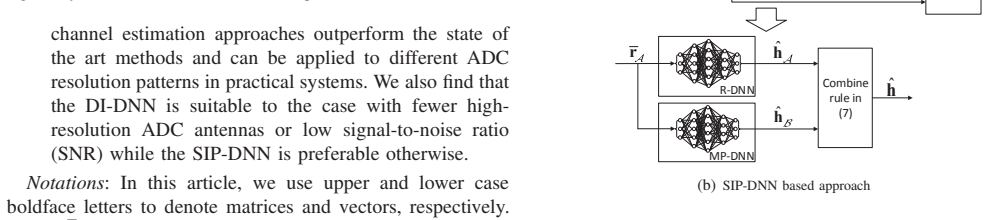
The central object is the selective-input prediction mapping from the channels of the high-resolution ADC antennas to the channels of the low-resolution ADC antennas. It is realized by two parallel fully connected networks: the R-DNN, which takes the least-squares estimates $\bar{r}_A$ from the high-resolution antennas and outputs refined channel estimates $\hat{h}_A$, and the MP-DNN, which maps $\bar{r}_A$ directly to predictions $\hat{h}_B$ for the low-resolution antennas. The paper replaces a serial prediction network with this parallel structure so the two sub-networks can be trained offline without backpropagating through each other. This machinery carries the argument because it removes the severely quantized signals from the estimation path entirely: instead of trying to invert one-bit quantization distortion, the network only has to exploit spatial correlation among antennas, which the paper models as a consequence of a limited number of scattering clusters and finite antenna spacing.
What would settle it
Train and test the same SIP-DNN with more propagation paths than high-resolution antennas, or with test AoAs drawn from a dense continuous range absent from training; if the trained network's normalized MSE then matches or exceeds that of LMMSE at high SNR, the central claim of learnable prediction from high-resolution antennas would be refuted.
Extended reading notes
Core claim
The paper asserts that the channels seen by low-resolution ADC antennas are learnable functions of the channels seen by high-resolution ADC antennas in a mixed-ADC massive MIMO uplink, and that a fully connected network can learn this mapping from data. In the simulated setting—64 antennas, 8 propagation paths, a uniform linear array, and AoAs drawn from a 20-point grid—the SIP-DNN, built from an R-DNN that refines the high-resolution antenna estimates and an MP-DNN that predicts the remaining channels, attains a lower normalized MSE than LMMSE and EM-GM-GAMP at every SNR tested. Unlike methods that ingest the coarsely quantized one-bit pilots, the SIP-DNN does not exhibit a significant high-SNR error floor, because the quantized observations are excluded from its input. The paper also claims the approach is effective across different ADC resolution patterns, including random antenna placement, and that a convolutional variant offers no accuracy gain over the fully connected version.
Load-bearing premise
The standing assumption is that the low-resolution antennas' channels are a learnable function of the high-resolution antennas' channels; the paper only tests this under 8 paths and a fixed 20-angle AoA grid, so a richer scattering environment or different array geometry could make the mapping unlearnable.
Editorial extensions
If this is right
- In a mixed-ADC massive MIMO uplink, the channels of one-bit ADC antennas can be estimated from the high-resolution antennas' pilots without any error floor at high SNR, so system designers can tolerate a large fraction of cheap ADCs.
- A plain fully connected network is sufficient for this prediction task, since the CNN variant performs about the same; no specialized architecture is required.
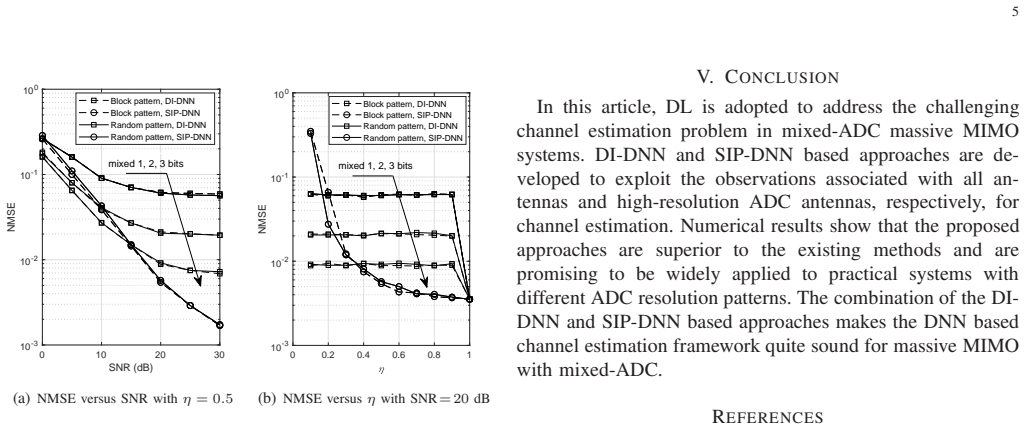
- Because random and block ADC resolution patterns give nearly identical NMSE, the proposed estimators do not depend on a particular antenna layout.
- The preferred network depends on operating conditions: DI-DNN suits low SNR or a very small fraction of high-resolution antennas, while SIP-DNN wins at medium-to-high SNR and larger fractions.
Reading between the lines
- Implicit in the paper but not tested: the prediction gain should shrink as the angular degrees of freedom of the channel grow, because the information carried by the high-resolution antennas becomes insufficient once the number of significant paths exceeds the number of those antennas.
- A natural but unrun extension is cross-condition generalization—training on one ADC resolution pattern or SNR and testing on another—which would reveal whether the network has learned the physical antenna correlation rather than the training distribution.
- In the paper's own terms, the same selective-input idea could transfer to other quantized sensor arrays: use a few fine sensors to predict many coarse ones whenever the underlying field is spatially correlated, provided the fine sensors are informative enough.
Signed reviews
Editorial analysis
A structured set of objections, weighed in public.
Referee Report
Summary. The manuscript proposes two deep-neural-network-based channel estimators for massive MIMO uplink with mixed-resolution ADCs: a direct-input DNN (DI-DNN) that uses the quantized received signals from all antennas, and a selective-input prediction DNN (SIP-DNN) that uses only the high-resolution-ADC antennas' LS estimates to predict the channels of both antenna groups. The system model is a single-user, 64-antenna uniform linear array with L=8 propagation paths, and the paper compares the proposed methods against LMMSE and EM-GM-GAMP baselines under block and random ADC resolution patterns. Numerical results in Section IV claim that DI-DNN outperforms the baselines at all SNRs and that SIP-DNN outperforms DI-DNN at medium/high SNR, with crossover points in SNR and in the high-resolution antenna ratio η used as design guidance. The paper also reports robustness to ADC resolution pattern and, in a footnote, claims generalization to different channel statistics.
Significance. If the performance claims were established on a common metric, the paper would be a useful contribution: it demonstrates a data-driven alternative to model-based estimation in mixed-ADC massive MIMO, with clearly described architectures, explicit simulation settings, and comparisons to two recognized baselines. The proposed SIP-DNN idea of predicting low-resolution-ADC channels from high-resolution-ADC observations is interesting and practically motivated, and the paper gives enough detail (architectures, training hyperparameters, dataset sizes) for the experiments to be reproduced. However, the central numerical comparison is weakened by the use of two different NMSE definitions for the methods being compared, and a key architectural-equivalence claim in Section III.B is unverified. These issues are load-bearing for the paper's headline claims, so the current evidence does not support the stated conclusions.
major comments (3)
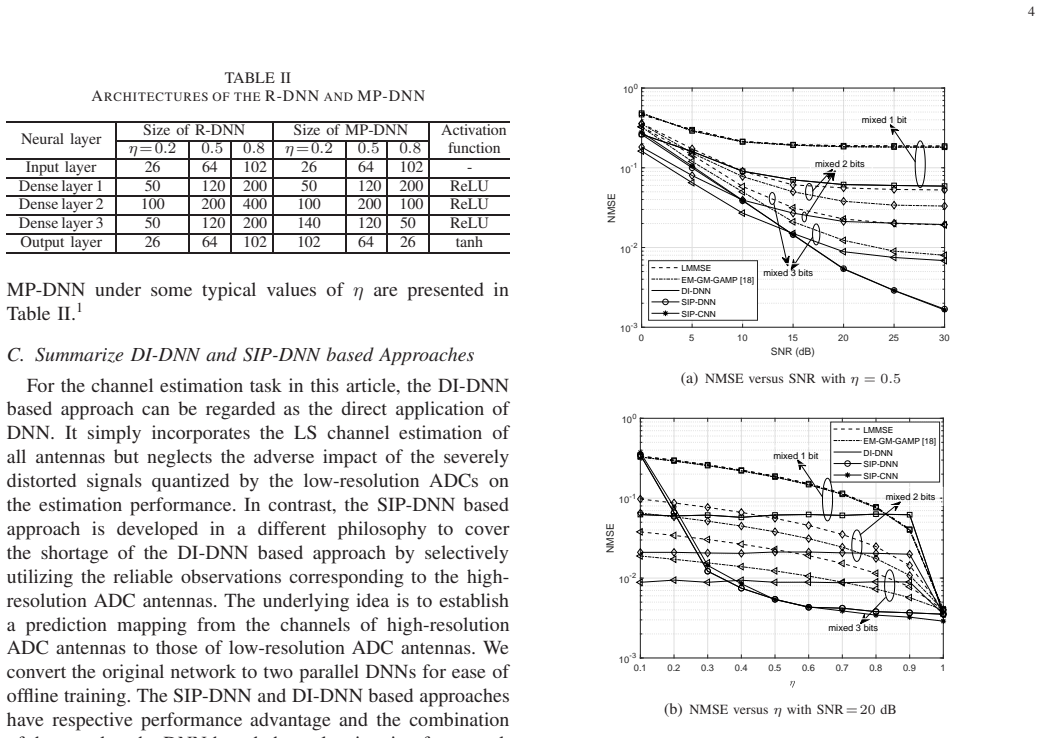
- [Section IV, NMSE definitions and Fig. 3] The paper compares DI-DNN against LMMSE, EM-GM-GAMP, and SIP-DNN using two different normalized mean-squared-error statistics. For DI-DNN the NMSE is E{||h−ĥ||²/||h||²}, while for LMMSE, EM-GM-GAMP, and SIP-DNN it is η·E{||hA−ĥA||²/||hA||²} + (1−η)·E{||hB−ĥB||²/||hB||²}. These are not the same quantity, and no argument is given that they are interchangeable for the simulated channel statistics. Consequently, the claims in Fig. 3(a) that DI-DNN always outperforms LMMSE and EM-GM-GAMP, and the crossover analysis in Fig. 3(b) that selects between DI-DNN and SIP-DNN, compare curves measured on different scales. The crossover in particular could be an artifact of the different normalizations rather than a genuine performance ordering. Please report results with one common NMSE definition, for example E{||h−ĥ||²/||h||²} for every method, or instead present per-antenna-set errors separately for all methods.
- [Section III.B, paragraph after Eq. (9)] The manuscript states that replacing the serial R-DNN plus P-DNN structure with the parallel R-DNN plus MP-DNN structure 'will not cause performance loss but facilitate the offline training significantly,' yet no simulation result, figure, or analytical argument in the paper supports this claim. Since all SIP-DNN numerical results are obtained with the parallel MP-DNN configuration, the claimed performance of SIP-DNN depends on this unverified equivalence. Please supply supporting evidence, or explicitly weaken the claim to state that the parallel structure is an approximation whose performance is evaluated empirically.
- [Footnote 2 and Section IV first paragraph] The generalization statement in footnote 2 is not supported by the experimental design. The AoAs in both the training and testing sets are drawn from the same discrete set of 20 angles, namely 2π/20 × {0,1,...,19}; with 90,000 training samples and only 20 possible angles per path, the training set almost certainly contains all grid values many times. Thus the testing procedure does not demonstrate that the networks 'can learn the inherent channel structure and are suitable for different channel statistics.' It only shows generalization to different random combinations of the same discrete angle grid. Please test on angles outside the training grid, or on different values of L, different array geometries, or different spatial correlation models, before making the broader generalization claim.
minor comments (4)
- [Section III.B, text near Eq. (7)] There is a typo: 'simulation trails' should be 'simulation trials.'
- [Section IV, first paragraph] The LMMSE baseline description says 'liner minimum mean-squared error'; this should be 'linear minimum mean-squared error.'
- [Section IV and Fig. 3] The SIP-CNN architecture is mentioned but not specified in the same detail as the DNN architectures; a sentence describing its layers, kernel sizes, and number of parameters would make the comparison reproducible.
- [Section IV, Fig. 4 caption] The caption says 'mixed 1, 2, 3 bits' but the main text explains the patterns; it would be clearer to state in the caption that the figure combines results for mixed 1-bit, 2-bit, and 3-bit ADC cases.
Circularity Check
No significant circularity: the DNN training and evaluation are self-contained; the shared-author citation supplies only a baseline coefficient.
full rationale
The paper's channel estimation methods are built by standard supervised learning: DI-DNN minimizes the MSE between its output and the true channel, and SIP-DNN trains R-DNN and MP-DNN on labeled pairs (r_A, h_A) and (r_A, h_B), respectively. No parameter fitted to a subset of data is renamed as a prediction, and no defining equation reduces a claimed output to its input. The only shared-author citation, [5], provides Bussgang linearization coefficients used in the LMMSE baseline; this is an external published result and does not determine the DNN outputs or the central claim. The held-out test set uses different random realizations from the same discrete AoA grid, which limits generalization claims but is not circular, since the DNNs are not evaluated on the training samples. The paper's separate NMSE definitions for DI-DNN versus LMMSE/EM-GM-GAMP/SIP-DNN are a comparison-validity concern rather than a circular derivation: the figures may compare curves on different scales, but this does not make any result equivalent to its inputs by construction. Accordingly, no circular step is identified.
Assumptions & free parameters
free parameters (2)
- Output scaling constant c =
3
- Hidden layer neuron counts for R-DNN and MP-DNN per eta =
Table II values, e.g., 50/100/50 for R-DNN at eta=0.2
assumptions (4)
- domain assumption Multipath channel model with L=8 paths, AoAs drawn uniformly from a fixed 20-direction grid, and gains alpha_l ~ CN(0, sigma^2_alpha) with unit variance.
- domain assumption High-resolution ADCs are ideal, i.e., their quantization error is ignored.
- domain assumption The channel has low enough spatial dimensionality that the low-resolution ADC channels can be predicted from high-resolution ADC observations.
- domain assumption Bussgang decomposition coefficients alpha for the LMMSE baseline are taken from [5, Table I].
Cite this review
Pith. "Pith review of Deep Learning based Channel Estimation for Massive MIMO with Mixed-Resolution ADCs." pith.science (2026). https://pith.science/paper/NZUMGZPA
@misc{pith2026190806245,
  author       = {Pith},
  title        = {Pith review of: Deep Learning based Channel Estimation for Massive MIMO with Mixed-Resolution ADCs},
  year         = {2026},
  howpublished = {\url{https://pith.science/paper/NZUMGZPA}},
  note         = {Machine review of arXiv:1908.06245}
}
read the original abstract
In this article, deep learning is applied to estimate the uplink channels for mixed analog-to-digital converters (ADCs) massive multiple-input multiple-output (MIMO) systems, where a portion of antennas are equipped with high-resolution ADCs while others employ low-resolution ones at the base station. A direct-input deep neural network (DI-DNN) is first proposed to estimate channels by using the received signals of all antennas. To eliminate the adverse impact of the coarsely quantized signals, a selective-input prediction DNN (SIP-DNN) is developed, where only the signals received by the high-resolution ADC antennas are exploited to predict the channels of other antennas as well as to estimate their own channels. Numerical results show the superiority of the proposed DNN based approaches over the existing methods, especially with mixed one-bit ADCs, and the effectiveness of the proposed approaches on different ADC resolution patterns.
Figures

Figures from the paper (1 more)
Reference graph
Works this paper leans on
-
[5]
Efficient low-resolu tion ADC relaying for multiuser massive MIMO system,
P . Dong, H. Zhang, W. Xu, and X. Y ou, “Efficient low-resolu tion ADC relaying for multiuser massive MIMO system,” IEEE Trans. V eh. Technol., vol. 66, no. 12, pp. 11039 − 11056, Dec. 2017
work page 2017
-
[1]
An overview of massive MIMO: benefits and challenges,
L. Lu, G. Y . Li, A. L. Swindlehurst, A. Ashikhmin, and R. Zh ang, “An overview of massive MIMO: benefits and challenges,” IEEE J. Sel. Topics in Signal Process. , vol. 8, no. 5, pp. 742 − 758, Oct. 2014
work page 2014
-
[2]
Low-complexity hybrid prec oding in massive multiuser MIMO systems,
L. Liang, W. Xu, and X. Dong, “Low-complexity hybrid prec oding in massive multiuser MIMO systems,” IEEE Wireless Commun. Lett. , vol. 3, no. 6, pp. 653 − 656, Dec. 2014
work page 2014
-
[3]
L. Dai, B. Wang, M. Peng, and S. Chen, “Hybrid precoding-b ased millimeter-wave massive MIMO-NOMA with simultaneous wire less information and power transfer,” IEEE J. Sel. Areas Commun. , vol. 37, no. 1, pp. 131 − 141, Jan. 2019
work page 2019
-
[4]
Uplink achievabl e rate for massive MIMO systems with low-resolution ADC,
L. Fan, S. Jin, C.-K. Wen, and H. Zhang, “Uplink achievabl e rate for massive MIMO systems with low-resolution ADC,” IEEE Commun. Lett., vol. 19, no. 12, pp. 2186 − 2189, Dec. 2015
work page 2015
-
[6]
N. Liang and W. Zhang, “Mixed-ADC massive MIMO,” IEEE J. Sel. Areas Commun. , vol. 34, no. 4, pp. 983 − 997, Apr. 2016
work page 2016
-
[7]
On low-resol ution ADCs in practical 5G millimeter-wave massive MIMO systems,
J. Zhang, L. Dai, X. Li, Y . Liu, and L. Hanzo, “On low-resol ution ADCs in practical 5G millimeter-wave massive MIMO systems, ” IEEE Commun. Mag. , vol. 56, no. 7, pp. 205 − 211, Jul. 2018
work page 2018
-
[8]
Performance ana lysis of mixed-ADC massive MIMO systems over Rician fading channels ,
J. Zhang, L. Dai, Z. He, S. Jin, and X. Li, “Performance ana lysis of mixed-ADC massive MIMO systems over Rician fading channels ,” IEEE J. Sel. Areas Commun. , vol. 35, no. 6, pp. 1327 − 1338, Jun. 2017
work page 2017
Show all 18 references
-
[9]
Outage probability analysis and res olution profile design for massive MIMO uplink with mixed-ADC,
Q. Ding and Y . Jing, “Outage probability analysis and res olution profile design for massive MIMO uplink with mixed-ADC,” IEEE Trans. Wireless Commun., vol. 17, no. 9, pp. 6293 − 6306, Sep. 2018
2018
-
[10]
Multiuser massi ve MIMO relaying with mixed-ADC receiver,
J. Liu, J. Xu, W. Xu, S. Jin, and X. Dong, “Multiuser massi ve MIMO relaying with mixed-ADC receiver,” IEEE Signal Process. Lett. , vol. 24, no. 1, pp. 76 − 80, Jan. 2017
2017
-
[11]
Mixed-ADC /DAC multipair massive MIMO relaying systems: Performance anal ysis and power optimization,
J. Zhang, L. Dai, Z. He, B. Ai, and O. A. Dobre, “Mixed-ADC /DAC multipair massive MIMO relaying systems: Performance anal ysis and power optimization,” IEEE Trans. Commun. , vol. 67, no. 1, pp. 140− 153, Jan. 2019
2019
-
[12]
Deep learnin g in physical layer communications,
Z.-J. Qin, H. Y e, G. Y . Li, and B.-H. Juang, “Deep learnin g in physical layer communications,” IEEE Wireless Commun. , vol. 26, no. 2, pp. 93− 99, Apr. 2019
2019
-
[13]
Model - driven deep learning for physical layer communications,
H. He, S. Jin, C.-K. Wen, F. Gao, G. Y . Li, and Z. Xu, “Model - driven deep learning for physical layer communications,” IEEE Wireless Commun., to be published
-
[14]
Power of deep learning f or channel estimation and signal detection in OFDM systems,
H. Y e, G. Y . Li, and B.-H. Juang, “Power of deep learning f or channel estimation and signal detection in OFDM systems,” IEEE Wireless Commun. Lett. , vol. 7, no. 1, pp. 114 − 117, Feb. 2018
2018
-
[15]
Deep CNN based channel estimation for mmWave massive MIMO system s,
P . Dong, H. Zhang, G. Y . Li, I. Gaspar, and N. NaderiAliza deh, “Deep CNN based channel estimation for mmWave massive MIMO system s,” IEEE J. Sel. Topics in Signal Process. , to be published
-
[16]
Supervised-learni ng-aided com- munication framework for MIMO systems with low-resolution ADCs,
Y .-S. Jeon, S.-N. Hong, and N. Lee, “Supervised-learni ng-aided com- munication framework for MIMO systems with low-resolution ADCs,” IEEE Trans. V eh. Technol., vol. 67, no. 8, pp. 7299 − 7313, Aug. 2018
2018
-
[17]
The multice ll multiuser MIMO uplink with very large antenna arrays and a finite-dimen sional channel,
H. Q. Ngo, E. G. Larsson, and T. L. Marzetta, “The multice ll multiuser MIMO uplink with very large antenna arrays and a finite-dimen sional channel,” IEEE Trans. Commun. , vol. 61, no. 6, pp. 2350 − 2361, Jun. 2013
2013
-
[18]
Channel estima tion in broadband millimeter wave MIMO systems with few-bit ADCs,
J. Mo, P . Schniter, and R. W. Heath, Jr., “Channel estima tion in broadband millimeter wave MIMO systems with few-bit ADCs,” IEEE Trans. Signal Process. , vol. 66, no. 5, pp. 1141 − 1154, Mar. 2018
2018
Reviewed August 14, 2026 · model on record in the stance chip above.
Discussion (0). Continue with ORCID to comment.