Probing intensity-field correlations of single-molecule surface-enhanced Raman-scattered light
Pith reviewed 2026-05-25 16:41 UTC · model grok-4.3
The pith
Conditional homodyne detection of intensity-field correlations reveals squeezing signatures in Raman photons from a single molecule in a plasmonic cavity.
A machine-rendered reading of the paper's core claim, the machinery that carries it, and where it could break.
Core claim
In the quantum-mechanical treatment of single-molecule surface-enhanced Raman scattering, the inelastic interplay between plasmons and vibrations of a diatomic molecule inside the cavity appears as phase-dependent third-order fluctuations of the emitted light when recorded via conditional homodyne detection; these fluctuations expose non-classical features, including squeezing, of the outgoing Raman photons.
What carries the argument
Conditional homodyne detection applied to phase-dependent third-order intensity-field correlations of the cavity light.
If this is right
- The detected fluctuations would confirm squeezing in the Raman field.
- The method isolates the inelastic plasmon-vibration contribution from other noise sources.
- Non-classicality signatures become accessible through third-order rather than second-order measurements.
- The technique extends the diagnostic toolkit for quantum features in single-molecule SERS.
Where Pith is reading between the lines
- Similar conditional detection could be tested on other cavity-molecule geometries to map how vibration frequency affects the squeezing strength.
- If the third-order signal survives in multi-molecule ensembles, the approach might scale toward brighter non-classical sources.
- The phase dependence implies that active phase locking between local oscillator and signal could further enhance visibility of the non-classical features.
Load-bearing premise
The quantum model of plasmon-vibration coupling generates third-order correlations that remain distinguishable from classical or thermal noise under realistic lab conditions.
What would settle it
An experiment recording the same conditional homodyne signal from the cavity but finding no phase-dependent third-order fluctuations beyond what a classical thermal source would produce.
Figures
read the original abstract
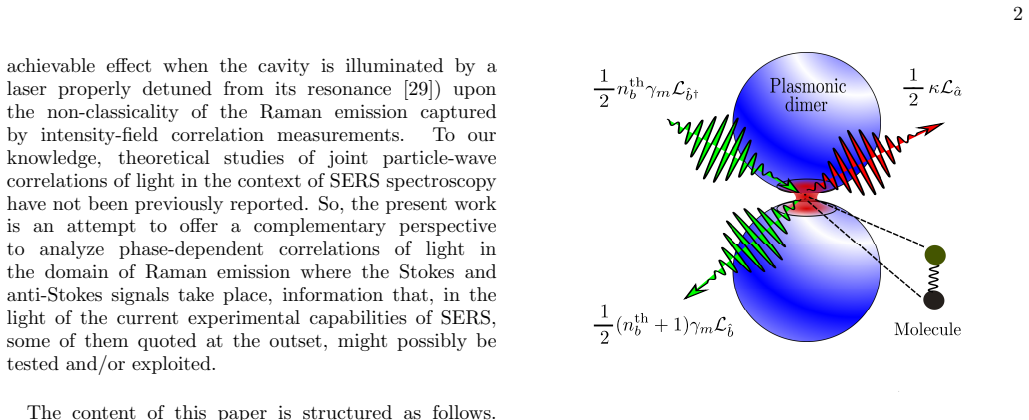
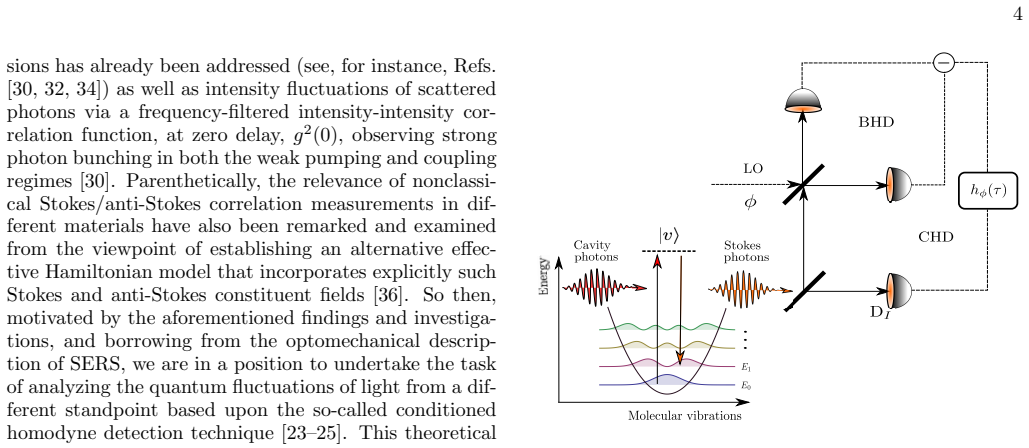
In the context of the quantum-mechanical description of single-molecule surface-enhanced Raman scattering, intensity-field correlation measurements of photons emitted from a plasmonic cavity are explored, theoretically, using the technique of conditional homodyne detection. The inelastic interplay between plasmons and vibrations of a diatomic molecule placed inside the cavity can be manifested in phase-dependent third-order fluctuations of the light recorded by the aforesaid technique, allowing us to reveal signatures of non-classicality (indicatives of squeezing) of the outgoing Raman photons.
Editorial analysis
A structured set of objections, weighed in public.
Referee Report
Summary. The manuscript develops a quantum-mechanical model of single-molecule surface-enhanced Raman scattering (SERS) inside a plasmonic cavity and explores intensity-field correlations via conditional homodyne detection. It claims that inelastic plasmon-vibration coupling produces phase-dependent third-order fluctuations whose measurement can reveal non-classical features, specifically squeezing, in the emitted Raman photons.
Significance. If the derivations and numerical results hold under realistic cavity losses and detection conditions, the work supplies a concrete theoretical protocol for accessing quantum-optical signatures in SERS that are inaccessible to standard intensity or second-order correlation measurements. It thereby links cavity quantum electrodynamics with molecular spectroscopy and could guide future experiments aimed at demonstrating photon squeezing in plasmon-enhanced Raman processes.
major comments (2)
- [Abstract and main theoretical sections] The central claim that conditional homodyne detection 'allows us to reveal' signatures of squeezing rests on the unverified assertion that the computed third-order phase-dependent correlations remain distinguishable from classical or thermal fluctuations once realistic SERS parameters (plasmon decay ~10-100 meV, finite detection efficiency, vibrational dephasing) are included. No explicit comparison to classical bounds or signal-to-noise estimates appears in the derivations or figures.
- [Theoretical model and results] The model of plasmon-vibration coupling is presented as producing measurable non-classical third-order moments, yet the manuscript does not quantify how cavity losses or the finite plasmon linewidth affect the visibility of the predicted squeezing signature relative to the classical limit.
minor comments (2)
- Notation for the conditional third-order correlation function should be defined explicitly at first use and kept consistent with standard quantum-optics conventions (e.g., g^(3) vs. intensity-field correlator).
- Figure captions should state the specific parameter values (coupling strengths, decay rates) used in each panel so that the reader can assess proximity to experimental regimes.
Simulated Author's Rebuttal
We thank the referee for the careful reading of our manuscript and the constructive comments. We address each major point below and have revised the manuscript to incorporate additional analysis under realistic SERS parameters as requested.
read point-by-point responses
-
Referee: [Abstract and main theoretical sections] The central claim that conditional homodyne detection 'allows us to reveal' signatures of squeezing rests on the unverified assertion that the computed third-order phase-dependent correlations remain distinguishable from classical or thermal fluctuations once realistic SERS parameters (plasmon decay ~10-100 meV, finite detection efficiency, vibrational dephasing) are included. No explicit comparison to classical bounds or signal-to-noise estimates appears in the derivations or figures.
Authors: We agree that the original manuscript lacked explicit comparisons to classical bounds and signal-to-noise estimates under realistic conditions. In the revised version we have added a dedicated subsection (new Section IV.C) that derives the third-order correlation functions including plasmon decay rates of 10-100 meV, detection efficiencies down to 10%, and vibrational dephasing times of 1-10 ps. We compare the phase-dependent signal directly to the classical limit (zero for a coherent state) and provide signal-to-noise estimates showing that the non-classical signature remains detectable for typical experimental parameters. A new figure (Fig. 5) illustrates these results. revision: yes
-
Referee: [Theoretical model and results] The model of plasmon-vibration coupling is presented as producing measurable non-classical third-order moments, yet the manuscript does not quantify how cavity losses or the finite plasmon linewidth affect the visibility of the predicted squeezing signature relative to the classical limit.
Authors: The referee correctly notes the absence of such quantification. We have extended the master-equation treatment to explicitly vary the plasmon linewidth and cavity loss rate. New numerical results (added to Figs. 3 and 4 and discussed in Section III) show that the squeezing signature in the third-order moment remains above the classical bound for linewidths up to ~80 meV; beyond this the visibility drops but can be recovered by adjusting the homodyne phase. These calculations are now included in the revised manuscript. revision: yes
Circularity Check
No significant circularity; derivation is self-contained theoretical model
full rationale
The paper develops a theoretical quantum-optical model of plasmon-vibration coupling in a cavity and computes third-order intensity-field correlations via conditional homodyne detection. No parameters are fitted to a data subset and then presented as predictions. No self-citations are invoked to establish uniqueness theorems or to smuggle in ansatze. The central claim follows directly from the model equations without reducing to self-definition or renaming of known results. The derivation chain is independent of the target observables and does not rely on load-bearing self-references.
Axiom & Free-Parameter Ledger
Reference graph
Works this paper leans on
-
[1]
(see also Ref. [31] for further details), the interplay between the localized plasmons in the gap and the molec- ular vibrations is such that the molecule, considered to be in its electronic ground state, dipolarly couples to the quantized field of the cavity via the interaction Hamil- tonian HI =− 1 2 ˆp· ˆE, where ˆp and ˆE are, respectively, the quantiz...
-
[2]
5 hφ=0(τ) − 1 ×10⁻⁵ −60 −40 −20 0 20 40 60 ωmτ −1. 0 −0. 5
-
[3]
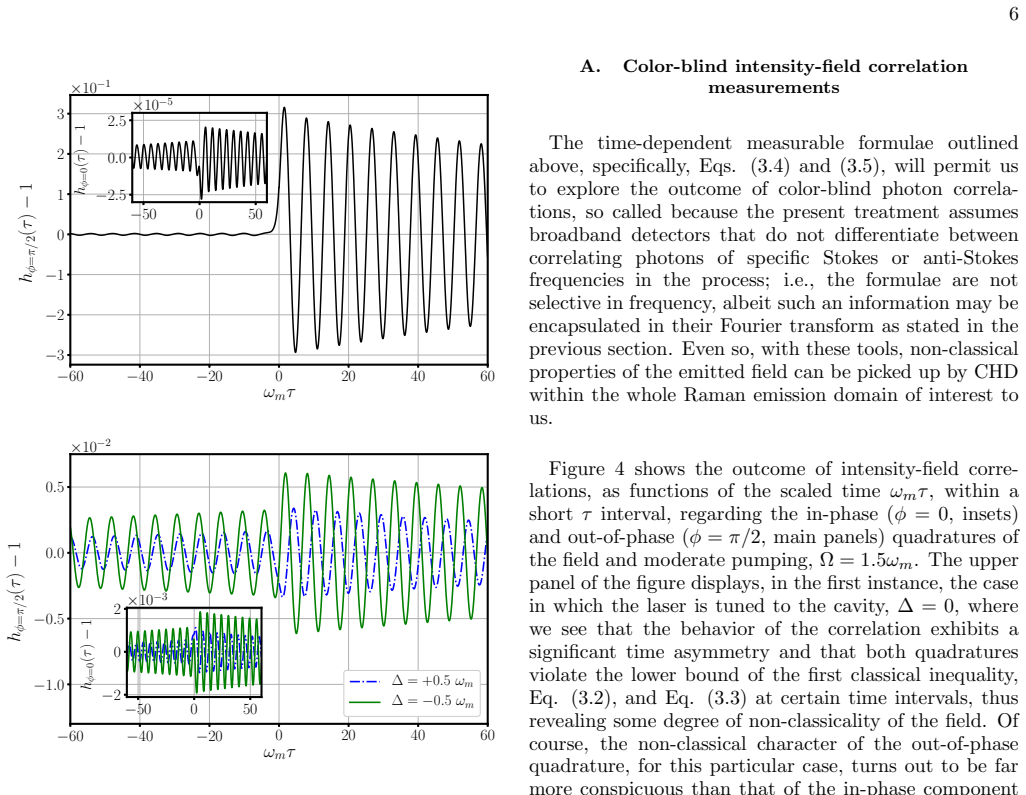
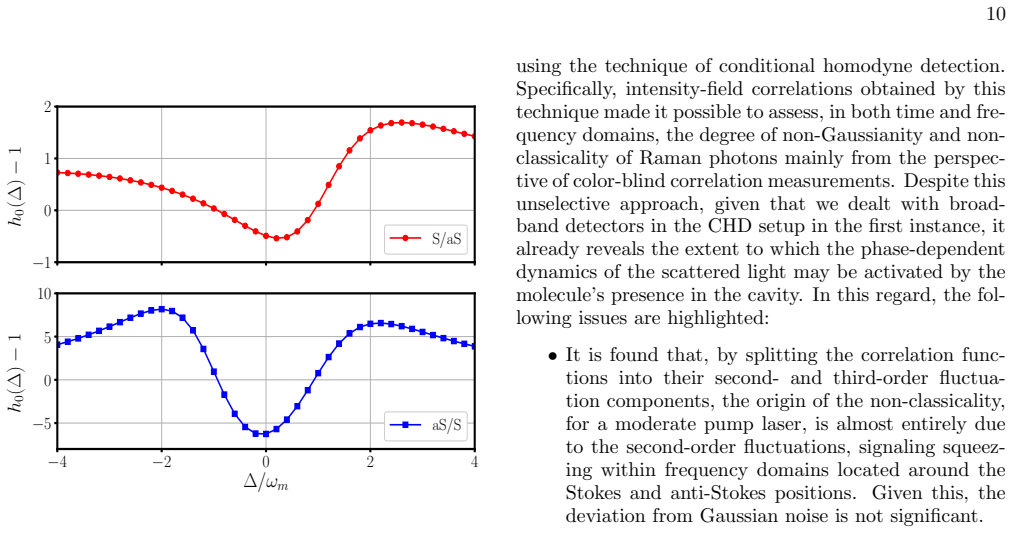
5 hφ=π/ 2(τ) − 1 ×10⁻² ∆ = +0 . 5 ωm ∆ = −0. 5 ωm−50 0 50 −2 0 2 hφ=0(τ) − 1 ×10⁻³ FIG. 4: Intensity-field correlations, Eqs. (3.4) and Eqs. (3.5), versus the scaled time ωmτ, for the φ = 0 (insets) and φ = π/2 (main panels) quadratures, calculated for the mod- erate pumping Ω = 1 .5ωm. In the upper panel the laser is tuned to the cavity (∆ = 0), whereas t...
-
[4]
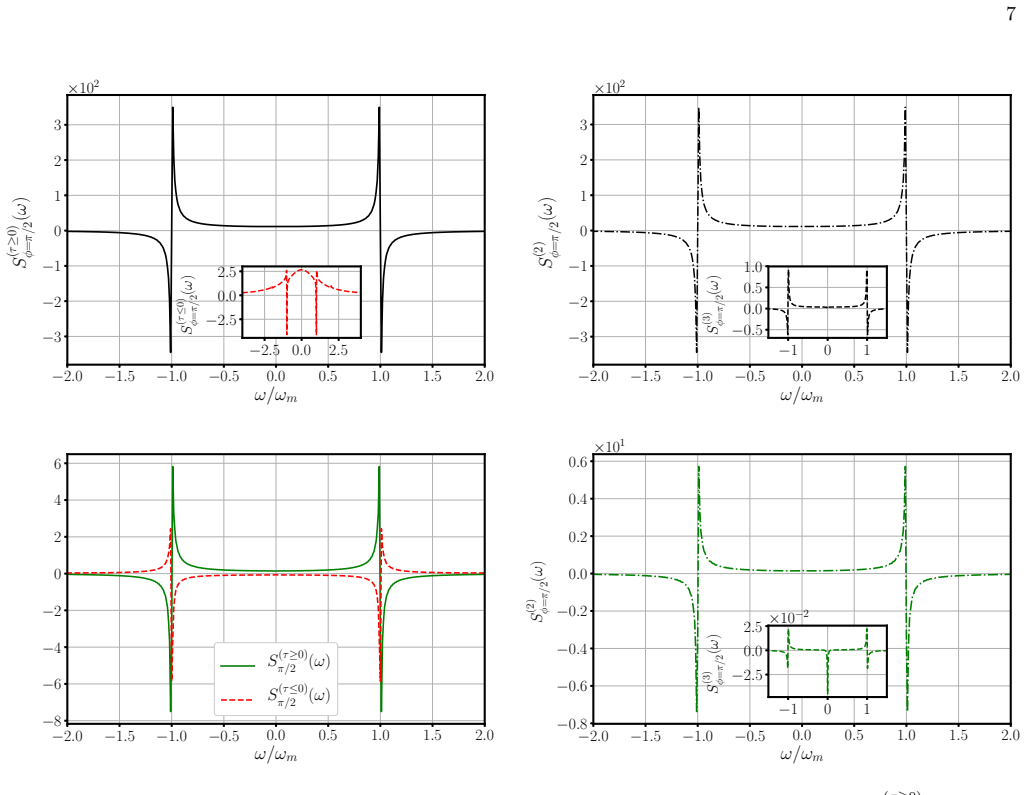
5 S(τ≤0) φ=π/ 2(ω) −2. 0 −1. 5 −1. 0 −0. 5 0. 0 0 . 5 1 . 0 1 . 5 2 . 0 ω/ω m −8 −6 −4 −2 0 2 4 6 S(τ≥0) π/ 2 (ω ) S(τ≤0) π/ 2 (ω ) FIG. 5: Spectra of the intensity-field correlation, Eqs. (3.6), continuous line, and (3.7), dashed line, for the φ = π/2 quadrature and moderate pumping Ω = 1 .5ωm. Upper and lower panels show, respectively, the spectral outco...
-
[5]
0 S(3) φ=π/ 2(ω) −2. 0 −1. 5 −1. 0 −0. 5 0. 0 0 . 5 1 . 0 1 . 5 2 . 0 ω/ω m −0. 8 −0. 6 −0. 4 −0. 2
-
[6]
6 S(2) φ=π/ 2(ω) ×101 −1 0 1 −2. 5
-
[7]
6: Decomposition of the spectrum S(τ ≥0) φ=π/2, shown in Fig
5 S(3) φ=π/ 2(ω) ×10−2 FIG. 6: Decomposition of the spectrum S(τ ≥0) φ=π/2, shown in Fig. 5, into its second- and third-order constituents, S(2) φ=π/2 (main panels) and S(3) φ=π/2 (insets), respectively. Upper and lower panels show, respectively, the spectral outcome for the zero- and negative-detuning cases: ∆ = 0 (black line) and ∆ = −0.5ωm (green line)...
-
[8]
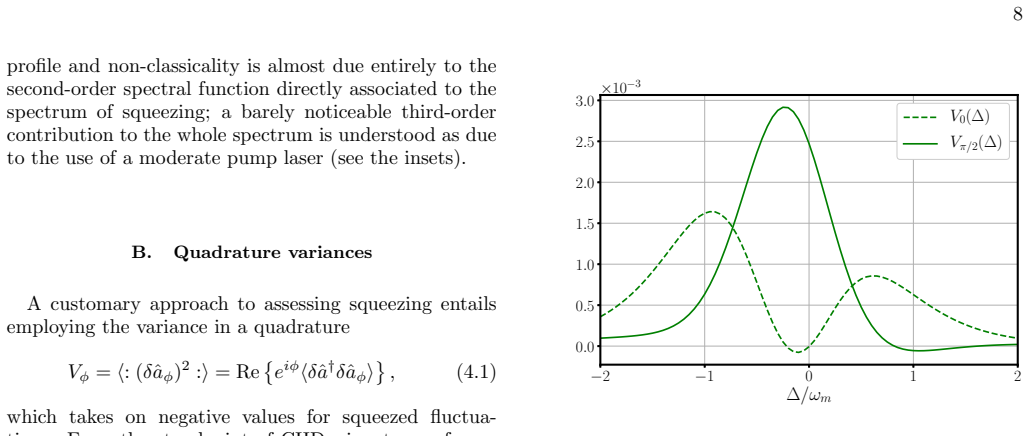
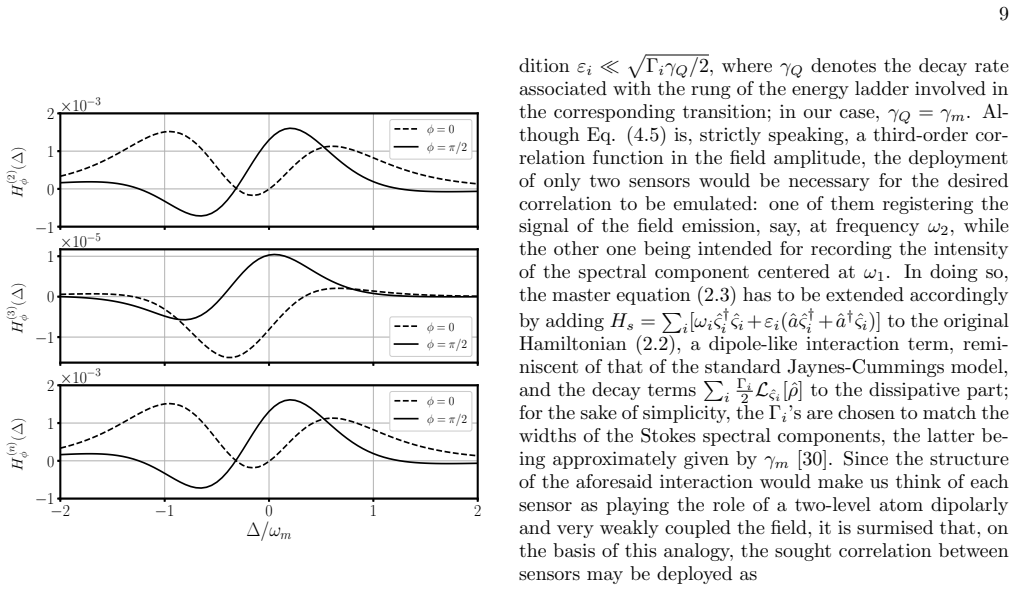
0 ×10−3 V0(∆) Vπ/ 2(∆) FIG. 7: Variance, Eq. (4.1), as a function of the scaled de- tuning ∆/ωm, for φ = 0 (dashed line) and π/2 (continuous line). The parameters are: Ω = 1 .5ωm, eV, g = 5 meV, and T = 300 K. the dominating source of noise, exhibiting, in the mean- while, negativities within certain intervals of negative de- tuning regarding the out-of-p...
-
[9]
L. E. C. Ru and P. G. Etchegoin, Principles of surface- enhanced Raman spectroscopy and related plasmonic ef- fects, Elsevier, 2009
work page 2009
-
[10]
F. Benz, M. K. Schmidt, A. Dreismann, R. Chikkaraddy, Y. Zhang, A. Demetriadou, C. Carnegie, H. Ohadi, B. de Nijs, R. Esteban, J. Aizpurua and J. J. Baumberg. Single- molecule optomechanics in picocavities, Science 354 726 (2016)
work page 2016
-
[11]
A. Lombardi, M. K. Schmidt, L. Weller, W. M. Deacon, F. Benz, B. de Nijs, J. Aizpurua and J. J. Baumberg. Pulsed molecular optomechanics in plasmonic nanocav- ities: From nonlinear vibrational instabilities to bond- breaking, Phys. Rev. X , 8(1) 011016 (2018)
work page 2018
-
[12]
A. M. Kern, D. Zhang, M. Brecht, A. I. Chizhik, A. V. Failla, F. Wackenhut and A. J. Meixner, Enhanced single-molecule spectroscopy in highly confined optical fields: from λ/2-Fabry-P´ erot resonators to plasmonic nano-antenas, Chem. Soc. Rev. 43, 1263 (2014)
work page 2014
- [13]
- [14]
-
[15]
P. Alonso-Gonz´ alez, P. Albella, M. Schnell, J. Chen, F. Huth, A. Garc´ ıa-Etxarri, F. Casanova, F. Golmar, L. Arzubiaga, L. Hueso, J. Aizpurua, R. Hillenbrand, Resolving the electromagnetic mechanism of surface- enhanced light scattering at single hot spots, Nat. Com- mun. 3, 684 (2012)
work page 2012
-
[16]
S. Yampolsky, D. A. Fishman, S. Dey, E. Hulkko, M. Banik, E. O. Potma and V. A. Apkarian. Seeing a sin- gle molecule vibrate through rime-resolved coherent anti- Stokes Raman scattering, Nat. Photonics 8, 650 (2014)
work page 2014
-
[17]
R. Chikkaraddy, B. de Nijs, F. Benz, S. J. Barrow, O. A. Scherman, E. Rosta, A. Demetriadou, P. Fox, O. Hess and J. J. Baumberg. Single-molecule strong cou- pling at room temperature in plasmonic nanocavities, Nature 535, 127 (2016)
work page 2016
- [18]
-
[19]
S. J. P. Kress, F. V. Antolinez, P. Richner, S. V. Jayanti, D. K. Kim, F. Prins, A. Riedinger, M. P. C. Fischer, S. Meyer, K. M. McPeak, D. Poulikakos, D. J. Norris. Wedge Waveguides and resonators for quantum plasmon- ics, Nano. Lett. 15, 6267 (2015)
work page 2015
-
[20]
C. Lee, F. Dieleman, J. Lee, C. Rockstuhl, S. A. Maier, M. Tame. Quantum plasmonic sensing: Beyond the shot- noise and diffraction limit. ACS Photonics 3, 992 (2016)
work page 2016
-
[21]
F. Peyskens, A. Dhakal, P. van Dorpe, N. Le Thomas, and R. Baets. Surface enhanced Raman spectroscopy using a single mode nanophotonic-plasmonic plataform. ACS Photonics 3, 102 (2016)
work page 2016
-
[22]
M. D. Basske and F. Vollmer. Optical observation of sin- gle atomic ions interacting with plasmonic nanorods in aqueous solution, Nat. Photonics 10, 733 (2016)
work page 2016
- [23]
-
[24]
H. Xu, E. J. Bjerneld, M. K¨ all and L. B¨ orjesson. Spec- troscopy of single hemoglobin molecules by surface en- hanced Raman scattering, Phys. Rev. Lett. 83(21) 4357 (1999)
work page 1999
-
[25]
C. E. Talley, J. B. Jackson, C. Oubre, N. K. Grady, C. W. Hollars, S. M. Lane, T. R. Huser, P. Nordlander, and N. J. Halas. Surface-enhanced Raman scattering from in- dividual Au nanoparticles and Nanoparticle dimer sub- strates, Nano. Lett. 5, 1569 (2005)
work page 2005
- [26]
- [27]
-
[28]
R. Hanbury-Brown and R. Q. Twiss. Correlations be- tween photons in two coherent beams of light, Nature (London) 177, 27 (1956)
work page 1956
-
[29]
D. F. Walls and P. Zoller. Reduced quantum fluctuations in resonance fluorescence, Phys. Rev. Lett. 47, 709 (1981) 12
work page 1981
- [30]
-
[31]
H. J. Carmichael, H. M. Castro-Beltr´ an, G. T. Foster and L. A. Orozco. Giant Violations of Classical Inequalities through Conditional Homodyne Detection of the Quadra- ture Amplitudes of Light, Phys. Rev. Lett. 85(9) 1855 (2000)
work page 2000
-
[32]
G. T. Foster, L. A. Orozco, H. M. Castro-Beltr´ an and H. J. Carmichael. Quantum State Reduction and Condi- tional Time Evolution of Wave-Particle Correlations in Cavity QED, Phys. Rev. Lett. 85(15) 3149 (2000)
work page 2000
-
[33]
G. T. Foster, W. P. Smith, J. E. Reiner and L. A. Orozco. Third-order correlations in cavity quantum elec- trodynamics, J. Opt. B: Quantum Semiclass. Opt. 4 S281 (2002)
work page 2002
-
[34]
A. Denisov, H. M. Castro-Beltr´ an and H. J. Carmichael. Time-Asymmetric Fluctuations of Light and the Break- down of Detailed Balance,Phys. Rev. Lett.88(24) 243601 (2002)
work page 2002
-
[35]
Intensity-field correlations of nonclassical light
Carmichael H J, Foster G T, Orozco L A, Reiner J E and Rice P R “Intensity-field correlations of nonclassical light” Progress in Optics , E. Wolf. ed. (Elsevier, 2004) 46
work page 2004
-
[36]
A. Shalabney, J. George, J. Hutchison, G. Pupillo, C. Genet and T. W. Ebbesen. Coherent coupling of Molecu- lar Resonators with a Microcavity Mode, Nat. Commun. 6, 5981 (2015)
work page 2015
-
[37]
T. J. Kippenberg and K. J. Vahala. Cavity Opto- Mechanics, Opt. Express 15, 17172 (2007)
work page 2007
-
[38]
M. K. Schmidt, R. Esteban, A. Gonz´ alez-Tudela, G. Giedke and J. Aizpurua. Quantum Mechanical Descrip- tion of Raman Scattering from Molecules in Plasmonic Cavities, ACS Nano 10(6) 6291 (2016)
work page 2016
-
[39]
M. K. Schmidt, R. Esteban, F. Benz, J. J. Baumberg and J. Aizpurua. Linking classical and molecular optome- chanics descriptions of SERS Faraday Discuss. 205, 31 (2017)
work page 2017
- [40]
-
[41]
M. Aspelmeyer, T. J. Kippenberg and F. Marquart. Cav- ity optomechanics, Rev. Mod. Phys. 86(4) 1391 (2014)
work page 2014
-
[42]
M. K. Dezfouli and S. Hughes. Quantum Optics Model of Surface-Enhanced Raman Spectroscopy for Arbitrarily Shaped Plasmonic Resonators ACS Photonics 4 (5) 1245 (2017)
work page 2017
-
[43]
H. J. Carmichael. An Open Systems Approach to Quan- tum Optics, Springer-Verlag, 1993
work page 1993
-
[44]
C. A. Parra-Murillo, M. F. Santos, C. H. Monken and A. Jorio. Stokes-anti-Stokes correlation in the inelastic scattering of light by matter and generalization of the Bose-Einstein population function Phys. Rev. B 93(12) 125141 (2016)
work page 2016
-
[45]
E. R. Marquina-Cruz and H. M. Castro-Beltr´ an. Nonclas- sicality of resonance fluorescence via amplitude-intensity field correlations, Laser Phys. 18 157 (2008)
work page 2008
-
[46]
H. M. Castro-Beltr´ an. Phase-dependent fluctuations of resonance fluorescence beyond the squeezing regime Opt. Commun. 283, 4680 (2010)
work page 2010
-
[47]
H. M. Castro-Beltr´ an, L. Guti´ errez and L. Horvath. Squeezed Versus Non-Gaussian Fluctuations in Reso- nance Fluorescence, Appl. Math. Inf. Sci. 9, 2849 (2015)
work page 2015
-
[48]
H. M. Castro-Beltr´ an, R. Rom´ an-Ancheyta and L. Guti´ errez. Phase-dependent fluctuations of intermittent resonance fluorescence, Phys. Rev. A 93(3) 033801 (2016)
work page 2016
-
[49]
L. Guti´ errez, H. M. Castro-Beltr´ an, R. Rom´ an-Ancheyta and L. Horvath. Large time-asymmetric quantum fluctu- ations in amplitude-intensity correlation measurements of V-type three-level atom resonance fluorescence,J. Opt. Soc. Am. B 34, 2301 (2017)
work page 2017
-
[50]
J. E. Reiner, W. P. Smith, L. A. Orozco, H. J. Carmichael and P. R. Rice. Time evolution and squeezing of the field amplitude in cavity QED, J. Opt. Soc. Am. B 18, 1911 (2001)
work page 1911
-
[51]
C. E. Strimbu, J. Leach and P. R. Rice. Conditioned ho- modyne detection at the single-photon level: Intensity- field correlations for a two-level atom in an optical para- metric oscillator, Phys. Rev. A 71(1) 013807 (2005)
work page 2005
-
[52]
F. Wang, X. Feng and C. H. Oh. Intensity-intensity and intensity-amplitude correlation of microwave pho- tons from a superconducting artificial atom, Laser Phys. Lett. 13, 105201 (2016)
work page 2016
- [53]
-
[54]
Q. Xu, E. Greplova, B. Julsgaard and K. Mølmer. Cor- relation functions and conditioned quantum dynamics in photodetection theory, Phys. Scr. 90 128004 (2015)
work page 2015
- [55]
-
[56]
M. J. Collet, D. F. Walls and P. Zoller. Spectrum of squeezing in resonance fluorescence, Opt. Commun. 52, 145 (1984)
work page 1984
-
[57]
P. R. Rice and H. J. Carmichael. Nonclassical effects in optical spectra, J. Opt. Soc. Am. B 5, 1661 (1988)
work page 1988
-
[58]
J. R. Johanson, P. D. Nation and F. Nori. QuTiP 2: A Python framework for the dynamics of open quantum systems, Comput. Phys. Comm. 284 1234 (2013)
work page 2013
- [59]
-
[60]
E. del Valle, A. Gonz´ alez-Tudela, F. P. Laussy, C. Tejedor and M. J. Hartmann. Theory of Frequency-Filtered and Time-Resolved N-Photon Correlations, Phys. Rev. Lett. 109(18) 183601 (2012)
work page 2012
- [61]
-
[62]
M. Carvajal, R. Lemus, A. Frank, C. Jung and E. Ziem- niak. An extended SU(2) model for coupled Morse oscil- lators, Chem. Phys. 105, 206 (2000)
work page 2000
-
[63]
M. I. Stockman, K. Kneipp, S. I. Bozhevolnyi, S. Saha, A. Dutta, J. Ndukaife, N. Kinsey, H. Reddy, U. Guler, V. M. Shalaev, A. Boltasseva, B. Gholipour, H. N. S. Krish- namoorthy, K. F. MacDonald, C. Soci, N. I. Zheludev, V. Savinov, R. Singh, P. Grob, C. Lienau, M. Vadai, M. L. Solomon, D. R. Barton III, M. Lawrence, J. A. Dionne, S. V. Boriskina, R. Est...
work page 2018
discussion (0)
Sign in with ORCID, Apple, or X to comment. Anyone can read and Pith papers without signing in.