REVIEW 3 major objections 3 minor 20 references
OrDA: Orthogonal Disentanglement of Access Habits Framework for Homepage Marketing Block Recommendations
T0 review · 3 major / 3 minor · reviewed 2026-08-02 · deepseek-v4-flash
Pith's one-line read Homepage clicks mix habit with interest; OrDA strips out the habit at ranking time.
desk verdict A useful industrial debiasing recipe that overstates its causal claims: the habit/interest split is architecture-imposed, not identified, so the 'purified interest score' is a modeling choice rather than a do-calculus result. read the letter →
The pith
A machine-rendered reading of the paper's core claim, the machinery that carries it, and where it could break.
The reading
What carries the argument
The central object is the structural causal model Y=H⊕I, with H=f_H(u) and I=f_I(u,c,u2c), where ⊕ denotes additive logit fusion. The key mechanism is the do-intervention at inference, S=E[Y|I,do(H=0)]=σ(I), implemented by zeroing the habit tower logit. Supporting components are the Gated Allocation Layer (a learnable router that splits user features into habit and interest streams), the orthogonal cosine regularization that forces v_int ⊥ v_hab, and the Causal Fusion Layer (a linear MLP that sums the two logits).
What would settle it
Run OrDA on a synthetic or logged dataset where ground-truth interest is known and where habit is deliberately made content-dependent (for example, users habitually click a slot that always shows a particular category). If the purified ranking still over-ranks that category even when true interest is low, then the causal graph is misspecified and the do-intervention fails.
Extended reading notes
Core claim
OrDA claims that access-habit bias can be removed by a causal intervention at inference: instead of ranking by the combined click probability σ(H⊕I), it ranks by σ(I), the interest component alone. The model trains a dual-tower network where the habit tower sees only user features, the interest tower sees user, content, and user-content features, and an orthogonal cosine constraint forces the two representations to be perpendicular. The click logit is the sum of the two tower logits; at serving time the habit logit is zeroed. On a 30-million-user production dataset, this purified score improves group AUC, especially for cold-start users, and an online A/B test reports a 5.64% UCTR lift.
Load-bearing premise
The paper's central claim depends on the assumption that a user's access habit is entirely a function of user features and that clicks are an additive logit sum of habit and interest; if habits are content-dependent or the fusion is non-additive, setting H=0 does not recover the true interest score.
Editorial extensions
If this is right
- Rankings driven by pure interest should improve cold-start recommendations, because habitual noise is removed before the score is computed.
- Active users' habitual clicks no longer inflate the scores of mediocre content in prime positions, so the ecosystem becomes less biased.
- The intervention is deployment-friendly: at serving time, one only needs to zero out the habit logit.
- This approach differs from inverse-propensity re-weighting by imposing a geometric constraint plus an explicit do-operator, potentially avoiding high-variance numerical divisions.
- If the online lift is reproducible, the method transfers from offline metrics to real user engagement.
Reading between the lines
- Because habit is modeled as a pure function of user features, the approach implicitly assumes habits are content-independent; a user who habitually clicks on a brand or category could have genuine interest removed along with the habit. This is our inference, not a claim in the paper.
- The orthogonal-plus-additive factorization suggests a testable extension: in a simulation with known ground-truth interest, one can verify whether zeroing the habit logit exactly recovers the true interest ranking.
- The same intervention recipe—train a confounder tower, orthogonalize, zero at serving—might generalize to position bias or popularity bias, but the paper only demonstrates it for access habits.
- The 5.64% UCTR gain could partly reflect short-term novelty or traffic reallocation; a longer-duration A/B test would disentangle genuine interest purification from exploration effects.
Editorial analysis
A structured set of objections, weighed in public.
Referee Report
Summary. The paper introduces OrDA, a dual-tower recommender architecture for homepage marketing blocks. It models clicks as an additive logit fusion of a latent access-habit component H and a latent interest component I (Eq. 4), trains both towers with BCE losses (Eq. 5) plus an orthogonality regularizer (Eq. 7), and at inference computes a 'purified' score S = E[Y | I, do(H=0)] = sigma(I) (Eq. 9). Offline GAUC experiments on a Zhima production dataset and a one-week online A/B test (+5.64% UCTR) are reported in support of the claim that OrDA eliminates access-habit bias.
Significance. The problem addressed is real and industrially relevant: distinguishing habitual clicks from genuine content interest in prominent homepage slots could improve cold-start recommendation and avoid over-rewarding position-driven clicks. The paper has practical strengths: a large-scale production dataset, a clear architectural story (GAL, orthogonal dual towers, CFL), and ablations that isolate the proposed components. If the causal claim were established, this would be a meaningful contribution. However, the central identification of the latent 'habit/interest' split is not demonstrated: the paper's do-calculus intervention is a substitution into the model's own structural equation, and the losses and orthogonality constraint do not identify the semantic split. The reported offline and online gains are consistent with a non-causal re-ranking heuristic but do not validate the central claim of unbiased interest scoring.
major comments (3)
- [Sec. 3.2, Eq. (9)] The equality S=E[Y|I,do(H=0)]=sigma(I) is asserted, not derived. Eq. (4) defines Y as H⊕I, so substituting H=0 gives logit_all=logit_int and S=sigma(I) by construction; this is a model-evaluation rule, not a do-calculus identification. No graph surgery, backdoor/frontdoor adjustment, or identification argument for the unobserved latent H is provided. Since H is never observed, the decomposition of the click logit into 'habit' and 'interest' is not identifiable from Y alone. In particular, L_Habit=BCE(y,sigma(H)) in Eq. (5) forces H to absorb the best user-only predictor of y, which can include a user's genuine interest baseline. Thus Eq. (9) does not establish that ranking by sigma(I) removes access-habit confounding.
- [Sec. 3.2, Eqs. (5)–(8); Sec. 4.3] The disentanglement is internally enforced, not externally validated. The orthogonality regularizer (Eq. 7) directly penalizes nonzero cosine similarity between v_int and v_hab, so the near-zero cosine similarity reported in Fig. 4 is a consequence of the loss, not independent evidence of semantic separation. The ablation w/o doC (Table 2) compares ranking with and without the fitted logit_hab under the model's own additive decomposition; a drop in GAUC_all when this term is included only shows that the fitted user-level main effect carries predictive signal under the model's label-fitting objective. It does not show that the remaining score is unbiased interest, nor that the removed term is pure habit. External validation, e.g., interest annotations, known preference probes, or an intervention that varies habit while holding content fixed, is needed to support the causal claim.
- [Sec. 4.2, Table 1] OrDA's GAUC_active (0.6304) is lower than BASE (0.6497) and lower than all debiasing baselines. The paper attributes this to active users' predictable habits being stripped away, but the drop is also consistent with the alternative explanation that H carries genuine interest signal and OrDA discards it. Given the lack of external ground truth for interest, this result does not support the claim that Eq. (9) recovers 'pure' interest; it may reflect over-correction. The online A/B result (Sec. 4.4) reports a single percentage with no confidence interval, significance test, or experiment size, which is insufficient to adjudicate between these explanations.
minor comments (3)
- [Sec. 4.4] The online A/B test reports only a 5.64% UCTR increase without confidence intervals, p-values, or the number of users/impressions in each arm. A formal statistical comparison with the baseline is needed before claiming industrial validity.
- [References] References [16] and [17] are the same paper (Zheng et al., WWW 2021) with identical titles and venues but different page ranges; the duplicate should be removed and the citation list corrected.
- [Sec. 3.3.1, Eq. (11)] The gating notation gate_A and gate_B is unclear: are these complementary probabilities (e.g., gate_B = 1 - gate_A) or independent sigmoid gates? If independent, the two feature streams may receive scaled but not strictly 'routed' features. Please clarify the relationship and the normalization.
Circularity Check
The 'purified interest' score is the model's own interest tower by construction, and the orthogonality 'confirmation' re-uses the training loss itself.
-
self definitional
[Sec. 3.2, Eq. (9); Sec. 3.3.3, Eq. (13)]
"we compute the purified user-content interest score S by applying do-operator do(H=0): S=E[Y|I,do(H=0)]=σ(I) (9) ... the ⊕ operator allows for the seamless removal of the habit component by setting logit_hab = 0 (Eq. 9), thereby yielding a purified interest score."
By Eq. (4), Y=H⊕I, and by Eq. (13), logit_all=logit_hab+logit_int. Replacing logit_hab with 0 yields exactly S=σ(logit_int). Thus Eq. (9) is a substitution into the paper's own additive SCM, not a do-calculus identification. I and H are never observed; both towers are fit with BCE losses on the same click label y (Eq. 5). The 'purified' score is therefore the fitted interest tower by construction, and 'do(H=0)' removes a user-level main effect of an arbitrary decomposition rather than a verified habit confounder.
-
fitted input called prediction
[Sec. 4.3 Latent Space Visualization; Eq. (7)]
"To quantitatively and visually assess the degree of disentanglement, we compute the cosine similarity matrix between the interest vectors v_int and the habit vectors v_habit across a random subset of the evaluation set... the similarity heatmap exhibits a near-zero distribution ... demonstrating the two vector spaces are constrained to be mutually orthogonal, thereby confirming that the disentanglement is both sample-wise consistent and globally robust."
Eq. (7) defines L_Orth as the squared cosine (v_int·v_hab/(||v_int|| ||v_hab||))^2 and is minimized during training. Section 4.3 reports this same cosine as near zero and treats it as evidence of 'globally robust' disentanglement. The observed near-zero cosine is the training objective itself, so the visualization confirms optimization convergence, not semantic separation. No external interest labels or independent behavioral probes are used to validate the interest/habit split.
full rationale
The central causal claim, Eq. (9), is not obtained from do-calculus; it is the paper's own structural equation Y=H⊕I with the habit logit set to zero. Since I is a latent tower fitted against the same click label as H, the 'purified interest score' reduces by construction to a fitted model output. The disentanglement validation in Sec. 4.3 is also circular: it measures the exact cosine that L_Orth already minimizes, so near-zero similarity is an expected training outcome rather than independent evidence. The online A/B and GAUC results provide external outcome-based evidence that the overall model is useful, but they do not identify the interest/habit decomposition or confirm that the retained score is unbiased interest. Hence the paper exhibits partial circularity (score 6): the headline causal prediction reduces to the model's definition, while the empirical evaluations retain some independent content.
Assumptions & free parameters
free parameters (2)
- Habit loss weight α (Eq. 8) =
1
- Orthogonality loss weight β (Eq. 8) =
1
assumptions (4)
- domain assumption Click logits are an additive fusion of latent habit and interest: Y = H ⊕ I (Eq. 4), realized as logit_hab + logit_int (Eq. 13).
- domain assumption Access habit H depends only on user features u: H = f_H(u) (Eq. 1).
- ad hoc to paper Setting the unobserved latent variable H to zero is a valid do-intervention do(H=0) (Eq. 9).
- ad hoc to paper Orthogonality of latent vectors implies causal independence of H and I (Eq. 7).
invented entities (1)
-
Access-habit latent variable H
Cite this review
Pith. "Pith review of OrDA: Orthogonal Disentanglement of Access Habits Framework for Homepage Marketing Block Recommendations." pith.science (2026). https://pith.science/paper/O2ESJUHV
@misc{pith2026260713420,
  author       = {Pith},
  title        = {Pith review of: OrDA: Orthogonal Disentanglement of Access Habits Framework for Homepage Marketing Block Recommendations},
  year         = {2026},
  howpublished = {\url{https://pith.science/paper/O2ESJUHV}},
  note         = {Machine review of arXiv:2607.13420}
}
read the original abstract
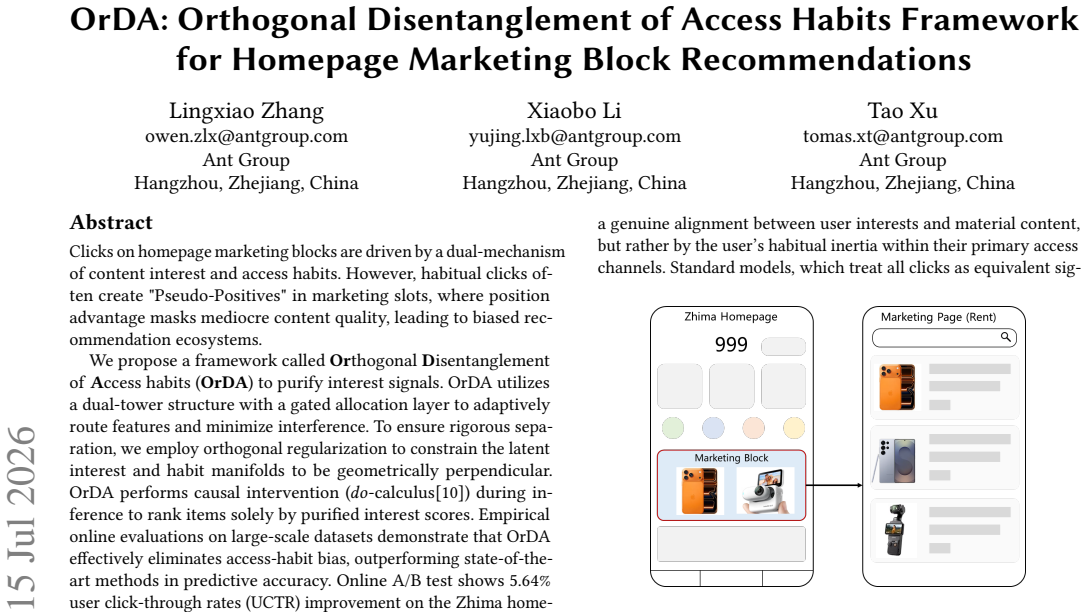
Clicks on homepage marketing blocks are driven by a dual-mechanism of content interest and access habits. However, habitual clicks often create Pseudo-Positives in marketing slots, where position advantage masks mediocre content quality, leading to biased recommendation ecosystems. We propose a framework called Orthogonal Disentanglement of Access habits (OrDA) to purify interest signals. OrDA utilizes a dual-tower structure with a gated allocation layer to adaptively route features and minimize interference. To ensure rigorous separation, we employ orthogonal regularization to constrain the latent interest and habit manifolds to be geometrically perpendicular. OrDA performs causal intervention (do-calculus) during inference to rank items solely by purified interest scores. Empirical online evaluations on large-scale datasets demonstrate that OrDA effectively eliminates access-habit bias, outperforming state-of-the-art methods in predictive accuracy. Online AB test 5.64% shows user click-through rates (UCTR) improvement on the Zhima homepage marketing block, Zhima rent-floor recommendation.
Figures


Figures from the paper (1 more)

Reference graph
Works this paper leans on
-
[1]
Konstantinos Bousmalis, George Trigeorgis, Nathan Silberman, Dilip Krishnan, and Dumitru Erhan. 2016. Domain separation networks. InProceedings of the 30th International Conference on Neural Information Processing Systems (NIPS’16). 343 – 351
2016
-
[2]
Jiawei Chen, Hande Dong, Xiang Wang, Fuli Feng, Meng Wang, and Xiangnan He
-
[3]
Huifeng Guo, Jinkai Yu, Qing Liu, Ruiming Tang, and Yuzhou Zhang. 2019. PAL: a position-bias aware learning framework for CTR prediction in live recommender systems. InProceedings of the 13th ACM Conference on Recommender Systems (RecSys ’19). 452–456
2019
-
[4]
Jiahui Huang, Lan Zhang, Junhao Wang, Shanyang Jiang, Dongbo Huang, Cheng Ding, and Lan Xu. 2024. Utilizing Non-click Samples via Semi-supervised Learn- ing for Conversion Rate Prediction. InProceedings of the 18th ACM Conference on Recommender Systems (RecSys ’24). 350–359
2024
-
[5]
2017.Cosine Nor- malization: Using Cosine Similarity Instead of Dot Product in Neural Networks
Chunjie Luo, Jianfeng Zhan, Lei Wang, and Qiang Yang. 2017.Cosine Nor- malization: Using Cosine Similarity Instead of Dot Product in Neural Networks. arXiv:1702.05870 [cs.LG]
arXiv 2017
-
[6]
Jiaqi Ma, Zhe Zhao, Xinyang Yi, Jilin Chen, Lichan Hong, and Ed H. Chi. 2018. Modeling Task Relationships in Multi-task Learning with Multi-gate Mixture- of-Experts. InProceedings of the 24th ACM SIGKDD International Conference on Knowledge Discovery & Data Mining (KDD ’18). 1930–1939
2018
-
[7]
Xiao Ma, Liqin Zhao, Guan Huang, Zhi Wang, Zelin Hu Ram, Xiaoqiang Zhu, and Kun Gai. 2018. Entire Space Multi-Task Model: An Effective Approach for Estimating Post-Click Conversion Rate. InProceedings of the 41th International ACM SIGIR Conference on Research and Development in Information Retrieval (SIGIR ’18). 1137–1140
2018
-
[8]
Tobias Schnabel, Adith Swaminathan, Ashudeep Singh, Navin Chandak, and Thorsten Joachims. 2016. Recommendations as treatments: Debiasing learning and evaluation.. InProceedings of the 33rd International Conference on International Conference on Machine Learning (ICML’16). 1670–1679
2016
Show all 20 references
-
[9]
Hongyan Tang, Junning Liu, Ming Zhao, and Xudong Gong. 2020. Progres- sive Layered Extraction (PLE): A Novel Multi-Task Learning (MTL) Model for Personalized Recommendations. InProceedings of the 14th ACM Conference on Recommender Systems (RecSys’20). 269–278
2020
-
[10]
Robert R. Tucci. 2013.Introduction to Judea Pearl’s Do-Calculus. arXiv:1305.5506 [cs.AI]
2013 arXiv
-
[11]
Hao Wang, Tai-Wei Chang, Tianqiao Liu, Jianmin Huang, Zhichao Chen, Chao Yu, Ruopeng Li, and Wei Chu. 2022. ESCM2: Entire Space Counterfactual Multi- Task Model for Post-Click Conversion Rate Estimation. InProceedings of the 45th International ACM SIGIR Conference on Research ...
2022
-
[12]
Xiaojie Wang, Rui Zhang, Yu Sun, and Jianzhong Qi. 2019. Doubly Robust Joint Learning for Recommendation on Data Missing Not at Random. InProceedings of the 36th International Conference on Machine Learning (ICML’19). 6638–6647
2019
-
[13]
Zhiqiang Wang, Qingyun She, and Junlin Zhang. 2021. MaskNet: Introducing Feature-Wise Multiplication to CTR Ranking Models by Instance-Guided Mask. InProceedings of DLP-KDD 2021
2021
-
[14]
Wenhao Zhang, Wentian Bao, Xiao-Yang Liu, Keping Yang, Quan Lin, Hong Wen, and Ramin Ramezani. 2020. Large-scale Causal Approaches to Debiasing Post-click Conversion Rate Estimation with Multi-task Learning. InProceedings of the Web Conference 2020 (WWW ’20). 2775–2781
2020
-
[15]
Jiaqi Zheng, Cheng Guo, Yi Cao, Chaoqun Hou, Tong Liu, and Bo Zheng. 2025. USD: A User-Intent-Driven Sampling and Dual-Debiasing Framework for Large- Scale Homepage Recommendations. InProceedings of the Nineteenth ACM Con- ference on Recommender Systems (ReSys ’25). 1108–1111
2025
-
[16]
Yu Zheng, Chen Gao, Xiang Li, Xiangnan He, Depeng Jin, and Yong Li. 2021. Disentangling User Interest and Conformity for Recommendation with Causal Embedding. InProceedings of the Web Conference 2021 (WWW ’21). 2980–2991
2021
-
[17]
Yu Zheng, Chen Gao, Xiang Li, Xiangnan He, Yong Li, and Depeng Jin. 2021. Disentangling User Interest and Conformity for Recommendation with Causal Embedding. InProceedings of the Web Conference 2021 (WWW ’21). 2980–2991
2021
-
[18]
Guorui Zhou, Xiaoqiang Zhu, Chenru Song, Ying Fan, Han Zhu, Xiao Ma, Yanghui Yan, Junqi Jin, Han Li, and Kun Gai. 2018. Deep Interest Network for ClickThrough Rate Prediction. InProceedings of the 24th ACM SIGKDD International Conference on Knowledge Discovery & Data Mining (S...
2018
-
[19]
Feng Zhu, Mingjie Zhong, Xinxing Yang, Longfei Li, Lu Yu, Tiehua Zhang, Jun Zhou, Chaochao Chen, Fei Wu, Guanfeng Liu, and Yan Wang. 2023. DCMT: A Direct Entire-Space Causal Multi-Task Framework for Post-Click Conversion Estimation. InProceedings of the 39th IEEE International...
2023
-
[2023]
ACM Transactions on Information Systems41, 67 (Feb
Bias and Debias in Recommender System: A Survey and Future Directions. ACM Transactions on Information Systems41, 67 (Feb. 2023), 1–39. doi:10.1145/ 3564284
2023
Reviewed August 2, 2026 · model on record in the stance chip above.
Discussion (0). Continue with ORCID to comment.