An agitated oscillator chain
Pith reviewed 2026-05-19 18:37 UTC · model grok-4.3
The pith
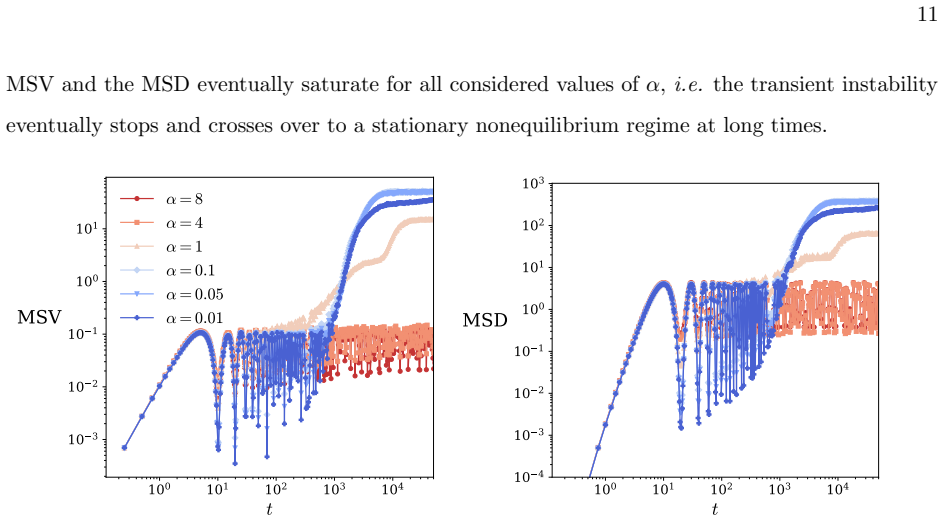
Coupling a harmonic oscillator chain to run-and-tumble particles creates self-sustained fluctuations with many-body Rayleigh-like dynamics.
A machine-rendered reading of the paper's core claim, the machinery that carries it, and where it could break.
Core claim
Assuming time-scale separation, the induced Langevin chain dynamics has explicit expressions for the streaming term, friction coefficient, and noise amplitude. At high persistence of the run-and-tumble particle bath, the linear friction turns negative, creating an instability that is arrested at long times due to nonlinear effects, reminiscent of a Rayleigh oscillator. Thus a passive harmonic chain can be transformed by its coupling to active matter into a self-sustained fluctuating medium with many-body Rayleigh-like dynamics, resulting in pulsations of the displacements, spatial oscillations, and the emergence of persistence in velocities along the chain.
What carries the argument
The induced Langevin dynamics for the oscillator chain, with a friction coefficient that becomes negative at high bath persistence, leading to anti-damping stabilized by nonlinear terms into Rayleigh-like behavior.
If this is right
- The linear friction turns negative at high persistence, creating an instability in the chain.
- Nonlinear effects arrest the anti-damping at long times.
- Pulsations of the displacements emerge in the chain.
- Spatial oscillations appear along the chain.
- Persistence develops in the velocities of the oscillators.
Where Pith is reading between the lines
- Similar couplings might produce self-sustained behaviors when other passive systems interact with active baths.
- Velocity autocorrelation functions could be measured in experiments to detect the predicted persistence.
- The mechanism offers a route to design active metamaterials from passive oscillator networks.
Load-bearing premise
The derivation assumes time-scale separation between the fast run-and-tumble particle bath and the slower oscillator chain to allow explicit averaging.
What would settle it
If simulations or experiments show that the effective friction remains positive even at high persistence of the run-and-tumble particles, or if no pulsations and velocity persistence develop, the claim of many-body Rayleigh-like dynamics would be falsified.
Figures




read the original abstract
We study how the stationary dynamics of an oscillator chain is modified when coupled to a bath of run-and-tumble particles. First, assuming time-scale separation, we derive the induced Langevin chain dynamics with explicit expressions for the streaming term, friction coefficient, and noise amplitude. At high persistence of the run-and-tumble particle bath, the linear friction turns negative, creating an instability. Second, we find that this anti-damping is arrested at long times due to nonlinear effects, reminiscent of a Rayleigh oscillator. We conclude that a passive harmonic chain can be transformed by its coupling to active matter into a self-sustained fluctuating medium with many-body Rayleigh-like dynamics. That transfer of activity results in pulsations of the displacements, spatial oscillations, and the emergence of persistence in velocities along the chain.
Editorial analysis
A structured set of objections, weighed in public.
Referee Report
Summary. The paper studies a harmonic oscillator chain coupled to a bath of run-and-tumble particles. Assuming time-scale separation, it derives an effective Langevin description for the chain with explicit expressions for a streaming term, friction coefficient, and noise amplitude obtained by averaging over the bath. At high bath persistence the linear friction becomes negative, producing an instability that is arrested by nonlinear effects, yielding self-sustained pulsations, spatial oscillations, and velocity persistence reminiscent of many-body Rayleigh dynamics.
Significance. If the central derivation holds, the work supplies a parameter-free route by which activity in a run-and-tumble bath is transferred to a passive oscillator chain, converting it into a fluctuating medium with emergent Rayleigh-like arrest and collective persistence. The explicit, closed-form expressions for the induced friction and noise constitute a concrete strength that could be tested against simulations or extended to other active baths.
major comments (1)
- [§2] §2 (derivation of the effective Langevin chain): the time-scale separation assumption used to perform the bath averaging is least secure precisely in the high-persistence regime where the friction coefficient changes sign and becomes negative. In that regime the oscillator growth or oscillation times set by |γ| can become comparable to the bath persistence time, undermining the separation invoked to close the averaging step and obtain the Rayleigh-like arrest.
minor comments (1)
- [Abstract] The abstract and introduction would benefit from a brief statement of the range of persistence times over which the derived friction remains valid before the separation assumption is expected to fail.
Simulated Author's Rebuttal
We thank the referee for their careful reading and constructive comments. We address the major comment on the time-scale separation assumption below.
read point-by-point responses
-
Referee: [§2] §2 (derivation of the effective Langevin chain): the time-scale separation assumption used to perform the bath averaging is least secure precisely in the high-persistence regime where the friction coefficient changes sign and becomes negative. In that regime the oscillator growth or oscillation times set by |γ| can become comparable to the bath persistence time, undermining the separation invoked to close the averaging step and obtain the Rayleigh-like arrest.
Authors: We agree that the time-scale separation assumption is most vulnerable precisely in the high-persistence regime where the effective friction γ changes sign. The derivation in §2 closes the bath average under the assumption that bath relaxation is fast relative to the oscillator dynamics, which yields the explicit expressions for the streaming term, γ, and noise. When |γ| becomes appreciable, the instability growth time 1/|γ| can approach the bath persistence time, so the separation is only marginal and the effective equation is an approximation. Nevertheless, the sign change in γ itself is a direct consequence of the averaging and correctly signals the onset of activity-induced instability; the subsequent nonlinear arrest into Rayleigh-like pulsations follows from the structure of the effective equation. We will revise §2 to state the validity condition explicitly (e.g., |γ|τ ≪ 1 with τ the bath persistence time) and to note the approximate character of the description in the strongly unstable regime. revision: yes
Circularity Check
No circularity; effective Langevin derived explicitly from bath averaging under stated separation
full rationale
The paper assumes time-scale separation to perform explicit averaging over the run-and-tumble bath statistics, yielding closed-form expressions for the streaming term, friction coefficient, and noise amplitude in the oscillator chain's Langevin dynamics. These derived coefficients are then inspected to reveal a sign change in friction at high bath persistence, with subsequent nonlinear analysis showing saturation into Rayleigh-like behavior. No load-bearing step reduces a claimed prediction or result to a fitted parameter, self-definition, or self-citation chain inside the paper; the central many-body dynamics follow directly from the averaged equations without circular reduction to the inputs.
Axiom & Free-Parameter Ledger
axioms (1)
- domain assumption Time-scale separation between the fast run-and-tumble bath and the slower oscillator chain
Reference graph
Works this paper leans on
-
[1]
G. A. van Lear and G. E. Uhlenbeck. The Brownian Motion of Strings and Elastic Rods.Phys. Rev., 38:1583–1598, 1931
work page 1931
-
[2]
D. R. Nelson, T. Piran, and S. Weinberg, editors.Statistical Mechanics of Membranes and Surfaces. World Scientific, 2004
work page 2004
-
[3]
C. Monzel and K. Sengupta. Measuring shape fluctuations in biological membranes.J. Phys. D: Appl. Phys., 49(24):243002, 2016. 18
work page 2016
-
[4]
C. Rovelli. General relativistic statistical mechanics.Phys. Rev. D, 87(8), 2013
work page 2013
-
[5]
A. G. Zilman and R. Granek. Undulations and Dynamic Structure Factor of Membranes.Phys. Rev. Lett., 77:4788–4791, 1996
work page 1996
-
[6]
E. Cerda and L. Mahadevan. Geometry and physics of wrinkling.Phys. Rev. Lett., 90:074302, 2003
work page 2003
-
[7]
M. C. Cross and P. C. Hohenberg. Pattern formation outside of equilibrium.Rev. Mod. Phys., 65:851– 1112, 1993
work page 1993
-
[8]
J. H.-C. Wang and B. P. Thampatty. An Introductory Review of Cell Mechanobiology.Biomech. Model. Mechanobiol., 5(1):1–16, 2006
work page 2006
-
[9]
B. L. Hu and E. Verdaguer. Stochastic Gravity: Theory and Applications.Living Rev. Relativ., 11(1), 2008
work page 2008
-
[10]
The National Academies Press, Washington, DC, 2022
National Academies of Sciences, Engineering, and Medicine.Physics of Life: A Decadal Survey for Biological Physics. The National Academies Press, Washington, DC, 2022
work page 2022
-
[11]
J. Tailleur, G. Gompper, M. C. Marchetti, J. M. Yeomans, and C. Salomon.Active Matter and Nonequilibrium Statistical Physics: Lecture Notes of the Les Houches Summer School: Volume 112, September 2018. Oxford University Press, 11 2022
work page 2018
- [12]
- [13]
- [14]
-
[15]
D. A. King, T. P. Russell, and A. K. Omar. Active Particles Destabilize Passive Membranes, 2026. arXiv:2601.16430 [cond-mat.soft]
work page internal anchor Pith review arXiv 2026
- [16]
-
[17]
Cagnetta, F.and ˇSkult´ ety, M
V. Cagnetta, F.and ˇSkult´ ety, M. R. Evans, and D. Marenduzzo. Universal properties of active mem- branes.Phys. Rev. E, 105:L012604, 2022
work page 2022
-
[18]
H. Vandebroek and C. Vanderzande. Dynamics of a polymer in an active and viscoelastic bath.Phys. Rev. E, 92:060601, 2015
work page 2015
-
[19]
C. J. Anderson, G. Briand, O. Dauchot, and A. Fern´ andez-Nieves. Polymer-chain configurations in active and passive baths.Phys. Rev. E, 106(6-1):064606, 2022
work page 2022
-
[20]
A. Kaiser and H. L¨ owen. Unusual swelling of a polymer in a bacterial bath.J. Chem. Phys., 141(4), 2014
work page 2014
-
[21]
F. Cagnetta, M. R. Evans, and D. Marenduzzo. Statistical mechanics of a single active slider on a fluctuating interface.Phys. Rev. E, 99(4), 2019
work page 2019
-
[22]
P. Bisht and M. Barma. Interface growth driven by a single active particle.Phys. Rev. E, 100(5), 2019. 19
work page 2019
-
[23]
D. Jana, A. Haldar, and A. Basu. Logarithmic or algebraic: Roughening of an active Kardar-Parisi- Zhang surface.Phys. Rev. E, 109(3), 2024
work page 2024
- [24]
-
[25]
G. Wang, T. V. Phan, S. Li, M. Wombacher, J. Qu, Y. Peng, G. Chen, D. I. Goldman, S. A. Levin, R. H. Austin, and L. Liu. Emergent Field-Driven Robot Swarm States.Phys. Rev. Lett., 126:108002, 2021
work page 2021
-
[26]
T. V. Phan, G. Wang, L. Liu, and R. H. Austin. Bootstrapped Motion of an Agent on an Adaptive Resource Landscape.Symmetry, 13(2), 2021
work page 2021
-
[27]
V. D´ emery and A. Gambassi. Non-Gaussian fluctuations of a probe coupled to a Gaussian field.Phys. Rev. E, 108(4), 2023
work page 2023
-
[28]
D. Venturelli, F. Ferraro, and A. Gambassi. Nonequilibrium relaxation of a trapped particle in a near-critical Gaussian field.Phys. Rev. E, 105(5), 2022
work page 2022
-
[29]
E. Reister-Gottfried, S. M. Leitenberger, and U. Seifert. Diffusing proteins on a fluctuating membrane: Analytical theory and simulations.Phys. Rev. E, 81:031903, 2010
work page 2010
-
[30]
M. Gopalakrishnan. Dynamics of a passive sliding particle on a randomly fluctuating surface.Phys. Rev. E, 69(1), 2004
work page 2004
-
[31]
A. H. Bialus, B. Rallabandi, and N. Oppenheimer. Enhancement and suppression of active particle movement due to membrane deformations.J. Fluid Mech., 1024:A42, 2025
work page 2025
-
[32]
C. Maes. Response Theory: A Trajectory-Based Approach.Front. Phys., 8, 2020
work page 2020
- [33]
-
[34]
T. Demaerel and C. Maes. Active processes in one dimension.Phys. Rev. E, 97:032604, 2018
work page 2018
-
[35]
I. Santra. Dynamical fluctuations of a tracer coupled to active and passive particles.JPhys.: Complexity, 4(1):015013, 2023
work page 2023
-
[36]
Tracer dynamics in an interacting active bath: fluctuations and energy partition
R Sarkar and I Santra. Tracer dynamics in an interacting active bath: fluctuations and energy partition. New Journal of Physics, 27(9):094601, 2025
work page 2025
-
[37]
A. Dhar, A. Kundu, S. N. Majumdar, S. Sabhapandit, and G. Schehr. Run-and-tumble particle in one-dimensional confining potentials: Steady-state, relaxation, and first-passage properties.Phys. Rev. E, 99:032132, 2019
work page 2019
- [38]
-
[39]
J. Tailleur and M. E. Cates. Statistical Mechanics of Interacting Run-and-Tumble Bacteria.Phys. Rev. Lett., 100(21), 2008
work page 2008
- [40]
-
[41]
C. Maes. Response Theory: A Trajectory-Based Approach.Front. Phys., 8, 2020. 20
work page 2020
-
[42]
R. Zwanzig. Ensemble Method in the Theory of Irreversibility.J. Chem. Phys., 33(5):1338–1341, 1960
work page 1960
- [43]
- [44]
-
[45]
J. W. Strutt (3rd Baron Rayleigh). XXXIII. On maintained vibrations.Philos. Mag., 15(94):229–235, 1883
-
[46]
L. Y. Chen, N. Goldenfeld, and Y. Oono. Renormalization Group Theory for Global Asymptotic Analysis.Phys. Rev. Lett., 73(10):1311–1315, 1994
work page 1994
-
[47]
L. B. Arosh, M. C. Cross, and R. Lifshitz. Quantum limit cycles and the Rayleigh and van der Pol oscillators.Phys. Rev. Res., 3:013130, 2021
work page 2021
-
[48]
Kardar.Statistical Physics of Fields
M. Kardar.Statistical Physics of Fields. Cambridge University Press, 2007
work page 2007
-
[49]
Zinn-Justin.Quantum Field Theory and Critical Phenomena
J. Zinn-Justin.Quantum Field Theory and Critical Phenomena. International series of monographs on physics. Oxford University Press, 2021
work page 2021
-
[50]
Padmanabhan.Gravitation: Foundations and Frontiers
T. Padmanabhan.Gravitation: Foundations and Frontiers. Cambridge University Press, 2010
work page 2010
-
[51]
A. Passegger and R. Verch. Probing Non-equilibrium Steady States of the Klein–Gordon Field with Unruh–DeWitt Detectors.Ann. Henri Poincar´ e, 2025
work page 2025
-
[52]
J. Doukas, S.-Y. Lin, B. L. Hu, and R. B. Mann. Unruh effect under non-equilibrium conditions: oscillatory motion of an Unruh-DeWitt detector.JHEP, 2013(11), 2013
work page 2013
- [53]
-
[54]
Negative Differential Heat Conductivity in a Harmonic Chain Coupled to a Particle Reservoir
S. Krekels, C. Maes, I. Santra, and R. Zhai. Negative Differential Heat Conductivity in a Harmonic Chain Coupled to a Particle Reservoir, 2026. arXiv:2604.00777 [cond-mat.stat-mech]
work page internal anchor Pith review Pith/arXiv arXiv 2026
-
[55]
M. Gautama, F. Khodabandehlou, C. Maes, and I. Santra. Specific heat of thermally driven chains,
-
[56]
arXiv:2604.14056 [cond-mat.stat-mech]
work page internal anchor Pith review Pith/arXiv arXiv
- [57]
-
[58]
H. Mori. Statistical-Mechanical Theory of Transport in Fluids.Phys. Rev., 112:1829–1842, 1958
work page 1958
-
[59]
H. Mori. Transport, Collective Motion, and Brownian Motion.Prog. Theor. Phys., 33(3):423–455, 03 1965
work page 1965
-
[60]
Grabert.Projection Operator Techniques in Nonequilibrium Statistical Mechanics
H. Grabert.Projection Operator Techniques in Nonequilibrium Statistical Mechanics. Communications and Control Engineering. Springer-Verlag, 1982
work page 1982
-
[61]
C. Maes. Frenesy: Time-Symmetric Dynamical Activity in Nonequilibria.Phys. Rep., 850:1–33, 2020
work page 2020
- [62]
- [63]
-
[64]
Y. Nakayama, K. Kawaguchi, and N. Nakagawa. Unattainability of Carnot efficiency in thermal motors: Coarse graining and entropy production of Feynman-Smoluchowski ratchets.Phys. Rev. E, 98(2), 2018
work page 2018
-
[65]
M. M. Dygas, B. J. Matkowsky, and Z. Schuss. A singular perturbation approach to non-Markovian escape rate problems with state dependent friction.J. Chem. Phys., 84(7):3731–3738, 1986
work page 1986
-
[66]
A. N. Tikhonov. Systems of differential equations containing small parameters in the derivatives.Mat. Sb., 31 (73)(3):575–586, 1952. in Russian
work page 1952
-
[67]
S. A. Lomov.Introduction to the General Theory of Singular Perturbations, volume 112 ofTranslations of Mathematical Monographs. American Mathematical Society, Providence, RI, 1992
work page 1992
-
[68]
I. Bena, C. Van den Broeck, R. Kawai, and Katja Lindenberg. Drift by dichotomous Markov noise. Phys. Rev. E, 68(4), 2003
work page 2003
-
[69]
N. G. Van Kampen.Stochastic Processes in Physics and Chemistry. North Holland, 3rd edition, 2007
work page 2007
-
[70]
Balakrishnan.Elements of Nonequilibrium Statistical Mechanics
V. Balakrishnan.Elements of Nonequilibrium Statistical Mechanics. Springer International Publishing, 2020
work page 2020
-
[71]
C. Maes. On the Second Fluctuation-Dissipation Theorem for Nonequilibrium Baths.J. Stat. Phys., 154(3):705–722, 2014
work page 2014
-
[72]
H. P. Breuer and F. Petruccione.The theory of open quantum systems. Oxford University Press, Great Clarendon Street, 2002
work page 2002
-
[73]
W.L. Briggs and V.E. Henson.The DFT: An Owners’ Manual for the Discrete Fourier Transform. Other Titles in Applied Mathematics. Society for Industrial and Applied Mathematics, 1995
work page 1995
-
[74]
U. Basu, S. N. Majumdar, A. Rosso, and G. Schehr. Long-time position distribution of an active Brownian particle in two dimensions.Phys. Rev. E, 100(6), 2019
work page 2019
-
[75]
L. Landau and E. Lifshitz.Statistical Physics: Volume 5, Part 1. Course of Theoretical Physics. Butterworth-Heinemann, Oxford, 3rd edition, 1980
work page 1980
- [76]
- [77]
-
[78]
A. Dhar. Heat conduction in the disordered harmonic chain revisited.Physical Review Letters, 86(26):5882, 2001
work page 2001
-
[79]
Watson.A Treatise on the Theory of Bessel Functions
G.N. Watson.A Treatise on the Theory of Bessel Functions. Cambridge Mathematical Library. Cam- bridge University Press, 1995. 22 Appendix A. Time scale separation We study the different scales in the forward generatorL † of the full system, which appears in the Fokker-Planck equation for the dynamics (4a)–(4b), ∂ρtot ∂t (q, p, ⃗ z, ⃗ σ) =L†ρtot(q, p, z, σ...
work page 1995
-
[80]
Streaming term In this section, we compute the streaming term ¯F(q) in (6): ζ ¯F(q) =ζN I dz F(r j −z) X σ=±1 ρq(z, σ) =ζN I dz F(r j −z)P q(z) (C1) Equation (B1) can be substituted in (C1), but the resulting integrals do not reduce to a simple or manageable form. Instead, for weak couplingζ≪1, we use the form (B4) ζ ¯F(q) =ζ N L I dx F(x)−ζ 2N βeff n−1X ...
discussion (0)
Sign in with ORCID, Apple, or X to comment. Anyone can read and Pith papers without signing in.