REVIEW 4 major objections 5 minor 1 cited by
WavePulse: Real-time Content Analytics of Radio Livestreams
T0 review · 4 major / 5 minor · reviewed 2026-08-11 · deepseek-v4-flash
Pith's one-line read Radio analytics pipeline transcribes 500,000 hours of U.S. airwaves
desk verdict A substantial radio-monitoring system and dataset whose headline analytical claims outpace their validation; the systems contribution deserves publication, but the narrative and sentiment findings need validation against human ground truth. read the letter →
The pith
A machine-rendered reading of the paper's core claim, the machinery that carries it, and where it could break.
The reading
What carries the argument
The load-bearing machinery is a staged audio-to-analytics pipeline. Live streams are recorded as 30-minute MP3 chunks; WhisperX (Whisper-large-v3 with PyAnnote speaker diarization) converts each chunk into timestamped, speaker-indexed JSON segments; Gemini-1.5-Flash labels each segment as political, apolitical, or advertisement and writes a distilled summary of each 30-minute transcript; BGE-M3 embeds the summaries into a 1024-dimensional FAISS index that Llama-3.1-8B-Instruct queries in a retrieval-augmented generation setup. For syndication, MinHash locality-sensitive hashing with a Jaccard similarity threshold of 0.8, followed by breadth-first search, groups identical broadcasts into a radio-station network. The summaries, embeddings, and retrieval together are what make the corpus searchable and the case-study numbers computable.
What would settle it
Pick a random sample of raw transcripts, have human readers mark every mention that claims the 2020 election was stolen and whether the broadcast promotes, reports, or debunks it, then run the automated counter on the summaries of those same transcripts. If the two counts disagree enough to change the published 10.4% promoting share, the narrative case study is not reliable.
Extended reading notes
Core claim
WavePulse demonstrates that a corpus of livestreamed radio can be captured, transcribed, diarized, summarized, and queried at national scale, and that the corpus supports content analytics that were previously impractical. In the pilot deployment, 396 AM/FM streams across all 50 states were recorded in 30-minute chunks from late June to early October 2024, yielding 970,181 raw transcripts, 329 million text segments, and about 4.5 billion words. After summarization with Gemini, a question-answering retrieval pipeline using BGE-M3 embeddings and Llama-3.1-8B-Instruct found 3,497 mentions of the claim that the 2020 election was stolen, with stance shares of 51.0% neutral reporting, 36.3% debunking, and 10.4% promoting. A MinHash-based syndication analysis found 1,776 subgroups and 2,684 station-pair edges, and a Twitter-domain sentiment model produced daily candidate scores that follow the shape of national polling averages. The paper argues that these results establish WavePulse's efficacy as a real-time radio content analytics system.
Load-bearing premise
The automated mention counts, stance shares, and sentiment scores all run on machine-written summaries of each half-hour transcript, not on the raw wording, and the 53 transcripts that humans checked were never used to verify those machine counts.
Editorial extensions
If this is right
- If the pipeline holds up, researchers can track a specific claim, rumor, or talking point across hundreds of stations without writing keyword rules by hand.
- The released dataset gives political scientists and media researchers a timestamped, speaker-diarized, state-labeled corpus covering a 100-day period around the 2024 U.S. election.
- The syndication graph provides a way to study media echo chambers and coordinated messaging among formally independent stations.
- Passive radio sentiment, if it continues to track polling, offers a high-frequency supplement to opinion polls between survey waves.
- The same pipeline can be pointed at other station sets or dates, since station URLs and schedules are configuration inputs.
Reading between the lines
- I would read the 3,497 automated mentions and the 53 human-verified transcripts as two separate results: the human set shows the narrative existed on the air, but it does not validate the LLM counts, so the 51/36/10 breakdown should be treated as provisional until raw transcripts are spot-checked.
- If summarization is the bottleneck, the pipeline's claim counts could be improved by running the mention and stance prompts on raw segments rather than Gemini summaries, or by training a small classifier on human-annotated raw transcripts.
- The sentiment curve resembles the polling curve, but the sentiment model was trained on Twitter text, and applying it to radio speech transcripts is a domain shift that should be tested on a labeled radio sample before the score is used as a polling proxy.
- The same architecture could be extended to non-English radio because the transcription and summarization models are multilingual, which would test whether the scale claims generalize beyond U.S. talk radio.
Signed reviews
Editorial analysis
A structured set of objections, weighed in public.
Referee Report
Summary. The paper presents WavePulse, an end-to-end system that records web-accessible AM/FM radio livestreams, transcribes them with WhisperX, diarizes speakers, classifies content as political/apolitical/advertisement, summarizes transcripts with Gemini, embeds them with BGE-M3, and enables semantic search and downstream analytics. The pilot deployment monitors 396 U.S. stations over 100 days, producing roughly 485,000 hours of audio, 329 million text segments, and about 4.5 billion words, with the promised dataset and code released at wave-pulse.io. The paper reports three case studies: tracking a specific 2020 election narrative, constructing a radio syndication network via MinHash similarity, and deriving candidate sentiment time series that the authors claim mirror national polling trends. The central contribution is the integrated pipeline plus the large-scale timestamped, diarized transcript corpus.
Significance. If the pipeline and corpus are as described, WavePulse is a genuinely useful resource for media and political communication research: it addresses an under-studied corner of the web, offers a reproducible system with explicit deployment details, and releases a very large public dataset. The paper also has concrete strengths: it reports comparative ASR timing and WER measurements, gives full prompts in the appendix, documents resource usage and costs, and provides an interactive website. However, the headline analytical claims—the 3,497-narrative count and stance distribution, the syndication network findings, and the sentiment-versus-polling mirroring—are not yet validated to the level required for those claims to be load-bearing. The most significant gap is that all automated narrative and sentiment measurements are computed on Gemini-generated summaries, and the only human-labeled transcripts are never used to verify that the summaries preserve the claim-relevant content or that the LLM-based downstream counts are accurate.
major comments (4)
- [§3.1 and Appendix A.2] The automated narrative count of 3,497 mentions and the stance distribution (51.0% neutral, 36.3% debunking, 10.4% promoting) are computed by prompting Llama-3.1-8B on Gemini summaries of 30-minute transcripts, but the paper never validates that these summaries preserve the claim-relevant statements of the original transcripts. The 53 human-labeled ground-truth transcripts produced in the manual methodology are not used to measure the precision or recall of the automated mention counting or stance labeling. Without such an evaluation, the headline finding could reflect summarization or LLM bias rather than properties of radio content. I ask the authors to report precision, recall, and stance agreement of the automated pipeline against the 53 human-labeled transcripts, and to add a summary-faithfulness check (e.g., what fraction of original claim-bearing sentences survive summarization).
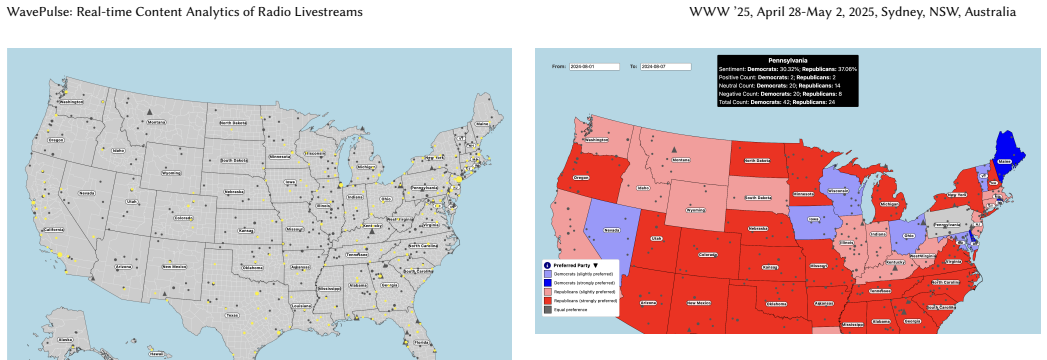
- [§3.3] The claim that WavePulse sentiment scores 'mirror national polling trends' is supported only by visual inspection of Figure 6; no quantitative correlation, error metric, or statistical test is provided. Moreover, the sentiment scores are produced by a Twitter-domain roBERTa model applied to keyword-filtered segments of Gemini summaries, so both domain mismatch and summary distortion can affect the result. The authors should add a time-series correlation analysis (e.g., daily or weekly Pearson/Spearman correlation, cross-correlation at relevant lags, or RMSE between normalized sentiment and polling averages), and should at least report a small human or domain-adaptation evaluation of the sentiment model on radio-summarized text. Without this, the 'supplementary tool for tracking public opinion' claim is not established.
- [§2.2, Table 1] The reported WER of 8.4% for WhisperX is measured with Microsoft Azure as the 'ground truth' rather than against human reference transcripts. ASR evaluation against another ASR system measures agreement, not word error rate, and the true error rate against human transcripts could be materially different. The authors should either report WER on a human-transcribed subset (even a small one) or explicitly relabel the metric as ASR agreement and temper the associated quality claims.
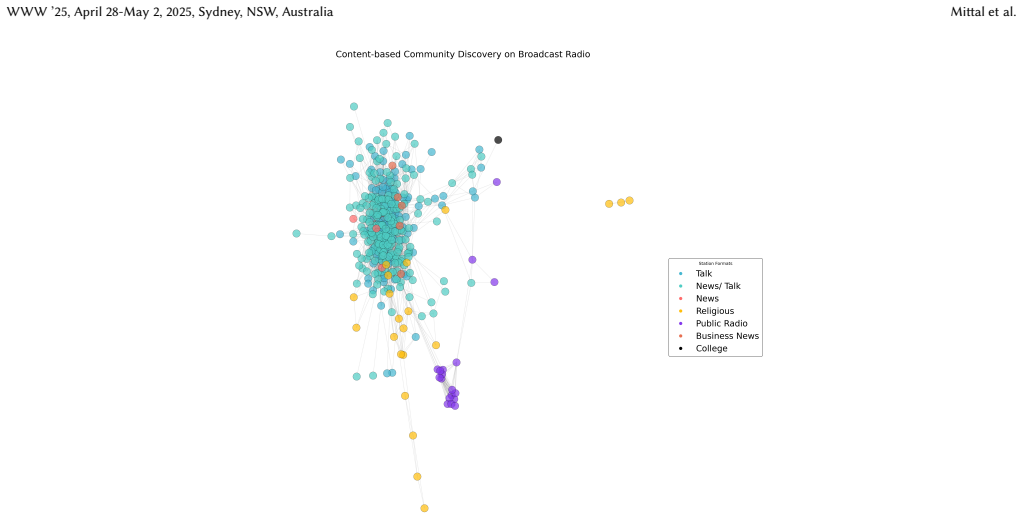
- [§3.2] The 'validation' of the syndication network via Louvain community detection is qualitative: the paper states that coloring by station format reveals 'distinct clustering patterns' but gives no quantitative evaluation of community-format correspondence, and the construction depends on heuristics (θ = 0.8, the refinement steps in §3.2) whose sensitivity is not examined. I recommend reporting a quantitative cluster-quality or format-purity metric and a sensitivity analysis over the similarity threshold and refinement choices, so the syndication network can be assessed as more than an illustrative artifact.
minor comments (5)
- [Abstract vs. Related Work] The abstract and Section 4 report the WhisperX WER as 8.4% and 8.3%, respectively; these numbers should be reconciled.
- [Appendix A.1] There is a typo, 'corn trigger,' that should read 'cron trigger.'
- [Table 4] The station location 'Presott, AZ' appears to be a typo for 'Prescott, AZ.'
- [§3.1] The manual methodology says 120 samples were split into four overlapping sets and aggregated into 53 ground-truth transcripts, but the paper does not report inter-annotator agreement; adding Cohen's kappa or a similar statistic would strengthen the manual ground truth.
- [§3.3] The description of the sentiment score would benefit from noting that the score is a weighted average on a 0–1 scale and from stating explicitly how neutral mentions are handled in the denominator; the current formula is clear but the text around it is terse.
Circularity Check
No significant circularity: all three case-study outputs are compared against external quantities, and the acknowledged limitations are validation gaps rather than circular reductions.
full rationale
The paper's central outputs are not defined in terms of the targets they are compared with. In Sec. 3.3, the normalized sentiment score is fixed before any comparison: S_bar = (2*S_plus + 1*S_neutral + 0*S_minus) / (2*S_T); the 'mirroring' of polling averages is a visual external comparison, and no parameter is fitted to polling data, so the claim is not a fitted prediction. In Sec. 3.1, the automated mention count and stance mix are produced by prompting Llama-3.1-8B on Gemini summaries, and the 53 human-labeled transcripts are never used to calibrate those counts; the paper explicitly says the retrieval mechanism 'did not have a ground truth to compare it against.' That is a validation gap, not a circular reduction, because the automated outputs are not constructed from the human labels. In Sec. 3.2, the syndication network is built from MinHash/Jaccard content similarity, and the Louvain community check uses format labels only afterward as an external consistency check; although weak, this does not define the network in terms of the format labels. The only self-citation is a related-work reference [2] involving co-author Sarthak Gupta, and it is not load-bearing. No self-definitional equation, fitted-parameter-as-prediction, imported uniqueness theorem, or ansatz-via-citation chain is present.
Assumptions & free parameters
free parameters (5)
- MinHash Jaccard similarity threshold theta =
0.8
- Sentiment score weights (w_pos, w_neu, w_neg) =
(2, 1, 0)
- Sentiment smoothing windows =
7-day national, 14-day state
- Keyword rules for manual narrative filtering =
10+ boolean rules, e.g., logic AND accuracy AND test
- ASR evaluation dataset size =
672 clips
assumptions (5)
- domain assumption Microsoft Azure ASR outputs are treated as ground truth for computing WER.
- domain assumption The selected 396 internet-live-streamed stations represent the distribution of U.S. political radio.
- domain assumption Twitter-roBERTa sentiment labels transfer to transcribed radio speech.
- ad hoc to paper Gemini summarization preserves the claims, stances, and sentiment-relevant details of each transcript.
- ad hoc to paper LLM-based stance and mention counts are accurate without precision or recall evaluation.
Cite this review
Pith. "Pith review of WavePulse: Real-time Content Analytics of Radio Livestreams." pith.science (2026). https://pith.science/paper/O3B75RYJ
@misc{pith2026241217998,
  author       = {Pith},
  title        = {Pith review of: WavePulse: Real-time Content Analytics of Radio Livestreams},
  year         = {2026},
  howpublished = {\url{https://pith.science/paper/O3B75RYJ}},
  note         = {Machine review of arXiv:2412.17998}
}
read the original abstract
Radio remains a pervasive medium for mass information dissemination, with AM/FM stations reaching more Americans than either smartphone-based social networking or live television. Increasingly, radio broadcasts are also streamed online and accessed over the Internet. We present WavePulse, a framework that records, documents, and analyzes radio content in real-time. While our framework is generally applicable, we showcase the efficacy of WavePulse in a collaborative project with a team of political scientists focusing on the 2024 Presidential Elections. We use WavePulse to monitor livestreams of 396 news radio stations over a period of three months, processing close to 500,000 hours of audio streams. These streams were converted into time-stamped, diarized transcripts and analyzed to track answer key political science questions at both the national and state levels. Our analysis revealed how local issues interacted with national trends, providing insights into information flow. Our results demonstrate WavePulse's efficacy in capturing and analyzing content from radio livestreams sourced from the Web. Code and dataset can be accessed at \url{https://wave-pulse.io}.
Figures


Figures from the paper (14 more)





Forward citations
Cited by 1 Pith paper
-
Gender Gap Analysis in News and Talk Online Radio Broadcast
Male speakers account for 77% of speaking time on U.S. news and talk radio, with female shares never exceeding 35.8% in any topic and falling to 10.8% in talk-show segments.
Reference graph
Works this paper leans on
- [1]
-
[2]
Television discourse decoded: Comprehensive multimodal analytics at scale
Agarwal, A., Priyadarshi, P., Sinha, S., Gupta, S., Jangra, H., Kumaraguru, P., and Garimella, K. Television discourse decoded: Comprehensive multimodal analytics at scale. In Proceedings of the 30th ACM SIGKDD Conference on Knowl- edge Discovery and Data Mining (New York, NY, USA, 2024), KDD ’24, Association for Computing Machinery, p. 4752–4763
work page 2024
-
[3]
Allen, J., W atts, D. J., and Rand, D. G.Quantifying the impact of misinformation and vaccine-skeptical content on facebook. Science 384, 6699 (2024), eadk3451
work page 2024
-
[4]
Whisperx: Time-accurate speech transcription of long-form audio
Bain, M., Huh, J., Han, T., and Zisserman, A. Whisperx: Time-accurate speech transcription of long-form audio. INTERSPEECH 2023 (2023)
work page 2023
-
[5]
Radiotalk: A large-scale corpus of talk radio transcripts
Beeferman, D., Brannon, W., and Roy, D. Radiotalk: A large-scale corpus of talk radio transcripts. In Interspeech 2019 (2019), pp. 564–568
work page 2019
-
[6]
Berry, J. M., and Sobieraj, S. Understanding the rise of talk radio. PS: Political Science & Politics 44 , 4 (2011), 762–767
work page 2011
-
[7]
D., Guillaume, J.-L., Lambiotte, R., and Lefebvre, E.Fast unfolding of communities in large networks
Blondel, V. D., Guillaume, J.-L., Lambiotte, R., and Lefebvre, E.Fast unfolding of communities in large networks. Journal of statistical mechanics: theory and experiment 2008, 10 (2008), P10008
work page 2008
-
[8]
Brannon, W., and Roy, D.The speed of news in twitter (x) versus radio.Scientific Reports 14, 1 (2024), 11939
work page 2024
Show all 36 references
-
[9]
TweetNLP: Cutting-edge natural language processing for social media
Camacho-collados, J., Rezaee, K., Riahi, T., Ushio, A., Loureiro, D., Antypas, D., Boisson, J., Espinosa Anke, L., et al. TweetNLP: Cutting-edge natural language processing for social media. In Proceedings of the 2022 Conference on Empirical Methods in Natural Language Process...
2022
-
[10]
Bge m3-embedding: Multi-lingual, multi-functionality, multi-granularity text embeddings through self-knowledge distillation, 2024
Chen, J., Xiao, S., Zhang, P., Luo, K., Lian, D., and Liu, Z. Bge m3-embedding: Multi-lingual, multi-functionality, multi-granularity text embeddings through self-knowledge distillation, 2024
2024
-
[11]
Chong, D., and Druckman, J. N. A theory of framing and opinion formation in competitive elite environments. Journal of communication 57 , 1 (2007), 99–118
2007
-
[12]
Activation, conversion, or reinforcement? the impact of partisan news exposure on vote choice
Dilliplane, S. Activation, conversion, or reinforcement? the impact of partisan news exposure on vote choice. American Journal of Political Science 58 , 1 (2014), 79–94
2014
-
[13]
The faiss library
Douze, M., Guzhva, A., Deng, C., Johnson, J., Szilvasy, G., Mazaré, P.-E., Lomeli, M., Hosseini, L., and Jégou, H. The faiss library
-
[14]
Drushel, B. E. The telecommunications act of 1996 and radio market structure. Journal of Media Economics 11 , 3 (1998), 3–20
1998
-
[15]
arXiv preprint arXiv:2407.21783 (2024)
Dubey, A., Jauhri, A., Pandey, A., Kadian, A., Al-Dahle, A., Letman, A., Mathur, A., Schelten, A., Y ang, A., Fan, A., et al.The llama 3 herd of models. arXiv preprint arXiv:2407.21783 (2024)
2024 arXiv
-
[16]
R., Barker, D
Hofstetter, C. R., Barker, D. C., Smith, J. T., Zari, G. M., and Ingrassia, T. A. Information, misinformation, and political talk radio. InRushed to Judgment: Talk Radio, Persuasion, and American Political Behavior . Columbia University Press, 2002, pp. 106–118
2002
-
[17]
R., and Gianos, C
Hofstetter, C. R., and Gianos, C. L. Political talk radio: Actions speak louder than words. Journal of Broadcasting & Electronic Media 41 , 4 (1997), 501–515
1997
-
[18]
M., and Vishak, J
Kim, Y. M., and Vishak, J. Just laugh! you don’t need to remember: The effects of entertainment media on political information acquisition and information processing in political judgment. Journal of communication 58 , 2 (2008), 338–360
2008
-
[19]
Lee, G., and Cappella, J. N. The effects of political talk radio on political attitude formation: Exposure versus knowledge. Political Communication 18 , 4 (2001), 369–394
2001
-
[20]
P., Li, S., Ni, J., and McAuley, J.Interview: Large-scale modeling of media dialog with discourse patterns and knowledge grounding
Majumder, B. P., Li, S., Ni, J., and McAuley, J.Interview: Large-scale modeling of media dialog with discourse patterns and knowledge grounding. InProceedings of the 2020 Conference on Empirical Methods in Natural Language Processing (EMNLP) (Online, Nov. 2020), B. Webber, T. ...
2020
-
[21]
Parakeet-rnnt-1.1b
NVIDIA. Parakeet-rnnt-1.1b. https://huggingface.co/nvidia/parakeet-rnnt-1.1b,
-
[22]
News platform fact sheet, 2024
Pew Research Center. News platform fact sheet, 2024. Accessed October 10, 2024
2024
-
[23]
Powerset multi-class cross entropy loss for neural speaker diarization
Plaqet, A., and Bredin, H. Powerset multi-class cross entropy loss for neural speaker diarization. In Proc. INTERSPEECH 2023 (2023)
2023
-
[24]
arXiv (2023)
Pratap, V., Tjandra, A., Shi, B., Tomasello, P., Babu, A., Kundu, S., Elkahky, A., Ni, Z., Vyas, A., Fazel-Zarandi, M., Baevski, A., Adi, Y., Zhang, X., Hsu, W.-N., Conneau, A., and Auli, M.Scaling speech technology to 1,000+ languages. arXiv (2023)
2023
-
[25]
W., Xu, T., Brockman, G., McLeavey, C., and Sutskever, I
Radford, A., Kim, J. W., Xu, T., Brockman, G., McLeavey, C., and Sutskever, I. Robust speech recognition via large-scale weak supervision. In International conference on machine learning (2023), PMLR, pp. 28492–28518
2023
-
[26]
R., Kriman, S., Majumdar, S., Noroozi, V., Huang, H., Hrinchuk, O., Puvvada, K., Kumar, A., Balam, J., et al
Rekesh, D., Koluguri, N. R., Kriman, S., Majumdar, S., Noroozi, V., Huang, H., Hrinchuk, O., Puvvada, K., Kumar, A., Balam, J., et al. Fast conformer with linearly scalable attention for efficient speech recognition. In 2023 IEEE Automatic Speech Recognition and Understanding ...
2023
-
[27]
Media bias monitor: Quantifying biases of social media news outlets at large-scale
Ribeiro, F., Henriqe, L., Benevenuto, F., Chakraborty, A., Kulshrestha, J., Babaei, M., and Gummadi, K. Media bias monitor: Quantifying biases of social media news outlets at large-scale. In Proceedings of the International AAAI Conference on Web and Social Media (2018), vol. 12
2018
-
[28]
Social media news commu- nities: gatekeeping, coverage, and statement bias
Saez-Trumper, D., Castillo, C., and Lalmas, M. Social media news commu- nities: gatekeeping, coverage, and statement bias. In Proceedings of the 22nd ACM international conference on Information & Knowledge Management (2013), pp. 1679–1684
2013
-
[29]
Nate silver 2024 president election polls model, 2024
Silver, N. Nate silver 2024 president election polls model, 2024. Accessed on October 13, 2024
2024
-
[30]
M., Hauth, A., et al
Team, G., Anil, R., Borgeaud, S., Wu, Y., Alayrac, J.-B., Yu, J., Soricut, R., Schalkwyk, J., Dai, A. M., Hauth, A., et al. Gemini: a family of highly capable multimodal models. arXiv preprint arXiv:2312.11805 (2023)
2023 arXiv
-
[31]
Defense department funds massive speech recognition and trans- lation program
Technica, A. Defense department funds massive speech recognition and trans- lation program. Accessed on October 13, 2024
2024
-
[32]
Elite domination of public doubts about climate change (not evolution)
Tesler, M. Elite domination of public doubts about climate change (not evolution). Political Communication 35, 2 (2018), 306–326
2018
-
[33]
Nielsen: Am/fm radio expands its ratings lead over tv and smashing am/fm radio’s drive time myth, 3 2024
Westwood One. Nielsen: Am/fm radio expands its ratings lead over tv and smashing am/fm radio’s drive time myth, 3 2024. Accessed October 10, 2024
2024
-
[34]
Wikipedia:size of wikipedia
Wikipedia contributors. Wikipedia:size of wikipedia. https://en.wikipedia. org/wiki/Wikipedia:Size_of_Wikipedia, 2024. Accessed on October 13, 2024
2024
-
[35]
url " :
Zaller, J. The nature and origins of mass opinion. Cambridge University (1992). WWW ’25, April 28-May 2, 2025, Sydney, NSW, Australia Mittal et al. A SUPPLEMENTARY MATERIAL FOR W A VEPULSE Table of Contents: A.1: Data Collection Pipeline A.2: Summarization A.3: Embedding Summa...
1992
-
[2024]
Accessed on October 13, 2024
2024
Reviewed August 11, 2026 · model on record in the stance chip above.
Discussion (0). Continue with ORCID to comment.