REVIEW 1 major objections 18 references
Fault-Tolerant Shared-Relay Communication in Circulant Interconnection Networks
T0 review · 1 major / 0 minor · reviewed 2026-06-26 · grok-4.3
Pith's one-line read Directed circulant networks achieve near-optimal f-relay-fault tolerance with optimized generator thresholds.
desk verdict Paper maps fault tolerance via R(n,m) in circulants with large enumeration, but rests on unverified cyclic multiplicity condition. read the letter →
The pith
A machine-rendered reading of the paper's core claim, the machinery that carries it, and where it could break.
The reading
What carries the argument
The cyclic difference-multiplicity condition, which determines the shared-relay multiplicity for every ordered terminal pair.
What would settle it
Finding a specific n, m, and generator set where the computed multiplicity does not match the actual number of shared relays for some terminal pair would falsify the condition's completeness.
Extended reading notes
Core claim
The choice of generators in directed circulants critically determines the worst-case shared-relay multiplicity for ordered terminal pairs, enabling designs where f-relay-fault tolerance is achieved close to the lower bound using threshold methods, while interval generators may not suffice.
Load-bearing premise
The cyclic difference-multiplicity condition correctly and completely determines the shared-relay multiplicity for every ordered terminal pair in the directed circulant.
Editorial extensions
If this is right
- Relay-table preprocessing and lookup algorithms allow efficient verification of fault tolerance.
- Adversarial and random failure guarantees can be established for the optimized designs.
- Certified upper-bound interpretations are possible for heuristic generator sets.
- Exact calibration for small n and reproducible studies over large generator sets validate the approach.
Reading between the lines
- The framework may apply to designing reliable networks in distributed systems beyond circulants.
- Load-balance considerations could lead to further optimizations in multi-hop scenarios.
- Comparison with other interconnection topologies might reveal similar design principles.
Signed reviews
Editorial analysis
A structured set of objections, weighed in public.
Referee Report
Summary. The paper maps the degree-redundancy landscape for fault-tolerant two-hop shared-relay communication in directed circulant networks. It defines R(n,m) as the largest achievable worst-case shared-relay multiplicity for n nodes under degree budget m, employs a cyclic difference-multiplicity condition to determine feasibility of f-relay-fault tolerance for every ordered terminal pair, proves a negative structural result for interval generators, supplies optimized threshold designs together with relay-table algorithms and load-balance analysis, and reports a reproducible computational enumeration over 526,539 generator sets. The headline quantitative result is that the optimized designs attain f-relay-fault tolerance within a factor of approximately 1.16–1.63 of the counting lower bound, while standard interval generators can fail even at substantially higher degrees.
Significance. If the multiplicity condition is rigorously justified, the work supplies a concrete, reproducible design methodology for choosing generators that materially improve worst-case relay survivability in circulant networks. The combination of an independent negative theorem, certified upper-bound interpretation of heuristics, exact small-n calibration, and a large-scale computational study constitutes a substantive contribution to interconnection-network fault tolerance.
major comments (1)
- [Abstract] Abstract (and throughout): the cyclic difference-multiplicity condition is invoked as the sole mathematical tool for counting shared relays and computing R(n,m) over all ordered pairs, yet the manuscript supplies neither a derivation of the condition nor a proof that it exactly enumerates nodes with outgoing links to both terminals for every pair (including wrap-around cases and duplicate differences). Because every quantitative claim—the 1.16–1.63 factor, the structural failure of interval generators, and the enumeration results—rests on this unverified counting rule, the omission is load-bearing for the central thesis.
Simulated Author's Rebuttal
We thank the referee for the careful reading and the recommendation for major revision. The single major comment is addressed below; we will revise the manuscript to include the requested derivation.
read point-by-point responses
-
Referee: [Abstract] Abstract (and throughout): the cyclic difference-multiplicity condition is invoked as the sole mathematical tool for counting shared relays and computing R(n,m) over all ordered pairs, yet the manuscript supplies neither a derivation of the condition nor a proof that it exactly enumerates nodes with outgoing links to both terminals for every pair (including wrap-around cases and duplicate differences). Because every quantitative claim—the 1.16–1.63 factor, the structural failure of interval generators, and the enumeration results—rests on this unverified counting rule, the omission is load-bearing for the central thesis.
Authors: We agree that an explicit derivation is needed for completeness. Although the condition is presented as a standard counting tool rather than a novel object, the manuscript does not derive it. In the revision we will add a short subsection deriving the cyclic difference-multiplicity condition from first principles. The derivation will show that, for any ordered pair (u,v), the number of nodes w with arcs w→u and w→v equals the multiplicity of the cyclic difference (v−u) mod n in the generator multiset, with explicit handling of wrap-around arithmetic and duplicate differences. A small worked example for n=8 will be included. This addition will be placed before the definition of R(n,m) and will not change any quantitative claims. revision: yes
Circularity Check
No significant circularity identified
full rationale
The paper defines R(n,m) and evaluates designs via the cyclic difference-multiplicity condition presented explicitly as an external mathematical tool rather than a derived object. No quoted equations or steps reduce the reported ratios (1.16-1.63 of counting lower bound), the negative theorem for interval generators, or the enumeration results to a self-definitional equivalence, a fitted parameter renamed as prediction, or a load-bearing self-citation chain. The counting lower bound and structural failure claims are obtained by applying the same modeling tool, but this constitutes standard use of a fixed feasibility condition rather than any of the enumerated circular patterns; the derivation chain therefore remains self-contained against its stated inputs.
Assumptions & free parameters
assumptions (1)
- domain assumption The cyclic difference-multiplicity condition determines shared-relay multiplicity for every ordered terminal pair.
Cite this review
Pith. "Pith review of Fault-Tolerant Shared-Relay Communication in Circulant Interconnection Networks." pith.science (2026). https://pith.science/paper/O3GESSRJ
@misc{pith2026260619833,
  author       = {Pith},
  title        = {Pith review of: Fault-Tolerant Shared-Relay Communication in Circulant Interconnection Networks},
  year         = {2026},
  howpublished = {\url{https://pith.science/paper/O3GESSRJ}},
  note         = {Machine review of arXiv:2606.19833}
}
abstract
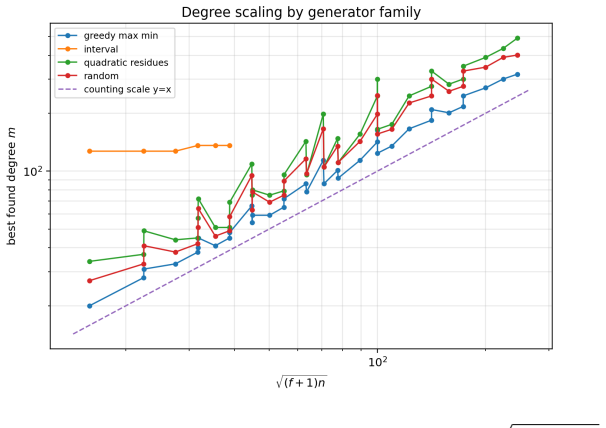
Circulant interconnection networks provide symmetric addressing, compact generator descriptions, and uniform local connectivity. This paper maps a degree--redundancy landscape for a fault-tolerant two-hop primitive in directed circulants: given $n$ nodes and degree budget $m$, how large can the worst-case shared-relay multiplicity $R(n,m)$ be? A node is a shared relay for an ordered terminal pair if it has outgoing links to both terminals; an $f$-relay-fault-tolerant circulant requires at least $f+1$ such relays for every pair. The underlying feasibility condition is a cyclic difference-multiplicity condition, which we use as a mathematical tool rather than claim as a new object. The contribution is the network-design framework around this tool: the parameters $R(n,m)$ and $D_f(n)$, a negative theorem for interval circulants, relay-table preprocessing and lookup algorithms, adversarial and random failure guarantees, load-balance scope, certified upper-bound interpretation of heuristic designs, exact small-$n$ calibration, a software lookup-versus-search microbenchmark, and a reproducible study of 526,539 generator sets. The results show that generator choice critically determines worst-case relay survivability: optimized threshold designs achieve $f$-relay-fault tolerance within about $1.16$--$1.63$ of the counting lower bound, while standard interval generators can fail structurally even at much larger degrees.
Figures
Figures from the paper (4 more)
Reference graph
Works this paper leans on
-
[1]
Distributed loop computer networks: A survey,
J.-C. Bermond, F. Comellas, and D. F. Hsu, “Distributed loop computer networks: A survey,”Journal of Parallel and Distributed Computing, vol. 24, no. 1, pp. 2–10, 1995
1995
-
[2]
Circulants and their connectivities,
F. T. Boesch and R. Tindell, “Circulants and their connectivities,”Journal of Graph Theory, vol. 8, no. 4, pp. 487–499, 1984
1984
-
[3]
Fault-tolerant routing in circulant networks and cycle prefix networks,
S.-C. Liaw, G. J. Chang, and C. Y. Tang, “Fault-tolerant routing in circulant networks and cycle prefix networks,”Networks, vol. 31, no. 2, pp. 127–136, 1998. 24
1998
-
[4]
Xu,Topological Structure and Analysis of Interconnection Networks
J.-M. Xu,Topological Structure and Analysis of Interconnection Networks. Dordrecht, The Netherlands: Kluwer, 2001
2001
-
[5]
Duato, S
J. Duato, S. Yalamanchili, and L. Ni,Interconnection Networks: An Engineering Ap- proach. San Francisco, CA, USA: Morgan Kaufmann, 2003
2003
-
[6]
Toeplitz and circulant matrices: A review,
R. M. Gray, “Toeplitz and circulant matrices: A review,”Foundations and Trends in Communications and Information Theory, vol. 2, no. 3, pp. 155–239, 2005
2005
-
[7]
Polynomial equations and circulant matrices,
D. Kalman and J. E. White, “Polynomial equations and circulant matrices,”The Amer- ican Mathematical Monthly, vol. 108, no. 9, pp. 821–840, 2001
2001
-
[8]
A survey on multi-loop networks,
F. K. Hwang, “A survey on multi-loop networks,”Theoretical Computer Science, vol. 299, no. 1–3, pp. 107–121, 2003
2003
Show all 18 references
-
[9]
A survey on undirected circulant graphs,
E. A. Monakhova, “A survey on undirected circulant graphs,”Discrete Mathematics, Algorithms and Applications, vol. 4, no. 1, Art. no. 1250002, 2012
2012
-
[10]
Fault-tolerant routing in distributed loop net- works,
K. Mukhopadhyaya and B. P. Sinha, “Fault-tolerant routing in distributed loop net- works,”IEEE Transactions on Computers, vol. 44, no. 12, pp. 1452–1456, 1995
1995
-
[11]
Development of routing algorithms in networks-on-chip based on two-dimensional optimal circulant topologies,
A. Y. Romanov, E. V. Lezhnev, A. Y. Glukhikh, and A. A. Amerikanov, “Development of routing algorithms in networks-on-chip based on two-dimensional optimal circulant topologies,”Heliyon, vol. 6, no. 1, Art. no. e03183, 2020
2020
-
[12]
Routing algorithms in opti- mal degree four circulant networks based on relative addressing: Comparative analysis for networks-on-chip,
E. A. Monakhova, O. G. Monakhov, and A. Y. Romanov, “Routing algorithms in opti- mal degree four circulant networks based on relative addressing: Comparative analysis for networks-on-chip,”IEEE Transactions on Network Science and Engineering, vol. 10, no. 1, pp. 413–425, 2023
2023
-
[13]
Difference bases in cyclic groups,
T. Banakh and V. Gavrylkiv, “Difference bases in cyclic groups,”Algebra and Discrete Mathematics, vol. 28, no. 2, pp. 195–214, 2019
2019
-
[14]
Cardinalities of g-difference bases,
E. Schmutz and M. Tait, “Cardinalities of g-difference bases,” arXiv:2501.11736, 2025
2025
-
[15]
Generalized additive bases and difference bases for Cartesian product of finite abelian groups,
S. Li and C. H. Yip, “Generalized additive bases and difference bases for Cartesian product of finite abelian groups,” arXiv:2509.24034, 2025
2025
-
[16]
Ring Interconnect,
Intel Corporation, “Ring Interconnect,”12th Generation Intel Core Processors Datasheet, Volume 1, 2022
2022
-
[17]
The PERCS high-performance interconnect,
B. Arimilliet al., “The PERCS high-performance interconnect,” inProc. IEEE Symp. High Performance Interconnects (HOTI), 2010, pp. 75–82
2010
-
[18]
Some properties of unitary Cayley graphs,
W. Klotz and T. Sander, “Some properties of unitary Cayley graphs,”Electronic Journal of Combinatorics, vol. 14, no. 1, 2007. 25
2007
Reviewed June 26, 2026 · model on record in the stance chip above.
Discussion (0). Continue with ORCID to comment.