REVIEW 3 major objections 4 minor 2 cited by
Yang-Baxter Equation and Related Algebraic Structures
T0 review · 3 major / 4 minor · reviewed 2026-08-06 · deepseek-v4-flash
Pith's one-line read The monograph shows that set-theoretic Yang-Baxter solutions are governed by a web of algebraic structures—skew braces, Rota-Baxter groups, racks, and quandles.
desk verdict Useful survey monograph, but a false theorem (1.83) and an incorrect example (1.13(2)) undermine its reliability as a reference as written. read the letter →
The pith
A machine-rendered reading of the paper's core claim, the machinery that carries it, and where it could break.
The reading
What carries the argument
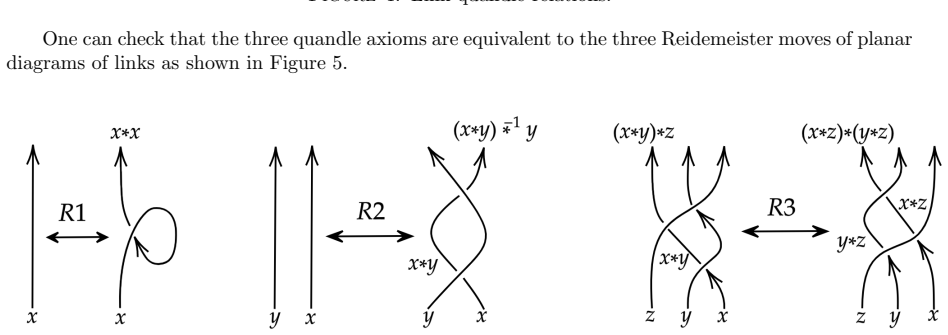
The structural engine is the passage between three equivalent descriptions of the same data. Given a solution $r(x,y)=(\sigma_x(y),\tau_y(x))$, the structure group $G(X,r)=\langle X \mid xy=\sigma_x(y)\,\tau_y(x)\rangle$ packages the braiding as a group law, and its bijective $1$-cocycle recovers a skew left brace; conversely, a skew left brace $(G,\cdot,\circ)$ yields a solution through the homomorphism $\lambda_a(b)=a^{-1}\cdot(a\circ b)$, with $r(a,b)=(\lambda_a(b),\ldots)$. Racks and quandles enter as the special case $r(x,y)=(y,x\ast y)$ with $x\ast x=x$ and right-distributivity, so that the three quandle axioms mirror the three Reidemeister moves. This brace-group-solution triangle, extended by Rota-Baxter operators, carries the argument across all three parts of the monograph.
What would settle it
Compare the table of non-isomorphic skew left braces of orders 1 through 30 in Chapter 2 against the computer enumeration described in [151], or verify a stated classification such as the claim that the unique indecomposable non-degenerate involutive solution on $\mathbb{Z}_p$ is the cyclic permutation solution $r(x,y)=(y-1,x+1)$; any mismatch would falsify the monograph's accuracy as a reference.
Extended reading notes
Core claim
The book's central claim, stated on its own terms, is that the algebraic study of set-theoretic solutions to the Yang-Baxter equation is a web of equivalent structures rather than a collection of isolated examples. A non-degenerate solution can be studied through its structure group, which carries a skew left brace structure, and every skew left brace returns a non-degenerate bijective solution. In the square-free case the same web passes through racks and quandles, which encode the three Reidemeister moves and serve as complete link invariants in the Joyce-Matveev sense. The monograph presents this framework chapter by chapter, from cycle sets and braces through Rota-Baxter groups to quandle homology and knot invariants, with proofs either given or explicitly delegated to cited sources.
Load-bearing premise
The load-bearing premise is that the monograph reproduces the results it cites faithfully: many theorems are presented with references rather than fresh proofs, so if any stated theorem is misquoted or any referenced proof is misattributed, the affected section would mislead readers despite the book's clarity.
Editorial extensions
If this is right
- Because every skew left brace gives a non-degenerate bijective solution and every such solution has a skew left brace structure on its structure group, classifying skew left braces is a complete route to classifying non-degenerate bijective solutions.
- Finite non-degenerate involutive solutions have solvable structure groups, and involutive solutions have Bieberbach, I-type structure groups, so the group-theoretic properties restrict which solutions can exist.
- Link quandles are complete invariants in the Joyce-Matveev sense, so algebraic invariants of quandles—homology, orderability, residual finiteness, automorphism groups—transfer to link invariants.
- The Rota-Baxter group connection places every skew left brace inside a Rota-Baxter group, bringing Yang-Baxter solutions into the operator-theoretic setting of Rota-Baxter algebra.
- Low-dimensional quandle cohomology, through state-sum invariants built from 2-cocycles, supplies practical knot and knotted-surface invariants.
Reading between the lines
- If the braces-solutions correspondence is as tight as the monograph presents, then the practical bottleneck for classification is computational: exhaustive enumeration of skew left braces, already possible through order 30 and beyond, effectively enumerates solutions, so sharper enumeration algorithms would directly expand the solved region of the classification tree.
- The Rota-Baxter and pre-Lie connections suggest a continuous analogue: differentiating Rota-Baxter operators on Lie groups yields Rota-Baxter operators on Lie algebras, so Lie-theoretic flows and affine structures could be used to deform or integrate set-theoretic solutions.
- The residual finiteness and orderability results for link quandles imply that algorithmic questions about links—word problem, left-orderability—can be approached through quandle rings and quandle automorphism groups, potentially distinguishing knots that classical polynomial invariants do not.
- A testable extension would be to search the monograph's small-order skew brace tables for the smallest skew brace whose solution is indecomposable but not of multipermutation type, and to see whether the structural invariants described in Part I predict its multipermutation level.
Editorial analysis
A structured set of objections, weighed in public.
Referee Report
Summary. The manuscript is a monograph-style survey of the algebraic theory of set-theoretic solutions to the Yang–Baxter equation. It develops the structure group and derived structure group of a solution, then treats skew braces, Rota–Baxter groups, racks, quandles, their adjoint groups, automorphisms, orderability, quandle rings, and homology theories. The intended role is a reference for graduate students and researchers, with the stated promise that proofs are either given in full or accompanied by comprehensive references.
Significance. If the reproduced results and examples were accurate, the monograph would fill a useful niche: it collects a large amount of scattered literature into a single progressive treatment, with a clear organization and an extensive bibliography. Strengths include the categorical perspective (e.g., the categories SLB and RBG), the explicit universal property of the structure group, the many worked examples, and the breadth from linear solutions to knot-theoretic quandles. However, for a reference text, the exact statement of theorems and examples is load-bearing, and the errors found in Chapter 1 undermine reader confidence in the monograph's reliability. These errors are local and correctable, but they need to be addressed before the text can serve as a dependable reference.
major comments (3)
- [§1.2, Theorem 1.83] The statement 'If (X,r) is an involutive solution, then G(X,r) is a Bieberbach group and is of I-type' is false as written. Under Definition 1.12(6), involutive means only r^2 = id; no finiteness or non-degeneracy is assumed. For X = {0,1} with r(x,y) = (x,y), the solution is involutive, and by Example 1.46(1) the structure group is the free group F_2, which is not abelian-by-finite and hence not Bieberbach. The theorem needs additional hypotheses (finite, non-degenerate, involutive, as in the cited sources) before it can be correct.
- [§1.2, Theorem 1.79(1)] The assertion that if (X,r) is a finite bijective solution then G(X,r) has a finitely generated abelian normal subgroup of finite index is refuted by the same example: the identity solution on a finite set with at least two elements is bijective, but G(X,r) is the free group F(X) by Example 1.46(1), which is not virtually abelian. The theorem should replace 'non-degenerate or bijective' with 'non-degenerate' (or 'non-degenerate bijective'); otherwise it is a genuine counterexample to a stated theorem in the foundational chapter.
- [§1.1, Example 1.13(2)] The claim that the solutions in Examples 1.4 and 1.5 are 'bijective as well as non-degenerate' is false for Example 1.5. Example 1.5 assumes only the right self-distributivity identity, which by Remark 1.22 defines a shelf, not a rack. On X = {0,1} with x*y = 0, the map r(x,y) = (y,0) satisfies the identity but is not bijective, and the map τ_0 is constant. Non-degeneracy requires the shelf to be a rack (cf. Proposition 1.23), which is an additional hypothesis not present in Example 1.5.
minor comments (4)
- [§1.2, Proof of Theorem 1.74] In the proof of Theorem 1.74, the reference to 'Theorem 1.24' should be to 'Proposition 1.24', which is the result about conjugation to an elementary solution.
- [§2.1, Example 2.6(4)] In Example 2.6(4), the stated normal form bounds appear to be interchanged: for the group with a^7 = b^3 = 1, elements should be written as a^i b^j with 0 ≤ i ≤ 6 and 0 ≤ j ≤ 2, not 0 ≤ i ≤ 2 and 0 ≤ j ≤ 6.
- [§1.2, Theorem 1.83] The term 'of I-type' is used in Theorem 1.83 without a definition in the body of Chapter 1; it is only informally mentioned in Chapter 0. Adding a precise definition or a clear pointer to the relevant literature would improve readability.
- [§1.1, Example 1.38] In Example 1.38, the assertion 'It can be checked that the above action by B_n on Z^{2n} is well-defined' is left entirely to the reader. For a monograph that promises complete proofs or comprehensive references, a proof sketch or a precise citation to the verification in [115] would be appropriate.
Circularity Check
No significant circularity: the monograph is an expository survey whose cited results, including self-citations, are used as references to prior published work rather than as fitted inputs or self-defined predictions.
full rationale
The paper does not claim to derive a prediction from fitted parameters. It presents set-theoretic solutions, structure groups, skew braces, Rota-Baxter groups, quandles, and cohomology as an interconnected survey. Most results are quoted with references; for example, Theorem 1.83 is attributed to [148, Theorem 1.6] and [180, Cor. 8.2.7], and many proofs given in the text are direct verifications, such as Proposition 1.7, which verifies the braid equation from the three component identities. Self-citations, including Bardakov-Gubarev on Rota-Baxter groups, Bardakov-Singh-Singh on residual finiteness, and Bardakov-Passi-Singh on quandle rings, point to earlier external publications; they are not used as a uniqueness theorem that forbids alternatives, nor does the text define a target object in terms of itself. The concerns raised by the skeptic about Theorem 1.83 and Example 1.13(2) are matters of mathematical accuracy and internal consistency: the former may omit finiteness or non-degeneracy hypotheses present in the cited sources, and the latter incorrectly labels a right-self-distributive example as bijective. These are correctness risks, not circularity, because the monograph's claims are not forced by its own definitions or by a self-citation chain. Accordingly, the circularity score is 1.
Assumptions & free parameters
assumptions (2)
- domain assumption The external results cited throughout the monograph are correctly stated and proved in the sources referenced.
- domain assumption The reader has the stated background in group theory, ring theory, homological algebra, algebraic topology, and knot theory.
Cite this review
Pith. "Pith review of Yang-Baxter Equation and Related Algebraic Structures." pith.science (2026). https://pith.science/paper/O3VSZD6U
@misc{pith2026250623175,
  author       = {Pith},
  title        = {Pith review of: Yang-Baxter Equation and Related Algebraic Structures},
  year         = {2026},
  howpublished = {\url{https://pith.science/paper/O3VSZD6U}},
  note         = {Machine review of arXiv:2506.23175}
}
read the original abstract
In the 1990s, Drinfel'd proposed the study of set-theoretical solutions to the quantum Yang-Baxter equation, initiating a line of research that has since garnered substantial attention and led to notable developments in algebra, low-dimensional topology, and related areas. This monograph offers a concise introduction to the algebraic theory of such solutions, focusing on key structures including skew braces, quandles, racks, and Rota-Baxter groups, which have emerged as central objects in this framework. We investigate the algebraic, combinatorial, and homological properties of these structures, with an emphasis on their interrelations and applications to knot theory. The monograph is intended as a reference for researchers interested in the deep interplay between these algebraic structures and the quantum Yang-Baxter equation.
Figures


Figures from the paper (26 more)





Forward citations
Cited by 2 Pith papers
-
Idempotents and Powers of Ideals in Quandle Rings
Core(Z) quandle rings over integral domains have only trivial idempotents, and augmentation ideal powers are computed for dihedral R3 and commutative C5 and C7 quandles.
-
Associated groups of symmetric quandles
Symmetric quandle associated groups are characterized: the underlying quandle's group is a central extension of the symmetric one with a free abelian kernel, and embeddability is equivalent.
Reference graph
Works this paper leans on
-
[1]
On left-orderability of involutory quandles of links
H. Abchir and M. Sabak, On left-orderability of involutory quandles of links . https://doi.org/10.48550/arXiv.2310.05735
-
[2]
J. E. Adney and T. Yen, Automorphisms of a p-group. Illinois J. Math. 9 (1965), 137–143
1965
-
[3]
A. A. Agraˇ cev and R. V. Gamkrelidze, Chronological algebras and nonstationary vector fields . (Russian) Problems in geometry, Vol. 11 (Russian), pp. 135–176, 243, Akad. Nauk SSSR, Vsesoyuz. Inst. Nauchn. i Tekhn. Informatsii, Moscow, 1980
1980
-
[4]
Akita, The adjoint group of a Coxeter quandle
T. Akita, The adjoint group of a Coxeter quandle . Kyoto J. Math. 60 (2020), 1245–1260
2020
-
[5]
A. A. Albert, On the power-associativity of rings . Summa Brasil. Math. 2 (1948), no. 2, 21–32
1948
-
[6]
An and C
H. An and C. Bai, From Rota–Baxter algebras to pre-Lie algebras . J. Phys. A 41 (2008), no. 1, 015201, 19 pp
2008
-
[7]
Andruskiewitsch and M
N. Andruskiewitsch and M. Gra˜ na,From racks to pointed Hopf algebras . Adv. Math. 178, no. 2 (2003), 177–243
2003
-
[8]
Aschbacher, Finite group theory
M. Aschbacher, Finite group theory . Cambridge Studies in Advanced Mathematics, 10. Cambridge University Press, Cambridge, 1986. x+274 pp
1986
Show all 300 references
-
[9]
Ashford and O
M. Ashford and O. Riordan, Counting racks of order n. Electron. J. Combin. 24 (2017), no. 2, Paper No. 2.32, 20 pp
2017
-
[10]
Bachiller, Counterexample to a conjecture about braces
D. Bachiller, Counterexample to a conjecture about braces . J. Algebra 453 (2016), 160–176
2016
-
[11]
D Bachiller, Solutions of the Yang–Baxter equation associated to skew left braces, with applications to racks . J. Knot Theory Ramifications 27 (2018), no. 8, 1850055, 36 pp
2018
-
[12]
Bachiller, F
D. Bachiller, F. Ced´ o, and E. Jespers, Solutions of the Yang–Baxter equation associated with a left brace . J. Algebra 463 (2016), 80–102
2016
-
[13]
Bachiller, F
D. Bachiller, F. Ced´ o, and L. Vendramin, A characterization of finite multipermutation solutions of the Yang–Baxter equation. Publ. Mat. 62 (2018), no. 2, 641–649
2018
-
[14]
Bai, An introduction to pre-Lie algebras
C. Bai, An introduction to pre-Lie algebras . Algebra and applications 1–non-associative algebras and categories, 245– 273, ISTE, London, 2020
2020
-
[15]
Bai, O Bellier, L
C. Bai, O Bellier, L. Guo, and X. Ni, Splitting of operations, Manin products, and Rota–Baxter operators . Int. Math. Res. Not. (2013), no. 3, 485–524
2013
-
[16]
Y. Bae, J. S. Carter, and B. Kim, Relations between quandle extensions and group extensions . J. Algebra 573 (2021), 410–435
2021
-
[17]
Bae and S
Y. Bae and S. Choi, On properties of commutative Alexander quandles . J. Knot Theory Ramifications, 23 (2014), 1460013, 8 pp
2014
-
[18]
Bae and S
Y. Bae and S. Choi, On rack homology groups of finite quandles via permutations . J. Knot Theory Ramifications 28 (2019), no. 11, 1940004, 26 pp
2019
-
[19]
V. G. Bardakov, Computation of commutator length in free groups . Algebra and Logic 39 (2000), no. 4, 224–251
2000
-
[20]
V. G. Bardakov, P. Dey, and M. Singh Automorphism groups of quandles arising from groups . Monatsh. Math. 184 (2017), no. 4, 519–530
2017
-
[21]
V. G. Bardakov and V. Gubarev, Rota–Baxter operators on groups. Proc. Indian Acad. Sci. Math. Sci. 133 (2023), no. 1, Paper No. 4, 29 pp
2023
-
[22]
V. G. Bardakov and V. Gubarev, Rota–Baxter groups, skew left braces, and the Yang–Baxter equation . J. Algebra 596 (2022), 328–351
2022
-
[23]
V. G. Bardakov and T. R. Nasybullov, Embeddings of quandles into groups . J. Algebra Appl. 19 (2020), no. 7, 2050136, 20 pp
2020
-
[24]
V. G. Bardakov and T. R. Nasybullov, Twisted conjugacy classes of the unit element . Sib. Math. J. 54 (2013), no. 1, 10–21
2013
-
[25]
V. G. Bardakov, T. R. Nasybullov, and M. Singh, Automorphism groups of quandles and related groups . Monatsh. Math. 189 (2019), no. 1, 1–21
2019
-
[26]
V. G. Bardakov, T. R. Nasybullov, and M. Singh, General constructions of biquandles and their symmetries . J. Pure Appl. Algebra 226 (2022), no. 7, Paper No. 106936, 40 pp
2022
-
[27]
V. G. Bardakov, M. V. Neshchadim, and M. K. Yadav, On λ-homomorphic skew braces . J. Pure Appl. Algebra 226 (2022), no. 6, Paper No. 106961, 37 pp
2022
-
[28]
V. G. Bardakov, M. V. Neshchadim, and M. K. Yadav, Computing skew left braces of small orders . Internat. J. Algebra Comput. 30 (2020), no. 4, 839–851
2020
-
[29]
V. G. Bardakov, I. B. S. Passi, and M. Singh, Quandle rings . J. Algebra Applications 18 (2019), 23 pp. 325 326 BIBLIOGRAPHY
2019
-
[30]
V. G. Bardakov, I. B. S. Passi, and M. Singh, Zero-divisors and idempotents in quandle rings . Osaka J. Math 59 (2022), 611–637
2022
-
[31]
V. B. Bardakov and M. Singh, Quandle cohomology, extensions and automorphisms . J. Algebra 585 (2021), 558–591
2021
-
[32]
V. G. Bardakov, M. Singh, and M. Singh, Free quandles and knot quandles are residually finite . Proc. Amer. Math. Soc. 147 (2019), no. 8, 3621–3633
2019
-
[33]
V. G. Bardakov, M. Singh, and M. Singh, Link quandles are residually finite . Monatsh. Math. 191 (2020), 679–690
2020
-
[34]
Baumslag and M
B. Baumslag and M. Tretkoff, Residually finite HNN extensions . Comm. Algebra 6 (1978), no. 2, 179–194
1978
-
[35]
Baxter, An analytic problem whose solution follows from a simple algebraic identity
G. Baxter, An analytic problem whose solution follows from a simple algebraic identity . Pacific J. Math. 10 (1960), 731–742
1960
-
[36]
R. J. Baxter, Partition function of the eight-vertex lattice model . Ann. Physics 70 (1972), 193–228
1972
-
[37]
R. J. Baxter, Exactly solved models in statistical mechanics . Academic Press, Inc. [Harcourt Brace Jovanovich, Pub- lishers], London, 1982. xii+486 pp
1982
-
[38]
R. P. Bakshi, D. Ibarra, S. Mukherjee, T. Nosaka, and J. H. Przytycki, Schur multipliers and second quandle homology . J. Algebra 552 (2020), 52–67
2020
-
[39]
A. A. Belavin and V. G. Drinfel’d, Solutions of the classical Yang–Baxter equation for simple Lie algebras . Funktsional. Anal. i Prilozhen. 16 (1982), no. 3, 1–29, 96
1982
-
[40]
Belk and R
J. Belk and R. W. McGrail, The word problem for finitely presented quandles is undecidable . Logic, language, informa- tion, and computation, 1–13, Lecture Notes in Comput. Sci., 9160, Springer, Heidelberg, 2015
2015
-
[41]
Belwal and N
P. Belwal and N. Rathee, A Wells-like exact sequence for abelian extensions of relative Rota–Baxter groups . Homology Homotopy Appl. 27 (2025), no. 1, 251–273
2025
-
[42]
Ballester-Bolinches and R
A. Ballester-Bolinches and R. Esteban-Romero, Triply factorised groups and the structure of skew left braces . Commun. Math. Stat. 10 (2022), no. 2, 353–370
2022
-
[43]
D. J. Benson, Representations and cohomology. I., Basic representation theory of finite groups and associative algebras. Cambridge Studies in Advanced Mathematics, 30. Cambridge University Press, Cambridge, 1991. xii+224 pp
1991
-
[44]
Bonatto, Principal and doubly homogeneous quandles
M. Bonatto, Principal and doubly homogeneous quandles . Monatsh. Math. 191 (2020) 691–717
2020
-
[45]
Bonatto and P
M. Bonatto and P. Jedliˇ cka,Central nilpotency of skew braces . J. Algebra Appl. 22 (2025), 2350255
2025
-
[46]
Borel, Seminar on transformation groups
A. Borel, Seminar on transformation groups. With contributions by G. Bredon, E. E. Floyd, D. Montgomery, R. Palais. Annals of Mathematics Studies, No. 46. Princeton University Press, Princeton, NJ, 1960. vii+245 pp
1960
-
[47]
Boyer, D
S. Boyer, D. Rolfsen, and B. Wiest, Orderable 3-manifold groups . Ann. Inst. Fourier (Grenoble) 55 (2005), no. 1, 243–288
2005
-
[48]
S. L. de Braganca, Finite dimensional Baxter algebras . Studies in Appl. Math. 54 (1975), no. 1, 75–89
1975
-
[49]
Brieskorn, Automorphic sets and singularities
E. Brieskorn, Automorphic sets and singularities . Contemp. Math. 78 (1988), 45–115
1988
-
[50]
K. S. Brown, Cohomology of groups . Graduate Texts in Mathematics, 87. Springer-Verlag, New York-Berlin, 1982. x+306 pp
1982
-
[51]
Brown and P
R. Brown and P. J. Higgins, On the algebra of cubes . J. Pure Appl. Algebra 21 (1981), no. 3, 233–260
1981
-
[52]
Brundan and A
J. Brundan and A. S. Kleshchev, Representations of the symmetric group which are irreducible over subgroups. J. Reine Angew. Math. 530 (2001), 145–190
2001
-
[53]
Budden and R
S. Budden and R. Fenn, Quaternion algebras and invariants of virtual knots and links. II. The hyperbolic case . J. Knot Theory Ramifications 17 (2008), no. 3, 305–314
2008
-
[54]
Budden and R
S. Budden and R. Fenn, The equation [B, (A − 1)(A, B)] = 0 and virtual knots and links . Fund. Math. 184 (2004), 19–29
2004
-
[55]
Burde, Affine structures on nilmanifolds
D. Burde, Affine structures on nilmanifolds . Internat. J. Math. 7 (1996), no. 5, 599–616
1996
-
[56]
Burde, ´Etale affine representations of the Lie groups
D. Burde, ´Etale affine representations of the Lie groups . Geometry and representation theory of real and p-adic groups (C´ ordoba, 1995), 35–44, Progr. Math., 158, Birkh¨ auser Boston, Boston, MA, 1998
1995
-
[57]
Burde, Left-symmetric algebras, or pre-Lie algebras in geometry and physics
D. Burde, Left-symmetric algebras, or pre-Lie algebras in geometry and physics . Cent. Eur. J. Math. 4 (2006), no. 3, 323–357
2006
-
[58]
Burde and V
D. Burde and V. Gubarev, Rota–Baxter operators and post-Lie algebra structures on semisimple Lie algebras . Comm. Algebra 47 (2019), no. 5, 2280–2296
2019
-
[59]
Burde and H
G. Burde and H. Zieschang, Knots. De Gruyter Studies in Mathematics, 5. Walter de Gruyter & Co., Berlin, 1985. xii+399 pp
1985
-
[60]
Burnside, On the outer isomorphisms of a group
W. Burnside, On the outer isomorphisms of a group . Proc. London Math. Soc. (2) 11 (1913), 40–42
1913
-
[61]
Burnside, On the outer automorphism of a p-group
W. Burnside, On the outer automorphism of a p-group. Proc. London Math. Soc. (2) 11 (1913), 40–42
1913
-
[62]
Burstin and W
C. Burstin and W. Mayer, Distributive Gruppen von endlicher Ordnung . J. Reine Angew. Math. 160 (1929), 111–130
1929
-
[63]
Caranti, Bi-skew braces and regular subgroups of the holomorph
A. Caranti, Bi-skew braces and regular subgroups of the holomorph . J. Algebra 562 (2020), 647–665
2020
-
[64]
Caranti and L
A. Caranti and L. Stefanello, Brace blocks from bilinear maps and liftings of endomorphisms . J. Algebra 610 (2022), 831–851
2022
-
[65]
Caranti and L
A. Caranti and L. Stefanello, Skew braces from Rota–Baxter operators: a cohomological characterisation and some examples. Ann. Mat. Pura Appl. (4) 202 (2023), no. 1, 1–13
2023
-
[66]
J. S. Carter, A. Ishii, M. Saito, and K. Tanaka, Homology for quandles with partial group operations . Pacific J. Math. 287 (2017), no. 1, 19–48
2017
-
[67]
J. S. Carter and M. Saito, Knotted surfaces and their diagrams . Mathematical Surveys and Monographs, 55. American Mathematical Society, Providence, RI, 1998. BIBLIOGRAPHY 327
1998
-
[68]
J. S. Carter, A survey of quandle ideas . Introductory lectures on knot theory, 22–53, Ser. Knots Everything, 46, World Sci. Publ., Hackensack, NJ, 2012
2012
-
[69]
J. S. Carter, A. S. Crans, M. Elhamdadi, and M. Saito, Cohomology of categorical self-distributivity . J. Homotopy Relat. Struct. 3 (2008), no. 1, 13–63
2008
-
[70]
J. S. Carter, A. S. Crans, M. Elhamdadi, and M. Saito, Cohomology of the adjoint of Hopf algebras . J. Gen. Lie Theory Appl. 2 (2008), no. 1, 19–34
2008
-
[71]
J. S. Carter, M. Elhamdadi, M. Gra˜ na, and M. Saito, Cocycle knot invariants from quandle modules and generalised quandle homology . Osaka J. Math. 42 (2005), no. 3, 499–541
2005
-
[72]
J. S. Carter, M. Elhamdadi, M. A. Nikiforou, and M. Saito, Extensions of quandles and cocycle knot invariants . J. Knot Theory Ramifications 12 (2003), no. 6, 725–738
2003
-
[73]
J. S. Carter, M. Elhamdadi, and M. Saito, Homology theory for the set-theoretic Yang–Baxter equation and knot invariants from generalizations of quandles . Fund. Math. 184 (2004), 31–54
2004
-
[74]
J. S. Carter, M. Elhamdadi, and M. Saito, Twisted quandle homology theory and cocycle knot invariants . Algebr. Geom. Topol. 2 (2002), 95–135
2002
-
[75]
J. S. Carter, D. Jelsovsky, S. Kamada, L. Langford, and M. Saito, Quandle cohomology and state-sum invariants of knotted curves and surfaces . Trans. Amer. Math. Soc. 355 (2003), no. 10, 3947–3989
2003
-
[76]
J. S. Carter, D. Jelsovsky, S. Kamada, and M. Saito, Quandle homology groups, their Betti numbers, and virtual knots . J. Pure Appl. Algebra 157 (2001), no. 2-3, 135–155
2001
-
[77]
J. S. Carter, S. Kamada, and M. Saito, Diagrammatic computations for quandles and cocycle knot invariants . Dia- grammatic morphisms and applications (San Francisco, CA, 2000), 51–74, Contemp. Math., 318, Amer. Math. Soc., Providence, RI, 2003
2000
-
[78]
S Carter, S
J. S Carter, S. Kamada, and M. Saito, Geometric interpretations of quandle homology . J. Knot Theory Ramifications 10 (2001), no. 3, 345–386
2001
-
[79]
Catino, I
F. Catino, I. Colazzo, and P. Stefanelli, Semi-braces and the Yang–Baxter equation. J. Algebra 483 (2017), 163–187
2017
-
[80]
Catino, I
F. Catino, I. Colazzo, and P. Stefanelli, Skew left braces with non-trivial annihilator . J. Algebra Appl. 18 (2019), no. 2, 1950033, 23 pp
2019
-
[81]
Catino and R
F. Catino and R. Rizzo, Regular subgroups of the affine group and radical circle algebras . Bull. Aust. Math. Soc. 79 (2009), no. 1, 103–107
2009
-
[82]
Ceccherini-Silberstein and M
T. Ceccherini-Silberstein and M. Coornaert, Cellular automata and groups . Springer Monographs in Mathematics. Springer-Verlag, Berlin, 2010. xx+439 pp
2010
-
[83]
Ced´ o,Left braces: solutions of the Yang–Baxter equation
F. Ced´ o,Left braces: solutions of the Yang–Baxter equation . Adv. Group Theory Appl. 5 (2018), 33–90
2018
-
[84]
Ced´ o, T
F. Ced´ o, T. Gateva-Ivanova, and A. Smoktunowicz,On the Yang–Baxter equation and left nilpotent left braces . J. Pure Appl. Algebra 221 (2017), no. 4, 751–756
2017
-
[85]
Ced´ o, E
F. Ced´ o, E. Jespers, and A. del R ´ ıo, Involutive Yang–Baxter groups . Trans. Amer. Math. Soc. 362 (2010), no. 5, 2541–2558
2010
-
[86]
Ced´ o, E
F. Ced´ o, E. Jespers, and J. Okni´ nski,Braces and the Yang–Baxter equation . Comm. Math. Phys. 327 (2014), no. 1, 101–116
2014
-
[87]
Ced´ o, A
F. Ced´ o, A. Smoktunowicz, and L. Vendramin,Skew left braces of nilpotent type. Proc. Lond. Math. Soc. (3) 118 (2019), no. 6, 1367–1392
2019
-
[88]
Ceniceros, M
J. Ceniceros, M. Elhamdadi, M. Green, and S. Nelson, Augmented biracks and their homology . Internat. J. Math. 25 (2014), no. 9, 1450087, 19 pp
2014
-
[89]
L. N. Childs, Bi-skew braces and Hopf Galois structures . New York J. Math. 25 (2019), 574–588
2019
-
[90]
Church, J
T. Church, J. Ellenberg, and B. Farb, FI-modules and stability for representations of symmetric groups . Duke Math. J. 164 (2015), no. 9, 1833–1910
2015
-
[91]
W. E. Clark, M. Elhamdadi, M. Saito, and T. Yeatman, Quandle colorings of knots and applications . J. Knot Theory Ramifications 23 (2014), no. 6, 1450035, 29 pp
2014
-
[92]
W. E. Clark and M. Saito, Algebraic properties of quandle extensions and values of cocycle knot invariants . J. Knot Theory Ramifications 25 (2016), no. 14, 1650080, 17 pp
2016
-
[93]
Cheng and H
Z. Cheng and H. Gao, Positive quandle homology and its applications in knot theory . Algebr. Geom. Topol. 15 (2015), no. 2, 933–963
2015
-
[94]
Chouraqui, Garside groups and Yang–Baxter equation
F. Chouraqui, Garside groups and Yang–Baxter equation . Comm. Algebra 38 (2010), no. 12, 4441–4460
2010
-
[95]
Chouraqui and E
F. Chouraqui and E. Godelle, Folding of set-theoretic solutions of the Yang–Baxter equation. Algebr. Represent. Theory 15 (2012), no. 6, 1277–1290
2012
-
[96]
W. E. Clark, M. Saito, and L. Vendramin, Quandle coloring and cocycle invariants of composite knots and abelian extensions. J. Knot Theory Ramifications 25 (2016), no. 5, 1650024, 34 pp
2016
-
[97]
Clauwens, The algebra of rack and quandle cohomology
F. Clauwens, The algebra of rack and quandle cohomology . J. Knot Theory Ramifications 20 (2011), no. 11, 1487–1535
2011
-
[98]
D. E. Cohen, Residual finiteness and Britton ’s lemma. J. London Math. Soc. (2) 16 (1977), no. 2, 232–234
1977
-
[99]
Colazzo, E
I. Colazzo, E. Jespers, A. Van Antwerpen, and C. Verwimp, Left non-degenerate set-theoretic solutions of the Yang– Baxter equation and semitrusses . J. Algebra 610 (2022), 409–462
2022
-
[100]
Covez, M
S. Covez, M. Farinati, V. Lebed, and D. Manchon, Bialgebraic approach to rack cohomology. Algebr. Geom. Topol. 23 (2023), no. 4, 1551–1582. 328 BIBLIOGRAPHY
2023
-
[101]
Crans, A
A. Crans, A. Henrich, and S. Nelson, Polynomial knot and link invariants from the virtual biquandle . J. Knot Theory Ramif. 22 (4) (2013) 134004
2013
-
[102]
R. H. Crowell and R. H. Fox, Introduction to knot theory. Based upon lectures given at Haverford College under the Philips Lecture Program Ginn and Co., Boston, Mass. 1963 x+182 pp
1963
-
[103]
M. J. Curran and D. J. McCaughan, Central automorphisms that are almost inner . Comm. Algebra 29 (2001), no. 5, 2081–2087
2001
-
[104]
M. A. Dabkowska, M. K. Dabkowski, V. S. Harizanov, J. H. Przytycki, and M. A. Veve, Compactness of the space of left orders. J. Knot Theory Ramifications 16 (2007), no. 3, 257–266
2007
-
[105]
Damiani, A journey through loop braid groups
C. Damiani, A journey through loop braid groups . Expo. Math. 35 (2017), no. 3, 252–285
2017
-
[106]
Das and N
A. Das and N. Rathee, Extensions and automorphisms of Rota–Baxter groups . J. Algebra 636 (2023), 626–665
2023
-
[107]
M. W. Davis, The geometry and topology of Coxeter groups . London Mathematical Society Monographs Series, 32. Princeton University Press, Princeton, NJ, 2008. xvi+584 pp
2008
-
[108]
Dehornoy, Braid groups and left distributive operations
P. Dehornoy, Braid groups and left distributive operations . Trans. Amer. Math. Soc. 345 (1994), no. 1, 115–150
1994
-
[109]
Dehornoy, I
P. Dehornoy, I. A. Dynnikov, D. Rolfsen, and B. Wiest,Why are braids orderable? Panoramas et Synth´ eses [Panoramas and Syntheses], 14. Soci´ et´ e Math´ ematique de France, Paris, 2002. xiv+190 pp
2002
-
[110]
Deroin, A
B. Deroin, A. Navas, and C. Rivas, Groups, Orders, and Dynamics . https://doi.org/10.48550/arXiv.1408.5805
-
[111]
N. K. Dhanwani and M Singh, Finiteness of canonical quotients of Dehn quandles of surfaces . J. Australian Math. Soc. 118 (2025), 317–334
2025
-
[112]
N. K. Dhanwani, D. Saraf, and M Singh, Residual finiteness of fundamental n-quandles of links . https://doi.org/10.48550/arXiv.2403.17703
-
[113]
J. D. Dixon and B. Mortimer, Permutation groups. Graduate Texts in Mathematics, 163. Springer–Verlag, New York,
-
[114]
V. G. Drinfel’d, On some unsolved problems in quantum group theory . Quantum groups (Leningrad, 1990), 1–8, Lecture Notes in Math., 1510, Springer, Berlin, 1992
1990
-
[115]
I. A. Dynnikov, On a Yang–Baxter mapping and the Dehornoy ordering . (Russian) Uspekhi Mat. Nauk 57 (2002), no. 3(345), 151–152; translation in Russian Math. Surveys 57 (2002), no. 3, 592–594
2002
-
[116]
Ehrman, A
G. Ehrman, A. Gurpinar, M. Thibault, and D. N. Yetter, Toward a classification of finite quandles . J. Knot Theory Ramifications 17 (2008), no. 4, 511–520
2008
-
[117]
Eilenberg and S
S. Eilenberg and S. MacLane, Acyclic models. Amer. J. Math. 75 (1953), 189–199
1953
-
[118]
Eisermann, Homological characterization of the unknot
M. Eisermann, Homological characterization of the unknot . J. Pure Appl. Algebra 177 (2003), no. 2, 131–157
2003
-
[119]
Eisermann, Quandle coverings and their Galois correspondence
M. Eisermann, Quandle coverings and their Galois correspondence . Fund. Math. 225 (2014), no. 1, 103–168
2014
-
[120]
Eisermann, Yang–Baxter deformations and rack cohomology
M. Eisermann, Yang–Baxter deformations and rack cohomology . Trans. Amer. Math. Soc. 366 (2014), no. 10, 5113– 5138
2014
-
[121]
Eisermann, Yang–Baxter deformations of quandles and racks
M. Eisermann, Yang–Baxter deformations of quandles and racks . Algebr. Geom. Topol. 5 (2005), 537–562
2005
-
[122]
Elhamdadi, N
M. Elhamdadi, N. Fernando, and B. Tsvelikhovskiy, Ring theoretic aspects of quandles. J. Algebra 526 (2019), 166–187
2019
-
[123]
Elhamdadi, J
M. Elhamdadi, J. Macquarrie, and R. Restrepo, Automorphism groups of quandles . J. Algebra Appl. 11 (2012), 1250008, 9 pp
2012
-
[124]
Elhamdadi, A
M. Elhamdadi, A. Makhlouf, S. Silvestrov, and E. Zappala, Derivation problem for quandle algebras . Internat. J. Algebra Comput. 32 (2022), no. 5, 985–1007
2022
-
[125]
Elhamdadi and S
M. Elhamdadi and S. Nelson, Quandles–an introduction to the algebra of knots . Student Mathematical Library, 74. American Mathematical Society, Providence, RI, 2015. x+245 pp
2015
-
[126]
Elhamdadi, B
M. Elhamdadi, B. Nunez, and M. Singh, Enhancements of link colorings via idempotents of quandle rings . J. Pure Appl. Algebra 227 (2023), no. 10, Paper No. 107400
2023
-
[127]
Elhamdadi, B
M. Elhamdadi, B. Nunez, M. Singh, and D. Swain, Idempotents, free products and quandle coverings . Internat. J. Math. 34 (2023), no. 3, Paper No. 2350011, 27 pp
2023
-
[128]
Elhamdadi, M
M. Elhamdadi, M. Saito, and E. Zappala, Skein theoretic approach to Yang–Baxter homology . Topology Appl. 302 (2021), Paper No. 107836, 24 pp
2021
-
[129]
Etingof and S
P. Etingof and S. Gelaki, A method of construction of finite-dimensional triangular semisimple Hopf algebras . Math. Res. Lett. 5 (1998), no. 4, 551–561
1998
-
[130]
Etingof and M
P. Etingof and M. Gra˜ na,On rack cohomology. J. Pure Appl. Algebra 177 (2003), no. 1, 49–59
2003
-
[131]
Etingof, T
P. Etingof, T. Schedler, and A. Soloviev, set-theoretic solutions to the quantum Yang–Baxter equation . Duke Math. J. 100 (1999), no. 2, 169–209
1999
-
[132]
Etingof, A
P. Etingof, A. Soloviev, and R. Guralnick, Indecomposable set-theoretic solutions to the quantum Yang–Baxter equation on a set with a prime number of elements . J. Algebra 242 (2001), no. 2, 709–719
2001
-
[133]
Falk and R
M. Falk and R. Randell, Pure braid groups and products of free groups . Braids (Santa Cruz, CA, 1986), 217–228, Contemp. Math., 78, Amer. Math. Soc., Providence, RI, 1988
1986
-
[134]
Farb and D
B. Farb and D. Margalit, A primer on mapping class groups . Princeton Mathematical Series, 49. Princeton University Press, Princeton, NJ, 2012. xiv+472 pp
2012
-
[135]
Farinati, J
M. Farinati, J. A. Guccione, and J. J. Guccione, The homology of free racks and quandles . Comm. Algebra 42 (2014), no. 8, 3593–3606
2014
-
[136]
Fenn and A
R. Fenn and A. Bartholomew, Biquandles of small size and some invariants of virtual and welded knots . J. Knot Theory Ramif. 26 (8) (2017) 1792002. BIBLIOGRAPHY 329
2017
-
[137]
R. Fenn, M. Jordan-Santana, and L. Kauffman, Biquandles and virtual links . Topology Appl. 145 (2004), no. 1-3, 157–175
2004
-
[138]
R. Fenn, R. Rim´ anyi, and C. Rourke,The braid-permutation group. Topology 36 (1997), no. 1, 123–135
1997
-
[139]
Fenn and C
R. Fenn and C. Rourke, Racks and links in codimension two . J. Knot Theory Ramifications 1 (1992), no. 4, 343–406
1992
-
[140]
R. Fenn, C. Rourke, and B. Sanderson, An introduction to species and the rack space. Topics in knot theory (Erzurum, 1992), 33–55, NATO Adv. Sci. Inst. Ser. C: Math. Phys. Sci., 399, Kluwer Acad. Publ., Dordrecht, 1993
1992
-
[141]
R. Fenn, C. Rourke, and B. Sanderson, James bundles . Proc. London Math. Soc. (3) 89 (2004), no. 1, 217–240
2004
-
[142]
R. Fenn, C. Rourke, and B. Sanderson, James bundles and applications . www.maths.warwick.ac.uk/ cpr/james.ps
-
[143]
R. Fenn, C. Rourke, and B. Sanderson, The rack space. Trans. Amer. Math. Soc. 359 (2007), no. 2, 701–740
2007
-
[144]
R. Fenn, C. Rourke, and B. Sanderson, Trunks and classifying spaces. Appl. Categ. Structures 3 (1995), no. 4, 321–356
1995
-
[145]
Ferman, T
A. Ferman, T. Nowik, and M. Teicher, On the structure and automorphism group of finite Alexander quandles . J. Knot Theory Ramifications 20 (2011), 463–468
2011
-
[146]
Garcia Iglesias and L
A. Garcia Iglesias and L. Vendramin, An explicit description of the second cohomology group of a quandle . Math. Z. 286 (2017), no. 3-4, 1041–1063
2017
-
[147]
Gateva-Ivanova, Set-theoretic solutions of the Yang–Baxter equation, braces and symmetric groups
T. Gateva-Ivanova, Set-theoretic solutions of the Yang–Baxter equation, braces and symmetric groups . Adv. Math. 338 (2018), 649–701
2018
-
[148]
Gateva-Ivanova and M
T. Gateva-Ivanova and M. Van den Bergh, Semigroups of I-type. J. Algebra 206 (1998), no. 1, 97–112
1998
-
[149]
C. M. Gordon and J. Luecke, Knots are determined by their complements . J. Amer. Math. Soc. 2 (1989), no. 2, 371–415
1989
-
[150]
K. W. Gruenberg, Residual properties of infinite soluble groups . Proc. London Math. Soc. (3) 7 (1957), 29–62
1957
-
[151]
Guarnieri and L
L. Guarnieri and L. Vendramin, Skew braces and the Yang–Baxter equation . Math. Comp. 86 (2017), no. 307, 2519– 2534
2017
-
[152]
Gubarev, Rota–Baxter operators on a sum of fields
V. Gubarev, Rota–Baxter operators on a sum of fields . J. Algebra Appl. 19 (2020), no. 6, 2050118, 12 pp
2020
- [153]
-
[154]
Guo, An introduction to Rota–Baxter algebra
L. Guo, An introduction to Rota–Baxter algebra . Surveys of Modern Mathematics, 4. International Press, Somerville, MA; Higher Education Press, Beijing, 2012. xii+226 pp
2012
-
[155]
L. Guo, H. Lang, and Y. Sheng, Integration and geometrization of Rota–Baxter Lie algebras . Adv. Math. 387 (2021), Paper No. 107834, 34 pp
2021
-
[156]
M. Hall. Jr., The theory of groups . The Macmillan Co., New York, N.Y. 1959 xiii+434 pp
1959
-
[157]
Hartshorne, Algebraic geometry
R. Hartshorne, Algebraic geometry. Graduate Texts in Mathematics, No. 52. Springer-Verlag, New York-Heidelberg,
-
[158]
Hashimoto and K
Y. Hashimoto and K. Tanaka, Shifting chain maps in quandle homology and cocycle invariants . Trans. Amer. Math. Soc. 375 (2022), no. 10, 7261–7276
2022
-
[159]
Hatcher, Algebraic topology
A. Hatcher, Algebraic topology. Cambridge University Press, Cambridge, 2002. xii+544 pp
2002
-
[160]
Hempel, Residual finiteness for 3-manifolds
J. Hempel, Residual finiteness for 3-manifolds . Combinatorial group theory and topology (Alta, Utah, 1984), 379–396, Ann. of Math. Stud., 111, Princeton Univ. Press, Princeton, NJ, 1987
1984
-
[161]
Hertweck, A counterexample to the isomorphism problem for integral group rings
M. Hertweck, A counterexample to the isomorphism problem for integral group rings . Ann. of Math. (2) 154 (2001), no. 1, 115–138
2001
-
[162]
Higman, The units of group-rings
G. Higman, The units of group-rings . Proc. London Math. Soc. (2) 46 (1940), 231–248
1940
-
[163]
Ho and S
B. Ho and S. Nelson, Matrices and finite quandles . Homology Homotopy Appl. 7 (2005), no. 1, 197–208
2005
-
[164]
Hochschild and J.-P
G. Hochschild and J.-P. Serre, Cohomology of group extensions . Trans. Amer. Math. Soc. 74 (1953), 110–134
1953
-
[165]
Horvat, Constructing biquandles
E. Horvat, Constructing biquandles . Fundam. Math. 251 (2) (2020) 203–218
2020
-
[166]
X. D. Hou, Automorphism groups of Alexander quandles . J. Algebra 344 (2011), 373–385
2011
-
[167]
Huebschmann Cohomology of metacyclic groups
J. Huebschmann Cohomology of metacyclic groups . Trans. Amer. Math. Soc. 328 (1991), no. 1, 1–72
1991
-
[168]
Hulpke, D
A. Hulpke, D. Stanovsk´ y, and P. Vojtˇ echovsk´ y,Connected quandles and transitive groups . J. Pure Appl. Algebra 220 (2016), no. 2, 735–758
2016
-
[169]
Inoue and Y
A. Inoue and Y. Kabaya, Quandle homology and complex volume . Geom. Dedicata 171 (2014), 265–292
2014
-
[170]
Ishihara and H
Y. Ishihara and H. Tamaru, Flat connected finite quandles. Proc. Amer. Math. Soc. 144 (2016), no. 11, 4959–4971
2016
-
[171]
Itˆ o,¨Uber das Produkt von zwei abelschen Gruppen
N. Itˆ o,¨Uber das Produkt von zwei abelschen Gruppen . Math. Z. 62 (1955), 400–401
1955
- [172]
-
[173]
Jackson, Extensions of racks and quandles
N. Jackson, Extensions of racks and quandles . Homology Homotopy Appl. 7 (2005), no. 1, 151–167
2005
-
[174]
Jedliˇ cka and A
P. Jedliˇ cka and A. Pilitowska,Indecomposable involutive solutions of the Yang–Baxter equation of multipermutation level 2 with non-abelian permutation group . J. Combin. Theory Ser. A 197 (2023), Paper No. 105753, 35 pp
2023
-
[175]
Jedliˇ cka, A
P. Jedliˇ cka, A. Pilitowska, D. Stanovsk´ y, and A. Zamojska-Dzienio,The structure of medial quandles . J. Algebra 443 (2015), 300–334
2015
-
[176]
Jedliˇ cka, A
P. Jedliˇ cka, A. Pilitowska, and A. Zamojska-Dzienio, The construction of multipermutation solutions of the Yang– Baxter equation of level 2 . J. Combin. Theory Ser. A 176 (2020), 105295, 35 pp
2020
-
[177]
Jespers and A
E. Jespers and A. V. Antwerpen, Left semi-braces and solutions of the Yang–Baxter equation . Forum Math. 31 (2019), no. 1, 241–263. 330 BIBLIOGRAPHY
2019
-
[178]
Jespers, L
E. Jespers, L. Kubat, A. V. Antwerpen, and L. Vendramin, Factorizations of skew braces. Math. Ann. 375 (2019), no. 3-4, 1649–1663
2019
-
[179]
Jespers and J
E. Jespers and J. Okni´ nski,Monoids and groups of I-type . Algebr. Represent. Theory 8 (2005), no. 5, 709–729
2005
-
[180]
Jespers and J
E. Jespers and J. Okni´ nski, Noetherian semigroup algebras . Algebra and Applications, 7. Springer, Dordrecht, 2007. x+361 pp
2007
-
[181]
V. F. R. Jones, Hecke algebra representations of braid groups and link polynomials . Ann. of Math. (2) 126 (1987), no. 2, 335–388
1987
-
[182]
V. F. R. Jones, A polynomial invariant for knots via von Neumann algebras . Bull. Amer. Math. Soc. (N.S.) 12 (1985), no. 1, 103–111
1985
-
[183]
Joyce, An Algebraic Approach to Symmetry with Applications to Knot Theory
D. Joyce, An Algebraic Approach to Symmetry with Applications to Knot Theory . PhD Thesis, University of Penn- sylvania, 1979. vi+63 pp
1979
-
[184]
Joyce, A classifying invariant of knots, the knot quandle
D. Joyce, A classifying invariant of knots, the knot quandle . J. Pure Appl. Algebra, 23 (1982), 37–65
1982
-
[185]
Kabaya, Cyclic branched coverings of knots and quandle homology
Y. Kabaya, Cyclic branched coverings of knots and quandle homology . Pacific J. Math. 259 (2012), no. 2, 315–347
2012
-
[186]
Kamada and S
N. Kamada and S. Kamada, Biquandles with structures related to virtual links and twisted links . J. Knot Theory Ramif. 21 (13) (2012) 1240006
2012
-
[187]
Kamada, Knot invariants derived from quandles and racks
S. Kamada, Knot invariants derived from quandles and racks. Invariants of knots and 3-manifolds (Kyoto, 2001), 103–117, Geom. Topol. Monogr., 4, Geom. Topol. Publ., Coventry, 2002
2001
-
[188]
Kamada, Kyokumen musubime riron (Surface-knot theory)
S. Kamada, Kyokumen musubime riron (Surface-knot theory) . Springer Gendai Sugaku Series 16 (2012), Maruzen Publishing Co. Ltd
2012
-
[189]
Kamada, Surface-knots in 4-space, An introduction
S. Kamada, Surface-knots in 4-space, An introduction . Springer Monographs in Mathematics. Springer, Singapore,
-
[190]
Kamada and K
S. Kamada and K. Oshiro, Homology groups of symmetric quandles and cocycle invariants of links and surface-links . Trans. Amer. Math. Soc. 362 (2010), no. 10, 5501–5527
2010
-
[191]
Kamada and Y
S. Kamada and Y. Matsumoto, Certain racks associated with the braid groups . Knots in Hellas ’98 (Delphi), 118–130, Ser. Knots Everything, 24, World Sci. Publ., River Edge, NJ, 2000
2000
-
[192]
Kamada, H
S. Kamada, H. Tamaru, and K. Wada, On classification of quandles of cyclic type . Tokyo J. Math. 39 (2016), no. 1, 157–171
2016
-
[193]
Kaplansky, Fields and rings
I. Kaplansky, Fields and rings . Second edition. Chicago Lectures in Mathematics. The University of Chicago Press, Chicago, Ill.-London, 1972. x+206 pp
1972
-
[194]
Kassel and V
C. Kassel and V. Turaev, Braid groups. With the graphical assistance of Olivier Dodane. Graduate Texts in Mathe- matics, 247. Springer, New York, 2008. xii+340 pp
2008
-
[195]
L. H. Kauffman, On knots . Annals of Mathematics Studies, 115. Princeton University Press, Princeton, NJ, 1987. xvi+481 pp
1987
-
[196]
Kawauchi, A survey of knot theory
A. Kawauchi, A survey of knot theory. Translated and revised from the 1990 Japanese original by the author. Birkhauser Verlag, Basel, 1996. xxii+420 pp
1990
-
[197]
Kedra, On the geometry and bounded cohomology of racks and quandles
J. Kedra, On the geometry and bounded cohomology of racks and quandles . J. Knot Theory Ramifications 33 (2024), no. 5, Paper No. 2450020, 21 pp
2024
-
[198]
O. H. Kegel, Produkte nilpotenter Gruppen. Arch. Math. (Basel) 12 (1961), 90–93
1961
-
[199]
Khukhro and V
E. Khukhro and V. Mazurov, Kourovka Notebook (Unsolved Problems in Group Theory). no. 19, 2019
2019
-
[200]
Koch and P
A. Koch and P. J. Truman, Opposite skew left braces and applications . J. Algebra 546 (2020), 218–235
2020
-
[201]
A. G. Kurosh, General algebra. Lectures for the academic year 1969–1970. Edited by T. M. Baranovic. Izdat. “Nauka”, Moscow, 1974. 159 pp
1969
-
[202]
A. G. Kurosh, The theory of groups. Vol. II. Translated from the Russian and edited by K. A. Hirsch. Chelsea Publishing Company, New York, N.Y., 1956. 308 pp
1956
-
[203]
Lages, P
A. Lages, P. Lopes, and P. Vojtˇ echovsk´ y,A sufficient condition for a quandle to be Latin . J. Combin. Des. 30 (2022), no. 4, 251–259
2022
- [204]
-
[205]
Lebed, Homologies of algebraic structures via braidings and quantum shuffles
V. Lebed, Homologies of algebraic structures via braidings and quantum shuffles . J. Algebra 391 (2013), 152–192
2013
-
[206]
Lebed and A
V. Lebed and A. Mortier, Abelian quandles and quandles with abelian structure group . J. Pure Appl. Algebra 225 (2021), no. 1, Paper No. 106474, 22 pp
2021
- [207]
-
[208]
Lebed and L
V. Lebed and L. Vendramin, Homology of left non-degenerate set-theoretic solutions to the Yang–Baxter equation . Adv. Math. 304 (2017), 1219–1261
2017
-
[209]
Lebed and L
V. Lebed and L. Vendramin, On structure groups of set-theoretic solutions to the Yang–Baxter equation . Proc. Edinb. Math. Soc. (2) 62 (2019), no. 3, 683–717
2019
-
[210]
W. B. R. Lickorish, An introduction to knot theory . Graduate Texts in Mathematics, 175. Springer-Verlag, New York,
-
[211]
Litherland and S
R. Litherland and S. Nelson, The Betti numbers of some finite racks . J. Pure Appl. Algebra 178 (2003), no. 2, 187–202
2003
-
[212]
Livingston, Knot theory
C. Livingston, Knot theory. Carus Mathematical Monographs, 24. Mathematical Association of America, Washington, DC, 1993. xviii+240 pp
1993
-
[213]
Livingston, Lifting representations of knot groups
C. Livingston, Lifting representations of knot groups . J. Knot Theory Ramifications 4 (1995), no. 2, 225–234
1995
-
[214]
D. D. Long and G. A. Niblo, Subgroup separability and 3-manifold groups . Math. Z. 207 (1991), no. 2, 209–215. BIBLIOGRAPHY 331
1991
-
[215]
Loos, Symmetric Spaces I: General Theory
O. Loos, Symmetric Spaces I: General Theory . W. A. Benjamin, Inc., New York-Amsterdam 1969 viii+198 pp
1969
-
[216]
Loos, Reflexion spaces and homogeneous symmetric spaces
O. Loos, Reflexion spaces and homogeneous symmetric spaces . Bull. Amer. Math. Soc. 73 (1967) 250–253
1967
-
[217]
J.-H. Lu, M. Yan, and Y.-C. Zhu, Quasi-triangular structures on Hopf algebras with positive bases . New trends in Hopf algebra theory (La Falda, 1999), 339–356, Contemp. Math., 267, Amer. Math. Soc., Providence, RI, 2000
1999
-
[218]
J.-H. Lu, M. Yan, and Y.-C. Zhu, On Hopf algebras with positive bases . J. Algebra 237 (2001), no. 2, 421–445
2001
-
[219]
J.-H. Lu, M. Yan, and Y.-C. Zhu, On the set-theoretic Yang–Baxter equation . Duke Math. J. (1) 104 (2000), 1–18
2000
-
[220]
R. C. Lyndon and P. E. Schupp, Combinatorial group theory . Reprint of the 1977 edition. Classics in Mathematics. Springer-Verlag, Berlin, 2001. xiv+339 pp
1977
-
[221]
Magnus, A
W. Magnus, A. Karrass, and D. Solitar, Combinatorial group theory: Presentations of groups in terms of generators and relations. Interscience Publishers John Wiley & Sons, Inc., New York-London-Sydney 1966 xii+444 pp
1966
-
[222]
A. I. Mal’cev, Generalized nilpotent algebras and their associated groups . Mat. Sbornik N.S. 25(67) (1949), 347–366
1949
-
[223]
A. I. Mal’cev, On homomorphism onto finite groups . Uchen. Zap. Ivanov. Ped. Inst. 18 (1958), 49–60
1958
-
[224]
Mal’cev, On isomorphic matrix representations of infinite groups
A. Mal’cev, On isomorphic matrix representations of infinite groups . Rec. Math. Mat. Sbornik N.S. 8 (50), (1940). 405–422
1940
-
[225]
Manchon, A short survey on pre-Lie algebras
D. Manchon, A short survey on pre-Lie algebras . Noncommutative geometry and physics: renormalisation, motives, index theory, 89–102, ESI Lect. Math. Phys., Eur. Math. Soc., Z¨ urich, 2011
2011
-
[226]
Markhinina and T
E. Markhinina and T. Nasybullov, Verbal quandles with one parameter . Topology Appl. 362 (2025), 109203
2025
-
[227]
Matveev, Distributive groupoids in knot theory
S. Matveev, Distributive groupoids in knot theory . (Russian) Mat. Sb. (N.S.) 119 (161) (1982), 78–88
1982
-
[228]
E. J. Mayland, On residually finite knot groups . Trans. Amer. Math. Soc. 168 (1972), 221–232
1972
- [229]
-
[230]
McCarron, Small homogeneous quandles
J. McCarron, Small homogeneous quandles. ISSAC 2012–Proceedings of the 37th International Symposium on Symbolic and Algebraic Computation, 257–264, ACM, New York, 2012
2012
-
[231]
McCleary, A user’s guide to spectral sequences
J. McCleary, A user’s guide to spectral sequences. Second edition. Cambridge Studies in Advanced Mathematics, 58. Cambridge University Press, Cambridge, 2001
2001
-
[232]
Mochizuki, Some calculations of cohomology groups of finite Alexander quandles
T. Mochizuki, Some calculations of cohomology groups of finite Alexander quandles . J. Pure Appl. Algebra 179 (2003), no. 3, 287–330
2003
-
[233]
Mukherjee and J
S. Mukherjee and J. H. Przytycki, On the rack homology of graphic quandles . Nonassociative mathematics and its applications, 183–197, Contemp. Math., 721, Amer. Math. Soc., [Providence], RI, (2019)
2019
-
[234]
J. R. Munkres, Elements of algebraic topology . Addison-Wesley Publishing Company, Menlo Park, CA, 1984. ix+454 pp
1984
-
[235]
Murasugi, Knot theory and its applications
K. Murasugi, Knot theory and its applications . Translated from the 1993 Japanese original by Bohdan Kurpita. Birkhauser Boston, Inc., Boston, MA, 1996. viii+341 pp
1993
-
[236]
Murao, The Gordian distance of handlebody–knots and Alexander biquandle colorings
T. Murao, The Gordian distance of handlebody–knots and Alexander biquandle colorings . J. Math. Soc. Japan 70 (4) (2018) 1247–1267
2018
-
[237]
Nasybullov, Connections between properties of the additive and the multiplicative groups of a two-sided skew brace
T. Nasybullov, Connections between properties of the additive and the multiplicative groups of a two-sided skew brace . J. Algebra 540 (2019), 156–167
2019
-
[238]
E. A. Navas and S. Nelson, On symplectic quandles . Osaka J. Math. 45 (2008), no. 4, 973–985
2008
-
[239]
Nelson, A polynomial invariant of finite quandles
S. Nelson, A polynomial invariant of finite quandles . J. Algebra Appl. 7 (2008), no. 2, 263–273
2008
-
[240]
Nelson, Classification of finite Alexander quandles
S. Nelson, Classification of finite Alexander quandles . Proceedings of the Spring Topology and Dynamical Systems Conference. Topology Proc. 27 (2003), no. 1, 245–258
2003
-
[241]
Nelson, The combinatorial revolution in knot theory
S. Nelson, The combinatorial revolution in knot theory . Notices Amer. Math. Soc. 58 (2011), 1553–1561
2011
-
[242]
B. H. Neumann, Commutative Quandles . Lecture Notes in Mathematics, Vol. 1098 (Springer, Berlin, 1984), pp. 81–86
1984
-
[243]
L. P. Neuwirth, Knot groups. Annals of Mathematics Studies, No. 56 Princeton University Press, Princeton, N.J. 1965 vi+113 pp
1965
-
[244]
Niebrzydowski, Three geometric applications of quandle homology
M. Niebrzydowski, Three geometric applications of quandle homology . Topology Appl. 156 (2009), no. 9, 1729–1738
2009
-
[245]
Niebrzydowski and J
M. Niebrzydowski and J. Przytycki, Homology of dihedral quandles . J. Pure Appl. Algebra 213 (2009), no. 5, 742–755
2009
-
[246]
Niebrzydowski and J
M. Niebrzydowski and J. Przytycki, Homology operations on homology of quandles . J. Algebra 324 (2010), no. 7, 1529–1548
2010
-
[247]
Niebrzydowski and J
M. Niebrzydowski and J. Przytycki, The quandle of the trefoil knot as the Dehn quandle of the torus . Osaka J. Math. 46 (2009), no. 3, 645–659
2009
-
[248]
Niebrzydowski and J
M. Niebrzydowski and J. H. Przytycki, The second quandle homology of the Takasaki quandle of an odd abelian group is an exterior square of the group . J. Knot Theory Ramifications 20 (2011), no. 1, 171–177
2011
-
[249]
Nosaka, Central extensions of groups and adjoint groups of quandles
T. Nosaka, Central extensions of groups and adjoint groups of quandles . Geometry and analysis of discrete groups and hyperbolic spaces, 167–184, RIMS Kokyuroku Bessatsu, B66, Res. Inst. Math. Sci. (RIMS), Kyoto, 2017
2017
-
[250]
Nosaka, On homotopy groups of quandle spaces and the quandle homotopy invariant of links
T. Nosaka, On homotopy groups of quandle spaces and the quandle homotopy invariant of links . Topology Appl. 158 (2011), no. 8, 996–1011
2011
-
[251]
Nosaka, Quandles and Topological Pairs
T. Nosaka, Quandles and Topological Pairs. Symmetry, Knots, and Cohomology . SpringerBriefs in Mathematics. Springer, Singapore, 2017. ix+136 pp
2017
-
[252]
Nosaka, Quandle homotopy invariants of knotted surfaces
T. Nosaka, Quandle homotopy invariants of knotted surfaces . Math. Z. 274 (2013), no. 1-2, 341–365
2013
-
[253]
Nosaka, On quandle homology groups of Alexander quandles of prime order
T. Nosaka, On quandle homology groups of Alexander quandles of prime order . Trans. Amer. Math. Soc. 365 (2013), no. 7, 3413–3436. 332 BIBLIOGRAPHY
2013
-
[254]
Ohtsuki, Problems on invariants of knots and 3-manifolds
T. Ohtsuki, Problems on invariants of knots and 3-manifolds . Geom. Topol. Monogr., 4, Invariants of knots and 3-manifolds (Kyoto, 2001), i-iv, 377–572, Geom. Topol. Publ., Coventry, 2002
2001
-
[255]
C. D. Papakyriakopoulos, On Dehn ’s lemma and the asphericity of knots . Ann. of Math. (2) 66 (1957), 1–26
1957
-
[256]
I. B. S. Passi, Group rings and their augmentation ideals . Lecture Notes in Mathematics, 715. Springer, Berlin, 1979. vi+137 pp
1979
-
[257]
I. B. S. Passi, M. Singh, and M. K. Yadav, Automorphisms of finite groups . Springer Monographs in Mathematics. Springer, Singapore, 2018. xix+217 pp
2018
-
[258]
D. S. Passman, The algebraic structure of group rings , Pure and Applied Mathematics. Wiley-Interscience, New York-London-Sydney, 1977. xiv+720 pp
1977
- [259]
- [260]
- [261]
-
[262]
K. A. Perko, Octahedral knot covers. Knots, groups, and 3-manifolds (Papers dedicated to the memory of R. H. Fox), pp. 47–50. Ann. of Math. Studies, No. 84, Princeton Univ. Press, Princeton, N.J., 1975
1975
-
[263]
Perron and D
B. Perron and D. Rolfsen, On orderability of fibred knot groups . Math. Proc. Cambridge Philos. Soc. 135 (2003), no. 1, 147–153
2003
-
[264]
E. N. Poroshenko, Commutator width of elements in a free metabelian Lie algebra . Algebra and Logic 53 (2014), 377–396
2014
-
[265]
J. H. Przytycki, Distributivity versus associativity in the homology theory of algebraic structures . Demonstratio Math. 11 (2011) 823–869
2011
-
[266]
J. H. Przytycki, Knots and distributive homology: from arc colorings to Yang–Baxter homology . Ser. Knots Everything 56, World Sci. Publ., Hackensack, NJ, (2015), 413–488
2015
-
[267]
J. H. Przytycki and X. Wang, Equivalence of two definitions of set-theoretic Yang–Baxter homology and general Yang–Baxter homology. J. Knot Theory Ramifications 27 (2018), 1841013, 15 pages
2018
-
[268]
J. H. Przytycki and X. Wang, The second Yang–Baxter homology for the HOMFLYPT polynomial . J. Knot Theory Ramifications 30 (2021), no. 13, Paper No. 2141014, 14 pp
2021
-
[269]
J. H. Przytycki and S. Y. Yang, Annihilation of torsion in homology of finite m-AQ quandles . J. Knot Theory Ramifications 25 (2016), no. 12, 1642012, 16 pp
2016
-
[270]
J. H. Przytycki and S. Y. Yang, The torsion of a finite quasigroup quandle is annihilated by its order . J. Pure Appl. Algebra 219 (2015), no. 10, 4782–4791
2015
-
[271]
Ramos, Asymptotic behaviours in the homology of symmetric group and finite general linear group quandles
E. Ramos, Asymptotic behaviours in the homology of symmetric group and finite general linear group quandles . J. Pure Appl. Algebra 222 (2018), no. 12, 3858–3876
2018
-
[272]
Rathee, Extensions and Wells type exact sequence of skew braces
N. Rathee, Extensions and Wells type exact sequence of skew braces . J. Algebra Appl. 23 (2024), no. 1, Paper No. 2450009, 19 pp
2024
-
[273]
Rathee and M
N. Rathee and M. K. Yadav, Cohomology, extensions and automorphisms of skew braces . J. Pure Appl. Algebra 228 (2024), no. 2, Paper No. 107462, 30 pp
2024
-
[274]
Raundal, N
H. Raundal, N. Dhanwani, and M. Singh, Dehn quandles of groups and orientable surfaces . Fund. Math. 263 (2023), no. 2, 167–201
2023
-
[275]
Raundal, N
H. Raundal, N. Dhanwani, and M. Singh, Presentations of Dehn quandles . J. Algebra 636 (2023), 207–247
2023
-
[276]
Raundal, M
H. Raundal, M. Singh, and M. Singh, Orderability of link quandles . Proc. Edinburgh Math. Soc. 64 (2021), 620–649
2021
-
[277]
D. J. S. Robinson, A course in the theory of groups . Second edition. Graduate Texts in Mathematics, 80. Springer- Verlag, New York, 1996. xviii+499 pp
1996
-
[278]
Rolfsen, Knots and links
D. Rolfsen, Knots and links . Mathematics Lecture Series, No. 7. Publish or Perish, Inc., Berkeley, Calif., 1976. ix+439 pp
1976
-
[279]
Rolfsen, The Rolfsen Knot Table
D. Rolfsen, The Rolfsen Knot Table . http://katlas.org
-
[280]
V. A. Roman’kov, The commutator width of some relatively free Lie algebras and nilpotent groups . Sib. Math. J. 57 (2016), no. 4, 679–695
2016
-
[281]
Rost and H
M. Rost and H. Zieschang, Meridional generators and plat presentations of torus links . J. London Math. Soc. (2) 35 (1987), no. 3, 551–562
1987
-
[282]
R. L. Roth, On the conjugating representation of a finite group . Pacific J. Math. 36 (1971), 515–521
1971
-
[283]
J. J. Rotman, An introduction to the theory of groups . Fourth edition. Graduate Texts in Mathematics, 148. Springer– Verlag, New York, 1995. xvi+513 pp
1995
-
[284]
Rowley, Finite groups admitting a fixed-point-free automorphism group
P. Rowley, Finite groups admitting a fixed-point-free automorphism group . J. Algebra 174 (1995), no. 2, 724–727
1995
-
[285]
Rump, A decomposition theorem for square-free unitary solutions of the quantum Yang–Baxter equation
W. Rump, A decomposition theorem for square-free unitary solutions of the quantum Yang–Baxter equation . Adv. Math. 193 (2005), no. 1, 40–55
2005
-
[286]
Rump, Braces, radical rings, and the quantum Yang–Baxter equation
W. Rump, Braces, radical rings, and the quantum Yang–Baxter equation . J. Algebra 307 (2007), no. 1, 153–170
2007
-
[287]
Rump, The brace of a classical group
W. Rump, The brace of a classical group . Note Mat. 34 (2014), no. 1, 115–144
2014
-
[288]
Ryder, An algebraic condition to determine whether a knot is prime
H. Ryder, An algebraic condition to determine whether a knot is prime . Math. Proc. Cambridge Philos. Soc. 120 (1996), no. 3, 385–389. BIBLIOGRAPHY 333
1996
-
[289]
Saxl, The complex characters of the symmetric groups that remain irreducible in subgroups
J. Saxl, The complex characters of the symmetric groups that remain irreducible in subgroups . J. Algebra 111 (1987), no. 1, 210–219
1987
-
[290]
Schedler, Poisson algebras and Yang–Baxter equations
T. Schedler, Poisson algebras and Yang–Baxter equations . Advances in quantum computation, 91–106, Contemp. Math., 482, Amer. Math. Soc., Providence, RI, 2009
2009
-
[291]
M. A. Semenov-Tyan-Shanskii, What a classical r-matrix is? (Russian) Funktsional. Anal. i Prilozhen. 17 (1983), no. 4, 17–33
1983
-
[292]
J. P. Serre, Homologie singuli´ ere des espaces fibr´ es. Applications. Ann. of Math. (2) 54 (1951), 425–505
1951
-
[293]
A. S. Sikora, Topology on the spaces of orderings of groups . Bull. London Math. Soc. 36 (2004), no. 4, 519–526
2004
-
[294]
Singh, Classification of flat connected quandles
M. Singh, Classification of flat connected quandles . J. Knot Theory Ramifications 25 (2016), no. 13, 1650071, 8 pp
2016
-
[295]
Smoktunowicz, Algebraic approach to Rump’s results on relations between braces and pre-Lie algebras
A. Smoktunowicz, Algebraic approach to Rump’s results on relations between braces and pre-Lie algebras . J. Algebra Appl. 21 (2022), no. 3, Paper No. 2250054, 13 pp
2022
-
[296]
Smoktunowicz, On Engel groups, nilpotent groups, rings, braces and the Yang–Baxter equation
A. Smoktunowicz, On Engel groups, nilpotent groups, rings, braces and the Yang–Baxter equation . Trans. Amer. Math. Soc. 370 (2018), no. 9, 6535–6564
2018
-
[297]
Smoktunowicz and L
A. Smoktunowicz and L. Vendramin, On skew braces (with an appendix by N. Byott and L. Vendramin) . J. Comb. Algebra 2 (2018), no. 1, 47–86
2018
-
[298]
Solomon, A decomposition of the group algebra of a finite Coxeter group
L. Solomon, A decomposition of the group algebra of a finite Coxeter group . J. Algebra 9 (1968), 220–239
1968
-
[299]
Soloviev, Non-unitary set-theoretic solutions to the quantum Yang–Baxter equation
A. Soloviev, Non-unitary set-theoretic solutions to the quantum Yang–Baxter equation . Math. Res. Lett. 7 (2000), no. 5-6, 577–596
2000
-
[300]
J. R. Stallings, On torsion-free groups with infinitely many ends . Ann. of Math. (2) 88 (1968), 312–334
1968
Reviewed August 6, 2026 · model on record in the stance chip above.
Discussion (0). Continue with ORCID to comment.