Radiation Damage of TF-1 and PbWO₄ Crystals with 20 MeV Electrons
Pith reviewed 2026-06-30 01:24 UTC · model grok-4.3
The pith
PbWO4 crystals resist 20 MeV electron radiation far better than TF-1 lead glass, showing little optical degradation even after higher doses.
A machine-rendered reading of the paper's core claim, the machinery that carries it, and where it could break.
Core claim
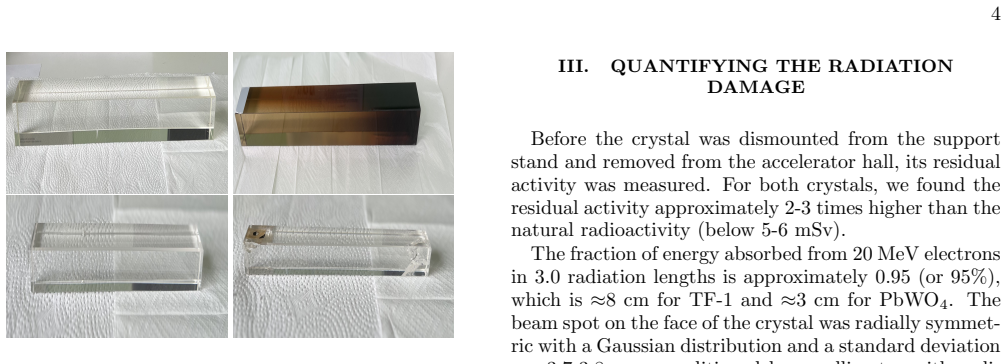
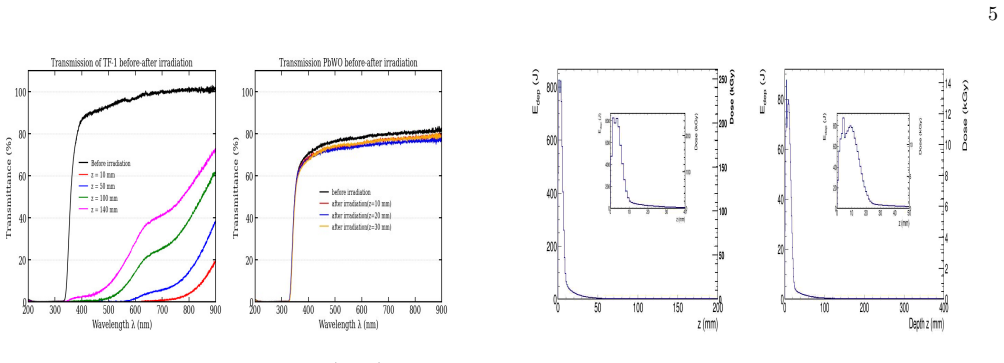
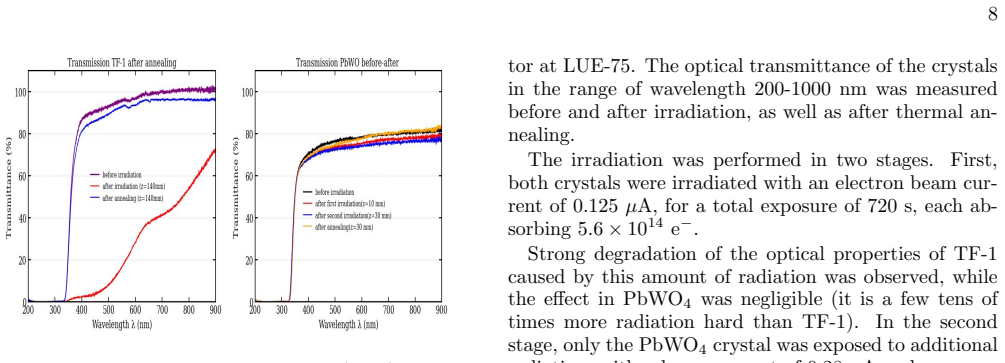
Irradiation with 20 MeV electrons causes strong degradation of the optical transmittance of TF-1 crystals but negligible effect on PbWO4, indicating that PbWO4 is a few tens of times harder to radiation damage than TF-1. Further irradiation of PbWO4 confirms the resistance, and thermal annealing improves transmittance with increasing temperature and time.
What carries the argument
Comparison of pre- and post-irradiation transmittance spectra in the 200-1000 nm range, with two-stage irradiation protocol to quantify differential radiation hardness.
If this is right
- PbWO4 can withstand higher radiation doses without significant loss in optical performance.
- TF-1 requires lower radiation exposure limits or protective measures in applications.
- Thermal annealing can be used to recover some optical properties in irradiated crystals.
- PbWO4 is preferable for use in radiation-intensive settings like particle detectors.
Where Pith is reading between the lines
- These results suggest PbWO4 could extend the lifetime of detectors in high-energy physics experiments.
- The differential hardness might relate to material structure, warranting studies on defect formation mechanisms.
- Annealing protocols could be optimized for faster recovery in practical applications.
- Testing with other radiation types like protons or gammas could confirm if the hardness ratio holds.
Load-bearing premise
That the observed changes in transmittance are caused only by radiation-induced defects and not by other factors like sample heating or non-uniform beam exposure.
What would settle it
Repeating the transmittance measurements on new samples with uniform beam exposure and temperature control, or checking for heating effects during irradiation.
Figures
read the original abstract
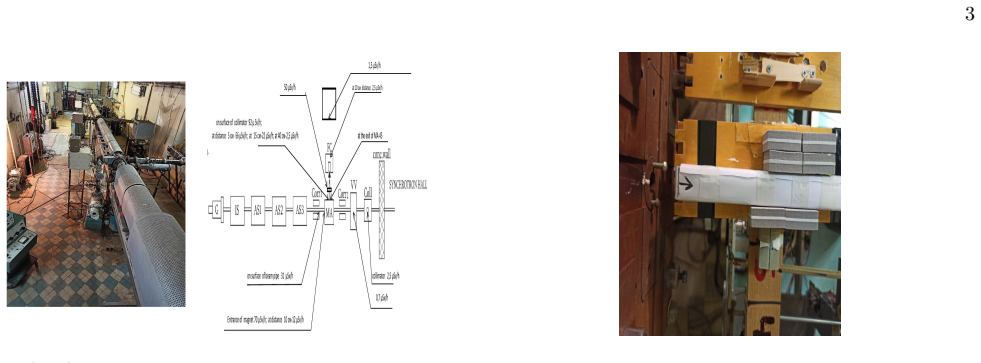
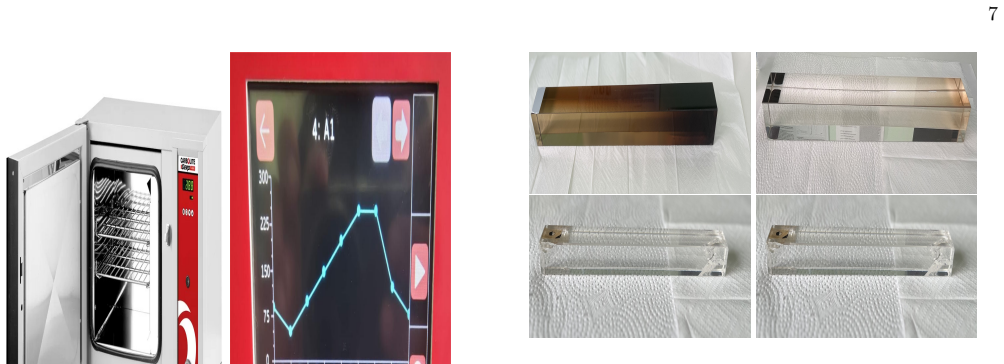
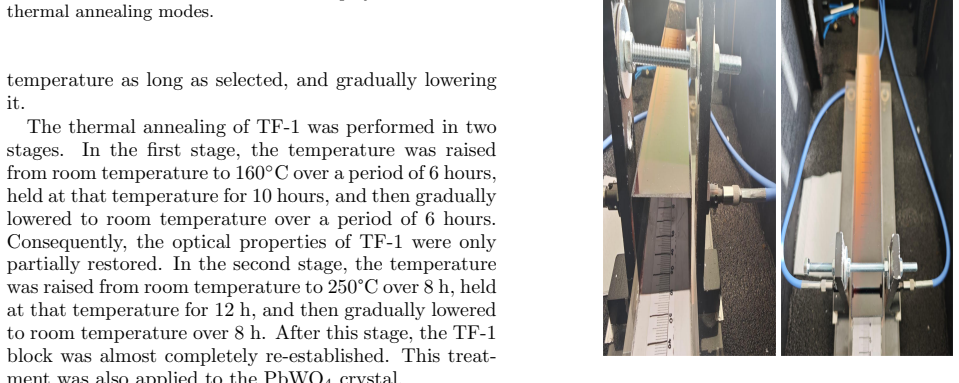
We studied the radiation hardness of two types of crystals, lead glass TF-1 and lead tungstate PbWO$_4$, using a 20 MeV electron beam from the LUE-75 linear accelerator at AANL. The transmittance of the crystals in the wavelength range of 200-1000 nm was measured before and after irradiation, and after thermal annealing. % The irradiation was performed in two stages. First, both crystals were irradiated with beam current of 0.125 $\mu$A, each for a total exposure time of 720 s and absorbing $5.6 \times 10^{14}~e^-$. % Strong degradation of the optical properties of TF-1 caused by this amount of radiation was observed, while the effect on PbWO$_4$ was negligible (it is a few tens of times radiation harder than TF-1). % In the second stage, only the PbWO$_4$ crystal was exposed to radiation, with a beam current of 0.28 $\mu$A and an exposure time of 1200 s, absorbing an additional $2.1 \times 10^{15}e^-$, still no notable effect. % Thermal annealing was performed in the temperature range of 160 to 250$^\circ$C (isochronal) for 10-12 hours. The transmittance of the annealed crystals increased with the annealing temperature and time.
Editorial analysis
A structured set of objections, weighed in public.
Referee Report
Summary. The manuscript reports an experimental study of radiation damage in TF-1 lead glass and PbWO4 crystals using 20 MeV electrons from the LUE-75 accelerator. Transmittance spectra (200-1000 nm) were measured before and after two-stage irradiation (first stage: both crystals receive 5.6×10^14 electrons at 0.125 μA for 720 s; second stage: PbWO4 receives additional 2.1×10^15 electrons at 0.28 μA for 1200 s) and after isochronal annealing (160-250°C for 10-12 h). The central claim is that TF-1 exhibits strong optical degradation while PbWO4 shows negligible change, implying PbWO4 is a few tens of times more radiation hard, with partial transmittance recovery upon annealing.
Significance. If the quantitative transmittance data and controls were provided, the comparative radiation-hardness result would be of modest utility for scintillator or detector material selection in high-radiation environments. The direct observation of differential damage and annealing recovery constitutes a strength of the experimental approach, but the absence of supporting spectra, statistics, or dose-normalized metrics limits the result to a qualitative demonstration rather than a reusable benchmark.
major comments (3)
- [Abstract] Abstract: the statement that PbWO4 'is a few tens of times radiation harder than TF-1' is unsupported by any tabulated transmittance values, change ratios, or dose-scaling analysis; the absorbed electron counts are given but no optical metrics allow verification or reproduction of the factor.
- [Abstract] Abstract (first-stage irradiation paragraph): no sample dimensions, thermal conductivity, mounting details, or in-situ temperature monitoring are described for the 720 s exposure delivering ~2.5 W, so the possibility that beam-induced heating contributes to the TF-1 transmittance loss cannot be excluded and weakens attribution to radiation defects alone.
- [Abstract] Abstract: transmittance is stated to have been measured before/after irradiation and annealing, yet no spectra, error bars, number of samples, or beam-uniformity verification are reported, rendering the qualitative claims of 'strong degradation' versus 'negligible' effect unverifiable from the presented information.
minor comments (2)
- [Abstract] The manuscript would benefit from explicit comparison of the two irradiation stages on a common dose or fluence basis rather than sequential description.
- Standard references to prior radiation-damage studies on PbWO4 (e.g., CMS or other HEP contexts) are absent and would help place the 'few tens of times' claim in context.
Simulated Author's Rebuttal
We thank the referee for the careful review and specific comments on the abstract. We address each point below. Where the comments identify unsupported or missing elements, we have revised the manuscript to correct or qualify the claims and add relevant details.
read point-by-point responses
-
Referee: [Abstract] Abstract: the statement that PbWO4 'is a few tens of times radiation harder than TF-1' is unsupported by any tabulated transmittance values, change ratios, or dose-scaling analysis; the absorbed electron counts are given but no optical metrics allow verification or reproduction of the factor.
Authors: We agree that the specific multiplier 'a few tens of times' is not quantitatively supported by tabulated optical data or dose-scaling analysis in the abstract. The phrasing was a qualitative estimate based on the dose at which TF-1 showed strong degradation versus the higher cumulative dose with no notable effect on PbWO4. In the revised version we will replace this with a more accurate statement that PbWO4 showed negligible degradation at fluences several times higher than those causing damage in TF-1, and we will ensure the main text presents the transmittance changes for verification. revision: yes
-
Referee: [Abstract] Abstract (first-stage irradiation paragraph): no sample dimensions, thermal conductivity, mounting details, or in-situ temperature monitoring are described for the 720 s exposure delivering ~2.5 W, so the possibility that beam-induced heating contributes to the TF-1 transmittance loss cannot be excluded and weakens attribution to radiation defects alone.
Authors: The abstract omits these experimental parameters due to length constraints. We acknowledge that the absence of in-situ temperature monitoring means a contribution from beam-induced heating cannot be excluded on the basis of the reported information. In the revised manuscript we will add sample dimensions, mounting details, and a brief discussion of possible thermal effects (including the estimated power) to the methods section, together with a note on this limitation. revision: yes
-
Referee: [Abstract] Abstract: transmittance is stated to have been measured before/after irradiation and annealing, yet no spectra, error bars, number of samples, or beam-uniformity verification are reported, rendering the qualitative claims of 'strong degradation' versus 'negligible' effect unverifiable from the presented information.
Authors: The abstract is a concise summary; the transmittance spectra before and after irradiation and annealing, together with the experimental conditions, appear as figures and in the results section of the full manuscript. We will revise the abstract to explicitly direct readers to the relevant figures. Number of samples and any associated uncertainties are described in the main text; beam-uniformity verification details will be added if available from the experimental log. revision: partial
Circularity Check
No circularity: purely observational experimental report with no derivations or fitted parameters
full rationale
The paper consists entirely of direct experimental observations: irradiation of crystals with a 20 MeV electron beam in two stages, followed by transmittance measurements (200-1000 nm) before/after exposure and after isochronal annealing (160-250°C). No equations, models, predictions, parameters, or derivations are present in the abstract or described methods/results. Claims of relative radiation hardness are stated as observed outcomes, not derived quantities. This matches the default expectation of no circularity for non-theoretical papers; the reader's assessment of score 0.0 is confirmed by absence of any load-bearing steps that could reduce to inputs by construction.
Axiom & Free-Parameter Ledger
axioms (1)
- domain assumption Transmittance changes measured in 200-1000 nm accurately quantify radiation damage without significant contribution from non-radiation effects.
Reference graph
Works this paper leans on
-
[1]
A strong coordinate dependence of TF-1 was evident from the measurements taken after irradia- tion
and [18, 19]). A strong coordinate dependence of TF-1 was evident from the measurements taken after irradia- tion. This is because of the different amounts of energy deposited by electrons with depth in the crystal, which can be estimated using simulations. Owing to the high radiation resistance of the PbWO4 crystal, this effect was insignificant at this ...
-
[2]
The exact conditions (temperature, duration, atmosphere) depend on the desired outcome and initial conditions of the crystal (e.g., as-grown, doped, or irra- diated)
or lead tungstate (PbWO 4) crystals involves specific heating and cooling cycles in a controlled atmosphere to reduce crystal defects, relieve internal stresses, and im- prove properties such as the light output and radiation hardness. The exact conditions (temperature, duration, atmosphere) depend on the desired outcome and initial conditions of the crys...
-
[3]
Antoniazi et all,The experiment 705 electromagnetic shower calorimeter,Nucl.Instrum
L. Antoniazi et all,The experiment 705 electromagnetic shower calorimeter,Nucl.Instrum. Meth.A 332(1993) 57-77, https://doi.org/10.1016/0168-9002(93)90741-Y
-
[4]
Brikman et all,A combined photon-hadron hodoscope calorimeter,Nucl
C. Brikman et all,A combined photon-hadron hodoscope calorimeter,Nucl. Instrum. Meth.A 269(1988) 10-108, https://doi.org/10.1016/0168-9002(88)90866-2
-
[5]
Mkrtchyan, H. et al.,The lead-glass electromagnetic calorimeters for the magnetic spectrometers in Hall C at Jefferson Lab, Nucl. Instrum. Meth.A 719(2013) 85, https://doi.org/10.1016/j.nima.2013.03.070
-
[6]
A. J. R. Puckett,Recoil Polarization Measure- ment of the Proton Electromagnetic Form Factor Ratio to High Momentum Transfer, Ph.D. the- 9 sis, MIT (2009), arXiv:1508.01456 [nucl-ex], 2015, https://doi.org/10.48550/arXiv.1508.0145
work page internal anchor Pith review Pith/arXiv arXiv doi:10.48550/arxiv.1508.0145 2009
-
[7]
A. J. R. Puckett et al.,Technical Supplement to Polarization Transfer Observables in Elastic Electron-Proton Scattering at Q2 = 25, 5.2, 6.8 and 8.5 GeV2, arXiv:1707.07750 [nucl-ex], 2017, https://doi.org/10.48550/arXiv.1707.07750
-
[8]
A. J. R. Puckett et al.,Polarization Transfer Observ- ables in Elastic Electron Proton Scattering at Q2=2.5, 5.2, 6.8, and 8.5 GeV 2,Phys. Rev.C 96(2017) 055203, https://doi.org/10.1103/PhysRevC.96.055203
-
[9]
Marco Paganoni,The CMS electromagnetic calorime- ter,Nucl. Instrum. Meth.A 535(2004) 461–465, https://doi.org/10.1016/j.nima.2004.07.174
-
[10]
M. Kubantsev, Ilya Larin, A. Gasparyan for the PrimEx Collaboration,Performance of the PrimEx electromag- netic calorimeter,AIP Conference Proceedings867(1) (2006) 51–58, arXiv:physics/0609201 [physics.ins-det], https://doi.org/10.1063/1.2396938
-
[11]
JLab Neutral Particle Spectrometer Collaboration: Tanja Horn (Catholic U.) for the collaboration,A PbWO4 based Neutral Particle Spectrometer in Hall C at 12 GeV JLab, J.Phys.Conf.Ser.587(2015) 1, 012048, doi:10.1088/1742-6596/587/1/012048
-
[12]
PANDA Collaboration: W. Erni et al.,Technical design report for PANDA electromagnetic calorime- ter (EMC), arxiv.org/abs/0810.1216v1 (2008), https://doi.org/10.48550/arXiv.0810.1216
-
[13]
R. Abdul Khalek et al.,Science Requirements and Detector Concepts for the Electron-Ion Collider: EIC Yellow Report,Nucl. Phys.A 1026(2022) 122447, https://doi.org/10.1016/j.nuclphysa.2022.122447
-
[14]
Lytcarino factory of optical glasses, 140061, Lytkarino, Moskow
-
[15]
s r.o., Na lukach 2283, 51101 Turnov, Czech Republic, https://www.crytur.com/contact/
CRYTUR spol. s r.o., Na lukach 2283, 51101 Turnov, Czech Republic, https://www.crytur.com/contact/
-
[16]
A. S. Hakobyan,Status of Electron Linear Accelerator LUE-75 of the A. Alikhanyan National Science Labora- tory and Stability of Electron Beam Energy,J Contemp. Phys. (Armenian Academy of Sciences)56(2022) 169- 176, doi: 10.3103/S1068337221030038
-
[17]
S. Burachas et al.Lead tungstate PbWO4 crystals for high energy physics,Journal of Crystal Growth198- 199(1999) 881-884, https://doi.org/10.1016/S0022- 0248(98)01237-8
-
[18]
Tanja Horn in collaboration with eRD-1,Em calorimeter technologies for EIC, https://indico.bnl.gov/event/7449/contributions/35966/ attachments/27177/41430/EIC-DWG-Calo- 03192020.pdf
-
[19]
B. D. Schaefer, R.E. Mitchell, P.McChesney, M.R. Shep- herd, J.M. Frye,Radiation Damage of F8 Lead Glass with 20 MeV Electrons, arXiv:1107.3332v2 [physics.iinst-det] 18 Jan 2012
Pith/arXiv arXiv 2012
-
[20]
H. Mkrtchyan et al.,Lead Tungstate Electromag- netic Calorimeter Prototype Built in AANL for EIC,EPJ Web of Conferences,320(2025) 00049, https://doi.org/10.1051/epjconf/202532000049
-
[21]
Mkrtchyan et al.,A Prototype of Electromagnetic Calorimeter Constructed of Lead Tungstate,J Contemp
H. Mkrtchyan et al.,A Prototype of Electromagnetic Calorimeter Constructed of Lead Tungstate,J Contemp. Phys. (Armenian Academy of Sciences)59(1) (2024) 11–16, doi:10.1134/S1068337224700026
-
[22]
Agostinelli et al.,Geant4—a simulation toolkit, Nucl
S. Agostinelli et al.,Geant4—a simulation toolkit, Nucl. Instrum. Meth.A 506(2003) 250–303, https://doi.org/10.1016/S0168-9002(03)01368-8
-
[23]
Particle Data Group,Section 34, Passage of Par- ticles Through Matter, http://pdg.lbl.gov (Accessed: 03.03.2026)
2026
-
[24]
Wenliang Zhu, Xiqi Feng, Zhonghua Wu, Zhenyong Man, On the annealing mechanism in PbWO 4 crystals,Phys. Condens. MatterB 324(2002) 53-58, https://doi.org/10.1016/s0921-4526(02)01269-3
-
[25]
Baoguo Han, Xiqi Feng, Guanqin Hu, Yanxing Zhang, and Zhiwen Yin,Annealing effects and ra- diation damage mechanisms of PbWO4 single crys- tals,Journal of Applied Physics86(1999), 3571; https://doi.org/10.1063/1.371260
-
[26]
C.H. Yang, G. Chen, B. Wang, P.F. Shi,Effect of an- nealing on the luminescence property of PbWO 4 crystals grown by the Czochralski method,Cryst. Res. Technol.36 (2001) 543-547
2001
discussion (0)
Sign in with ORCID, Apple, or X to comment. Anyone can read and Pith papers without signing in.