REVIEW 4 major objections 5 minor 23 references
Automatically Identifying Comparator Groups on Twitter for Digital Epidemiology of Pregnancy Outcomes
T0 review · 4 major / 5 minor · reviewed 2026-08-14 · deepseek-v4-flash
Pith's one-line read Twitter timelines can be scanned automatically to find users reporting a term pregnancy and a normal-weight baby from the same pregnancy, at a user-level F1-score of 0.933.
desk verdict The reported 0.933 F1 is real on the tested sample, but that sample is preselected by the same regexes the pipeline depends on, so the deployment claim needs an end-to-end evaluation. read the letter →
The pith
A machine-rendered reading of the paper's core claim, the machinery that carries it, and where it could break.
The reading
What carries the argument
The load-bearing device is the temporal same-pregnancy link: a user enters the comparator group only if the classifier marks one 'term pregnancy' tweet positive and one 'normal birthweight' tweet positive within 50 days of each other — the rule that separates one completed pregnancy from reports scattered across two pregnancies or borrowed from another person's baby. Around it sits the rest of the machinery: hand-crafted regular expressions, augmented with automatically generated lexical variants such as misspellings and abbreviations, that retrieve candidate tweets from a database of users who announced pregnancy; pre-filtering rules that drop bot-like accounts; normalization of matched phrases into '_term_' and '_normalbirthweight_' tokens; and the majority-voting ensemble of a decision tree, logistic regression, and a support vector machine with radial-basis kernel, trained on 1,851 annotated tweets using word n-grams and word clusters as features.
What would settle it
Take a random sample of users the pipeline places in the comparator group and verify their outcomes independently — by survey, by a second annotator reading the full timeline, or by linked birth records — and count how many actually had a full-term birth at normal weight in the same pregnancy; the paper's own test-set comparison already shows that a 125-day window changes the numbers, so the same-pregnancy rule is directly testable.
Extended reading notes
Core claim
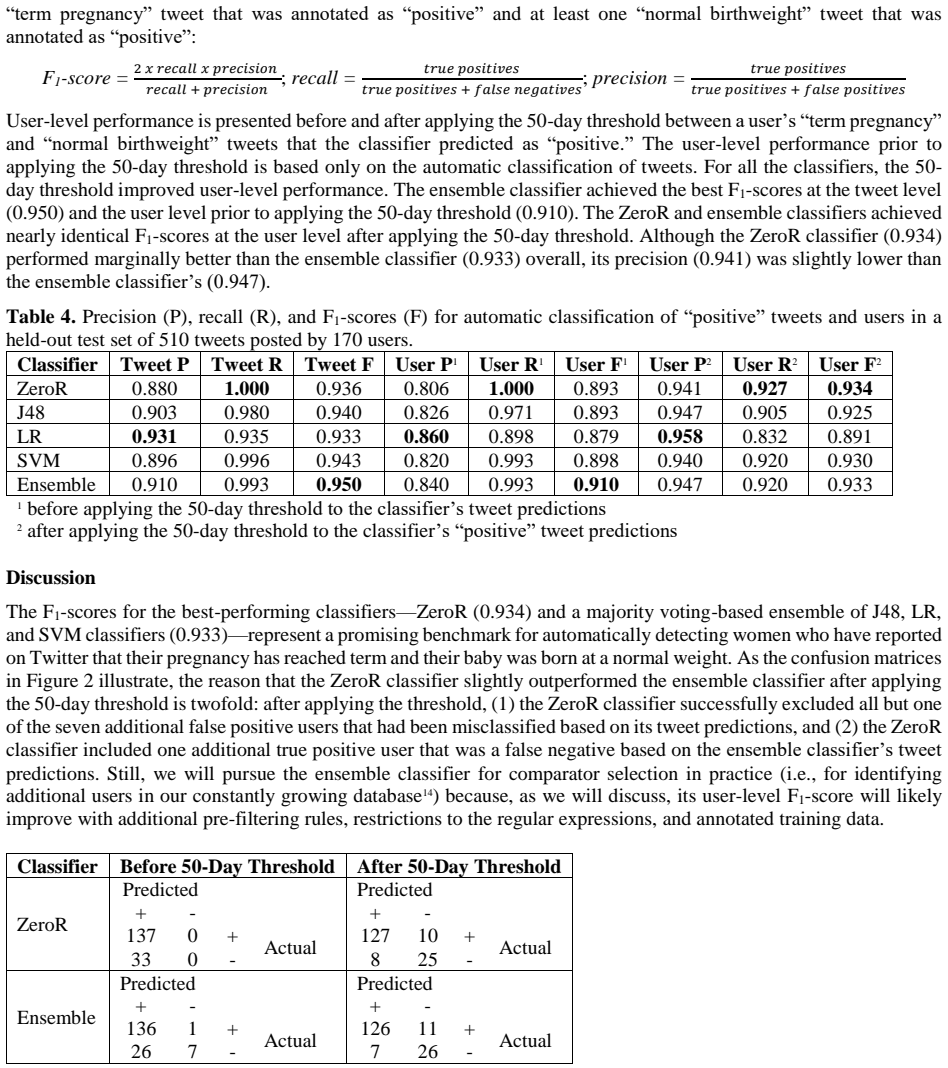
The discovery is that a user-level judgment — 'this person reported a term pregnancy and a normal-weight baby for the same pregnancy' — can be automated end to end from raw tweets. Tweet classification alone, with a majority-voting ensemble of a decision tree, logistic regression, and a support vector machine over n-gram and word-cluster features, reaches an F1-score of 0.950. Adding the 50-day constraint lifts user-level performance to precision 0.947, recall 0.920, and F1 0.933, up from 0.910 before the constraint. The same-pregnancy link is the point: users fail the test not only when a tweet is about someone else's baby or a preterm '36 weeker', but also when a term tweet and a birthweight tweet belong to different pregnancies. The paper further reports that a 125-day window evaluated on the test set yields F1 0.967, and that a majority-class baseline nearly ties the ensemble, evidence that the high-precision retrieval patterns rather than the classifier carry most of the signal.
Load-bearing premise
The evaluation assumes the annotators' guidelines plus the 50-day same-pregnancy rule define what a true 'term pregnancy with normal birthweight' report is, and the paper offers no external check — clinical records, surveys, or registries — that these tweet-based labels correspond to real pregnancy outcomes.
Editorial extensions
If this is right
- Comparator groups can grow much larger, because the pipeline removes the manual timeline-verification step that had capped the earlier case-control study at one control per case.
- Excluding users who reported a miscarriage, stillbirth, preterm birth, or low birthweight makes the comparison group a cleaner baseline for studying those very outcomes.
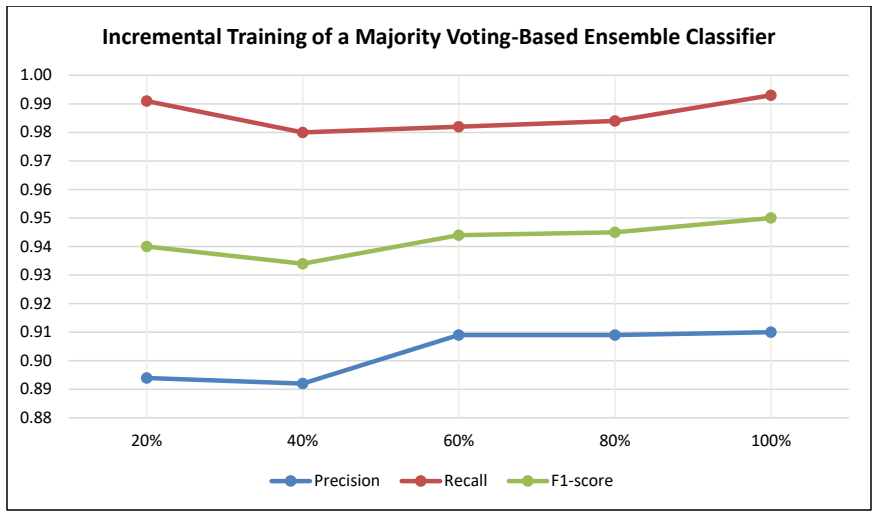
- A 125-day same-pregnancy window evaluated on the test set raises recall to 0.956 and F1 to 0.967, and the paper's learning curve projects further gains from more annotated data, so the deployed system may beat the reported 0.933.
- The pipeline is intended to be run against a constantly growing database of pregnancy-announcing users, so comparator cohorts can accumulate prospectively rather than being assembled by hand.
- The majority-class baseline (ZeroR) nearly ties the ensemble at the user level (F1 0.934 vs 0.933), and the paper's confusion-matrix analysis attributes the tiny gap to one-user differences — yet it will deploy the ensemble because its tweet-level accuracy is expected to keep improving.
Reading between the lines
- Because 88% of the annotated tweets were positive, the regular-expression retrieval appears to be doing most of the hard filtering; a deployment that loosens the query patterns to gain recall would shift the discrimination burden onto the tweet classifier, whose reported F1 may not survive that shift.
- The pipeline's polarity is easily reversed: analogous patterns for '36 weeker', NICU stays, or birth weights under 5 lb 8 oz could turn the comparator finder into a case finder for preterm or low-birthweight outcomes, giving both arms of a case-control study from one system.
- The 50-day window was tuned on cross-validation predictions, while the paper's own test-set comparison shows 125 days performs better (F1 0.967); because a '38 weeks' tweet and a birth announcement are physiologically constrained to be roughly zero to six weeks apart, the window's calibration against true gestational timing remains an open question.
- The gold standard has no external anchor: a follow-up validation that surveys a sample of identified users or links them to birth records would reveal whether 'term plus normal birthweight' tweets are genuine pregnancy outcomes or truthful statements that occasionally describe a different pregnancy.
Signed reviews
Editorial analysis
A structured set of objections, weighed in public.
Referee Report
Summary. The paper presents an NLP pipeline for automatically identifying Twitter users who report that their pregnancy reached term and that their baby was born at a normal weight, with the goal of selecting comparator groups for observational studies of adverse pregnancy outcomes. The pipeline consists of handcrafted regular expressions for tweet retrieval, pre-filtering rules to remove non-personal accounts, tweet-level classification (ZeroR, J48, logistic regression, SVM, and a majority-voting ensemble), and a 50-day temporal threshold to link a term-pregnancy tweet and a normal-birthweight tweet to the same pregnancy. The authors annotated 2,361 tweets from 847 users, split by user into training and held-out test sets, and report a user-level F1-score of 0.933 for the ensemble classifier after applying the 50-day threshold.
Significance. If the reported performance held in deployment, the pipeline would be a valuable tool for constructing larger and more valid comparator groups in social-media-based pregnancy outcome research, a field that currently relies on weak exclusion-based controls. The paper has notable strengths: the train/test split is performed at the user level, inter-annotator agreement is reported (Cohen's κ = 0.80), and the temporal threshold is selected on training predictions rather than on the test set. However, the significance is strongly tempered by the fact that the evaluation population is limited to users who already matched both the term-pregnancy and normal-birthweight regular expressions, and by a post-hoc test-set evaluation of a different threshold. The near-tie with the ZeroR baseline also raises the question of how much of the reported performance is due to the supervised classifiers versus the handcrafted retrieval and thresholding rules.
major comments (4)
- [Data Collection; Results, Classification] The test set is drawn exclusively from the 847 users who already had at least one tweet matching a 'term pregnancy' regex and at least one matching a 'normal birthweight' regex. Therefore, the reported user-level F1 of 0.933 is a conditional measure: it estimates performance only on users for whom regex retrieval already succeeded. In the deployment population of all pregnancy announcers, recall is the product of regex recall, pre-filtering recall, classifier recall, and the temporal-threshold recall; the paper only measures the latter two. Because the regexes are explicitly designed as high-precision patterns, they likely miss paraphrased or non-lexical reports, and no experiment quantifies this loss. The conclusion that the pipeline 'will be deployed to identify large comparator groups' requires an end-to-end evaluation on a random sample of the underlying database, or at least an explicit statement of the unmeasured components and a conservative estimate of deployment performance.
- [Discussion] The paragraph reporting that 'in evaluating a higher, 125-day threshold directly on the annotated test set' F1 improved to 0.967 is a post-hoc use of the test set for model selection. These numbers are not unbiased estimates of performance for an a priori chosen threshold; presenting them as evidence that 'increasing the temporal threshold will improve user-level performance' overstates what the test set can support. Either pre-specify the threshold, use nested cross-validation on the training set, or clearly label this analysis as exploratory and separate from the main held-out evaluation.
- [Results, Classification] The reported composition of the test set is arithmetically inconsistent: '137 users reporting a term pregnancy and normal birthweight for the same pregnancy, 13 users reporting a term pregnancy and normal birthweight for different pregnancies, and 80 users did not post at least one...' sums to 230 users, not the stated 170. The confusion matrices in Figure 2 appear to correspond to 137 true-positive users and 33 true-negative users, totaling 170. Please reconcile these numbers and precisely define the user-level ground-truth categories, including how users without at least one positive term tweet and one positive normal-birthweight tweet are labeled.
- [Classification, Table 4] The ZeroR baseline achieves a user-level F1 of 0.934 after the 50-day threshold, essentially matching the ensemble's 0.933, with the ensemble's advantage limited to precision (0.947 versus 0.941). Because ZeroR predicts every tweet as positive, the post-threshold ZeroR rule is almost equivalent to 'user has a term regex hit and a birthweight regex hit within 50 days.' This suggests that the handcrafted regexes, pre-filtering, and temporal threshold account for nearly all of the pipeline's performance, and the supervised classifiers provide little measurable benefit on this test set. To support the abstract's claim that the approach uses supervised machine learning 'as a basis' for detection, the authors should report confidence intervals or a significance test of the F1 difference and show that the learned classifiers contribute beyond the regex-intersection rule.
minor comments (5)
- [Abstract; Conclusion] Please qualify the F1-score of 0.933 as measured on users who already matched both the term-pregnancy and normal-birthweight regular expressions, to avoid implying end-to-end performance on the full pregnancy-announcer database.
- [Table 4; Figure 2] Define the superscripts 1 and 2 in Table 4 in the caption (before and after the 50-day threshold), and reformat Figure 2's confusion matrices with explicit row and column labels so that predicted and actual classes are unambiguous.
- [Results, Annotation] The paper reports κ = 0.80 on 2,170 overlapping annotations out of 2,361 tweets; please clarify how the remaining 191 tweets were handled (single annotator, adjudication, or exclusion).
- [Classification] State the search range and selection criterion used to choose the 50-day threshold on the cross-validated training predictions (e.g., the threshold maximizing user-level F1), so that readers can assess the risk of threshold overfitting.
- [Introduction] When describing the database of 'more than 100,000 users who have announced their pregnancy,' specify that the deployment denominator for comparator selection is this population, and briefly note that the current evaluation addresses only the subpopulation that matches the retrieval patterns.
Circularity Check
Headline user-level F1 is a legitimate held-out evaluation; the only circular step is the post-hoc 125-day threshold fitted directly on the test set and then offered as a predicted improvement.
-
fitted input called prediction
[Discussion, paragraph on the 125-day threshold]
"However, in evaluating a higher, 125-day threshold directly on the annotated test set, we found that recall increased from 0.920 to 0.956, with an increase in precision (from 0.947 to 0.978) and F1-score (from 0.933 to 0.967) as well. Thus, improving the performance of tweet-level classification and increasing the temporal threshold will improve user-level performance."
Unlike the 50-day threshold, which was selected using cross-validated predictions on the training set, the 125-day threshold is evaluated directly on the held-out test set. Reporting the resulting metrics and then asserting that 'increasing the temporal threshold will improve user-level performance' makes the improvement a consequence of having fitted the threshold to the test labels rather than an independent prediction. The improved F1 is therefore a test-set fit presented as a forward-looking result, though it is peripheral to the headline 50-day evaluation.
full rationale
The paper's central claim is an empirical performance measurement, not a mathematical derivation: a stratified held-out test set of 510 tweets from 170 users is used to compute tweet- and user-level precision/recall/F1, with SVM hyperparameters and the 50-day same-pregnancy threshold selected on training folds via cross-validation. Human annotation, not the classifier, defines the gold standard, and the handcrafted regexes are only a retrieval filter, so the headline estimate is not equivalent to the model's inputs by construction. Self-citations (cohort database, birth-defect corpus, medication classifier) supply background or data infrastructure but are not the load-bearing justification for the reported F1. The main caveat is external validity: because the evaluation population is restricted to users whose tweets already match the term and normal-birthweight regexes, the reported recall is conditional on regex retrieval and does not estimate deployment recall over all pregnancy announcers. That is a sampling/generalizability limitation, not circularity, so it does not raise the score. The one genuine circular step is the 125-day threshold experiment in the Discussion: this threshold is evaluated directly on the annotated test set and its improved metrics are then used to claim that increasing the temporal threshold 'will improve user-level performance,' which is fitting a parameter to the test set and presenting the result as a prediction. This does not affect the headline 50-day result, so the overall circularity is minor.
Assumptions & free parameters
free parameters (3)
- Temporal proximity threshold (days) =
50 days
- SVM cost parameter c =
128
- SVM negative-class weight =
8.5
assumptions (4)
- domain assumption Manual annotation is a valid gold standard for detecting reports of term pregnancy and normal birthweight.
- ad hoc to paper A 50-day gap between a positive term tweet and a positive normal-birthweight tweet indicates the same pregnancy.
- domain assumption Users who matched both term and NB regex patterns represent the population for comparator selection.
- domain assumption Tweet text features generalize across users.
Cite this review
Pith. "Pith review of Automatically Identifying Comparator Groups on Twitter for Digital Epidemiology of Pregnancy Outcomes." pith.science (2026). https://pith.science/paper/O43QNRRY
@misc{pith2026190806015,
  author       = {Pith},
  title        = {Pith review of: Automatically Identifying Comparator Groups on Twitter for Digital Epidemiology of Pregnancy Outcomes},
  year         = {2026},
  howpublished = {\url{https://pith.science/paper/O43QNRRY}},
  note         = {Machine review of arXiv:1908.06015}
}
read the original abstract
Despite the prevalence of adverse pregnancy outcomes such as miscarriage, stillbirth, birth defects, and preterm birth, their causes are largely unknown. We seek to advance the use of social media for observational studies of pregnancy outcomes by developing a natural language processing pipeline for automatically identifying users from which to select comparator groups on Twitter. We annotated 2361 tweets by users who have announced their pregnancy on Twitter, which were used to train and evaluate supervised machine learning algorithms as a basis for automatically detecting women who have reported that their pregnancy had reached term and their baby was born at a normal weight. Upon further processing the tweet-level predictions of a majority voting-based ensemble classifier, the pipeline achieved a user-level F1-score of 0.933, with a precision of 0.947 and a recall of 0.920. Our pipeline will be deployed to identify large comparator groups for studying pregnancy outcomes on Twitter.
Figures

Reference graph
Works this paper leans on
-
[1]
A system atic review to calculate background miscarriage rates using life table analysis
Ammon Avalos L, Galindo C, Li DK. A system atic review to calculate background miscarriage rates using life table analysis. Birth Defects Res A Clin Mol Teratol. 2012;94(6):417-423
work page 2012
-
[2]
Xu J, Murphy SL, Kochanek K, Bastian B, Arias E. Deaths: final data for 2016. Natl Vital Stat Rep. 2018;67(5)
work page 2016
-
[3]
Estimated pregnancy rates and rates of pregnancy outcomes for the United States, 1990-2008
Ventura SJ, Curtin SC, Abma JC. Estimated pregnancy rates and rates of pregnancy outcomes for the United States, 1990-2008. Natl Vital Stat Rep. 2012;60(7)
work page 1990
-
[4]
Update on overall prevalence of major birth defects—Atlanta, Georgia, 1978-2005
Rynn L, Cragan J, Correa A. Update on overall prevalence of major birth defects—Atlanta, Georgia, 1978-2005. MMWR Morb Mortal Wkly Rep. 2008;57(1):1-5
work page 1978
-
[5]
Fetal and perinatal mortality: United States, 2013
MacDorman MF, Gregory ECW. Fetal and perinatal mortality: United States, 2013. Natl Vital Stat Rep. 2015;64(8)
work page 2013
-
[6]
Ferré C, Callaghan W, Olson C, Sharma A, Barfield W. Effects of maternal age and age -specific preterm birth rates on overall preterm birth rates —United States, 2007 and 2014. MMWR Morb Mortal Wkly Rep. 2016;65(43):1181-1184. 0.88 0.89 0.90 0.91 0.92 0.93 0.94 0.95 0.96 0.97 0.98 0.99 1.00 20% 40% 60% 80% 100% Incremental Training of a Majority Voting-Ba...
work page 2007
-
[7]
Liu L, Johnson HL, Cousens S, Perin J, Scott S, Lawn JE, Rudan I, Campbell H, Cibulskis R, Li M, Mathers C, Black RE. Global, regional, and national causes of child mortality: an updated systematic analysis for 2010 with time trends since 2000. Lancet. 2012;379(9832):2151-2161
work page 2010
-
[8]
Epidemiology and the medical causes of miscarriage
Regan L, Rai R. Epidemiology and the medical causes of miscarriage. Baillieres Best Pract Res Clin Obstet Gynaecol. 2000;14(5):839-854
work page 2000
Show all 23 references
-
[9]
Comparison of the aetiology of stillbirth over five decades in a single centre: a retrospective study
Wou K, Ouellet MP, Chen MF, Brown RN. Comparison of the aetiology of stillbirth over five decades in a single centre: a retrospective study. BMJ Open. 2014;4(6):e004635
2014
-
[10]
BMJ 2017;357:j2249
Feldkamp ML, Carey JC, Byrne JLB, Krikov S , Botto LD Etiology and clinical presentation of birth defects: population based study. BMJ 2017;357:j2249
2017
-
[11]
Spontaneous preterm birth, a clinical dilemma: etiologic, pathophysiologic and genetic heterogeneities and racial disparity
Menon R. Spontaneous preterm birth, a clinical dilemma: etiologic, pathophysiologic and genetic heterogeneities and racial disparity. Acta Obstet Gynecol Scand. 2008;87(6):590-600
2008
-
[12]
Social Media Use in 2018
Smith A, Anderson M. Social Media Use in 2018. Pew Research Center Report. 2018. https://www.pewinternet.org/2018/03/01/social-media-use-in-2018/ (accessed 2019 June 17)
2018
-
[13]
Social media mining for birth defects research: a rule -based, bootstrapping approach to collecting data for rare health -related events on Twitter
Klein AZ, Sarker A, Cai H, Weissenbacher D, Gonzalez -Hernandez G. Social media mining for birth defects research: a rule -based, bootstrapping approach to collecting data for rare health -related events on Twitter. J Biomed Inform. 2018;87:68-78
2018
-
[14]
Discovering cohorts of pregnant women from social media for safety surveillance and analysis
Sarker A, Chandrashekar P, Magge A, Cai H, Klein A, Gonzalez G. Discovering cohorts of pregnant women from social media for safety surveillance and analysis. J Med Internet Res. 2017;19(10):e361
2017
-
[15]
Pharmacoepidemiologic evaluation of birth defects from health -related postings in social media during pregnancy
Golder S, Chiuve S, Weissenbacher D, Klein A, O’Connor K, Bland M, Malin M, Bhattacharya M, Scarazinni LJ, Gonzalez-Hernandez G. Pharmacoepidemiologic evaluation of birth defects from health -related postings in social media during pregnancy. Drug Saf. 2019;42(3):389-400
2019
-
[16]
Detecting personal medication intake in Twitter: an annotated corpus and baseline classification system
Klein AZ, Sarker A, Rouhizadeh M, O’Connor K, Gonzalez G. Detecting personal medication intake in Twitter: an annotated corpus and baseline classification system. In: Proceedings of the BioNLP 2017 Workshop; 2017 Aug 4; Vancouver, Canada. Association for Computational Linguist...
2017
-
[17]
A systematic review of pregnancy exposure registries: examination of protocol -specified pregnancy outcomes, target sample size, and comparator selection
Gelperin K, Hammad H, Leishear K, Bird ST, Taylor L, Hampp C, Sahin L. A systematic review of pregnancy exposure registries: examination of protocol -specified pregnancy outcomes, target sample size, and comparator selection. Pharmacoepidemiol Drug Saf. 2017;26(2):208-214
2017
-
[18]
Risk of adverse birth outcome and miscarriage in pregnant users of non -steroidal anti -inflammatory drugs: population based observational and case -control study
Nielsen GL, S ørenson HT, Larsen H, Pedersen L. Risk of adverse birth outcome and miscarriage in pregnant users of non -steroidal anti -inflammatory drugs: population based observational and case -control study. BMJ. 2001;322:266
2001
-
[19]
An unsupervised and c ustomizable misspelling generator for mining n oisy health-related text sources
Sarker A, Gonzalez -Hernandez G. An unsupervised and c ustomizable misspelling generator for mining n oisy health-related text sources. J Biomed Inform. 2018;88:98-107
2018
-
[20]
Top Names of the Period 2010 -2018
Social Security Administration. Top Names of the Period 2010 -2018. 2019. https://www.ssa.gov/oact/babynames/decades/names2010s.html
2010
-
[21]
An algorithm for suffix stripping
Porter MF. An algorithm for suffix stripping. Program. 1980;14(3):130 -137
1980
-
[22]
Part-of-speech tagging for Twitter: word clusters and other advances
Owoputi O, O’Connor B, Dyer C, Gimpel K, Schneider N. Part-of-speech tagging for Twitter: word clusters and other advances. 2012. http://www.cs.cmu.edu/~ark/TweetNLP/owoputi+etal.tr12.pdf
2012
-
[23]
Understanding interobserver agreement: the kappa statistic
Viera AJ, Garret JM. Understanding interobserver agreement: the kappa statistic. Fam Med. 2005;37(5):360-363
2005
Reviewed August 14, 2026 · model on record in the stance chip above.
Discussion (0). Continue with ORCID to comment.