Quantum-Native Maximum Likelihood Detection in Random Access Channel with Overloaded MIMO
Pith reviewed 2026-05-20 03:18 UTC · model grok-4.3
The pith
Quantum-native maximum likelihood detection achieves optimal performance in overloaded MIMO while reducing Grover rotations by up to 65 percent.
A machine-rendered reading of the paper's core claim, the machinery that carries it, and where it could break.
Core claim
The paper claims that formulating maximum likelihood detection as a binary optimization problem and solving it via Grover adaptive search with search space reduction and tuned parameters achieves the same optimal detection performance as exhaustive search while cutting the required Grover rotation count by up to approximately 65 percent compared with conventional Grover adaptive search.
What carries the argument
Grover adaptive search applied to a binary optimization reformulation of maximum likelihood detection, augmented by search space reduction and probability-based parameter tuning.
Load-bearing premise
The maximum likelihood detection problem can be exactly reformulated as a binary optimization problem whose solution via Grover adaptive search preserves optimality, assuming fault-tolerant quantum hardware that runs without decoherence.
What would settle it
A quantum simulation or hardware run in which the proposed detector produces a higher error rate than classical exhaustive search or fails to reduce the Grover rotation count by a substantial fraction would falsify the optimality and efficiency claims.
Figures




read the original abstract
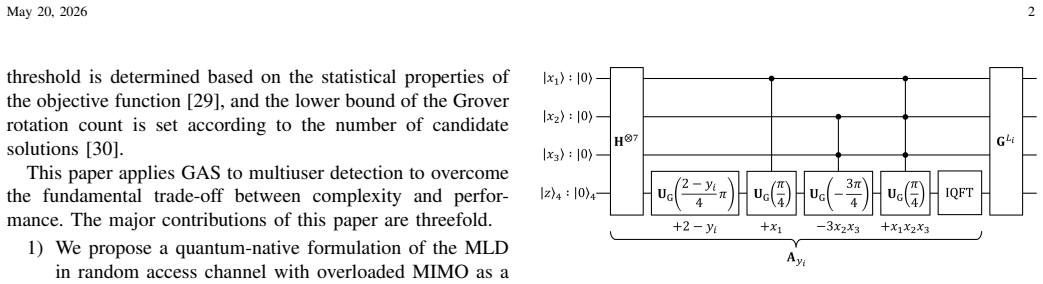
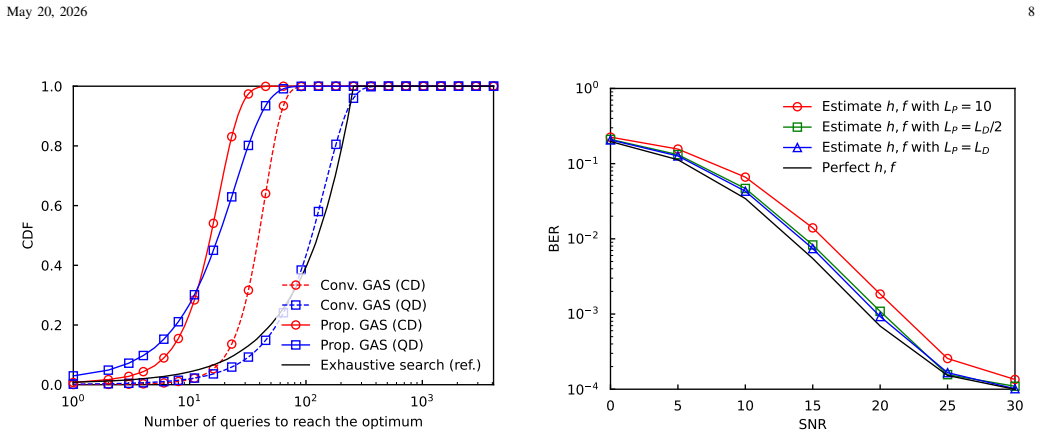
In this paper, we propose a quantum-native formulation of maximum likelihood detection (MLD) for overloaded multiple-input multiple-output (MIMO) systems in a random access channel, where numerous user terminals share the same channel resource and asynchronously transmit signals. Classical linear detectors suffer from significant performance degradation in this scenario, whereas the exhaustive-search MLD achieves the optimal performance but incurs an exponential computational complexity. To overcome this trade-off, we formulate the MLD as a binary optimization problem and solve it via Grover adaptive search (GAS) -- a quantum exhaustive search algorithm offering quadratic speedup in fault-tolerant quantum computing. We then introduce a search space reduction technique to substantially decrease the required computational resources. In addition, we investigate efficient parameter settings for GAS through probability analysis to improve convergence performance. We demonstrate that the proposed detector achieves the optimal detection performance while reducing the required Grover rotation count to reach the solution by up to approximately 65% compared with the conventional GAS, showing its potential as a viable solution for future quantum-accelerated wireless systems.
Editorial analysis
A structured set of objections, weighed in public.
Referee Report
Summary. The manuscript proposes a quantum-native maximum likelihood detection method for overloaded MIMO systems in random access channels. It reformulates the MLD problem as a binary optimization problem and solves it using Grover adaptive search (GAS), introducing a search space reduction technique that reportedly reduces the number of Grover rotations by up to 65% while achieving optimal detection performance. The work also includes analysis for efficient GAS parameter settings.
Significance. If the search space reduction is shown to preserve the exact optimality of the ML solution and the simulation results are statistically robust, this could represent a meaningful step toward practical quantum-accelerated signal detection in wireless systems, leveraging the quadratic speedup of quantum search algorithms in fault-tolerant quantum computing. The probability analysis for GAS parameters is a useful contribution to improving convergence.
major comments (2)
- The search space reduction technique is key to the claimed 65% reduction in Grover rotations. However, without a clear demonstration that the reduced space always includes the global optimum (e.g., via mathematical equivalence or exhaustive checks in simulations), the optimality claim is at risk, particularly in overloaded MIMO with asynchronous users.
- Numerical Results section: the comparison to classical MLD should include statistical error bars and specify the number of trials to validate that the quantum detector achieves identical performance.
minor comments (1)
- Clarify the exact nature of the search space reduction (e.g., is it based on norm thresholds or timing estimates?) to allow readers to assess its generality.
Simulated Author's Rebuttal
We thank the referee for the constructive comments, which will help strengthen the presentation and rigor of our work. We address each major comment in detail below and outline the specific revisions planned for the next version of the manuscript.
read point-by-point responses
-
Referee: The search space reduction technique is key to the claimed 65% reduction in Grover rotations. However, without a clear demonstration that the reduced space always includes the global optimum (e.g., via mathematical equivalence or exhaustive checks in simulations), the optimality claim is at risk, particularly in overloaded MIMO with asynchronous users.
Authors: We agree that an explicit demonstration of optimality preservation is essential. The reduction technique eliminates candidate vectors whose Euclidean distance to the received signal exceeds a threshold derived from the noise variance and the asynchronous user model, while retaining all vectors that could achieve the minimum distance. In the revised manuscript we will add a dedicated subsection containing a formal proof that the global ML solution is always retained under this criterion, leveraging the structure of the overloaded MIMO random-access signal model. We will also include exhaustive enumeration results for small-scale instances (up to 4 users) with asynchronous offsets to empirically confirm that the reduced space contains the optimum in every trial. revision: yes
-
Referee: Numerical Results section: the comparison to classical MLD should include statistical error bars and specify the number of trials to validate that the quantum detector achieves identical performance.
Authors: We concur that statistical validation strengthens the comparison. In the revised Numerical Results section we will add error bars representing the standard deviation across independent Monte Carlo trials and will explicitly state that each BER/SNR point is obtained from 10,000 independent channel and noise realizations. This will confirm that the proposed detector matches classical MLD performance within statistical fluctuations. revision: yes
Circularity Check
No significant circularity in derivation chain
full rationale
The paper's core chain begins with an exact reformulation of classical MLD as a binary optimization problem (standard encoding of finite-alphabet exhaustive search), followed by direct application of the known Grover adaptive search algorithm for quadratic speedup. The subsequent search-space reduction and probability-based parameter tuning are presented as efficiency enhancements whose performance impact is demonstrated separately rather than defined into the optimality claim. No equation reduces to its own input by construction, no fitted quantity is relabeled as a prediction, and no load-bearing step relies on a self-citation chain or smuggled ansatz. The derivation remains self-contained against external benchmarks of MLD and Grover search.
Axiom & Free-Parameter Ledger
axioms (1)
- standard math Grover adaptive search provides quadratic speedup for unstructured search problems on fault-tolerant quantum computers.
Lean theorems connected to this paper
-
IndisputableMonolith/Cost/FunctionalEquation.leanwashburn_uniqueness_aczel unclear?
unclearRelation between the paper passage and the cited Recognition theorem.
formulate the MLD as a binary optimization problem and solve it via Grover adaptive search (GAS)
-
IndisputableMonolith/Foundation/AlexanderDuality.leanalexander_duality_circle_linking unclear?
unclearRelation between the paper passage and the cited Recognition theorem.
search space reduction technique ... using W-state generation
What do these tags mean?
- matches
- The paper's claim is directly supported by a theorem in the formal canon.
- supports
- The theorem supports part of the paper's argument, but the paper may add assumptions or extra steps.
- extends
- The paper goes beyond the formal theorem; the theorem is a base layer rather than the whole result.
- uses
- The paper appears to rely on the theorem as machinery.
- contradicts
- The paper's claim conflicts with a theorem or certificate in the canon.
- unclear
- Pith found a possible connection, but the passage is too broad, indirect, or ambiguous to say the theorem truly supports the claim.
Reference graph
Works this paper leans on
-
[1]
H. Iizumi, N. Ishikawa, S. Uehashi, K. Nakamura, A. Kurita, and M. Oga, “Quantum-native formulation of maximum likelihood detection in random access channel with overloaded MIMO,” inIEEE V ehicular Technology Conference, Chengdu, China, 2025, pp. 1–5
work page 2025
-
[2]
Efficient high-performance de- coding for overloaded MIMO antenna systems,
K. Wong, A. Paulraj, and R. Murch, “Efficient high-performance de- coding for overloaded MIMO antenna systems,”IEEE Transactions on Wireless Communications, vol. 6, no. 5, pp. 1833–1843, May 2007
work page 2007
-
[3]
Gaussian message passing for overloaded massive MIMO-NOMA,
L. Liu, C. Yuen, Y . L. Guan, Y . Li, and C. Huang, “Gaussian message passing for overloaded massive MIMO-NOMA,”IEEE Transactions on Wireless Communications, vol. 18, no. 1, pp. 210–226, Nov. 2018
work page 2018
-
[4]
Packet separation in phase noise impaired random access channel,
M. Pajovic, G. Ozcan, T. Koike-Akino, P. Wang, and P. Orlik, “Packet separation in phase noise impaired random access channel,” inIEEE Global Communications Conference, Abu Dhabi, United Arab Emirates, 2018, pp. 1–7
work page 2018
-
[5]
Multiuser detection of collided AIS packets with accurate estimates of Doppler frequencies,
K. Nozaki, Y . Takanezawa, Y . Chang, K. Fukawa, and D. Hirahara, “Multiuser detection of collided AIS packets with accurate estimates of Doppler frequencies,” inIEEE V ehicular Technology Conference, 2021, pp. 1–5
work page 2021
-
[6]
G. D. Golden, C. J. Foschini, R. A. Valenzuela, and P. W. Wolniansky, “Detection algorithm and initial laboratory results using V-BLAST space-time communication architecture,”Electronics Letters, vol. 35, no. 1, pp. 14–16, 1999
work page 1999
-
[7]
An iterative groupwise mul- tiuser detector for overloaded MIMO applications,
B. Zarikoff, J. Cavers, and S. Bavarian, “An iterative groupwise mul- tiuser detector for overloaded MIMO applications,”IEEE Transactions on Wireless Communications, vol. 6, no. 2, pp. 443–447, Feb. 2007
work page 2007
-
[8]
Enhanced V-BLAST performance in MIMO wireless communication systems,
B. M. Lee, R. J. P. De Figueiredo, and Laboratory for Intelligent Signal Processing and Communications University of California, “Enhanced V-BLAST performance in MIMO wireless communication systems,” Synchroinfo Journal, vol. 7, no. 6, pp. 26–30, 2021
work page 2021
-
[9]
Application of deep learning to sphere decoding for large MIMO systems,
N. T. Nguyen, K. Lee, and H. Dai, “Application of deep learning to sphere decoding for large MIMO systems,”IEEE Transactions on Wireless Communications, vol. 20, no. 10, pp. 6787–6803, Oct. 2021
work page 2021
- [10]
-
[11]
A Quantum Approximate Optimization Algorithm
E. Farhi, J. Goldstone, and S. Gutmann, “A quantum approximate optimization algorithm,”arXiv:1411.4028 [quant-ph], Nov. 2014
work page internal anchor Pith review Pith/arXiv arXiv 2014
-
[12]
Quantum annealing in the transverse ising model,
T. Kadowaki and H. Nishimori, “Quantum annealing in the transverse ising model,”Physical Review E, vol. 58, no. 5, pp. 5355–5363, Jan. 1998
work page 1998
-
[13]
Learning quantum many-body systems from a few copies,
C. Rouz ´e and D. S. Franc ¸a, “Learning quantum many-body systems from a few copies,”Quantum, vol. 8, p. 1319, Apr. 2024
work page 2024
-
[14]
Algorithms for quantum computation: discrete logarithms and factoring,
P. Shor, “Algorithms for quantum computation: discrete logarithms and factoring,” inIEEE Symposium on F oundations of Computer Science, Santa Fe, NM, USA, 1994, pp. 124–134
work page 1994
-
[15]
A fast quantum mechanical algorithm for database search,
L. K. Grover, “A fast quantum mechanical algorithm for database search,” inACM Symposium on Theory of Computing, Philadelphia, Pennsylvania, United States, 1996, pp. 212–219
work page 1996
-
[16]
Quantum algorithm for solving linear systems of equations,
A. W. Harrow, A. Hassidim, and S. Lloyd, “Quantum algorithm for solving linear systems of equations,”Physical Review Letters, vol. 103, no. 15, p. 150502, Oct. 2009
work page 2009
-
[17]
Grover adaptive search for constrained polynomial binary optimization,
A. Gilliam, S. Woerner, and C. Gonciulea, “Grover adaptive search for constrained polynomial binary optimization,”Quantum, vol. 5, p. 428, Apr. 2021
work page 2021
-
[18]
Quantum search algorithms for wireless commu- nications,
P. Botsinis, D. Alanis, Z. Babar, H. V . Nguyen, D. Chandra, S. X. Ng, and L. Hanzo, “Quantum search algorithms for wireless commu- nications,”IEEE Communications Surveys Tutorials, vol. 21, no. 2, pp. 1209–1242, 2019
work page 2019
-
[19]
Quantum-accelerated wireless communications: Concepts, connections, and implications,
N. Ishikawa, G. T. F. de Abreu, P. Popovski, and R. W. Heath, “Quantum-accelerated wireless communications: Concepts, connections, and implications,”IEEE Communications Magazine, vol. 64, no. 3, pp. 156–162, Dec. 2025
work page 2025
-
[20]
Quan- tum codes in classical communication: A space-time block code from quantum error correction,
T. C. Cuvelier, S. A. Lanham, B. R. L. Cour, and R. W. Heath, “Quan- tum codes in classical communication: A space-time block code from quantum error correction,”IEEE Open Journal of the Communications Society, vol. 2, pp. 2383–2412, 2021
work page 2021
-
[21]
Quantum approximate optimization algorithm based maximum likelihood detection,
J. Cui, Y . Xiong, S. X. Ng, and L. Hanzo, “Quantum approximate optimization algorithm based maximum likelihood detection,”IEEE Transactions on Communications, vol. 70, no. 8, pp. 5386–5400, Aug. 2022
work page 2022
-
[22]
B. G ¨ulbahar, “Maximum-likelihood detection with QAOA for massive MIMO and Sherrington-Kirkpatrick model with local field at infinite size,”IEEE Transactions on Wireless Communications, vol. 23, no. 9, pp. 11 567–11 579, Sep. 2024
work page 2024
-
[23]
Leveraging quantum anealing for large MIMO processing in centralized radio access networks,
M. Kim, D. Venturelli, and K. Jamieson, “Leveraging quantum anealing for large MIMO processing in centralized radio access networks,” in ACM Special Interest Group on Data Communication, Beijing, China, 2019, pp. 241–255
work page 2019
-
[24]
Evaluation of quantum annealer performance via the massive MIMO problem,
Z. I. Tabi, A. Marosits, Z. Kallus, P. Vaderna, I. Godor, and Z. Zimboras, “Evaluation of quantum annealer performance via the massive MIMO problem,”IEEE Access, vol. 9, pp. 131 658–131 671, 2021
work page 2021
-
[25]
Fixed-complexity quantum-assisted multi-user detection for CDMA and SDMA,
P. Botsinis, S. X. Ng, and L. Hanzo, “Fixed-complexity quantum-assisted multi-user detection for CDMA and SDMA,”IEEE Transactions on Communications, vol. 62, no. 3, pp. 990–1000, 2014
work page 2014
-
[26]
Quantum search algorithm for binary constant weight codes,
K. Yukiyoshi and N. Ishikawa, “Quantum search algorithm for binary constant weight codes,”Quantum Information Processing, vol. 23, no. 10, p. 360, Oct. 2024
work page 2024
-
[27]
Qubit reduction and quantum speedup for wireless channel assignment problem,
Y . Sano, M. Norimoto, and N. Ishikawa, “Qubit reduction and quantum speedup for wireless channel assignment problem,”IEEE Transactions on Quantum Engineering, pp. 1–12, 2023
work page 2023
-
[28]
Quantum speedup of the dispersion and codebook design problems,
K. Yukiyoshi, T. Mikuriya, H. S. Rou, G. T. F. de Abreu, and N. Ishikawa, “Quantum speedup of the dispersion and codebook design problems,”IEEE Transactions on Quantum Engineering, vol. 5, pp. 1– 16, Aug. 2024
work page 2024
-
[29]
M. Norimoto, R. Mori, and N. Ishikawa, “Quantum algorithm for higher-order unconstrained binary optimization and MIMO maximum likelihood detection,”IEEE Transactions on Communications, vol. 71, no. 4, pp. 1926–1939, Apr. 2023
work page 1926
-
[30]
Quantum speedup for mul- tiuser detection with optimized parameters in Grover adaptive search,
M. Norimoto, T. Mikuriya, and N. Ishikawa, “Quantum speedup for mul- tiuser detection with optimized parameters in Grover adaptive search,” IEEE Access, vol. 12, pp. 83 810–83 821, 2024
work page 2024
-
[31]
A Quantum Algorithm for Finding the Minimum
C. Durr and P. Hoyer, “A quantum algorithm for finding the minimum,” arXiv:quant-ph/9607014, Jan. 1999
work page internal anchor Pith review Pith/arXiv arXiv 1999
-
[32]
Tight bounds on quantum searching,
M. Boyer, G. Brassard, P. Hoeyer, and A. Tapp, “Tight bounds on quantum searching,”F ortschritte der Physik, vol. 46, no. 4-5, pp. 493– 505, Jun. 1998
work page 1998
-
[33]
ProjectQ: An open source software framework for quantum computing,
D. S. Steiger, T. H ¨aner, and M. Troyer, “ProjectQ: An open source software framework for quantum computing,”Quantum, vol. 2, p. 49, Jan. 2018
work page 2018
-
[34]
Efficient quantum algorithms for GHZ and W states, and implementation on the IBM quantum computer,
D. Cruz, R. Fournier, F. Gremion, A. Jeannerot, K. Komagata, T. Tosic, J. Thiesbrummel, C. L. Chan, N. Macris, M. A. Dupertuis, and C. J. Galy, “Efficient quantum algorithms for GHZ and W states, and implementation on the IBM quantum computer,”Advanced Quantum Technologies, vol. 2, no. 5-6, p. 1900015, Jun. 2019
work page 2019
-
[35]
M. A. Nielsen and I. L. Chuang,Quantum computation and quantum information. Cambridge University Press, 2010
work page 2010
-
[36]
Performance analysis of a linear MMSE receiver in time-variant Rayleigh fading channels,
G. Fodor, S. Fodor, and M. Telek, “Performance analysis of a linear MMSE receiver in time-variant Rayleigh fading channels,”IEEE Trans- actions on Communications, vol. 69, no. 6, pp. 4098–4112, Jun. 2021
work page 2021
-
[37]
Semidefinite relaxation of quadratic optimization problems,
Z. Luo, W. Ma, A. So, Y . Ye, and S. Zhang, “Semidefinite relaxation of quadratic optimization problems,”IEEE Signal Processing Magazine, vol. 27, no. 3, pp. 20–34, May 2010
work page 2010
discussion (0)
Sign in with ORCID, Apple, or X to comment. Anyone can read and Pith papers without signing in.