REVIEW 3 major objections 5 minor 29 references
High-Level Control of Drum Track Generation Using Learned Patterns of Rhythmic Interaction
T0 review · 3 major / 5 minor · reviewed 2026-08-14 · deepseek-v4-flash
Pith's one-line read A learned mapping code captures the rhythmic interaction between kick, bass, and snare, enabling conditional generation and style transfer.
desk verdict A clean relational-code idea for conditional drum generation, with honest but thin evidence for the headline style-transfer and tempo-invariance claims. read the letter →
The pith
A machine-rendered reading of the paper's core claim, the machinery that carries it, and where it could break.
The reading
What carries the argument
The central object is the Convolutional Gated Autoencoder (CGAE), a convolutional variant of a gated autoencoder in which the mapping code modulates the pathway between two signals. The mapping code $m$ is formed by convolving context $x$ and target $y$, taking their elementwise product, and convolving again; the reconstruction does the same operation in reverse. Three auxiliary objectives shape the code: an adversarial discriminator pushes $m$ toward a Gaussian prior and strips away information about $x$; a temporal-constancy loss penalizes differences between consecutive codes; and a standardization loss keeps each code dimension centered and unit-variance. During training, random shifts and tempo scalings of the input teach the code to be invariant to those transformations.
What would settle it
Compute the inferred mapping code for one song at 80% and at 120% tempo; if the mean cosine distance between those codes exceeds the mean distance between codes of different songs, the claim that codes are largely tempo-invariant is refuted.
Extended reading notes
Core claim
The central claim is that relational structure, not content, is the right unit of control for conditional drum generation. The model defines mapping codes $m$ from the gated interaction of context features (bass, snare, beat, downbeat onset functions) and the target kick onset function, and reconstructs the target from the context plus the code. The mapping is trained so that $m$ follows a standard Gaussian, carries no information about the context, and is locally constant over time; the last property is enforced by penalizing successive-code differences and by data augmentation that randomly shifts and time-scales the inputs during training. On the validation set, ground-truth codes reconstruct kick onsets with an F-score of 0.867, and a constant code obtained as the largest cluster centroid transfers style with F-score 0.723. The paper takes these numbers as evidence that the mapping code is a faithful and reusable description of rhythmic interaction.
Load-bearing premise
The load-bearing assumption is that rhythmic interaction patterns stay roughly constant over a song section, so a single mapping code can be applied across time and reused in another song; when this locality fails, style transfer fidelity drops.
Editorial extensions
If this is right
- Sampling a 16-dimensional Gaussian code and holding it constant over a song section yields a wide variety of kick patterns that still adapt to the local bass, snare, and beat context.
- The same code can be transferred: the largest cluster centroid of a source song's codes induces a similar rhythmic style in another song, with self-transfer onset F-score 0.723.
- Because the codes are learned to be tempo-invariant, a pattern generated at 100% tempo remains stylistically consistent at 80–120% tempo without retraining.
- Ground-truth mapping codes reconstruct target onsets nearly faithfully (F-score 0.867 on validation), so the relational code retains most of the musically relevant onset information.
Reading between the lines
- As an editorial extension, one could measure code invariance directly—for example, cosine distance between codes of the same song at different tempos versus across songs—rather than relying on the paper's visual inspection.
- The same gated relational-code mechanism should apply to other paired streams, such as melody against harmony or snare against kick, because it models pairwise interaction rather than instrument-specific content.
- The paper's self-transfer F-score of 0.723 suggests the constant-code assumption is the main fidelity bottleneck; allowing codes to vary smoothly in time could improve transfer through rhythmic breaks.
- Interpolating between two sampled codes should produce intermediate rhythmic styles, potentially enabling gradual transitions between song sections.
Signed reviews
Editorial analysis
A structured set of objections, weighed in public.
Referee Report
Summary. The paper proposes a Convolutional Gated Autoencoder (CGAE) for conditional kick-drum generation from bass, snare, and beat inputs, where a low-dimensional "mapping code" is learned to encode rhythmic interactions between the conditioning material and the target. The model combines a reconstruction loss, an adversarial loss to impose a Gaussian prior and remove input information from the code, and a constancy loss to encourage locally constant codes. The authors claim three results: sampling codes produces varied plausible kick drum tracks; codes can transfer rhythmic style from one song to another; and the codes are largely invariant to tempo and time-shift. The quantitative evaluation is limited to onset reconstruction F-scores on a held-out validation set (validation F=0.867 for ground-truth codes and 0.723 for self-transfer with a constant centroid), while the style-transfer and tempo-invariance claims are supported mainly by listening examples and a single visualization.
Significance. If the claims hold, the paper contributes a novel control mechanism for conditional music generation: instead of controlling output characteristics directly, the user controls the relation between generated and conditioning material. The core architecture (Eqs. 1-2) is clearly formulated, and the held-out reconstruction result (validation F=0.867) is a useful falsifiable check that the learned codes are informative and that overfitting is not severe. The paper is also honest about the difficulty of evaluating musical output. However, the significance is substantially tempered by the absence of quantitative evidence for the two headline applications (cross-song style transfer and tempo invariance) and by the lack of baselines or error bars in the quantitative evaluation. The approach is promising, but the current evidence does not fully support the abstract's claims.
major comments (3)
- [Section 4, Style Transfer paragraph and Table 1] The abstract and Section 1 claim that the model "can be used to transfer kick drum patterns from one song to another," but the only quantitative experiment for the constant-code heuristic is self-transfer: Table 1 applies the largest-cluster centroid of a song to that same song, yielding F=0.723 versus 0.867 for ground-truth mappings. Because the centroid is estimated from the target song's own mapping distribution, this is an optimistic proxy for cross-song transfer. No quantitative result is reported for applying a code inferred from a different source song, and the web audio examples do not provide an objective measure. Since cross-song style transfer is one of the three headline claims, this is a load-bearing gap.
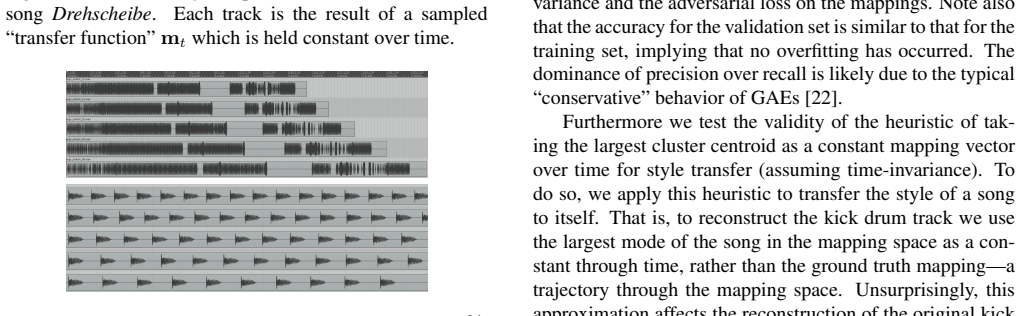
- [Section 4, Tempo-invariance paragraph and Figure 3] The claim that "the learned codes are largely invariant to tempo and time-shift" rests on a single visualization (Figure 3, song "Orgs Waltz") and on listening examples. There is no quantitative measure, such as the consistency of inferred mapping codes across time-stretched versions or reconstruction accuracy on time-stretched validation data. No error bars or statistical tests are provided. Because tempo invariance is stated in the abstract as a demonstrated property, it requires either a quantitative evaluation or a clear downgrade of the claim.
- [Section 4, Table 1 and the evaluation protocol] The onset reconstruction F-scores are reported without baselines, error bars, or significance tests. It is unclear whether F=0.867 for ground-truth mappings is meaningfully better than a simple baseline (for example, predicting onsets at beat/downbeat positions, or a model without the adversarial and constancy losses). The paper's statement that the results "show that the mappings are specific enough to largely reconstruct the target onsets correctly" would be considerably strengthened by including at least one baseline and reporting variance over songs or training runs.
minor comments (5)
- [Section 4, Style Transfer paragraph] The text refers to the "Davis-Bouldin score," but reference [19] is the Davies-Bouldin index; the name should be corrected.
- [Table 1] The row label "Style transfer" is ambiguous; since the experiment uses the song's own largest cluster, a clearer label would be "Constant centroid (self-transfer)."
- [Section 3, Eq. (3)] The notation D(·)_t is used without definition; the authors should specify that it denotes the discriminator output at time step t.
- [Figure 3 caption] The caption does not name the song or state that the close-up alignment is manual; the surrounding text provides this information, but the caption should be self-contained.
- [Section 3.3] The claim that thresholds of 20% and 30% yield "similar figures" is not quantified; reporting the corresponding F-scores would make the robustness claim verifiable.
Circularity Check
No significant circularity; the core autoencoder and transfer claims are empirically evaluated rather than constructed from their inputs.
full rationale
The paper's central derivation chain is self-contained. The mapping code m is defined explicitly in Eq. 1 as a learned function of the context signals x and target signal y, and the reconstruction in Eq. 2 is trained by minimizing the MSE between y and y-tilde. The quantitative reconstruction results in Table 1 are computed on a held-out validation set using an external onset-detection metric (MIREX), so the reconstruction performance is an honest out-of-sample evaluation rather than a fitted-parameter-renamed-as-prediction. The style-transfer experiment in Section 4 does use a self-transfer heuristic: the largest cluster centroid of a song's own mapping codes is applied back to that same song. While this is an optimistic proxy for genuine cross-song transfer and is acknowledged as such, it is a sanity check of the constant-code approximation, not a circular reduction; the cross-song transfer is presented qualitatively on the companion website. The tempo-invariance demonstration is also an empirical validation of the model under WSOLA time stretching, even though tempo/time-shift invariance was encouraged by data augmentation during training; the experiment could have failed and is not equivalent to the training objective by construction. The only self-citations, [15] and [18], are used as related-work and as a method citation for data augmentation, respectively; neither imports a uniqueness theorem or smuggles in an ansatz that forces the paper's conclusions. The paper itself notes that 'it is not obvious how to evaluate the output of the model other than by listening' (Section 4), which is a limitation in evaluation strength, not evidence of circularity. No load-bearing step reduces, by equation or by self-citation, to its own input.
Assumptions & free parameters
assumptions (3)
- domain assumption Onset functions from audio (Yaafe ComplexDomainOnsetDetection and madmom downbeat RNN) accurately represent musical events for learning and evaluation.
- domain assumption Rhythmic interaction patterns are locally constant over time, so a single constant mapping code can summarize a section or song.
- ad hoc to paper The adversarial training objective (Eq. 3) removes all mutual information between mapping codes m and input x and enforces a standard Gaussian prior.
Cite this review
Pith. "Pith review of High-Level Control of Drum Track Generation Using Learned Patterns of Rhythmic Interaction." pith.science (2026). https://pith.science/paper/O45HKIPF
@misc{pith2026190800948,
  author       = {Pith},
  title        = {Pith review of: High-Level Control of Drum Track Generation Using Learned Patterns of Rhythmic Interaction},
  year         = {2026},
  howpublished = {\url{https://pith.science/paper/O45HKIPF}},
  note         = {Machine review of arXiv:1908.00948}
}
read the original abstract
Spurred by the potential of deep learning, computational music generation has gained renewed academic interest. A crucial issue in music generation is that of user control, especially in scenarios where the music generation process is conditioned on existing musical material. Here we propose a model for conditional kick drum track generation that takes existing musical material as input, in addition to a low-dimensional code that encodes the desired relation between the existing material and the new material to be generated. These relational codes are learned in an unsupervised manner from a music dataset. We show that codes can be sampled to create a variety of musically plausible kick drum tracks and that the model can be used to transfer kick drum patterns from one song to another. Lastly, we demonstrate that the learned codes are largely invariant to tempo and time-shift.
Figures


Reference graph
Works this paper leans on
-
[1]
INTRODUCTION A crucial issue in music generation is that of user control. Es- pecially for problems where musical material is to be gener- ated conditioned on existing musical material (so-calledcon- ditional generation), it is not desirable for a system to pro- duce its output deterministically. Typically there are multiple valid ways to complement exist...
-
[2]
High-Level Control of Drum Track Generation Using Learned Patterns of Rhythmic Interaction
RELA TED WORK In addition to the V AE-based methods for control over mu- sic generation processes mentioned above, a number of other studies have applied deep learning methods to address the problem of music generation in general, as reviewed in [4]. Drum track generation has been tackled using recurrent ar- chitectures [5, 6], Restricted Boltzmann Machin...
work page Pith review arXiv 1908
-
[3]
METHOD A schematic overview of the proposed model architecture is shown in Figure 1. For time series modeling, we adapt the common dense GAE architecture to 1D convolution in time, yielding a Convolutional Gated Autoencoder (CGAE). We aim to model the rhythmic interactions between input signals x∈R M×T and a target signal y∈R 1×T . More precisely, x repre...
work page 2019
-
[4]
EXPERIMENTS For the qualitative experiments we use four songs, Gipsy Love, Orgs Waltz, Miss You and Drehscheibe, produced by the first author. We encourage the reader to listen to the re- sults on the accompanying web page 3. Three scenarios are chosen to show the effectiveness of the proposed approach: Conditional Generation of Drum Patterns To gener- ate...
work page 2019
-
[5]
CONCLUSIONS AND FUTURE WORK We have presented a model for the conditional genera- tion of kick drums tracks given snare and bass tracks in pop/rock/electro music. The model was trained on a dataset of multi-track recordings, using a custom objective func- tion to capture the relationship between onset patterns in the tracks of the same song in mapping cod...
work page 2019
-
[6]
ACKNOWLEDGEMENTS We thank Cyran Aouameur for his valuable support, as well as Adonis Storr, Tegan Koster, Stefan Weißenberger and Clemens Riedl for their contribution in producing the exam- ple tracks
-
[7]
A hierarchical latent vector model for learn- ing long-term structure in music,
A. Roberts, J. Engel, C. Raffel, C. Hawthorne, and D. Eck, “A hierarchical latent vector model for learn- ing long-term structure in music,” in Proceedings of the 35th International Conference on Machine Learn- ing, ICML 2018, Stockholmsmässan, Stockholm, Swe- den, July 10-15, 2018, 2018, pp. 4361–4370
work page 2018
-
[8]
Learning a Latent Space of Multitrack Measures
I. Simon, A. Roberts, C. Raffel, J. Engel, C. Hawthorne, and D. Eck, “Learning a latent space of multitrack mea- sures,”arXiv preprint arXiv:1806.00195, 2018
work page Pith review arXiv 2018
Show all 29 references
-
[9]
Gradient-based learning of higher- order image features,
R. Memisevic, “Gradient-based learning of higher- order image features,” in IEEE International Conf. on Computer Vision, ICCV 2011, Barcelona, Spain, November 6-13, 2011, 2011, pp. 1591–1598
2011
-
[10]
Deep learning techniques for music generation - A survey,
J. Briot, G. Hadjeres, and F. Pachet, “Deep learning techniques for music generation - A survey,” CoRR, vol. abs/1709.01620, 2017. [Online]. Available: http: //arxiv.org/abs/1709.01620
2017 arXiv
-
[11]
Conditional neural sequence learn- ers for generating drums’ rhythms,
D. Makris, M. Kaliakatsos-Papakostas, I. Karydis, and K. L. Kermanidis, “Conditional neural sequence learn- ers for generating drums’ rhythms,”Neural Computing and Applications, pp. 1–12, 2018
2018
-
[12]
Combining LSTM and feed for- ward neural networks for conditional rhythm composi- tion,
D. Makris, M. A. Kaliakatsos-Papakostas, I. Karydis, and K. L. Kermanidis, “Combining LSTM and feed for- ward neural networks for conditional rhythm composi- tion,” in EANN, ser. Communications in Computer and Information Science, vol. 744. Springer, 2017, pp. 570–582
2017
-
[13]
An intelligent drum machine for electronic dance music production and perfor- mance,
R. V ogl and P. Knees, “An intelligent drum machine for electronic dance music production and perfor- mance,” in 17th International Conference on New Interfaces for Musical Expression, NIME 2017, Aal- borg University, Copenhagen, Denmark, May 15-18, 2017., C. Erkut, Ed. nime.o...
2017
-
[14]
Musegan: Multi-track sequential generative adversar- ial networks for symbolic music generation and accom- paniment,
H.-W. Dong, W.-Y . Hsiao, L.-C. Yang, and Y .-H. Yang, “Musegan: Multi-track sequential generative adversar- ial networks for symbolic music generation and accom- paniment,” in Thirty-Second AAAI Conference on Arti- ficial Intelligence, 2018
2018
-
[15]
DeepBach: A steerable model for bach chorales generation,
G. Hadjeres, F. Pachet, and F. Nielsen, “DeepBach: A steerable model for bach chorales generation,” in Proceedings of the 34th International Conference on Machine Learning, ICML 2017, Sydney, NSW, Australia, August 6-11, 2017 , ser. Proceedings of Machine Learning Research, D....
2017
-
[16]
Deepj: Style- specific music generation,
H. H. Mao, T. Shin, and G. Cottrell, “Deepj: Style- specific music generation,” in 2018 IEEE 12th Inter- national Conference on Semantic Computing (ICSC) . IEEE, 2018, pp. 377–382
2018
-
[17]
Anticipation-rnn: enforc- ing unary constraints in sequence generation, with ap- plication to interactive music generation,
G. Hadjeres and F. Nielsen, “Anticipation-rnn: enforc- ing unary constraints in sequence generation, with ap- plication to interactive music generation,”Neural Com- puting and Applications, pp. 1–11, 2018
2018
-
[18]
Imposing higher-level structure in polyphonic music generation using convolutional restricted Boltzmann machines and constraints,
S. Lattner, M. Grachten, and G. Widmer, “Imposing higher-level structure in polyphonic music generation using convolutional restricted Boltzmann machines and constraints,” Journal of Creative Music Systems , vol. 3(1), 2018. [Online]. Available: http://jcms.org.uk/ issues/V ol3Issue1/
2018
-
[19]
Audio style transfer,
E. Grinstein, N. Q. K. Duong, A. Ozerov, and P. Pérez, “Audio style transfer,” in 2018 IEEE International Conference on Acoustics, Speech and Signal Process- ing, ICASSP 2018, Calgary, AB, Canada, April 15-20,
2018
-
[20]
An overlap-add tech- nique based on waveform similarity (WSOLA) for high quality time-scale modification of speech,
W. Verhelst and M. Roelands, “An overlap-add tech- nique based on waveform similarity (WSOLA) for high quality time-scale modification of speech,” in IEEE In- ternational Conference on Acoustics, Speech, and Sig- nal Processing, vol. 2, April 1993, pp. 554–557
1993
-
[21]
Lead sheet generation and ar- rangement by conditional generative adversarial net- work,
H. Liu and Y . Yang, “Lead sheet generation and ar- rangement by conditional generative adversarial net- work,” in 17th IEEE International Conference on Ma- chine Learning and Applications (ICMLA) , 2018, pp. 722–727
2018
-
[22]
A predictive model for music based on learned interval representations,
S. Lattner, M. Grachten, and G. Widmer, “A predictive model for music based on learned interval representations,” in Proceedings of the 19th International Society for Music Informa- tion Retrieval Conference, ISMIR 2018, Paris, France, September 23-27 , 2018. [Online]. Availab...
2018
-
[23]
Adversarial autoencoders,
A. Makhzani, J. Shlens, N. Jaitly, and I. J. Goodfellow, “Adversarial autoencoders,” CoRR, vol. abs/1511.05644, 2015. [Online]. Available: http: //arxiv.org/abs/1511.05644
2015 arXiv
-
[24]
Self-normalizing neural networks,
G. Klambauer, T. Unterthiner, A. Mayr, and S. Hochre- iter, “Self-normalizing neural networks,” in Advances in Neural Information Processing Systems 30: Annual Conference on Neural Information Processing Systems 2019 IEEE Workshop on Applications of Signal Processing to Audio ...
2019
-
[25]
Learning transposition-invariant interval features from symbolic music and audio,
S. Lattner, M. Grachten, and G. Widmer, “Learning transposition-invariant interval features from symbolic music and audio,” in Proceedings of the 19th International Society for Music Information Retrieval Conference, ISMIR 2018, Paris, France, September 23-27, 2018. [Online]. ...
2018
-
[26]
A cluster separation measure,
D. L. Davies and D. W. Bouldin, “A cluster separation measure,” IEEE Transactions on Pattern Analysis and Machine Intelligence, vol. 1, no. 2, pp. 224–227, 1979
1979
-
[28]
MIREX Onset Detection Task,
“MIREX Onset Detection Task,” https://www.music-ir. org/mirex/wiki/2018:Audio_Onset_Detection, 2018
2018
-
[29]
On multi-view feature learning,
R. Memisevic, “On multi-view feature learning,” in Proceedings of the 29th International Conference on Machine Learning (ICML-12), ser. ICML ’12, J. Lang- ford and J. Pineau, Eds. New York, NY , USA: Omni- press, July 2012, pp. 161–168
2012
-
[2018]
IEEE, 2018, pp. 586–590
2018
Reviewed August 14, 2026 · model on record in the stance chip above.
Discussion (0). Continue with ORCID to comment.