REVIEW 2 major objections 4 minor 42 references
Stability of zero energy Dirac touchings in the honeycomb Hofstadter problem
T0 review · 2 major / 4 minor · reviewed 2026-08-14 · deepseek-v4-flash
Pith's one-line read This paper proves that on a honeycomb lattice threaded by 1/q flux quanta per hexagon, every bipartite hopping model that preserves the honeycomb lattice symmetries and an anti-unitary particle-hole symmetry has exactly 2q zero-energy…
desk verdict A useful symmetry proof with a gap: the paper establishes an even number of zero modes under a nondegeneracy assumption, not yet the full 2q linear Dirac-touching theorem claimed in the abstract. read the letter →
The pith
A machine-rendered reading of the paper's core claim, the machinery that carries it, and where it could break.
The reading
What carries the argument
The load-bearing object is the restriction of the 2π/3 rotation to each special point K_n, written as two q x q matrices R_A(n) and R_B(n), one on each sublattice. The proof's engine is the phase identity: det(R_A(n) R_B(n)^\dagger) has argument 2π/3, which contradicts the real determinant that would be forced if every nonzero eigenstate were simultaneously an eigenstate of both blocks. Two supporting pieces carry the rest: the optimal-gauge Peierls-phase formula, which lets arbitrary-range bipartite hoppings respect uniform flux with a q-cell magnetic unit cell, and the chiral block form of the Bloch Hamiltonian at the special points.
What would settle it
Numerically diagonalize a small-q Bloch Hamiltonian at a special point K_n for a bipartite, lattice-symmetric, S-symmetric model whose longer-range hopping parameters are tuned so that two nonzero eigenvalues at K_n are exactly degenerate; if no zero-energy eigenstate appears there, the theorem's nondegeneracy assumption is not merely technical, while a zero mode would show the conclusion survives a case the proof did not cover.
Extended reading notes
Core claim
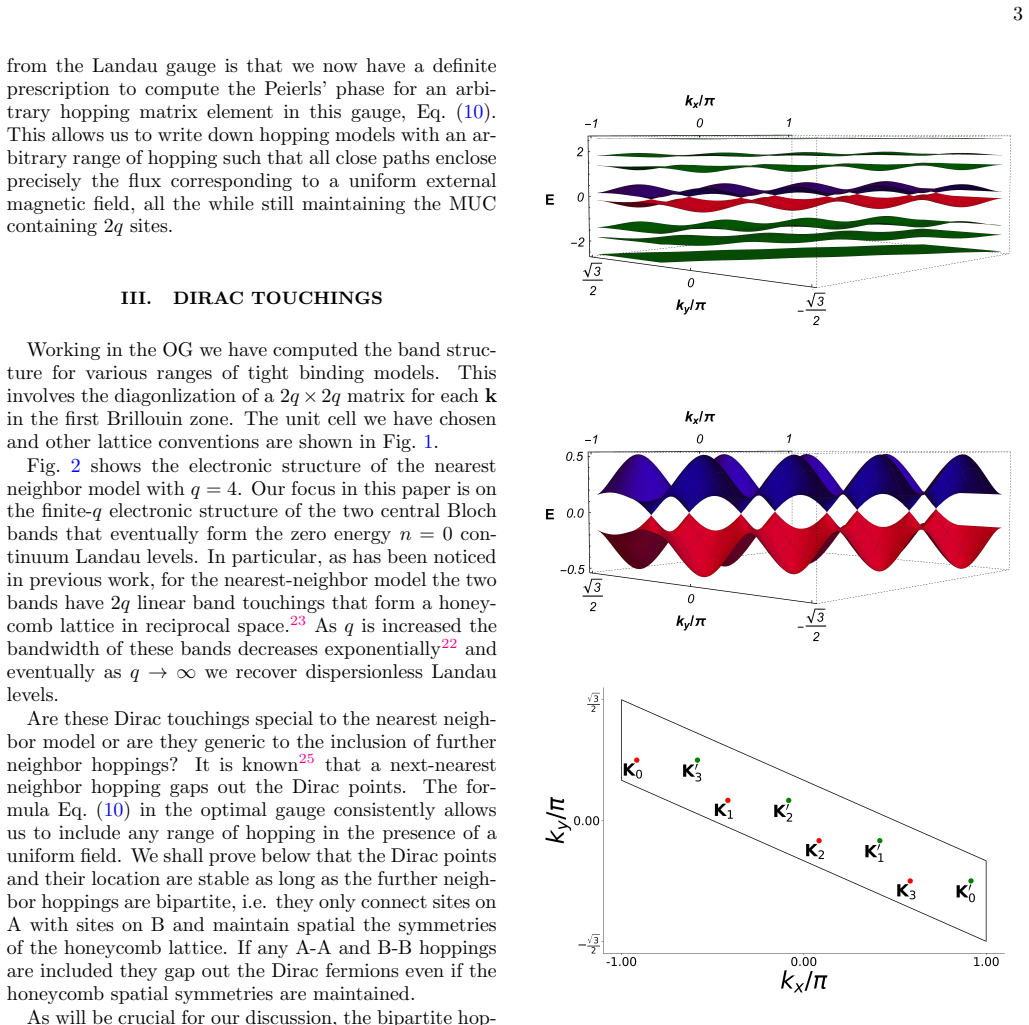
The central discovery is a proof-by-contradiction that the 2q special points K_n and K'_n in the magnetic Brillouin zone are forced to carry zero-energy states whenever the Hamiltonian is bipartite, flux-compatible, and symmetric under the honeycomb lattice operations and S. Chiral symmetry puts the Hamiltonian at these points in off-diagonal block form, so every nonzero-energy eigenstate has equal weight on the A and B sublattices. The 2π/3 rotation about an A site then acts block-diagonally, and for a nonzero eigenstate the A- and B-components must be eigenvectors of the two blocks R_A(n) and R_B(n) with a common eigenvalue. If no zero mode existed, all eigenvalues of the two blocks would coincide, forcing det(R_A(n) R_B(n)^\dagger) to be real; an explicit calculation fixes its phase as 2π/3. This contradiction implies at least one zero-energy state, and pairing from S makes the number even. Since k·p analysis finds no symmetry reason for the linear term to vanish, the touchings are generically linear.
Load-bearing premise
The proof assumes that, at each special wavevector, the nonzero energy levels are all distinct; if two nonzero levels happen to be degenerate, the step that forces the two rotation blocks to share all eigenvalues no longer follows.
Editorial extensions
If this is right
- Any symmetry-respecting bipartite hopping extension of the honeycomb Hofstadter model, not just nearest-neighbor hopping, has the same 2q zero-energy Dirac points in the same locations.
- The Dirac cones survive perturbations that keep S and the honeycomb lattice symmetries when the perturbation fits in the magnetic unit cell; only their positions may shift if some spatial symmetry is reduced.
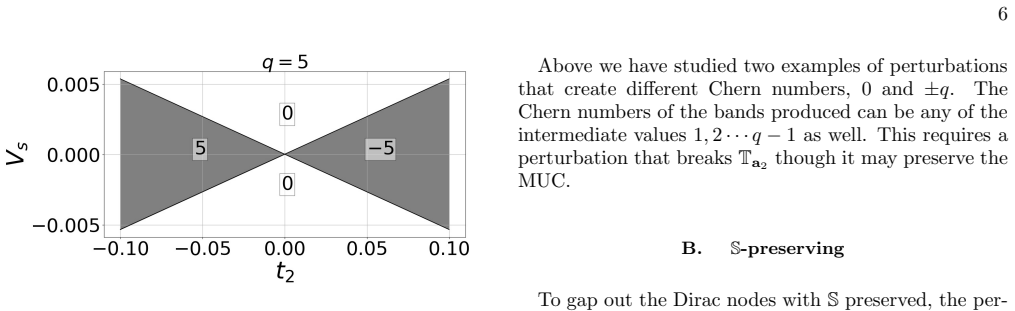
- A staggered sublattice potential or a same-sublattice second-neighbor hopping breaks S and gaps the cones, producing a band insulator whose two central bands carry total Chern number 0 or ±q.
- A periodic modulation whose wavevector connects a K-type node to a K'-type node, which carry opposite winding numbers, can gap the Dirac points even while S is preserved.
- Each K_n node has winding number -1 and each K'_n node +1, so opposite-winding nodes annihilate when folded together in an enlarged unit cell.
Reading between the lines
- Beyond the paper: the same determinant-phase mechanism should protect Dirac touchings on other bipartite lattices with a threefold lattice rotation and commensurate flux, whenever the analogue of arg det(R_A R_B^\dagger) is nonzero; the paper does not test this.
- Beyond the paper: the proof's nondegeneracy caveat leaves a concrete open case—an S- and lattice-symmetric bipartite model with intentionally degenerate nonzero levels at K_n—which could either falsify or extend the theorem.
- Beyond the paper: because the node locations are fixed by symmetry rather than by hopping details, the 2q touchings are a natural observable diagnostic for cold-atom or photonic-waveguide realizations of the honeycomb Hofstadter model with longer-range couplings.
Signed reviews
Editorial analysis
A structured set of objections, weighed in public.
Referee Report
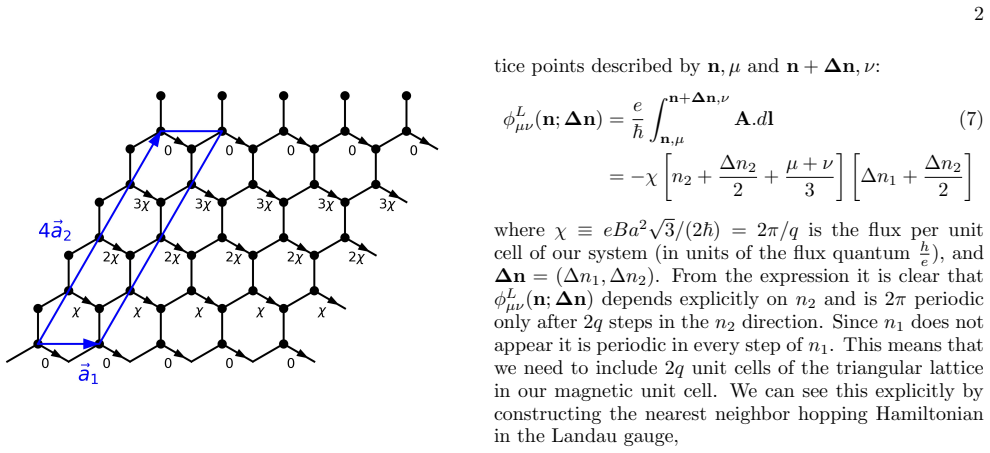
Summary. This manuscript studies the honeycomb Hofstadter problem at 1/q flux per unit cell and asks whether the 2q zero-energy Dirac touchings of the nearest-neighbor model are stable under generic bipartite hopping models that preserve the chiral (sublattice) symmetry S and the lattice symmetries of the honeycomb lattice. The authors present a proof by contradiction at the 2q special points of the magnetic Brillouin zone: assuming no zero-energy states and a nondegenerate spectrum, they show that the restriction of the 2π/3 rotation to each special point gives two q×q matrices RA(n) and RB(n) whose eigenvalues must coincide but whose determinant phases differ by 2π/3, contradicting the eigenvalue identity. They conclude that at each special point an even, nonzero number of zero-energy states must exist, and argue that k·p perturbation theory generically gives linear dispersion. The paper then analyzes stability against S-breaking and S-preserving perturbations, computing Chern numbers for specific perturbations, and includes extensive appendices with the symmetry transformations and the Rhim-Park wavefunction construction.
Significance. If the central theorem is correct, it substantially generalizes the well-known symmetry protection of Dirac points in zero-field graphene to the Hofstadter problem, showing that the locations and existence of the 2q zero-energy touchings are forced by S plus lattice symmetries for any bipartite hopping model. The proof strategy is parameter-free: the determinant phase in Eqs. (22)-(24) is computed from explicit symmetry matrices with no fitting, and the authors report numerical verification for several hopping ranges and q values. The stability analysis to S-breaking and S-preserving perturbations, including the winding-number argument and the resulting Chern-number changes, is a useful contribution. However, two load-bearing gaps in the proof, the unhandled degenerate-spectrum case and the gap between 'an even number of zero modes' and 'exactly 2q linear Dirac touchings', prevent the theorem from being fully established as stated.
major comments (2)
- [Section III.A, paragraph after Eq. (18)] The proof assumes a nondegenerate spectrum at each special point: 'Let us further assume that there are no degneracies in the spectrum'. This assumption is load-bearing: for a nonzero-energy degenerate level, the step that ψ_A and ψ_B are individually eigenstates of RA(n) and RB(n) with the same eigenvalue is not justified, because the degenerate subspace can rotate under R_{2π/3} without any single vector being an eigenstate. The paper gives no argument that such degeneracies can be lifted by a small symmetry-preserving perturbation that does not close a gap at zero energy, nor does it state the theorem as conditional on spectral nondegeneracy. Since the abstract and Section III claim protection for all hopping models with S and the lattice symmetries, this is a significant gap.
- [Section III.A, final paragraph; Section III, opening paragraph] Even granting the nondegeneracy assumption, the proof establishes only that an even, nonzero number of zero-energy states exists at each of the 2q special points. It does not prove that this number is exactly two, nor that the dispersion is linear for every allowed model. The sentence 'there is no symmetry reason for the first derivative to vanish' is a genericity assertion, not a proof; a k·p expansion can have a vanishing first derivative for special parameter values even when no symmetry enforces it. Appendix H is explicitly empirical ('we have not been able to prove them') and thus cannot supply the missing counting or linearity argument. Therefore the stated conclusion 'all hopping models ... have 2q Dirac touchings at zero energy' is stronger than what the proof supports.
minor comments (4)
- [Section III.A] Typo: 'degneracies' should be 'degeneracies'.
- [Section III] Typo: 'diagonlization' should be 'diagonalization'.
- [Section V] Typo: 'vauable' should be 'valuable' in the acknowledgments.
- [Eq. (22)] The notation '=real' is nonstandard; it should say that the determinant is real or that its imaginary part vanishes, e.g. 'Im [...] = 0'.
Circularity Check
No significant circularity: the central proof is self-contained and the empirically fitted Appendix H is not load-bearing.
full rationale
The paper's central claim is that all bipartite hopping models with the chiral symmetry S and the full honeycomb lattice symmetry have 2q zero-energy Dirac touchings at the same BZ locations as the nearest-neighbor model. The proof in Section III.A is a self-contained contradiction argument: it assumes no zero-energy states and no degeneracies at a special point K_n, uses the explicit R_{2π/3} matrices R_A(n) and R_B(n) derived in Appendices C–F, and obtains the determinant phase 2π/3 in Eq. (24), contradicting the real determinant required by Eq. (22). The K_n locations are taken from the nearest-neighbor model, but they are used only as candidate points; the theorem proves that zero modes must occur there by a direct symmetry computation, not by fitting or by importing the nearest-neighbor result as an assumption. The empirical fit in Appendix H is explicitly admitted ('we have not been able to prove them: rather, we fitted the action of R_{2π/3} on the Rhim-Park wavefunctions to an analytic form') and is not used in the proof of the main theorem, so it is not a fitted input masquerading as a prediction. The proof does have genuine gaps — it assumes away degeneracies ('Let us further assume that there are no degneracies in the spectrum'), and it concludes only that an even number of zero-energy states exists at each K_n, with linearity asserted by genericity rather than proven. These are correctness and rigor concerns, not circularity. There are no load-bearing self-citations, no uniqueness theorem imported from the authors' prior work, and no ansatz smuggled in via citation. The derivation therefore does not reduce to its inputs by construction.
Assumptions & free parameters
assumptions (6)
- domain assumption Peierls substitution with a uniform magnetic field yields the hopping phases in the optimal gauge (Eq. 10).
- domain assumption The Hamiltonian is restricted to bipartite A-B hoppings so that the anti-unitary particle-hole symmetry S commutes with H.
- ad hoc to paper The symmetry operators T_a1, T_a2, R_{2π/3}, and R_π in the optimal gauge (Eqs. 12 to 14 and B1 to B3) act as written and commute with H.
- standard math Bloch's theorem applies with a magnetic unit cell of q hexagons, containing 2q sites.
- standard math Chiral symmetry forces H(k) into off-diagonal block form and pairs energies ±E.
- ad hoc to paper The spectrum at each K_n is assumed nondegenerate in the contradiction proof.
Cite this review
Pith. "Pith review of Stability of zero energy Dirac touchings in the honeycomb Hofstadter problem." pith.science (2026). https://pith.science/paper/O4QR4GBZ
@misc{pith2026190803483,
  author       = {Pith},
  title        = {Pith review of: Stability of zero energy Dirac touchings in the honeycomb Hofstadter problem},
  year         = {2026},
  howpublished = {\url{https://pith.science/paper/O4QR4GBZ}},
  note         = {Machine review of arXiv:1908.03483}
}
read the original abstract
We study the band structure of electrons hopping on a honeycomb lattice with 1/q (q integer) flux quanta through each elementary hexagon. In the nearest neighbor hopping model the two bands that eventually form the n = 0 Landau level have 2q zero energy Dirac touchings. In this work, we study the conditions needed for these Dirac points and their stability to various perturbations. We prove that these touchings and their locations are guaranteed by a combination of an anti-unitary particle-hole symmetry and the lattice symmetries of the honeycomb structure. We also study the stability of the Dirac touchings to one-body perturbations that explicitly lower the symmetry.
Figures
Reference graph
Works this paper leans on
-
[1]
author N. Ashcroft and author N. Mermin , title Solid State Physics ( publisher Saunders College , address Philadelphia , year 1976 )
work page 1976
-
[2]
author C. L. Kane and author E. J. Mele , journal Phys. Rev. Lett. volume 95 , pages 226801 ( year 2005 a ), ://link.aps.org/doi/10.1103/PhysRevLett.95.226801
-
[3]
author C. L. Kane and author E. J. Mele , journal Phys. Rev. Lett. volume 95 , pages 146802 ( year 2005 b ), ://link.aps.org/doi/10.1103/PhysRevLett.95.146802
-
[4]
author J. E. Moore and author L. Balents , journal Phys. Rev. B volume 75 , pages 121306 ( year 2007 ), ://link.aps.org/doi/10.1103/PhysRevB.75.121306
-
[5]
author L. Fu , author C. L. Kane , and author E. J. Mele , journal Phys. Rev. Lett. volume 98 , pages 106803 ( year 2007 ), ://link.aps.org/doi/10.1103/PhysRevLett.98.106803
-
[6]
author L. Fu and author C. L. Kane , journal Phys. Rev. B volume 76 , pages 045302 ( year 2007 ), ://link.aps.org/doi/10.1103/PhysRevB.76.045302
-
[7]
author R. Roy , journal Phys. Rev. B volume 79 , pages 195322 ( year 2009 ), ://link.aps.org/doi/10.1103/PhysRevB.79.195322
-
[8]
author M. Z. Hasan and author C. L. Kane , journal Rev. Mod. Phys. volume 82 , pages 3045 ( year 2010 ), ://link.aps.org/doi/10.1103/RevModPhys.82.3045
Show all 42 references
-
[9]
author J. L. Ma\ nes , author F. Guinea , and author M. A. H. Vozmediano , journal Phys. Rev. B volume 75 , pages 155424 ( year 2007 ), ://link.aps.org/doi/10.1103/PhysRevB.75.155424
2007 doi
-
[10]
Murakami , journal New Journal of Physics volume 9 , pages 356 ( year 2007 ), https://doi.org/10.1088
author S. Murakami , journal New Journal of Physics volume 9 , pages 356 ( year 2007 ), https://doi.org/10.1088
2007
-
[11]
Wan , author A
author X. Wan , author A. M. Turner , author A. Vishwanath , and author S. Y. Savrasov , journal Phys. Rev. B volume 83 , pages 205101 ( year 2011 ), ://link.aps.org/doi/10.1103/PhysRevB.83.205101
2011 doi
-
[12]
Turner and author A
author A. Turner and author A. Vishwanath , title Chaper 11, Topological Insulators, Volume 6 (Contemporary Concepts of Condensed Matter Science) ( publisher Elsevier , year 2013 ), ://arxiv.org/abs/1301.0330
2013 arXiv
-
[13]
Hou and author W
author J.-M. Hou and author W. Chen , journal Scientific Reports volume 5 , pages 17571 EP ( year 2015 ), note article , ://doi.org/10.1038/srep17571
2015 doi
-
[14]
author D. J. Thouless , author M. Kohmoto , author M. P. Nightingale , and author M. den Nijs , journal Phys. Rev. Lett. volume 49 , pages 405 ( year 1982 ), ://link.aps.org/doi/10.1103/PhysRevLett.49.405
1982 doi
-
[15]
author F. D. M. Haldane , journal Phys. Rev. Lett. volume 61 , pages 2015 ( year 1988 ), ://link.aps.org/doi/10.1103/PhysRevLett.61.2015
2015 doi
-
[16]
author D. R. Hofstadter , journal Phys. Rev. B volume 14 , pages 2239 ( year 1976 ), ://link.aps.org/doi/10.1103/PhysRevB.14.2239
1976 doi
-
[17]
, journal J
author Rammal, R. , journal J. Phys. France volume 46 , pages 1345 ( year 1985 ), ://doi.org/10.1051/jphys:019850046080134500
1985 doi
-
[18]
Kohmoto and author A
author M. Kohmoto and author A. Sedrakyan , journal Phys. Rev. B volume 73 , pages 235118 ( year 2006 ), ://link.aps.org/doi/10.1103/PhysRevB.73.235118
2006 doi
-
[19]
Agazzi , author J.-P
author A. Agazzi , author J.-P. Eckmann , and author G. M. Graf , journal Journal of Statistical Physics volume 156 , pages 417 ( year 2014 ), ://doi.org/10.1007/s10955-014-0992-0
2014 doi
-
[20]
Sato , author D
author M. Sato , author D. Tobe , and author M. Kohmoto , journal Phys. Rev. B volume 78 , pages 235322 ( year 2008 ), ://link.aps.org/doi/10.1103/PhysRevB.78.235322
2008 doi
-
[21]
Hatsugai , author T
author Y. Hatsugai , author T. Fukui , and author H. Aoki , journal Phys. Rev. B volume 74 , pages 205414 ( year 2006 ), ://link.aps.org/doi/10.1103/PhysRevB.74.205414
2006 doi
-
[22]
ANDREI BERNEVIG , author T
author B. ANDREI BERNEVIG , author T. L. HUGHES , author S.-C. ZHANG , author H.-D. CHEN , and author C. WU , journal International Journal of Modern Physics B volume 20 , pages 3257 ( year 2006 ), https://doi.org/10.1142/S0217979206035448 , ://doi.org/10.1142/S0217979206035448
2006 doi
-
[23]
Rhim and author K
author J.-W. Rhim and author K. Park , journal Phys. Rev. B volume 86 , pages 235411 ( year 2012 ), ://link.aps.org/doi/10.1103/PhysRevB.86.235411
2012 doi
-
[24]
author I. N. Karnaukhov , journal EPL (Europhysics Letters) volume 124 , pages 37002 ( year 2018 ), https://doi.org/10.1209
2018
-
[25]
author I. N. Karnaukhov , journal Physics Letters A volume 383 , pages 2114 ( year 2019 ), ISSN issn 0375-9601 , ://www.sciencedirect.com/science/article/pii/S0375960119303135
2019
-
[26]
Hou , journal Phys
author J.-M. Hou , journal Phys. Rev. Lett. volume 111 , pages 130403 ( year 2013 ), ://link.aps.org/doi/10.1103/PhysRevLett.111.130403
2013 doi
-
[27]
Hou , journal Phys
author J.-M. Hou , journal Phys. Rev. B volume 89 , pages 235405 ( year 2014 ), ://link.aps.org/doi/10.1103/PhysRevB.89.235405
2014 doi
-
[28]
Hou and author W
author J.-M. Hou and author W. Chen , journal Frontiers of Physics volume 13 , pages 130301 ( year 2017 ), ISSN issn 2095-0470 , ://doi.org/10.1007/s11467-017-0712-8
2017 doi
-
[29]
author A. P. Schnyder , author S. Ryu , author A. Furusaki , and author A. W. W. Ludwig , journal Phys. Rev. B volume 78 , pages 195125 ( year 2008 ), ://link.aps.org/doi/10.1103/PhysRevB.78.195125
2008 doi
-
[30]
Kitaev , journal AIP Conf
author A. Kitaev , journal AIP Conf. Proc. volume 1134 , pages 22 ( year 2009 ), 0901.2686
2009 arXiv
-
[31]
Ryu and author Y
author S. Ryu and author Y. Hatsugai , journal Phys. Rev. Lett. volume 89 , pages 077002 ( year 2002 ), ://link.aps.org/doi/10.1103/PhysRevLett.89.077002
2002 doi
-
[32]
Ryu , author A
author S. Ryu , author A. P. Schnyder , author A. Furusaki , and author A. W. W. Ludwig , journal New Journal of Physics volume 12 , pages 065010 ( year 2010 ), https://doi.org/10.1088
2010
-
[33]
author I. C. Fulga , author F. Hassler , and author A. R. Akhmerov , journal Phys. Rev. B volume 85 , pages 165409 ( year 2012 ), ://link.aps.org/doi/10.1103/PhysRevB.85.165409
2012 doi
-
[34]
author I. F. Herbut , journal Phys. Rev. Lett. volume 97 , pages 146401 ( year 2006 ), ://link.aps.org/doi/10.1103/PhysRevLett.97.146401
2006 doi
-
[35]
Alicea and author M
author J. Alicea and author M. P. A. Fisher , journal Phys. Rev. B volume 74 , pages 075422 ( year 2006 ), ://link.aps.org/doi/10.1103/PhysRevB.74.075422
2006 doi
-
[36]
Kharitonov , journal Phys
author M. Kharitonov , journal Phys. Rev. B volume 85 , pages 155439 ( year 2012 ), ://link.aps.org/doi/10.1103/PhysRevB.85.155439
2012 doi
-
[37]
Feshami and author H
author B. Feshami and author H. A. Fertig , journal Phys. Rev. B volume 94 , pages 245435 ( year 2016 ), ://link.aps.org/doi/10.1103/PhysRevB.94.245435
2016 doi
-
[38]
Jung and author A
author J. Jung and author A. H. MacDonald , journal Phys. Rev. B volume 80 , pages 235417 ( year 2009 ), ://link.aps.org/doi/10.1103/PhysRevB.80.235417
2009 doi
-
[39]
Mishra , author S
author A. Mishra , author S. R. Hassan , and author R. Shankar , journal arXiv e-prints eid arXiv:1401.5295 ( year 2014 ), 1401.5295
2014 arXiv
-
[40]
Buividovich , author D
author P. Buividovich , author D. Smith , author M. Ulybyshev , and author L. von Smekal , journal PoS volume LATTICE2016 , pages 244 ( year 2016 ), 1610.09855
2016 arXiv
-
[41]
Mishra , author S
author A. Mishra , author S. R. Hassan , and author R. Shankar , journal Phys. Rev. B volume 93 , pages 125134 ( year 2016 ), ://link.aps.org/doi/10.1103/PhysRevB.93.125134
2016 doi
-
[42]
Mishra , author S
author A. Mishra , author S. R. Hassan , and author R. Shankar , journal Phys. Rev. B volume 95 , pages 035140 ( year 2017 ), ://link.aps.org/doi/10.1103/PhysRevB.95.035140
2017 doi
Reviewed August 14, 2026 · model on record in the stance chip above.
Discussion (0). Continue with ORCID to comment.