REVIEW 2 major objections 5 minor 7 cited by
JWST/NIRSpec Observations of High Ionization Emission Lines in Galaxies at High Redshift
T0 review · 2 major / 5 minor · reviewed 2026-08-15 · deepseek-v4-flash
Pith's one-line read This paper reports narrow N V $\lambda$1240 emission in two z>6 galaxies while C IV and He II stay undetected, and finds very high ionization lines in only 2.2% of z>4 NIRSpec grating spectra.
desk verdict A well-executed census and two plausible but unconfirmed N V detections; the doublet-ratio problem is real but the paper handles it honestly. read the letter →
The pith
A machine-rendered reading of the paper's core claim, the machinery that carries it, and where it could break.
The reading
What carries the argument
The central diagnostic is the N V $\lambda\lambda$1239, 1243 doublet, whose excitation requires 77 eV photons, above the He$^+$ edge (54 eV) that separates stellar from AGN-like ionizing spectra. The paper combines detected N V with non-detections of C IV and He II into flux-ratio limits and compares them to a grid of AGN photoionization models that vary power-law slope, ionization parameter, metallicity, and nitrogen-to-oxygen abundance. Resonant scattering of Ly$\alpha$ redshifted into the N V transitions is invoked to explain the anomalous single-component doublet ratios, which fall far below or above the expected ratio of 1–2.
What would settle it
A deeper NIRSpec spectrum that resolves both N V doublet components in the z=8.72 galaxy and the Little Red Dot: if the missing component does not appear with a flux ratio near 1–2 at the expected velocity, the N V identification fails, and the high N V/C IV and N V/He II limits would no longer be supported.
Extended reading notes
Core claim
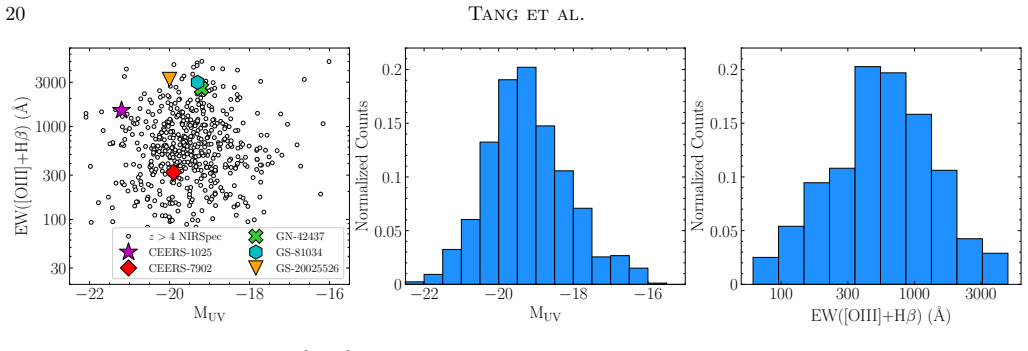
The paper establishes that narrow N V $\lambda$1240 emission can appear in z>6 galaxies while C IV and He II remain undetected, and that this pattern is rare. In the z=8.72 galaxy the detected line is attributed to N V $\lambda$1243 (EW = 7.0 $\pm$ 1.1 $\AA$), and in the z=6.98 Little Red Dot it is attributed to N V $\lambda$1239 (EW = 27.9 $\pm$ 3.4 $\AA$). Neither source shows C IV or He II, yielding limits N V/C IV > 1.4 and N V/He II > 2.6 in the z=8.72 galaxy, with even larger limits in the Little Red Dot. A census of 851 z>4 NIRSpec grating spectra finds that only 2.2$^{+1.7}_{-1.0}$% show very high ionization lines (N V, He II, [Ne IV], or [Ne V]) with EW > 10 $\AA$.
Load-bearing premise
The interpretation rests on the single detected line near rest wavelength 1240 $\AA$ in each galaxy being one member of the N V doublet; if it is instead a shifted Ly$\alpha$ feature or an unrelated line, the detections and the derived ratio limits collapse.
Editorial extensions
If this is right
- If the identifications hold, high-ionization narrow lines trace a small but real population of AGN-like engines at z>4, and searches should include the N V doublet rather than stopping at C IV and He II.
- The detection in a Little Red Dot with Balmer absorption implies that dense neutral gas does not completely cover the nucleus in all such systems, so ionizing photons can reach narrow-line clouds.
- The measured 2.2% incidence at EW > 10 $\AA$ sets a benchmark for AGN photoionization at z>4 that future deeper surveys can test.
- Nitrogen-enhanced line ratios suggest unusual chemical enrichment near the nucleus, possibly from top-heavy star formation or tidal disruption events.
Reading between the lines
- If the single-line identifications are confirmed, the anomalous N V doublet ratios predict that deeper spectra should reveal scattered line flux, broadened or spatially extended, rather than a second narrow component at the systemic velocity.
- The 2.2% fraction is likely an underestimate for fainter N V because most archival spectra cannot reach EW = 10 $\AA$; targeted deep G140H observations of Little Red Dots should yield a higher detection rate.
- The nitrogen-loud pattern seen here may connect to nitrogen enhancement reported in other high-redshift galaxies, implying a shared abundance mechanism; a testable extension is to measure N/O in the same galaxies through rest-optical nitrogen lines once they become available.
Signed reviews
Editorial analysis
A structured set of objections, weighed in public.
Referee Report
Summary. The paper analyzes 53 new JWST/NIRSpec R=2700 G140H spectra from program GO 4287 and combines them with archival R=1000/2700 grating spectra to search for very high ionization lines (N V, [Ne IV], [Ne V], He II) at z>4. It reports narrow N V λ1240 emission in two galaxies: CEERS-1025 at z=8.7166 (EW 7.0±1.1 Å, attributed to λ1243) and the LRD CEERS-7902 at z=6.9827 (EW 27.9±3.4 Å, attributed to λ1239), with neither showing C IV or He II. The authors interpret the implied N V/C IV and N V/He II limits as evidence for hard radiation fields with nitrogen enhancement and resonant scattering, and use an 899-galaxy database to place a 2.2% incidence on high-ionization lines with EW>10 Å, together with a separate LRD census.
Significance. If the N V identifications hold, the paper provides rare evidence for hard (≥77 eV) radiation fields at z>6 and adds two important follow-up targets, including an N V-emitting LRD with Balmer absorption that constrains the covering fraction of dense neutral gas. The census is useful, and the treatment of upper limits, resampling uncertainties, and small-number statistics is careful. The archival LRD UV constraints and the composite upper limits on broad UV lines are a valuable addition. The strength of the conclusions is nonetheless tempered by the reliance of both central detections on a single N V doublet component with an anomalous doublet ratio, and by the absence of a quantitative scattering model.
major comments (2)
- [§3.1.1, §3.2.1, §3.4] The two central N V detections each rest on a single member of the λλ1239,1243 doublet, with inferred doublet ratios that are formally inconsistent with the expected 1–2 range (CEERS-1025: <0.37; CEERS-7902: >3.7 or <0.27 depending on component assignment). The resonant-scattering explanation offered in Section 3.4 is qualitative and is acknowledged by the authors to require fine tuning, but no radiative-transfer calculation is provided. Because the N V/C IV and N V/He II limits, the model comparisons in Figures 8–9, and the census detections in Section 4 all inherit this identification, this is a load-bearing issue. I request either a quantitative scattering model or an explicit reclassification of both sources as N V candidates, with the abstract and summary claims adjusted accordingly.
- [§4.2.1, §5, Abstract] The headline incidence fraction 2.2^{+1.7}_{-1.0}% is not derived where it first appears. Section 4.2.1 gives individual line fractions (2/87 for N V, 1/97 for [Ne IV], 1/57 for [Ne V]) and a non-BL fraction of 5/166=3.0^{+2.0}_{-1.3}%, while the abstract quotes a combined 2.2% that appears to correspond to 4/185 (excluding the two tentative detections), but this association is never stated. Please specify the exact numerator, denominator, and inclusion criteria (including whether tentative detections count) for the census used in the abstract, and reconcile the quoted 2.2% with the similarly labeled 3.0% in Section 4.2.1.
minor comments (5)
- [§3.3.1] The sentence 'We do not detect either C IV or He II in the G140H spectrum of CEERS-7902' appears in the section on CEERS-10444 and should refer to CEERS-10444.
- [Abstract, §6] The generic label 'NVλ1240' should be replaced by a reference to the doublet components λλ1239,1243, since the identification is component-dependent and the doublet ratio is central to the interpretation.
- [Figure 15] The caption contains the typo 'blue plux'; this should read 'blue plus'.
- [§3.1.2] The text says 'The same analysis is presented to the other 55 z>4 galaxies in the GO 4287 spectra,' while the abstract and Section 2 state that 53 new galaxies are added; please clarify whether the 55 includes the five galaxies overlapping with CEERS.
- [§4.2.2] The C IV detection rate of 1/8 for LRDs should be explained more explicitly: one detection plus seven non-detections with 3σ EW limits <10 Å yields the denominator 8, whereas the text mentions 15 galaxies with C IV coverage; as written, the transition is difficult to follow.
Circularity Check
No significant circularity: the detections and census are direct spectral measurements, and the photoionization interpretation is explicitly exploratory rather than a fitted prediction.
full rationale
The central claims are (1) detections of narrow features near the N V doublet in CEERS-1025 and CEERS-7902, (2) upper limits on C IV and He II implying elevated N V/C IV and N V/He II ratios, and (3) incidence fractions of high-ionization lines in archival NIRSpec samples. These are all derived from measured spectra using standard line fitting and upper-limit calculations; no parameter is fitted to a subset of the data and then renamed as a prediction of the same quantity. The 2.2% census is a detection fraction over a fixed sample, not a model output forced by construction. The Section 3.4 photoionization comparison uses external model grids (Feltre et al. 2016; Mignoli et al. 2019) with openly adjustable N/O, ionization parameter, metallicity, and power-law slope, and the paper states its goal is 'to investigate the range of factors that might adjust the N V-based line ratios and not to derive the specific properties of the two N V emitters.' Finding that nitrogen-enhanced models can reproduce the observed ratios is standard inverse modeling, not a claim that the ratios are predicted from independent inputs already containing them. Self-citations to Topping et al. (2025a) and Tang et al. (2023) concern reduction procedures and previously published redshifts, and are not load-bearing in any uniqueness or forced-ansatz sense. The acknowledged uncertainty in assigning the single detected feature to one component of the N V doublet is an empirical identification risk, not a circularity: the paper explicitly notes that deeper spectra detecting both components are required. The derivation chain therefore does not reduce to its inputs by construction.
Assumptions & free parameters
free parameters (7)
- AGN power-law slope alpha =
alpha = -2.0 and -1.2
- Ionization parameter log U =
log U = -5 to -1
- Metallicity Z =
Z = 0.006 to 4 Z_sun
- Nitrogen enhancement log(N/O) =
log(N/O) = 0 and 0.7
- Turbulent velocity =
100 km/s
- Inner radius of NLR clouds =
90 pc
- Electron density for CEERS-1025 =
n_e = 1000 cm^-3
assumptions (5)
- standard math Case B recombination applies to the narrow Balmer lines (H gamma/H beta = 0.47, H alpha/H beta = 2.76).
- domain assumption Emission lines from species with ionization energy above 54 eV (N V, [Ne IV], [Ne V]) trace photoionization by a hard radiation field, primarily AGN, rather than by ordinary stars.
- domain assumption The CLOUDY photoionization models of Feltre et al. (2016) and Mignoli et al. (2019), with the adopted parameter choices, accurately represent the narrow-line region of high-redshift AGN.
- standard math Systemic redshifts derived from narrow [O III] and H beta emission lines are accurate to the claimed precision and define the rest-frame wavelengths for line identification.
- standard math The small-number statistics of Gehrels (1986) give valid confidence intervals for the incidence fractions.
Cite this review
Pith. "Pith review of JWST/NIRSpec Observations of High Ionization Emission Lines in Galaxies at High Redshift." pith.science (2026). https://pith.science/paper/O4ULV3YF
@misc{pith2026250506359,
  author       = {Pith},
  title        = {Pith review of: JWST/NIRSpec Observations of High Ionization Emission Lines in Galaxies at High Redshift},
  year         = {2026},
  howpublished = {\url{https://pith.science/paper/O4ULV3YF}},
  note         = {Machine review of arXiv:2505.06359}
}
abstract
JWST spectroscopy has built large emission line samples at $z\gtrsim4$, but it has yet to confidently reveal many galaxies with the hard radiation fields commonly associated with AGN photoionization. While this may indicate a weaker UV ionizing spectrum in many $z>4$ AGNs or obscuration from dense neutral gas and dust, the complete picture remains unclear owing to the small number of deep rest-UV spectra. Here we characterize the strength of high ionization lines in $53$ new galaxies observed with NIRSpec $R=2700$ grating spectroscopy. We present new detections of narrow NV$\lambda1240$ in two galaxies. One is a previously-confirmed $z=6.98$ Little Red Dot (LRD) with broad H$\beta$, and the other is a $z=8.72$ galaxy with a narrow line spectrum. Neither source exhibits CIV or HeII emission, indicating large NV/CIV and NV/HeII ratios that may reflect a combination of nitrogen-enhancement and resonant scattering effects. We investigate the incidence of narrow high ionization lines in a large database of $851$ NIRSpec grating spectra, and we separately quantify the fraction of LRDs with narrow high ionization UV emission lines. Our results likely suggest that hard radiation fields are indeed present in a small subset of LRDs ($12.5^{+23.7}_{-10.4}\%$) and UV-selected galaxies ($2.2^{+1.7}_{-1.0}\%$) at $z>4$. The identification of narrow high ionization lines in the population of LRDs with strong Balmer absorption suggests the dense neutral hydrogen gas may not uniformly cover the nucleus. The strong NV (coupled with weak CIV and HeII) suggests that efforts to identify high ionization lines should extend down in wavelength to the NV doublet.
Figures


Figures from the paper (12 more)




Forward citations
Cited by 7 Pith papers
-
SPURS: Massive Stars, Dense Gas, and Ly$\alpha$ Escape in GN-z11 at $z = 10.6$
GN-z11's rest-UV spectrum shows young massive stars with very massive star winds, dense gas, and a broad red Ly alpha wing that may help Ly alpha escape the largely neutral early universe.
-
Misaligned or chaotic? A strong break of axial symmetry in the local LRD J1025 revealed with VLT/FORS2 spectropolarimetry
The local Little Red Dot J1025 shows a 48° polarisation-angle offset between continuum and broad H-alpha, requiring broken axial symmetry.
-
What you see is what you get: empirically measured bolometric luminosities of Little Red Dots
Directly integrating the observed spectra of two Little Red Dots shows the bolometric luminosity is dominated by rest-frame optical light, lowering implied black hole masses to about 10^5 to 10^7 solar masses.
-
Quenching of X-ray emission in little red dots by both Compton-thick gas and high accretion rates
X-ray non-detection of little red dots requires both Compton-thick gas columns (~1e25 cm^-2) and intrinsically weak X-ray emission with bolometric correction k_bol,X ≳ 30.
-
Deep JWST spectroscopy of galaxies in a candidate ionized bubble at $z = 8.7$: probing reionization at pMpc scales with Ly$\alpha$ emission
Lyα transmission in the z=8.7 EGS volume is T_IGM=0.26+0.25−0.14, consistent with the field average and mildly inconsistent with a 2-pMpc ionized bubble, making such a bubble unlikely.
-
Discovery of Multiply Ionized Iron Emission Powered by an Active Galactic Nucleus in a z~7 Little Red Dot
The z=6.68 Little Red Dot THRILS 46403 shows a 4.5 sigma [FeVII] line, the first robust coronal-line detection among z>5 LRDs, plus narrow Balmer absorption, supporting an AGN with direct sightlines to gas at or beyon...
-
Little Red Dots as Obscured Little Blue Dots: A Super-Eddington Unification Model
Little Red Dots are proposed to be dust-reddened, edge-on views of the same super-Eddington accreting blue AGNs seen face-on as Little Blue Dots.
Reference graph
Works this paper leans on
-
[1]
2019, MNRAS, 489, 3042, doi: 10.1093/mnras/stz2279
Alarie, A., & Drissen, L. 2019, MNRAS, 489, 3042, doi: 10.1093/mnras/stz2279
-
[2]
Alexandroff, R., Strauss, M. A., Greene, J. E., et al. 2013, MNRAS, 435, 3306, doi: 10.1093/mnras/stt1500
-
[3]
Allen, M. G., Groves, B. A., Dopita, M. A., Sutherland, R. S., & Kewley, L. J. 2008, ApJS, 178, 20, doi: 10.1086/589652 ´Alvarez-M´ arquez, J., Crespo G´ omez, A., Colina, L., et al. 2025, A&A, 695, A250, doi: 10.1051/0004-6361/202451731
doi:10.1086/589652 2008
-
[4]
Asplund, M., Grevesse, N., Sauval, A. J., & Scott, P. 2009, ARA&A, 47, 481, doi: 10.1146/annurev.astro.46.060407.145222
arXiv 2009
-
[5]
Backhaus, B. E., Trump, J. R., Pirzkal, N., et al. 2024, ApJ, 962, 195, doi: 10.3847/1538-4357/ad1520
-
[6]
Baldwin, J. A., Hamann, F., Korista, K. T., et al. 2003, ApJ, 583, 649, doi: 10.1086/345449
doi:10.1086/345449 2003
-
[7]
2023, MNRAS, 526, L26, doi: 10.1093/mnrasl/slad108
Bekki, K., & Tsujimoto, T. 2023, MNRAS, 526, L26, doi: 10.1093/mnrasl/slad108
-
[8]
1969, JQSRT, 9, 1145, doi: 10.1016/0022-4073(69)90139-3 B¨ oker, T., Beck, T
Bickel, W. 1969, JQSRT, 9, 1145, doi: 10.1016/0022-4073(69)90139-3 B¨ oker, T., Beck, T. L., Birkmann, S. M., et al. 2023, PASP, 135, 038001, doi: 10.1088/1538-3873/acb846
Show all 162 references
-
[9]
2023, MNRAS, 525, 2087, doi: 10.1093/mnras/stad1704
Brinchmann, J. 2023, MNRAS, 525, 2087, doi: 10.1093/mnras/stad1704
2023 doi
-
[10]
J., Saxena, A., Cameron, A
Bunker, A. J., Saxena, A., Cameron, A. J., et al. 2023, A&A, 677, A88, doi: 10.1051/0004-6361/202346159
2023 doi
-
[11]
J., Cameron, A
Bunker, A. J., Cameron, A. J., Curtis-Lake, E., et al. 2024, A&A, 690, A288, doi: 10.1051/0004-6361/202347094
2024 doi
-
[12]
2024, JWST Calibration Pipeline, 1.16.1, Zenodo, doi: 10.5281/zenodo.6984365
Bushouse, H., Eisenhamer, J., Dencheva, N., et al. 2024, JWST Calibration Pipeline, 1.16.1, Zenodo, doi: 10.5281/zenodo.6984365
2024 doi
-
[13]
2011, SoPh, 268, 255, doi: 10.1007/s11207-010-9541-4 High Ionization Emission Lines in z >4 Galaxies 31
Bonifacio, P. 2011, SoPh, 268, 255, doi: 10.1007/s11207-010-9541-4 High Ionization Emission Lines in z >4 Galaxies 31
2011 doi
-
[14]
J., Katz, H., Rey, M
Cameron, A. J., Katz, H., Rey, M. P., & Saxena, A. 2023a, MNRAS, 523, 3516, doi: 10.1093/mnras/stad1579
-
[15]
J., Katz, H., Witten, C., et al
Cameron, A. J., Katz, H., Witten, C., et al. 2024, MNRAS, 534, 523, doi: 10.1093/mnras/stae1547
2024 doi
-
[16]
J., Saxena, A., Bunker, A
Cameron, A. J., Saxena, A., Bunker, A. J., et al. 2023b, A&A, 677, A115, doi: 10.1051/0004-6361/202346107
-
[17]
1986, MNRAS, 223, 811, doi: 10.1093/mnras/223.4.811
Campbell, A., Terlevich, R., & Melnick, J. 1986, MNRAS, 223, 811, doi: 10.1093/mnras/223.4.811
1986 doi
-
[18]
2024, Nature, 633, 318, doi: 10.1038/s41586-024-07860-9
Carniani, S., Hainline, K., D’Eugenio, F., et al. 2024, Nature, 633, 318, doi: 10.1038/s41586-024-07860-9
2024 doi
-
[19]
2024, ApJ, 972, 143, doi: 10.3847/1538-4357/ad5f88
Castellano, M., Napolitano, L., Fontana, A., et al. 2024, ApJ, 972, 143, doi: 10.3847/1538-4357/ad5f88
2024 doi
-
[20]
2024, MNRAS, 532, 3526, doi: 10.1093/mnras/stae1664
Chang, S.-J., & Gronke, M. 2024, MNRAS, 532, 3526, doi: 10.1093/mnras/stae1664
2024 doi
-
[21]
2001, MNRAS, 323, 887, doi: 10.1046/j.1365-8711.2001.04260.x
Charlot, S., & Longhetti, M. 2001, MNRAS, 323, 887, doi: 10.1046/j.1365-8711.2001.04260.x
2001
-
[22]
P., Mason, C., et al
Chen, Z., Stark, D. P., Mason, C., et al. 2024, MNRAS, 528, 7052, doi: 10.1093/mnras/stae455
2024 doi
-
[23]
2016, MNRAS, 462, 1415, doi: 10.1093/mnras/stw1756
Chevallard, J., & Charlot, S. 2016, MNRAS, 462, 1415, doi: 10.1093/mnras/stw1756
2016 doi
-
[24]
A., Endsley, R., et al
Chisholm, J., Berg, D. A., Endsley, R., et al. 2024, MNRAS, 534, 2633, doi: 10.1093/mnras/stae2199
2024 doi
-
[25]
L., Aird, J., Reddy, N., et al
Coil, A. L., Aird, J., Reddy, N., et al. 2015, ApJ, 801, 35, doi: 10.1088/0004-637X/801/1/35
2015 doi
-
[26]
2016, MNRAS, 462, 1256, doi: 10.1093/mnras/stw1689
Cracco, V., Ciroi, S., Berton, M., et al. 2016, MNRAS, 462, 1256, doi: 10.1093/mnras/stw1689
2016 doi
-
[27]
2025, A&A, 697, A89, doi: 10.1051/0004-6361/202451410
Curti, M., Witstok, J., Jakobsen, P., et al. 2025, A&A, 697, A89, doi: 10.1051/0004-6361/202451410
2025 doi
-
[28]
P., et al
Davis, M., Guhathakurta, P., Konidaris, N. P., et al. 2007, ApJL, 660, L1, doi: 10.1086/517931 de Graaff, A., Rix, H.-W., Naidu, R. P., et al. 2025a, arXiv e-prints, arXiv:2503.16600, doi: 10.48550/arXiv.2503.16600 de Graaff, A., Brammer, G., Weibel, A., et al. 2025b, A&A, 697...
-
[29]
C., Wang, J.-G., et al
Dong, X.-B., Ho, L. C., Wang, J.-G., et al. 2010, ApJL, 721, L143, doi: 10.1088/2041-8205/721/2/L143
2010 doi
-
[30]
L., Cardaci, M
Dors, O. L., Cardaci, M. V., H¨ agele, G. F., & Krabbe,ˆA. C. 2014, MNRAS, 443, 1291, doi: 10.1093/mnras/stu1218
2014 doi
-
[31]
E., Tang, M., et al
Du, X., Shapley, A. E., Tang, M., et al. 2020, ApJ, 890, 65, doi: 10.3847/1538-4357/ab67b8
2020 doi
- [32]
-
[33]
J., Johnson, B
Eisenstein, D. J., Johnson, B. D., Robertson, B., et al. 2023b, arXiv e-prints, arXiv:2310.12340, doi: 10.48550/arXiv.2310.12340
-
[34]
P., Whitler, L., et al
Endsley, R., Stark, D. P., Whitler, L., et al. 2024, MNRAS, 533, 1111, doi: 10.1093/mnras/stae1857
2024 doi
-
[35]
2016, MNRAS, 456, 3354, doi: 10.1093/mnras/stv2794
Feltre, A., Charlot, S., & Gutkin, J. 2016, MNRAS, 456, 3354, doi: 10.1093/mnras/stv2794
2016 doi
- [36]
-
[37]
2022, A&A, 661, A81, doi: 10.1051/0004-6361/202142673
Ferruit, P., Jakobsen, P., Giardino, G., et al. 2022, A&A, 661, A81, doi: 10.1051/0004-6361/202142673
2022 doi
-
[38]
L., Bagley, M
Finkelstein, S. L., Bagley, M. B., Arrabal Haro, P., et al. 2025, ApJL, 983, L4, doi: 10.3847/2041-8213/adbbd3
2025 doi
-
[39]
2023, Data from The Cosmic Evolution Early Release Science Survey (CEERS), STScI/MAST, doi: 10.17909/Z7P0-8481
Finkelstein, Steven, Bagley, Micaela, & Yang, Guang. 2023, Data from The Cosmic Evolution Early Release Science Survey (CEERS), STScI/MAST, doi: 10.17909/Z7P0-8481
2023 doi
-
[40]
J., Labb´ e, I., Zitrin, A., et al
Furtak, L. J., Labb´ e, I., Zitrin, A., et al. 2024, Nature, 628, 57, doi: 10.1038/s41586-024-07184-8
2024 doi
-
[41]
P., Mather, J
Gardner, J. P., Mather, J. C., Abbott, R., et al. 2023, PASP, 135, 068001, doi: 10.1088/1538-3873/acd1b5
2023 doi
-
[42]
Garnett, D. R. 1992, AJ, 103, 1330, doi: 10.1086/116146
1992 doi
-
[43]
1986, ApJ, 303, 336, doi: 10.1086/164079
Gehrels, N. 1986, ApJ, 303, 336, doi: 10.1086/164079
1986 doi
-
[44]
2010, A&A, 519, A92, doi: 10.1051/0004-6361/201014039
Gilli, R., Vignali, C., Mignoli, M., et al. 2010, A&A, 519, A92, doi: 10.1051/0004-6361/201014039
2010 doi
-
[45]
Grandi, S. A. 1980, ApJ, 238, 10, doi: 10.1086/157952
1980 doi
- [46]
-
[47]
E., Labbe, I., Goulding, A
Greene, J. E., Labbe, I., Goulding, A. D., et al. 2024, ApJ, 964, 39, doi: 10.3847/1538-4357/ad1e5f
2024 doi
-
[48]
A., Dopita, M
Groves, B. A., Dopita, M. A., & Sutherland, R. S. 2004, ApJS, 153, 9, doi: 10.1086/421113
2004 doi
-
[49]
2016, MNRAS, 462, 1757, doi: 10.1093/mnras/stw1716
Gutkin, J., Charlot, S., & Bruzual, G. 2016, MNRAS, 462, 1757, doi: 10.1093/mnras/stw1716
2016 doi
-
[50]
2014, A&A, 565, A27, doi: 10.1051/0004-6361/201322696
Hainich, R., R¨ uhling, U., Todt, H., et al. 2014, A&A, 565, A27, doi: 10.1051/0004-6361/201322696
2014 doi
-
[51]
N., Shapley, A
Hainline, K. N., Shapley, A. E., Greene, J. E., & Steidel, C. C. 2011, ApJ, 733, 31, doi: 10.1088/0004-637X/733/1/31
2011 doi
-
[52]
N., Maiolino, R., Juodˇ zbalis, I., et al
Hainline, K. N., Maiolino, R., Juodˇ zbalis, I., et al. 2025, ApJ, 979, 138, doi: 10.3847/1538-4357/ad9920
2025 doi
-
[53]
1992, ApJL, 391, L53, doi: 10.1086/186397 —
Hamann, F., & Ferland, G. 1992, ApJL, 391, L53, doi: 10.1086/186397 —. 1993, ApJ, 418, 11, doi: 10.1086/173366
1992 doi
-
[54]
Hamann, F., & Korista, K. T. 1996, ApJ, 464, 158, doi: 10.1086/177307
1996 doi
-
[55]
2023, ApJ, 959, 39, doi: 10.3847/1538-4357/ad029e
Harikane, Y., Zhang, Y., Nakajima, K., et al. 2023, ApJ, 959, 39, doi: 10.3847/1538-4357/ad029e
2023 doi
-
[56]
E., Watson, D., Brammer, G., et al
Heintz, K. E., Watson, D., Brammer, G., et al. 2024, Science, 384, 890, doi: 10.1126/science.adj0343 32 Tang et al
2024 doi
-
[57]
2019, MNRAS, 487, 333, doi: 10.1093/mnras/stz1256
Hirschmann, M., Charlot, S., Feltre, A., et al. 2019, MNRAS, 487, 333, doi: 10.1093/mnras/stz1256
2019 doi
-
[58]
Y.-Y., Abdurro’uf, Coe, D., et al
Hsiao, T. Y.-Y., Abdurro’uf, Coe, D., et al. 2024, ApJ, 973, 8, doi: 10.3847/1538-4357/ad5da8
2024 doi
-
[59]
2024, ApJ, 971, 21, doi: 10.3847/1538-4357/ad5015
Hu, W., Papovich, C., Dickinson, M., et al. 2024, ApJ, 971, 21, doi: 10.3847/1538-4357/ad5015
2024 doi
-
[60]
A., Papovich, C., Finkelstein, S
Hutchison, T. A., Papovich, C., Finkelstein, S. L., et al. 2019, ApJ, 879, 70, doi: 10.3847/1538-4357/ab22a2
2019 doi
-
[61]
2025, ApJL, 980, L27, doi: 10.3847/2041-8213/adaebd
Inayoshi, K., & Maiolino, R. 2025, ApJL, 980, L27, doi: 10.3847/2041-8213/adaebd
2025 doi
-
[62]
2023a, ApJ, 956, 139, doi: 10.3847/1538-4357/acf376
Isobe, Y., Ouchi, M., Nakajima, K., et al. 2023a, ApJ, 956, 139, doi: 10.3847/1538-4357/acf376
-
[63]
2023b, ApJ, 959, 100, doi: 10.3847/1538-4357/ad09be
Isobe, Y., Ouchi, M., Tominaga, N., et al. 2023b, ApJ, 959, 100, doi: 10.3847/1538-4357/ad09be
-
[64]
2025, MNRAS, 541, L71, doi: 10.1093/mnrasl/slaf056
Isobe, Y., Maiolino, R., D’Eugenio, F., et al. 2025, MNRAS, 541, L71, doi: 10.1093/mnrasl/slaf056
2025 doi
-
[65]
I., Thuan, T
Izotov, Y. I., Thuan, T. X., & Privon, G. 2012, MNRAS, 427, 1229, doi: 10.1111/j.1365-2966.2012.22051.x
2012
-
[66]
2022, A&A, 661, A80, doi: 10.1051/0004-6361/202142663
Jakobsen, P., Ferruit, P., Alves de Oliveira, C., et al. 2022, A&A, 661, A80, doi: 10.1051/0004-6361/202142663
2022 doi
-
[67]
2024, MNRAS, 535, 881, doi: 10.1093/mnras/stae2375
Ji, X., ¨Ubler, H., Maiolino, R., et al. 2024, MNRAS, 535, 881, doi: 10.1093/mnras/stae2375
2024 doi
-
[68]
2025, arXiv e-prints, arXiv:2501.13082, doi: 10.48550/arXiv.2501.13082
Ji, X., Maiolino, R., ¨Ubler, H., et al. 2025, arXiv e-prints, arXiv:2501.13082, doi: 10.48550/arXiv.2501.13082
2025 doi
-
[69]
2008, ApJ, 679, 962, doi: 10.1086/587868
Jiang, L., Fan, X., & Vestergaard, M. 2008, ApJ, 679, 962, doi: 10.1086/587868
2008 doi
-
[70]
M., & Davis, S
Jiang, Y.-F., Stone, J. M., & Davis, S. W. 2019, ApJ, 880, 67, doi: 10.3847/1538-4357/ab29ff Juodˇ zbalis, I., Ji, X., Maiolino, R., et al. 2024, MNRAS, 535, 853, doi: 10.1093/mnras/stae2367 Juodˇ zbalis, I., Maiolino, R., Baker, W. M., et al. 2025, arXiv e-prints, arXiv:2504....
2019
-
[71]
J., Dopita, M
Kewley, L. J., Dopita, M. A., Sutherland, R. S., Heisler, C. A., & Trevena, J. 2001, ApJ, 556, 121, doi: 10.1086/321545
2001 doi
-
[72]
2024, ApJL, 962, L6, doi: 10.3847/2041-8213/ad1de1
Kobayashi, C., & Ferrara, A. 2024, ApJL, 962, L6, doi: 10.3847/2041-8213/ad1de1
2024 doi
-
[73]
D., Onoue, M., Inayoshi, K., et al
Kocevski, D. D., Onoue, M., Inayoshi, K., et al. 2023, ApJL, 954, L4, doi: 10.3847/2041-8213/ace5a0
2023 doi
-
[74]
D., Finkelstein, S
Kocevski, D. D., Finkelstein, S. L., Barro, G., et al. 2025, ApJ, 986, 126, doi: 10.3847/1538-4357/adbc7d
2025 doi
-
[75]
Kochanek, C. S. 2016, MNRAS, 458, 127, doi: 10.1093/mnras/stw267
2016 doi
-
[76]
2023, ApJL, 957, L7, doi: 10.3847/2041-8213/ad037a
Kokorev, V., Fujimoto, S., Labbe, I., et al. 2023, ApJL, 957, L7, doi: 10.3847/2041-8213/ad037a
2023 doi
-
[77]
I., Greene, J
Kokorev, V., Caputi, K. I., Greene, J. E., et al. 2024, ApJ, 968, 38, doi: 10.3847/1538-4357/ad4265
2024 doi
-
[78]
B., & Crenshaw, D
Kraemer, S. B., & Crenshaw, D. M. 2000, ApJ, 544, 763, doi: 10.1086/317246
2000 doi
- [79]
- [80]
-
[81]
K., Green, P
Kuraszkiewicz, J. K., Green, P. J., Crenshaw, D. M., et al. 2004, ApJS, 150, 165, doi: 10.1086/379809
2004 doi
-
[82]
Kwan, J., & Krolik, J. H. 1981, ApJ, 250, 478, doi: 10.1086/159395 Labb´ e, I., van Dokkum, P., Nelson, E., et al. 2023, Nature, 616, 266, doi: 10.1038/s41586-023-05786-2
1981 doi
- [83]
-
[84]
E., Bezanson, R., et al
Labbe, I., Greene, J. E., Bezanson, R., et al. 2025, ApJ, 978, 92, doi: 10.3847/1538-4357/ad3551
2025 doi
- [85]
-
[86]
S., et al
Laporte, N., Nakajima, K., Ellis, R. S., et al. 2017, ApJ, 851, 40, doi: 10.3847/1538-4357/aa96a8 Le F` evre, O., Lemaux, B. C., Nakajima, K., et al. 2019, A&A, 625, A51, doi: 10.1051/0004-6361/201732197
2017 doi
-
[87]
2024, ApJ, 974, 147, doi: 10.3847/1538-4357/ad6565
Lin, X., Wang, F., Fan, X., et al. 2024, ApJ, 974, 147, doi: 10.3847/1538-4357/ad6565
2024 doi
-
[88]
2025, arXiv e-prints, arXiv:2507.10659, doi: 10.48550/arXiv.2507.10659
Lin, X., Fan, X., Cai, Z., et al. 2025, arXiv e-prints, arXiv:2507.10659, doi: 10.48550/arXiv.2507.10659
2025 doi
-
[89]
Luridiana, V., Morisset, C., & Shaw, R. A. 2015, A&A, 573, A42, doi: 10.1051/0004-6361/201323152
2015 doi
-
[90]
F., et al
Lusso, E., Worseck, G., Hennawi, J. F., et al. 2015, MNRAS, 449, 4204, doi: 10.1093/mnras/stv516
2015 doi
-
[91]
1988, ApJ, 327, 116, doi: 10.1086/166175 —
Madau, P. 1988, ApJ, 327, 116, doi: 10.1086/166175 —. 2025, arXiv e-prints, arXiv:2501.09854, doi: 10.48550/arXiv.2501.09854
1988 doi
-
[92]
2024, ApJL, 976, L24, doi: 10.3847/2041-8213/ad90e1
Madau, P., & Haardt, F. 2024, ApJL, 976, L24, doi: 10.3847/2041-8213/ad90e1
2024 doi
-
[93]
A., Stark, D
Mainali, R., Kollmeier, J. A., Stark, D. P., et al. 2017, ApJL, 836, L14, doi: 10.3847/2041-8213/836/1/L14
2017 doi
-
[94]
P., Tang, M., et al
Mainali, R., Stark, D. P., Tang, M., et al. 2020, MNRAS, 494, 719, doi: 10.1093/mnras/staa751
2020 doi
-
[95]
2024a, A&A, 691, A145, doi: 10.1051/0004-6361/202347640
Maiolino, R., Scholtz, J., Curtis-Lake, E., et al. 2024a, A&A, 691, A145, doi: 10.1051/0004-6361/202347640
-
[96]
2024b, Nature, 627, 59, doi: 10.1038/s41586-024-07052-5 Mart´ ınez-Aldama, M
Maiolino, R., Scholtz, J., Witstok, J., et al. 2024b, Nature, 627, 59, doi: 10.1038/s41586-024-07052-5 Mart´ ınez-Aldama, M. L., Dultzin, D., Marziani, P., et al. 2015, ApJS, 217, 3, doi: 10.1088/0067-0049/217/1/3
2015 doi
-
[97]
2014, ApJ, 785, 153, doi: 10.1088/0004-637X/785/2/153 High Ionization Emission Lines in z >4 Galaxies 33
Masters, D., McCarthy, P., Siana, B., et al. 2014, ApJ, 785, 153, doi: 10.1088/0004-637X/785/2/153 High Ionization Emission Lines in z >4 Galaxies 33
2014 doi
-
[98]
2011, A&A, 527, A100, doi: 10.1051/0004-6361/201015584
Taniguchi, Y. 2011, A&A, 527, A100, doi: 10.1051/0004-6361/201015584
2011 doi
-
[99]
P., Brammer, G., et al
Matthee, J., Naidu, R. P., Brammer, G., et al. 2024, ApJ, 963, 129, doi: 10.3847/1538-4357/ad2345
2024 doi
-
[100]
2024a, arXiv e-prints, arXiv:2408.15615, doi: 10.48550/arXiv.2408.15615
Mazzolari, G., Scholtz, J., Maiolino, R., et al. 2024a, arXiv e-prints, arXiv:2408.15615, doi: 10.48550/arXiv.2408.15615
-
[101]
2024b, A&A, 691, A345, doi: 10.1051/0004-6361/202450407
Mazzolari, G., ¨Ubler, H., Maiolino, R., et al. 2024b, A&A, 691, A345, doi: 10.1051/0004-6361/202450407
-
[102]
2025, MNRAS, 540, 190, doi: 10.1093/mnras/staf745
McClymont, W., Tacchella, S., D’Eugenio, F., et al. 2025, MNRAS, 540, 190, doi: 10.1093/mnras/staf745
2025 doi
-
[103]
2019, A&A, 626, A9, doi: 10.1051/0004-6361/201935062
Mignoli, M., Feltre, A., Bongiorno, A., et al. 2019, A&A, 626, A9, doi: 10.1051/0004-6361/201935062
2019 doi
-
[104]
2006a, A&A, 447, 863, doi: 10.1051/0004-6361:20054127
Nagao, T., Maiolino, R., & Marconi, A. 2006a, A&A, 447, 863, doi: 10.1051/0004-6361:20054127
-
[105]
2006b, A&A, 447, 157, doi: 10.1051/0004-6361:20054024
Nagao, T., Marconi, A., & Maiolino, R. 2006b, A&A, 447, 157, doi: 10.1051/0004-6361:20054024
- [106]
-
[107]
2023, ApJS, 269, 33, doi: 10.3847/1538-4365/acd556
Nakajima, K., Ouchi, M., Isobe, Y., et al. 2023, ApJS, 269, 33, doi: 10.3847/1538-4365/acd556
2023 doi
-
[108]
2018, A&A, 612, A94, doi: 10.1051/0004-6361/201731935
Nakajima, K., Schaerer, D., Le F` evre, O., et al. 2018, A&A, 612, A94, doi: 10.1051/0004-6361/201731935
2018 doi
-
[109]
2024, arXiv e-prints, arXiv:2410.18763, doi: 10.48550/arXiv.2410.18763 —
Napolitano, L., Castellano, M., Pentericci, L., et al. 2024, arXiv e-prints, arXiv:2410.18763, doi: 10.48550/arXiv.2410.18763 —. 2025, A&A, 693, A50, doi: 10.1051/0004-6361/202452090
2024 doi
-
[110]
Netzer, H., Elitzur, M., & Ferland, G. J. 1985, ApJ, 299, 752, doi: 10.1086/163741
1985 doi
- [111]
-
[112]
E., & Ferland, G
Osterbrock, D. E., & Ferland, G. J. 2006, Astrophysics of gaseous nebulae and active galactic nuclei
2006
-
[113]
2024, ApJ, 976, 96, doi: 10.3847/1538-4357/ad84f7
Pacucci, F., & Narayan, R. 2024, ApJ, 976, 96, doi: 10.3847/1538-4357/ad84f7
2024 doi
- [114]
-
[115]
2020, MNRAS, 492, 4058, doi: 10.1093/mnras/staa078
Pognan, Q., Trakhtenbrot, B., Sbarrato, T., Schawinski, K., & Bertemes, C. 2020, MNRAS, 492, 4058, doi: 10.1093/mnras/staa078
2020 doi
-
[116]
J., Kelly, D., & Horner, S
Rieke, M. J., Kelly, D., & Horner, S. 2005, in Society of Photo-Optical Instrumentation Engineers (SPIE) Conference Series, Vol. 5904, Cryogenic Optical Systems and Instruments XI, ed. J. B. Heaney & L. G. Burriesci, 1–8, doi: 10.1117/12.615554
2005 doi
-
[117]
J., Kelly, D
Rieke, M. J., Kelly, D. M., Misselt, K., et al. 2023, PASP, 135, 028001, doi: 10.1088/1538-3873/acac53
2023 doi
-
[118]
2023, Data from the JWST Advanced Deep Extragalactic Survey (JADES), STScI/MAST, doi: 10.17909/8TDJ-8N28
Rieke, Marcia, Robertson, Brant, Tacchella, Sandro, et al. 2023, Data from the JWST Advanced Deep Extragalactic Survey (JADES), STScI/MAST, doi: 10.17909/8TDJ-8N28
2023 doi
-
[119]
Riffel, R., Rodr´ ıguez-Ardila, A., & Pastoriza, M. G. 2006, A&A, 457, 61, doi: 10.1051/0004-6361:20065291
2006 doi
-
[120]
2023, PASP, 135, 048001, doi: 10.1088/1538-3873/acb293
Rigby, J., Perrin, M., McElwain, M., et al. 2023, PASP, 135, 048001, doi: 10.1088/1538-3873/acb293
2023 doi
-
[121]
2024, ApJ, 976, 193, doi: 10.3847/1538-4357/ad85d3 Rodr´ ıguez-Ardila, A., Viegas, S
Roberts-Borsani, G., Treu, T., Shapley, A., et al. 2024, ApJ, 976, 193, doi: 10.3847/1538-4357/ad85d3 Rodr´ ıguez-Ardila, A., Viegas, S. M., Pastoriza, M. G.,
2024 doi
-
[122]
Prato, L., & Donzelli, C. J. 2002, ApJ, 572, 94, doi: 10.1086/340192
2002 doi
-
[123]
Rose, M., Elvis, M., & Tadhunter, C. N. 2015, MNRAS, 448, 2900, doi: 10.1093/mnras/stv113
2015 doi
-
[124]
L., Shapley, A
Sanders, R. L., Shapley, A. E., Topping, M. W., Reddy, N. A., & Brammer, G. B. 2023, ApJ, 955, 54, doi: 10.3847/1538-4357/acedad —. 2024, ApJ, 962, 24, doi: 10.3847/1538-4357/ad15fc
2023 doi
-
[125]
L., Shapley, A
Sanders, R. L., Shapley, A. E., Reddy, N. A., et al. 2020, MNRAS, 491, 1427, doi: 10.1093/mnras/stz3032
2020 doi
- [126]
-
[127]
2025, A&A, 697, A175, doi: 10.1051/0004-6361/202348804
Scholtz, J., Maiolino, R., D’Eugenio, F., et al. 2025, A&A, 697, A175, doi: 10.1051/0004-6361/202348804
2025 doi
-
[128]
P., et al
Senchyna, P., Plat, A., Stark, D. P., et al. 2024, ApJ, 966, 92, doi: 10.3847/1538-4357/ad235e
2024 doi
-
[129]
E., Reddy, N
Shapley, A. E., Reddy, N. A., Sanders, R. L., Topping, M. W., & Brammer, G. B. 2023, ApJL, 950, L1, doi: 10.3847/2041-8213/acd939
2023 doi
-
[130]
E., Steidel, C
Shapley, A. E., Steidel, C. C., Pettini, M., & Adelberger, K. L. 2003, ApJ, 588, 65, doi: 10.1086/373922
2003 doi
-
[131]
E., Sanders, R
Shapley, A. E., Sanders, R. L., Topping, M. W., et al. 2025, ApJ, 980, 242, doi: 10.3847/1538-4357/adad68
2025 doi
-
[132]
1981, MNRAS, 196, 257, doi: 10.1093/mnras/196.2.257
Sikora, M. 1981, MNRAS, 196, 257, doi: 10.1093/mnras/196.2.257
1981 doi
- [133]
-
[134]
P., Richard, J., Siana, B., et al
Stark, D. P., Richard, J., Siana, B., et al. 2014, MNRAS, 445, 3200, doi: 10.1093/mnras/stu1618
2014 doi
-
[135]
P., Richard, J., Charlot, S., et al
Stark, D. P., Richard, J., Charlot, S., et al. 2015a, MNRAS, 450, 1846, doi: 10.1093/mnras/stv688
-
[136]
P., Walth, G., Charlot, S., et al
Stark, D. P., Walth, G., Charlot, S., et al. 2015b, MNRAS, 454, 1393, doi: 10.1093/mnras/stv1907
-
[137]
P., Ellis, R
Stark, D. P., Ellis, R. S., Charlot, S., et al. 2017, MNRAS, 464, 469, doi: 10.1093/mnras/stw2233
2017 doi
-
[138]
1987, A&A, 177, 42 34 Tang et al
Surdej, J., & Hutsemekers, D. 1987, A&A, 177, 42 34 Tang et al
1987
-
[139]
P., Chevallard, J., & Charlot, S
Tang, M., Stark, D. P., Chevallard, J., & Charlot, S. 2019, MNRAS, 489, 2572, doi: 10.1093/mnras/stz2236
2019 doi
-
[140]
P., Chevallard, J., et al
Tang, M., Stark, D. P., Chevallard, J., et al. 2021, MNRAS, 501, 3238, doi: 10.1093/mnras/staa3454
2021 doi
-
[141]
P., Topping, M
Tang, M., Stark, D. P., Topping, M. W., Mason, C., & Ellis, R. S. 2024, ApJ, 975, 208, doi: 10.3847/1538-4357/ad7eb7
2024 doi
-
[142]
P., Chen, Z., et al
Tang, M., Stark, D. P., Chen, Z., et al. 2023, MNRAS, 526, 1657, doi: 10.1093/mnras/stad2763
2023 doi
-
[143]
J., Finkelstein, S
Taylor, A. J., Finkelstein, S. L., Kocevski, D. D., et al. 2025, ApJ, 986, 165, doi: 10.3847/1538-4357/add15b
2025 doi
-
[144]
W., Shapley, A
Topping, M. W., Shapley, A. E., Stark, D. P., et al. 2021, ApJL, 917, L36, doi: 10.3847/2041-8213/ac1a79
2021 doi
-
[145]
W., Stark, D
Topping, M. W., Stark, D. P., Senchyna, P., et al. 2024, MNRAS, 529, 3301, doi: 10.1093/mnras/stae682 —. 2025a, ApJ, 980, 225, doi: 10.3847/1538-4357/ada95c
2024 doi
-
[146]
W., Sanders, R
Topping, M. W., Sanders, R. L., Shapley, A. E., et al. 2025b, arXiv e-prints, arXiv:2502.08712. https://arxiv.org/abs/2502.08712
-
[147]
2025, arXiv e-prints, arXiv:2507.10681, doi: 10.48550/arXiv.2507.10681
Trakhtenbrot, B., Ricci, C., Treister, E., et al. 2025, arXiv e-prints, arXiv:2507.10681, doi: 10.48550/arXiv.2507.10681
2025 doi
-
[148]
E., Weaver, J
Treiber, H., Greene, J. E., Weaver, J. R., et al. 2025, ApJ, 984, 93, doi: 10.3847/1538-4357/adc38f
2025 doi
-
[149]
2022, ApJ, 935, 110, doi: 10.3847/1538-4357/ac8158
Treu, T., Roberts-Borsani, G., Bradac, M., et al. 2022, ApJ, 935, 110, doi: 10.3847/1538-4357/ac8158
2022 doi
-
[150]
2023, High-level science products produced by the GLASS-JWST team, as described in Paris, et al
Treu, Tommaso, & Paris, Diego. 2023, High-level science products produced by the GLASS-JWST team, as described in Paris, et al. 2024 (ADS bibcode: 2023ApJ...952...20P), and in Mascia, et al. 2024 (ADS bibcode: 2024A&A...690A...2M)., STScI/MAST, doi: 10.17909/KW3C-N857
2023 doi
- [151]
-
[152]
R., Arrabal Haro, P., Simons, R
Trump, J. R., Arrabal Haro, P., Simons, R. C., et al. 2023, ApJ, 945, 35, doi: 10.3847/1538-4357/acba8a
2023 doi
-
[153]
Weymann, R. J. 1988, ApJ, 325, 651, doi: 10.1086/166036 ¨Ubler, H., Maiolino, R., Curtis-Lake, E., et al. 2023, A&A, 677, A145, doi: 10.1051/0004-6361/202346137 ¨Ubler, H., Maiolino, R., P´ erez-Gonz´ alez, P. G., et al. 2024, MNRAS, 531, 355, doi: 10.1093/mnras/stae943
1988 doi
-
[154]
Valentino, F., Brammer, G., Gould, K. M. L., et al. 2023, ApJ, 947, 20, doi: 10.3847/1538-4357/acbefa Vidal-Garc´ ıa, A., Plat, A., Curtis-Lake, E., et al. 2024, MNRAS, 527, 7217, doi: 10.1093/mnras/stad3252
2023 doi
-
[155]
Vink, J. S. 2022, ARA&A, 60, 203, doi: 10.1146/annurev-astro-052920-094949
2022 doi
- [156]
-
[157]
2024, ApJL, 969, L13, doi: 10.3847/2041-8213/ad55f7
Wang, B., Leja, J., de Graaff, A., et al. 2024, ApJL, 969, L13, doi: 10.3847/2041-8213/ad55f7
2024 doi
-
[158]
L., et al
Wang, B., de Graaff, A., Davies, R. L., et al. 2025, ApJ, 984, 121, doi: 10.3847/1538-4357/adc1ca
2025 doi
-
[159]
2010, ApJ, 710, 78, doi: 10.1088/0004-637X/710/1/78
Wang, H., Wang, T., Yuan, W., et al. 2010, ApJ, 710, 78, doi: 10.1088/0004-637X/710/1/78
2010 doi
-
[160]
Wang, J.-M., Qiu, J., Du, P., & Ho, L. C. 2014, ApJ, 797, 65, doi: 10.1088/0004-637X/797/1/65
2014 doi
-
[161]
J., Morris, S
Weymann, R. J., Morris, S. L., Foltz, C. B., & Hewett, P. C. 1991, ApJ, 373, 23, doi: 10.1086/170020
1991 doi
-
[162]
L., Strauss, M
Zakamska, N. L., Strauss, M. A., Krolik, J. H., et al. 2003, AJ, 126, 2125, doi: 10.1086/378610
2003 doi
Reviewed August 15, 2026 · model on record in the stance chip above.
Discussion (0). Continue with ORCID to comment.