REVIEW 3 major objections 4 minor 1 cited by
BELT: Block Encoding of Linear Transformation on Density Matrices
T0 review · 3 major / 4 minor · reviewed 2026-08-15 · deepseek-v4-flash
Pith's one-line read The authors prove that any linear map acting on a quantum state — even one that would make the output nonphysical — can be embedded as a block of a unitary operator by the BELT protocol.
desk verdict The core BELT construction is clean, correct, and genuinely new; the sample-complexity claims need to be framed more carefully around the stronger purification-oracle model. read the letter →
The pith
A machine-rendered reading of the paper's core claim, the machinery that carries it, and where it could break.
The reading
What carries the argument
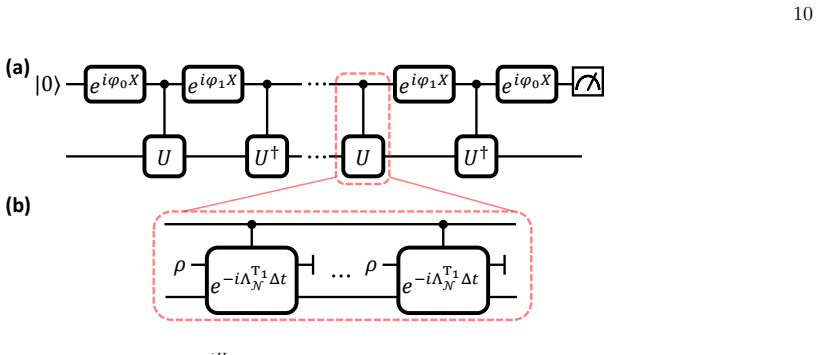
The load-bearing object is the partially transposed Choi matrix $\Lambda_\mathcal{N}^{T_1}=(I\otimes\mathcal{N})(|\Phi^+\rangle\langle\Phi^+|)^{T_1}$, which encodes the whole linear map and can be block-encoded even when $\mathcal{N}(\rho)$ is not a valid state. The circuit sandwiches the block-encoding unitary $U_\mathcal{N}$ between the purification oracle $U_\rho$ and its inverse, so the ancilla register of the purification carries the input state while the Choi-transpose matrix applies $\mathcal{N}$; replacing the swap operator used for the identity channel with $\Lambda_\mathcal{N}^{T_1}$ is what lifts block encoding from states to arbitrary linear transformations.
What would settle it
Take a small exactly known case, such as the transpose map on a single qubit with $\rho=|+\rangle\langle+|$; construct $U_\mathcal{N}$ as a block encoding of $\Lambda_\mathcal{N}^{T_1}$, run the BELT circuit, and compare the top-left block of the resulting unitary with $\rho^{T}/\alpha$. If the operator-norm error exceeds $\epsilon$, Theorem 1 is false; equivalently, measuring the postselection probability and checking that it equals $\alpha^{-2}\operatorname{Tr}[\mathcal{N}(\rho)\sigma\mathcal{N}(\rho)^\dagger]$ tests the identity underlying the protocol.
Extended reading notes
Core claim
Theorem 1 is the core: for a linear map $\mathcal{N}:\mathcal{L}(\mathbb{C}^{2^n})\to\mathcal{L}(\mathbb{C}^{2^k})$, let $U_\rho$ prepare a purification of $\rho$ and let $U_\mathcal{N}$ be an $(\alpha,m,\epsilon)$-block encoding of the partially transposed Choi matrix $\Lambda_\mathcal{N}^{T_1}$. Then the circuit $(I_m\otimes U_\rho^\dagger\otimes I_k)(U_\mathcal{N}\otimes I_r)(I_m\otimes U_\rho\otimes I_k)$ is an $(\alpha,m+r+n,\epsilon)$-block encoding of $\mathcal{N}(\rho)$. The tensor-network proof replaces the only non-unitary ingredient, $\Lambda_\mathcal{N}^{T_1}$, by its block-encoding unitary; choosing $\mathcal{N}$ as the identity recovers the standard block encoding of $\rho$ via the swap operator, so BELT is a direct generalization that turns the nonphysical object $\mathcal{N}(\rho)$ into a physically realizable unitary block.
Load-bearing premise
The protocol is efficient only when the operator norm of the partially transposed Choi matrix of the map stays bounded or grows slowly with system size, because the postselection success probability is controlled by the square of that norm.
Editorial extensions
If this is right
- BELT can simulate maps that lie outside quantum singular value transformation: the transpose map $\rho\mapsto\rho^T$ is basis-dependent and not a spectral function, yet it becomes block-encodable.
- For entanglement detection on states drawn from the paper's distribution, BELT detects entanglement with six calls to the purification oracle and its inverse, while any single-copy protocol needs exponentially many copies.
- For a known invertible channel $\mathcal{E}$ acting on an unknown pure state $\psi$, BELT prepares $\psi$ from $\mathcal{E}(\psi)$ exactly upon postselection, with sample complexity polynomial in $\|\Lambda_{\mathcal{E}^{-1}}^{T_1}\|_\infty$ and logarithmic in $1/\delta$.
- Combining BELT with QSVT yields block encodings of $f(\alpha^{-1}\mathcal{N}(\rho))$ for spectral functions $f$, enabling amplitude amplification that boosts the postselection probability.
- For completely positive maps with Stinespring dilation $\mathcal{F}(\rho)=\operatorname{Tr}_Z(A\rho A^\dagger)$, BELT block-encodes $\mathcal{F}(\rho)$ efficiently when $\|A\|_\infty$ is bounded, which applies to pseudo-differential operators through existing block encodings of $T$.
Reading between the lines
- If BELT is correct, the notion of physical simulability of a linear map shifts from complete positivity or Hermitian preservation to the cost of block-encoding $\Lambda_\mathcal{N}^{T_1}$; maps that are hard to block-encode remain hard regardless of their positivity properties.
- Because the protocol requires a purification oracle rather than copies of $\rho$, it trades a stronger input assumption for an exponential sample-complexity gain; a natural test is whether the gain survives when $U_\rho$ must itself be learned from copies.
- The norm $\|\Lambda_\mathcal{N}^{T_1}\|_\infty$ is the real resource: for maps where it grows exponentially, BELT's postselection probability falls exponentially, so the method's practical reach will be decided by identifying useful maps with bounded Choi-transpose norm, which the paper leaves as an open direction.
Signed reviews
Editorial analysis
A structured set of objections, weighed in public.
Referee Report
Summary. BELT is a protocol for block-encoding the output N(rho) of an arbitrary linear map N acting on an unknown state rho. The construction uses a block encoding of the partially transposed Choi matrix Lambda_N^{T1} and an oracle U_rho that prepares a purification of rho. Theorem 1 proves that the circuit (I_m tensor U_rho^dagger tensor I_k)(U_N tensor I_r)(I_m tensor U_rho tensor I_k) is an (alpha, m+r+n, epsilon)-block encoding of N(rho). The paper applies BELT to entanglement detection via the reduction criterion, to exact inversion of known quantum channels, and to simulating pseudo-differential operators; it also proposes an alternative QETU+HME approach in Appendix D. The central derivation is self-contained and uses no fitted parameters.
Significance. If Theorem 1 holds, and the Appendix A proof indeed gives a clean error-propagation argument, BELT is a conceptually useful primitive: it extends block encoding from spectral functions of rho to general linear maps, including non-CP maps, and it enables coherent postprocessing of N(rho) with QSVT. The reduction-criterion entanglement protocol and the exact channel-recovery protocol are interesting, and the discussion of maps with bounded Choi-transpose norm is honest. The main caveat, acknowledged in part but under-emphasized, is that the claimed sample-complexity improvements are obtained in a stronger oracle model than the copy-based models used by the HME and single-copy baselines. The paper would be stronger if the resource-model distinction and the norm dependence were placed at the center of the exposition.
major comments (3)
- [Theorem 2 and Appendix B] Theorem 2 states that the entanglement-detection protocol uses 6 oracle calls to U_rho or U_rho^dagger, but the proof in Appendix B sets K=2, and each run of the circuit in Fig. 2(a) contains one U_rho and one U_rho^dagger. The protocol therefore uses 4 oracle calls, not 6. Since K=2 already gives success probability at least 2/3, the theorem should be corrected to 4 calls, or changed to K=3 with 6 calls.
- [Abstract, Section III.A, and Table I] The constant-versus-exponential separation in sample complexity is not a comparison in the same resource model. BELT requires oracle access to U_rho and U_rho^dagger, which for an unknown state is strictly stronger than access to copies of rho; the HME and single-copy baselines use only copies. The Table I note and the text after Theorem 3 acknowledge this 'stronger oracle model', but the abstract and introduction still advertise improved sample complexity. The claims should be reframed as oracle-query complexity, with an explicit statement that no sample-complexity improvement over copy-based protocols is claimed in the identical resource model.
- [Eq. (7) and Abstract] The norm dependence of the protocol is load-bearing for the advertised scope. Eq. (7) gives success probability alpha^{-2} Tr[N(rho) sigma N(rho)^dagger], and for the transpose map one has alpha = ||Lambda_T^{T1}||_infty = 2^n, so the post-selection probability is exponentially small (e.g., 4^{-n} for a real pure state with sigma = rho). The text after Eq. (7) does note that maps with bounded alpha are preferable, and the applications indeed use such maps, but the abstract's mention of the transpose map as a headline example invites an opposite reading. The norm caveat should be moved into the abstract and introduction.
minor comments (4)
- [Section II, after Definition 1] The statement 'A block encoding of A exists iff ||A||_infty <= alpha' is correct for exact block encodings (epsilon=0) but not as an iff statement for approximate block encodings, since a matrix with ||A||_infty > alpha can still be approximately block encoded. The sentence should be qualified.
- [Section II, first paragraph] There is a typo: 'In the identity on n qubits' should read 'I_n the identity on n qubits'.
- [Figure 1 and surrounding text] The displayed formula describing the spectral map in Fig. 1(c), containing TN and Lambda_{E^{-1}}^{T1}, appears garbled in the manuscript text; the intended expression should be typeset legibly.
- [Section III.A] In the paragraph after Theorem 2, the phrase 'sample complexity' should be replaced by 'oracle-query complexity' or 'number of oracle calls' to avoid conflating the two resource measures.
Circularity Check
No significant circularity: Theorem 1 derives N(rho) directly from the Choi–Jamiolkowski identity and the definition of block encoding; no fitted parameter is renamed as a prediction.
full rationale
The central derivation is self-contained. Theorem 1 and Appendix A start from the Choi representation Lambda_N = (I tensor N)(Phi+) and the tensor-network identity N(rho) = (psi-dagger tensor I_k)(I_r tensor Lambda_N^{T1})(psi tensor I_k), where U_rho prepares the purification psi. Substituting the block-encoding condition for Lambda_N^{T1} then yields the block-encoding condition for N(rho). This is a proof, not a definitional restatement: the input is a block encoding of the Choi-transpose matrix and the output is a block encoding of N(rho), with the connecting step being a nontrivial application of the Choi isomorphism and of the standard definition of block encoding (Definition 1). No parameter is fitted to data, and no later predicted quantity is a renamed version of a fitted input. The self-citations to [7] and [34] appear as external comparisons (HME sample complexity and the single-copy lower bound) and in the alternative protocol of Appendix D; they are published, parameter-free results with stated assumptions, and they are not used to establish Theorem 1. The paper also explicitly acknowledges the norm dependence of the success probability and the stronger oracle model in the text after Eq. (7) and in the Table I note, so those caveats are not hidden. No circular step can be exhibited from the paper's own equations.
Assumptions & free parameters
assumptions (5)
- standard math Choi-Jamiolkowski identity: for any linear map N and purification |psi> of rho, N(rho) = (<psi| tensor I_k)(I_r tensor Lambda_N^{T1})(|psi> tensor I_k).
- domain assumption Existence of a purification oracle U_rho for the input state rho, together with its inverse U_rho^dagger.
- standard math Efficient block encodings exist for sparse matrices with efficiently computable entries (Lemma 1, from Gilyen et al.).
- domain assumption Single-copy lower bound Omega(2^{n/4}) for entanglement detection (Fact 1, from Liu and Wei).
- standard math QSVT and robust oblivious amplitude amplification achieve the stated complexity (Theorem 15 in Gilyen et al.).
Cite this review
Pith. "Pith review of BELT: Block Encoding of Linear Transformation on Density Matrices." pith.science (2026). https://pith.science/paper/O4UMHTSI
@misc{pith2026250812858,
  author       = {Pith},
  title        = {Pith review of: BELT: Block Encoding of Linear Transformation on Density Matrices},
  year         = {2026},
  howpublished = {\url{https://pith.science/paper/O4UMHTSI}},
  note         = {Machine review of arXiv:2508.12858}
}
abstract
Linear maps that are not completely positive play a crucial role in the study of quantum information, yet their non-completely positive nature renders them challenging to realize physically. The core difficulty lies in the fact that when acting such a map $\mathcal{N}$ on a state $\rho$, $\mathcal{N}(\rho)$ may not correspond to a valid density matrix, making it difficult to prepare directly in a physical system. We introduce Block Encoding of Linear Transformation (BELT), a systematic protocol that simulates arbitrary linear maps by embedding the output $\mathcal{N}(\rho)$ into a block of a unitary operator. BELT enables the manipulation and extraction of information about $\mathcal{N}(\rho)$ through coherent quantum evolution. Notably, BELT accommodates maps that fall outside the scope of quantum singular value transformation, such as the transpose map. BELT finds applications in entanglement detection, quantum channel inversion, and simulating pseudo-differential operators, and demonstrates improved sample complexity compared to protocols based on Hermitian-preserving map exponentiation.
Figures


Forward citations
Cited by 1 Pith paper
-
Circuit-Efficient Randomized Quantum Simulation of Non-Unitary Dynamics with Observable-Driven and Symmetry-Aware Designs
A randomized compilation of LCHS for non-unitary dynamics, with an observable-driven variant and a symmetry-aware sampler, claims reduced ancilla and circuit depth at the cost of more repetitions.
Reference graph
Works this paper leans on
-
[1]
M. A. Nielsen and I. L. Chuang, Quantum Computation and Quantum Information: 10th Anniversary Edition (Cambridge University Press, 2010)
2010
-
[2]
Watrous, The Theory of Quantum Information (Cam- bridge University Press, Cambridge, 2018)
J. Watrous, The Theory of Quantum Information (Cam- bridge University Press, Cambridge, 2018)
2018
-
[3]
Pechukas, Reduced dynamics need not be completely positive, Phys
P. Pechukas, Reduced dynamics need not be completely positive, Phys. Rev. Lett. 73, 1060 (1994)
1994
-
[4]
G¨ uhne and G
O. G¨ uhne and G. T´ oth, Entanglement detection, Physics Reports 474, 1 (2009)
2009
-
[5]
Z. Cai, R. Babbush, S. C. Benjamin, S. Endo, W. J. Hug- gins, Y. Li, J. R. McClean, and T. E. O’Brien, Quantum error mitigation, arXiv:2210.00921 (2022)
arXiv 2022
-
[6]
S. Endo, Z. Cai, S. C. Benjamin, and X. Yuan, Hybrid quantum-classical algorithms and quantum error mitiga- tion, Journal of the Physical Society of Japan 90, 032001 (2021)
work page 2021
-
[7]
F. Wei, Z. Liu, G. Liu, Z. Han, D.-L. Deng, and Z. Liu, Simulating non-completely positive actions via exponen- tiation of hermitian-preserving maps, npj Quantum In- formation 10, 134 (2024)
work page 2024
-
[8]
J. Son, M. Gluza, R. Takagi, and N. H. Y. Ng, Quantum dynamic programming, Phys. Rev. Lett. 134, 180602 (2025)
work page 2025
Show all 70 references
-
[9]
Salgado, J
D. Salgado, J. L. S´ anchez-G´ omez, and M. Ferrero, Evolu- tion of any finite open quantum system always admits a kraus-type representation, although it is not always com- pletely positive, Phys. Rev. A 70, 054102 (2004)
2004
-
[10]
H. A. Carteret, D. R. Terno, and K. ˙Zyczkowski, Dynam- ics beyond completely positive maps: Some properties and applications, Phys. Rev. A 77, 042113 (2008)
2008
-
[11]
Temme, S
K. Temme, S. Bravyi, and J. M. Gambetta, Error mitiga- tion for short-depth quantum circuits, Phys. Rev. Lett. 119, 180509 (2017)
2017
-
[12]
S. Endo, S. C. Benjamin, and Y. Li, Practical quantum error mitigation for near-future applications, Phys. Rev. X 8, 031027 (2018)
2018
-
[13]
X. Zhao, L. Zhang, B. Zhao, and X. Wang, Power of quantum measurement in simulating unphysical opera- tions, Phys. Rev. Res. 7, 013334 (2025)
2025
-
[14]
Horodecki and A
P. Horodecki and A. Ekert, Method for direct detection of quantum entanglement, Phys. Rev. Lett. 89, 127902 (2002)
2002
-
[15]
J. K. Korbicz, M. L. Almeida, J. Bae, M. Lewenstein, and A. Ac´ ın, Structural approximations to positive maps and entanglement-breaking channels, Phys. Rev. A 78, 062105 (2008)
2008
-
[16]
Q. Dong, M. T. Quintino, A. Soeda, and M. Murao, Im- plementing positive maps with multiple copies of an input state, Phys. Rev. A 99, 052352 (2019)
2019
-
[17]
A. W. Harrow, A. Hassidim, and S. Lloyd, Quantum al- gorithm for linear systems of equations, Phys. Rev. Lett. 103, 150502 (2009)
2009
-
[18]
Gily´ en, Y
A. Gily´ en, Y. Su, G. H. Low, and N. Wiebe, Quantum singular value transformation and beyond: Exponential improvements for quantum matrix arithmetics, in Pro- ceedings of the 51st Annual ACM SIGACT Symposium on Theory of Computing , STOC 2019 (Association for Computing Machin...
2019
-
[19]
Dong and L
Y. Dong and L. Lin, Random circuit block-encoded ma- trix and a proposal of quantum linpack benchmark, Phys- ical Review A 103, 10.1103/physreva.103.062412 (2021)
2021 doi
-
[20]
P. C. Costa, D. An, Y. R. Sanders, Y. Su, R. Bab- bush, and D. W. Berry, Optimal scaling quantum linear- systems solver via discrete adiabatic theorem, PRX Quantum 3, 040303 (2022)
2022
-
[21]
Gily´ en, S
A. Gily´ en, S. Lloyd, I. Marvian, Y. Quek, and M. M. Wilde, Quantum algorithm for Petz recovery channels 7 and pretty good measurements, Phys. Rev. Lett. 128, 220502 (2022)
2022
-
[22]
G. H. Low and Y. Su, Quantum eigenvalue processing, in 2024 IEEE 65th Annual Symposium on Foundations of Computer Science (FOCS) (2024) pp. 1051–1062
2024
-
[23]
Chakraborty, S
S. Chakraborty, S. Hazra, T. Li, C. Shao, X. Wang, and Y. Zhang, Quantum singular value transformation with- out block encodings: Near-optimal complexity with min- imal ancilla (2025), arXiv:2504.02385 [quant-ph]
2025 arXiv
-
[24]
R. Niwa, Z. M. Rossi, P. Taranto, and M. Murao, Singu- lar value transformation for unknown quantum channels (2025), arXiv:2506.24112 [quant-ph]
2025 arXiv
-
[25]
G. H. Low and I. L. Chuang, Optimal Hamiltonian sim- ulation by quantum signal processing, Phys. Rev. Lett. 118, 010501 (2017)
2017
-
[26]
G. H. Low and I. L. Chuang, Hamiltonian Simulation by Qubitization, Quantum 3, 163 (2019)
2019
-
[27]
An, J.-P
D. An, J.-P. Liu, and L. Lin, Linear combination of Hamiltonian simulation for nonunitary dynamics with optimal state preparation cost, Physical Review Letters 131, 150603 (2023), arXiv:2303.01029
2023 arXiv
-
[28]
D. An, A. M. Childs, and L. Lin, Quantum algorithm for linear non-unitary dynamics with near-optimal de- pendence on all parameters (2023), arXiv:2312.03916
2023
-
[29]
D. An, A. M. Childs, L. Lin, and L. Ying, Laplace transform based quantum eigenvalue transformation via linear combination of Hamiltonian simulation (2024), arXiv:2411.04010
2024 arXiv
-
[30]
Lu, H.-E
R. Lu, H.-E. Li, Z. Liu, and J.-P. Liu, Infinite- dimensional extension of the linear combination of hamil- tonian simulation: Theorems and applications (2025), arXiv:2502.19688 [quant-ph]
2025 arXiv
-
[31]
S. Jin, N. Liu, and Y. Yu, Quantum simulation of partial differential equations: Applications and detailed analy- sis, Physical Review A 108, 032603 (2023)
2023
-
[32]
S. Jin, X. Li, N. Liu, and Y. Yu, Quantum simulation for quantum dynamics with artificial boundary conditions, SIAM Journal on Scientific Computing 46, B403 (2024), arXiv:2304.00667
2024 arXiv
-
[33]
S. Jin, X. Li, N. Liu, and Y. Yu, Quantum simulation for partial differential equations with physical boundary or interface conditions, Journal of Computational Physics 498, 112707 (2024), arXiv:2305.02710
2024 arXiv
-
[34]
Liu and F
Z. Liu and F. Wei, Separation between entanglement cri- teria and entanglement detection protocols, Phys. Rev. Res. 7, 033121 (2025)
2025
-
[35]
J. M. Martyn, Z. M. Rossi, A. K. Tan, and I. L. Chuang, Grand unification of quantum algorithms, PRX Quan- tum 2, 040203 (2021)
2021
-
[36]
Lin, Lecture notes on quantum algorithms for scientific computation, arXiv:2201.08309 (2022)
L. Lin, Lecture notes on quantum algorithms for scientific computation, arXiv:2201.08309 (2022)
2022 arXiv
-
[37]
A. W. Harrow and A. Montanaro, Quantum computa- tional supremacy, Nature 549, 203 (2017)
2017
-
[38]
Chitambar and G
E. Chitambar and G. Gour, Quantum resource theories, Rev. Mod. Phys. 91, 025001 (2019)
2019
-
[39]
A. K. Ekert, Quantum cryptography based on Bell’s the- orem, Phys. Rev. Lett. 67, 661 (1991)
1991
-
[40]
C. H. Bennett and S. J. Wiesner, Communication via one- and two-particle operators on Einstein-Podolsky- Rosen states, Phys. Rev. Lett. 69, 2881 (1992)
1992
-
[41]
C. H. Bennett, G. Brassard, C. Cr´ epeau, R. Jozsa, A. Peres, and W. K. Wootters, Teleporting an unknown quantum state via dual classical and Einstein-Podolsky- Rosen channels, Phys. Rev. Lett. 70, 1895 (1993)
1993
-
[42]
Raussendorf and H
R. Raussendorf and H. J. Briegel, A one-way quantum computer, Phys. Rev. Lett. 86, 5188 (2001)
2001
-
[43]
Calabrese and J
P. Calabrese and J. Cardy, Entanglement entropy and quantum field theory, Journal of Statistical Mechanics: Theory and Experiment 2004, P06002 (2004)
2004
-
[44]
Amico, R
L. Amico, R. Fazio, A. Osterloh, and V. Vedral, Entan- glement in many-body systems, Rev. Mod. Phys. 80, 517 (2008)
2008
-
[45]
Horodecki, P
R. Horodecki, P. Horodecki, M. Horodecki, and K. Horodecki, Quantum entanglement, Rev. Mod. Phys. 81, 865 (2009)
2009
-
[46]
Pan, Z.-B
J.-W. Pan, Z.-B. Chen, C.-Y. Lu, H. Weinfurter, A. Zeilinger, and M. ˙Zukowski, Multiphoton entangle- ment and interferometry, Rev. Mod. Phys. 84, 777 (2012)
2012
-
[47]
Peres, Separability criterion for density matrices, Phys
A. Peres, Separability criterion for density matrices, Phys. Rev. Lett. 77, 1413 (1996)
1996
-
[48]
entangled
(with reduction mapR(A) = Tr(A)I−A). Verifying these criteria usually requires highly joint operations or exponential repetition times [49–52], especially for single- copy protocols [34]. BELT offers a fully coherent route. For a bipartite state ρ on A⊗B and a positive map P a...
-
[49]
Horodecki and P
M. Horodecki and P. Horodecki, Reduction criterion of separability and limits for a class of distillation protocols, Phys. Rev. A 59, 4206 (1999)
1999
-
[50]
J. Gray, L. Banchi, A. Bayat, and S. Bose, Machine- learning-assisted many-body entanglement measure- ment, Phys. Rev. Lett. 121, 150503 (2018)
2018
-
[51]
X.-D. Yu, S. Imai, and O. G¨ uhne, Optimal entanglement certification from moments of the partial transpose, Phys. Rev. Lett. 127, 060504 (2021)
2021
-
[52]
Y. Zhou, P. Zeng, and Z. Liu, Single-copies estimation of entanglement negativity, Phys. Rev. Lett. 125, 200502 (2020)
2020
-
[53]
Elben, R
A. Elben, R. Kueng, H.-Y. R. Huang, R. van Bij- nen, C. Kokail, M. Dalmonte, P. Calabrese, B. Kraus, J. Preskill, P. Zoller, and B. Vermersch, Mixed-state en- tanglement from local randomized measurements, Phys. Rev. Lett. 125, 200501 (2020)
2020
-
[54]
M. T. Quintino, Q. Dong, A. Shimbo, A. Soeda, and M. Murao, Reversing unknown quantum transforma- tions: Universal quantum circuit for inverting general unitary operations, Phys. Rev. Lett. 123, 210502 (2019)
2019
-
[55]
Yoshida, A
S. Yoshida, A. Soeda, and M. Murao, Reversing unknown qubit-unitary operation, deterministically and exactly, Phys. Rev. Lett. 131, 120602 (2023)
2023
-
[56]
C. Zhu, Y. Mo, Y.-A. Chen, and X. Wang, Reversing un- known quantum processes via virtual combs for channels with limited information, Phys. Rev. Lett. 133, 030801 (2024)
2024
-
[57]
Y. Mo, T. Lin, and X. Wang, Efficient inversion of un- known unitary operations with structured Hamiltonians (2025), arXiv:2506.20570 [quant-ph]
2025 arXiv
-
[58]
Y. Mo, L. Zhang, Y.-A. Chen, Y. Liu, T. Lin, and X. Wang, Parameterized quantum comb and simpler cir- cuits for reversing unknown qubit-unitary operations, npj Quantum Information 11, 32 (2025)
2025
-
[59]
P. W. Shor, Scheme for reducing decoherence in quantum computer memory, Phys. Rev. A 52, R2493 (1995)
1995
-
[60]
Gottesman, Stabilizer codes and quantum error cor- rection (California Institute of Technology, 1997)
D. Gottesman, Stabilizer codes and quantum error cor- rection (California Institute of Technology, 1997)
1997
-
[61]
Jiang, K
J. Jiang, K. Wang, and X. Wang, Physical Imple- mentability of Linear Maps and Its Application in Error Mitigation, Quantum 5, 600 (2021)
2021
-
[62]
Regula, R
B. Regula, R. Takagi, and M. Gu, Operational applica- tions of the diamond norm and related measures in quan- tifying the non-physicality of quantum maps, Quantum 5, 522 (2021). 8
2021
-
[63]
D. W. Berry, A. M. Childs, R. Cleve, R. Kothari, and R. D. Somma, Exponential improvement in precision for simulating sparse hamiltonians, in Proceedings of the Forty-Sixth Annual ACM Symposium on Theory of Com- puting, STOC ’14 (Association for Computing Machin- ery, New York...
2014
-
[64]
W. F. Stinespring, Positive functions on c*-algebras, Pro- ceedings of the American Mathematical Society 6, 211 (1955)
1955
-
[65]
C. J. Wood, J. D. Biamonte, and D. G. Cory, Tensor net- works and graphical calculus for open quantum systems, arXiv:1111.6950 (2011)
2011 arXiv
-
[66]
H. Li, H. Ni, and L. Ying, On efficient quantum block en- coding of pseudo-differential operators, Quantum 7, 1031 (2023)
2023
-
[67]
Y. Dong, L. Lin, and Y. Tong, Ground-state prepara- tion and energy estimation on early fault-tolerant quan- tum computers via quantum eigenvalue transformation of unitary matrices, PRX Quantum 3, 040305 (2022)
2022
-
[68]
Lubkin and T
E. Lubkin and T. Lubkin, Average quantal behavior and thermodynamic isolation, International Journal of Theo- retical Physics 32, 933 (1993)
1993
-
[69]
Hiroka, M.-H
T. Hiroka, M.-H. Hsieh, and T. Morimae, Hardness of quantum distribution learning and quantum cryptogra- phy (2025), arXiv:2507.01292 [quant-ph]. Appendix A: Proof of Theorem 1 We can writeN (ρ) as (see Fig. 1(d)) N (ρ) =N (TrC2r|ψ⟩⟨ψ|) =N (⟨ψ|⊗ In)(Ir⊗S)(|ψ⟩⊗ In) = (⟨ψ|⊗ Ik) ...
2025 arXiv
-
[70]
Lemma 2 (QETU [66])
and Hermitian-preserving map exponentiation (HME) [7]. Lemma 2 (QETU [66]). LetU =e−iH, whereH is an n-qubit Hermitian matrix. Consider a real function f : R→ R and define g(x) = 2 arccos(x). If there exists a real even polynomial F (x) of degree d such that|F (x)|≤ 1 for ever...
Reviewed August 15, 2026 · model on record in the stance chip above.
Discussion (0). Continue with ORCID to comment.