REVIEW 5 minor 102 references
Royal Society Inaugural Article Perspective: Multiferroics Beyond Electric-Field Control of Magnetism
T0 review · 0 major / 5 minor · reviewed 2026-08-14 · deepseek-v4-flash
Pith's one-line read Multiferroic materials now matter beyond electric-field control of magnetism, in biomedicine, energy, and fundamental physics.
desk verdict A solid, honest perspective from a field leader; no new results but a credible survey of multiferroics' expanding reach, worth reading for context and for the candid limitations it admits. read the letter →
The pith
A machine-rendered reading of the paper's core claim, the machinery that carries it, and where it could break.
The reading
What carries the argument
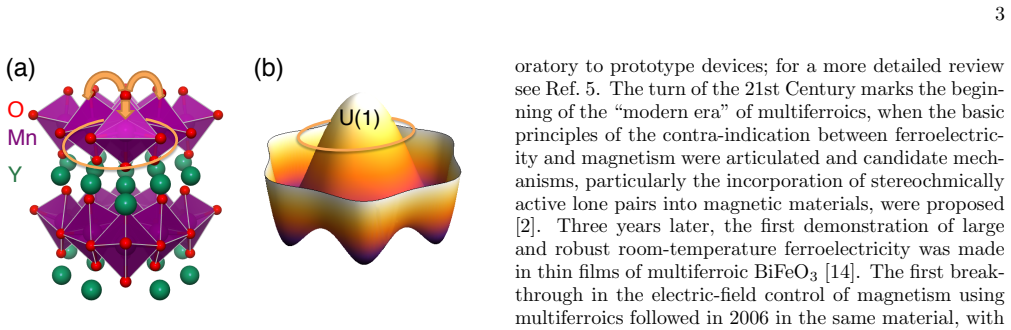
The central object is the multiferroic crystal itself: a single phase that combines a switchable electric polarization (ferroelectricity) with magnetic order, thereby breaking both space-inversion and time-reversal symmetry. The argument is carried by the chemical mechanisms that make this coexistence possible—the $d^0$/$d^n$ contra-indication between ferroelectricity and magnetism and its workarounds, notably stereochemically active lone pairs in BiFeO$_3$, geometric improper ferroelectricity in hexagonal manganites such as YMnO$_3$, and strain- or chemical-pressure-induced ferroelectricity in EuTiO$_3$—and by derived formal objects such as magnetoelectric multipoles, conducting improper ferroelectric domain walls, and the Mexican-hat-like potential that governs domain formation in the hexagonal manganites. Each application in the paper follows from one of these mechanisms, so the machinery is a toolbox of symmetry-breaking routes rather than a single identity.
What would settle it
A direct check would be to repeat the three pivotal demonstrations independently: measure the cooling-rate dependence of domain-wall density in YMnO$_3$ to see if Kibble-Zurek scaling holds over the quoted range; replicate the mouse blood-brain barrier delivery with core-shell magnetoelectric nanoparticles in a second laboratory; and remeasure the magnetization imbalance in (Eu,Ba)TiO$_3$ in an applied electric field to confirm the $6.05\times10^{-25}\,\mathrm{e\,cm}$ bound. Failure of any of these would remove a pillar of the paper's broad claim.
Extended reading notes
Core claim
The paper's central claim is that the relevance of multiferroic materials now vastly exceeds the electric-field control of magnetism that motivated the field's renaissance. It argues that the same materials, through their combined ferroelectric and magnetic order, support a set of qualitatively different applications: magnetic-remote-controlled drug release and tissue engineering, solar energy conversion and photocatalytic water purification, searches for the electron electric dipole moment, and the laboratory simulation of cosmic-string formation via Kibble-Zurek scaling in hexagonal manganites. It also points to ferroelectric domain walls in these manganites, whose conductivity depends on the head-to-head or tail-to-tail orientation of the polarization, as a new basis for energy-efficient storage and sensing. The overarching assertion is that the side effects of the multiferroics research program have become at least as important as the original target.
Load-bearing premise
The load-bearing premise is that the cited experimental results are correct and representative—especially the Kibble-Zurek scaling in YMnO$_3$, the blood-brain barrier transport of magnetoelectric nanoparticles in mice, and the electron electric dipole moment bound from (Eu,Ba)TiO$_3$; if any of these fail to reproduce in independent hands or hold only for the specific samples studied, the corresponding outlook sections lose their foundation.
Editorial extensions
If this is right
- If the MESO prototype matures as described, switching voltages near 100 mV and spin-orbit outputs of hundreds of millivolts would put memory and logic at roughly 1 aJ per bit, a step change in computing energy efficiency.
- Core-shell magnetoelectric nanoparticles that cross the blood-brain barrier without toxicity in mice would enable targeted, remote-triggered drug delivery for traumatic neuronal injury and degenerative disease.
- The verified Kibble-Zurek scaling in hexagonal manganites turns a tabletop ferroelectric into a testbed for cosmological defect formation, complementing direct astronomical searches for cosmic strings.
- Conducting tail-to-tail and insulating head-to-head ferroelectric domain walls in ErMnO$_3$, moved by small electric fields, offer a device concept in which the domain wall itself is the functional element.
- A solid-state electron electric dipole moment bound of $6.05\times10^{-25}\,\mathrm{e\,cm}$ from (Eu,Ba)TiO$_3$, if improved by avoiding hysteretic heating, would continue to constrain beyond-Standard-Model theories alongside molecular spectroscopy.
Reading between the lines
- A natural extension the paper leaves implicit is that other improper ferroelectrics with quasi-continuous order parameters could serve as cosmic-string simulators, with cooling-rate and A-site-cation dependence providing tunable knobs that the hexagonal manganites cannot vary independently.
- The magnetoelectric-monopole formalism suggests a tabletop test of axion electrodynamics: a magnetoelectric slab should generate a divergent magnetic field above an electric charge, and a spontaneous magnetoelectric Hall effect should appear without an applied field; the paper reports hints in muon spin-rotation data but no unambiguous confirmation.
- If conducting domain walls can be positioned deterministically, domain-wall networks could form reconfigurable wiring or memory without transistors, a device architecture the paper sketches but does not develop; the unresolved challenge is fast, reliable control of wall motion and readout of the conduction state.
- The paper's closing suggestion of multiferroic quantum criticality implies that coupled magnetic and ferroelectric quantum critical fluctuations could produce novel superconductivity or scaling phenomena beyond the separate quantum critical behaviors already seen in magnets and SrTiO$_3$.
Signed reviews
Editorial analysis
A structured set of objections, weighed in public.
Referee Report
Summary. This perspective, derived from the author's July 2017 Royal Society Inaugural Lecture, reviews the chemical origins of the multiferroic contra-indication between ferroelectricity and magnetism, surveys routes around it, and then develops a series of application areas that go beyond electric-field control of magnetism: remote magnetic-field-controlled biomedical delivery and tissue scaffolds, photovoltaics and photocatalysis, cosmology and high-energy physics (electron electric dipole moment, magnetoelectric monopoles, Kibble-Zurek cosmic-string analogues), and conducting domain-wall functionality. The manuscript closes by identifying magnetoelectric multipoles and multiferroic quantum criticality as cross-cutting directions. The presentation is a selective, synoptic review rather than a new technical result, with the central claim that the relevance of multiferroic materials now vastly exceeds the applications originally envisaged for them.
Significance. The value of the paper lies in its synthesis: it connects disparate communities—biomedicine, photovoltaics, high-energy physics, and oxide electronics—through the common thread of symmetry breaking and the multiferroic materials toolbox. The author is suitably cautious: the text explicitly notes that a room-temperature single-phase multiferroic remains to be identified, labels biomedical and photovoltaic results as promising with known challenges, and describes the magnetoelectric-monopole and Higgs-related items as open questions. Because the central claim is a hedged, qualitative synthesis supported by peer-reviewed citations, it is internally consistent, and the main risk is the standard one that selected proof-of-principle demonstrations (e.g., refs. 24, 38, and 62) may not prove fully representative over time. I consider the central argument sound and the remaining issues local to presentation.
minor comments (5)
- [IV.D.2 and IV.D.3] References 73 and 86 were not yet published in the posted version of the manuscript, with ref. 73 listed as 'Phys. Rev. X, in press' and ref. 86 as 'in preparation'. Since these references support the muon-spin hints of magnetoelectric-monopole behavior and the claim that the Higgs/Goldstone question is 'being actively pursued', the published version should update both to their final citations or, if final versions remain unavailable, soften the claims accordingly.
- [IV.C] The sentence about capturing 'low-energy solar phonons' should read 'solar photons'; the use of 'phonons' is a clear typo in a physics statement that is otherwise accurate.
- [IV.A] The word 'stereochmically' appears where 'stereochemically' is intended; similarly, Section IV.D.3 contains a duplicated article in 'indicated by the the black and white regions', and Section IV.C contains 'helfpul' for 'helpful'.
- [IV.D.1] The statement that the product of charge conjugation, parity inversion, and time reversal is 'known to be an invariant' is imprecise: the CPT theorem states that the combined operation is an exact symmetry of Lorentz-invariant local quantum field theories. This should be rephrased to avoid implying a conserved charge.
- [IV.A] The sentence describing '1 aJ of energy per bit' as 'predicted to yield' transformative technology would benefit from an explicit caveat that the figure is an extrapolation based on the cited device analysis (ref. 5), not an experimentally demonstrated value; as written it could be read as a consensus specification.
Circularity Check
No circularity: the paper is a hedged literature perspective whose claims depend on external, falsifiable experiments, not on construction-equivalent definitions or fitted parameters.
full rationale
This paper is a review/perspective based on the author's Inaugural Lecture; it does not present a derivation chain, fitted model, or uniqueness theorem that could reduce to its own inputs. The central claim is qualitative and explicitly hedged: the relevance of multiferroics 'now vastly exceeds the applications envisaged at the start of the multiferroics renaissance.' Support for this claim comes from cited experimental demonstrations (Kibble-Zurek scaling in YMnO3, blood-brain barrier transport, electron EDM bound, domain-wall conductivity), which are external, falsifiable results even where the author is a co-author. No equation in the paper is fitted to a subset of data and then renamed as a prediction; no quantity is defined in terms of the quantity it is supposed to explain. The heavy self-citation, including in-press ref. 73 and in-preparation ref. 86, is not load-bearing: ref. 73 is cited for 'hints' of monopole behavior that 'still await unambiguous confirmation,' and ref. 86 is cited only to note that the Higgs question 'remains an open question.' The paper itself flags its main limitations, such as the absence of a room-temperature single-phase material with strong magnetoelectric coupling, the challenges of biocompatibility and particle-size retention for biomedical use, and the need for further studies on photocatalysis, thermoelectrics, and related applications. Because there is no reduction of a derived result to an input by construction, and no self-citation chain that forces the conclusion, the appropriate finding is no significant circularity.
Assumptions & free parameters
assumptions (2)
- domain assumption Cited experimental and theoretical results in the literature are accurate and correctly interpreted.
- domain assumption The hexagonal manganite phase transition is a valid laboratory analogue of early-universe symmetry breaking (Mexican-hat potential).
Cite this review
Pith. "Pith review of Royal Society Inaugural Article Perspective: Multiferroics Beyond Electric-Field Control of Magnetism." pith.science (2026). https://pith.science/paper/O4XVD5UM
@misc{pith2026190808352,
  author       = {Pith},
  title        = {Pith review of: Royal Society Inaugural Article Perspective: Multiferroics Beyond Electric-Field Control of Magnetism},
  year         = {2026},
  howpublished = {\url{https://pith.science/paper/O4XVD5UM}},
  note         = {Machine review of arXiv:1908.08352}
}
read the original abstract
Multiferroic materials, with their combined and coupled magnetism and ferroelectricity, providea playground for studying new physics and chemistry as well as a platform for development ofnovel devices and technologies. Based on my July 2017 Royal Society Inaugural Lecture, I review recent progress and propose future directions in the fundamentals and applications of multiferroics, with a focus on unanticipated developments outside of the core activity of electric-field control of magnetism.
Figures

Figures from the paper (2 more)


Reference graph
Works this paper leans on
-
[1]
Search for the electron electric dipole moment. For materials scientists, both the charge and the spin of the electron are familiar properties that are essen- tial for the behavior of materials, the former being re- sponsible for example for ionic bonding and the latter for magnetism. We tend to think less often about the electric dipole moment of the ele...
2013
-
[2]
monopolotronic
Magnetoelectric monopoles and beyond. As discussed in the Introduction, many multiferroics exhibit a linear magnetoelectric effect, in which a mag- netic field induces a polarization linearly proportional to its strength, and reciprocally an electric field induces a linear magnetization. It has been pointed out that the linear magnetoelectric response can be...
-
[3]
Cosmic string formation in the early universe. The ferroelectric and ferromagnetic states in multifer- roics, in which the electric or magnetic dipoles are aligned in an ordered fashion, are often obtained by cooling through phase transitions from higher symmetry dipole- disordered paraelectric or paramagnetic phases, respec- tively. Such spontaneous symm...
-
[4]
Electric-field control of magnetism in complex oxide thin films,
N. A. Spaldin and R. Ramesh, “Electric-field control of magnetism in complex oxide thin films,” MRS Bull. 33, 1047–1050 (2008)
2008
-
[5]
98), in which an applied electric field generates a linear magnetization and vice versa
Indeed, the field of multiferroic materials emerged from a small but long-standing effort to develop magnetoelectric materials (see for example Ref. 98), in which an applied electric field generates a linear magnetization and vice versa
-
[6]
Why are there so few magnetic ferro- electrics?
N. A. Hill, “Why are there so few magnetic ferro- electrics?” J. Phys. Chem. B 104, 6694–6709 (2000)
2000
-
[7]
The renaissance of mag- netoelectric multiferroics,
N. A. Spaldin and M. Fiebig, “The renaissance of mag- netoelectric multiferroics,” Science 309, 391–392 (2005)
2005
-
[8]
Magnetoferroelectricity in Cr 2BeO4,
R. E. Newnham, J. J. Kramer, W. E. Schulze, and L. E. Cross, “Magnetoferroelectricity in Cr 2BeO4,” J. Appl. Phys. 49, 6088–6091 (1978)
1978
Show all 102 references
-
[9]
Advances in magneto- electric multiferroics,
N. A. Spaldin and R. Ramesh, “Advances in magneto- electric multiferroics,” Nat. Mater. 18, 203–212 (2019)
2019
-
[10]
Use of the Jahn-Teller theorem in inor- ganic chemistry,
J. K. Burdett, “Use of the Jahn-Teller theorem in inor- ganic chemistry,” Inorg. Chem. 20, 1959–1962 (1981)
1981
-
[11]
Non-d0 Mn-driven ferroelectricity in antiferromagnetic BaMnO3,
J. M. Rondinelli, A. S. Eidelson, and N. A. Spaldin, “Non-d0 Mn-driven ferroelectricity in antiferromagnetic BaMnO3,” Phys. Rev. B 79, 205119 (2009)
2009
-
[12]
Atomically engineered ferroic layers yield a room-temperature magnetoelectric multiferroic,
J. A. Mundy, C. M. Brooks, M. E. Holtz, Jarrett A. Moyer, H. Das, A. F. R´ ebola, J. T. Heron, J. D. Clarkson, S. M. Disseler, Z. Liu, A. Farhan, R. Held, R. Hovden, E. Padgett, Q. Mao, H. Paik, R. Misra, L. F. Kourk- outis, E. Arenholz, A. Scholl, J. A. Borchers, W. D. Rat- c...
2016
-
[13]
Magnetic control of ferroelectric polar- ization,
T. Kimura, T. Goto, H. Shintani, K. Ishizaka, T. Arima, and Y. Tokura, “Magnetic control of ferroelectric polar- ization,” Nature 426, 55–58 (2003)
2003
-
[14]
Multi- ferroics: Past, present, and future,
N. A. Spaldin, R. Ramesh, and S.-W. Cheong, “Multi- ferroics: Past, present, and future,” Physics Today Oc- tober, 38–43 (2010)
2010
-
[15]
Multiferroic BaTiO3-CoFe2O4 nanostructures,
H. Zheng, J. Wang, S. E. Lofland, Z. Ma, L. Mohaddes- Ardabili, T. Zhao, L. Salamanca-Riba, S. R. Shinde, S. B. Ogale, F. Bai, D. Viehland, Y. Jia, D. G. Schlom, M. Wuttig, A. Roytburd, and R. Ramesh, “Multiferroic BaTiO3-CoFe2O4 nanostructures,” Science 303, 661–663 (2004)
2004
-
[16]
Visualizing the role of Bi 6 s “lone pairs
R. Seshadri and N. A. Hill, “Visualizing the role of Bi 6 s “lone pairs” in the off-center distortion in ferromagnetic 10 BiMnO3,” Chem. Mater. 13, 2892–2899 (2001)
2001
-
[17]
Magnetoelectric coupling effects in multiferroic complex oxide composite structures,
C. A. F. Vaz, J. Hoffman, C. H. Ahn, and R. Ramesh, “Magnetoelectric coupling effects in multiferroic complex oxide composite structures,” Adv. Mater. 22, 2900–2918 (2010)
2010
-
[18]
Epitaxial BiFeO 3 multifer- roic thin film heterostructures,
J. Wang, J. B. Neaton, H. Zheng, V. Nagarajan, S. B. Ogale, B. Liu, D. Viehland, V. Vaithyanathan, D. G. Schlom, U. V. Waghmare, N. A. Spaldin, K. M. Rabe, M. Wuttig, and R. Ramesh, “Epitaxial BiFeO 3 multifer- roic thin film heterostructures,” Science 299, 1719–1722 (2003)
2003
-
[19]
First principles investigation of ferromagnetism and ferroelectricity in BiMnO3,
N. A. Hill and K. M. Rabe, “First principles investigation of ferromagnetism and ferroelectricity in BiMnO3,” Phys. Rev. B 59, 8759–8769 (1999)
1999
-
[20]
The origin of ferroelectricity in magne- toelectric YMnO 3,
B. B. van Aken, T. T. M. Palstra, A. Filippetti, and N. A. Spaldin, “The origin of ferroelectricity in magne- toelectric YMnO 3,” Nat. Mater. 3, 164–170 (2004)
2004
-
[21]
A strong ferroelectric ferromagnet created by means of spin-lattice coupling,
J. H. Lee, L. Fang, E. Vlahos, X. Ke, Y. W. Jung, L. Fitting Kourkoutis, J.-W. Kim, P. J. Ryan, T. Heeg, M. Roeckerath, V. Goian, M. Bernhagen, R. Uecker, P. C. Hammel, K. M. Rabe, S. Kamba, J. Schubert, J. W. Freeland, D. A. Muller, C. J. Fennie, P. Schiffer, V. Gopalan, E. Jo...
2010
-
[22]
A multiferroic material to search for the perma- nent electric dipole moment of the electron,
K. Rushchanskii, S. Kamba, V. Goian, P. Vanˇ ek, M. Savi- nov, J. Prokleˇ ska, D. Nuzhnyy, K. Kn´ ıˇ zek, S. Eckel, S. K. Lamoreaux, A. O. Sushkov, M. Leˇ zai´ c, and N. A. Spaldin, “A multiferroic material to search for the perma- nent electric dipole moment of the electron,”...
2010
-
[23]
Multiferroics: Past, present, and future,
N. A. Spaldin, “Multiferroics: Past, present, and future,” MRS Bull. 42, 385–389 (2017)
2017
-
[24]
Scaling behavior and beyond equilibrium in the hexagonal manganites,
S. M. Griffin, M. Lilienblum, K. T. Delaney, Y. Kumagai, M. Fiebig, and N. A. Spaldin, “Scaling behavior and beyond equilibrium in the hexagonal manganites,” Phys. Rev. X 2, 041022 (2012)
2012
-
[25]
Origin of ferroelectricity in the multiferroic barium fluorides BaMF 4,
C. Ederer and N. A. Spaldin, “Origin of ferroelectricity in the multiferroic barium fluorides BaMF 4,” Phys. Rev. B 74, 024102 (2006)
2006
-
[26]
Ferroelectric transi- tion in YMnO 3 from first principles,
C. J. Fennie and K. M. Rabe, “Ferroelectric transi- tion in YMnO 3 from first principles,” Phys. Rev. B 72, 100103(R) (2005)
2005
-
[27]
Landau theory of topological defects in multiferroic hexagonal manganites,
S. Artyukhin, K. T. Delaney, N. A. Spaldin, and M. Mostovoy, “Landau theory of topological defects in multiferroic hexagonal manganites,” Nat. Mater. 13, 42– 49 (2014)
2014
-
[28]
Elec- trically controllable antiferromagnets: Nanoscale obser- vation of coupling between antiferromagnetism and fer- roelectricity in multiferroic BiFeO3,
T. Zhao, A. Scholl, F. Zavaliche, K. Lee, M. Barry, A. Do- ran, M. P. Cruz, Y. H. Chu, C. Ederer, N. A. Spaldin, R. R. Das, B. M. Kim, C. B. Eom, and R. Ramesh, “Elec- trically controllable antiferromagnets: Nanoscale obser- vation of coupling between antiferromagnetism and fe...
2006
-
[29]
Anisotropic conductance at improper ferroelectric do- main walls,
D. Meier, J. Seidel, A. Cano, K. Delaney, Y. Kumagai, M. Mostovoy, N. A. Spaldin, R. Ramesh, and M. Fiebig, “Anisotropic conductance at improper ferroelectric do- main walls,” Nat. Mater. 11, 284–288 (2012)
2012
-
[30]
On the relationship be- tween topological and geometric defects,
S. M. Griffin and N. A. Spaldin, “On the relationship be- tween topological and geometric defects,” J. Phys.: Con- dens. Matter 29, 343001 (2017)
2017
-
[31]
Weak ferromagnetism and magnetoelectric coupling in bismuth ferrite,
C. Ederer and N. A. Spaldin, “Weak ferromagnetism and magnetoelectric coupling in bismuth ferrite,” Phys. Rev. B 71, 060401(R) (2005)
2005
-
[32]
Scalable energy- efficient magnetoelectric spin–orbit logic,
S. Manipatruni, D. E. Nikonov, C.-C. Lin, T. A. Gosavi, H. Liu, B. Prasad, Y.-L. Huang, E. Bon- turim, R. Ramesh, and I. A. Young, “Scalable energy- efficient magnetoelectric spin–orbit logic,” Nature 565, 1–9 (2018)
2018
-
[33]
Areas to watch,
Editors of Science, “Areas to watch,” Science 318, 1848– 1849 (2007)
2007
-
[34]
Robust isothermal electric control of exchange bias at room tem- perature,
X. He, Y. Wang, N. Wu, A. N. Caruso, E. Vescovo, K. D. Belashchenko, P. A. Dowben, and C. Binek, “Robust isothermal electric control of exchange bias at room tem- perature,” Nat. Mater. 9, 579–585 (2010)
2010
-
[35]
Deterministic switching of ferromagnetism at room temperature using an electric field,
J. T. Heron, J. L. Bosse, Q. He, Y. Gao, M. Trassin, L. Ye, J. D. Clarkson, C. Wang, J. Liu, S. Salahuddin, D. C. Ralph, D. G. Schlom, J. ´I˜ niguez, B. D. Huey, and R. Ramesh, “Deterministic switching of ferromagnetism at room temperature using an electric field,” Nature516, 3...
2014
-
[36]
Externally controlled on-demand release of anti-HIV drug using magneto-electric nanoparticles as carriers,
M. Nair, R. Guduru, P. Liang, J. Hong, V. Sagar, and S. Khizroev, “Externally controlled on-demand release of anti-HIV drug using magneto-electric nanoparticles as carriers,” Nat. Commun. 4, 1707 (2013)
2013
-
[37]
Hybrid magnetoelec- tric nanowires for nanorobotic applications: Fabrication, magnetoelectric coupling, and magnetically assisted in vitro targeted drug delivery,
X.-Z. Chen, M. Hoop, N. Shamsudhin, T. Huang, B. ¨Ozkale, Q. Li, E. Siringil, F. Mushtaq, L. Di Tizio, B. J. Nelson, and S. Pan´ e, “Hybrid magnetoelec- tric nanowires for nanorobotic applications: Fabrication, magnetoelectric coupling, and magnetically assisted in vitro targe...
2016
-
[38]
Motile piezoelectric nanoeels for targeted drug delivery,
F. Mushtaq, H. Torlakcik, M. Hoop, B. Jang, F. Carlson, T. Grunow, N. L¨ aubli, A. Ferreira, X.-Z. Chen, B. J. Nelson, and S. Pan´ e, “Motile piezoelectric nanoeels for targeted drug delivery,” Adv. Funct. Mater. 29, 1808135 (2019)
2019
-
[39]
Magnetically driven piezoelectric soft mi- croswimmers for neuron-like cell delivery and neuronal differentiation,
X.-Z. Chen, J.-H. Liu, M. Dong, L. M¨ uller, G. Chatzipir- piridis, C. Hu, A. Terzopoulou, H. Torlakcik, X. Wang, F. Mushtaq, J. Puigmart´ ı-Luis, Q.-D. Shen, B. J. Nelson, and S. Pan´ e, “Magnetically driven piezoelectric soft mi- croswimmers for neuron-like cell delivery and...
2019
-
[40]
Magnetoelectric 3d scaffolds for enhanced bone cell proliferation,
F. Mushtaq, H. Torlakcik, Q. Vallmajo-Martin, E. C. Siringil, J. Zhang, C. R¨ ohrig, Y. Shen, Y. Yu, X.-Z. Chen, R. M¨ uller, B. J. Nelson, and S. Pan´ e, “Magnetoelectric 3d scaffolds for enhanced bone cell proliferation,” Applied Materials Today 16, 290–300 (2019)
2019
-
[41]
Mag- netoelectric micromachines with wirelessly controlled navigation and functionality,
X.-Z. Chen, N. Shamsudhin, M. Hoop, R. Pieters, E. Siringil, M. S. Sakar, B. J. Nelson, and S. Pan´ e, “Mag- netoelectric micromachines with wirelessly controlled navigation and functionality,” Mater. Horiz. 3, 113–118 (2016)
2016
-
[42]
Magnet- ically guided central nervous system delivery and toxicity evaluation of magneto-electric nanocarriers,
A. Kaushik, R. D. Jayant, R. Nikkhah-Moshaie, V. Bhardwaj, U. Roy, Z. Huang, A. Ruiz, A. Yndart, V. Atluri, N. El-Hage, K. Khalili, and M. Nair, “Magnet- ically guided central nervous system delivery and toxicity evaluation of magneto-electric nanocarriers,” Sci. Rep. 6, 25309 (2016)
2016
-
[43]
are particularly promising, offering open-circuit volt- ages of∼ 0.8 V and external quantum efficiencies up to 10 %. The power conversion efficiency is improved by A- site or B-site doping and by increase of oxygen vacancy concentration [44], likely as a result of reducing the band...
-
[44]
Proving the suitability of magneto- electric stimuli for tissue engineering applications,
C. Ribeiro, V. Correia, P. Martins, F. M. Gama, and S. Lanceros-Mendez, “Proving the suitability of magneto- electric stimuli for tissue engineering applications,” Col- loids Surf. B 140, 430–436 (2016)
2016
-
[45]
Theory of the photovoltaic and light-induced effects in multiferroics,
B. Mettout and P. Toledano, “Theory of the photovoltaic and light-induced effects in multiferroics,” in Emerging Photovoltaic Materials (wiley, 2019) pp. 1–44
2019
-
[46]
Switchable ferroelectric diode and photovoltaic effect in BiFeO3,
T. Choi, S. Lee, Y. J. Choi, V. Kiryukhin, and S.-W. Cheong, “Switchable ferroelectric diode and photovoltaic effect in BiFeO3,” Science 324, 63–66 (2009)
2009
-
[47]
Photovoltaic ef- fects in BiFeO3,
S. Y. Yang, L. W. Martin, S. J. Byrnes, T. E. Conry, S. R. Basu, D. Paran, L. Reichertz, J. Ihlefeld, C. Adamo, A. Melville, Y. H. Chu, C. H. Yang, J. L. Musfeldt, D. G. Schlom, J. W. Ager, and R. Ramesh, “Photovoltaic ef- fects in BiFeO3,” Appl. Phys. Lett. 95, 062909 (2009)
2009
-
[48]
Tunable bandgap in BiFeO3 nanoparti- cles: The role of microstrain and oxygen defects ,
P. S. V. Mocherla, C. Karthik, R. Ubic, M. S. R. Rao, and C. Sudakar, “Tunable bandgap in BiFeO3 nanoparti- cles: The role of microstrain and oxygen defects ,” Appl. Phys. Lett. 103, 022910 (2013)
2013
-
[49]
Bismuth ferrite materials for solar cells: Cur- 11 rent status and prospects,
G. Chen, J. Chen, W. Pei, Y. Lu, Q. Zhang, Q. Zhang, and Y. He, “Bismuth ferrite materials for solar cells: Cur- 11 rent status and prospects,” Mater. Res. Bull. 110, 39–49 (2019)
2019
-
[50]
Photocatalytic properties of BiFeO 3 nanoparticles with different sizes,
T. Xian, H. Yang, J. F. Dai, Z. Q. Wei, J. Y. Ma, and W. J. Feng, “Photocatalytic properties of BiFeO 3 nanoparticles with different sizes,” Mater. Lett. 65, 1573–1575 (2011)
2011
-
[51]
Sono-synthesis of bis- muth ferrite nanoparticles with high photocatalytic ac- tivity in degradation of Rhodamine B under solar light irradiation ,
T. Soltani and M. H. Entezari, “Sono-synthesis of bis- muth ferrite nanoparticles with high photocatalytic ac- tivity in degradation of Rhodamine B under solar light irradiation ,” Chem. Eng. J. 223, 145–154 (2013)
2013
-
[52]
Piezoelectrically enhanced photocatalysis with BiFeO 3 nanostructures for efficient water remediation,
F. Mushtaq, X. Chen, M. Hoop, H. Torlakcik, E. Pel- licer, J. Sort, C. Gattinoni, B. J. Nelson, and S. Pan´ e, “Piezoelectrically enhanced photocatalysis with BiFeO 3 nanostructures for efficient water remediation,” iScience 4, 236–246 (2018)
2018
-
[53]
Magnetoelectrically driven cat- alytic degradation of organics,
F. Mushtaq, X. Chen, H. Torlakcik, C. Steuer, M. Hoop, E. C. Siringil, X. Mart´ ı, G. Limburg, P. Stipp, B. J. Nelson, and S. Pan´ e, “Magnetoelectrically driven cat- alytic degradation of organics,” Adv. Mater. 16, 1901378 (2019)
2019
-
[54]
A review: Preparation of bismuth fer- rite nanoparticles and its applications in visible-light in- duced photocatalyses,
T. Gao, Z. Chen, Q. Huang, F. Niu, X. Huang, L. Qin, and Y. Huang, “A review: Preparation of bismuth fer- rite nanoparticles and its applications in visible-light in- duced photocatalyses,” Rev. Adv. Mater. Sci. 40, 97–109 (2015)
2015
-
[55]
Improved rate and cycling performances of electrodes based on BiFeO3 nanoflakes by compositing with organic pectin for advanced rechargeable Na-ion batteries,
B. Sun, S. Mao, S. Zhu, G. Zhou, Y. Xia, and Y. Zhao, “Improved rate and cycling performances of electrodes based on BiFeO3 nanoflakes by compositing with organic pectin for advanced rechargeable Na-ion batteries,” ACS Appl. Nano Mater. 1, 1291–1299 (2018)
2018
-
[56]
Thermoelectric properties of Co-doped BiFeO 3 and Bi 24CoO37-BiFeO3 compound systems,
T. Yokota, R. Aoyagi, and M. Gomi, “Thermoelectric properties of Co-doped BiFeO 3 and Bi 24CoO37-BiFeO3 compound systems,” J. Ceramic Soc. Jpn. 121, 675–678 (2013)
2013
-
[57]
Light- induced size changes in BiFeO3 crystals,
B. Kundys, M. Viret, D. Colson, and D. Kundys, “Light- induced size changes in BiFeO3 crystals,” Nat. Mater. 9, 803–805 (2010)
2010
-
[58]
En- hanced photocurrent in BiFeO 3 materials by coupling temperature and thermo-phototronic effects for self- powered ultraviolet photodetector system,
J. Qi, N. Ma, X. Ma, R. Adelung, and Y. Yang, “En- hanced photocurrent in BiFeO 3 materials by coupling temperature and thermo-phototronic effects for self- powered ultraviolet photodetector system,” ACS Appl. Mater. Interfaces 10, 13712–13719 (2018)
2018
-
[59]
Efficient gas sensitivity in mixed bismuth ferrite micro (cubes) and nano (plates) structures,
S. D. Waghmare, V. V. Jadhav, S. K. Gore, S.-J. Yoon, S. B. Ambade, B. J. Lokhande, R. S. Mane, and S.-H. Han, “Efficient gas sensitivity in mixed bismuth ferrite micro (cubes) and nano (plates) structures,” Mater. Res. Bull. 47, 4169–4173 (2012)
2012
-
[60]
Gas- sensing and electrical properties of perovskite structure p-type barium-substituted bismuth ferrite,
G. Dong, H. Fan, H. Tian, J. Fang, and Q. Li, “Gas- sensing and electrical properties of perovskite structure p-type barium-substituted bismuth ferrite,” RSC Adv.5, 29618–29623 (2015)
2015
-
[61]
Thermionic emission based resis- tive memory with ultrathin ferroelectric BiFe 1−xCrxO3 films deposited by mineralizer-free microwave-assisted hydrothermal synthesis,
G. Kolhatkar, F. Ambriz-Vargas, B. Huber, R. Thomas, and A. Ruediger, “Thermionic emission based resis- tive memory with ultrathin ferroelectric BiFe 1−xCrxO3 films deposited by mineralizer-free microwave-assisted hydrothermal synthesis,” Crystal Growth & Design 18, 1864–1872 (2018)
2018
-
[62]
Fast oxygen exchange kinetics of pore-free Bi 1−xSrxFeO3−δ thin films,
A. Wedig, R. Merkle, B. Stuhlhofer, H.-U. Habermeier, J. Maier, and E. Heifets, “Fast oxygen exchange kinetics of pore-free Bi 1−xSrxFeO3−δ thin films,” Phys. Chem. Chem. Phys. 13, 16530 (2011)
2011
-
[63]
Multiferroics: from the cosmically large to the subatomically small,
N. A. Spaldin, “Multiferroics: from the cosmically large to the subatomically small,” Nat. Rev. Mater. 2, 17017 (2017)
2017
-
[64]
Solid-state systems for the electron electric dipole moment and other fundamental measure- ments,
S. K. Lamoreaux, “Solid-state systems for the electron electric dipole moment and other fundamental measure- ments,” Phys. Rev. A 66, 022109 (2002)
2002
-
[65]
Prospects for an electron electric-dipole-moment search with ferroelectric (Eu,Ba)TiO 3 ceramics,
A. O. Sushkov, S. Eckel, and S. K. Lamoreaux, “Prospects for an electron electric-dipole-moment search with ferroelectric (Eu,Ba)TiO 3 ceramics,” Phys. Rev. A 81, 628 (2010)
2010
-
[66]
Limit on the electron electric dipole moment using param- agnetic ferroelectric Eu 0.5Ba0.5TiO3,
S. Eckel, A. O. Sushkov, and S. K. Lamoreaux, “Limit on the electron electric dipole moment using param- agnetic ferroelectric Eu 0.5Ba0.5TiO3,” Phys. Rev. Lett. 109, 193003 (2012)
2012
-
[67]
The search for a permanent electric dipole moment,
N. Fortson, P. Sandars, and S. Barr, “The search for a permanent electric dipole moment,” Physics Today 56, 33–39 (2003)
2003
-
[68]
Order of magnitude smaller limit on the electric dipole moment of the electron,
J. Baron, W. C. Campbell, D. DeMille, J. M. Doyle, G. Gabrielse, Y. V. Gurevich, P. W. Hess, N. R. Hutzler, E. Kirilov, I. Kozyryev, B. R. O’Leary, C. D. Panda, M. F. Parsons, E. S. Petrik, B. Spaun, A. C. Vutha, and A. D. West, “Order of magnitude smaller limit on the electri...
2014
-
[69]
Improved limit on the electric dipole moment of the electron,
V. Andreev, D. G. Ang, D. DeMille, J. M. Doyle, G. Gabrielse, J. Haefner, N. R. Hutzler, Z. Lasner, C. Meisenhelder, B. R. O’Leary, C. D. Panda, A. D. West, E. P. West, and X. Wu, “Improved limit on the electric dipole moment of the electron,” Nature562, 355– 360 (2018)
2018
-
[70]
Monopole-based formalism for the diagonal magnetoelectric response,
N. A. Spaldin, M. Fechner, E. Bousquet, A. Balatsky, and L. Nordstr¨ om, “Monopole-based formalism for the diagonal magnetoelectric response,” Phys. Rev. B 88, 094429 (2013)
2013
-
[71]
The toroidal moment in condensed-matter physics and its re- lation to the magnetoelectric effect,
N. A. Spaldin, M. Fiebig, and M. Mostovoy, “The toroidal moment in condensed-matter physics and its re- lation to the magnetoelectric effect,” J. Phys. Condens. Matter 20, 434203 (2008)
2008
-
[72]
Problem of strong P and T invariance in presence of instantons,
F. Wilczek, “Problem of strong P and T invariance in presence of instantons,” Phys. Rev. Lett. 40, 279–282 (1978)
1978
-
[73]
A New Light Boson?
S. Weinberg, “A New Light Boson?” Phys. Rev. Lett.40, 223–226 (1978)
1978
-
[74]
Two applications of axion electrodynamics,
F. Wilczek, “Two applications of axion electrodynamics,” Phys. Rev. Lett. 58, 1799–1802 (1987)
1987
-
[75]
Search for the magnetic monopole at a magnetoelectric surface,
Q. N. Meier, M. Fechner, T. Nozaki, M. Sahashi, Z. Salman, T. Prokscha, A. Suter, P. Schoen- herr, M. Lilienblum, P. Borisov, I. E. Dzyaloshinskii, M. Fiebig, H. Luetkens, and N. A. Spaldin, “Search for the magnetic monopole at a magnetoelectric surface,” Phys. Rev. X 9, 011011 (2019)
2019
-
[76]
Magnetic monopoles and unusual dy- namics of magnetoelectrics,
D. I. Khomskii, “Magnetic monopoles and unusual dy- namics of magnetoelectrics,” Nat. Commun. 5, 4793 (2014)
2014
-
[77]
Observation of a charge-neutral muon polaron complex in antiferromagnetic Cr 2O3,
M. H. Dehn, J. K. Shenton, S. Holenstein, Q. N. Meier, D. J. Arsenau, D. L. Cortie, B. Hitti, A. C. Y. Fang, W. A. MacFarlane, R. M. L. McFadden, G. D. Mor- ris, Z. Salman, H. Luetkens, N. A. Spaldin, M. Fechner, and R. F. Kiefl, “Observation of a charge-neutral muon polaron co...
2019
-
[78]
Dicke quantum phase transition with a su- perfluid gas in an optical cavity,
K. Baumann, C. Guerlin, F. Brennecke, and T. Esslinger, “Dicke quantum phase transition with a su- perfluid gas in an optical cavity,” Nature464, 1301–1306 (2010)
2010
-
[79]
Spontaneous symme- 12 try breaking in a quenched ferromagnetic spinor Bose– Einstein condensate,
L. E. Sadler, J. M. Higbie, S. R. Leslie, M. Vengalat- tore, and D. M. Stamper-Kurn, “Spontaneous symme- 12 try breaking in a quenched ferromagnetic spinor Bose– Einstein condensate,” Nature 443, 312–315 (2006)
2006
-
[80]
Broken symmetry and the mass of gauge vector mesons,
F. Englert and R. Brout, “Broken symmetry and the mass of gauge vector mesons,” Phys. Rev. Lett. 13, 321– 323 (1964)
1964
-
[81]
Broken symmetries and the masses of gauge bosons,
P. W. Higgs, “Broken symmetries and the masses of gauge bosons,” Phys. Rev. Lett. 13, 508–509 (1964)
1964
-
[82]
Global conservation laws and massless particles,
G. S. Guralnik, C. R. Hagen, and T. W. B. Kibble, “Global conservation laws and massless particles,” Phys. Rev. Lett. 13, 585–587 (1964)
1964
-
[83]
Topology of cosmic strings and do- mains,
T. W. B. Kibble, “Topology of cosmic strings and do- mains,” J. Phys. A 9, 1387 (1976)
1976
-
[84]
Cosmological experiments in superfluid helium?
W. H. Zurek, “Cosmological experiments in superfluid helium?” Nature 317, 505–508 (1985)
1985
-
[85]
Symmetry breaking and defects,
T. W. B. Kibble, “Symmetry breaking and defects,” in Patterns of Symmetry Breaking , NATO Science Se- ries II: Mathematics, Physics and Chemistry, Vol. 127 (2003) pp. 3–36, proceedings of the Conference of the NATO-Advanced-Study-Institute on Patterns of Symme- try Breaking, C...
2003
-
[86]
Direct Observation of Multiferroic Vortex Domains in YMnO 3,
Q. Zhang, G. Tan, L. Gu, Y. Yao, C. Jin, Y. Wang, X. Duan, and R. Yu, “Direct Observation of Multiferroic Vortex Domains in YMnO 3,” Sci. Rep. 3, 02741 (2013)
2013
-
[87]
Global formation of topological defects in the multiferroic hexagonal manganites,
Q. N. Meier, M. Lilienblum, S. M. Griffin, K. Conder, E. Pomjakushina, Z. Yan, E. Bourret, D. Meier, F. Licht- enberg, E. K. H. Salje, N. A. Spaldin, M. Fiebig, and A. Cano, “Global formation of topological defects in the multiferroic hexagonal manganites,” Phys. Rev. X 7, 041014 (2017)
2017
-
[88]
Un- conventional continuous structural disorder at the order- disorder phase transition in the hexagonal manganites,
S. H. Skjaervo, Q. N. Meier, M. Feygenson, N. A. Spaldin, S. J. L. Billinge, E. S. Bozin, and S. M. Selbach, “Un- conventional continuous structural disorder at the order- disorder phase transition in the hexagonal manganites,” Phys. Rev. X 9, 031001 (2019)
2019
-
[89]
Mn 3+ in trigo- nal bipyramidal coordination: A new blue chromophore,
A. E. Smith, H. Mizoguchi, K. T. Delaney, N. A. Spaldin, A. W. Sleight, and M. A. Subramanian, “Mn 3+ in trigo- nal bipyramidal coordination: A new blue chromophore,” J. Am. Chem. Soc. 131, 17084–17086 (2009)
2009
-
[90]
Do indications of crystallo- graphic Higgs and Goldstone dynamics manifest in the hexagonal manganites?
Q. Meier, A. Stucky, J. Teyssier, S. Griffin, D. van der Marel, and N. A. Spaldin, “Do indications of crystallo- graphic Higgs and Goldstone dynamics manifest in the hexagonal manganites?” (2019), in preparation
2019
-
[91]
The evolution of multiferroics,
M. Fiebig, T. Lottermoser, D. Meier, and M. Trassin, “The evolution of multiferroics,” Nat. Rev. Mater. 1, 16046 (2016)
2016
-
[92]
Parity- and time- odd atomic multipoles in magnetoelectric GaFeO3 as seen via soft x-ray Bragg diffraction,
U. Staub, Y. Bodenthin, C. Piamonteze, M. Garc´ ıa- Fern´ andez, V. Scagnoli, M. Garganourakis, S. Kooh- payeh, D. Fort, and S. W. Lovesey, “Parity- and time- odd atomic multipoles in magnetoelectric GaFeO3 as seen via soft x-ray Bragg diffraction,” Phys. Rev. B80, 140410 (2009)
2009
-
[93]
Ferro- type order of magneto-electric quadrupoles as an order- parameter for the pseudo-gap phase of a cuprate super- conductor,
S. W. Lovesey, D. D. Khalyavin, and U. Staub, “Ferro- type order of magneto-electric quadrupoles as an order- parameter for the pseudo-gap phase of a cuprate super- conductor,” J. Phys. Cond. Matter 27, 1–5 (2015)
2015
-
[94]
Quasistatic magnetoelectric multipoles as order parameter for pseudogap phase in cuprate su- perconductors,
M. Fechner, M. J. A. Fierz, F. Th¨ ole, U. Staub, and N. A. Spaldin, “Quasistatic magnetoelectric multipoles as order parameter for pseudogap phase in cuprate su- perconductors,” Phys. Rev. B 93, 174419 (2016)
2016
-
[95]
On the matter of topologi- cal insulators as magnetoelectrics,
N. P. Armitage and L. Wu, “On the matter of topologi- cal insulators as magnetoelectrics,” SciPost Phys. 6, 046 (2019)
2019
-
[96]
Magnetoelectric multipoles in metals,
F. Th¨ ole and N. A. Spaldin, “Magnetoelectric multipoles in metals,” Philos. Trans. Royal Soc. A 376, 20170450 (2018)
2018
-
[97]
Ferroelectric quantum criticality,
S. E. Rowley, L. J. Spalek, R. P. Smith, M. P. M. Dean, M. Itoh, J. F. Scott, G. G. Lonzarich, and S. S. Saxena, “Ferroelectric quantum criticality,” Nat. Phys. 10, 367 (2014)
2014
-
[98]
Quantum critical origin of the supercon- ducting dome in SrTiO 3,
J. M. Edge, Y. Kadem, U. Aschauer, N. A. Spaldin, and A. V. Balatsky, “Quantum critical origin of the supercon- ducting dome in SrTiO 3,” Phys. Rev. Lett. 115, 247002 (2015)
2015
-
[99]
Isotope effect in superconducting n- doped SrTiO 3,
A. Stucky, G. W. Scheerer, Z. Ren, D. Jaccard, J. M. Poumirol, C. Barreteau, E. Giannini, and D. van der Marel, “Isotope effect in superconducting n- doped SrTiO 3,” Sci. Rep. 6, 37582 (2016)
2016
-
[100]
Multiferroic quantum criticality,
A. Narayan, A. Cano, A. V. Balatsky, and N. A. Spaldin, “Multiferroic quantum criticality,” Nat. Mater. 18, 223– 228 (2019)
2019
-
[101]
Universe’s existence may be explained by new material,
J. Roach, “Universe’s existence may be explained by new material,” (2010), National Geographic, https://www.nationalgeographic.com/news/2010/8/100803- science-space-universe-electrons-matter-antimatter- imbalance/
2010
-
[102]
A. J. Freeman and H. Schmid, eds., Magnetoelectric in- teraction phenomena in crystals (Gordon and Breach, 1975)
1975
Reviewed August 14, 2026 · model on record in the stance chip above.
Discussion (0). Continue with ORCID to comment.