REVIEW 4 major objections 6 minor 41 references
IPENS:Interactive Unsupervised Framework for Rapid Plant Phenotyping Extraction via NeRF-SAM2 Fusion
T0 review · 4 major / 6 minor · reviewed 2026-08-15 · deepseek-v4-flash
Pith's one-line read IPENS claims that SAM2-propagated 2D masks, lifted into 3D by NeRF mask inverse rendering, turn single-round click prompts into grain-level 3D point clouds of rice and wheat organs, with mIoU 63.72% (rice) and 89.68% (wheat) and trait R²…
desk verdict The system is a plausible engineering contribution and the segmentation numbers are worth discussing, but the grain/panicle volume claims are undermined by Eq. (4), which counts surface voxels as if they filled the interior. read the letter →
The pith
A machine-rendered reading of the paper's core claim, the machinery that carries it, and where it could break.
The reading
What carries the argument
The central object is mask inverse rendering: a 3D voxel mask grid $V\in\mathbb{R}^{L\times W\times H}$ whose per-object mask scores $G(r(t))$ are rendered along NeRF rays by Eq. (1), then optimized with the projection loss $L_{\text{proj}}$ in Eq. (3) so that the grid's 2D projections match SAM2's propagated masks across all views. Each object gets its own mask-score channel, and all channels are optimized together, which is what turns one round of 2D prompts into separated 3D instances. The pipeline also relies on SAM2's video-propagation memory for mask continuity, morphological closing/opening for mask repair, and an SSIM-based rear-frame detector (Algorithm 2) that locates where an occluded target reappears so the user can re-prompt; together these components let the method handle small self-occluded grains that defeat earlier interactive approaches such as SA3D.
What would settle it
Capture a calibration object with known physical dimensions (a ruler, a cube, or a sphere) with the identical robotic-arm capture and nerfacto reconstruction pipeline, run IPENS on the sequence, and compare the predicted volume and leaf length/width against the object's true measurements; any systematic scale error directly invalidates the reported RMSE values and the physical interpretation of the trait estimates.
Extended reading notes
Core claim
IPENS claims that SAM2's streaming-memory video segmentation, followed by mask inverse rendering through a pre-trained nerfacto NeRF field, can segment small, self-occluded organs at the grain level in 3D from single-round prompts. The multi-target collaborative optimization in Eq. (3) lets one interaction simultaneously produce separated 3D masks for grains, leaves, stems and panicles. Two post-processing stages—morphological closing/opening to repair 2D masks and an SSIM-based algorithm that flags rear-view frames where the target reappears—recover masks lost to self-occlusion. On the MMR and MMW datasets the method reports grain IoU 61.48% (rice) and 92.82% panicle IoU (wheat), exceeding the unsupervised baseline CrossPoint (23.41% and 16.50% mIoU) and approaching the first-interaction results of the supervised interactive method Agile3D, with the fully supervised oneformer3D serving as the labeled-data upper bound.
Load-bearing premise
The reconstructed point cloud is assumed to be in metric units (or at least at the same fixed scale as the manual annotations) so that the volume formula $V = \text{num\_points} \times (0.01)^3$ and the leaf length/width values in cm are physically meaningful; the paper never states how this scale is recovered from the COLMAP/nerfacto reconstruction.
Editorial extensions
If this is right
- Grain-level 3D instance extraction is possible without annotated training data: single-round prompts on a few key frames suffice, because SAM2 propagates masks through the video and mask inverse rendering lifts them into 3D.
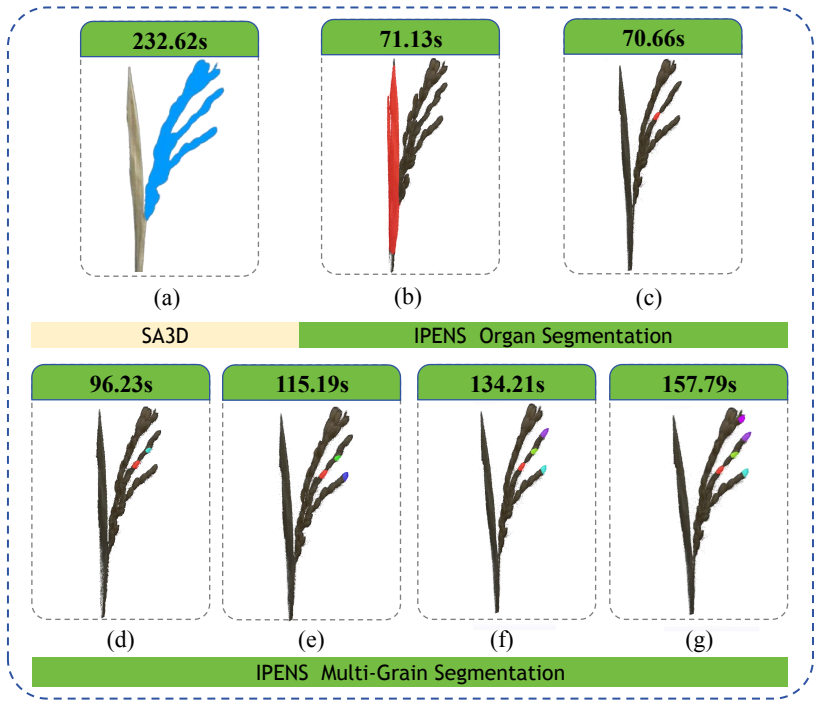
- Multiple organ types (grains, leaves, stems, panicles) can be segmented in parallel from one interaction; inference time grows nearly linearly with target count, and IPENS runs roughly 3.3 times faster than SA3D on the reported data.
- Morphological inpainting of 2D masks and SSIM-guided re-prompting of rear frames raise 3D mask quality, which is the stated reason the grain-level results are achievable despite self-occlusion.
- Phenotypic traits computed from the extracted point clouds track manual labels well: rice grain volume R²=0.7697, rice leaf area R²=0.84, rice leaf length/width R²=0.97/0.87, wheat panicle volume R²=0.9956, and wheat leaf length/width R²=0.99/0.92.
- The same interactive pipeline extends to other crops without retraining; the appendix shows segmentations for apple, cherry tomato, maize, and multiple wheat plants.
Reading between the lines
- The reported physical traits (cm³, cm², cm) are only meaningful if the reconstruction is metric or at fixed scale; the paper never states how scale is recovered, so a calibrated-capture extension (embedding a known-size reference in the acquisition cube) is the natural next step and would convert relative rankings into absolute trait values.
- The mask-inverse-rendering mechanism is not specific to NeRF; the same 2D-to-3D mask lifting could operate on 3D Gaussian Splatting fields, trading some of the robustness the paper credits to NeRF for faster reconstruction.
- The framework already contains the pieces of full automation: YOLOv11 generates first-frame prompts and the SSIM detector locates re-prompt frames, so removing the human click entirely is a testable extension rather than a new method.
- Because segmentation quality appears to follow 2D mask quality, replacing the heuristic SSIM rear-frame test with a learned re-identification of the reappeared target could improve accuracy on crops whose rear views are not approximate mirror images.
Signed reviews
Editorial analysis
A structured set of objections, weighed in public.
Referee Report
Summary. The paper proposes IPENS, an interactive unsupervised pipeline for extracting 3D organ point clouds from rice and wheat image sequences. The method combines SAM2 2D mask propagation with a NeRF mask inverse-rendering optimization to lift multi-target masks into 3D, adds morphological post-processing and an SSIM-based re-prompting heuristic, and derives phenotypic traits (grain/panicle volume, leaf area, leaf length/width) from the extracted point clouds. On the authors' MMR and MMW datasets, IPENS reports mIoU of 63.72% (rice) and 89.68% (wheat), with trait R² values up to 0.9956 for wheat panicle volume and 1.00 for wheat leaf area. The paper also compares against CrossPoint, Agile3D, and oneformer3D and reports inference times of about 3 minutes after reconstruction.
Significance. If the quantitative claims held, IPENS would be a practically useful zero-training interactive phenotyping tool: it avoids 3D annotation, handles multiple targets in one interaction, and reports competitive organ segmentation relative to the included baselines on two crop species. The strengths of the manuscript are the concrete system design, the use of standard components (nerfacto, SAM2), and the explicit multi-target collaborative optimization and post-processing heuristics. However, the trait-validation pipeline and evaluation protocol have load-bearing gaps, notably the volume formula, the missing metric-scale calibration, and the undefined instance-matching rule, so the reported numerical claims cannot currently be taken at face value. The paper does not provide code, data, or an evaluation script, which limits reproducibility.
major comments (4)
- [§2.10.1, Eq. (4)] The formula V = num_points × 0.01³ does not compute a physical volume for the point clouds produced by the pipeline. The extracted point cloud comes from a NeRF density field, so the high-density points are concentrated on object surfaces; after voxel downsampling with voxel size 0.01, each occupied voxel contains one representative point, and the occupied voxels form a surface shell rather than a filled interior. Multiplying the number of surface voxels by the voxel volume therefore measures a shell-like quantity that scales roughly as R² for a sphere while the true volume scales as R³, and the bias depends on object size and shape. Consequently, the reported grain-volume R² = 0.7697 (Figure 9), panicle-volume R² = 0.9956 (Figure 10), and their RMSEs do not validate physical volume estimation. The authors need to fill the interior voxels (e.g., flood-fill or occupancy carving) or compute volume from a watertight mesh, and then re-report all volumetric trait metrics.
- [§2.2 and §2.10] The manuscript never explains how the NeRF/COLMAP reconstruction is scaled to metric units. COLMAP sparse reconstruction and nerfacto determine geometry up to an unknown global scale unless a reference length is provided, yet Section 2.10 hard-codes a voxel size of 0.01 and reports volumes in cm³, areas in cm², and lengths/widths in cm (Tables 9–12). Without a documented calibration procedure (calibration object, known camera baseline, or manual reference measurement), the dimensional RMSE values are unanchored, and the '0.01' voxel size is an arbitrary unitless constant. The authors should state how scale was recovered and verify it on objects not used for calibration.
- [§3.1, Eqs. (18)–(19)] The mIoU evaluation protocol is incomplete because the predicted-to-ground-truth instance matching rule is never specified. In scenes with thousands of grain instances and many leaves/stems (Table 1), different matching conventions, such as Hungarian assignment, greedy best-overlap, a minimum IoU threshold, or allowing many-to-one matches, can materially change the reported mIoU. The paper also defines N in Eq. (19) as the number of categories, which is inconsistent with an instance-level IoU computation; clarify whether mIoU averages per-category or per-instance values. No confidence intervals or significance tests are provided for the IoU or trait comparisons, so differences such as the 8.12% gap against Agile3D@1 in Table 6 cannot be assessed statistically.
- [§3.2.1] The baseline comparison protocol is under-specified. The text states that 30% of the data was held out as a validation set and the remainder used for training comparison algorithms, but it does not say whether IPENS reports results on the same 30% split, how the same prompts were administered to Agile3D and oneformer3D, or how the 'first interaction' for Agile3D was standardized. Since the comparison is a central claim of the paper, the shared evaluation split, prompt protocol, and matching code must be specified or released. Relatedly, the paper gives no ablation of the two proposed post-processing steps (morphological inpainting and SSIM-based re-prompting), so their individual contributions to the reported IoU gains are unknown.
minor comments (6)
- [Table 3] The header '1≪11' appears to be a typographical corruption of '<< 11'; also clarify that 'Batch Rays' is rays per chunk to match the surrounding text.
- [§2.7] The prompting strategy description is ambiguous: it first says 'five adjacent center points' are selected as negative prompts, then describes fixed grid sampling with grid size 3 and radius 1; please reconcile these statements and define the sampling parameters in one place.
- [Tables 11 and 12] Report unrounded R² values and sample sizes; an entry of 1.00 with RMSE 0.67 on 35 plants is likely a rounded value and should be given to more decimal places.
- [Appendix B] In the bullet list, 'Medium-Speed Models ( 1 hour)' has a missing symbol; use '~1 hour' or '≈1 hour'. Also clarify whether the FPS column refers to rendering speed during reconstruction or to some other quantity.
- [General] The paper would benefit from a data availability statement: no code, datasets, or evaluation scripts are provided, which hinders reproduction of the numerical claims.
- [General] The term 'unsupervised' is used loosely: the system relies on pre-trained SAM2 and YOLOv11 models and on user prompts; consider 'training-free' or 'zero-shot interactive' to avoid confusion with unsupervised learning.
Circularity Check
Grain/panicle 'volume' predictions are point-counts by Eq. (4), and the same formula defines the labels, so volume R² reduces to voxel-count agreement; nothing else in the pipeline is circular.
-
self definitional
[Section 2.10.1, Eq. (4); applied to both label and prediction in Sections 2.1, 3.3.1, and 3.3.2]
"phenotypic traits are extracted from both the manually annotated 3D point cloud and the model-generated masks, and the resulting estimation errors are evaluated. // Calculate the point cloud volume V using the following formula based on the voxel size and the number of points in the point cloud num_points, to obtain the volumes of grains and panicles... V=num_points*0.01^3 (4) // Based on the volume calculation algorithm, Figure 9 shows the correlation between the labeled and predicted volume of rice grains"
The predicted and labeled 'volumes' are both computed with the identical expression V=num_points*0.01^3 after the same voxel downsampling. Hence the reported R²/RMSE for grain and panicle volume is a self-comparison of point counts: it measures how well the extracted point cloud's occupied-voxel count tracks the manually annotated cloud's occupied-voxel count. Volume is defined as point count times a constant, so no independent physical-volume information enters; the trait 'prediction' reduces by construction to point-count agreement. Additionally, because NeRF density points are concentrated on object surfaces, the occupied voxels typically form a shell, so even at a calibrated metric scale Eq. (4) is a surface-voxel measure rather than an interior volume.
full rationale
The core segmentation contribution—SAM2 2D masks lifted into 3D via mask inverse rendering with a multi-target optimization—is evaluated against manual 3D instance labels, and the mIoU/precision/recall/F1 results are not circular. Leaf area, length, and width are computed with fixed geometric formulas (triangle areas, PCA midrib path, ARAP width) and compared with manual annotations rather than fitted to them. The one prediction that reduces by construction is the volume trait: Eq. (4) defines volume as num_points times voxel volume, and the same preprocessing and formula are applied to both the model-extracted and manually annotated clouds. Therefore the grain and panicle volume R² values (0.7697 and 0.9956) validate voxel-count consistency between predicted and labeled point clouds, not physical volume. This is a partial, not wholesale, circularity: the segmentation pipeline itself has independent content, and no load-bearing self-citation or uniqueness-imported-from-authors pattern appears. The score of 6 reflects that one highlighted phenotypic prediction is equivalent by construction to its own point-count input, while the rest of the framework remains externally benchmarked.
Assumptions & free parameters
free parameters (8)
- voxel_size =
0.01 (unit unspecified)
- mask_optimization_lr =
0.1
- lambda (loss weight) =
not stated
- morphology_kernel_size =
5x5
- PNP_grid_and_radius =
grid 3, radius 1
- ssim_threshold =
not stated
- leaf_length_params =
K, theta_max=pi/2, epsilon, M_max unspecified
- rays_per_chunk =
2^14
assumptions (4)
- domain assumption COLMAP pose estimation and nerfacto reconstruction are sufficiently accurate for point-level segmentation and trait measurement.
- domain assumption SAM2 mask propagation is reliable across views for the prompted organs.
- domain assumption Manual point cloud annotations in CloudCompare are an error-free ground truth.
- ad hoc to paper NeRF reconstruction scale is consistent with real-world units or with the manual labels.
Cite this review
Pith. "Pith review of IPENS:Interactive Unsupervised Framework for Rapid Plant Phenotyping Extraction via NeRF-SAM2 Fusion." pith.science (2026). https://pith.science/paper/O5BGKKRX
@misc{pith2026250513633,
  author       = {Pith},
  title        = {Pith review of: IPENS:Interactive Unsupervised Framework for Rapid Plant Phenotyping Extraction via NeRF-SAM2 Fusion},
  year         = {2026},
  howpublished = {\url{https://pith.science/paper/O5BGKKRX}},
  note         = {Machine review of arXiv:2505.13633}
}
read the original abstract
Advanced plant phenotyping technologies play a crucial role in targeted trait improvement and accelerating intelligent breeding. Due to the species diversity of plants, existing methods heavily rely on large-scale high-precision manually annotated data. For self-occluded objects at the grain level, unsupervised methods often prove ineffective. This study proposes IPENS, an interactive unsupervised multi-target point cloud extraction method. The method utilizes radiance field information to lift 2D masks, which are segmented by SAM2 (Segment Anything Model 2), into 3D space for target point cloud extraction. A multi-target collaborative optimization strategy is designed to effectively resolve the single-interaction multi-target segmentation challenge. Experimental validation demonstrates that IPENS achieves a grain-level segmentation accuracy (mIoU) of 63.72% on a rice dataset, with strong phenotypic estimation capabilities: grain volume prediction yields R2 = 0.7697 (RMSE = 0.0025), leaf surface area R2 = 0.84 (RMSE = 18.93), and leaf length and width predictions achieve R2 = 0.97 and 0.87 (RMSE = 1.49 and 0.21). On a wheat dataset,IPENS further improves segmentation accuracy to 89.68% (mIoU), with equally outstanding phenotypic estimation performance: spike volume prediction achieves R2 = 0.9956 (RMSE = 0.0055), leaf surface area R2 = 1.00 (RMSE = 0.67), and leaf length and width predictions reach R2 = 0.99 and 0.92 (RMSE = 0.23 and 0.15). This method provides a non-invasive, high-quality phenotyping extraction solution for rice and wheat. Without requiring annotated data, it rapidly extracts grain-level point clouds within 3 minutes through simple single-round interactions on images for multiple targets, demonstrating significant potential to accelerate intelligent breeding efficiency.
Figures


Figures from the paper (6 more)



Reference graph
Works this paper leans on
-
[1]
Two-dimensional homography-based correction of positional errors in widefield MRT images
Y . Pan, Analysis of concepts and categories of plant phenome and phenomics, Acta Agronom- ica Sinica 41 (2015) 175.doi:10.3724/SP.J. 1006.2015.00175
work page Pith review arXiv 2015
-
[2]
H.-J. Liu, J. Yan, Crop genome-wide asso- ciation study: a harvest of biological rel- evance, The Plant Journal 97 (1) (2019) 8–18.arXiv:https://onlinelibrary. wiley.com/doi/pdf/10.1111/tpj.14139, doi:https://doi.org/10.1111/tpj.14139. URLhttps://onlinelibrary.wiley.com/ doi/abs/10.1111/tpj.14139
-
[4]
J. L. Araus, S. C. Kefauver, M. Zaman-Allah, M. S. Olsen, J. E. Cairns, Translating high- throughput phenotyping into genetic gain, Trends in Plant Science 23 (5) (2018) 451–466. doi:https://doi.org/10.1016/j.tplants. 2018.02.001. URLhttps://www.sciencedirect.com/ science/article/pii/S1360138518300207
-
[5]
C. Zhao, Y . Zhang, J. Du, X. Guo, W. Wen, S. Gu, J. Wang, J. Fan, Crop phenomics: Current status and perspectives, Fron- tiers in Plant Science V olume 10 - 2019. doi:10.3389/fpls.2019.00714. URLhttps://www.frontiersin.org/ journals/plant-science/articles/10. 3389/fpls.2019.00714
arXiv 2019
-
[6]
M. S. Akhtar, Z. Zafar, R. Nawaz, M. M. Fraz, Unlocking plant secrets: A systematic review of 3d imaging in plant phenotyping techniques, Computers and Electronics in Agriculture 222 (2024) 109033.doi:https://doi.org/10. 1016/j.compag.2024.109033. URLhttps://www.sciencedirect.com/ science/article/pii/S0168169924004241
arXiv 2024
-
[7]
J. Li, X. Qi, S. H. Nabaei, M. Liu, D. Chen, X. Zhang, X. Yin, Z. Li, A survey on 3d recon- struction techniques in plant phenotyping: From classical methods to neural radiance fields (nerf), 3d gaussian splatting (3dgs), and beyond (2025). arXiv:2505.00737. URLhttps://arxiv.org/abs/2505.00737
work page Pith review arXiv 2025
-
[8]
Z. Li, R. Guo, M. Li, Y . Chen, G. Li, A review of computer vision technologies for plant pheno- typing, Computers and Electronics in Agriculture 176 (2020) 105672.doi:https://doi.org/ 10.1016/j.compag.2020.105672. URLhttps://www.sciencedirect.com/ science/article/pii/S0168169920307511
-
[9]
K. Panjvani, A. V . Dinh, K. A. Wahid, Li- darpheno - a low-cost lidar-based 3d scanning system for leaf morphological trait extraction, Frontiers in Plant Science V olume 10 - 2019. doi:10.3389/fpls.2019.00147. URLhttps://www.frontiersin.org/ journals/plant-science/articles/10. 3389/fpls.2019.00147
Show all 41 references
-
[10]
Q. Xu, L. Cao, L. Xue, B. Chen, F. An, T. Yun, Extraction of leaf biophysical attributes based on a computer graphic-based algorithm using terrestrial laser scanning data, Remote Sensing 11 (1).doi:10.3390/rs11010015. URLhttps://www.mdpi.com/2072-4292/ 11/1/15
-
[11]
Mildenhall, P
B. Mildenhall, P. P. Srinivasan, M. Tancik, J. T. Barron, R. Ramamoorthi, R. Ng, Nerf: Represent- ing scenes as neural radiance fields for view syn- 17 thesis, Communications of the ACM 65 (1) (2021) 99–106
2021
-
[12]
Kerbl, G
B. Kerbl, G. Kopanas, T. Leimkühler, G. Dret- takis, 3d gaussian splatting for real-time radiance field rendering, ACM Transactions on Graphics 42 (4). URLhttps://repo-sam.inria.fr/ fungraph/3d-gaussian-splatting/
-
[13]
Choi, J.-K
H.-B. Choi, J.-K. Park, S. H. Park, T. S. Lee, Nerf-based 3d reconstruction pipeline for acquisition and analysis of tomato crop morphology, Frontiers in Plant Science 15. doi:10.3389/fpls.2024.1439086. URLhttps://www.frontiersin.org/ journals/plant-science/articles/10. 3389/f...
2024
-
[14]
X. Yang, X. Lu, P. Xie, Z. Guo, H. Fang, H. Fu, X. Hu, Z. Sun, H. Cen, Paniclenerf: Low-cost, high-precision in-field phenotyping of rice pani- cles with smartphone, Plant Phenomics 6 (2024) 0279.doi:https://doi.org/10.34133/ plantphenomics.0279. URLhttps://www.sciencedirect.c...
2024
-
[15]
Kirillov, E
A. Kirillov, E. Mintun, N. Ravi, H. Mao, C. Rol- land, L. Gustafson, T. Xiao, S. Whitehead, A. C. Berg, W.-Y . Lo, P. Dollár, R. Girshick, Segment anything, arXiv:2304.02643
-
[16]
Saeed, J
F. Saeed, J. Sun, P. Ozias-Akins, Y . J. Chu, C. C. Li, Peanutnerf: 3d radiance field for peanuts, in: 2023 IEEE/CVF Conference on Com- puter Vision and Pattern Recognition Workshops (CVPRW), 2023, pp. 6254–6263.doi:10.1109/ CVPRW59228.2023.00665
2023
-
[17]
Y . Shen, H. Zhou, X. Yang, X. Lu, Z. Guo, L. Jiang, Y . He, H. Cen, Biomass phenotyping of oilseed rape through uav multi-view oblique imaging with 3dgs and sam model, Computers and Electronics in Agriculture 235 (2025) 110320. doi:https://doi.org/10.1016/j.compag. 2025.11032...
2025
-
[18]
Jiang, J
L. Jiang, J. Sun, P. W. Chee, C. Li, L. Fu, Cot- ton3dgaussians: Multiview 3d gaussian splatting for boll mapping and plant architecture analysis, Computers and Electronics in Agriculture 234 (2025) 110293.doi:https://doi.org/10. 1016/j.compag.2025.110293. URLhttps://www.scien...
2025
-
[19]
D. Reis, J. Kupec, J. Hong, A. Daoudi, Real- time flying object detection with yolov8 (2024). arXiv:2305.09972. URLhttps://arxiv.org/abs/2305.09972
2024 arXiv
-
[20]
J. Cen, J. Fang, C. Yang, L. Xie, X. Zhang, W. Shen, Q. Tian, Segment any 3d gaussians, arXiv preprint arXiv:2312.00860
-
[21]
Müller, A
T. Müller, A. Evans, C. Schied, A. Keller, Instant neural graphics primitives with a multiresolution hash encoding, ACM Trans. Graph. 41 (4) (2022) 102:1–102:15. doi:10.1145/3528223.3530127. URLhttps://doi.org/10.1145/3528223. 3530127
2022
-
[22]
K. G. Liakos, P. Busato, D. Moshou, S. Pearson, D. Bochtis, Machine learning in agriculture: A re- view, Sensors 18 (8) (2018) 2674
2018
-
[23]
Y . Li, W. Wen, T. Miao, S. Wu, Z. Yu, X. Wang, X. Guo, C. Zhao, Automatic organ-level point cloud segmentation of maize shoots by integrating high-throughput data acquisition and deep learn- ing, Computers and Electronics in Agriculture 193 (2022) 106702.doi:https://doi.org/ ...
2022
-
[24]
Z. Ao, F. Wu, S. Hu, Y . Sun, Y . Su, Q. Guo, Q. Xin, Automatic segmentation of stem and leaf components and individual maize plants in field terrestrial lidar data using convolutional neural networks, The Crop Journal 10 (5) (2022) 1239–1250, crop phenotyping studies with app...
2022 doi
-
[25]
D. Li, G. Shi, J. Li, Y . Chen, S. Zhang, S. Xi- ang, S. Jin, Plantnet: A dual-function point cloud segmentation network for multiple plant species, ISPRS Journal of Photogram- metry and Remote Sensing 184 (2022) 243– 263.doi:https://doi.org/10.1016/j. isprsjprs.2022.01.007. 1...
2022 doi
-
[26]
M. Peng, Y . Liu, I. A. Qadri, U. A. Bhatti, B. Ahmed, N. M. Sarhan, E. Awwad, Advanced image segmentation for precision agriculture us- ing cnn-gat fusion and fuzzy c-means cluster- ing, Computers and Electronics in Agriculture 226 (2024) 109431
2024
-
[27]
J. Yan, X. Wang, Unsupervised and semi- supervised learning: The next frontier in machine learning for plant systems biology, The Plant Jour- nal 111 (6) (2022) 1527–1538
2022
-
[28]
H. Zhu, X. Liu, H. Zheng, L. Yang, X. Li, Z. Han, Identifying strawberry appearance quality based on unsupervised deep learning, Precision Agricul- ture 25 (2) (2024) 614–632
2024
-
[29]
Huang, A
Y . Huang, A. Bais, Unsupervised domain adapta- tion for weed segmentation using greedy pseudo- labelling, in: Proceedings of the IEEE/CVF Con- ference on Computer Vision and Pattern Recogni- tion, 2024, pp. 2484–2494
2024
-
[30]
J. Cen, Z. Zhou, J. Fang, C. Yang, W. Shen, L. Xie, D. Jiang, X. Zhang, Q. Tian, Segment anything in 3d with nerfs, in: NeurIPS, 2023
2023
-
[31]
Y . Liu, B. Hu, C.-K. Tang, Y .-W. Tai, Sanerf-hq: Segment anything for nerf in high quality, arXiv preprint arXiv:2312.01531
-
[32]
Y . Zhou, J. Gu, T. Y . Chiang, F. Xiang, H. Su, Point-sam: Promptable 3d segmentation model for point clouds (2024).arXiv:2406.17741. URLhttps://arxiv.org/abs/2406.17741
2024 arXiv
-
[33]
N. Ravi, V . Gabeur, Y .-T. Hu, R. Hu, C. Ryali, T. Ma, H. Khedr, R. Rädle, C. Rolland, L. Gustafson, E. Mintun, J. Pan, K. V . Alwala, N. Carion, C.-Y . Wu, R. Girshick, P. Dollár, C. Fe- ichtenhofer, Sam 2: Segment anything in images and videos, arXiv preprint arXiv:2408.007...
-
[34]
Vaswani, N
A. Vaswani, N. Shazeer, N. Parmar, J. Uszkoreit, L. Jones, A. N. Gomez, Ł. Kaiser, I. Polosukhin, Attention is all you need, Advances in neural in- formation processing systems 30
-
[35]
Khanam, M
R. Khanam, M. Hussain, Yolov11: An overview of the key architectural enhancements (2024). arXiv:2410.17725. URLhttps://arxiv.org/abs/2410.17725
2024 arXiv
-
[36]
Z. Wang, A. C. Bovik, H. R. Sheikh, E. P. Simon- celli, Image quality assessment: from error visi- bility to structural similarity, IEEE transactions on image processing 13 (4) (2004) 600–612
2004
-
[37]
J. L. Schönberger, J.-M. Frahm, Structure-from- motion revisited, in: 2016 IEEE Conference on Computer Vision and Pattern Recognition (CVPR), 2016, pp. 4104–4113.doi:10.1109/ CVPR.2016.445
2016
-
[38]
J. L. Schönberger, E. Zheng, J.-M. Frahm, M. Pollefeys, Pixelwise view selection for unstruc- tured multi-view stereo, in: B. Leibe, J. Matas, N. Sebe, M. Welling (Eds.), Computer Vision – ECCV 2016, Springer International Publishing, Cham, 2016, pp. 501–518
2016
-
[39]
Tancik, E
M. Tancik, E. Weber, E. Ng, R. Li, B. Yi, J. Kerr, T. Wang, A. Kristoffersen, J. Austin, K. Salahi, A. Ahuja, D. McAllister, A. Kanazawa, Nerfstu- dio: A modular framework for neural radiance field development, in: ACM SIGGRAPH 2023 Conference Proceedings, SIGGRAPH ’23, 2023
2023
-
[40]
Afham, I
M. Afham, I. Dissanayake, D. Dissanayake, A. Dharmasiri, K. Thilakarathna, R. Rodrigo, Crosspoint: Self-supervised cross-modal con- trastive learning for 3d point cloud understand- ing, in: Proceedings of the IEEE/CVF Confer- ence on Computer Vision and Pattern Recognition (CV...
2022
-
[41]
Y . Yue, S. Mahadevan, J. Schult, F. Engelmann, B. Leibe, K. Schindler, T. Kontogianni, AG- ILE3D: Attention Guided Interactive Multi-object 3D Segmentation, in: International Conference on Learning Representations (ICLR), 2024
2024
-
[42]
Kolodiazhnyi, A
M. Kolodiazhnyi, A. V orontsova, A. Konushin, D. Rukhovich, Oneformer3d: One transformer for unified point cloud segmentation, in: Proceedings of the IEEE/CVF Conference on Computer Vision and Pattern Recognition, 2024, pp. 20943–20953. 19
2024
Reviewed August 15, 2026 · model on record in the stance chip above.
Discussion (0). Continue with ORCID to comment.