REVIEW 4 major objections 6 minor 58 references
Growing Through Experience: Scaling Episodic Grounding in Language Models
T0 review · 4 major / 6 minor · reviewed 2026-08-07 · deepseek-v4-flash
Pith's one-line read A weak-to-strong episodic grounding recipe transfers planning behavior learned by a small language model to a 405B model, whose adjusted outputs outperform GPT-4o by 3.45 percentage points on VirtualHome planning and QA tasks.
desk verdict A real weak-to-strong recipe with a plausible 70B gain, but the headline 3.45% claim over GPT-4o is not reproducible from the printed tables and needs major revision before it can stand. read the letter →
The pith
A machine-rendered reading of the paper's core claim, the machinery that carries it, and where it could break.
The reading
What carries the argument
The load-bearing object is the behavior ratio $\pi_E(y_m|y_{<m},x)/\pi_N(y_m|y_{<m},x)$, the per-token change a small LM's distribution undergoes after episodic post-training. Equation 3 multiplies this ratio into the large LM's distribution at each decoding step and renormalizes, so the large model is pushed toward tokens whose probability rose during small-model training; Equation 4 then distills that adjusted behavior into the 70B model via reverse KL divergence, and Equation 5 adds DPO on MCTS success/failure pairs. For the 405B model the paper does not update weights; it applies the correction at inference time using behavior captured from the trained 70B model.
What would settle it
Run the 405B inference-time adjustment while logging, for each decoded token, the small model's post-training probability and the large model's unadjusted probability; if the large model assigns near-zero probability to tokens whose behavior ratio is highest, the adjusted policy is dominated by renormalization, and a control that renormalizes the large model's distribution without episodic ratios would match the reported 74.34, falsifying the transfer claim.
Extended reading notes
Core claim
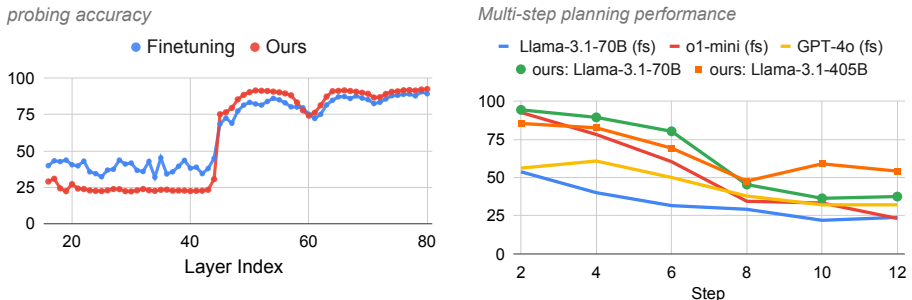
The central claim is that episodic grounding scales through weak-to-strong behavior transfer: a small LM is post-trained on Monte Carlo tree search trajectories from a physical simulator, and the shift in its output distribution—the ratio $\pi_E/\pi_N$ between the post-trained and naive small policies—is used as a multiplicative correction on the large LM's per-token probabilities, followed by reverse-KL distillation and preference optimization on successful versus failed trajectories. On the paper's own terms, this transfers the small model's learned episodic behavior into the large model rather than merely prompting it, and the 405B configuration outperforms GPT-4o by 3.45% on average across plan generation, activity recognition, and QA tasks while retaining accuracy beyond eight planning steps.
Load-bearing premise
The claim stands on the assumption that the change a small model shows after episodic training—the before/after ratio of its token probabilities—can be carried over and multiplied into a much larger model's predictions; if the large model barely ever predicts the tokens the small model favors, the reported 405B gains would be a reweighting artifact rather than transferred episodic grounding.
Editorial extensions
If this is right
- If the central claim is right, a model too large to fine-tune can still acquire episodic grounding through an inexpensive inference-time adjustment computed from a small trained model.
- The reported stability on long plans means the method is claimed to extend planning accuracy beyond the four-step regime where few-shot and o1-style scaling collapse.
- The layer-wise probing results indicate that weak-to-strong training aligns deeper layers with task goals, so episodic knowledge is encoded closer to the output rather than re-derived at the final layer.
- The 3.45% gain over GPT-4o on the combined VirtualHome tasks is presented as evidence that experience streams, not just scale or pretraining data, drive physical-planning performance.
Reading between the lines
- Beyond the paper: the same behavior-ratio correction could be tested on other episodic domains such as tool use, navigation, or dialogue state tracking, where the small-model likelihood ratio would serve as a transferable prior; the paper only demonstrates VirtualHome.
- Beyond the paper: the five thematic scenarios rename objects but preserve the simulator's action space, so genuine novelty in the action vocabulary or in the physical dynamics remains untested.
- Beyond the paper: Equation 3 is effectively a Bayesian update of the large model's prior with a likelihood ratio from the small model, which suggests the method's success depends on the large model's token support covering the small model's high-ratio tokens—a condition the paper does not measure.
Editorial analysis
A structured set of objections, weighed in public.
Referee Report
Summary. The paper proposes a weak-to-strong episodic grounding framework for language models. It uses MCTS in VirtualHome to collect successful and failed instruction trajectories, post-trains small 8B LMs on this episodic data, and transfers the learned behavior to 70B and 405B LMs via a multiplicative policy ratio (Eq. 3), reverse-KL distillation, and a DPO-style preference loss. Experiments on plan generation and QA tasks report a 3.45% improvement over GPT-4o, scaling resilience on long planning sequences, and layer-wise probing evidence. The central contributions are empirical: a training recipe and a set of evaluations.
Significance. If correct, the framework would provide a computationally light way to inject episodic grounding into large LMs, and the behavior-ratio transfer is an interesting alternative to direct fine-tuning at scale. The paper deserves credit for constructing paired success/failure experiences, including redundant plans as negatives, and for attempting layer-wise probing diagnostics. However, the key quantitative claim is not currently verifiable: the headline number comes from an inference-time reweighted configuration rather than a trained 405B model, and the table arithmetic is internally inconsistent. The significance is therefore conditional on a corrected and more transparent evaluation.
major comments (4)
- [Table 1, Section 4.2] The reported averages in Table 1 are not consistent with the per-task values, and this blocks verification of the headline claim. For 405B-ours, the unweighted mean of the 11 printed cells is (311.54 + 514.91)/11 = 75.13 and the category average is (62.31 + 85.82)/2 = 74.06, neither of which equals the reported 74.34; GPT-4o's 70.89 does equal the unweighted mean of its cells, so the aggregation is not using a different formula. The Llama3.1-70B-ours row reports a QA average of 85.60 even though its six QA cells sum to 446.88 (average 74.48), and Llama3.1-70B-base receives an overall average of 61.21 in Table 1 but 67.48 in Table 2 for the same configuration. Please recompute all summary statistics, report the aggregation rule, and re-state the comparison to GPT-4o only if the corrected numbers support it.
- [Section 4.1, Eq. 3] The 405B-ours result is produced by an inference-time reweighting of a base 405B model, not by training a 405B model: Section 4.1 states that the authors 'capture behavioral changes from 70B LM trained by our solution and apply these adjustments to the 405B LM’s output distribution.' Consequently, comparing 405B-ours to GPT-4o and calling the result 'scaling episodic grounding' is not an apples-to-apples comparison, and the paper does not demonstrate that the 405B model has learned anything. Moreover, Eq. 3 multiplies the large model's distribution by the small model's behavior ratio π_E/π_N; this requires that the small model's vocabulary support be covered by the large model and that renormalization over the full vocabulary (the sum 'at' in the definition of Z) is tractable, neither of which is analyzed. Please provide token-level coverage and renormalization diagnostics, and add ablations (e.g., random or smoothed ratios) to show the improvement is due to episodic behavior rather than reweighting artifacts.
- [Section 4.4, Tables 1 and 3] The comparison between 70B-ours and 70B-ft is not correctly supported. Section 4.4 says 'As shown in Table 1, our model (70B-ours) achieves an average accuracy of 78.93%, surpassing the fine-tuned model (70B-ft) at 77.96%,' but Table 1 contains no 70B-ft row and the 78.93/77.96 numbers appear in Table 3 for Llama2 QA multi-choice. More importantly, Tables 1 and 2 do not include a 70B fine-tuned condition for plan generation, so the plan-generation gains of 70B-ours cannot be attributed to the weak-to-strong distillation and DPO components rather than to supervised fine-tuning on episodic data alone. Please add a 70B-ft plan-generation baseline and correct the cross-reference.
- [Section 4.4, Table 3] The probing 'upper bound' in Table 3 is computed on the direct fine-tuned LM, according to the table caption ('Probing means the hidden states of intermediate layers in the last position (on the direct fine-tuned LM) are sent to a trained predictor module'). If the predictor is trained only on fine-tuned features, then comparing base, 70B-ft, and 70B-ours against this fixed probing curve is not a valid upper bound for each configuration. Please clarify whether the probing predictor is retrained per configuration, and if it is not, either retrain it or drop the 'upper bound' interpretation.
minor comments (6)
- [Tables 1 and 2] Several cells are concatenated without separators (e.g., '52.0547.44', '49.6648.24', '61.7384.23'), which makes the tables ambiguous and likely contributed to the aggregation problems; please separate every cell value.
- [Equation (3)] The normalization factor is defined with a sum over 'at', and no explanation is given for how the partition function is computed or approximated during decoding; please provide the exact sampling procedure.
- [Equation (5)] The second expectation is written as E_{x,y∼π} log(π(y|x)/π0(y|x)), but DPO-style losses are usually defined over preference pairs (y_+, y_-); clarify which distribution the expectation is over and how the KL penalty is estimated in practice.
- [Figure 5] The figure does not appear to have a legend in the rendered text, although the caption names seven curves; please add a legend and describe the prompting and sampling details for the o1-mini and few-shot baselines.
- [Appendix B] The Medieval Castle mapping appears identical to the Wild West mapping (e.g., 'apartment' maps to 'saloon' and 'bedroom' to 'bunk room' in both), which looks like a copy-paste error; please verify the thematic mappings.
- [Limitations] The Limitations section mentions only real-world physical interaction, but it should also state that the main result is currently based on an inference-time reweighting and on a single simulator (VirtualHome), and that no code or trained weights are released.
Circularity Check
No significant circularity: the episodic-grounding pipeline is an empirical training recipe; Eq. 3's ratio is fitted but evaluated against external baselines, and self-citations are not load-bearing.
full rationale
The claimed derivation chain is empirical rather than deductive. Eq. 3 defines an inference-time reweighted policy from the empirical ratio πE/πN of a post-trained versus naive small LM; this ratio is not constructed from the evaluation targets, and the transfer is tested against external baselines (GPT-4o, GPT-3.5) on VirtualHome tasks. Eq. 4's reverse-KL loss and Eq. 5's DPO variant are standard training objectives, not hidden restatements of the reported accuracies. The 405B-ours configuration is an approximation that applies 70B behavioral changes at inference; while it lacks distributional support analysis, that is a robustness gap, not a circular reduction. Self-citations (e.g., Zhang et al. 2024 in Section 4.6) support auxiliary claims about reasoning limits and are not load-bearing for the central result. The Limitations section appropriately restricts scope to virtual-simulator data. Arithmetic inconsistencies in Table 1 are correctness concerns outside the circularity definition. Verdict: no significant circularity.
Assumptions & free parameters
free parameters (7)
- MCTS exploration constant C =
not reported
- MCTS reward weights (+2 goal, -0.1 per timestep) =
+2 / -0.1
- Task weight alpha_v in instruction loss =
not reported
- DPO temperature beta =
not reported
- KL penalty lambda =
1
- Teacher small LM (8B) identity =
not explicitly named
- Probing predictor dimensions (n1, n2) =
not reported
assumptions (6)
- domain assumption The MCTS reward function (+2 for satisfying goal predicates, -0.1 per irrelevant timestep) is a valid proxy for planning quality.
- ad hoc to paper The post-training behavior shift pi_E / pi_N of a small LM can be applied multiplicatively to a larger LM's output distribution (Eq 3) and remains a meaningful episodic-grounding correction.
- domain assumption VirtualHome/RobotHow data and the five lexical theme mappings preserve task validity for transfer evaluation.
- domain assumption Reverse KL distillation and DPO preserve the large LM's pretrained capabilities while adding episodic behavior.
- domain assumption Probing hidden states with a trained linear predictor measures the model's 'full potential' and is a reliable diagnostic.
- domain assumption ROUGE-L and LCS are adequate metrics for plan correctness.
Cite this review
Pith. "Pith review of Growing Through Experience: Scaling Episodic Grounding in Language Models." pith.science (2026). https://pith.science/paper/O5CTVSYV
@misc{pith2026250601312,
  author       = {Pith},
  title        = {Pith review of: Growing Through Experience: Scaling Episodic Grounding in Language Models},
  year         = {2026},
  howpublished = {\url{https://pith.science/paper/O5CTVSYV}},
  note         = {Machine review of arXiv:2506.01312}
}
read the original abstract
Language models (LMs) require robust episodic grounding-the capacity to learn from and apply past experiences-to excel at physical planning tasks. Current episodic grounding approaches struggle with scalability and integration, limiting their effectiveness, especially for medium-sized LMs (7B parameters). While larger LMs (70-405B parameters) possess superior hierarchical representations and extensive pre-trained knowledge, they encounter a fundamental scale paradox: despite their advanced abstraction capabilities, they lack efficient mechanisms to leverage experience streams. We propose a scalable weak-to-strong episodic learning framework that effectively transfers episodic behaviors from smaller to larger LMs. This framework integrates Monte Carlo tree search for structured experience collection with a novel distillation method, preserving the inherent LM capabilities while embedding episodic memory. Experiments demonstrate our method surpasses state-of-the-art proprietary LMs by 3.45% across diverse planning and question-answering tasks. Layer-wise probing further indicates significant improvements in task alignment, especially within deeper LM layers, highlighting stable generalization even for previously unseen scenarios with increased planning complexity-conditions where baseline methods degrade markedly.
Figures


Figures from the paper (2 more)

Reference graph
Works this paper leans on
-
[1]
online" 'onlinestring :=
ENTRY address archivePrefix author booktitle chapter edition editor eid eprint eprinttype howpublished institution journal key month note number organization pages publisher school series title type volume year doi pubmed url lastchecked label extra.label sort.label short.list INTEGERS output.state before.all mid.sentence after.sentence after.block STRING...
-
[2]
write newline
" write newline "" before.all 'output.state := FUNCTION n.dashify 't := "" t empty not t #1 #1 substring "-" = t #1 #2 substring "--" = not "--" * t #2 global.max substring 't := t #1 #1 substring "-" = "-" * t #2 global.max substring 't := while if t #1 #1 substring * t #2 global.max substring 't := if while FUNCTION word.in bbl.in capitalize " " * FUNCT...
-
[3]
Alan Baddeley. 1992. Working memory. Science
work page 1992
-
[4]
Frederic Charles Bartlett. 1995. Remembering: A study in experimental and social psychology. Cambridge university press
work page 1995
-
[5]
Sid Black, Leo Gao, Phil Wang, Connor Leahy, and Stella Biderman. 2021. Gpt-neo: Large scale autoregressive language modeling with mesh-tensorflow. EleutherAI
work page 2021
-
[6]
Tom Brown, Benjamin Mann, Nick Ryder, Melanie Subbiah, Jared D Kaplan, Prafulla Dhariwal, Arvind Neelakantan, Pranav Shyam, Girish Sastry, Amanda Askell, et al. 2020. Language models are few-shot learners. In Advances in neural information processing systems
work page 2020
-
[7]
Thomas Carta, Cl \'e ment Romac, Thomas Wolf, Sylvain Lamprier, Olivier Sigaud, and Pierre-Yves Oudeyer. 2023. Grounding large language models in interactive environments with online reinforcement learning. In International Conference on Machine Learning
work page 2023
-
[8]
Qiguang Chen, Libo Qin, Jiaqi WANG, Jingxuan Zhou, and Wanxiang Che. 2024. Unlocking the capabilities of thought: A reasoning boundary framework to quantify and optimize chain-of-thought. In Advances in Neural Information Processing Systems
work page 2024
Show all 58 references
-
[9]
Didier Ch \'e telat, Joseph Cotnareanu, Rylee Thompson, Yingxue Zhang, and Mark Coates. 2025. Innerthoughts: Disentangling representations and predictions in large language models. In International Conference on Artificial Intelligence and Statistics
2025
-
[10]
Payel Das, Subhajit Chaudhury, Elliot Nelson, Igor Melnyk, Sarathkrishna Swaminathan, Sihui Dai, Aurelie Lozano, Georgios Kollias, Vijil Chenthamarakshan, Jiri Navratil, Soham Dan, and Pin-Yu Chen. 2024. Larimar: Large language models with episodic memory control. In Internati...
2024
-
[11]
Matt Deitke, Eli VanderBilt, Alvaro Herrasti, Luca Weihs, Jordi Salvador, Kiana Ehsani, Winson Han, Eric Kolve, Ali Farhadi, Aniruddha Kembhavi, and Roozbeh Mottaghi. 2022. ProcTHOR: Large-Scale Embodied AI Using Procedural Generation . In Advances in Neural Information Proces...
2022
-
[12]
Xingjian Diao, Chunhui Zhang, Tingxuan Wu, Ming Cheng, Zhongyu Ouyang, Weiyi Wu, and Jiang Gui. 2024. Learning musical representations for music performance question answering. In Findings of the 2024 Conference on Empirical Methods in Natural Language Processing
2024
-
[13]
Xingjian Diao, Chunhui Zhang, Weiyi Wu, Zhongyu Ouyang, Peijun Qing, Ming Cheng, Soroush Vosoughi, and Jiang Gui. 2025. Temporal working memory: Query-guided temporal segment refinement for enhanced multimodal understanding. In Findings of the 2025 Annual Conference of the Nor...
2025
-
[14]
Bradford C Dickerson and Howard Eichenbaum. 2010. The episodic memory system: neurocircuitry and disorders. Neuropsychopharmacology
2010
-
[15]
Danny Driess, Fei Xia, Mehdi S. M. Sajjadi, Corey Lynch, Aakanksha Chowdhery, Brian Ichter, Ayzaan Wahid, Jonathan Tompson, Quan Vuong, Tianhe Yu, Wenlong Huang, Yevgen Chebotar, Pierre Sermanet, Daniel Duckworth, Sergey Levine, Vincent Vanhoucke, Karol Hausman, Marc Toussaint...
2023
-
[16]
Abhimanyu Dubey, Abhinav Jauhri, Abhinav Pandey, Abhishek Kadian, Ahmad Al-Dahle, Aiesha Letman, Akhil Mathur, Alan Schelten, Amy Yang, Angela Fan, et al. 2024. The llama 3 herd of models. arXiv preprint arXiv:2407.21783
2024 arXiv
-
[17]
Linxi Fan, Guanzhi Wang, Yunfan Jiang, Ajay Mandlekar, Yuncong Yang, Haoyi Zhu, Andrew Tang, De-An Huang, Yuke Zhu, and Anima Anandkumar. 2022. Minedojo: Building open-ended embodied agents with internet-scale knowledge. In Advances in Neural Information Processing Systems Dat...
2022
-
[18]
Zitian Gao, Boye Niu, Xuzheng He, Haotian Xu, Hongzhang Liu, Aiwei Liu, Xuming Hu, and Lijie Wen. 2024. Interpretable contrastive monte carlo tree search reasoning. arXiv preprint arXiv:2410.01707
2024 arXiv
-
[19]
Yuxian Gu, Li Dong, Furu Wei, and Minlie Huang. 2024. Mini LLM : Knowledge distillation of large language models. In International Conference on Learning Representations
2024
-
[20]
Xiaotian Han, Yiren Jian, Xuefeng Hu, Haogeng Liu, Yiqi Wang, Qihang Fan, Yuang Ai, Huaibo Huang, Ran He, Zhenheng Yang, and Quanzeng You. 2024. Infimm-webmath-40b: Advancing multimodal pre-training for enhanced mathematical reasoning. In Proceedings of the 4th Workshop on Mat...
2024
-
[21]
Wenlong Huang, Pieter Abbeel, Deepak Pathak, and Igor Mordatch. 2022. Language models as zero-shot planners: Extracting actionable knowledge for embodied agents. In International conference on machine learning
2022
-
[22]
Brian Ichter, Anthony Brohan, Yevgen Chebotar, Chelsea Finn, Karol Hausman, Alexander Herzog, Daniel Ho, Julian Ibarz, Alex Irpan, Eric Jang, Ryan Julian, Dmitry Kalashnikov, Sergey Levine, Yao Lu, Carolina Parada, Kanishka Rao, Pierre Sermanet, Alexander T Toshev, Vincent Van...
2022
-
[23]
Yiren Jian, Chongyang Gao, and Soroush Vosoughi. 2023. Bootstrapping vision-language learning with decoupled language pre-training. In Proceedings of the 37th Conference on Neural Information Processing Systems. Spotlight
2023
-
[24]
Yiren Jian, Tingkai Liu, Yunzhe Tao, Chunhui Zhang, Soroush Vosoughi, and Hongxia Yang. 2024. Expedited training of visual conditioned language generation via redundancy reduction. In Proceedings of the 62nd Annual Meeting of the Association for Computational Linguistics. Oral...
2024
-
[25]
Chuanyang Jin, Yutong Wu, Jing Cao, Jiannan Xiang, Yen-Ling Kuo, Zhiting Hu, Tomer Ullman, Antonio Torralba, Joshua Tenenbaum, and Tianmin Shu. 2024. MMT o M - QA : Multimodal theory of mind question answering. In Annual Meeting of the Association for Computational Linguistics
2024
-
[26]
Shuang Li, Xavier Puig, Chris Paxton, Yilun Du, Clinton Wang, Linxi Fan, Tao Chen, De-An Huang, Ekin Aky \"u rek, Anima Anandkumar, et al. 2022. Pre-trained language models for interactive decision-making. In Advances in Neural Information Processing Systems
2022
-
[27]
Zheyuan Liu, Guangyao Dou, Xiangchi Yuan, Chunhui Zhang, Zhaoxuan Tan, and Meng Jiang. 2025. Modality-aware neuron pruning for unlearning in multimodal large language models. In Proceedings of the 63rd Annual Meeting of the Association for Computational Linguistics
2025
-
[28]
Dipendra Misra, Andrew Bennett, Valts Blukis, Eyvind Niklasson, Max Shatkhin, and Yoav Artzi. 2018. Mapping instructions to actions in 3 D environments with visual goal prediction. In Conference on Empirical Methods in Natural Language Processing
2018
-
[29]
Morris Moscovitch, Roberto Cabeza, Gordon Winocur, and Lynn Nadel. 2016. Episodic memory and beyond: the hippocampus and neocortex in transformation. Annual review of psychology
2016
-
[30]
Vishnu P Murty, Oriel FeldmanHall, Lindsay E Hunter, Elizabeth A Phelps, and Lila Davachi. 2016. Episodic memories predict adaptive value-based decision-making. Journal of Experimental Psychology: General
2016
-
[31]
Andrew Nuxoll and John E Laird. 2004. A cognitive model of episodic memory integrated with a general cognitive architecture. In International Conference on Cognitive Modeling
2004
-
[32]
Hadas Orgad, Michael Toker, Zorik Gekhman, Roi Reichart, Idan Szpektor, Hadas Kotek, and Yonatan Belinkov. 2025. LLM s know more than they show: On the intrinsic representation of LLM hallucinations. In The International Conference on Learning Representations
2025
-
[33]
Xavier Puig, Kevin Ra, Marko Boben, Jiaman Li, Tingwu Wang, Sanja Fidler, and Antonio Torralba. 2018. Virtualhome: Simulating household activities via programs. In IEEE conference on computer vision and pattern recognition
2018
-
[34]
Tenenbaum, Sanja Fidler, and Antonio Torralba
Xavier Puig, Tianmin Shu, Shuang Li, Zilin Wang, Yuan-Hong Liao, Joshua B. Tenenbaum, Sanja Fidler, and Antonio Torralba. 2021. Watch-and-help: A challenge for social perception and human- \ ai \ collaboration. In International Conference on Learning Representations
2021
-
[35]
Rafael Rafailov, Archit Sharma, Eric Mitchell, Christopher D Manning, Stefano Ermon, and Chelsea Finn. 2024. Direct preference optimization: Your language model is secretly a reward model. In Advances in Neural Information Processing Systems
2024
-
[36]
Karan Singhal, Shekoofeh Azizi, Tao Tu, S Sara Mahdavi, Jason Wei, Hyung Won Chung, Nathan Scales, Ajay Tanwani, Heather Cole-Lewis, Stephen Pfohl, et al. 2023. Large language models encode clinical knowledge. Nature
2023
-
[37]
Kai Sun, Yifan Xu, Hanwen Zha, Yue Liu, and Xin Luna Dong. 2024. Head-to-tail: How knowledgeable are large language models ( LLM s)? A . K . A . will LLM s replace knowledge graphs? In Conference of the North American Chapter of the Association for Computational Linguistics: H...
2024
-
[38]
Hugo Touvron, Thibaut Lavril, Gautier Izacard, Xavier Martinet, Marie-Anne Lachaux, Timoth \'e e Lacroix, Baptiste Rozi \`e re, Naman Goyal, Eric Hambro, Faisal Azhar, et al. 2023 a . Llama: Open and efficient foundation language models. arXiv preprint arXiv:2302.13971
2023 arXiv
-
[39]
Hugo Touvron, Louis Martin, Kevin Stone, Peter Albert, Amjad Almahairi, Yasmine Babaei, Nikolay Bashlykov, Soumya Batra, Prajjwal Bhargava, Shruti Bhosale, et al. 2023 b . Llama 2: Open foundation and fine-tuned chat models. arXiv:2307.09288
2023 arXiv
-
[40]
E Tulving. 1983. Elements of episodic memory. Oxford University Press
1983
-
[41]
Francisco J Varela, Eleanor Rosch, and Evan Thompson. 1992. The embodied mind, revised edition: Cognitive science and human experience. MIT press
1992
-
[42]
Ben Wang and Aran Komatsuzaki. 2021. Gpt-j-6b: A 6 billion parameter autoregressive language model
2021
-
[43]
Chaoqi Wang, Yibo Jiang, Chenghao Yang, Han Liu, and Yuxin Chen. 2024 a . Beyond reverse KL : Generalizing direct preference optimization with diverse divergence constraints. In International Conference on Learning Representations
2024
-
[44]
Guanzhi Wang, Yuqi Xie, Yunfan Jiang, Ajay Mandlekar, Chaowei Xiao, Yuke Zhu, Linxi Fan, and Anima Anandkumar. 2024 b . Voyager: An open-ended embodied agent with large language models. Transactions on Machine Learning Research
2024
-
[45]
Zihao Wang, Shaofei Cai, Guanzhou Chen, Anji Liu, Xiaojian Ma, and Yitao Liang. 2023. Describe, explain, plan and select: Interactive planning with LLM s enables open-world multi-task agents. In Advances in Neural Information Processing Systems
2023
-
[46]
Chi, Tatsunori Hashimoto, Oriol Vinyals, Percy Liang, Jeff Dean, and William Fedus
Jason Wei, Yi Tay, Rishi Bommasani, Colin Raffel, Barret Zoph, Sebastian Borgeaud, Dani Yogatama, Maarten Bosma, Denny Zhou, Donald Metzler, Ed H. Chi, Tatsunori Hashimoto, Oriol Vinyals, Percy Liang, Jeff Dean, and William Fedus. 2022. Emergent abilities of large language mod...
2022
-
[47]
Jiannan Xiang, Tianhua Tao, Yi Gu, Tianmin Shu, Zirui Wang, Zichao Yang, and Zhiting Hu. 2023. Language models meet world models: Embodied experiences enhance language models. In Advances in Neural Information Processing Systems
2023
-
[48]
Ivory Yang, Weicheng Ma, Chunhui Zhang, and Soroush Vosoughi. 2025 a . Is it navajo? accurate language detection in endangered athabaskan languages. In Proceedings of the 2025 Annual Conference of the North American Chapter of the Association for Computational Linguistics. Ora...
2025
-
[49]
Ivory Yang, Chunhui Zhang, Yuxin Wang, Zhongyu Ouyang, and Soroush Vosoughi. 2025 b . Visibility as survival: Generalizing nlp for native alaskan language identification. In Findings of the 63rd Annual Meeting of the Association for Computational Linguistics
2025
-
[50]
Sherry Yang, Yilun Du, Seyed Kamyar Seyed Ghasemipour, Jonathan Tompson, Leslie Pack Kaelbling, Dale Schuurmans, and Pieter Abbeel. 2024. Learning interactive real-world simulators. In International Conference on Learning Representations
2024
-
[51]
Zhifan Ye, Kejing Xia, Yonggan Fu, Xin Dong, Jihoon Hong, Xiangchi Yuan, Shizhe Diao, Jan Kautz, Pavlo Molchanov, and Yingyan Celine Lin. 2025. Longmamba: Enhancing mamba's long-context capabilities via training-free receptive field enlargement. In International Conference on ...
2025
-
[52]
Jifan Yu, Xiaozhi Wang, Shangqing Tu, Shulin Cao, Daniel Zhang-Li, Xin Lv, Hao Peng, Zijun Yao, Xiaohan Zhang, Hanming Li, Chunyang Li, Zheyuan Zhang, Yushi Bai, Yantao Liu, Amy Xin, Kaifeng Yun, Linlu GONG, Nianyi Lin, Jianhui Chen, Zhili Wu, Yunjia Qi, Weikai Li, Yong Guan, ...
2024
-
[53]
Xiangchi Yuan, Chunhui Zhang, Zheyuan Liu, Dachuan Shi, Soroush Vosoughi, and Wenke Lee. 2025. Superficial self-improved reasoners benefit from model merging. arXiv preprint arXiv:2503.02103
2025
-
[54]
Chunhui Zhang, Chao Huang, Youhuan Li, Xiangliang Zhang, Yanfang Ye, et al. 2022 a . Look twice as much as you say: Scene graph contrastive learning for self-supervised image caption generation. In Proceedings of the 31st ACM International Conference on Information and Knowled...
2022
-
[55]
Chunhui Zhang, Yiren Jian, Zhongyu Ouyang, and Soroush Vosoughi. 2024. Working memory identifies reasoning limits in language models. In Conference on Empirical Methods in Natural Language Processing
2024
-
[56]
Chunhui Zhang, Yiren Jian, Zhongyu Ouyang, and Soroush Vosoughi. 2025 a . Pretrained image-text models are secretly video captioners. In Proceedings of the 2025 Annual Conference of the North American Chapter of the Association for Computational Linguistics. Oral Presentation
2025
-
[57]
Chunhui Zhang, Zhongyu Ouyang, Kwonjoon Lee, Nakul Agarwal, Sean Dae Houlihan, Soroush Vosoughi, and Shao-Yuan Lo. 2025 b . Overcoming multi-step complexity in theory-of-mind reasoning: A scalable bayesian planner. In Proceedings of the 42nd International Conference on Machine...
2025
-
[58]
Susan Zhang, Stephen Roller, Naman Goyal, Mikel Artetxe, Moya Chen, Shuohui Chen, Christopher Dewan, Mona Diab, Xian Li, Xi Victoria Lin, et al. 2022 b . Opt: Open pre-trained transformer language models. arXiv preprint arXiv:2205.01068
2022 arXiv
Reviewed August 7, 2026 · model on record in the stance chip above.
Discussion (0). Sign in to comment.