REVIEW 3 major objections 4 minor 44 references
You Are What You Bought: Generating Customer Personas for E-commerce Applications
T0 review · 3 major / 4 minor · reviewed 2026-08-16 · deepseek-v4-flash
Pith's one-line read Representing customers as readable personas — a few LLM labels spread by random-walk affinity — lifts e-commerce recommendation quality by up to about 12 percent.
desk verdict Solid LLM+graph persona paper with a real confound in the recommendation experiment and a hole in the main proof; worth reviewing, but needs a shuffled control and a repaired Theorem 3. read the letter →
The pith
A machine-rendered reading of the paper's core claim, the machinery that carries it, and where it could break.
The reading
What carries the argument
The load-bearing object is the user-persona affinity matrix $\Psi = \Pi L$. $\Pi$ is a truncated random-walk attention matrix on the bipartite purchase graph, $\Pi = \frac{1}{\hat{\ell}}\sum_{\ell\le\hat{\ell}}(P P')^\ell$, where $P$ and $P'$ are the user-to-item and item-to-user transition matrices; the entry $\Pi[u_i,u_k]$ is the mean probability that a short walk from user $u_i$ reaches user $u_k$ by hopping through products both purchased. $L$ is a row-normalized persona-label matrix for the LLM-labeled prototype users, rescaled by a de-biasing coefficient $c_m$ that amplifies rare personas so minority labels are not drowned out. Their product $\Psi = \Pi L$ aggregates the personas of nearby labeled users into a weighted affinity from every user to every persona, and each unlabeled user keeps its top-$k$ affinities. RevAff is the efficiency device: instead of materializing the dense $\Pi$, it propagates mass backwards from each persona's labeled users across the graph and drops contributions below a threshold, yielding an $\varepsilon$-approximation of $\Psi$ with time bound $O\big(\frac{1}{\varepsilon}\hat{\ell}^2 (N\log(\hat{\ell}N)+|E|)\big)$. The downstream integration is a graph rewrite: persona nodes join users and items as a third partition, connected to users by $\Phi$ and to items by LLM-generated persona affinities, so a graph convolution-based recommender is upgraded by swapping its adjacency matrix $A$ for the tripartite $A'$.
What would settle it
A held-out test would settle the mechanism: label a random subset of users directly with the LLM, propagate personas to them from the rest of the graph using GPLR, and measure agreement between propagated and directly labeled personas; if agreement is near chance while the NDCG@K and F1-Score@K gains (up to 12%) persist, the gain is not attributable to persona semantics. A complementary permutation test replaces the persona matrix with randomly shuffled labels of the same density and rebuilds LGCN3 — if the ranking gain survives the shuffle, the lift comes from the added embeddings and edges rather than from the persona content.
Extended reading notes
Core claim
The central discovery is that a customer's entire purchasing history can be condensed into a short list of named personas, each carrying a natural-language definition, and that these persona vectors — generated mostly by propagation rather than direct LLM reading of each customer — carry signal that improves the downstream recommender. GPLR labels a prototype user set with the LLM, reweights the labels to counter skewed persona frequencies, computes a user-persona affinity matrix $\Psi = \Pi L$ via short random walks on the bipartite purchase graph, and hands each unlabeled user its top-$k$ personas. The resulting LGCN3 improves the LGCN base by up to 10.4% in NDCG@K and 11.7% in F1-Score@K across OnlineRetail, Instacart, and Instacart Full, beats the category-based explicit representation LGCNL by up to 3.6%, and pairing personas with AFDGCF's de-correlation loss yields further gains of up to 6.4% over AFDGCF. The paper also reports that a 5% LLM labeling budget nearly matches full labeling in downstream quality, that persona representations keep 18% of customers stable across two six-month periods versus 1.3% for RFM, and that RevAff approximates the affinities on a 206,209-user graph in about 50 seconds with empirical error roughly twenty times smaller than its theoretical bound.
Load-bearing premise
The load-bearing premise is homophily — that users who buy similar products share identical personas — because GPLR never asks the LLM about the roughly 90 to 95 percent of unlabeled users, inferring their personas purely from random-walk similarity to the labeled few; the seed labels themselves are also noisy, with only about 33% of a user's assigned personas stable across three LLM runs.
Editorial extensions
If this is right
- A platform can obtain explicit, explainable profiles at roughly 5% of the full LLM-labeling cost: LGCN3 built from a 5% prototype sample nearly matches the quality achieved when every persona is LLM-generated, against a backdrop where relabeling 10 million users monthly with GPT-4 would cost about 2.4 million dollars per year.
- Any graph convolution-based recommender can absorb personas without redesign: replacing the adjacency matrix with the tripartite version upgrades the model, and the experiments report LGCN3 over LGCN by up to 10.4% in NDCG@K and 11.7% in F1-Score@K, plus A-LGCN3 over AFDGCF by up to 6.4%.
- Personas behave as longer-lived segmentation labels than recency-frequency-monetary features: across two six-month periods, 18% of customers keep their persona representation unchanged versus 1.3% for RFM, and silhouette scores improve by an average of 61.3%.
- The method ships with a concrete scalability guarantee: RevAff computes $\varepsilon$-approximate affinities in $O\big(\frac{1}{\varepsilon}\hat{\ell}^2 (N\log(\hat{\ell}N)+|E|)\big)$ time, and on the largest dataset (206,209 users, 13.3 million interactions) runs in roughly 50 seconds with empirical error below $2\times 10^{-3}$.
Reading between the lines
- Editorial inference: the reported gains may not be caused by persona semantics. The case study shows LGCN3's main visible effect is dampening popularity bias — replacing top-20 popular items with less popular baby-food matches — so a permutation test that shuffles persona labels while preserving their density would reveal whether the lift comes from the meaning of the personas or merely from the e
- Editorial inference: the paper's integration adds two kinds of edges — user–persona edges from $\Phi$ and item–persona edges from the LLM — and does not ablate them separately; measuring each edge type alone would locate where the recommendation signal actually enters.
- Editorial inference: with only 33% of a user's personas stable across three identical LLM runs, the labels are noisy by construction; propagating label distributions rather than hard binary labels, or ensembling several LLM calls, is a natural strengthening that the de-bias coefficient only partially addresses.
- Editorial inference: the cold-start use case the paper sketches — new customers self-select personas, new items get matched to personas — is directly testable, and the paper does not run that experiment; comparing persona-seeded cold-start recommendations against popularity or category baselines would extend the claims.
Signed reviews
Editorial analysis
A structured set of objections, weighed in public.
Referee Report
Summary. The paper introduces "customer persona" representations for e-commerce users: each user is mapped to a small binary vector over a predefined, human-readable persona set (e.g., Bargain Hunter, Health Enthusiast). The proposed pipeline GPLR labels a small prototype user set with an LLM and propagates these labels to the remaining users through random-walk-based affinity scores on the user-item purchase graph; a reverse approximate computation method, RevAff, is proposed with an absolute-error guarantee. The persona matrix is then added as a third node partition to graph-convolution-based recommenders, yielding LGCN3 and A-LGCN3. Experiments on OnlineRetail, Instacart, and Instacart Full report NDCG@K and F1-Score@K improvements of up to about 12% over the base LGCN model, plus a customer-segmentation study and a scalability evaluation of RevAff.
Significance. If the reported gains are caused by persona semantics rather than by added model capacity, the work is a useful contribution: it provides a readable, explicit user representation that can be integrated into standard GCN recommenders with modest code changes, and it shows that LLM labeling can be restricted to a small fraction of users without losing downstream accuracy. The paper also ships a reproducibility link, includes three datasets of varying scale, and reports ablations over LLM choice, sampling budget, and random-walk length. The segmentation robustness result (18% consistent customers for personas vs. 1.3% for RFM) and the RevAff runtime/error table are concrete positive evidence. The main caveats are that the recommendation experiment does not isolate persona content from added parameters, and the proof of the central error guarantee is incomplete as written.
major comments (3)
- [Section 6, Section 7.2, Table 3] LGCN3 differs from LGCN in three simultaneous ways: it adds |R| trainable persona-node embeddings, it adds user-persona edges derived from the GPLR matrix Phi, and it adds LLM-derived item-persona edges. The ablations in Section 7.3 vary LLM choice, sampling budget, and random-walk length, but they never vary the content of Phi while holding architecture and parameter count fixed. The up-to-12% improvements over LGCN could therefore be driven by the additional trainable parameters rather than by persona semantics. I request a control experiment with shuffled or randomized persona labels (e.g., permuting Phi rows or item-persona incidence while preserving graph degree distributions and the number of added edges) to show that the gain depends on the specific persona assignment. Without this control, the central causal claim that personas improve recommendations is not established. The Appendix B consistency result (only 33% of assigned personas stable across three LLM runs, 42% appearing exactly once) makes this control more necessary, not less.
- [Appendix A.2, proof of Theorem 3] The induction proving the epsilon-approximation guarantee is incomplete. In the step bounding E*_1, the proof writes |s_0(w,r_m) - hat-Psi_0[w,r_m] + q_0(w)| <= E*_0 + epsilon/(2*ell-hat), which requires q_0(w) <= epsilon/(2*ell-hat). But q_0 is initialized to L[w,r_m] from Eq. (3), and L values are not bounded by epsilon/(2*ell-hat); they can be substantially larger. The loop terminates only after all q_t values are below the threshold, so an additional processing-order invariant is needed to show that unprocessed residuals never violate the bound used at each induction step. As written, Theorem 3, and consequently the advertised complexity/error claim in the abstract and Theorem 4, rest on an unproved invariant.
- [Section 7.1, Section 7.2, Table 3] The paper states that each experiment is repeated three times and reports the average, but no variance, standard deviation, or confidence interval is given for any entry of Table 3. The paired t-test p-values reported in Section 7.2 (0.027 and 0.012) cannot be verified without per-run results or a reported dispersion measure. Because the recommendation improvement is the paper's main empirical claim, I ask that the authors report mean +/- std (or equivalently per-trial values) for at least the main results, and state the number of paired comparisons underlying each t-test.
minor comments (4)
- [Section 7.2] There is a typo: "statisticatlly meaningful" should be "statistically meaningful."
- [Table 3] The first column header reads "OnelineRetail"; it should be "OnlineRetail."
- [Equation (1)] The displayed DU score in Eq. (1) would be clearer if the entropy term were enclosed in parentheses: sum_{r_m} [hat-Q(r_m) log(hat-Q(r_m)/Q_i(r_m)) - Q_i(r_m) log Q_i(r_m)]. The current line break makes it easy to misread the second term as outside the summation.
- [Appendix B] The consistency analysis reports percentages of stable personas but does not state how many users were labeled in the three runs or how the 33%/42% figures vary across personas; adding that detail would help readers interpret the noise level.
Circularity Check
No significant circularity: personas are generated from training-side purchase data via an external LLM and random-walk propagation, then evaluated on held-out test purchases, so no prediction reduces by construction to its inputs.
full rationale
The paper's main derivation chain is: (i) LLMs label a small prototype user set from purchase histories; (ii) GPLR propagates these labels to remaining users through a random-walk affinity computation defined in Eq. (2)-(4); (iii) the resulting persona matrix Phi is added as a new partition to a graph-convolutional recommender, and the enhanced model is evaluated on a held-out 20% test split (Section 7.1). None of these steps defines its output in terms of the measured target. The RevAff approximation is proved as a standalone error-bound theorem (Theorem 3) and is not fitted to recommendation labels. The reported NDCG/F1 gains are measured on test purchases that were not used to generate personas, propagate labels, or train the recommender, so the central claim is not a fitted input renamed as a prediction. The paper contains no load-bearing self-citation: references [13], [31], and [35] are standard external method papers, and the authors do not invoke their own prior uniqueness theorems or ansatz-rescaling results to force the architecture. The strongest residual concern is a capacity/architecture confound: LGCN3 adds persona embeddings and edges on top of LGCN, and the ablations do not include a shuffled-persona control, so the causal role of persona semantics is not fully isolated. That is an experimental-control issue about confounds, not a circularity of the derivation, and the reviewer guidance explicitly separates correctness risk from circularity. Appendix B's 33% multi-run label consistency further questions label quality but does not show that any claimed result is true by definition. Accordingly, no circular step satisfies the requirement of quoting a specific reduction of Eq. X to Eq. Y, and the honest finding is a score of 0.
Assumptions & free parameters
free parameters (7)
- beta =
0.5
- random walk length ell_hat =
1 (default; 2 in ablation)
- LLM labeling budget tau =
10% of users (default; 5-100% in ablation)
- iterations T =
10
- cutoff k =
5
- error tolerance epsilon =
0.001 for Instacart Full; 0 otherwise
- persona set size |R| =
20 for OnlineRetail; 51 mentioned for Instacart
assumptions (5)
- domain assumption Homophily: users who exhibit similar purchasing behaviors share personas.
- domain assumption LLMs can reliably infer personas from serialized purchase histories.
- domain assumption Random walk attention (mean of probabilities over up to ell_hat steps) measures user-user structural closeness relevant to personas.
- domain assumption The predefined persona set R comprehensively covers the customer base.
- standard math Standard graph convolution and BPR training assumptions hold.
invented entities (2)
-
Customer persona label
-
Persona nodes in tripartite graph
Cite this review
Pith. "Pith review of You Are What You Bought: Generating Customer Personas for E-commerce Applications." pith.science (2026). https://pith.science/paper/O5MMO3HI
@misc{pith2026250417304,
  author       = {Pith},
  title        = {Pith review of: You Are What You Bought: Generating Customer Personas for E-commerce Applications},
  year         = {2026},
  howpublished = {\url{https://pith.science/paper/O5MMO3HI}},
  note         = {Machine review of arXiv:2504.17304}
}
abstract
In e-commerce, user representations are essential for various applications. Existing methods often use deep learning techniques to convert customer behaviors into implicit embeddings. However, these embeddings are difficult to understand and integrate with external knowledge, limiting the effectiveness of applications such as customer segmentation, search navigation, and product recommendations. To address this, our paper introduces the concept of the customer persona. Condensed from a customer's numerous purchasing histories, a customer persona provides a multi-faceted and human-readable characterization of specific purchase behaviors and preferences, such as Busy Parents or Bargain Hunters. This work then focuses on representing each customer by multiple personas from a predefined set, achieving readable and informative explicit user representations. To this end, we propose an effective and efficient solution GPLR. To ensure effectiveness, GPLR leverages pre-trained LLMs to infer personas for customers. To reduce overhead, GPLR applies LLM-based labeling to only a fraction of users and utilizes a random walk technique to predict personas for the remaining customers. We further propose RevAff, which provides an absolute error $\epsilon$ guarantee while improving the time complexity of the exact solution by a factor of at least $O(\frac{\epsilon\cdot|E|N}{|E|+N\log N})$, where $N$ represents the number of customers and products, and $E$ represents the interactions between them. We evaluate the performance of our persona-based representation in terms of accuracy and robustness for recommendation and customer segmentation tasks using three real-world e-commerce datasets. Most notably, we find that integrating customer persona representations improves the state-of-the-art graph convolution-based recommendation model by up to 12% in terms of NDCG@K and F1-Score@K.
Figures


Figures from the paper (2 more)

Reference graph
Works this paper leans on
-
[1]
Josh Achiam, Steven Adler, Sandhini Agarwal, Lama Ahmad, Ilge Akkaya, Floren- cia Leoni Aleman, Diogo Almeida, Janko Altenschmidt, Sam Altman, Shyamal Anadkat, et al. 2023. Gpt-4 technical report. arXiv preprint arXiv:2303.08774 (2023)
arXiv 2023
-
[2]
Aslan Ahmedov. 2010. Market Basket Analysis. https://www.kaggle.com/ datasets/aslanahmedov/market-basket-analysis Accessed: 2024-08-07
work page 2010
-
[3]
Qingyao Ai, Daniel N Hill, SVN Vishwanathan, and W Bruce Croft. 2019. A zero attention model for personalized product search. In Proceedings of the 28th ACM International Conference on Information and Knowledge Management . 379–388
2019
-
[4]
Qingyao Ai, Yongfeng Zhang, Keping Bi, Xu Chen, and W Bruce Croft. 2017. Learning a hierarchical embedding model for personalized product search. In Proceedings of the 40th International ACM SIGIR Conference on Research and Development in Information Retrieval . 645–654
2017
-
[5]
Joydeep Banerjee, Gurulingesh Raravi, Manoj Gupta, Sindhu Ernala, Shruti Kunde, and Koustuv Dasgupta. 2016. CAPReS: context aware persona based recommen- dation for shoppers. InProceedings of the AAAI Conference on Artificial Intelligence, Vol. 30
work page 2016
-
[6]
Oren Barkan, Yonatan Fuchs, Avi Caciularu, and Noam Koenigstein. 2020. Ex- plainable recommendations via attentive multi-persona collaborative filtering. In Proceedings of the 14th ACM Conference on Recommender Systems . 468–473
work page 2020
-
[7]
Rianne van den Berg, Thomas N Kipf, and Max Welling. 2017. Graph convolu- tional matrix completion. arXiv preprint arXiv:1706.02263 (2017)
arXiv 2017
-
[8]
Yizhou Chen, Guangda Huzhang, Anxiang Zeng, Qingtao Yu, Hui Sun, Heng-Yi Li, Jingyi Li, Yabo Ni, Han Yu, and Zhiming Zhou. 2023. Clustered Embedding Learning for Recommender Systems. In Proceedings of the ACM Web Conference
work page 2023
Show all 44 references
-
[9]
Nurendra Choudhary, Edward W Huang, Karthik Subbian, and Chandan K Reddy
-
[10]
Yang Deng, Yaliang Li, Wenxuan Zhang, Bolin Ding, and Wai Lam. 2022. Toward personalized answer generation in e-commerce via multi-perspective preference modeling. ACM Transactions on Information Systems (TOIS) 40, 4 (2022), 1–28
2022
-
[11]
David Easley, Jon Kleinberg, et al. 2010. Networks, crowds, and markets . Vol. 8. Cambridge university press Cambridge
2010
-
[12]
Guy Elad, Ido Guy, Slava Novgorodov, Benny Kimelfeld, and Kira Radinsky. 2019. Learning to generate personalized product descriptions. In Proceedings of the 28th ACM International Conference on Information and Knowledge Management . 389–398
2019
-
[13]
Xiangnan He, Kuan Deng, Xiang Wang, Yan Li, Yongdong Zhang, and Meng Wang. 2020. Lightgcn: Simplifying and powering graph convolution network for recommendation. In Proceedings of the 43rd International ACM SIGIR conference on research and development in Information Retrieval ...
2020
-
[14]
Xiangnan He, Lizi Liao, Hanwang Zhang, Liqiang Nie, Xia Hu, and Tat-Seng Chua. 2017. Neural collaborative filtering. In Proceedings of the 26th international conference on world wide web . 173–182
2017
-
[15]
Instacart. 2017. Instacart Market Basket Analysis. https://www.kaggle.com/c/ instacart-market-basket-analysis/data Accessed: 2024-08-07
2017
-
[16]
Carl Gustav Jung. 2014. Two essays on analytical psychology . Routledge
2014
-
[17]
Shima Khoshraftar and Aijun An. 2024. A survey on graph representation learning methods. ACM Transactions on Intelligent Systems and Technology 15, 1 (2024), 1–55
2024
-
[18]
Yehuda Koren, Robert Bell, and Chris Volinsky. 2009. Matrix factorization tech- niques for recommender systems. Computer 42, 8 (2009), 30–37
2009
-
[19]
Kang Li, Vinay Deolalikar, and Neeraj Pradhan. 2015. Mining lifestyle personas at scale in e-commerce. In 2015 IEEE International Conference on Big Data (Big Data). IEEE, 1254–1261
2015
-
[20]
Peter Lofgren and Ashish Goel. 2013. Personalized pagerank to a target node. arXiv preprint arXiv:1304.4658 (2013)
2013 arXiv
-
[21]
Andrzej Maćkiewicz and Waldemar Ratajczak. 1993. Principal components analysis (PCA). Computers & Geosciences 19, 3 (1993), 303–342
1993
-
[22]
Sumit Pai, Fiona Brennan, Adrianna Janik, Teutly Correia, and Luca Costabello
-
[23]
Pengzhen Ren, Yun Xiao, Xiaojun Chang, Po-Yao Huang, Zhihui Li, Brij B Gupta, Xiaojiang Chen, and Xin Wang. 2021. A survey of deep active learning. ACM computing surveys (CSUR) 54, 9 (2021), 1–40
2021
-
[24]
Steffen Rendle, Christoph Freudenthaler, Zeno Gantner, and Lars Schmidt-Thieme
-
[25]
Peter J Rousseeuw. 1987. Silhouettes: a graphical aid to the interpretation and validation of cluster analysis. Journal of computational and applied mathematics 20 (1987), 53–65
1987
-
[26]
Shamane Siriwardhana, Mark McQuade, Thomas Gauthier, Lucas Atkins, Fer- nando Fernandes Neto, Luke Meyers, Anneketh Vij, Tyler Odenthal, Charles Goddard, Mary MacCarthy, et al . 2024. Domain Adaptation of Llama3-70B- Instruct through Continual Pre-Training and Model Merging: A...
2024 arXiv
-
[27]
Xiran Song, Jianxun Lian, Hong Huang, Zihan Luo, Wei Zhou, Xue Lin, Mingqi Wu, Chaozhuo Li, Xing Xie, and Hai Jin. 2023. xgcn: An extreme graph convolu- tional network for large-scale social link prediction. In Proceedings of the ACM Web Conference 2023. 349–359
2023
-
[28]
Yushi Sun, Hao Xin, Kai Sun, Yifan Ethan Xu, Xiao Yang, Xin Luna Dong, Nan Tang, and Lei Chen. 2024. Are Large Language Models a Good Replacement of Taxonomies? Proceedings of the VLDB Endowment 17, 11 (2024), 2919–2932
2024
-
[29]
Shicheng Wan, Jiahui Chen, Zhenlian Qi, Wensheng Gan, and Linlin Tang. 2022. Fast RFM model for customer segmentation. In Companion Proceedings of the Web Conference 2022. 965–972
2022
-
[30]
Tian Wang, Yuri M Brovman, and Sriganesh Madhvanath. 2021. Personal- ized embedding-based e-commerce recommendations at ebay. arXiv preprint arXiv:2102.06156 (2021)
2021 arXiv
-
[31]
Wei Wu, Chao Wang, Dazhong Shen, Chuan Qin, Liyi Chen, and Hui Xiong
-
[32]
Changlong Yu, Xin Liu, Jefferson Maia, Yang Li, Tianyu Cao, Yifan Gao, Yangqiu Song, Rahul Goutam, Haiyang Zhang, Bing Yin, et al. 2024. COSMO: A large- scale e-commerce common sense knowledge generation and serving system at Amazon. In Companion of the 2024 International Conf...
2024
-
[33]
Changlong Yu, Weiqi Wang, Xin Liu, Jiaxin Bai, Yangqiu Song, Zheng Li, Yifan Gao, Tianyu Cao, and Bing Yin. 2023. FolkScope: Intention Knowledge Graph Construction for E-commerce Commonsense Discovery. Findings of the Associa- tion for Computational Linguistics: ACL 2023 (2023)
2023
-
[34]
Wenhui Yu and Zheng Qin. 2020. Graph convolutional network for recommen- dation with low-pass collaborative filters. In International Conference on Machine Learning. PMLR, 10936–10945
2020
-
[35]
In Proceedings of the 47th International ACM SIGIR Conference on Research and Development in Information Retrieval
Afdgcf: Adaptive feature de-correlation graph collaborative filtering for recommendations. In Proceedings of the 47th International ACM SIGIR Conference on Research and Development in Information Retrieval . 1242–1252
-
[36]
Jiahao Zhang, Rui Xue, Wenqi Fan, Xin Xu, Qing Li, Jian Pei, and Xiaorui Liu
-
[37]
Wei Zhang, Dai Li, Chen Liang, Fang Zhou, Zhongke Zhang, Xuewei Wang, Ru Li, Yi Zhou, Yaning Huang, Dong Liang, et al. 2024. Scaling User Modeling: Large-scale Online User Representations for Ads Personalization in Meta. In Companion Proceedings of the ACM on Web Conference 20...
2024
-
[39]
Wenhui Yu, Zixin Zhang, and Zheng Qin. 2022. Low-pass graph convolutional network for recommendation. In Proceedings of the AAAI Conference on Artificial Intelligence, Vol. 36. 8954–8961
2022
-
[41]
In Proceedings of the ACM on Web Conference 2024
Linear-Time Graph Neural Networks for Scalable Recommendations. In Proceedings of the ACM on Web Conference 2024 . 3533–3544
2024
-
[43]
Home Comforts Enthusiast - Buys items focused on creating a cozy and inviting home atmosphere, such as wicker hearts, chalkboards, vintage decorative pieces, and heart-shaped ornaments
-
[44]
user_number
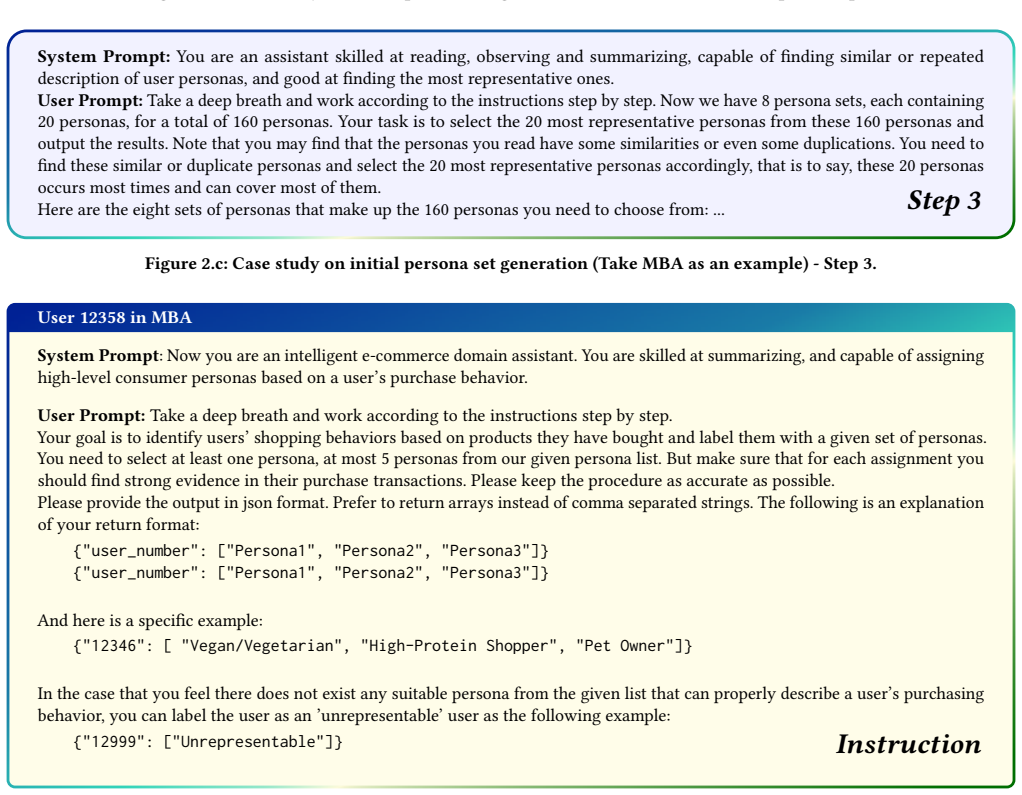
Craft and DIY Hobbyist - Often purchases crafting materials, DIY kits, sewing items, plush toys, and bespoke stationery sets for personal projects or to entertain children. ... (20 personas in total) Now considering the user purchasing data given below: ... Figure 2.a: Case st...
2025
-
[2009]
In Proceedings of the Twenty-Fifth Conference on Uncertainty in Artificial Intelligence
BPR: Bayesian personalized ranking from implicit feedback. In Proceedings of the Twenty-Fifth Conference on Uncertainty in Artificial Intelligence . 452–461
-
[2022]
In Companion Proceedings of the Web Conference 2022
Unsupervised Customer Segmentation with Knowledge Graph Embeddings. In Companion Proceedings of the Web Conference 2022 . 157–161
2022
-
[2024]
In Companion Proceedings of the ACM on Web Conference 2024
An interpretable ensemble of graph and language models for improving search relevance in e-commerce. In Companion Proceedings of the ACM on Web Conference 2024. 206–215
2024
Reviewed August 16, 2026 · model on record in the stance chip above.
Discussion (0). Continue with ORCID to comment.