Time lags as proxy of spectral evolution in gamma-ray bursts
Pith reviewed 2026-06-27 12:15 UTC · model grok-4.3
The pith
Time lags in GRBs distinguish spectral softening from new high-energy components
A machine-rendered reading of the paper's core claim, the machinery that carries it, and where it could break.
Core claim
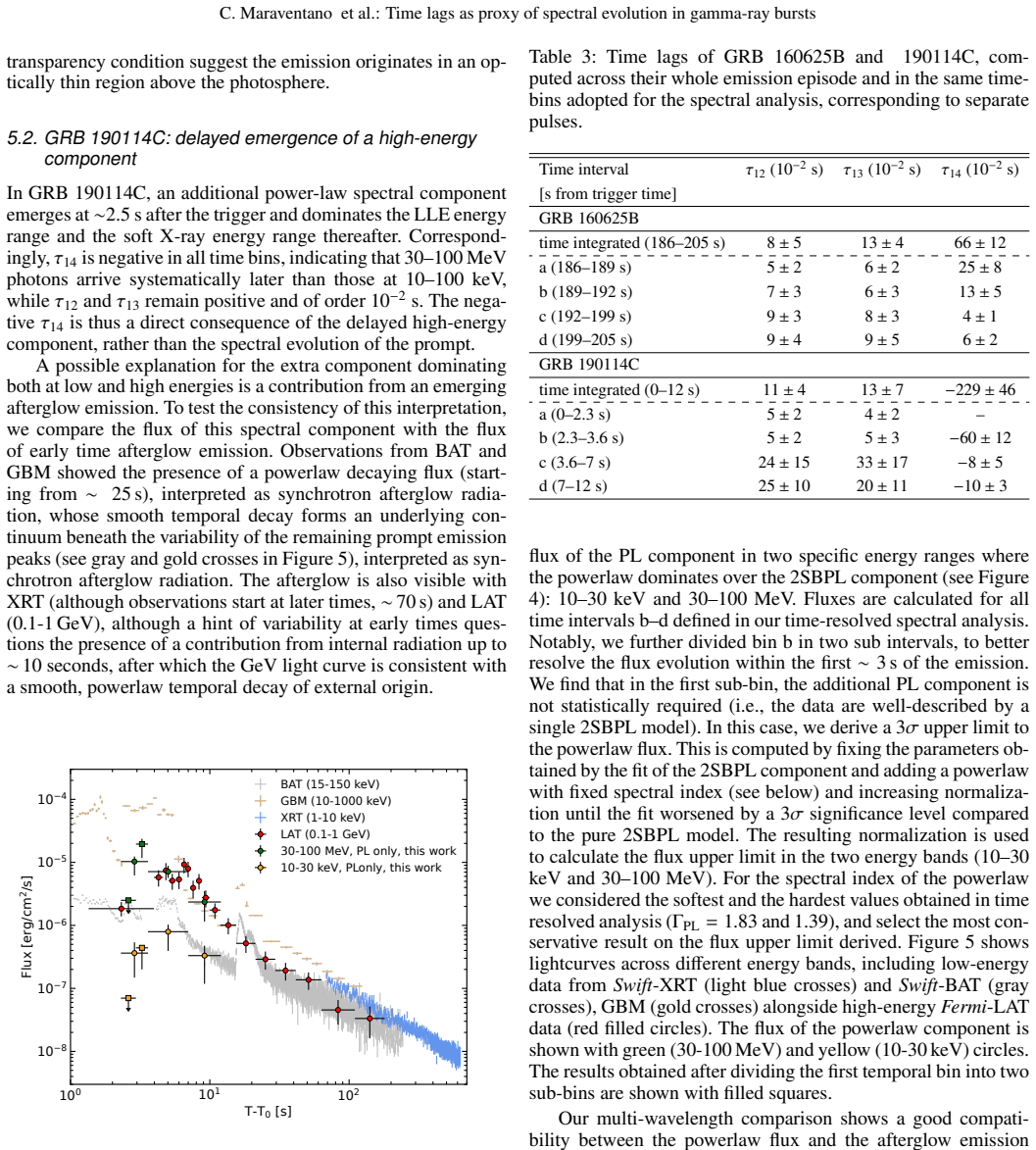
Time lags computed via the cross-correlation function between the 10-100 keV band and progressively higher bands up to 30-100 MeV act as diagnostic tools for spectral evolution: positive lags trace the softening of the prompt emission described by a single component, whereas negative lags indicate the appearance of a new, independent high-energy spectral component that dominates the LLE range.
What carries the argument
Cross-correlation function time lags between the lowest-energy band (10-100 keV) and higher-energy bands up to 30-100 MeV, applied across time-resolved joint spectral fits from 10 keV to 100 MeV
Load-bearing premise
The delayed high-energy power-law component in GRB 190114C is an independent spectral component rather than part of the same evolving spectrum or produced by other effects.
What would settle it
A time-resolved spectral fit of GRB 190114C that accounts for the high-energy data with a single continuously evolving component and eliminates the need for a separate power-law while also removing the negative lags.
Figures
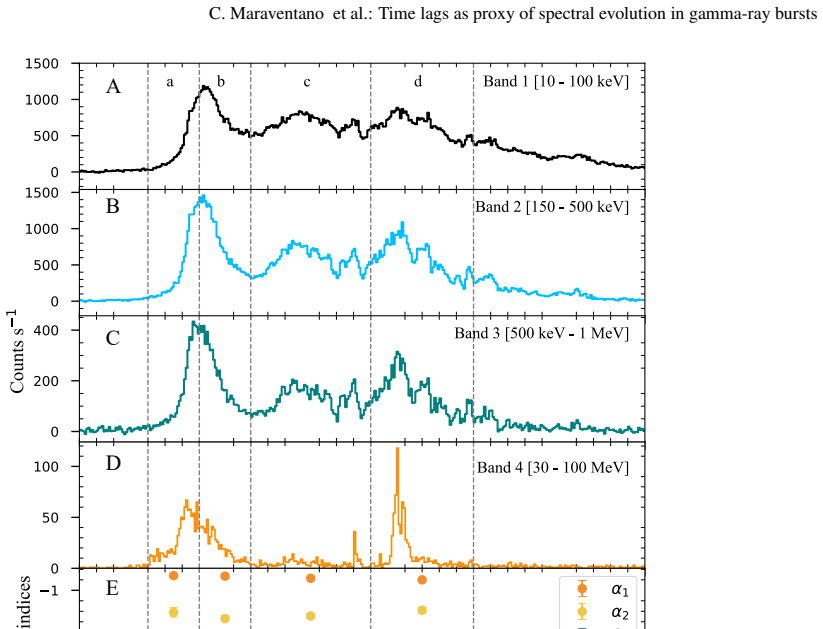
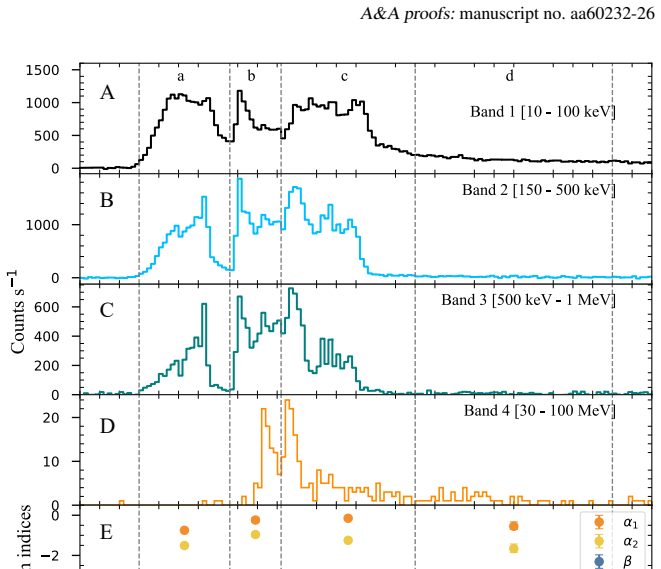
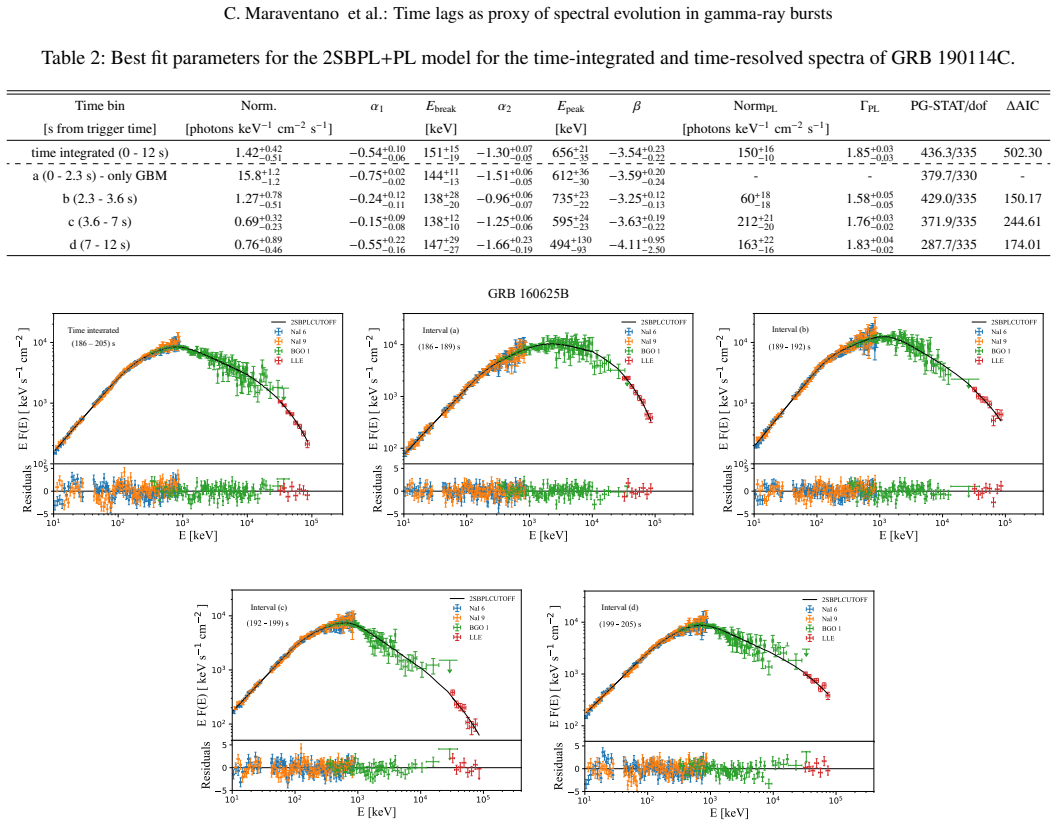
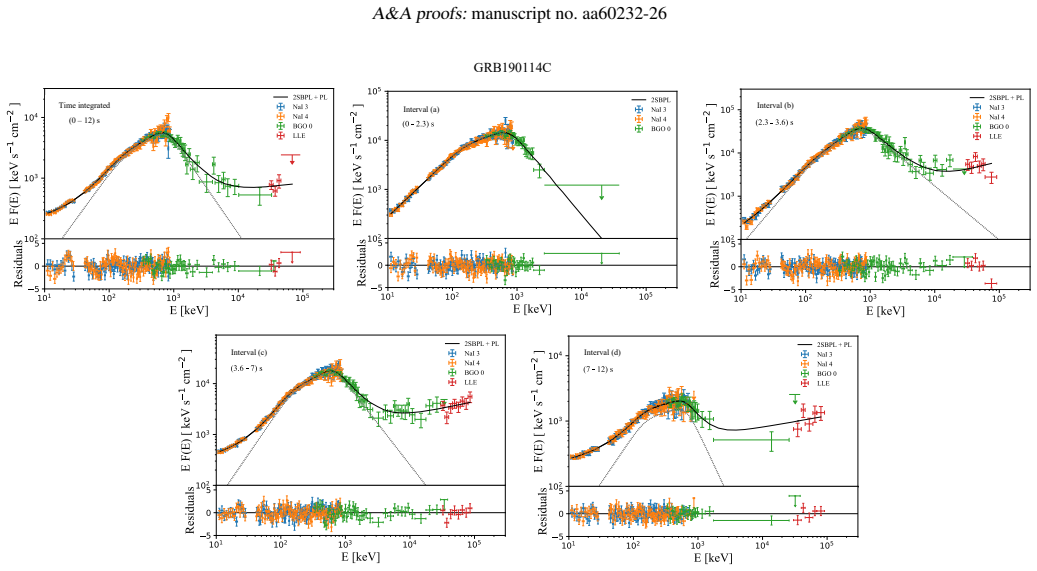
read the original abstract
Positive lags in gamma-ray bursts (GRBs), where hard photons anticipate softer ones, provide a unique window into the temporal evolution of their prompt emission. Negative lags, when hard photons are delayed, are instead more enigmatic to interpret. Disentangling the effects that produce both kinds of lags is critical for identifying the physical mechanisms at work in the prompt and early afterglow phases of GRBs. We investigate the potential of time lags for distinguishing different emission components at different energy bands. Using data from the Fermi Gamma-ray Burst Monitor (GBM) and the LAT Low Energy(LLE) technique, we perform a time-resolved joint spectral analysis in the range 10 keV-100 MeV for two exceptionally bright bursts, GRB 160625B and GRB 190114C. Time lags between the lowest-energy band (10-100 keV) and progressively higher-energy bands up to 30-100 MeV were computed across their distinct emission episodes via the cross-correlation function. For GRB 160625B, the spectra are described by a single component with clear hard-to-soft evolution, and the time lags are always positive. Analysis of the high-energy exponential cutoff, likely originating above the photosphere, yields bulk Lorentz factor estimates of $\Gamma \sim 120-250$. GRB 190114C exhibits negative lags in the 30-100 MeV band, coinciding with a delayed high-energy powerlaw component that dominates the LLE range after ~2.5 s. Comparison with multi-wavelength observations shows some compatibility with the early afterglow, though its origin remains open, leaving room for external shocks or internal dissipation. Time lags are effective diagnostic tools for the spectral evolution of GRBs: positive lags trace the softening of the prompt emission, whereas negative lags indicate the appearance of a new, independent high-energy spectral component.
Editorial analysis
A structured set of objections, weighed in public.
Referee Report
Summary. The manuscript analyzes time lags computed via cross-correlation functions between the 10-100 keV band and higher-energy bands (up to 30-100 MeV) for two bright GRBs observed with Fermi GBM and LLE. For GRB 160625B, positive lags are reported across episodes and linked to hard-to-soft evolution of a single spectral component (Band function plus exponential cutoff) via time-resolved joint fits; bulk Lorentz factors are derived from the cutoff. For GRB 190114C, negative lags appear in the 30-100 MeV band after ~2.5 s, coinciding with the dominance of a delayed high-energy power-law component whose origin (internal dissipation or early afterglow) is left open. The central claim is that positive lags diagnose spectral softening of a single component while negative lags diagnose the appearance of a new independent high-energy component.
Significance. If the proposed lag-to-component mapping is robust, the work supplies an observationally straightforward diagnostic that can flag the presence of distinct emission components in GRB prompt phases using only CCFs and limited spectral fitting. The analysis rests on public Fermi data and explicit multi-wavelength comparison for GRB 190114C, which aids reproducibility and allows direct tests by other groups.
major comments (2)
- [Abstract / GRB 190114C analysis section] Abstract and analysis of GRB 190114C: the attribution of negative lags to a new independent high-energy power-law component is not accompanied by a control demonstrating that continued single-component evolution (with the measured cutoff energy and softening rate from the earlier episodes) cannot produce a comparable CCF sign flip through band-dependent light-curve shapes alone. Without this test the causal mapping from lag sign to “new independent component” remains interpretive rather than necessary.
- [GRB 160625B analysis] GRB 160625B section: the positive-lag / hard-to-soft mapping is supported by the time-resolved Band+cutoff fits, but the manuscript does not quantify how sensitive the CCF sign is to the precise functional form of the cutoff or to the choice of energy-band boundaries; a modest change in either could alter the lag sign and weaken the claimed diagnostic power.
minor comments (2)
- [Abstract / Conclusions] The abstract states that the origin of the delayed power-law “remains open”; this qualification should be carried explicitly into the conclusion so that the diagnostic claim is not overstated.
- [Methods] Notation for the LLE band and the precise energy boundaries used in each CCF calculation should be tabulated for reproducibility.
Simulated Author's Rebuttal
We thank the referee for the thoughtful and constructive report. The comments highlight important points regarding the robustness of our lag-to-component interpretation. We address each major comment below and indicate the revisions we will make.
read point-by-point responses
-
Referee: [Abstract / GRB 190114C analysis section] Abstract and analysis of GRB 190114C: the attribution of negative lags to a new independent high-energy power-law component is not accompanied by a control demonstrating that continued single-component evolution (with the measured cutoff energy and softening rate from the earlier episodes) cannot produce a comparable CCF sign flip through band-dependent light-curve shapes alone. Without this test the causal mapping from lag sign to “new independent component” remains interpretive rather than necessary.
Authors: We agree that an explicit control test would make the interpretation more robust. Our time-resolved spectral fits show a clear transition after ~2.5 s to a spectrum dominated by an additional power-law component in the LLE band, coinciding exactly with the onset of negative lags. Nevertheless, to rule out the possibility that single-component evolution alone could produce a sign flip, we will add Monte Carlo simulations of light curves generated from the measured Band+cutoff parameters (with the observed softening rate and cutoff evolution) and recompute the CCFs. The results of this test will be included in the revised manuscript. revision: yes
-
Referee: [GRB 160625B analysis] GRB 160625B section: the positive-lag / hard-to-soft mapping is supported by the time-resolved Band+cutoff fits, but the manuscript does not quantify how sensitive the CCF sign is to the precise functional form of the cutoff or to the choice of energy-band boundaries; a modest change in either could alter the lag sign and weaken the claimed diagnostic power.
Authors: We accept that quantifying this sensitivity would strengthen the claimed diagnostic. We will add a dedicated subsection performing two sets of tests: (i) varying the cutoff functional form (e.g., exponential vs. smoothly broken power law) within the fit uncertainties, and (ii) shifting the energy-band boundaries by ~20% (e.g., 15-150 keV and 30-150 MeV). In both cases the positive lag sign remains unchanged for GRB 160625B. These robustness checks will be reported in the revised manuscript. revision: yes
Circularity Check
No circularity: direct observational analysis with independent spectral fits and CCF measurements.
full rationale
The paper computes time lags via cross-correlation on Fermi GBM/LLE data and performs time-resolved spectral fitting (Band function plus power-law components) on the same public observations. Positive lags are mapped to observed hard-to-soft evolution in GRB 160625B; negative lags in GRB 190114C are noted to coincide with the appearance of a delayed high-energy component whose origin is explicitly left open. No equations, parameters, or claims reduce by construction to prior fits; no self-citations are invoked as load-bearing uniqueness theorems or ansatzes. The central diagnostic claim rests on the empirical correspondence between measured lag signs and independently fitted spectral evolution, which is externally falsifiable against the raw light curves and spectra.
Axiom & Free-Parameter Ledger
Reference graph
Works this paper leans on
-
[1]
, volume=
High energy time lags of gamma-ray bursts , author=. , volume=. 2025 , publisher=
2025
-
[2]
GeV emission from gamma-ray bursts: a radiative fireball?. , keywords =. doi:10.1111/j.1365-2966.2009.16171.x , archivePrefix =. 0910.2459 , primaryClass =
-
[3]
, volume=
Insights into the physics of gamma-ray bursts from the high-energy extension of their prompt emission spectra , author=. , volume=. 2024 , publisher=
2024
-
[4]
, volume=
Time evolution of the spectral break in the high-energy extra component of GRB 090926A , author=. , volume=. 2017 , publisher=
2017
-
[5]
, volume=
Consistency with synchrotron emission in the bright GRB 160625B observed by Fermi , author=. , volume=. 2018 , publisher=
2018
-
[6]
, volume=
The slope of the low-energy spectrum of prompt gamma-ray burst emission , author=. , volume=. 2021 , publisher=
2021
-
[7]
Nature Astronomy , volume=
The case for a minute-long merger-driven gamma-ray burst from fast-cooling synchrotron emission , author=. Nature Astronomy , volume=. 2023 , publisher=
2023
-
[8]
, journal=
Akaike, H. , journal=. A new look at the statistical model identification , year=
-
[9]
Multimodel inference: understanding AIC and BIC in model selection , author=. Soc. Methods & Research , volume=
-
[10]
On Uncertainties in Cross-Correlation Lags and the Reality of Wavelength-dependent Continuum Lags in Active Galactic Nuclei. , keywords =. doi:10.1086/316177 , archivePrefix =. astro-ph/9802103 , primaryClass =
work page internal anchor Pith review Pith/arXiv arXiv doi:10.1086/316177
-
[11]
Vianello, G. and Gill, R. and Granot, J. and Omodei, N. and Cohen-Tanugi, J. and Longo, F. , title =. 2018 , month =. doi:10.3847/1538-4357/aad6ea , url =
-
[12]
GCN , year = 2019, month = jan, volume =
GRB 190114C: Fermi-LAT detection. GCN , year = 2019, month = jan, volume =
2019
-
[13]
GRB Coordinates Network , year = 2019, month = jan, volume =
GRB 190114C: Fermi GBM detection. GRB Coordinates Network , year = 2019, month = jan, volume =
2019
-
[14]
, volume=
Lower limits on Lorentz factors in gamma-ray bursts , author=. , volume=. 2001 , publisher=
2001
-
[15]
, volume=
Do Fermi Large Area Telescope observations imply very large Lorentz factors in gamma-ray burst outflows? , author=. , volume=. 2012 , publisher=
2012
-
[16]
, volume=
A new method of determining the initial size and Lorentz factor of gamma-ray burst fireballs using a thermal emission component , author=. , volume=. 2007 , publisher=
2007
-
[17]
, volume=
The internal-collision-induced magnetic reconnection and turbulence (ICMART) model of gamma-ray bursts , author=. , volume=. 2010 , publisher=
2010
-
[18]
GCN , year = 2016, month = jan, volume =
GRB 160625B: VLT/X-shooter redshift. GCN , year = 2016, month = jan, volume =
2016
-
[19]
, volume=
The energy dependence of GRB minimum variability timescales , author=. , volume=. 2015 , publisher=
2015
-
[20]
, volume=
Regulation of the spectral peak in gamma-ray bursts , author=. , volume=. 2013 , publisher=
2013
-
[21]
, volume=
External forward shock origin of high-energy emission for three gamma-ray bursts detected by Fermi , author=. , volume=. 2010 , publisher=
2010
-
[22]
, volume=
Modeling the early afterglow in the short and hard GRB 090510 , author=. , volume=. 2016 , publisher=
2016
-
[23]
, volume=
Observation of GRB 221009A early afterglow in X-Ray/gamma-ray energy bands , author=. , volume=. 2024 , publisher=
2024
-
[24]
, volume=
Connection between Energy-dependent Lags and PeakLuminosity in Gamma-RayBursts , author=. , volume=. 2000 , publisher=
2000
-
[25]
, volume=
Is the time lag-luminosity relation of gamma-ray bursts a consequence of the Amati relation? , author=. , volume=. 2007 , publisher=
2007
-
[26]
, volume=
Detection of a spectral break in the extra hard component of GRB 090926A , author=. , volume=. 2011 , publisher=
2011
-
[27]
, volume=
Marginally fast cooling synchrotron models for prompt GRBs , author=. , volume=. 2018 , publisher=
2018
-
[28]
ICRC 2019 , year = 2019, series =
High-energy emission from GRBs: 10 years with Fermi-LAT. ICRC 2019 , year = 2019, series =. doi:10.22323/1.358.0555 , archivePrefix =. 1909.05984 , primaryClass =
-
[29]
, volume=
Testing a model for subphotospheric dissipation in GRBs: fits to Fermi data constrain the dissipation scenario , author=. , volume=. 2019 , publisher=
2019
-
[30]
, volume=
Identification and Properties of the Photospheric Emission in GRB090902B , author=. , volume=. 2010 , publisher=
2010
-
[31]
, volume=
Rise and fall of the high-energy afterglow emission of GRB 180720B , author=. , volume=. 2020 , publisher=
2020
-
[32]
, volume=
Fermi and Swift observations of GRB 190114C: tracing the evolution of high-energy emission from prompt to afterglow , author=. , volume=. 2020 , publisher=
2020
-
[33]
, volume=
Prompt high-energy emission from gamma-ray bursts in the internal shock model , author=. , volume=. 2009 , publisher=
2009
-
[34]
, volume=
Bulk Lorentz factors of gamma-ray bursts , author=. , volume=. 2018 , publisher=
2018
-
[35]
, volume=
The onset of the GeV afterglow of GRB 090510 , author=. , volume=. 2010 , publisher=
2010
-
[36]
Planck 2018 results. VI. Cosmological parameters , author=. , volume=
2018
-
[37]
GRB 211211A: A Neutron Star-White Dwarf Merger?. , keywords =. doi:10.3847/2041-8213/acca83 , archivePrefix =. 2304.04009 , primaryClass =
-
[38]
GCN , year = 2023, month = apr, volume =
GRB 230307A: good match with kilonova models. GCN , year = 2023, month = apr, volume =
2023
-
[39]
The Peculiar Short-duration GRB 200826A and Its Supernova. , keywords =. doi:10.3847/1538-4357/ac60a2 , archivePrefix =. 2105.03829 , primaryClass =
-
[40]
arXiv preprint astro-ph/9404038 , year=
Unsteady outflow models for cosmological gamma-ray bursts , author=. arXiv preprint astro-ph/9404038 , year=
-
[41]
, volume=
Can internal shocks produce the variability in gamma-ray bursts? , author=. , volume=. 1997 , publisher=
1997
-
[42]
, volume=
Gamma-ray bursts from internal shocks in a relativistic wind: temporal and spectral properties , author=. , volume=. 1998 , publisher=
1998
-
[43]
, volume=
The internal-collision-induced magnetic reconnection and turbulence (ICMART) model of gamma-ray bursts , author=. , volume=. 2011 , publisher=
2011
-
[44]
, volume=
A reconnection switch to trigger gamma-ray burst jet dissipation , author=. , volume=. 2012 , publisher=
2012
-
[45]
, volume=
Properties of GRB light curves from magnetic reconnection , author=. , volume=. 2016 , publisher=
2016
-
[46]
, volume=
Dissipative photosphere models of gamma-ray bursts and X-ray flashes , author=. , volume=. 2005 , publisher=
2005
-
[47]
Photospheric emission in gamma-ray bursts , author=. Int. J. Mod. Phys. D , volume=. 2017 , publisher=
2017
-
[48]
Space Science Reviews , volume=
Photospheric emission of gamma-ray bursts , author=. Space Science Reviews , volume=
-
[49]
, volume=
Long-lag, wide-pulse gamma-ray bursts , author=. , volume=. 2005 , publisher=
2005
-
[50]
, volume=
Distribution of spectral lags in Gamma-ray bursts , author=. , volume=. 2005 , publisher=
2005
-
[51]
, volume=
The lag--luminosity relation in the GRB source frame: an investigation with Swift BAT bursts , author=. , volume=. 2012 , publisher=
2012
-
[52]
, volume=
A gamma-ray burst database of BATSE spectral lag and internal luminosity function values , author=. , volume=. 2007 , publisher=
2007
-
[53]
, volume=
Spectral lags and the lag--luminosity relation: an investigation with Swift BAT gamma-ray bursts , author=. , volume=. 2010 , publisher=
2010
-
[54]
, volume=
Comparing the spectral lag of short and long gamma-ray bursts and its relation with the luminosity , author=. , volume=. 2015 , publisher=
2015
-
[55]
, volume=
Short gamma-ray bursts with extended emission , author=. , volume=. 2006 , publisher=
2006
-
[56]
, volume=
Revisiting the characteristics of the spectral lags in short gamma-ray bursts , author=. , volume=. 2006 , publisher=
2006
-
[57]
Astronomy & Astrophysics , volume=
Short versus long gamma-ray bursts: spectra, energetics, and luminosities , author=. Astronomy & Astrophysics , volume=. 2009 , publisher=
2009
-
[58]
Annual review of Astronomy and Astrophysics , volume=
Short-duration gamma-ray bursts , author=. Annual review of Astronomy and Astrophysics , volume=. 2014 , publisher=
2014
-
[59]
, volume=
Multiwavelength observations of GRB 110731A: GeV emission from onset to afterglow , author=. , volume=. 2013 , publisher=
2013
-
[60]
, volume=
Time delays between Fermi-LAT and GBM light curves of gamma-ray bursts , author=. , volume=. 2014 , publisher=
2014
-
[61]
, volume=
A decade of gamma-ray bursts observed by Fermi-LAT: the second GRB catalog , author=. , volume=. 2019 , publisher=
2019
-
[62]
Gamma-Ray Burst Spectral Evolution Through Crosscorrelations of Discriminator Light Curves
Gamma-Ray Burst Spectral Evolution through Cross-Correlations of Discriminator Light Curves. , keywords =. doi:10.1086/304566 , archivePrefix =. astro-ph/9704206 , primaryClass =
work page internal anchor Pith review Pith/arXiv arXiv doi:10.1086/304566
-
[63]
, volume=
The connection between spectral evolution and gamma-ray burst lag , author=. , volume=. 2003 , publisher=
2003
-
[64]
Analytical and numerical study of spectral lags , author=
Interpretations of gamma-ray burst spectroscopy-I. Analytical and numerical study of spectral lags , author=. , volume=. 2005 , publisher=
2005
-
[65]
, volume=
A new measurement of the spectral lag of gamma-ray bursts and its implications for spectral evolution behaviors , author=. , volume=. 2017 , publisher=
2017
-
[66]
, volume=
The physics of pulses in gamma-ray bursts: emission processes, temporal profiles and time-lags , author=. , volume=. 2003 , publisher=
2003
-
[67]
, volume=
The lag and duration--luminosity relations of gamma-ray burst pulses , author=. , volume=. 2010 , publisher=
2010
-
[68]
, volume=
A simple theory of lags in gamma-ray bursts: Comparison to observations , author=. , volume=. 2016 , publisher=
2016
-
[69]
AN , volume=
Spectral lag of gamma-ray bursts caused by the intrinsic spectral evolution and the curvature effect , author=. AN , volume=. 2011 , publisher=
2011
-
[70]
, volume=
Evidence of bulk acceleration of the GRB X-ray flare emission region , author=. , volume=. 2016 , publisher=
2016
-
[71]
Spectral evolution of GRBs with negative spectral lag using Fermi GBM observations , author=. J. HE Astr. , year=
-
[72]
, volume=
GRB 190114C: from prompt to afterglow? , author=. , volume=. 2019 , publisher=
2019
-
[73]
, volume=
The Fermi gamma-ray burst monitor , author=. , volume=. 2009 , publisher=
2009
-
[74]
, volume=
The large area telescope on the Fermi gamma-ray space telescope mission , author=. , volume=. 2009 , publisher=
2009
-
[75]
arXiv preprint arXiv:1002.2617 , year=
The LAT Low-Energy technique for Fermi Gamma-Ray Bursts spectral analysis , author=. arXiv preprint arXiv:1002.2617 , year=
-
[76]
, volume=
The fourth fermi-gbm gamma-ray burst catalog: A decade of data , author=. , volume=. 2020 , publisher=
2020
-
[77]
Science , volume=
Fermi observations of high-energy gamma-ray emission from GRB 080916C , author=. Science , volume=. 2009 , publisher=
2009
-
[78]
, volume=
Fermi observations of GRB 090902B: a distinct spectral component in the prompt and delayed emission , author=. , volume=. 2009 , publisher=
2009
-
[79]
Physics Reports , volume=
The physics of gamma-ray bursts & relativistic jets , author=. Physics Reports , volume=. 2015 , publisher=
2015
-
[80]
Universe , volume=
Gamma-Ray Bursts at the highest energies , author=. Universe , volume=. 2021 , publisher=
2021
discussion (0)
Sign in with ORCID, Apple, or X to comment. Anyone can read and Pith papers without signing in.