Autonomous scanning electrochemical cell microscopy enables rapid exploration of large compositionally complex material spaces
Pith reviewed 2026-06-28 18:12 UTC · model grok-4.3
The pith
An autonomous SECCM system predicts full composition-activity trends for Au-Ir-Rh alloys after measuring only 15 percent of 966 areas.
A machine-rendered reading of the paper's core claim, the machinery that carries it, and where it could break.
Core claim
The autonomous robotic SECCM platform rapidly establishes composition-electrocatalytic activity relationships for large compositional spaces across multiple thin-film CCSS materials libraries via active learning and automated library exchange. Embedding analytical expressions of voltammetry in the algorithm enables the learning of whole voltammograms rather than a single selected metric. As a demonstration, the composition-activity trend for the hydrogen evolution reaction in Au-Ir-Rh was accurately predicted after measuring only 15 percent of all 966 measurement areas, with Au30Ir20Rh50 and Au10Ir35Rh55 exhibiting highest activities and standard rate constants of about 0.012 cm/s that demon
What carries the argument
Active learning algorithm that embeds analytical expressions of voltammetry to learn and extrapolate entire voltammograms and activity trends across unmeasured compositional areas in CCSS libraries.
If this is right
- Composition-activity trends for CCSS electrocatalysts can be mapped with measurements limited to a small fraction of the full space.
- Au30Ir20Rh50 and Au10Ir35Rh55 show the highest HER activities among the sampled Au-Ir-Rh compositions due to positive synergy from mixing.
- The same autonomous SECCM approach applies to screening many other electrocatalytic reactions beyond HER.
- Automated library exchange combined with active learning removes the manual bottleneck in exploring large alloy libraries.
Where Pith is reading between the lines
- The method could be tested on quaternary or higher-order CCSS libraries to check whether the 15-percent sampling fraction remains sufficient as dimensionality increases.
- Predictions might be validated against density-functional-theory calculations of hydrogen binding energies to see whether the observed synergies align with electronic-structure expectations.
- Extending the platform to operate under varied pH or temperature conditions would test whether the learned voltammetry expressions generalize beyond the original experimental setup.
- Coupling the SECCM output directly to machine-learning models for inverse design could generate new target compositions for synthesis and testing.
Load-bearing premise
Embedding analytical expressions of voltammetry inside the active learning algorithm produces accurate extrapolations of whole voltammograms and activity trends to the remaining unmeasured areas without large errors from unmodeled interactions or experimental variability.
What would settle it
Directly measuring the HER activity at the remaining 85 percent of the 966 areas and finding that the predicted composition-activity map deviates substantially from the new measurements would falsify the extrapolation accuracy.
Figures
read the original abstract
Alloying is a central strategy in electrocatalysis, enabling fine-tuning of electronic structure. In particular, compositionally complex solid solutions (CCSS) often called high-entropy alloys are of high interest as they allow active site design. However, the "combinatorial explosion" in the number of possible compositions poses a critical bottleneck for the discovery of active CCSS electrocatalysts. We present an autonomous scanning electrochemical cell microscopy (SECCM) system for ultrahigh-throughput and large-scale CCSS activity screening. The platform rapidly establishes composition-electrocatalytic activity relationships for large compositional spaces across multiple thin-film CCSS materials libraries via active learning and automated library exchange. Embedding analytical expressions of voltammetry in the algorithm enables the learning of whole voltammograms rather than a single selected metric. As a demonstration, we investigated hydrogen evolution reaction (HER) activities of Au-Ir-Rh, where Ir and Rh exhibit strong metal-hydrogen binding and Au exhibits relatively weak binding as derived from the HER volcano plot. The composition-activity trend was accurately predicted after measuring only 15% of all 966 measurement areas. Au30Ir20Rh50 and Au10Ir35Rh55 exhibit highest activities with standard rate constants of about 0.012 cm/s, demonstrating positive synergistic contributions from elemental mixing. The autonomous robotic SECCM platform is broadly applicable to a wide range of electrocatalytic reactions, providing a general pathway for accelerating CCSS electrocatalyst discovery and optimization.
Editorial analysis
A structured set of objections, weighed in public.
Referee Report
Summary. The paper presents an autonomous SECCM platform that integrates active learning with embedded analytical voltammetry expressions to enable high-throughput screening of large CCSS compositional spaces for electrocatalytic activity. As a demonstration on the HER in Au-Ir-Rh thin-film libraries (966 measurement areas), it claims that the full composition-activity trend, including identification of optimal compositions Au30Ir20Rh50 and Au10Ir35Rh55 with k0 ≈ 0.012 cm/s, can be accurately predicted after measuring only 15% of the points by learning entire voltammograms rather than scalar metrics.
Significance. If validated, the work offers a scalable route to mitigate the combinatorial explosion in CCSS electrocatalyst discovery by reducing required measurements while capturing synergistic elemental effects; the whole-voltammogram learning approach is a coherent methodological strength that could generalize to other reactions.
minor comments (2)
- The abstract states the trend was 'accurately predicted' after 15% sampling but provides no quantitative error metric, baseline comparison to random sampling, or cross-validation details; these should be added to the results section for reproducibility.
- Clarify in the methods how the analytical voltammetry expressions are embedded in the active learning loop (e.g., which parameters are learned vs. fixed) to allow readers to assess extrapolation reliability.
Simulated Author's Rebuttal
We thank the referee for their positive assessment of the manuscript, recognition of the methodological contribution of whole-voltammogram learning, and recommendation for minor revision. No specific major comments were provided in the report.
Circularity Check
No significant circularity; derivation is self-contained
full rationale
The paper's central claim rests on an active-learning loop that measures 15% of 966 points, embeds analytical voltammetry expressions to learn full voltammograms, and extrapolates the remaining composition-activity map for Au-Ir-Rh HER. This process is driven by external experimental data and model fitting to measured voltammograms rather than any self-definitional reduction, fitted-input-renamed-as-prediction, or load-bearing self-citation chain. No equations or steps reduce the output to the inputs by construction; the extrapolation is falsifiable against the withheld 85% of measured areas. The approach is therefore self-contained and receives the default non-circularity finding.
Axiom & Free-Parameter Ledger
Reference graph
Works this paper leans on
-
[1]
G. Arruda De Oliveira, M. Kim, C.S. Santos, N. Limani, T.D. Chung, E.B. Tetteh, W. Schuhmann, Controlling Surface Wetting in High-Alkaline Electrolytes for Single Facet Pt Oxygen Evolution Electrocatalytic Activity Mapping by Scanning Electrochemical Cell Microscopy, Chem. Sci. 15 (2024) 16331–16337. https://doi.org/10.1039/D4SC04407J. [22] S. Trasatti, W...
-
[2]
ATC2200”, AJA International, Inc.) with 8 cathodes (“A320-XP UHV
Experimental procedures 1.1. Synthesis of thin-film materials libraries synthesis in the system Au–Ir–Rh The depositions of thin-film materials libraries were performed in a sputter system (“ATC2200”, AJA International, Inc.) with 8 cathodes (“A320-XP UHV”, AJA International). For Rh and Ir, pulsed DC power supplies (“DCXP 1500”, AJA International) were u...
-
[3]
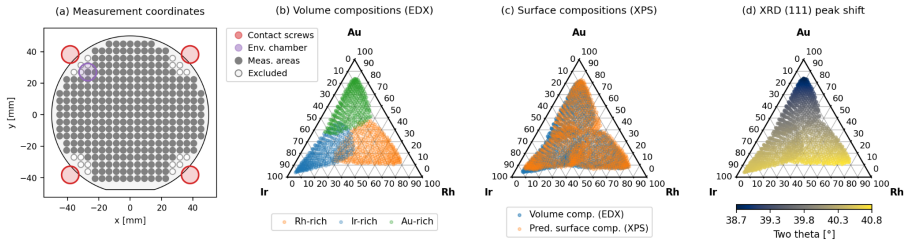
Supplementary figures (Figure S7–S23) and supplementary notes 2.1. Analysis of the volume composition Figure S7: (Volume) compositions of the Au-rich (a-c), Ir-rich (d-f) and Rh-rich (g-i) libraries acquired by EDX. 2.2. Analysis of the surface composition The autonomous exploration of the Au–Ir–Rh system was performed using compositions acquired by energ...
discussion (0)
Sign in with ORCID, Apple, or X to comment. Anyone can read and Pith papers without signing in.