REVIEW 3 major objections 5 minor 38 references
Explaining Risks: Axiomatic Risk Attributions for Financial Models
T0 review · 3 major / 5 minor · reviewed 2026-08-07 · deepseek-v4-flash
Pith's one-line read Risk can be fairly attributed to features by running the Shapley value on a risk-measure characteristic function.
desk verdict Extends Shapley to risk measures, but the central symmetry theorem is false as stated; the idea is worth referee time if fixed. read the letter →
The pith
A machine-rendered reading of the paper's core claim, the machinery that carries it, and where it could break.
The reading
What carries the argument
The carrying object is the Shapley value formula, applied not to a model prediction but to a characteristic function built from a risk measure: $v_R(S) = \rho(f(X_S; x'_{M\setminus S}))$ for population data, and its sample analogue for realized data. Absent features are pinned to a baseline constant $x'$, so the characteristic function asks what the risk would be if only the features in $S$ were random. This single substitution converts the classical cooperative-game allocation into a risk allocation, and all axiomatic results follow from Shapley's original axioms applied to $v_R$. For one special case, Euler's decomposition gives an alternative closed-form split for homogeneous functions, but it is not linear in the characteristic-function sense and does not generalize; the Shapley route is proposed for general nonlinear models.
What would settle it
Compute BShap (RAM) for a fixed model and risk measure under two different baseline choices, such as $x'=(0,0)$ and $x'=(r,r)$ for a two-asset portfolio; if the attributed risks change materially, the method's allocation is convention-dependent rather than determined by the model and data.
Extended reading notes
Core claim
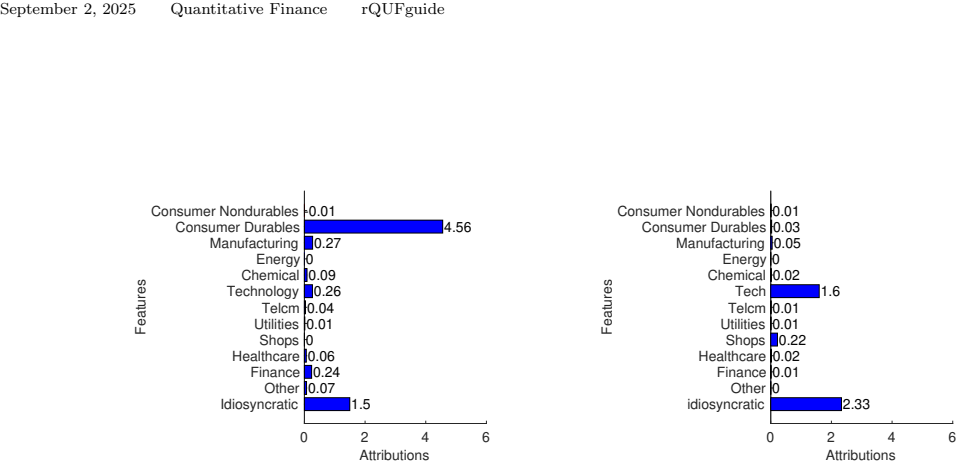
The central claim is that defining $v_R(S) = \rho(f(X_S; x'_{M\setminus S}))$ and substituting it into the Shapley value formula allocates the risk $\rho(f(X))$ among features in a way that is fair in the axiomatic sense. For this BShap (RAM) method, Theorem 3.3 shows that Completeness (RAM), Dummy (RAM), and Symmetry (RAM) hold. The paper also shows that Linearity cannot hold for RAMs together with completeness and dummy, and that symmetric monotonicity across different models is incompatible with the other axioms. Empirically, the method attributes the largest option risk to stock price, followed by volatility, and gives positive risk attributions to risky factors in a neural-network factor model, treating idiosyncratic error as an extra feature.
Load-bearing premise
The allocation is defined relative to a chosen baseline feature state $x'$, and the paper selects that baseline without a principled rule; if no natural no-randomness baseline exists, the claimed fairness of the split is not well defined.
Editorial extensions
If this is right
- For a linear portfolio with a sub-additive risk measure, BShap (RAM) assigns each asset an attribution no larger than its standalone risk, so diversification lowers attributed risk and the attributions sum to portfolio risk.
- In nonlinear factor models, the method ranks factors by their risk contribution and can isolate idiosyncratic risk by treating the residual as an additional feature.
- In option pricing, the method allocates the bulk of risk to the log stock price, then volatility, then the interest rate, suggesting which sources to hedge.
- The axiomatic guarantees give a formal sense in which the allocation is fair, extending baseline Shapley explanations from predictions to risk.
- Because Linearity is impossible for risk attributions, users should not expect additive feature decompositions across different models or risk measures.
Reading between the lines
- The method's output inherits the baseline-dependence of baseline Shapley: choosing different $x'$ can change every attribution, and the paper exercises ad hoc choices without a criterion; a principled baseline-selection rule would be needed for regulatory use.
- Although the paper demonstrates CVaR and standard deviation, the construction applies to any risk measure $\rho$, including expected shortfall, VaR, and drawdown-based measures; whether the axioms keep their force for non-coherent measures is a testable extension.
- The Shapley value requires evaluating $2^m$ risk computations, so for high-dimensional factor models an approximation or sampling scheme would be needed before the method scales to production risk systems.
- The symmetry axiom uses symmetry of the joint distribution of $f(X)$, which is stronger than symmetry of the model function alone; this suggests the method will behave differently from prediction explanations exactly when feature distributions are skewed or correlated.
Editorial analysis
A structured set of objections, weighed in public.
Referee Report
Summary. The paper proposes risk attribution methods (RAMs) for financial models by defining a characteristic function vR(S)=rho(f(X_S; x'_M\S)) and applying the Shapley value. It claims that BShap(RAM) preserves completeness, dummy, and symmetry axioms, proves a sub-additivity bound for additive portfolios, and illustrates the method on portfolio CVaR, nonlinear factor models, and option pricing.
Significance. If the symmetry theorem were correct, the paper would offer a general and axiomatically motivated method for allocating model risk to features, with closed-form results for linear portfolios and a clear connection to the diversification principle. The paper is useful in framing the RAM problem and in showing that standard BAM axioms do not transfer directly to risk measures. The analytical examples and Shapley computations are carefully worked out. However, the central fairness theorem requires a substantive repair before the paper's main claim can be accepted, and the empirical sections are illustrative rather than statistically validated.
major comments (3)
- [§3.2, Theorem 3.3 and Appendix A] Theorem 3.3 is false as stated. The proof in Appendix A asserts that Symmetry (RAM) implies Symmetry (SH) for vR(S)=rho(f(X_S; x'_M\S)), but the density condition in Definition 7 does not force vR(S∪i)=vR(S∪j) for every coalition S. Counterexample: let m=2, f(x1,x2)=x1+2x2, X1,X2 iid N(0,1), x'=(0,0), and rho=STD. The law of f(X) is N(0,5); after swapping inputs, f(X*) = X2+2X1 is also N(0,5), so the stated symmetry hypothesis is satisfied under the natural reading that the law of f(X) is invariant under coordinate swapping (it is also satisfied if g is read as the density of X, because X1 and X2 are exchangeable). Yet vR({1})=STD(X1)=1 while vR({2})=STD(2X2)=2, so vR is not symmetric and the Shapley attributions differ: BSR_1=(√5−1)/2 and BSR_2=(√5+1)/2. The theorem can be repaired by requiring f(x)=f(x*) for all x together with exchangeability of Xi and Xj, or by directly assuming vR-symmetry; as written, the central fairness guarantee is not established. This also affects Example 4.4, which relies on Symmetry (RAM) to conclude that X1 and X2 contribute equally to f.
- [§3.1 and §5.3] The choice of baseline constant x' is a load-bearing modeling input. In the portfolio example x'=0 is justified as a risk-free asset, but in the option example x'=(ST, sigma_T, r_T) is chosen as 'current market conditions' without a principled criterion. Since vR(S) replaces features by x'_M\S, every attribution depends on x'; different baselines will generally produce different risk allocations. The paper does not analyze this sensitivity or provide a general rule for selecting the baseline, which limits the claim that the resulting allocation is 'fair' rather than merely axiomatic relative to an arbitrary reference point.
- [§5 (Figures 1–4)] The empirical sections present point estimates without error bars, repeated training runs, or any comparison to alternative risk allocation methods such as Euler's decomposition (which the paper discusses in §4.1) or Aumann–Shapley values. As a result, the statement that risk 'can be well allocated' is supported only by qualitative agreement with domain knowledge. If the empirical material is meant to demonstrate practical utility, it needs robust validation; otherwise it should be explicitly labeled as a toy illustration.
minor comments (5)
- [Definition 7] The notation g(x) for the density of f(X) is dimensionally inconsistent; rewrite the symmetry condition in terms of the law of f(X) or the density of X.
- [Theorem 2.1] The phrase 'only for i = j' is ambiguous; specify whether it means the monotonicity axioms hold only when the two characteristic functions in the comparison involve the same player.
- [Section 4.1] 'Symmetryic Monotonicity' should be 'Symmetric Monotonicity'.
- [Section 5.3] The text says log prices, log volatility, and log interest rates are used as inputs, but the baseline is given as x'=(ST, sigma_T, r_T); the baseline should be the logs of these values for consistency.
- [Remark 1] Both BAM and RAM attributions appear to use the same symbol A_i; the claimed distinction is not visible in the text.
Circularity Check
No significant circularity; the risk-attribution method is a direct Shapley-value construction with self-citations only in background discussion.
full rationale
The paper's central construction is explicit and self-contained: it defines the characteristic function vR(S) = rho(f(X_S; x'_{M\S})) and applies the classical Shapley value formula. Completeness (RAM) is literally the Shapley Completeness identity for this vR, and Dummy (RAM) is the corresponding Shapley dummy condition under the stated derivative assumption, so those parts of Theorem 3.3 follow from the definitions rather than from any fitted or imported result. No parameter is fitted to data and then renamed a prediction; the baseline x' is a modeling input, not an optimized constant. The self-citations (Chen and Ye, Chen and Gao) support background monotonicity discussion and are not load-bearing for the main risk-allocation claim. The proof of Theorem 3.3 is terse, and the one-sentence argument that Symmetry (RAM) implies the Shapley Symmetry condition is not actually demonstrated — a mathematical correctness concern, but not a circularity. Overall, no significant circularity.
Assumptions & free parameters
free parameters (1)
- Baseline constant x' (per example) =
0 for portfolio returns; current market (S_T, sigma_T, r_T) for option; not specified for factor models
assumptions (5)
- standard math Shapley value uniqueness under Completeness, Linearity, Dummy, Symmetry (Shapley 1953).
- domain assumption Baseline replacement vB(S)=f(x_S; x'_M\S) is the correct way to encode feature absence.
- domain assumption The model class is real analytic functions and a learned model f approximates the true relationship Y=f(X)+epsilon in Equation (1).
- domain assumption Risk measures used (STD, VaR, CVaR) are the relevant notions of risk for the applications.
- domain assumption Empirical samples (2011-2023 stock data, 2008 option data) are treated as representative for computing risk.
Cite this review
Pith. "Pith review of Explaining Risks: Axiomatic Risk Attributions for Financial Models." pith.science (2026). https://pith.science/paper/O63AJWSQ
@misc{pith2026250606653,
  author       = {Pith},
  title        = {Pith review of: Explaining Risks: Axiomatic Risk Attributions for Financial Models},
  year         = {2026},
  howpublished = {\url{https://pith.science/paper/O63AJWSQ}},
  note         = {Machine review of arXiv:2506.06653}
}
read the original abstract
In recent years, machine learning models have achieved great success at the expense of highly complex black-box structures. By using axiomatic attribution methods, we can fairly allocate the contributions of each feature, thus allowing us to interpret the model predictions. In high-risk sectors such as finance, risk is just as important as mean predictions. Throughout this work, we address the following risk attribution problem: how to fairly allocate the risk given a model with data? We demonstrate with analysis and empirical examples that risk can be well allocated by extending the Shapley value framework.
Figures

Reference graph
Works this paper leans on
-
[1]
\@ifclassloaded aguplus natbib The aguplus class already includes natbib coding, so you should not add it explicitly Type <Return> for now, but then later remove the command natbib from the document \@ifclassloaded nlinproc natbib The nlinproc class already includes natbib coding, so you should not add it explicitly Type <Return> for now, but then later r...
-
[2]
@stdbsttrue NAT@ctr \@lbibitem[ NAT@ctr ] \@lbibitem[#1]#2 \@extra@b@citeb \@ifundefined br@#2\@extra@b@citeb \@namedef br@#2 \@nameuse br@#2\@extra@b@citeb \@ifundefined b@#2\@extra@b@citeb @num @parse #2 [ @natanchorstart #2\@extra@b@citeb \@biblabel @num @natanchorend] @ifcmd#1(@)(@)\@nil #2 @lbibitem\@undefined @lbibitem\@lbibitem \@lbibitem[#1]#2 @lb...
-
[3]
Santos-Pereira, Carla M. and Pires, Ana M
@open @close @open @close and [1] URL: #1 \@ifundefined chapter * \@mkboth \@ifundefined NAT@sectionbib * \@mkboth * \@mkboth\@gobbletwo \@ifclassloaded amsart * \@ifclassloaded amsbook * \@ifundefined bib@heading @heading NAT@ctr thebibliography [1] @ \@biblabel NAT@ctr \@bibsetup #1 NAT@ctr 0 @openbib .11em \@plus.33em \@minus.07em 4000 4000 `\.=1000 \@...
-
[4]
, " * write output.state after.block = add.period write newline
ENTRY accessed address author booktitle chapter chaptertitle englishtitle edition editor eid howpublished institution journal key month note number organization pages publisher location school series title type url volume year label extra.label sort.label short.list INTEGERS output.state before.all mid.sentence after.sentence after.block FUNCTION init.sta...
-
[5]
" write newline "" before.all 'output.state := FUNCTION n.dashify 't := "" t empty not t #1 #1 substring "-" = t #1 #2 substring "--" = not "--" * t #2 global.max substring 't := t #1 #1 substring "-" = "-" * t #2 global.max substring 't := while if t #1 #1 substring * t #2 global.max substring 't := if while FUNCTION word.in bbl.in " " * FUNCTION word.pl...
-
[6]
@open @close @open @close and [1] URL: #1 \@ifundefined chapter * \@mkboth \@ifundefined NAT@sectionbib * \@mkboth * \@mkboth\@gobbletwo \@ifclassloaded amsart * \@ifclassloaded amsbook * \@ifundefined bib@heading @heading NAT@ctr thebibliography [1] @ \@biblabel NAT@ctr \@bibsetup #1 NAT@ctr 0 @openbib .11em \@plus.33em \@minus.07em 4000 4000 `\.=1000 \@...
-
[7]
Using stocks or portfolios in tests of factor models
Andrew Ang, Jun Liu, and Krista Schwarz. Using stocks or portfolios in tests of factor models. Journal of Financial and Quantitative Analysis, 55 0 (3): 0 709--750, 2020
work page 2020
-
[8]
Philippe Artzner, Freddy Delbaen, Jean-Marc Eber, and David Heath. Coherent measures of risk. Mathematical finance, 9 0 (3): 0 203--228, 1999
work page 1999
Show all 38 references
-
[9]
Inferential theory for factor models of large dimensions
Jushan Bai. Inferential theory for factor models of large dimensions. Econometrica, 71 0 (1): 0 135--171, 2003
2003
-
[10]
Determining the number of factors in approximate factor models
Jushan Bai and Serena Ng. Determining the number of factors in approximate factor models. Econometrica, 70 0 (1): 0 191--221, 2002
2002
-
[11]
The pricing of options and corporate liabilities
Fischer Black and Myron Scholes. The pricing of options and corporate liabilities. Journal of political economy, 81 0 (3): 0 637--654, 1973
1973
-
[12]
Sign symmetry vs symmetry: Young’s characterization of the shapley value revisited
Andr \'e Casajus. Sign symmetry vs symmetry: Young’s characterization of the shapley value revisited. Economics letters, 169: 0 59--62, 2018
2018
-
[13]
Dangxing Chen and Yuan Gao. Attribution methods in asset pricing: Do they account for risk? In 2024 IEEE Symposium on Computational Intelligence for Financial Engineering and Economics (CIFEr), pages 1--8, 2024. doi:10.1109/CIFEr62890.2024.10772752
2024
-
[14]
Monotonic neural additive models: Pursuing regulated machine learning models for credit scoring
Dangxing Chen and Weicheng Ye. Monotonic neural additive models: Pursuing regulated machine learning models for credit scoring. In Proceedings of the Third ACM International Conference on AI in Finance, pages 70--78, 2022
2022
-
[15]
Dangxing Chen and Weicheng Ye. How to address monotonicity for model risk management? In Proceedings of the 40th International Conference on Machine Learning, volume 202 of Proceedings of Machine Learning Research, pages 5282--5295. PMLR, 23--29 Jul 2023
2023
-
[16]
Variance allocation and shapley value
Riccardo Colini-Baldeschi, Marco Scarsini, and Stefano Vaccari. Variance allocation and shapley value. Methodology and Computing in Applied Probability, 20: 0 919--933, 2018
2018
-
[17]
Drawdown beta and portfolio optimization
Rui Ding and Stan Uryasev. Drawdown beta and portfolio optimization. Quantitative Finance, 22 0 (7): 0 1265--1276, 2022
2022
-
[18]
Incorporating functional knowledge in neural networks
Charles Dugas, Yoshua Bengio, Fran c ois B \'e lisle, Claude Nadeau, and Ren \'e Garcia. Incorporating functional knowledge in neural networks. Journal of Machine Learning Research, 10 0 (6), 2009
2009
-
[19]
The cboe volatility index-vix
Chicago Board Options Exchange. The cboe volatility index-vix. White paper, pages 1--23, 2009
2009
-
[20]
Three methods to share joint costs or surplus
Eric Friedman and Herve Moulin. Three methods to share joint costs or surplus. Journal of economic Theory, 87 0 (2): 0 275--312, 1999
1999
-
[21]
Portfolio risk allocation through shapley value
Patrick S Hagan, Andrew Lesniewski, Georgios E Skoufis, and Diana E Woodward. Portfolio risk allocation through shapley value. International Journal of Financial Engineering, page 2350004, 2023
2023
-
[22]
A unified approach to interpreting model predictions
Scott M Lundberg and Su-In Lee. A unified approach to interpreting model predictions. Advances in neural information processing systems, 30, 2017
2017
-
[23]
Four axiomatic characterizations of the integrated gradients attribution method
Daniel Lundstrom and Meisam Razaviyayn. Four axiomatic characterizations of the integrated gradients attribution method. arXiv preprint arXiv:2306.13753, 2023 a
2023 arXiv
-
[24]
A unifying framework to the analysis of interaction methods using synergy functions
Daniel Lundstrom and Meisam Razaviyayn. A unifying framework to the analysis of interaction methods using synergy functions. In International Conference on Machine Learning, pages 23005--23032. PMLR, 2023 b
2023
-
[25]
A rigorous study of integrated gradients method and extensions to internal neuron attributions
Daniel D Lundstrom, Tianjian Huang, and Meisam Razaviyayn. A rigorous study of integrated gradients method and extensions to internal neuron attributions. In International Conference on Machine Learning, pages 14485--14508. PMLR, 2022
2022
-
[26]
Theory of rational option pricing
Robert C Merton. Theory of rational option pricing. The Bell Journal of economics and management science, pages 141--183, 1973
1973
-
[27]
Risk and asset allocation, volume 1
Attilio Meucci. Risk and asset allocation, volume 1. Springer, 2005
2005
-
[28]
Multicriteria interpretability driven deep learning
Marco Repetto. Multicriteria interpretability driven deep learning. Annals of Operations Research, pages 1--15, 2022
2022
-
[29]
Conditional value-at-risk for general loss distributions
R Tyrrell Rockafellar and Stanislav Uryasev. Conditional value-at-risk for general loss distributions. Journal of banking & finance, 26 0 (7): 0 1443--1471, 2002
2002
-
[30]
Optimization of conditional value-at-risk
R Tyrrell Rockafellar, Stanislav Uryasev, et al. Optimization of conditional value-at-risk. Journal of risk, 2: 0 21--42, 2000
2000
-
[31]
The shapley value decomposition of optimal portfolios
Haim Shalit. The shapley value decomposition of optimal portfolios. Annals of Finance, 17 0 (1): 0 1--25, 2021
2021
-
[32]
A value for n-person games
Lloyd S Shapley et al. A value for n-person games. 1953
1953
-
[33]
Stochastic calculus for finance II: Continuous-time models, volume 11
Steven E Shreve et al. Stochastic calculus for finance II: Continuous-time models, volume 11. Springer, 2004
2004
-
[34]
The many shapley values for model explanation
Mukund Sundararajan and Amir Najmi. The many shapley values for model explanation. In International conference on machine learning, pages 9269--9278. PMLR, 2020
2020
-
[35]
Axiomatic attribution for deep networks
Mukund Sundararajan, Ankur Taly, and Qiqi Yan. Axiomatic attribution for deep networks. In International conference on machine learning, pages 3319--3328. PMLR, 2017
2017
-
[36]
Risk attribution using the shapley value: Methodology and policy applications
Nikola Tarashev, Kostas Tsatsaronis, and Claudio Borio. Risk attribution using the shapley value: Methodology and policy applications. Review of Finance, 20 0 (3): 0 1189--1213, 2016
2016
-
[37]
Robust portfolio optimization: a categorized bibliographic review
Panos Xidonas, Ralph Steuer, and Christis Hassapis. Robust portfolio optimization: a categorized bibliographic review. Annals of Operations Research, 292 0 (1): 0 533--552, 2020
2020
-
[38]
Producer incentives in cost allocation
H Peyton Young. Producer incentives in cost allocation. Econometrica: Journal of the Econometric Society, pages 757--765, 1985
1985
Reviewed August 7, 2026 · model on record in the stance chip above.
Discussion (0). Sign in to comment.