Anyon Exchange Phase from Antidot Interferometry
Pith reviewed 2026-06-25 22:27 UTC · model grok-4.3
The pith
The bare anyon exchange phase is obtained from the difference between transmission phase plateaus around an antidot resonance.
A machine-rendered reading of the paper's core claim, the machinery that carries it, and where it could break.
Core claim
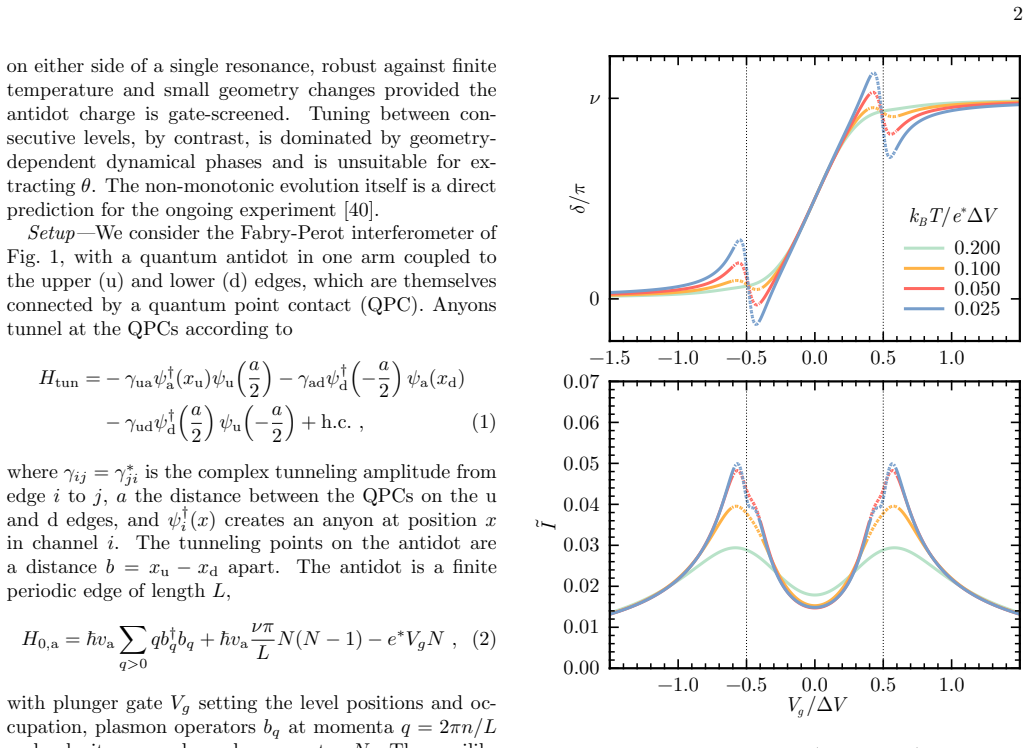
Within a systematic non-equilibrium Keldysh treatment that consistently includes the occupation and level broadening of the antidot, the transmission phase evolves non-monotonically when a gate voltage tunes the antidot through a resonance, in contrast to the monotonic evolution for electrons. The bare exchange phase can be extracted from the difference between the phase plateaus.
What carries the argument
The difference between the two transmission-phase plateaus that appear when the antidot is tuned through resonance under the Keldysh treatment that retains occupation and level broadening.
If this is right
- The exchange phase of anyons becomes a measurable interferometric quantity rather than an inferred one.
- Anyonic and fermionic statistics produce qualitatively different phase traces in the same device geometry.
- The plateau-difference method supplies a new observable that can be combined with existing charge and braiding measurements.
- The approach is formulated for fractional quantum Hall quasiparticles but relies only on the fractional exchange phase entering the scattering phase.
Where Pith is reading between the lines
- The same antidot geometry might be used to compare exchange phases across different filling factors in a single cooldown.
- If the plateau difference survives additional dephasing channels, the method could be adapted to interferometers that already demonstrate anyon braiding.
- Numerical checks of the Keldysh equations for other fractional statistics would test whether the non-monotonic signature is universal for anyons.
Load-bearing premise
The non-equilibrium Keldysh treatment that includes occupation and level broadening produces a non-monotonic phase evolution for anyons whose plateau difference equals the bare exchange phase with no additional corrections.
What would settle it
An experimental trace showing strictly monotonic phase advance through the antidot resonance for anyons, or a measured plateau difference that deviates from the independently known exchange phase, would falsify the extraction procedure.
Figures
read the original abstract
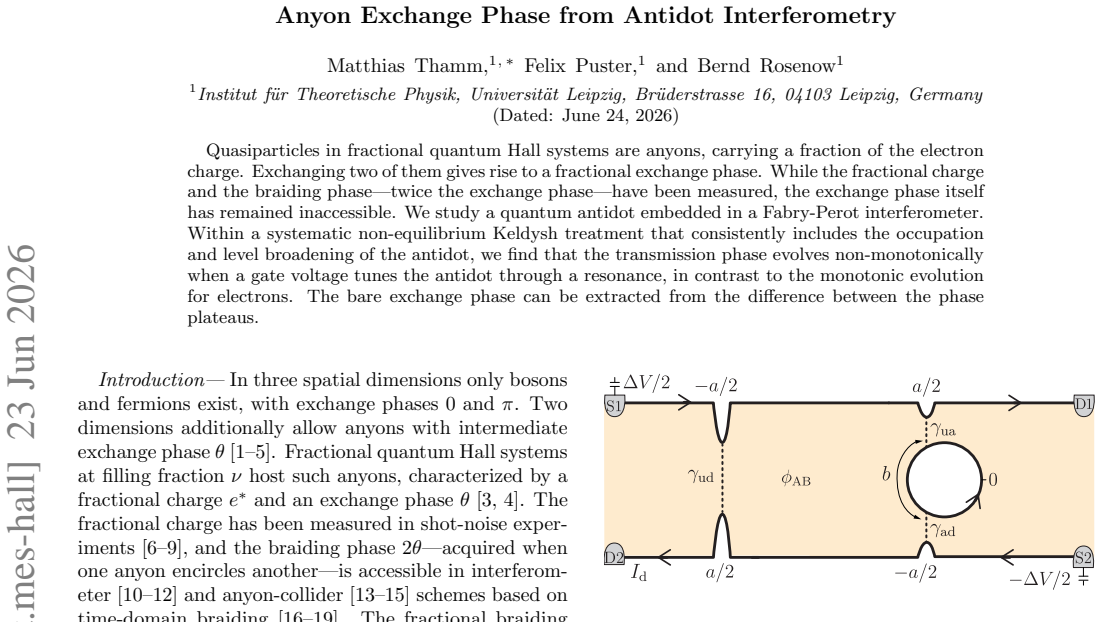
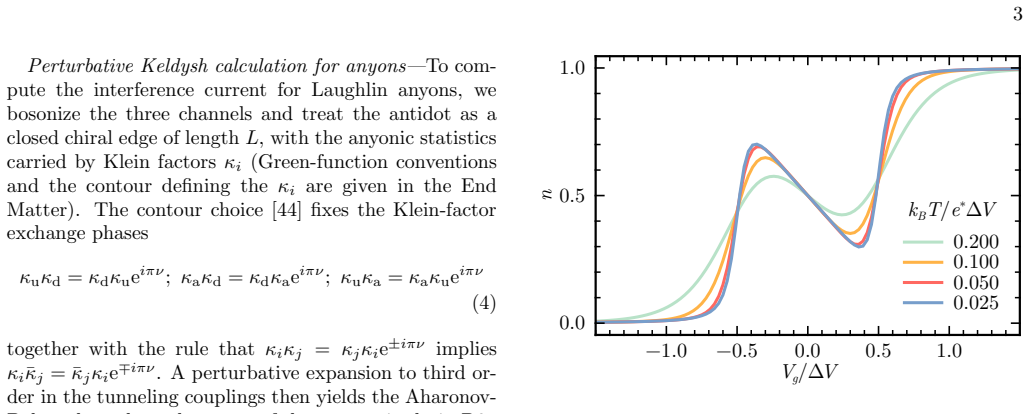
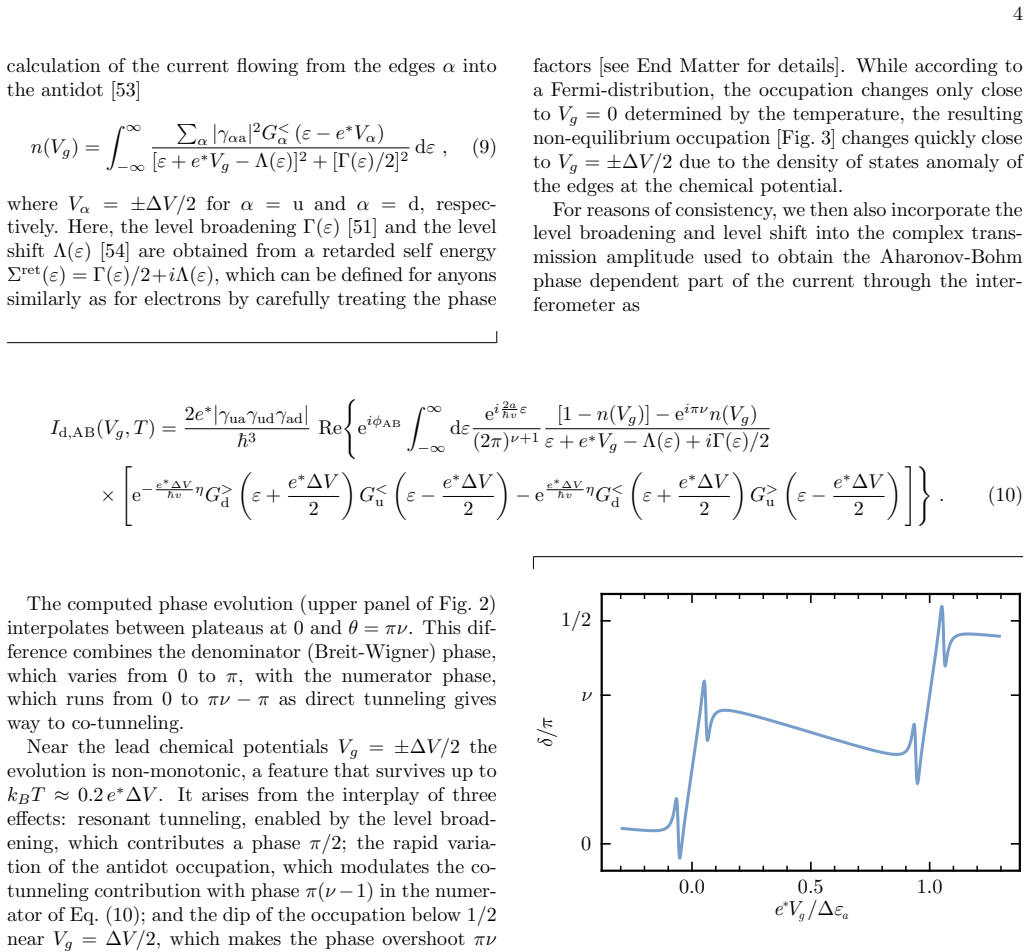
Quasiparticles in fractional quantum Hall systems are anyons, carrying a fraction of the electron charge. Exchanging two of them gives rise to a fractional exchange phase. While the fractional charge and the braiding phase -- twice the exchange phase -- have been measured, the exchange phase itself has remained inaccessible. We study a quantum antidot embedded in a Fabry-Perot interferometer. Within a systematic non-equilibrium Keldysh treatment that consistently includes the occupation and level broadening of the antidot, we find that the transmission phase evolves non-monotonically when a gate voltage tunes the antidot through a resonance, in contrast to the monotonic evolution for electrons. The bare exchange phase can be extracted from the difference between the phase plateaus.
Editorial analysis
A structured set of objections, weighed in public.
Referee Report
Summary. The manuscript claims that a quantum antidot embedded in a Fabry-Perot interferometer, treated with a systematic non-equilibrium Keldysh formalism that includes occupation and level broadening, produces non-monotonic transmission-phase evolution when a gate voltage tunes the antidot through resonance for anyons, in contrast to the monotonic evolution found for electrons. From this contrast the authors conclude that the bare anyon exchange phase can be extracted directly from the difference between the resulting phase plateaus.
Significance. If the central extraction is rigorously shown to be free of residual Keldysh corrections, the result would supply the first direct access to the exchange phase itself, complementing existing measurements of fractional charge and braiding phase. The consistent non-equilibrium treatment is a methodological strength relative to equilibrium approximations commonly used in interferometry studies.
major comments (2)
- [Abstract] Abstract: the claim that 'the bare exchange phase can be extracted from the difference between the phase plateaus' is load-bearing for the entire result, yet the abstract supplies no derivation showing how anyonic statistics enter the Keldysh self-energies or transmission amplitude, nor an explicit demonstration that phase shifts arising from fractional statistics, charging, occupation, and level broadening cancel exactly in the plateau difference.
- [Keldysh calculation (results section)] The non-monotonic versus monotonic contrast is asserted to arise solely from the anyonic exchange phase. An explicit step-by-step derivation (or numerical check) is required to confirm that the Keldysh corrections from broadening and occupation do not contribute an additional phase offset that survives the subtraction; without this the extraction procedure remains unverified.
minor comments (1)
- [Abstract] The abstract would be clearer if it specified the filling factor or the model Hamiltonian used for the anyons.
Simulated Author's Rebuttal
We thank the referee for their thorough review and for identifying the need to make the extraction procedure fully explicit. The comments correctly highlight that the central claim requires a clear demonstration that non-statistical Keldysh contributions cancel in the plateau difference. We address each point below and will revise the manuscript accordingly.
read point-by-point responses
-
Referee: [Abstract] Abstract: the claim that 'the bare exchange phase can be extracted from the difference between the phase plateaus' is load-bearing for the entire result, yet the abstract supplies no derivation showing how anyonic statistics enter the Keldysh self-energies or transmission amplitude, nor an explicit demonstration that phase shifts arising from fractional statistics, charging, occupation, and level broadening cancel exactly in the plateau difference.
Authors: The abstract is a concise summary; the explicit incorporation of anyonic statistics into the Keldysh self-energies (via the fractional phase factor in the tunneling amplitudes) and the resulting transmission phase is derived in the main text. We agree that a brief pointer in the abstract would strengthen clarity. In the revision we will add one sentence referencing the key equations that establish the cancellation in the plateau difference. revision: yes
-
Referee: [Keldysh calculation (results section)] The non-monotonic versus monotonic contrast is asserted to arise solely from the anyonic exchange phase. An explicit step-by-step derivation (or numerical check) is required to confirm that the Keldysh corrections from broadening and occupation do not contribute an additional phase offset that survives the subtraction; without this the extraction procedure remains unverified.
Authors: We acknowledge that an explicit verification of the cancellation is necessary. The anyonic exchange phase enters as an additional phase shift in the resonant tunneling amplitude that is absent for electrons; the occupation and broadening corrections appear symmetrically in both cases and therefore subtract when the plateau difference is taken. In the revised manuscript we will insert a dedicated paragraph (or short subsection) providing the analytical steps that isolate this cancellation, confirming that residual Keldysh offsets vanish in the difference. revision: yes
Circularity Check
No circularity: central result follows from explicit Keldysh calculation
full rationale
The paper performs a systematic non-equilibrium Keldysh treatment that incorporates occupation and level broadening, derives non-monotonic transmission-phase evolution specifically for anyons (contrasted with monotonic evolution for electrons), and states that the bare exchange phase follows from the difference of the resulting phase plateaus. This chain is self-contained: the non-monotonicity and the extraction step are outputs of the calculation rather than inputs redefined or fitted parameters renamed as predictions. No self-definitional loop, no fitted-input-called-prediction, and no load-bearing self-citation chain is present in the provided derivation outline. The result is therefore independent of its own inputs by construction.
Axiom & Free-Parameter Ledger
axioms (2)
- domain assumption Anyons in fractional quantum Hall systems carry fractional charge and exhibit a fractional exchange phase upon particle exchange.
- standard math The non-equilibrium Keldysh formalism consistently incorporates antidot occupation and level broadening to compute transmission phase.
Reference graph
Works this paper leans on
-
[1]
Leinaas and J
J. Leinaas and J. Myrheim, On the theory of identical particles, Il nuovo cimento37, 132 (1977)
1977
-
[2]
R. B. Laughlin, Anomalous quantum Hall effect: An in- compressible quantum fluid with fractionally charged ex- citations, Physical Review Letters50, 1395 (1983)
1983
-
[3]
B. I. Halperin, Statistics of quasiparticles and the hierar- chy of fractional quantized Hall states, Physical Review Letters52, 1583 (1984)
1984
-
[4]
Arovas, J
D. Arovas, J. R. Schrieffer, and F. Wilczek, Fractional statistics and the quantum Hall effect, Physical Review Letters53, 722 (1984)
1984
-
[5]
D. E. Feldman and B. I. Halperin, Fractional charge and fractional statistics in the quantum Hall effects, Reports on progress in physics. Physical Society (Great Britain) 84, 10.1088/1361-6633/ac03aa (2021)
-
[6]
C. L. Kane and M. P. Fisher, Nonequilibrium noise and fractional charge in the quantum Hall effect, Physical Re- view Letters72, 724 (1994)
1994
-
[7]
Reznikov, R
M. Reznikov, R. d. Picciotto, T. Griffiths, M. Heiblum, and V. Umansky, Observation of quasiparticles with one- fifth of an electron’s charge, Nature399, 238 (1999)
1999
-
[8]
Saminadayar, D
L. Saminadayar, D. C. Glattli, Y. Jin, and B. Etienne, Observation of the e/3 fractionally charged Laughlin quasiparticle, Physical Review Letters79, 2526 (1997)
1997
-
[9]
de Picciotto, M
R. de Picciotto, M. Reznikov, M. Heiblum, V. Uman- sky, G. Bunin, and D. Mahalu, Direct observation of a fractional charge, Nature389, 162 (1997)
1997
-
[10]
C. de C. Chamon, D. E. Freed, S. A. Kivelson, S. L. Sondhi, and X. G. Wen, Two point-contact interferom- eter for quantum Hall systems, Physical Review B55, 2331 (1997)
1997
-
[11]
B. I. Halperin, A. Stern, I. Neder, and B. Rosenow, Theory of the Fabry-P´ erot quantum Hall interferometer, Physical Review B83, 155440 (2011)
2011
-
[12]
Rosenow and A
B. Rosenow and A. Stern, Flux superperiods and period- icity transitions in quantum Hall interferometers, Physi- cal Review Letters124, 106805 (2020)
2020
-
[13]
Rosenow, I
B. Rosenow, I. P. Levkivskyi, and B. I. Halperin, Current correlations from a mesoscopic anyon collider, Physical Review Letters116, 156802 (2016)
2016
-
[14]
Thamm and B
M. Thamm and B. Rosenow, Effect of the soliton width on nonequilibrium exchange phases of anyons, Physical Review Letters132, 156501 (2024)
2024
-
[15]
Schiller, Y
N. Schiller, Y. Shapira, A. Stern, and Y. Oreg, Anyon statistics through conductance measurements of time- domain interferometry, Physical Review Letters131, 186601 (2023)
2023
-
[16]
C. Han, J. Park, Y. Gefen, and H.-S. Sim, Topological vacuum bubbles by anyon braiding, Nature communica- tions7, 11131 (2016)
2016
-
[17]
B. Lee, C. Han, and H.-S. Sim, Negative excess shot noise by anyon braiding, Physical Review Letters123, 016803 (2019)
2019
-
[18]
J.-Y. M. Lee, C. Han, and H.-S. Sim, Fractional mutual statistics on integer quantum Hall edges, Physical Review Letters125, 196802 (2020)
2020
-
[19]
Schiller, Y
N. Schiller, Y. Oreg, and K. Snizhko, Extracting the scal- ing dimension of quantum Hall quasiparticles from cur- rent correlations, Physical Review B105, 165150 (2022)
2022
-
[20]
Nakamura, S
J. Nakamura, S. Liang, G. C. Gardner, and M. J. Manfra, Direct observation of anyonic braiding statistics, Nature Physics16, 931 (2020)
2020
-
[21]
Nakamura, S
J. Nakamura, S. Liang, G. C. Gardner, and M. J. Manfra, Impact of bulk-edge coupling on observation of anyonic braiding statistics in quantum Hall interferometers, Na- ture Communications13, 344 (2022)
2022
-
[22]
Nakamura, S
J. Nakamura, S. Liang, G. C. Gardner, and M. J. Man- fra, Fabry-P´ erot interferometry at theν= 2/5 frac- tional quantum Hall state, Physical Review X13, 041012 (2023)
2023
-
[23]
Bartolomei, M
H. Bartolomei, M. Kumar, R. Bisognin, A. Marguerite, J.-M. Berroir, E. Bocquillon, B. Placais, A. Cavanna, Q. Dong, U. Gennser,et al., Fractional statistics in anyon 6 collisions, Science368, 173 (2020)
2020
-
[24]
J.-Y. M. Lee, C. Hong, T. Alkalay, N. Schiller, V. Uman- sky, M. Heiblum, Y. Oreg, and H.-S. Sim, Partitioning of diluted anyons reveals their braiding statistics, Nature 617, 277 (2023)
2023
-
[25]
Ruelle, E
M. Ruelle, E. Frigerio, J.-M. Berroir, B. Pla¸ cais, J. Rech, A. Cavanna, U. Gennser, Y. Jin, and G. F` eve, Comparing fractional quantum Hall Laughlin and Jain topological orders with the anyon collider, Physical Review X13, 011031 (2023)
2023
-
[26]
Glidic, O
P. Glidic, O. Maillet, A. Aassime, C. Piquard, A. Ca- vanna, U. Gennser, Y. Jin, A. Anthore, and F. Pierre, Cross-correlation investigation of anyon statistics in the ν= 1/3 and 2/5 fractional quantum Hall states, Physical Review X13, 011030 (2023)
2023
-
[27]
N. L. Samuelson, L. A. Cohen, W. Wang, S. Blanch, T. Taniguchi, K. Watanabe, M. P. Zaletel, and A. F. Young, Anyonic statistics and slow quasiparticle dynam- ics in a graphene fractional quantum Hall interferometer, arXiv preprint arXiv:2403.19628 (2024)
arXiv 2024
-
[28]
J. Kim, H. Dev, A. Shaer, R. Kumar, A. Ilin, A. Haug, S. Iskoz, K. Watanabe, T. Taniguchi, D. F. Mross, A. Stern, and Y. Ronen, Aharonov-Bohm interference in even-denominator fractional quantum Hall states, arXiv preprint arXiv:2412.19886 (2024)
arXiv 2024
-
[29]
Werkmeister, J
T. Werkmeister, J. R. Ehrets, M. E. Wesson, D. H. Na- jafabadi, K. Watanabe, T. Taniguchi, B. I. Halperin, A. Yacoby, and P. Kim, Anyon braiding and telegraph noise in a graphene interferometer, Science (New York, N.Y.)388, 730 (2025)
2025
-
[30]
Read and S
N. Read and S. Das Sarma, Clarification of braiding statistics in Fabry–Perot interferometry, Nature Physics 20, 381 (2024)
2024
-
[31]
I. Safi, P. Devillard, and T. Martin, Partition noise and statistics in the fractional quantum Hall effect, Physical Review Letters86, 4628 (2001)
2001
-
[32]
E.-A. Kim, M. Lawler, S. Vishveshwara, and E. Fradkin, Signatures of fractional statistics in noise experiments in quantum Hall fluids, Physical Review Letters95, 176402 (2005)
2005
-
[33]
E.-A. Kim, M. J. Lawler, S. Vishveshwara, and E. Frad- kin, Measuring fractional charge and statistics in frac- tional quantum Hall fluids through noise experiments, Physical Review B74, 155324 (2006)
2006
-
[34]
Vishveshwara, Revisiting the Hanbury Brown-Twiss setup for fractional statistics, Physical Review Letters 91, 196803 (2003)
S. Vishveshwara, Revisiting the Hanbury Brown-Twiss setup for fractional statistics, Physical Review Letters 91, 196803 (2003)
2003
-
[35]
Campagnano, O
G. Campagnano, O. Zilberberg, I. V. Gornyi, D. E. Feldman, A. C. Potter, and Y. Gefen, Hanbury Brown- Twiss interference of anyons, Physical Review Letters 109, 106802 (2012)
2012
-
[36]
Campagnano, O
G. Campagnano, O. Zilberberg, I. V. Gornyi, and Y. Gefen, Hanbury Brown and Twiss correlations in quantum Hall systems, Physical Review B88, 235415 (2013)
2013
-
[37]
S. A. Kivelson and C. Murthy, Modified interferometer to measure anyonic braiding statistics, Phys. Rev. Lett. 135, 126605 (2025)
2025
- [38]
-
[39]
[55, 56]
See Supplemental Material for additional details, includ- ing Refs. [55, 56]
-
[40]
Ehrets, T
J. Ehrets, T. Werkmeister, C. E. Henzinger, M. Wes- son, D. H. Najafabadi, K. Watanabe, T. Taniguchi, B. Halperin, A. Yacoby, and P. Kim, Measuring the fun- damental exchange phase of anyons in a modified quan- tum Hall interferometer, Bulletin of the American Phys- ical Society (talk at the APS Global Physics Summit) (2025)
2025
-
[41]
Schuster, E
R. Schuster, E. Buks, M. Heiblum, D. Mahalu, V. Uman- sky, and H. Shtrikman, Phase measurement in a quantum dot via a double-slit interference experiment, Nature385, 417 (1997)
1997
-
[42]
K¨ onig and Y
J. K¨ onig and Y. Gefen, Coherence and partial coherence in interacting electron systems, Physical review letters 86, 3855 (2001)
2001
-
[43]
K¨ onig and Y
J. K¨ onig and Y. Gefen, Aharonov-Bohm interferome- try with interacting quantum dots: Spin configurations, asymmetric interference patterns, bias-voltage-induced Aharonov-Bohm oscillations, and symmetries of trans- port coefficients, Physical Review B65, 045316 (2002)
2002
-
[44]
Altland, Y
A. Altland, Y. Gefen, and B. Rosenow, Intermediate fixed point in a Luttinger liquid with elastic and dissipative backscattering, Physical Review B92, 085124 (2015)
2015
-
[45]
M. R. Geller and D. Loss, Aharonov-Bohm effect in the chiral Luttinger liquid, Physical Review B56, 9692 (1997)
1997
-
[46]
D. V. Averin and J. A. Nesteroff, Coulomb blockade of anyons in quantum antidots, Physical review letters99, 096801 (2007)
2007
-
[47]
Goldman and B
V. Goldman and B. Su, Resonant tunneling in the quan- tum Hall regime: measurement of fractional charge, Sci- ence267, 1010 (1995)
1995
-
[48]
Maasilta and V
I. Maasilta and V. Goldman, Energetics of quantum an- tidot states in the quantum Hall regime, Physical Review B57, R4273 (1998)
1998
-
[49]
Kataoka, C
M. Kataoka, C. Ford, G. Faini, D. Mailly, M. Sim- mons, D. Mace, C.-T. Liang, and D. Ritchie, Detection of Coulomb charging around an antidot in the quantum Hall regime, Physical review letters83, 160 (1999)
1999
-
[50]
C. L. Kane and M. P. Fisher, Transmission through barriers and resonant tunneling in an interacting one- dimensional electron gas, Physical Review B46, 15233 (1992)
1992
-
[52]
C. L. Kane, Telegraph noise and fractional statistics in the quantum Hall effect, Physical Review Letters90, 226802 (2003)
2003
-
[53]
C. d. C. Chamon and X. G. Wen, Resonant tunneling in the fractional quantum Hall regime, Physical review letters70, 2605 (1993)
1993
-
[54]
Jauho, N
A.-P. Jauho, N. S. Wingreen, and Y. Meir, Time- dependent transport in interacting and noninteracting resonant-tunneling systems, Physical Review B50, 5528 (1994)
1994
-
[55]
Rosenow and Y
B. Rosenow and Y. Gefen, Dephasing by a zero- temperature detector and the Friedel sum rule, Phys. Rev. Lett.108, 256805 (2012)
2012
-
[56]
Weisz, H
E. Weisz, H. K. Choi, M. Heiblum, Y. Gefen, V. Uman- sky, and D. Mahalu, Controlled dephasing of an electron interferometer with a path detector at equilibrium, Phys. Rev. Lett.109, 250401 (2012)
2012
-
[57]
Guyon, P
R. Guyon, P. Devillard, T. Martin, and I. Safi, Klein fac- tors in multiple fractional quantum Hall edge tunneling, Physical Review B65, 153304 (2002). 7 End Matter Details onT-matrix calculation—In the case of electrons, the calculation simplifies as we can introduce antidot single-particle energy levelsϵ m and operatorsd † m, which create an electron in...
2002
-
[58]
Rosenow and Y
B. Rosenow and Y. Gefen, Dephasing by a zero- temperature detector and the Friedel sum rule, Phys. Rev. Lett. 108, 256805 (2012)
2012
-
[59]
Weisz, H
E. Weisz, H. K. Choi, M. Heiblum, Y. Gefen, V. Uman- sky, and D. Mahalu, Controlled dephasing of an electron interferometer with a path detector at equilibrium, Phys. Rev. Lett. 109, 250401 (2012)
2012
-
[60]
Jauho, N
A.-P. Jauho, N. S. Wingreen, and Y. Meir, Time- dependent transport in interacting and noninteracting resonant-tunneling systems, Physical Review B 50, 5528 (1994)
1994
-
[61]
Kane and M
C. Kane and M. P. Fisher, Edge-state transport, Perspec- tives in quantum Hall effects: Novel quantum liquids in low-dimensional semiconductor structures , 109 (1996)
1996
-
[62]
C. d. C. Chamon and X. G. Wen, Resonant tunneling in the fractional quantum Hall regime, Physical review let- ters 70, 2605 (1993)
1993
discussion (0)
Sign in with ORCID, Apple, or X to comment. Anyone can read and Pith papers without signing in.