Thermal Sunyaev-Zel'dovich cross-correlations with unWISE galaxies: disentangling radio contamination, dust properties, and electron pressure
Pith reviewed 2026-06-29 02:56 UTC · model grok-4.3
The pith
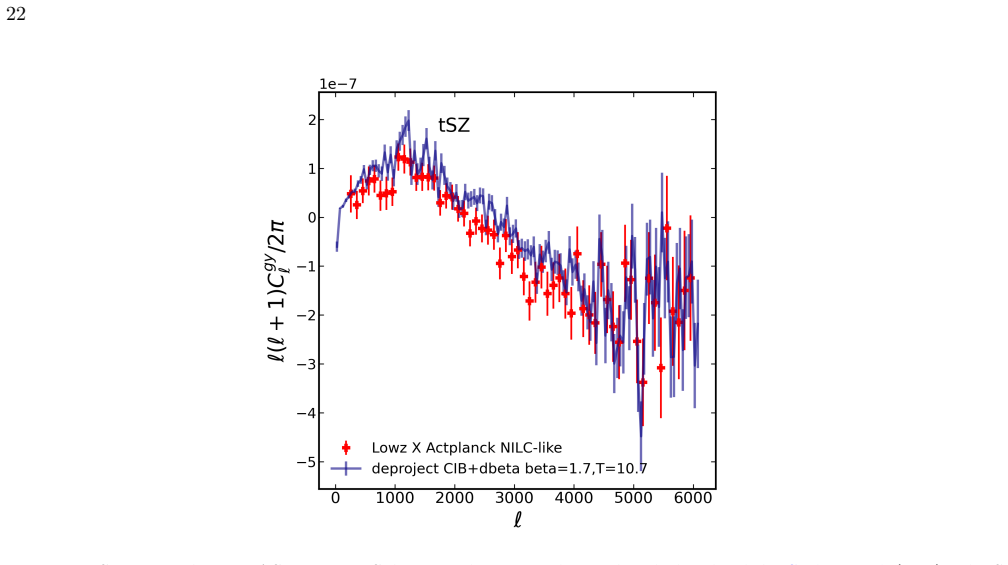
Including radio emission in the model for tSZ cross-correlations with unWISE galaxies is required and produces a positive signal to high multipoles consistent with halo models.
A machine-rendered reading of the paper's core claim, the machinery that carries it, and where it could break.
Core claim
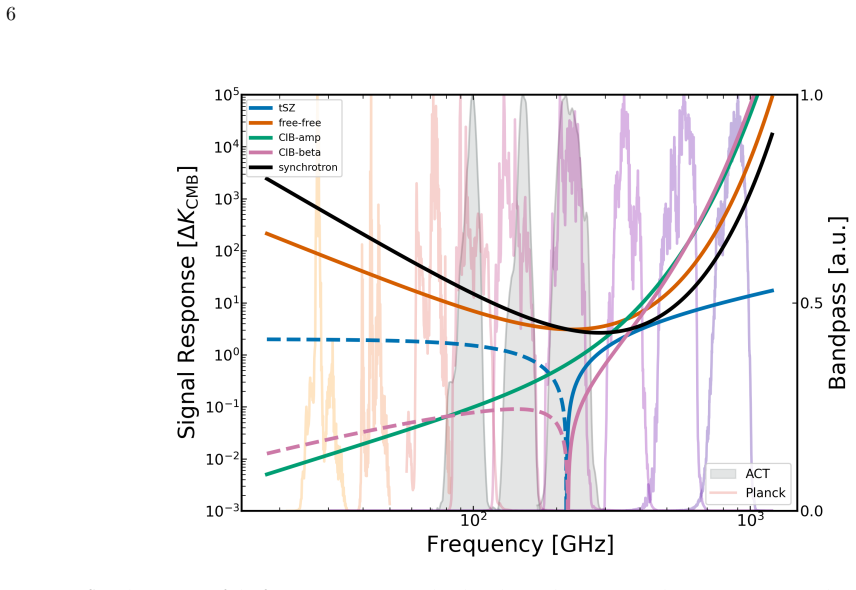
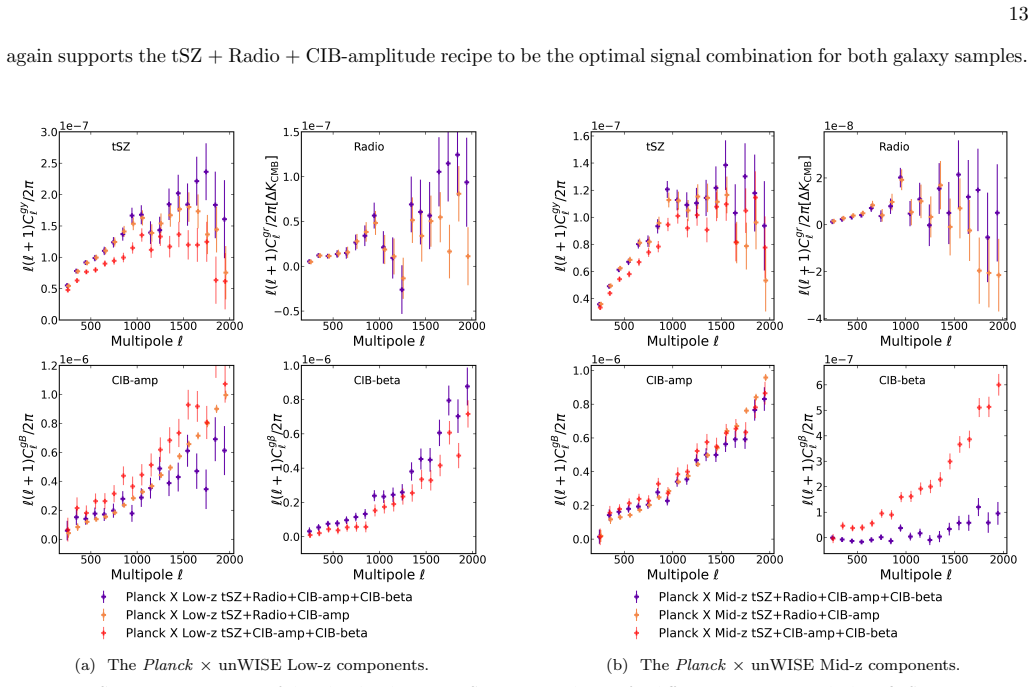
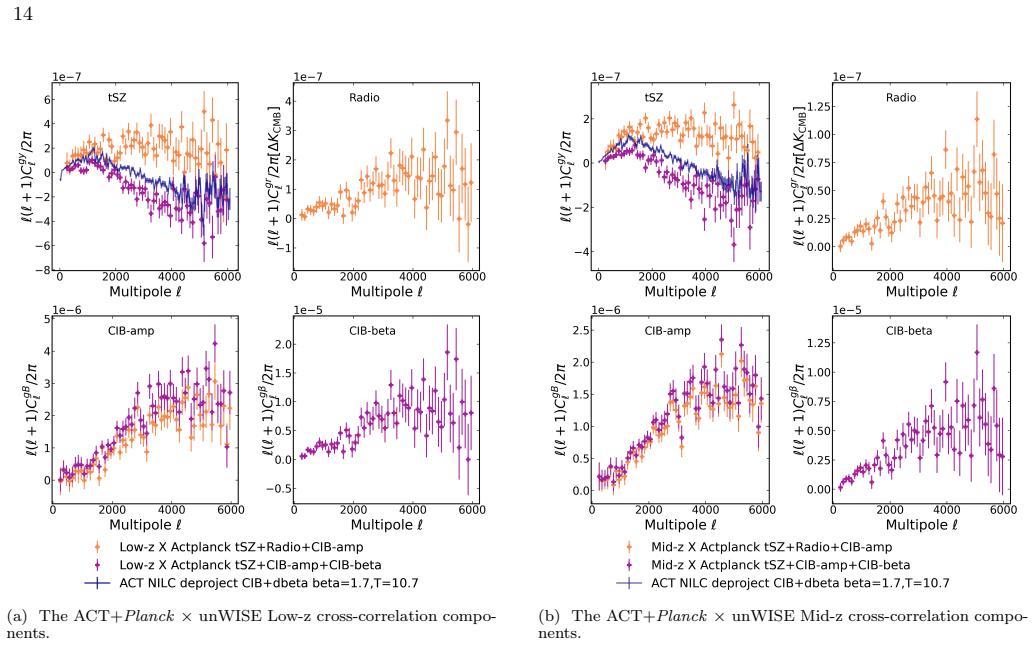
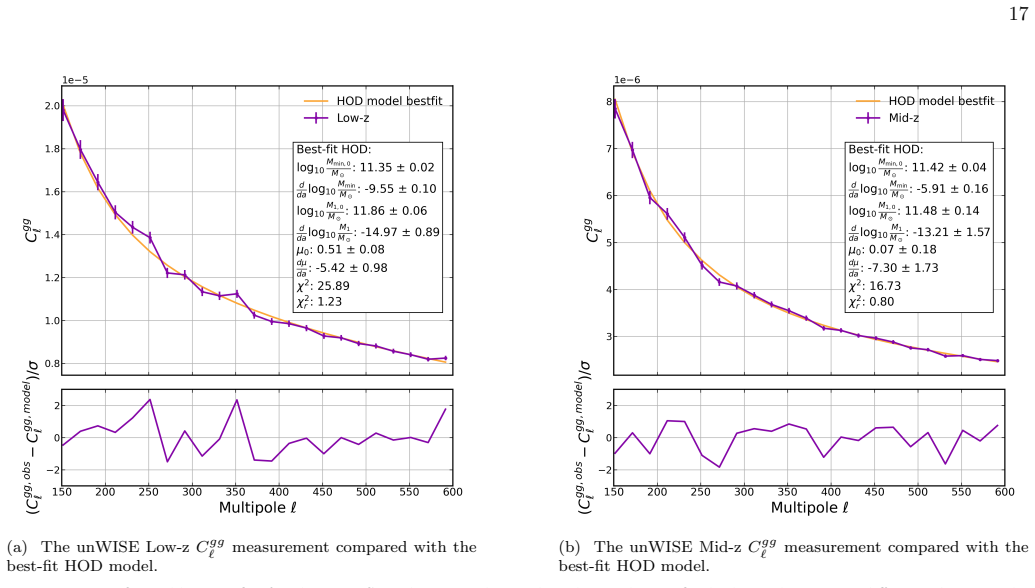
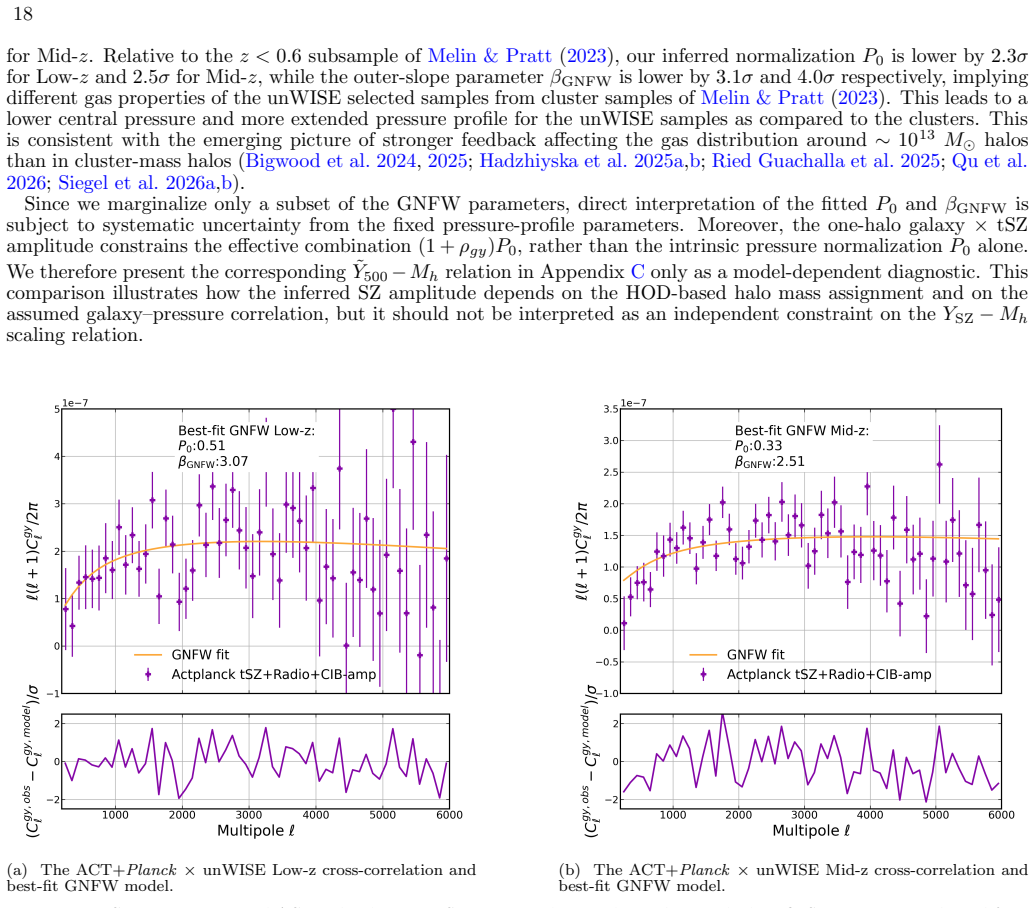
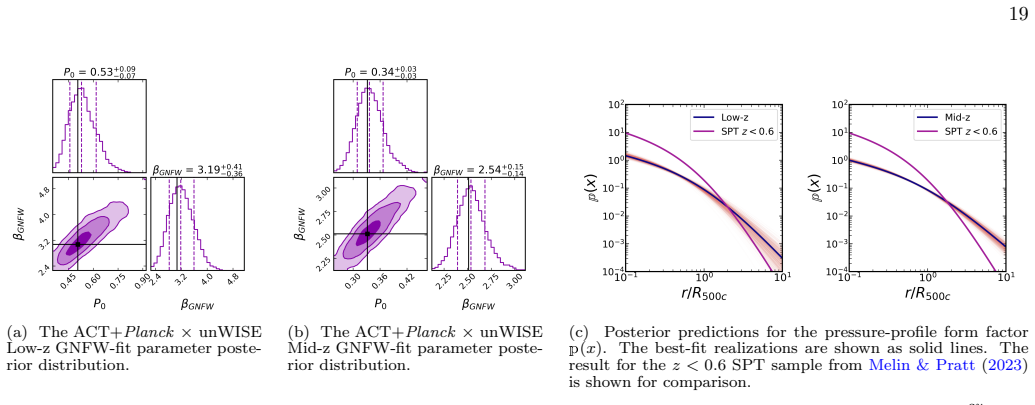
Fitting the galaxy-tSZ cross-power spectra directly in harmonic space with a model containing tSZ, radio emission, and a CIB amplitude term, the three-component model is strongly preferred; the derived effective CIB emissivity indices, dust temperatures, and radio spectral indices allow subtraction from the ACT 90/150/220 GHz maps, after which the cleaned spectra remain positive to ℓ ≃ 6000 and are well described by a conventional halo model calibrated to the galaxy population together with a two-parameter generalized NFW electron pressure profile.
What carries the argument
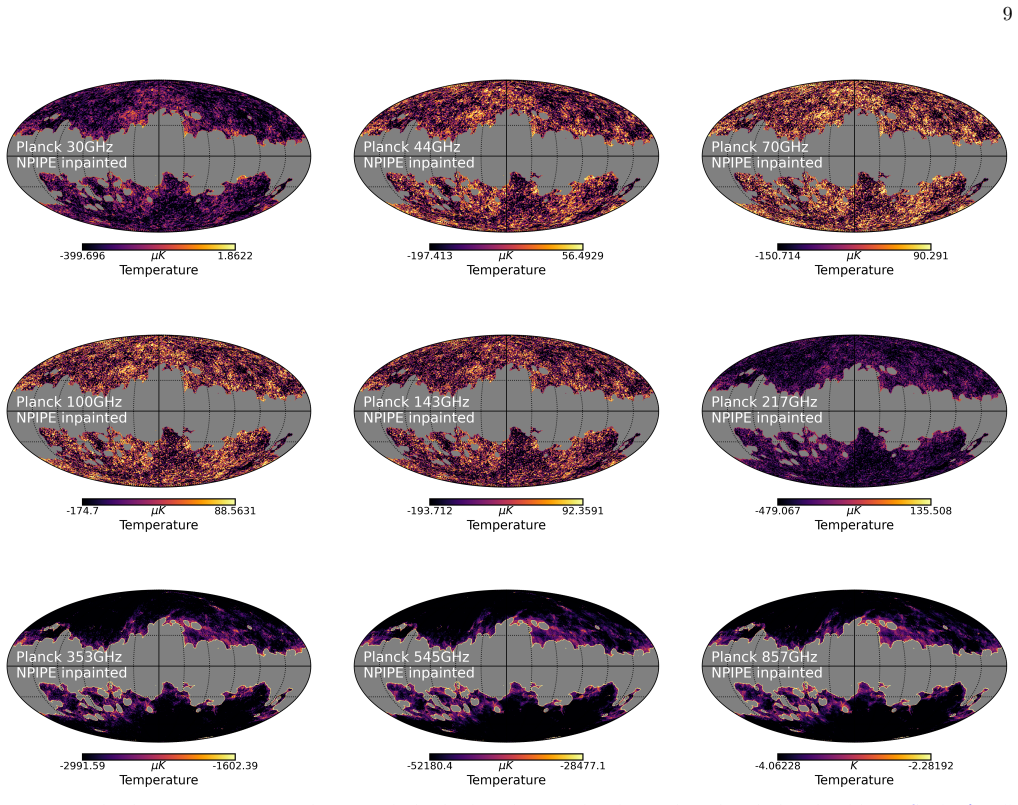
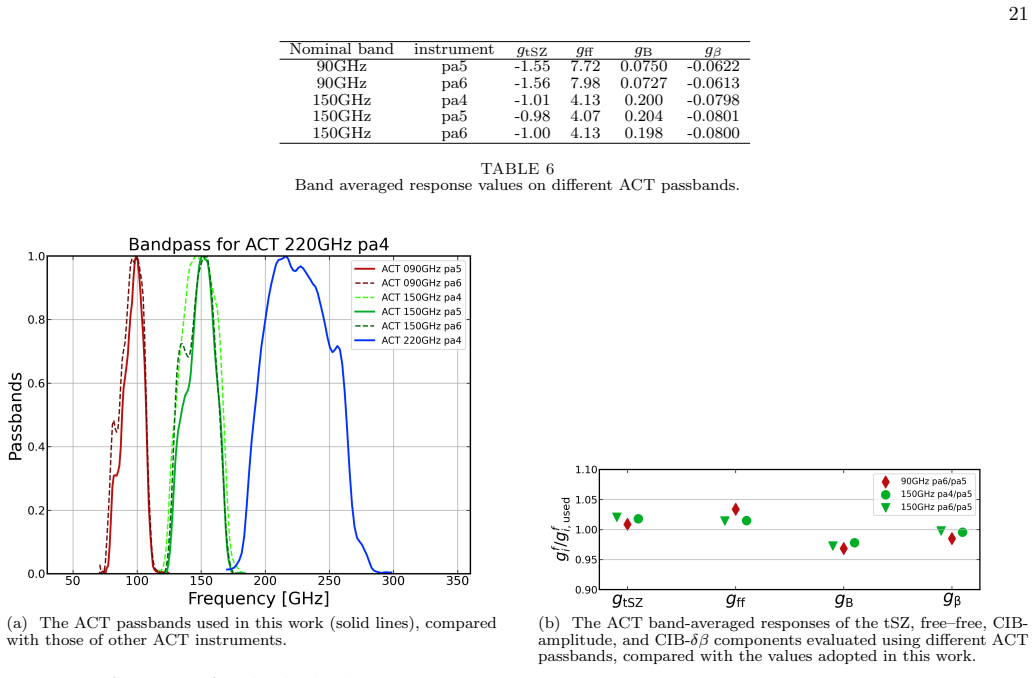
Three-component harmonic-space fit (tSZ + radio + CIB amplitude) using nine Planck bands to fix effective spectral parameters for foreground subtraction from ACT maps.
If this is right
- The tSZ-galaxy cross-correlation can be measured positively on small scales once radio contamination is included.
- The remaining signal after cleaning is consistent with a halo model using a two-parameter generalized NFW electron pressure profile.
- Planck-derived foreground parameters can be transferred to ACT data to obtain consistent multi-frequency measurements.
- Low-redshift unWISE samples can be used to probe hot gas in low-mass halos without the bias from omitted radio emission.
Where Pith is reading between the lines
- The same cleaning approach could be tested on other galaxy catalogs to check whether the recovered pressure profile parameters remain stable.
- If the radio spectral index shows redshift dependence beyond the two samples studied, multi-redshift analyses would require additional free parameters.
- The positive high-multipole signal opens the possibility of using these cross-correlations to constrain the scale at which AGN feedback begins to suppress gas pressure.
Load-bearing premise
The effective spectral parameters for CIB and radio fitted from Planck nine-band data accurately describe the foregrounds in the ACT 90, 150, and 220 GHz maps without residual bias on the tSZ component.
What would settle it
A radio-cleaned tSZ cross-spectrum that turns negative at high multipoles or deviates significantly from the halo-model plus generalized NFW prediction would falsify the result.
Figures
read the original abstract
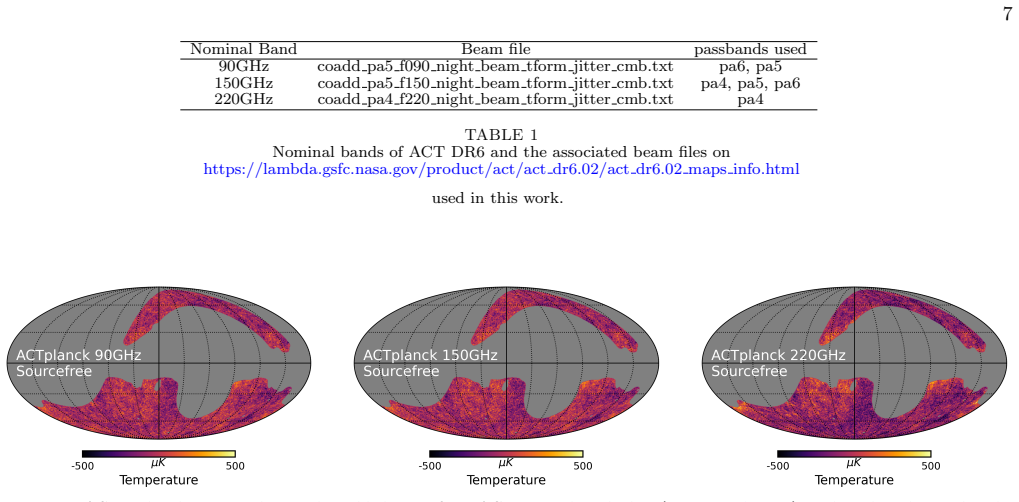
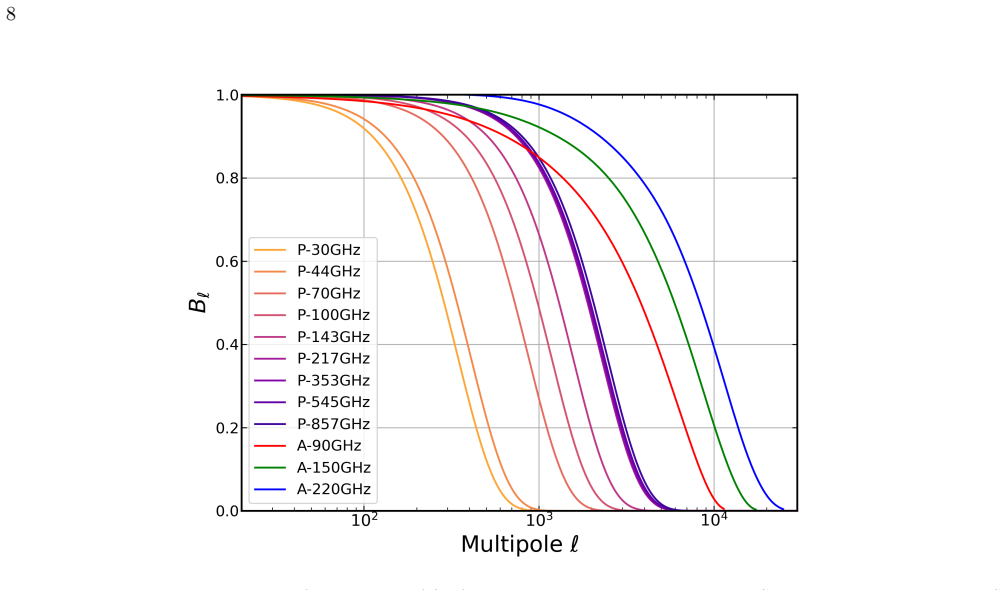
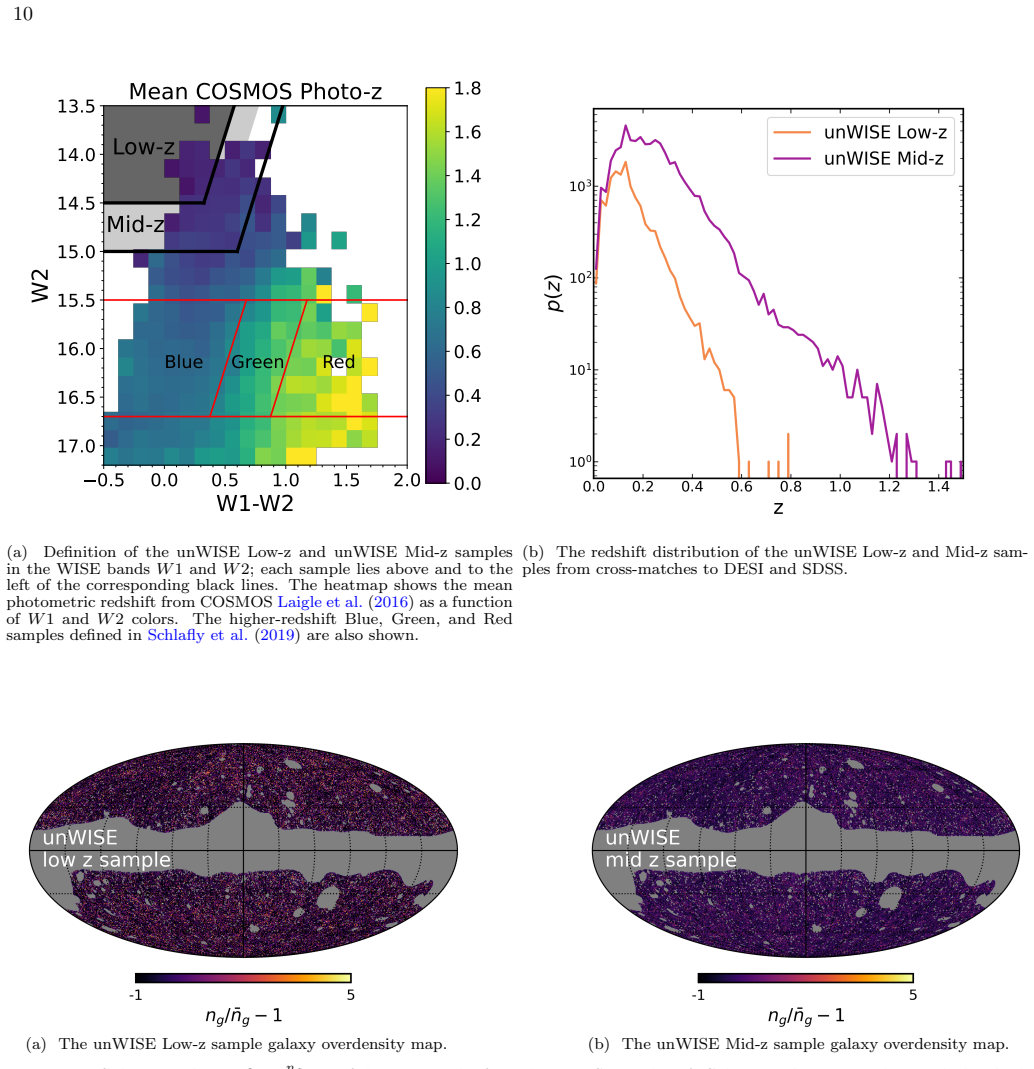
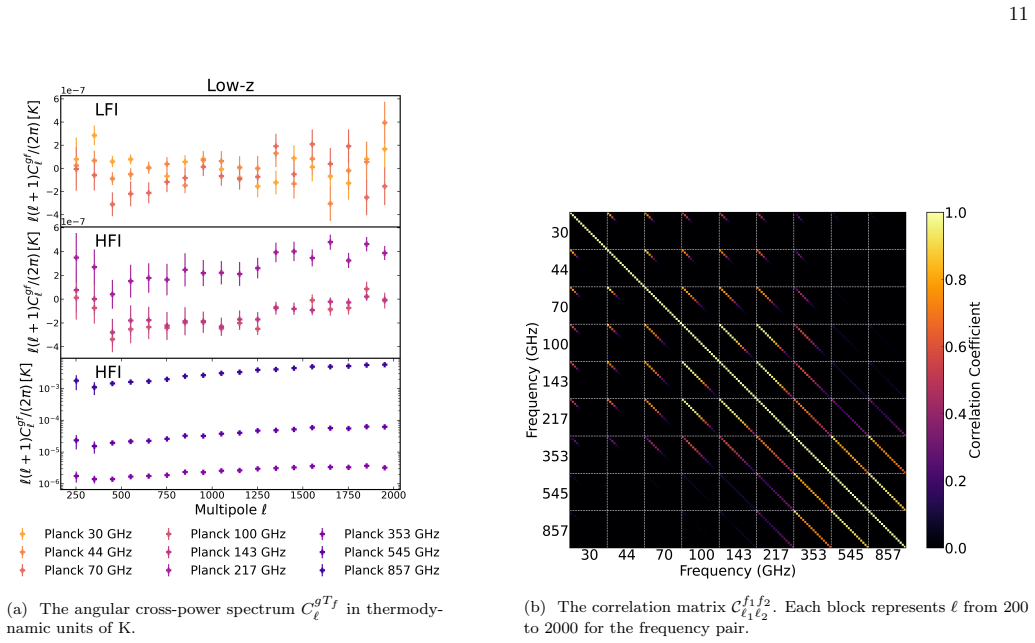
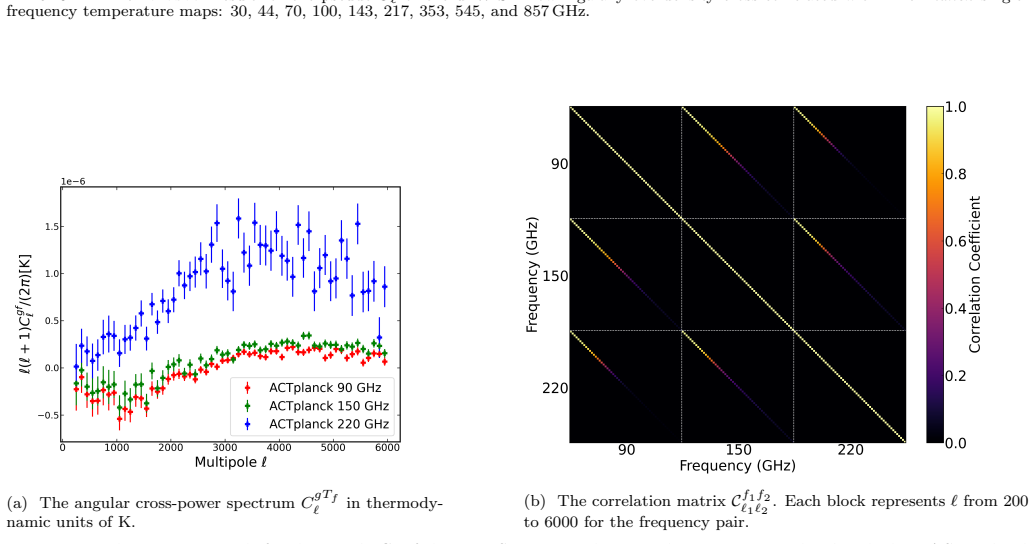
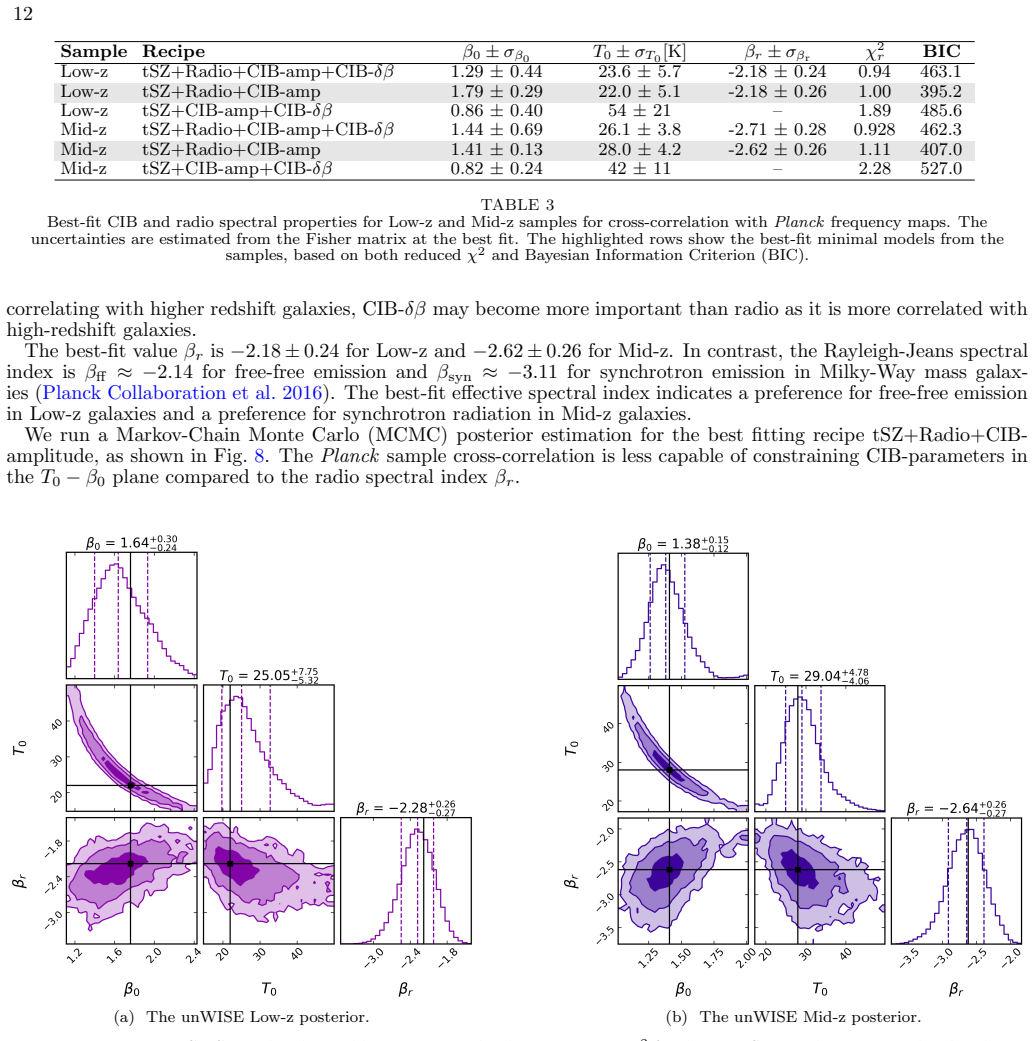
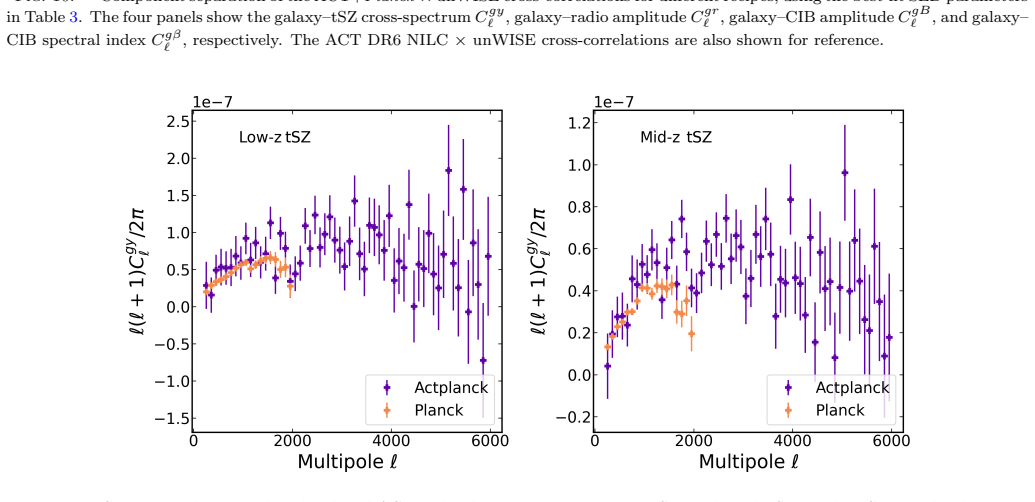
Cross-correlations between the thermal Sunyaev-Zel'dovich (tSZ) effect and galaxy surveys provide a sensitive probe of hot gas in low-mass halos, but on the angular scales of greatest astrophysical interest they are also highly vulnerable to residual foreground contamination. We analyze the cross-correlation of two low-redshift unWISE galaxy samples with Planck PR4 and ACT DR6 microwave temperature sky maps directly in harmonic space, fitting simultaneously for correlated tSZ, cosmic infrared background (CIB), and radio emission. Using the nine Planck bands to perform model selection, we find that a three-component model consisting of tSZ, radio emission, and a CIB amplitude term is strongly preferred over a model that omits radio contamination, with a significance of $9.5\sigma$ for the unWISE Low-z sample and $11\sigma$ for the unWISE Mid-z sample respectively. For the unWISE Low-z sample ($\bar{z}=0.14$) the preferred \textit{Planck} fit gives an effective CIB emissivity index $\beta_0=1.79\pm0.29$, an effective CIB dust temperature $T_0=22.0\pm5.1 K$, and a radio spectral index $\beta_r=-2.18\pm0.24$; for the unWISE Mid-z sample ($\bar{z}=0.23$) we find $\beta_0=1.41\pm0.13$, $T_0=28.0\pm4.2 K$, and $\beta_r=-2.62\pm0.26$. We apply this radio-inclusive recipe to the ACT+Planck 90, 150, and 220 GHz maps to obtain the best small-scale measurements. This removes the apparent negative galaxy-tSZ cross-correlation seen in the fiducial ACT DR6 NILC reconstruction and in no-radio fits. The cleaned tSZ cross unWISE spectra remain positive to $\ell \simeq 6000$ and are broadly consistent with the Planck-only reconstruction on overlapping scales. We show that these radio-cleaned spectra are well described by a conventional halo model calibrated to the galaxy population and a two-parameter generalized NFW electron pressure profile.
Editorial analysis
A structured set of objections, weighed in public.
Referee Report
Summary. The manuscript analyzes cross-correlations between two unWISE galaxy samples (Low-z at z-bar=0.14 and Mid-z at z-bar=0.23) and Planck PR4 plus ACT DR6 microwave maps in harmonic space. It fits a three-component model (tSZ + radio + CIB amplitude) to the nine Planck bands, finding this model preferred over a no-radio model at 9.5σ (Low-z) and 11σ (Mid-z). The resulting effective parameters (β0, T0, βr) are applied to clean the ACT 90/150/220 GHz maps, yielding positive tSZ cross-spectra to ℓ ≃ 6000 that are consistent with a halo model plus two-parameter generalized NFW electron pressure profile.
Significance. If the foreground subtraction holds, the result strengthens constraints on electron pressure in low-mass halos by mitigating radio contamination that can produce spurious negative signals. The multi-frequency model selection on Planck and the reported consistency of cleaned ACT spectra with Planck on overlapping scales provide a useful cross-check, though the transferability of fitted spectral indices remains a key assumption.
major comments (2)
- [Abstract] Abstract: the model-selection significances of 9.5σ and 11σ are presented as direct evidence for radio contamination, yet no information is given on the covariance estimation procedure, parameter degeneracies among tSZ/radio/CIB amplitudes, or validation of the likelihood ratio test; these details are load-bearing for interpreting the radio detection strength.
- [Abstract] Abstract: the effective spectral parameters (β0=1.79±0.29, T0=22.0±5.1 K, βr=-2.18±0.24 for Low-z; analogous values for Mid-z) are fitted exclusively to Planck PR4 cross-spectra and then used to subtract radio and CIB from ACT DR6 maps at ℓ ≃ 6000. The manuscript notes consistency on overlapping scales but does not quantify possible residuals arising from scale- or redshift-dependent variations in source populations, which directly affects the sign and amplitude of the reported positive tSZ signal.
minor comments (1)
- [Abstract] Abstract: the statement that the cleaned spectra 'are well described by' the halo model plus gNFW profile would benefit from an explicit goodness-of-fit value or χ² per degree of freedom to allow readers to assess the level of agreement.
Simulated Author's Rebuttal
We thank the referee for their thorough review and constructive feedback on our manuscript. We address each major comment below with additional details from the analysis and indicate where revisions will be made to improve clarity.
read point-by-point responses
-
Referee: [Abstract] Abstract: the model-selection significances of 9.5σ and 11σ are presented as direct evidence for radio contamination, yet no information is given on the covariance estimation procedure, parameter degeneracies among tSZ/radio/CIB amplitudes, or validation of the likelihood ratio test; these details are load-bearing for interpreting the radio detection strength.
Authors: The covariance estimation is described in Section 3.2, where we construct an analytic Gaussian covariance matrix from the auto- and cross-spectra and validate it against 1000 mock realizations (Appendix A). Parameter degeneracies are shown explicitly in the posterior corner plots of Figure 6, confirming that the radio amplitude is constrained with only modest correlation to the tSZ and CIB terms. The likelihood ratio test is cross-checked against both AIC and Bayesian evidence ratios in Section 4.3. While these details reside in the main text rather than the abstract, we will add a short parenthetical reference in the revised abstract directing readers to the relevant sections. revision: partial
-
Referee: [Abstract] Abstract: the effective spectral parameters (β0=1.79±0.29, T0=22.0±5.1 K, βr=-2.18±0.24 for Low-z; analogous values for Mid-z) are fitted exclusively to Planck PR4 cross-spectra and then used to subtract radio and CIB from ACT DR6 maps at ℓ ≃ 6000. The manuscript notes consistency on overlapping scales but does not quantify possible residuals arising from scale- or redshift-dependent variations in source populations, which directly affects the sign and amplitude of the reported positive tSZ signal.
Authors: We acknowledge the importance of testing the transferability assumption. The manuscript already shows that the cleaned ACT spectra agree with the Planck reconstruction on overlapping scales (ℓ ≲ 2000) within the reported uncertainties (Figure 7). To quantify scale dependence, we performed an additional test by refitting the spectral parameters to Planck data restricted to ℓ < 2000 and recovered values consistent within 1σ of the full-range fit. Redshift dependence is addressed by the similarity of the Low-z and Mid-z results and by the discussion in Section 5.2 that the dominant radio sources share comparable redshift distributions. While a exhaustive propagation of all possible population variations lies outside the present scope, these internal consistency checks support the robustness of the positive high-ℓ tSZ signal. We will incorporate a concise summary of the scale-split test into the revised text. revision: partial
Circularity Check
No significant circularity detected
full rationale
The paper performs model selection and parameter estimation for tSZ + radio + CIB on Planck PR4 nine-band cross-spectra, then applies the resulting effective parameters to clean independent ACT DR6 maps at 90/150/220 GHz. The cleaned spectra are compared to a conventional halo model plus gNFW profile. No step reduces a claimed result to its inputs by construction (no self-definitional equations, no fitted parameter renamed as prediction, no load-bearing self-citation chain). The cross-experiment cleaning and external halo-model comparison are independent of the Planck fit values.
Axiom & Free-Parameter Ledger
free parameters (7)
- β0 (Low-z) =
1.79 ± 0.29
- T0 (Low-z) =
22.0 ± 5.1 K
- βr (Low-z) =
-2.18 ± 0.24
- β0 (Mid-z) =
1.41 ± 0.13
- T0 (Mid-z) =
28.0 ± 4.2 K
- βr (Mid-z) =
-2.62 ± 0.26
- gNFW parameters
axioms (2)
- domain assumption CIB and radio emission can be described by the effective power-law and modified-blackbody forms with constant indices across the relevant frequencies and redshifts
- domain assumption The galaxy population and electron pressure profile are adequately described by a conventional halo model plus two-parameter generalized NFW form
Reference graph
Works this paper leans on
-
[1]
2019, , 2019, 056
Ade , P., Aguirre , J., Ahmed , Z., et al. 2019, , 2019, 056
2019
-
[2]
Afshordi , N., Lin , Y.-T., Nagai , D., & Sanderson , A. J. R. 2007, , 378, 293
2007
-
[3]
2020, , 249, 3
Ahumada , R., Allende Prieto , C., Almeida , A., et al. 2020, , 249, 3
2020
-
[4]
2017, , 465, 4853
Alam , S., Miyatake , H., More , S., Ho , S., & Mandelbaum , R. 2017, , 465, 4853
2017
-
[5]
Alonso, D., Sanchez, J., Slosar, A., & Collaboration, L. D. E. S. 2019, Monthly Notices of the Royal Astronomical Society, 484, 4127
2019
-
[6]
2018, , 473, 4318
Ando , S., Benoit-L \'e vy , A., & Komatsu , E. 2018, , 473, 4318
2018
-
[7]
W., Piffaretti , R., et al
Arnaud , M., Pratt , G. W., Piffaretti , R., et al. 2010, , 517, A92
2010
-
[8]
R., Pfrommer , C., & Sievers , J
Battaglia , N., Bond , J. R., Pfrommer , C., & Sievers , J. L. 2012 a , , 758, 74
2012
-
[9]
R., Pfrommer , C., & Sievers , J
Battaglia , N., Bond , J. R., Pfrommer , C., & Sievers , J. L. 2012 b , , 758, 75
2012
-
[10]
R., Pfrommer , C., & Sievers , J
Battaglia , N., Bond , J. R., Pfrommer , C., & Sievers , J. L. 2013, , 777, 123
2013
-
[11]
2024, , 534, 655
Bigwood , L., Amon , A., Schneider , A., et al. 2024, , 534, 655
2024
-
[12]
2025, arXiv e-prints, arXiv:2510.15822
Bigwood , L., Yamamoto , M., Siegel , J., et al. 2025, arXiv e-prints, arXiv:2510.15822
arXiv 2025
-
[13]
1999, , 310, 97
Birkinshaw , M. 1999, , 310, 97
1999
-
[14]
E., Holder , G
Carlstrom , J. E., Holder , G. P., & Reese , E. D. 2002, , 40, 643
2002
-
[15]
& Ostriker , J
Cen , R. & Ostriker , J. P. 1999, , 514, 1
1999
-
[16]
D., et al
Chadayammuri , U., Bogd \'a n , \'A ., Oppenheimer , B. D., et al. 2022, , 936, L15
2022
-
[17]
Chandran , J., Remazeilles , M., & Barreiro , R. B. 2023, , 526, 5682
2023
-
[18]
Chandran , J., Remazeilles , M., & Barreiro , R. B. 2026, arXiv e-prints, arXiv:2603.17799
arXiv 2026
-
[19]
E., Alonso , D., Krause , E., et al
Chisari , N. E., Alonso , D., Krause , E., et al. 2019, , 242, 2
2019
-
[20]
C., & Abitbol , M
Chluba , J., Hill , J. C., & Abitbol , M. H. 2017, , 472, 1195
2017
-
[21]
S., Duivenvoorden , A
Coulton , W., Madhavacheril , M. S., Duivenvoorden , A. J., et al. 2024, , 109, 063530
2024
-
[22]
de Graaff , A., Cai , Y.-C., Heymans , C., & Peacock , J. A. 2019, , 624, A48
2019
-
[23]
G., et al
DESI Collaboration , Abdul Karim , M., Adame , A. G., et al. 2026, , 171, 285
2026
-
[24]
2017, Astronomische Nachrichten, 338, 293
Eckert , D., Ettori , S., Pointecouteau , E., et al. 2017, Astronomische Nachrichten, 338, 293
2017
-
[25]
Fixsen , D. J. 2009, , 707, 916
2009
-
[26]
W., Lang , D., & Goodman , J
Foreman-Mackey , D., Hogg , D. W., Lang , D., & Goodman , J. 2013, PASP, 125, 306
2013
-
[27]
2019, JCAP, 11, 043
Garc \' a-Garc \' a, C., Alonso, D., & Bellini, E. 2019, JCAP, 11, 043
2019
-
[28]
M., Hivon , E., Banday , A
G \'o rski , K. M., Hivon , E., Banday , A. J., et al. 2005, , 622, 759
2005
-
[29]
S., Sailer , N., & Zhou , R
Hadzhiyska , B., Ferraro , S., Farren , G. S., Sailer , N., & Zhou , R. 2025 a , , 112, 123507
2025
-
[30]
2025 b , , 112, 083509
Hadzhiyska , B., Ferraro , S., Ried Guachalla , B., et al. 2025 b , , 112, 083509
2025
-
[31]
A., Puchwein, E., Sijacki, D., Schwope, A., & Klein, M
Henden, N. A., Puchwein, E., Sijacki, D., Schwope, A., & Klein, M. 2019, Monthly Notices of the Royal Astronomical Society, 489, 2439
2019
-
[32]
M., Netterfield , C
Hivon , E., G \'o rski , K. M., Netterfield , C. B., et al. 2002, , 567, 2
2002
-
[33]
A., et al
Ishiyama , T., Prada , F., Klypin , A. A., et al. 2021, , 506, 4210
2021
-
[34]
Koukoufilippas , N., Alonso , D., Bilicki , M., & Peacock , J. A. 2020, , 491, 5464
2020
-
[35]
Kravtsov , A. V. & Borgani , S. 2012, , 50, 353
2012
-
[36]
F., & White, M
Krolewski, A., Ferraro, S., Schlafly, E. F., & White, M. 2020, Journal of Cosmology and Astroparticle Physics, 2020, 047
2020
-
[37]
J., Ilbert , O., et al
Laigle , C., McCracken , H. J., Ilbert , O., et al. 2016, , 224, 24
2016
-
[38]
2014, , 147, 108
Lang , D. 2014, , 147, 108
2014
-
[39]
H., Mo , H
Lim , S. H., Mo , H. J., Li , R., et al. 2018, , 854, 181
2018
-
[40]
Limber , D. N. 1953, , 117, 134
1953
-
[41]
H., Ferraro , S., Schaan , E., et al
Liu , R. H., Ferraro , S., Schaan , E., et al. 2025, , 112, 083561
2025
-
[42]
& Afshordi, N
LoVerde, M. & Afshordi, N. 2008, Phys. Rev. D, 78, 123506
2008
-
[43]
& Hill, J
McCarthy, F. & Hill, J. C. 2024, , 109, 023528
2024
-
[44]
& Hill, J
McCarthy , F. & Hill, J. C. 2024, , 109, 023528
2024
-
[45]
& Madhavacheril, M
McCarthy, F. & Madhavacheril, M. S. 2021, Phys. Rev. D, 103, 103515
2021
-
[46]
G., Schaye , J., Bird , S., & Le Brun , A
McCarthy , I. G., Schaye , J., Bird , S., & Le Brun , A. M. C. 2017, , 465, 2936
2017
-
[47]
& Pratt , G
Melin , J.-B. & Pratt , G. W. 2023, , 678, A197
2023
-
[48]
E., et al
Naess , S., Aiola , S., Austermann , J. E., et al. 2020, , 2020, 046
2020
-
[49]
J., et al
Naess , S., Guan , Y., Duivenvoorden , A. J., et al. 2025, , 2025, 061
2025
-
[50]
F., Frenk , C
Navarro , J. F., Frenk , C. S., & White , S. D. M. 1997, , 490, 493
1997
-
[51]
2020, , 2020, 044
Nicola , A., Alonso , D., S \'a nchez , J., et al. 2020, , 2020, 044
2020
-
[52]
Planck Collaboration , Adam , R., Ade , P. A. R., et al. 2016, , 594, A10
2016
-
[53]
Planck Collaboration , Ade , P. A. R., Aghanim , N., et al. 2014, , 571, A30
2014
-
[54]
Planck Collaboration , Ade , P. A. R., Aghanim , N., et al. 2013, , 557, A52
2013
-
[55]
J., et al
Planck Collaboration , Akrami , Y., Andersen , K. J., et al. 2020, , 643, A42
2020
-
[56]
J., Ried Guachalla , B., Schaan , E., et al
Qu , F. J., Ried Guachalla , B., Schaan , E., et al. 2026, arXiv e-prints, arXiv:2604.19744
Pith/arXiv arXiv 2026
-
[57]
J., Sherwin , B
Qu , F. J., Sherwin , B. D., Madhavacheril , M. S., et al. 2024, , 962, 112
2024
-
[58]
L., Shaw , L., Zahn , O., et al
Reichardt , C. L., Shaw , L., Zahn , O., et al. 2012, , 755, 70
2012
-
[59]
2025, , 112, 103512
Ried Guachalla , B., Schaan , E., Hadzhiyska , B., et al. 2025, , 112, 103512
2025
-
[60]
Sarazin , C. L. 1986, Reviews of Modern Physics, 58, 1
1986
-
[61]
F., Meisner , A
Schlafly , E. F., Meisner , A. M., & Green , G. M. 2019, , 240, 30
2019
-
[62]
2026 a , [ [arXiv] 2512.02954 ]
Siegel , J., Bigwood , L., Amon , A., et al. 2026 a , [ [arXiv] 2512.02954 ]
Pith/arXiv arXiv 2026
-
[63]
C., Amon , A., McCarthy , I
Siegel , J. C., Amon , A., McCarthy , I. G., et al. 2026 b , , 1003, 151
2026
-
[64]
Sunyaev , R. A. & Zeldovich , Y. B. 1972, Comments on Astrophysics and Space Physics, 4, 173
1972
-
[65]
2019, , 625, A67
Tanimura , H., Aghanim , N., Douspis , M., Beelen , A., & Bonjean , V. 2019, , 625, A67
2019
-
[66]
V., Klypin , A., et al
Tinker , J., Kravtsov , A. V., Klypin , A., et al. 2008, , 688, 709
2008
-
[67]
L., Robertson , B
Tinker , J. L., Robertson , B. E., Kravtsov , A. V., et al. 2010, , 724, 878
2010
-
[68]
P., Schaye , J., Booth , C
van Daalen , M. P., Schaye , J., Booth , C. M., & Dalla Vecchia , C. 2011, , 415, 3649
2011
-
[69]
P., Wang , L., Zemcov , M., et al
Viero , M. P., Wang , L., Zemcov , M., et al. 2013, , 772, 77
2013
-
[70]
Voit , G. M. 2005, Reviews of Modern Physics, 77, 207
2005
-
[71]
2019, , 215, 7
Walker , S., Simionescu , A., Nagai , D., et al. 2019, , 215, 7
2019
-
[72]
2021, , 651, A76
Yan , Z., van Waerbeke , L., Tr \"o ster , T., et al. 2021, , 651, A76
2021
-
[73]
J., et al
Yuan , S., Zhang , H., Ross , A. J., et al. 2024, , 530, 947
2024
-
[74]
2024 a , , 690, A267
Zhang , Y., Comparat , J., Ponti , G., et al. 2024 a , , 690, A267
2024
-
[75]
2024 b , , 690, A268
Zhang , Y., Comparat , J., Ponti , G., et al. 2024 b , , 690, A268
2024
-
[76]
L., & Zehavi , I
Zheng , Z., Coil , A. L., & Zehavi , I. 2007, , 667, 760
2007
-
[77]
2019, Journal of Open Source Software, 4, 1298
Zonca, A., Singer, L., Lenz, D., et al. 2019, Journal of Open Source Software, 4, 1298
2019
-
[78]
The Uchuu simulations: Data Release 1 and dark matter halo concentrations , volume=
The Uchuu simulations: Data Release 1 and dark matter halo concentrations. , keywords =. doi:10.1093/mnras/stab1755 , archivePrefix =. 2007.14720 , primaryClass =
-
[79]
Probing galaxy bias and intergalactic gas pressure with KiDS Galaxies-tSZ-CMB lensing cross-correlations. , keywords =. doi:10.1051/0004-6361/202140568 , archivePrefix =. 2102.07701 , primaryClass =
-
[80]
Evidence for large baryonic feedback at low and intermediate redshifts from kinematic Sunyaev-Zel'dovich observations with ACT and DESI photometric galaxies. , keywords =. doi:10.1103/kclp-x5j1 , archivePrefix =. 2407.07152 , primaryClass =
discussion (0)
Sign in with ORCID, Apple, or X to comment. Anyone can read and Pith papers without signing in.