Circularly Polarized Magneto-Photoluminescence in Two-Dimensional Chiral Perovskites R- and S-(C4H9NH3)2PbI4 under High Magnetic Fields
Pith reviewed 2026-06-29 04:28 UTC · model grok-4.3
The pith
Chiral two-dimensional perovskites R- and S-(C4H9NH3)2PbI4 show 10:1 circular polarization preference in emission that stays robust up to 50 T magnetic fields.
A machine-rendered reading of the paper's core claim, the machinery that carries it, and where it could break.
Core claim
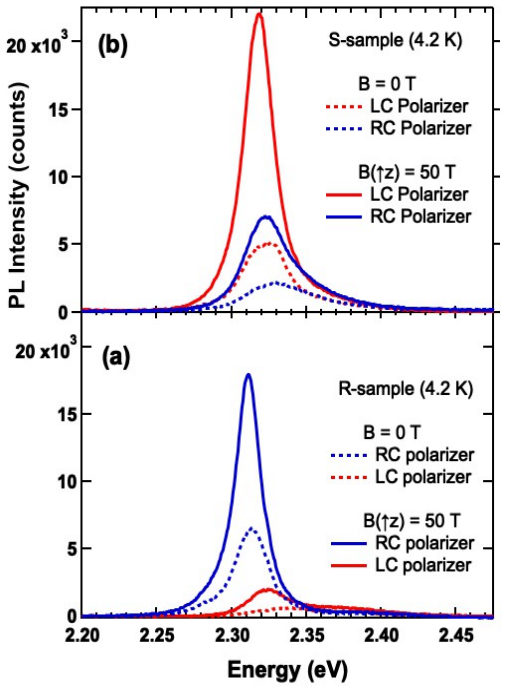
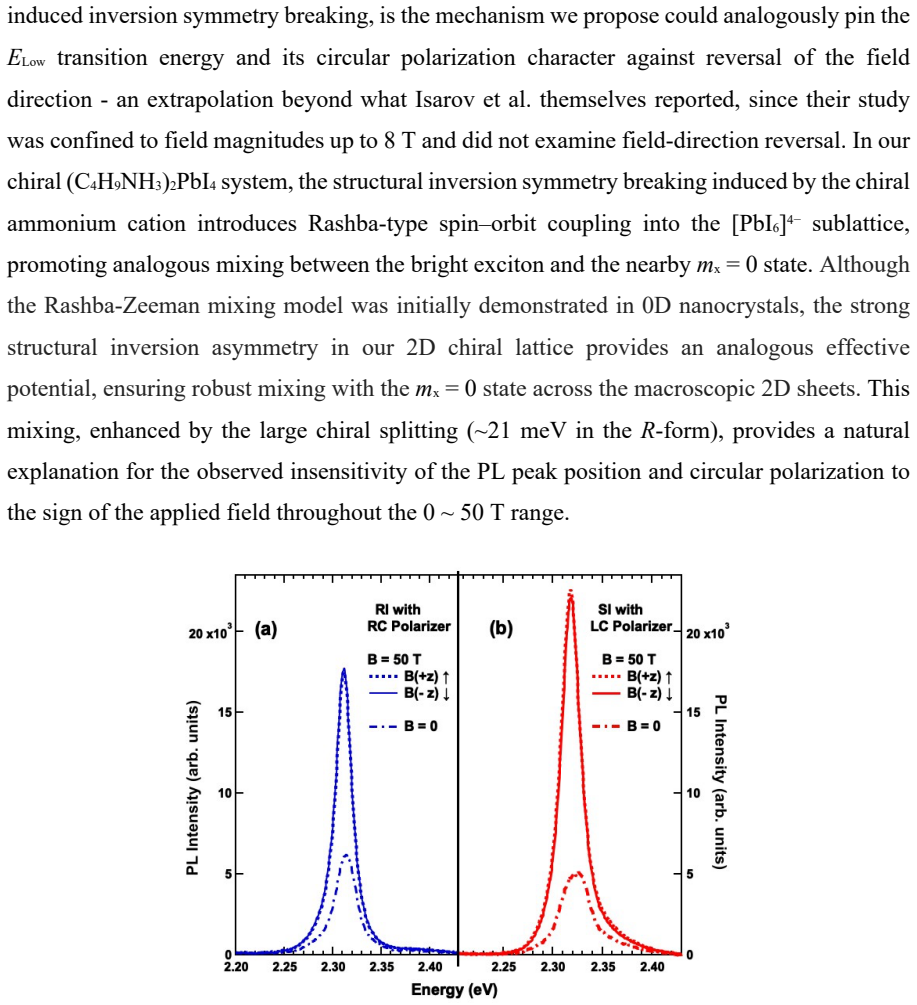
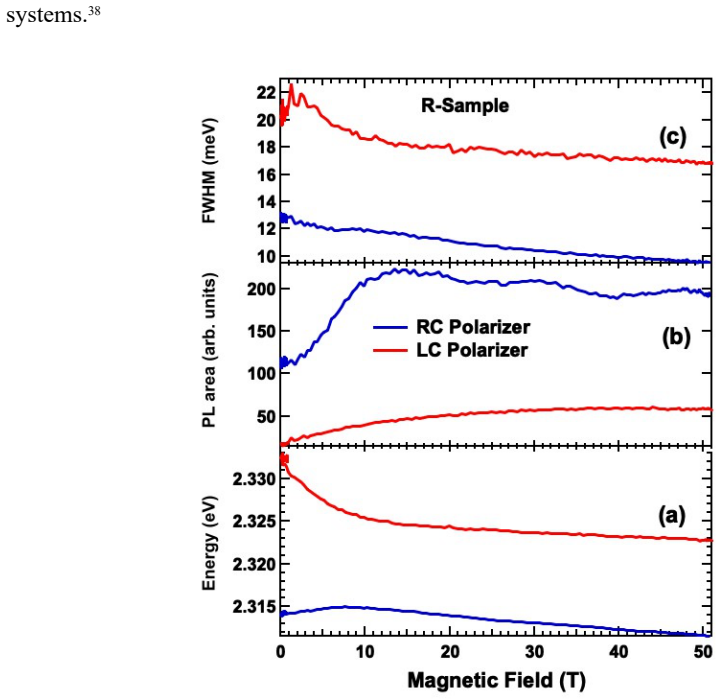
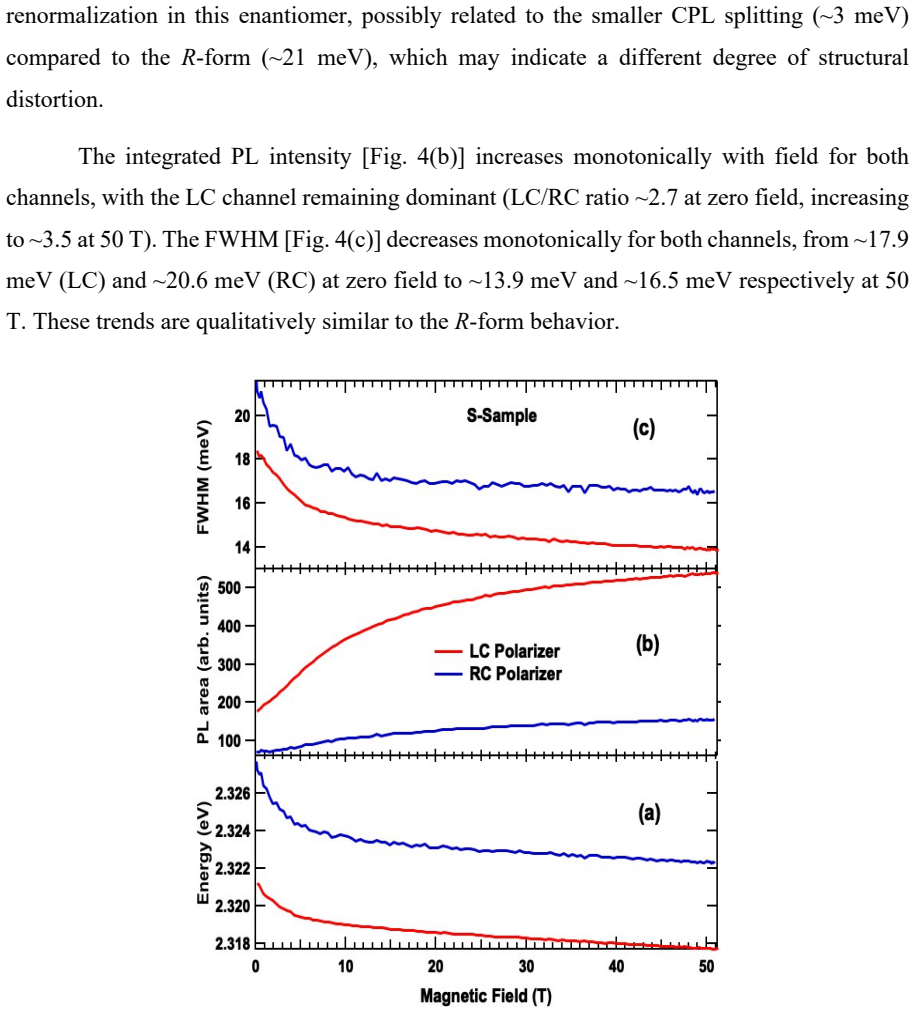
The R-form exhibits strong preferential emission into the RC channel (I_RC/I_LC = 10:1), with the S-form showing the opposite sense, robust against the applied field. Three key observations include anomalous redshift of all exciton transition energies with increasing field, complete invariance of PL peak positions upon reversal of the field direction, and field-induced increase in PL intensity and narrowing of the linewidth. These results are interpreted in the framework of Rashba spin-splitting and polaron formation in the chiral two-dimensional perovskite lattice.
What carries the argument
Rashba-induced mixing of the bright exciton with a nearby m_x = 0 dark state together with polaron formation that suppresses disorder scattering as the cyclotron orbit contracts.
If this is right
- The 10:1 circular polarization ratio remains fixed across the full field range up to 50 T.
- Exciton energies exhibit a non-monotonic initial blueshift to 7.6 T followed by redshift in the dominant channel.
- PL intensity grows and linewidth narrows because contracting cyclotron orbits reduce disorder scattering via polaron formation.
- Invariance of peak positions to field reversal follows directly from the Rashba mixing of bright and dark states.
Where Pith is reading between the lines
- The built-in polarization preference could allow chiral perovskites to serve as sources of circularly polarized light without continuous external field control.
- Similar Rashba and polaron mechanisms may appear in other chiral 2D layered materials and could be checked by comparing linewidth narrowing rates.
- The initial non-monotonic blueshift region offers a window to separate the Rashba contribution from the overall redshift trend.
Load-bearing premise
The anomalous redshift, field-direction invariance, and intensity changes arise from Rashba mixing and polaron formation in the chiral lattice rather than from structural changes or measurement artifacts.
What would settle it
Repeating the experiment on the corresponding achiral perovskite under identical conditions and finding the same redshift, field-reversal invariance, and intensity increase would undermine the claim that these effects require the chiral lattice and Rashba mechanism.
Figures
read the original abstract
We report circularly polarized magneto-photoluminescence (MPL) measurements on the enantiomeric pair of two-dimensional chiral perovskites R- and S-(C4H9NH3)2PbI4 in pulsed magnetic fields up to 50 T at 4.2 K. The R-form exhibits strong preferential emission into the RC channel (I_RC/I_LC = 10:1), with the S-form showing the opposite sense, robust against the applied field. Three key observations are reported: (i) an anomalous redshift of all exciton transition energies with increasing field-contrasting with the normal diamagnetic blueshift of achiral perovskites-with a non-monotonic initial blueshift to 7.6 T in the dominant RC channel of the R-form; (ii) complete invariance of PL peak positions upon reversal of the field direction, consistent with Rashba-induced mixing of the bright exciton with a nearby m_x = 0 dark state; and (iii) field-induced increase in PL intensity and narrowing of the linewidth, attributed to suppression of disorder scattering as the cyclotron orbit contracts. These results are interpreted in the framework of Rashba spin-splitting and polaron formation in the chiral two-dimensional perovskite lattice.
Editorial analysis
A structured set of objections, weighed in public.
Referee Report
Summary. The manuscript reports circularly polarized magneto-photoluminescence measurements on enantiomeric 2D chiral perovskites R- and S-(C4H9NH3)2PbI4 in pulsed fields up to 50 T at 4.2 K. It claims strong enantiomer-specific preferential emission (I_RC/I_LC = 10:1 for R-form, opposite for S-form) that is robust to field, an anomalous redshift of all exciton transition energies with increasing field (contrasting diamagnetic blueshift in achiral analogs), complete invariance of PL peak positions to field reversal, and field-induced PL intensity increase with linewidth narrowing. These are interpreted as arising from Rashba spin-splitting (mixing bright excitons with nearby m_x=0 dark states) and polaron formation suppressing disorder scattering in the chiral lattice.
Significance. If the interpretation is quantitatively validated, the work would supply high-field experimental data on how structural chirality modulates exciton spin and energy shifts via Rashba effects in 2D perovskites, potentially informing models of spin-orbit coupling and polaron physics in these materials. The 50 T pulsed-field regime and the reported field-direction invariance are technically notable and could help discriminate mechanisms, though the current qualitative framing limits immediate impact.
major comments (2)
- [Abstract] Abstract: The attribution of the anomalous redshift (few meV up to 50 T) and its invariance to field reversal to Rashba-induced mixing of the bright exciton with a m_x=0 dark state is presented only qualitatively. No derivation or fit of the expected energy shift ΔE(B) from the Rashba Hamiltonian plus diamagnetic term is provided, nor is the Rashba parameter α_R estimated from the data or used to model the non-monotonic RC-channel behavior below 7.6 T.
- [Abstract] Abstract: The field-induced PL intensity increase and linewidth narrowing are attributed to polaron formation and cyclotron-orbit contraction suppressing disorder scattering, but no estimate of the scattering-rate change or comparison to a quantitative model (e.g., mobility or linewidth vs. B) is given to support this over alternatives such as lattice relaxation or pulsed-magnet artifacts.
minor comments (1)
- [Abstract] The abstract states the I_RC/I_LC ratio and key observations but does not mention error bars, number of samples, or raw spectra; adding these would strengthen the experimental claims.
Simulated Author's Rebuttal
We thank the referee for their thorough review and valuable feedback on our manuscript. We address each of the major comments below.
read point-by-point responses
-
Referee: [Abstract] Abstract: The attribution of the anomalous redshift (few meV up to 50 T) and its invariance to field reversal to Rashba-induced mixing of the bright exciton with a m_x=0 dark state is presented only qualitatively. No derivation or fit of the expected energy shift ΔE(B) from the Rashba Hamiltonian plus diamagnetic term is provided, nor is the Rashba parameter α_R estimated from the data or used to model the non-monotonic RC-channel behavior below 7.6 T.
Authors: We agree that the interpretation is presented qualitatively. The primary goal of the manuscript is to report the novel experimental observations in high magnetic fields, with the Rashba mixing proposed as a consistent mechanism explaining the redshift, its magnitude of a few meV, and especially the invariance to field reversal, which would not be expected from standard diamagnetic shifts. A full derivation from the Rashba Hamiltonian would involve detailed calculations of the exciton wavefunctions in the chiral 2D structure, which we have not performed. Similarly, estimating α_R would require fitting to a specific model that accounts for the non-monotonic behavior below 7.6 T, possibly due to competing effects at low fields. We believe the qualitative framework is sufficient to highlight the role of chirality, but we acknowledge the referee's point and will expand the discussion section to include a schematic diagram of the proposed level mixing in the revised manuscript. revision: partial
-
Referee: [Abstract] Abstract: The field-induced PL intensity increase and linewidth narrowing are attributed to polaron formation and cyclotron-orbit contraction suppressing disorder scattering, but no estimate of the scattering-rate change or comparison to a quantitative model (e.g., mobility or linewidth vs. B) is given to support this over alternatives such as lattice relaxation or pulsed-magnet artifacts.
Authors: We appreciate this comment. The attribution to polaron formation is based on the observed field-induced intensity increase and narrowing, which is absent in achiral analogs, suggesting the chiral lattice plays a role in polaron stabilization. However, we have not provided a quantitative estimate of the scattering rate change or a model for linewidth vs. B. Alternatives such as lattice relaxation or experimental artifacts cannot be entirely ruled out without further measurements, though the enantiomer-specific nature and consistency across samples argue against artifacts. We will add a brief discussion of possible mechanisms and note the limitations of the current interpretation in the revised version, but a full quantitative model is beyond the scope of this work. revision: partial
Circularity Check
No circularity: experimental observations interpreted qualitatively in existing framework
full rationale
The paper presents magneto-photoluminescence measurements on chiral perovskites and offers qualitative interpretations (Rashba mixing for redshift invariance, polaron effects for intensity narrowing) that are consistent with prior models but do not derive new results from equations or fits that reduce to the inputs. No predictions, first-principles derivations, or parameter fittings are claimed that loop back by construction. The central claims are observational data points, not self-referential outputs. This is self-contained experimental work against external benchmarks (field-dependent PL spectra), warranting score 0.
Axiom & Free-Parameter Ledger
axioms (2)
- domain assumption Rashba spin-splitting mixes the bright exciton with a nearby dark state in the chiral perovskite lattice
- domain assumption Field-induced suppression of disorder scattering occurs via cyclotron orbit contraction in the presence of polarons
Reference graph
Works this paper leans on
-
[1]
Optical properties due to electronic transitions in two-dimensional semiconductors (CₙH₂ₙ₊₁NH₃)₂PbI₄
Ishihara, T.; Takahashi, J.; Goto, T. Optical properties due to electronic transitions in two-dimensional semiconductors (CₙH₂ₙ₊₁NH₃)₂PbI₄. Phys. Rev. B 1990, 42, 11099
1990
-
[2]
Dielectric confinement effect on excitons in PbI₄-based layered semiconductors
Hong, X.; Ishihara, T.; Nurmikko, A. Dielectric confinement effect on excitons in PbI₄-based layered semiconductors. Phys. Rev. B 1992, 45,
1992
-
[3]
Saparov, B.; Mitzi, D. B. Organic–inorganic perovskites: structural versatility for functional materials design. Chem. Rev. 2016, 116,
2016
-
[4]
Pedesseau, L. et al. Advances and promises of layered halide hybrid perovskite semiconductors. ACS Nano 2016, 10,
2016
-
[5]
Even, J. et al. Importance of spin–orbit coupling in hybrid organic/inorganic perovskites for photovoltaic applications. J. Phys. Chem. Lett. 2013, 4,
2013
-
[6]
Tanaka, K. et al. Image charge effect on two-dimensional excitons in an inorganic–organic quantum-well crystal. Phys. Rev. B 2005, 71, 045312
2005
-
[7]
Miyata, A. et al. Direct measurement of the exciton binding energy and effective masses for charge carriers in organic–inorganic tri-halide perovskites. Nat. Phys. 2015, 11,
2015
-
[8]
A.; Rashba, E
Bychkov, Y. A.; Rashba, E. I. Oscillatory effects and the magnetic susceptibility of carriers in inversion layers. J. Phys. C 1984, 17,
1984
-
[9]
Isarov, M. et al. Rashba effect in a single colloidal CsPbBr₃ perovskite nanocrystal detected by magneto-optical measurements. Nano Lett. 2017, 17,
2017
-
[10]
Excitons in metal-halide perovskites
Baranowski, M.; Plochocka, P. Excitons in metal-halide perovskites. Adv. Energy Mater. 2020, 10, 1903659
2020
-
[11]
Kim, Y.-H. et al. The structural origin of chiroptical properties in perovskite nanocrystals with chiral organic ligands. Adv. Funct. Mater. 2022, 32, 2200454
2022
-
[12]
Ma, J. et al. Chiral 2D perovskites with a high degree of circularly polarized photoluminescence. ACS Nano 2019, 13,
2019
-
[13]
Long, G. et al. Spin control in reduced-dimensional chiral perovskites. Nat. Photonics 2018, 12,
2018
-
[14]
Long, G. et al. Chiral-perovskite optoelectronics. Nat. Rev. Mater. 2020, 5,
2020
-
[15]
Kim, H. et al. Giant chiral amplification of chiral 2D perovskites via dynamic crystal reconstruction. Sci. Adv. 2024, 10, eado5942
2024
-
[16]
Lu, H. et al. Control of light, spin and charge with chiral metal halide semiconductors. Nat. Rev. Chem. 2022, 6,
2022
-
[17]
Georgiou, K. et al. Bright circularly polarized photoluminescence in chiral layered hybrid lead-halide perovskites. Sci. Adv. 2024, 10, eadh5083
2024
-
[18]
Liu, T. et al. High responsivity circular polarized light detectors based on quasi two-dimensional chiral perovskite films. ACS Nano 2022, 16,
2022
-
[19]
Shin, Y. H. et al. Combination of optical transitions of polarons with Rashba effect in methylammonium lead trihalide perovskites under high magnetic fields. Phys. Rev. B 2021, 104, 035205
2021
-
[20]
Miyata, A. et al. Direct measurement of the exciton binding energy in MAPbI₃ under magnetic fields up to 60 T. Phys. Rev. B 2017, 96, 115418
2017
-
[21]
Galkowski, K. et al. Determination of the exciton binding energy and effective masses for methylammonium and formamidinium lead tri-halide perovskite semiconductors. Energy Environ. Sci. 2016, 9,
2016
-
[22]
Sercel, P. C. et al. Optical activity of chiral excitons. Adv. Mater. 2025, 37, 2415901
2025
-
[23]
Magnetic-field manipulation of circularly polarized photoluminescence in chiral perovskites
Pan, R.; Wang, K.; Yu, Z.-G. Magnetic-field manipulation of circularly polarized photoluminescence in chiral perovskites. Mater. Horiz. 2022, 9,
2022
-
[24]
Dai, S. et al. Tuning the circularly polarized photoluminescence of chiral 2D perovskites by high pressure. J. Phys. Chem. Lett. 2024, 15,
2024
-
[25]
Spin-orbit coupling effects in zinc blende structures
Dresselhaus, G. Spin-orbit coupling effects in zinc blende structures. Phys. Rev. 1955, 100,
1955
-
[26]
The Rashba effect and indirect electron–hole recombination in hybrid organic–inorganic perovskites
Yu, Z.-G. The Rashba effect and indirect electron–hole recombination in hybrid organic–inorganic perovskites. Phys. Chem. Chem. Phys. 2017, 19, 14907
2017
-
[27]
Jana, M. K. et al. Structural descriptor for enhanced spin-splitting in 2D hybrid perovskites. Nat. Commun. 2021, 12,
2021
-
[28]
Liu, X. et al. Circular photogalvanic spectroscopy of Rashba splitting in 2D hybrid organic–inorganic perovskite multiple quantum wells. Nat. Commun. 2020, 11,
2020
-
[29]
Yin, J. et al. Layer-dependent Rashba band splitting in 2D hybrid perovskites. Chem. Mater. 2018, 30,
2018
-
[30]
Do, T. T. H. et al. Bright exciton fine-structure in two-dimensional lead halide perovskites. Nano Lett. 2020, 20,
2020
-
[31]
Becker, M. A. et al. Bright triplet excitons in caesium lead halide perovskites. Nature 2018, 553,
2018
-
[32]
Baranowski, M. et al. Probing dimensionality reduction of the photon recycling with magneto-reflectance measurements in 2D Ruddlesden–Popper perovskites. npj 2D Mater. Appl. 2019, 3,
2019
-
[33]
Dyksik, M. et al. Bright excitons in Ruddlesden–Popper perovskites: the plexciton route to nonlinear optics. ACS Photonics 2021, 8,
2021
-
[34]
Dyksik, M. et al. Microscopic insights into magneto-optics and magneto-transport in 2D perovskites. Nano Lett. 2025, 25,
2025
-
[35]
Fu, M. et al. Neutral and charged exciton fine structure in single lead halide perovskite nanocrystals revealed by magneto-optical spectroscopy. Nano Lett. 2017, 17,
2017
-
[36]
Neumann, T. et al. Manganese doping for enhanced magnetic brightening and circular polarization control of dark excitons in paramagnetic layered hybrid metal-halide perovskites. Nat. Commun. 2021, 12,
2021
-
[37]
Stier, A. V. et al. Magnetooptics of exciton Rydberg states in a monolayer semiconductor. Phys. Rev. Lett. 2018, 120, 057405
2018
-
[38]
Piot, B. A. et al. Disorder-driven cyclotron resonance linewidth broadening in two-dimensional systems. Phys. Rev. B 2010, 82, 081307
2010
-
[39]
Kirstein, E. et al. The Landé g-factor of electrons and holes in lead halide perovskites. Nat. Commun. 2022, 13,
2022
-
[40]
C.; Vardeny, Z
Sercel, P. C.; Vardeny, Z. V.; Efros, A. L. Circular dichroism in non-chiral metal halide perovskites. Nanoscale 2020, 12, 18067
2020
-
[41]
Jurow, M. J. et al. Manipulating the transition dipole moment of CsPbBr₃ perovskite nanocrystals for superior optical properties. Nano Lett. 2019, 19,
2019
-
[42]
Frost, J. M. Calculating polaron mobility in halide perovskites. Phys. Rev. B 2017, 96, 195202
2017
-
[43]
Thouin, F. et al. Phonon coherences reveal the polaronic character of excitons in two-dimensional lead halide perovskites. Nat. Mater. 2019, 18,
2019
-
[44]
Miyata, K. et al. Large polarons in lead halide perovskites. Sci. Adv. 2017, 3, e1701217
2017
-
[45]
Yamada, Y. et al. Polaron masses in CH₃NH₃PbX₃ perovskites determined by Landau level spectroscopy in low magnetic fields. Phys. Rev. Lett. 2020, 125, 216405
2020
-
[46]
Neukirch, A. J. et al. Polaron stabilization by cooperative lattice distortion and cation rotations in hybrid perovskite materials. Nano Lett. 2016, 16,
2016
-
[47]
Thouin, F. et al. Stable biexcitons in two-dimensional metal-halide perovskites with strong dynamic lattice disorder. Phys. Rev. Mater. 2018, 2, 034001
2018
-
[48]
Deng, S. et al. Long-range exciton transport and slow annihilation in two-dimensional hybrid perovskites. Nat. Commun. 2020, 11,
2020
-
[49]
Lu, H. et al. Spin-dependent charge transport through 2D chiral hybrid lead-iodide perovskites. Sci. Adv. 2019, 5, eaay0571
2019
-
[50]
Kim, Y.-H. et al. Chiral-induced spin selectivity enables a room-temperature spin light-emitting diode. Science 2021, 371,
2021
discussion (0)
Sign in with ORCID, Apple, or X to comment. Anyone can read and Pith papers without signing in.