Universal logic gates for coupled period-doubling systems
Pith reviewed 2026-05-20 05:47 UTC · model grok-4.3
The pith
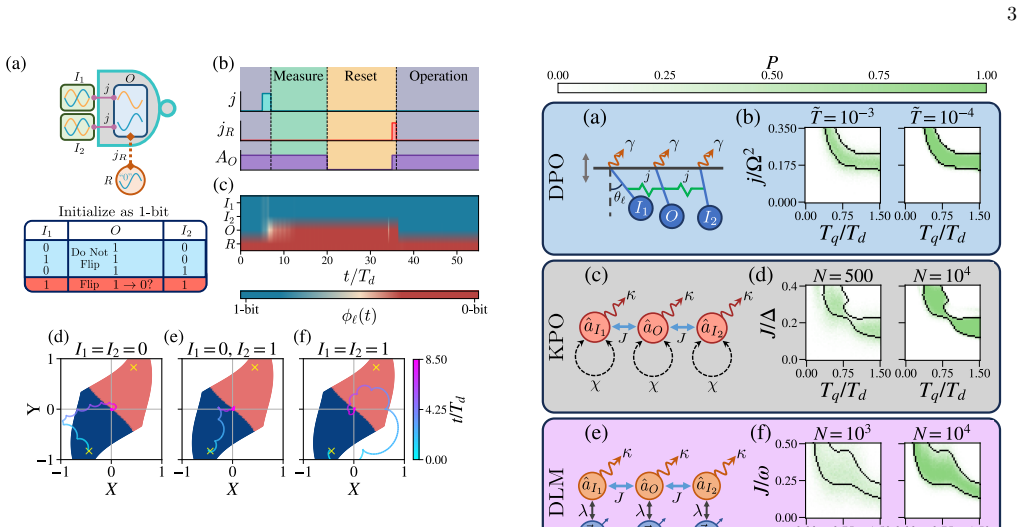
Tuning a single coupling pulse between period-doubled nodes implements universal NAND and NOR logic gates.
A machine-rendered reading of the paper's core claim, the machinery that carries it, and where it could break.
Core claim
A general architecture performs universal logic operations with NAND and NOR gates whose inputs and outputs are the period-doubled states of periodically driven systems. The protocol consists of a single pulse that simultaneously couples two input nodes to an output node; the resulting states are set by the chosen coupling strength and pulse duration so that the output realizes the required Boolean function for every combination of inputs. The same construction works for classical networks of dissipative parametric oscillators, quantum networks of Kerr parametric oscillators, and the periodically driven open Dicke lattice model that emulates discrete time crystals, with explicit parameterReg
What carries the argument
The single pulse that couples two input nodes to an output node, where coupling strength and pulse duration are the two controls that map the pair of input period-doubled states onto the desired output state.
If this is right
- The same pulse-coupling protocol yields working NAND and NOR gates in networks of dissipative parametric oscillators.
- The protocol also produces working gates in networks of quantum Kerr parametric oscillators.
- The protocol produces working gates inside the periodically driven open Dicke lattice that realizes discrete time crystals.
- The gates remain functional when moderate fluctuations are added to the system parameters.
Where Pith is reading between the lines
- Larger networks built from many such coupled triples could perform complete Boolean circuits directly inside a driven physical medium.
- The approach may be tested in other periodically driven platforms that already exhibit stable period doubling, such as mechanical or optical resonators.
- Because the information is carried by the period-doubled response rather than by a steady state, the gates might operate at frequencies set by the driving rather than by electronic switching limits.
Load-bearing premise
A single coupling pulse produces independent, controllable period-doubled states in the three nodes without residual interactions or decoherence that would break the NAND or NOR mapping.
What would settle it
Measure the output node after the pulse for all four input combinations; if any output period-doubled state deviates from the expected NAND or NOR result when the coupling strength and duration are held fixed, the claimed logic architecture is falsified.
Figures



read the original abstract
We propose a general architecture for universal logic operations using NAND and NOR gates on classical information encoded in period-doubled states of periodically-driven systems. The protocol involves applying a single pulse that simultaneously couple two input nodes with an output node. We show that the states of the nodes can be precisely controlled by tuning the coupling strength and pulse duration, allowing for robust logic gate operation. To highlight the universality of the protocol, we demonstrate its applicability on different systems, such as classical networks of dissi- pative parametric oscillators (DPO), quantum networks of Kerr parametric oscillators (KPO), and the periodically-driven open Dicke lattice model (DLM) emulating discrete time crystals (DTCs). We identify the parameter regimes in which the logic gate architecture is valid, and we showcase its robustness in the presence of fluctuations.
Editorial analysis
A structured set of objections, weighed in public.
Referee Report
Summary. The manuscript proposes a general architecture for universal logic operations using NAND and NOR gates on classical information encoded in period-doubled states of periodically-driven systems. The protocol applies a single pulse that simultaneously couples two input nodes with an output node. The states are controlled by tuning the coupling strength and pulse duration, enabling robust logic gate operation. Applicability is demonstrated on dissipative parametric oscillators (DPO), Kerr parametric oscillators (KPO), and the periodically-driven open Dicke lattice model (DLM) emulating discrete time crystals (DTCs), with identification of valid parameter regimes and robustness to fluctuations.
Significance. If the central claims hold, the work provides a potentially versatile framework for implementing logic in nonlinear dynamical systems across classical and quantum platforms. Demonstrating the same protocol in DPO, KPO, and DLM highlights a degree of universality that could inform designs for information processing in period-doubling and time-crystal systems. The focus on robustness under fluctuations is a constructive element for assessing practical viability.
major comments (2)
- [§3.1] §3.1, the single-pulse coupling protocol: The central claim that the pulse produces independent, controllable period-doubled states realizing the NAND/NOR truth table without residual interactions rests on the post-pulse dynamics relaxing strictly into the target attractor. In the open dissipative cases (DPO and DLM), the simultaneous modulation of amplitudes and phases during the pulse can leave a remnant term if pulse duration does not precisely match the inverse dissipation rate; this shifts the effective period-doubling threshold near the bifurcation and risks invalidating the exact mapping. A quantitative check of basin stability for the reported pulse parameters is needed.
- [§4.3] §4.3, DLM numerics: Robustness is shown for specific fluctuation levels, yet the fidelity of the NOR mapping under a 10% mismatch in pulse duration (relative to the optimal value used) is not reported. Because the bifurcation threshold is sensitive to small coherent or incoherent remnants, this omission leaves the load-bearing assumption about decoupling untested for the exact conditions claimed to support universal operation.
minor comments (2)
- The abstract states that valid regimes are identified but does not list the key inequalities or bounds; adding a compact summary of the regime conditions would improve clarity.
- Notation for the coupling strength and pulse duration is introduced without an explicit table of symbols; a short nomenclature table would aid readability across the three physical realizations.
Simulated Author's Rebuttal
We thank the referee for their careful reading of the manuscript and for the constructive comments, which help us clarify the robustness of the proposed protocol. We address each major comment below.
read point-by-point responses
-
Referee: [§3.1] §3.1, the single-pulse coupling protocol: The central claim that the pulse produces independent, controllable period-doubled states realizing the NAND/NOR truth table without residual interactions rests on the post-pulse dynamics relaxing strictly into the target attractor. In the open dissipative cases (DPO and DLM), the simultaneous modulation of amplitudes and phases during the pulse can leave a remnant term if pulse duration does not precisely match the inverse dissipation rate; this shifts the effective period-doubling threshold near the bifurcation and risks invalidating the exact mapping. A quantitative check of basin stability for the reported pulse parameters is needed.
Authors: We appreciate the referee's observation on potential remnant terms in dissipative systems. The protocol in Section 3.1 selects pulse durations and coupling strengths such that the transient interaction allows relaxation into the target period-doubled attractors, with the effective threshold remaining within the valid regime for the chosen parameters. To directly address the request, we will add a quantitative basin-stability analysis for the reported pulse parameters in both DPO and DLM cases in the revised manuscript. revision: yes
-
Referee: [§4.3] §4.3, DLM numerics: Robustness is shown for specific fluctuation levels, yet the fidelity of the NOR mapping under a 10% mismatch in pulse duration (relative to the optimal value used) is not reported. Because the bifurcation threshold is sensitive to small coherent or incoherent remnants, this omission leaves the load-bearing assumption about decoupling untested for the exact conditions claimed to support universal operation.
Authors: We agree that an explicit test of NOR fidelity under a 10% pulse-duration mismatch would further substantiate the decoupling assumption for the DLM. Although the current numerics already demonstrate robustness to fluctuations, we will include this additional simulation and report the resulting fidelity in the revised Section 4.3. revision: yes
Circularity Check
No circularity detected in derivation or protocol
full rationale
The manuscript proposes an architecture for NAND/NOR gates realized by single-pulse coupling of period-doubled states. Control is achieved by explicit tuning of coupling strength and pulse duration; valid regimes are identified numerically and robustness is shown under fluctuations for DPO, KPO and DLM systems. No equation or claim reduces a predicted logic function to a quantity defined by the result itself, nor does any central step rely on a self-citation chain, fitted-input renaming, or imported uniqueness theorem. The protocol is therefore self-contained against external benchmarks and receives the default non-circularity finding.
Axiom & Free-Parameter Ledger
free parameters (2)
- coupling strength
- pulse duration
axioms (1)
- domain assumption Period-doubled states remain stable and distinguishable under the applied coupling pulse in the chosen parameter regimes.
Lean theorems connected to this paper
-
IndisputableMonolith/Foundation/ArithmeticFromLogic.leanLogicNat recovery from Law of Logic unclear?
unclearRelation between the paper passage and the cited Recognition theorem.
applying a single pulse that simultaneously couple two input nodes with an output node... tuning the coupling strength and pulse duration
-
IndisputableMonolith/Foundation/ArrowOfTime.leantime-as-orbit certificate echoes?
echoesECHOES: this paper passage has the same mathematical shape or conceptual pattern as the Recognition theorem, but is not a direct formal dependency.
period-doubled DTC states... effective mapping to a parametric oscillator
What do these tags mean?
- matches
- The paper's claim is directly supported by a theorem in the formal canon.
- supports
- The theorem supports part of the paper's argument, but the paper may add assumptions or extra steps.
- extends
- The paper goes beyond the formal theorem; the theorem is a base layer rather than the whole result.
- uses
- The paper appears to rely on the theorem as machinery.
- contradicts
- The paper's claim conflicts with a theorem or certificate in the canon.
- unclear
- Pith found a possible connection, but the passage is too broad, indirect, or ambiguous to say the theorem truly supports the claim.
Reference graph
Works this paper leans on
-
[1]
I. Kovacic, R. Rand, and S. Mohamed Sah, Applied Me- chanics Reviews70, 020802 (2018)
work page 2018
- [2]
- [3]
- [4]
-
[5]
G. Fabiani and J. H. Mentink, Applied Physics Letters 120, 152402 (2022)
work page 2022
- [6]
-
[7]
i. c. v. Nosan, P. M¨ arki, N. Hauff, C. Knaut, and A. Eich- ler, Phys. Rev. E99, 062205 (2019)
work page 2019
- [8]
-
[9]
M. Frimmer, T. L. Heugel, i. c. v. Nosan, F. Tebben- johanns, D. H¨ alg, A. Akin, C. L. Degen, L. Novotny, R. Chitra, O. Zilberberg, and A. Eichler, Phys. Rev. Lett. 123, 254102 (2019)
work page 2019
-
[10]
Goto, Proceedings of the IRE47, 1304 (1959)
E. Goto, Proceedings of the IRE47, 1304 (1959)
work page 1959
- [11]
- [12]
-
[13]
D. Hatanaka, I. Mahboob, K. Onomitsu, and H. Yam- aguchi, Scientific Reports7, 10207 (2017)
work page 2017
-
[14]
Z. R. Lin, K. Inomata, K. Koshino, W. D. Oliver, Y. Nakamura, J. S. Tsai, and T. Yamamoto, Nature Communications5, 4480 (2014)
work page 2014
-
[15]
N. Y. Yao, A. C. Potter, I.-D. Potirniche, and A. Vish- wanath, Phys. Rev. Lett.118, 030401 (2017)
work page 2017
-
[16]
D. V. Else, C. Monroe, C. Nayak, and N. Y. Yao, Annual Review of Condensed Matter Physics11, 467 (2020)
work page 2020
-
[17]
M. P. Zaletel, M. Lukin, C. Monroe, C. Nayak, F. Wilczek, and N. Y. Yao, Rev. Mod. Phys.95, 031001 (2023)
work page 2023
-
[18]
D. V. Else, B. Bauer, and C. Nayak, Phys. Rev. Lett. 117, 090402 (2016)
work page 2016
-
[19]
A. Lazarides, S. Roy, F. Piazza, and R. Moessner, Phys. Rev. Res.2, 022002 (2020)
work page 2020
-
[21]
J. O’Sullivan, O. Lunt, C. W. Zollitsch, M. L. W. The- walt, J. J. L. Morton, and A. Pal, New Journal of Physics 22, 085001 (2020)
work page 2020
- [22]
-
[23]
F. M. Gambetta, F. Carollo, M. Marcuzzi, J. P. Gar- rahan, and I. Lesanovsky, Phys. Rev. Lett.122, 015701 (2019)
work page 2019
-
[24]
V. Khemani, A. Lazarides, R. Moessner, and S. L. Sondhi, Phys. Rev. Lett.116, 250401 (2016)
work page 2016
-
[25]
C.-K. Chan, T. E. Lee, and S. Gopalakrishnan, Phys. Rev. A91, 051601 (2015)
work page 2015
- [26]
-
[27]
E. T. Owen, J. Jin, D. Rossini, R. Fazio, and M. J. Hart- mann, New Journal of Physics20, 045004 (2018)
work page 2018
-
[28]
M. Krishna, P. Solanki, M. Hajduˇ sek, and S. Vinjanam- pathy, Phys. Rev. Lett.130, 150401 (2023)
work page 2023
-
[29]
M. H. Mu˜ noz Arias, K. Chinni, and P. M. Poggi, Phys. Rev. Res.4, 023018 (2022)
work page 2022
-
[30]
A. Russomanno, F. Iemini, M. Dalmonte, and R. Fazio, Phys. Rev. B95, 214307 (2017)
work page 2017
-
[31]
C. W. von Keyserlingk and S. L. Sondhi, Phys. Rev. B 93, 245146 (2016)
work page 2016
- [32]
- [33]
-
[34]
T. L. Heugel, M. Oscity, A. Eichler, O. Zilberberg, and R. Chitra, Phys. Rev. Lett.123, 124301 (2019)
work page 2019
-
[35]
N. Y. Yao, C. Nayak, L. Balents, and M. P. Zaletel, Na- ture Physics16, 438–447 (2020)
work page 2020
-
[36]
R. D. Jara, D. F. Salinel, and J. G. Cosme, Phys. Rev. A109, 042212 (2024)
work page 2024
-
[37]
R. R. W. Wang, B. Xing, G. G. Carlo, and D. Poletti, Phys. Rev. E97, 020202(R) (2018)
work page 2018
-
[38]
R. D. Jara, P. Kongkhambut, H. Keßler, A. Hemmerich, and J. G. Cosme, Phys. Rev. B112, 024303 (2025)
work page 2025
-
[39]
A. Kotb, A. Hatziefremidis, G. Said, and K. E. Zoiros, Photonics11, 10.3390/photonics11121182 (2024)
- [40]
-
[41]
See Supplemental Material for further information about the derivations for the mean-field and TWA EOM, cal- culations for the basins of attractions for the two period- doubled DPO states, and further information regarding reset protocol
-
[42]
E. D. U, R. D. Jara Jr., and J. G. Cosme, Time crystals and logic operations in the open dicke dimer (2026), in preparation
work page 2026
- [43]
-
[44]
L. Zou, D. Marcos, S. Diehl, S. Putz, J. Schmiedmayer, J. Majer, and P. Rabl, Phys. Rev. Lett.113, 023603 (2014)
work page 2014
- [45]
-
[46]
B. Zhu, J. Marino, N. Y. Yao, M. D. Lukin, and E. A. Demler, New Journal of Physics21, 073028 (2019)
work page 2019
-
[47]
Z. Gong, R. Hamazaki, and M. Ueda, Phys. Rev. Lett. 120, 040404 (2018)
work page 2018
- [48]
- [49]
-
[50]
C. Emary and T. Brandes, Phys. Rev. E67, 10.1103/PhysRevE.67.066203 (2003)
- [51]
- [52]
- [53]
-
[54]
Polkovnikov, Annals of Physics325, 1790 (2010)
A. Polkovnikov, Annals of Physics325, 1790 (2010)
work page 2010
-
[55]
R. J. L. Tuquero and J. G. Cosme, Phys. Rev. A110, 063314 (2024)
work page 2024
- [56]
-
[57]
X. H. H. Zhang and H. U. Baranger, Phys. Rev. A103, 033711 (2021)
work page 2021
- [58]
-
[59]
C. Nowoczyn, L. Mathey, and K. Seibold, Phys. Rev. A 113, 052208 (2026). Supplemental Material for Universal logic gates for coupled period-doubling systems Emmanuel Joseph Lee D.G. U, 1 Roy D. Jara Jr., 1 and Jayson G. Cosme 1 1National Institute of Physics, University of the Philippines, Diliman, Quezon City 1101, Philippines (Dated: May 20, 2026) METHO...
work page 2026
-
[60]
Polkovnikov, Phase space representation of quantum dynamics, Annals of Physics325, 1790 (2010)
A. Polkovnikov, Phase space representation of quantum dynamics, Annals of Physics325, 1790 (2010)
work page 2010
-
[61]
X. H. H. Zhang and H. U. Baranger, Driven-dissipative phase transition in a kerr oscillator: From semiclassicalPTsymmetry to quantum fluctuations, Phys. Rev. A103, 033711 (2021)
work page 2021
-
[62]
C. Nowoczyn, L. Mathey, and K. Seibold, Universal quantum melting of quasiperiodic attractors in driven-dissipative cavities, Phys. Rev. A113, 052208 (2026)
work page 2026
-
[63]
T. Holstein and H. Primakoff, Field dependence of the intrinsic domain magnetization of a ferromagnet, Phys. Rev.58, 1098 (1940)
work page 1940
-
[64]
R. D. Jara, D. F. Salinel, and J. G. Cosme, Theory of parametric resonance for discrete time crystals in fully connected spin-cavity systems, Phys. Rev. A109, 042212 (2024)
work page 2024
-
[65]
F. Carollo and I. Lesanovsky, Exactness of mean-field equations for open dicke models with an application to pattern retrieval dynamics, Phys. Rev. Lett.126, 230601 (2021)
work page 2021
-
[66]
R. J. L. Tuquero and J. G. Cosme, Impact of quantum noise on phase transitions in an atom-cavity system with limit cycles, Phys. Rev. A 110, 063314 (2024)
work page 2024
discussion (0)
Sign in with ORCID, Apple, or X to comment. Anyone can read and Pith papers without signing in.