REVIEW 3 minor 68 references
Terahertz frequency upconversion by coherently driving charge dynamics in the InSb/CdTe heterostructure
T0 review · 0 major / 3 minor · reviewed 2026-06-26 · grok-4.3
Pith's one-line read An InSb/CdTe heterostructure produces efficient second-harmonic generation of terahertz radiation under an in-plane magnetic field through orbital-Zeeman corrections to Drude conductivity.
desk verdict The paper shows in-plane B-field SHG in InSb/CdTe via orbital-Zeeman Drude correction plus competitive THG, with the mechanism derivation holding up on inspection. read the letter →
The pith
A machine-rendered reading of the paper's core claim, the machinery that carries it, and where it could break.
The reading
What carries the argument
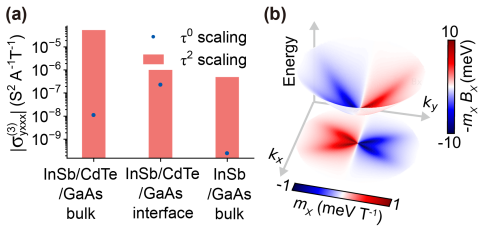
orbital-Zeeman correction to Drude conductivity that produces the nonlinear response under magnetic field
What would settle it
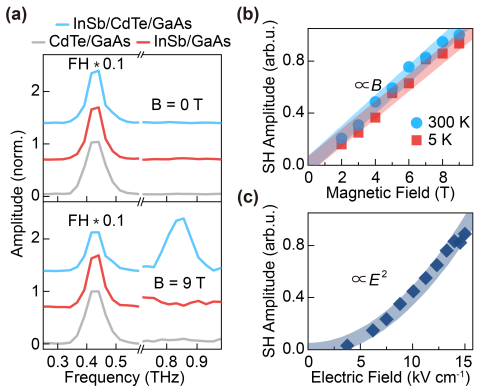
A measurement of second-harmonic intensity versus magnetic field strength that deviates from the scaling predicted by the orbital-Zeeman term in the Drude model.
Extended reading notes
Core claim
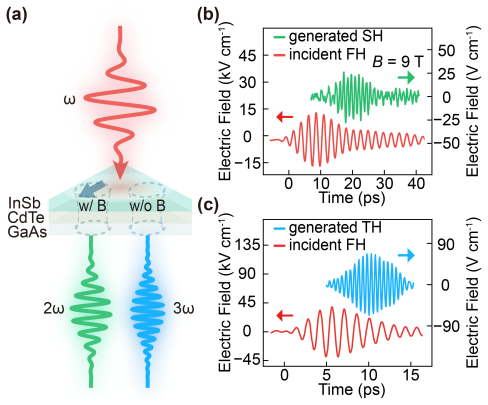
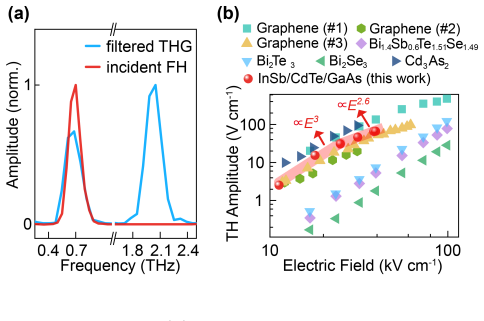
In the InSb/CdTe heterostructure, an in-plane magnetic field induces efficient second-harmonic generation of THz radiation with the primary mechanism identified as the orbital-Zeeman correction to Drude conductivity, while the dominant third-harmonic generation also exhibits Drude-like behavior, thereby supplying a general route to efficient THz harmonic generation in high-mobility materials.
Load-bearing premise
The orbital-Zeeman correction to Drude conductivity is the dominant mechanism responsible for the observed second-harmonic generation.
Editorial extensions
If this is right
- High-mobility semiconductors can achieve THz harmonic generation without requiring Dirac-fermion band structures.
- Third-harmonic generation efficiency in InSb/CdTe matches or exceeds that reported for graphene and Cd3As2.
- The magnetic-field dependence provides a tunable handle on the strength of the harmonic output.
- The same Drude-based mechanism is expected to operate across other high-mobility material systems.
Reading between the lines
- Similar harmonic generation may appear in other narrow-gap high-mobility semiconductors once an in-plane field is applied.
- Device-scale THz sources or mixers could be constructed if the conversion efficiency scales linearly with carrier mobility.
- Temperature-dependent measurements of the harmonic signals would provide an independent test of the Drude-origin hypothesis.
Signed reviews
Editorial analysis
A structured set of objections, weighed in public.
Referee Report
Summary. The manuscript reports experimental observation of efficient in-plane magnetic-field-induced second-harmonic generation (SHG) at terahertz frequencies in an InSb/CdTe heterostructure, together with strong third-harmonic generation (THG) whose magnitude rivals that reported for graphene and Cd3As2. Theoretical analysis in the nonlinear-response section attributes the dominant SHG contribution to the orbital-Zeeman correction of the Drude conductivity and shows that the leading THG term is likewise Drude-like; the authors conclude that this mechanism supplies a general route to THz harmonic generation in high-mobility materials.
Significance. If the reported signals and the mechanism assignment hold, the work constitutes a notable advance in THz nonlinear optics by demonstrating field-tunable harmonic generation in a conventional semiconductor heterostructure rather than in exotic Dirac or topological systems. The explicit derivation of the orbital-Zeeman term, its quantitative comparison with the Lorentz-force contribution, and the demonstration that the former dominates under the measured mobility and field range provide a concrete physical basis for the claimed generality.
minor comments (3)
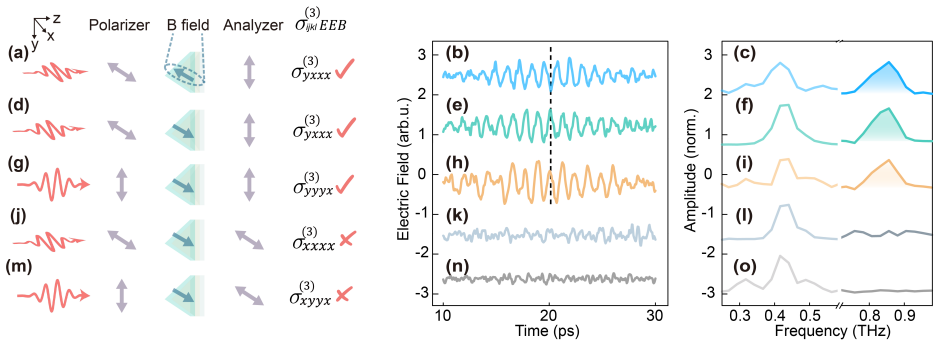
- [Figure 3] Figure 3 caption: the orientation of the in-plane magnetic field relative to the THz polarization is stated only qualitatively; a schematic or explicit angle definition would remove ambiguity when comparing data to the orbital-Zeeman model.
- [Section 2.2] Section 2.2: the quoted mobility value is given without the corresponding measurement temperature or Hall-bar geometry; adding these details would allow readers to verify that the reported dominance of the orbital-Zeeman term is consistent with the experimental conditions.
- [Eq. (8)] Eq. (8) and surrounding text: the symbol τ (scattering time) appears without an explicit definition or reference to its extraction from linear conductivity data; a brief parenthetical note would improve clarity.
Simulated Author's Rebuttal
We thank the referee for the positive and constructive assessment of our manuscript. The recommendation for minor revision is appreciated, and we will incorporate any editorial improvements in the revised version. Since no specific major comments were raised, we address the overall evaluation below.
Circularity Check
No significant circularity; derivation self-contained
full rationale
The central theoretical step derives the orbital-Zeeman correction to Drude conductivity explicitly in the nonlinear response section and compares its magnitude to the Lorentz-force term under the reported mobility and field values, showing dominance without reducing to a fitted parameter or self-citation. No load-bearing step matches any of the enumerated circularity patterns; the mechanism assignment follows from the derived equations rather than from renaming, ansatz smuggling, or input-output equivalence.
Assumptions & free parameters
Cite this review
Pith. "Pith review of Terahertz frequency upconversion by coherently driving charge dynamics in the InSb/CdTe heterostructure." pith.science (2026). https://pith.science/paper/O7DNSSCW
@misc{pith2026260620080,
  author       = {Pith},
  title        = {Pith review of: Terahertz frequency upconversion by coherently driving charge dynamics in the InSb/CdTe heterostructure},
  year         = {2026},
  howpublished = {\url{https://pith.science/paper/O7DNSSCW}},
  note         = {Machine review of arXiv:2606.20080}
}
read the original abstract
We investigate terahertz (THz) harmonic generation in the InSb/CdTe heterostructure, demonstrating, for the first time, efficient in-plane magnetic field-induced second-harmonic generation (SHG). We also achieve significant third-harmonic generation (THG), rivalling Dirac materials such as graphene and Cd3As2. Our theoretical analysis identifies the primary SHG mechanism as the orbital-Zeeman correction to Drude conductivity, while the dominant THG contribution also shows Drude-like behavior. The results provide a general route to efficient THz harmonic generation in high mobility materials.
Figures
Figures from the paper (2 more)
Reference graph
Works this paper leans on
-
[1]
Sengupta, T
K. Sengupta, T. Nagatsuma, and D. M. Mittleman, Terahertz integrated electronic and hybrid electronic–photonic systems, Nature Electronics1, 622 (2018)
2018
-
[2]
I. F. Akyildiz, C. Han, Z. Hu, S. Nie, and J. M. Jornet, Terahertz band communication: An old problem revisited and research directions for the next decade, IEEE Transactions on Communications70, 4250 (2022)
2022
-
[3]
Ideue, K
T. Ideue, K. Hamamoto, S. Koshikawa, M. Ezawa, S. Shimizu, Y. Kaneko, Y. Tokura, N. Na- gaosa, and Y. Iwasa, Bulk rectification effect in a polar semiconductor, Nature Physics13, 578 (2017)
2017
-
[4]
Ma, S.-Y
Q. Ma, S.-Y. Xu, H. Shen, D. MacNeill, V. Fatemi, T.-R. Chang, A. M. Mier Valdivia, S. Wu, Z. Du, C.-H. Hsu, S. Fang, Q. D. Gibson, K. Watanabe, T. Taniguchi, R. J. Cava, E. Kaxiras, H.-Z. Lu, H. Lin, L. Fu, N. Gedik, and P. Jarillo-Herrero, Observation of the nonlinear hall effect under time-reversal-symmetric conditions, Nature565, 337 (2019)
2019
-
[5]
S. Lai, H. Liu, Z. Zhang, J. Zhao, X. Feng, N. Wang, C. Tang, Y. Liu, K. S. Novoselov, S. A. Yang, and W.-b. Gao, Third-order nonlinear hall effect induced by the berry-connection polarizability tensor, Nature Nanotechnology16, 869 (2021)
2021
-
[6]
Gao, Y.-F
A. Gao, Y.-F. Liu, J.-X. Qiu, B. Ghosh, T. V. Trevisan, Y. Onishi, C. Hu, T. Qian, H.-J. Tien, S.-W. Chen, M. Huang, D. B´ erub´ e, H. Li, C. Tzschaschel, T. Dinh, Z. Sun, S.-C. Ho, S.-W. Lien, B. Singh, K. Watanabe, T. Taniguchi, D. C. Bell, H. Lin, T.-R. Chang, C. R. Du, A. Bansil, L. Fu, N. Ni, P. P. Orth, Q. Ma, and S.-Y. Xu, Quantum metric nonlinear ...
2023
-
[7]
N. Wang, D. Kaplan, Z. Zhang, T. Holder, N. Cao, A. Wang, X. Zhou, F. Zhou, Z. Jiang, C. Zhang, S. Ru, H. Cai, K. Watanabe, T. Taniguchi, B. Yan, and W. Gao, Quantum-metric- induced nonlinear transport in a topological antiferromagnet, Nature621, 487 (2023)
2023
-
[8]
Z. Z. Du, H.-Z. Lu, and X. C. Xie, Nonlinear hall effects, Nature Reviews Physics3, 744 13 (2021)
2021
Show all 68 references
-
[9]
Tokura and N
Y. Tokura and N. Nagaosa, Nonreciprocal responses from non-centrosymmetric quantum ma- terials, Nature Communications9, 3740 (2018)
2018
-
[10]
Sodemann and L
I. Sodemann and L. Fu, Quantum nonlinear hall effect induced by berry curvature dipole in time-reversal invariant materials, Physical Review Letters115, 216806 (2015)
2015
-
[11]
Kaplan, T
D. Kaplan, T. Holder, and B. Yan, Unification of nonlinear anomalous hall effect and nonre- ciprocal magnetoresistance in metals by the quantum geometry, Physical Review Letters132, 026301 (2024)
2024
-
[12]
Nagaosa and Y
N. Nagaosa and Y. Yanase, Nonreciprocal transport and optical phenomena in quantum ma- terials, Annual Review of Condensed Matter Physics15, 63 (2024)
2024
-
[13]
G. Sala, M. T. Mercaldo, K. Domi, S. Gariglio, M. Cuoco, C. Ortix, and A. D. Caviglia, The quantum metric of electrons with spin-momentum locking, Science389, 822 (2025)
2025
-
[14]
Isobe, S.-Y
H. Isobe, S.-Y. Xu, and L. Fu, High-frequency rectification via chiral bloch electrons, Science Advances6, eaay2497 (2020)
2020
-
[15]
Kumar, C.-H
D. Kumar, C.-H. Hsu, R. Sharma, T.-R. Chang, P. Yu, J. Wang, G. Eda, G. Liang, and H. Yang, Room-temperature nonlinear hall effect and wireless radiofrequency rectification in weyl semimetal tairte4, Nature Nanotechnology16, 421 (2021)
2021
-
[16]
Y. Gao, S. A. Yang, and Q. Niu, Field induced positional shift of bloch electrons and its dynamical implications, Physical Review Letters112, 166601 (2014)
2014
-
[17]
Y. Gao, S. A. Yang, and Q. Niu, Geometrical effects in orbital magnetic susceptibility, Physical Review B91, 214405 (2015)
2015
-
[18]
Z. Z. Du, C. M. Wang, S. Li, H.-Z. Lu, and X. C. Xie, Disorder-induced nonlinear hall effect with time-reversal symmetry, Nature Communications10, 3047 (2019)
2019
-
[19]
Su´ arez-Rodr´ ıguez, B
M. Su´ arez-Rodr´ ıguez, B. Mart´ ın-Garc´ ıa, W. Skowro´ nski, F. Calavalle, S. S. Tsirkin, I. Souza, F. De Juan, A. Chuvilin, A. Fert, M. Gobbi, F. Casanova, and L. E. Hueso, Odd nonlinear conductivity under spatial inversion in chiral tellurium, Physical Review Letters132, ...
2024
-
[20]
Mehraeen, Quantum kinetic theory of quadratic responses, Physical Review B110, 174423 (2024)
M. Mehraeen, Quantum kinetic theory of quadratic responses, Physical Review B110, 174423 (2024)
2024
-
[21]
H. A. Hafez, S. Kovalev, J.-C. Deinert, Z. Mics, B. Green, N. Awari, M. Chen, S. Germanskiy, U. Lehnert, J. Teichert, Z. Wang, K.-J. Tielrooij, Z. Liu, Z. Chen, A. Narita, K. M¨ ullen, 14 M. Bonn, M. Gensch, and D. Turchinovich, Extremely efficient terahertz high-harmonic gen-...
2018
-
[22]
Kovalev, R
S. Kovalev, R. M. A. Dantas, S. Germanskiy, J.-C. Deinert, B. Green, I. Ilyakov, N. Awari, M. Chen, M. Bawatna, J. Ling, F. Xiu, P. H. M. van Loosdrecht, P. Sur´ owka, T. Oka, and Z. Wang, Non-perturbative terahertz high-harmonic generation in the three-dimensional dirac semim...
2020
-
[23]
Cheng, N
B. Cheng, N. Kanda, T. N. Ikeda, T. Matsuda, P. Xia, T. Schumann, S. Stemmer, J. Itatani, N. P. Armitage, and R. Matsunaga, Efficient terahertz harmonic generation with coherent acceleration of electrons in the dirac semimetal cd3as2, Physical Review Letters124, 117402 (2020)
2020
-
[24]
Matsunaga, N
R. Matsunaga, N. Tsuji, H. Fujita, A. Sugioka, K. Makise, Y. Uzawa, H. Terai, Z. Wang, H. Aoki, and R. Shimano, Light-induced collective pseudospin precession resonating with higgs mode in a superconductor, Science345, 1145 (2014)
2014
-
[25]
Giorgianni, E
F. Giorgianni, E. Chiadroni, A. Rovere, M. Cestelli-Guidi, A. Perucchi, M. Bellaveglia, M. Castellano, D. Di Giovenale, G. Di Pirro, M. Ferrario, R. Pompili, C. Vaccarezza, F. Villa, A. Cianchi, A. Mostacci, M. Petrarca, M. Brahlek, N. Koirala, S. Oh, and S. Lupi, Strong nonli...
2016
-
[26]
Kovalev, K.-J
S. Kovalev, K.-J. Tielrooij, J.-C. Deinert, I. Ilyakov, N. Awari, M. Chen, A. Ponomaryov, M. Bawatna, T. V. a. G. de Oliveira, L. M. Eng, K. A. Kuznetsov, D. A. Safronenkov, G. K. Kitaeva, P. I. Kuznetsov, H. A. Hafez, D. Turchinovich, and M. Gensch, Terahertz signatures of ul...
2021
-
[27]
Reinhoffer, S
C. Reinhoffer, S. Esser, S. Esser, E. A. Mashkovich, S. Germanskiy, P. Gegenwart, F. Anders, P. H. M. van Loosdrecht, and Z. Wang, Strong terahertz third-harmonic generation by kinetic heavy quasiparticles in caruo3, Physical Review Letters132, 196501 (2024)
2024
-
[28]
G. L. Prajapati, S. Ray, I. Ilyakov, A. N. Ponomaryov, A. Arshad, T. V. A. G. de Oliveira, G. Dubey, D. S. Rana, J.-C. Deinert, P. Werner, and S. Kovalev, Terahertz harmonic genera- tion across the mott insulator-metal transition (2024), arXiv:2410.01424 [cond-mat]
2024
-
[29]
Nakamura, K
S. Nakamura, K. Katsumi, H. Terai, and R. Shimano, Nonreciprocal terahertz second- harmonic generation in superconducting nbn under supercurrent injection, Physical Review 15 Letters125, 097004 (2020)
2020
-
[30]
Vaswani, M
C. Vaswani, M. Mootz, C. Sundahl, D. H. Mudiyanselage, J. H. Kang, X. Yang, D. Cheng, C. Huang, R. H. J. Kim, Z. Liu, L. Luo, I. E. Perakis, C. B. Eom, and J. Wang, Terahertz second-harmonic generation from lightwave acceleration of symmetry-breaking nonlinear su- percurrents,...
2020
-
[31]
Salikhov, I
R. Salikhov, I. Ilyakov, A. Reinold, J.-C. Deinert, T. V. A. G. de Oliveira, A. Ponomaryov, G. L. Prajapati, P. Pilch, A. Ghalgaoui, M. Koch, J. Fassbender, J. Lindner, Z. Wang, and S. Kovalev, Ultrafast unidirectional spin hall magnetoresistance driven by terahertz light fiel...
2025
-
[32]
Ilyakov, A
I. Ilyakov, A. Brataas, T. V. A. G. de Oliveira, A. Ponomaryov, J.-C. Deinert, O. Hellwig, J. Faßbender, J. Lindner, R. Salikhov, and S. Kovalev, Efficient ultrafast field-driven spin current generation for spintronic terahertz frequency conversion, Nature Communications14, 70...
2023
-
[33]
Makushko, S
P. Makushko, S. Kovalev, Y. Zabila, I. Ilyakov, A. Ponomaryov, A. Arshad, G. L. Prajapati, T. V. A. G. de Oliveira, J.-C. Deinert, P. Chekhonin, I. Veremchuk, T. Kosub, Y. Skourski, F. Ganss, D. Makarov, and C. Ortix, A tunable room-temperature nonlinear hall effect in element...
2024
-
[34]
Stensberg, X
J. Stensberg, X. Han, Z. Ni, X. Yao, X. Yuan, D. Mallick, A. Gandhi, S. Oh, and L. Wu, Ob- servation of terahertz second harmonic generation from dirac surface states in the topological insulator bi2se3, Physical Review B109, 245112 (2024)
2024
-
[35]
P. Gu, M. Tani, S. Kono, K. Sakai, and X.-C. Zhang, Study of terahertz radiation from inas and insb, Journal of Applied Physics91, 5533 (2002)
2002
-
[36]
J. Li, C. Tang, P. Du, Y. Jiang, Y. Zhang, X. Zhao, Q. Gong, and X. Kou, Epitaxial growth of lattice-matched insb/cdte heterostructures on the gaas(111) substrate by molecular beam epitaxy, Applied Physics Letters116, 122102 (2020)
2020
-
[37]
L. Li, Y. Wu, X. Liu, J. Liu, H. Ruan, Z. Zhi, Y. Zhang, P. Huang, Y. Ji, C. Tang, Y. Yang, R. Che, and X. Kou, Room-temperature gate-tunable nonreciprocal charge transport in lattice- matched insb/cdte heterostructures, Advanced Materials35, 2207322 (2023)
2023
-
[38]
T. N. K. Phan, S. Tomoki, Y. W. Wang, K. Kato, V. C. Agulto, G. Isoyama, S. Fujioka, and M. Nakajima, Third harmonic generation due to free carrier in insb using a terahertz free electron laser, Optics Letters49, 1073 (2024). 16
2024
-
[39]
T. N. K. Phan, Y. W. Wang, T. Shimizu, K. Kato, V. C. Agulto, G. Isoyama, S. Fujioka, and M. Nakajima, Complex anisotropy ratio of third harmonic generation in a semiconductor using a terahertz free electron laser, Optics Letters49, 5039 (2024)
2024
-
[40]
X. B. Wang, H. Wang, J. Y. Yuan, X. Y. Zeng, L. Cheng, J. Qi, J. L. Luo, T. Dong, and N. L. Wang, Table-top laser-based terahertz high harmonic generation spectroscopy under magnetic fields and low temperatures, Review of Scientific Instruments95, 103007 (2024)
2024
-
[41]
Vaidya, S
P. Vaidya, S. A. Morley, J. van Tol, Y. Liu, R. Cheng, A. Brataas, D. Lederman, and E. del Barco, Subterahertz spin pumping from an insulating antiferromagnet, Science368, 160 (2020)
2020
-
[42]
M. A. Seo, H. R. Park, S. M. Koo, D. J. Park, J. H. Kang, O. K. Suwal, S. S. Choi, P. C. M. Planken, G. S. Park, N. K. Park, Q. H. Park, and D. S. Kim, Terahertz field enhancement by a metallic nano slit operating beyond the skin-depth limit, Nature Photonics3, 152 (2009)
2009
-
[43]
Deinert, D
J.-C. Deinert, D. Alcaraz Iranzo, R. P´ erez, X. Jia, H. A. Hafez, I. Ilyakov, N. Awari, M. Chen, M. Bawatna, A. N. Ponomaryov, S. Germanskiy, M. Bonn, F. H. Koppens, D. Turchinovich, M. Gensch, S. Kovalev, and K.-J. Tielrooij, Grating-graphene metamaterial as a platform for t...
2021
-
[44]
Rao, Y.-L
W. Rao, Y.-L. Zhou, Y.-j. Wu, H.-J. Duan, M.-X. Deng, and R.-Q. Wang, Theory for linear and nonlinear planar hall effect in topological insulator thin films, Physical Review B103, 155415 (2021)
2021
-
[45]
Huang, Y
Y.-X. Huang, Y. Wang, H. Wang, C. Xiao, X. Li, and S. A. Yang, Nonlinear current response of two-dimensional systems under in-plane magnetic field, Physical Review B108, 075155 (2023)
2023
-
[46]
Battilomo, N
R. Battilomo, N. Scopigno, and C. Ortix, Anomalous planar hall effect in two-dimensional trigonal crystals, Physical Review Research3, L012006 (2021)
2021
-
[47]
Huang, X
Y.-X. Huang, X. Feng, H. Wang, C. Xiao, and S. A. Yang, Intrinsic nonlinear planar hall effect, Physical Review Letters130, 126303 (2023)
2023
-
[48]
Ba, Y.-M
J.-Y. Ba, Y.-M. Wang, H.-J. Duan, M.-X. Deng, and R.-Q. Wang, Nonlinear planar hall effect induced by interband transitions: Application to surface states of topological insulators, Physical Review B108, L241104 (2023)
2023
-
[49]
P. He, S. M. Walker, S. S.-L. Zhang, F. Y. Bruno, M. S. Bahramy, J. M. Lee, R. Ramaswamy, K. Cai, O. Heinonen, G. Vignale, F. Baumberger, and H. Yang, Observation of out-of-plane 17 spin texture in a srtio3 (111) two-dimensional electron gas, Physical Review Letters120, 266802 (2018)
2018
-
[50]
Su´ arez-Rodr´ ıguez, F
M. Su´ arez-Rodr´ ıguez, F. de Juan, I. Souza, M. Gobbi, F. Casanova, and L. E. Hueso, Nonlinear transport in non-centrosymmetric systems, Nature Materials24, 1005 (2025)
2025
-
[51]
R. Aoki, Y. Kousaka, and Y. Togawa, Anomalous nonreciprocal electrical transport on chiral magnetic order, Physical Review Letters122, 057206 (2019)
2019
-
[52]
Calavalle, M
F. Calavalle, M. Su´ arez-Rodr´ ıguez, B. Mart´ ın-Garc´ ıa, A. Johansson, D. C. Vaz, H. Yang, I. V. Maznichenko, S. Ostanin, A. Mateo-Alonso, A. Chuvilin, I. Mertig, M. Gobbi, F. Casanova, and L. E. Hueso, Gate-tuneable and chirality-dependent charge-to-spin conversion in tel...
2022
-
[53]
He, C.-H
P. He, C.-H. Hsu, S. Shi, K. Cai, J. Wang, Q. Wang, G. Eda, H. Lin, V. M. Pereira, and H. Yang, Nonlinear magnetotransport shaped by fermi surface topology and convexity, Nature Communications10, 1290 (2019)
2019
-
[54]
Guillet, C
T. Guillet, C. Zucchetti, Q. Barbedienne, A. Marty, G. Isella, L. Cagnon, C. Vergnaud, H. Jaffr` es, N. Reyren, J.-M. George, A. Fert, and M. Jamet, Observation of large unidirectional rashba magnetoresistance in ge(111), Physical Review Letters124, 027201 (2020)
2020
-
[55]
G. L. J. A. Rikken and N. Avarvari, Strong electrical magnetochiral anisotropy in tellurium, Physical Review B99, 245153 (2019)
2019
-
[56]
J. Jia, L. Xiang, Z. Qiao, and J. Wang, Equivalence of semiclassical and response theories for second-order nonlinear ac hall effects, Physical Review B110, 245406 (2024)
2024
-
[57]
Priessnitz, L
T. Priessnitz, L. Feng, T. V. A. G. de Oliveira, G. Baker, I. Ilyakov, A. Ponomaryov, A. Ar- shad, G. L. Prajapati, J.-C. Deinert, S. Kovalev, B. Keimer, and S. Kaiser, Thz second and third harmonic generation in pdcoo$ 2$thin films (2024), arXiv:2409.07872 [cond-mat]
2024
-
[58]
S. Duan, L. Shi, P. Pilch, A. Reinold, S. Kovalev, R. M. A. Dantas, Y. Yang, F. Xiu, M. S. Vitiello, and Z. Wang, Giant enhancement of terahertz high-harmonic generation by cavity engineering of dirac semimetal (2025), arXiv:2510.01760 [cond-mat]
2025
-
[59]
E. O. Kane, Band structure of indium antimonide, Journal of Physics and Chemistry of Solids 1, 249 (1957)
1957
-
[60]
Mayer and F
A. Mayer and F. Keilmann, Far-infrared nonlinear optics. ii.χ( 3 ) contributions from the dynamics of free carriers in semiconductors, Physical Review B33, 6962 (1986)
1986
-
[61]
V. V. Pavlov, A. M. Kalashnikova, R. V. Pisarev, I. S¨ anger, D. R. Yakovlev, and M. Bayer, 18 Magnetic-field-induced second-harmonic generation in semiconductor gaas, Physical Review Letters94, 157404 (2005)
2005
-
[62]
R. V. Pisarev, I. S¨ anger, G. A. Petrakovskii, and M. Fiebig, Magnetic-field induced second harmonic generation in cub2o4, Physical Review Letters93, 037204 (2004)
2004
-
[63]
M. C. Hoffmann, J. Hebling, H. Y. Hwang, K.-L. Yeh, and K. A. Nelson, Impact ionization in insb probed by terahertz pump—terahertz probe spectroscopy, Physical Review B79, 161201 (2009)
2009
-
[64]
Matsuda, T
T. Matsuda, T. Higo, T. Koretsune, N. Kanda, Y. Hirai, H. Peng, T. Matsuo, N. Yoshikawa, R. Shimano, S. Nakatsuji, and R. Matsunaga, Ultrafast dynamics of intrinsic anomalous hall effect in the topological antiferromagnet mn3sn, Physical Review Letters130, 126302 (2023)
2023
-
[65]
I. A. Dmitriev, A. D. Mirlin, D. G. Polyakov, and M. A. Zudov, Nonequilibrium phenomena in high landau levels, Reviews of Modern Physics84, 1709 (2012)
2012
-
[66]
Tseng, T
C.-C. Tseng, T. Song, Q. Jiang, Z. Lin, C. Wang, J. Suh, K. Watanabe, T. Taniguchi, M. A. McGuire, D. Xiao, J.-H. Chu, D. H. Cobden, X. Xu, and M. Yankowitz, Gate-tunable prox- imity effects in graphene on layered magnetic insulators, Nano Letters22, 8495 (2022)
2022
-
[67]
T. S. Ghiasi, D. Petrosyan, J. Ingla-Ayn´ es, T. Bras, K. Watanabe, T. Taniguchi, S. Ma˜ nas- Valero, E. Coronado, K. Zollner, J. Fabian, P. Kim, and H. S. J. van der Zant, Quantum spin hall effect in magnetic graphene, Nature Communications16, 5336 (2025)
2025
-
[68]
F. Xue, Y. Zhang, Y. Zhang, L. Liao, L. Li, H. Ruan, L. Sun, J. Dong, C. Tang, G. Yu, Y. Yang, and X. Kou, Narrow-band semiconductor heterostructures for efficient spintronic memory device applications, 2021 IEEE International Electron Devices Meeting (IEDM) , 32.5.1 (2021). 19
2021
Reviewed June 26, 2026 · model on record in the stance chip above.
Discussion (0). Continue with ORCID to comment.