REVIEW 2 major objections 2 minor 1 cited by
Lazy-Move Compilation for Neutral-Atom Quantum Computers via a Buffer-Relay Fabric
T0 review · 2 major / 2 minor · reviewed 2026-07-01 · grok-4.3
Pith's one-line read A static buffer-relay fabric in dual-species atom arrays enables data-stable execution with zero data-atom movement for neutral-atom quantum circuits.
desk verdict BRIDGE introduces a dual-species buffer-relay fabric that cuts data movement to zero in neutral-atom compilation, but the reported fidelity gains rest on an unvalidated crosstalk assumption. read the letter →
The pith
A machine-rendered reading of the paper's core claim, the machinery that carries it, and where it could break.
The reading
What carries the argument
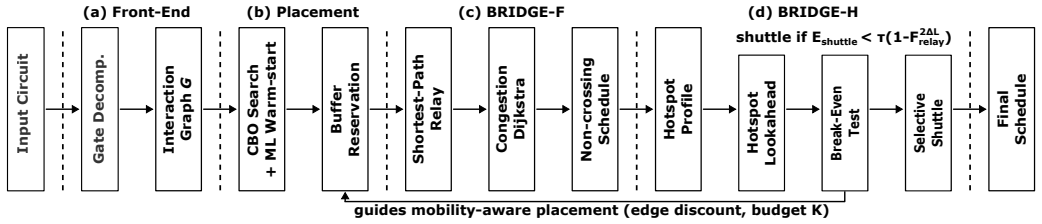
The Buffer-Relay Interconnect for Data-stable Gate Execution (BRIDGE), which builds a static routing backbone from buffer atoms in a dual-species array to allow compiler-directed lazy moves instead of full shuttling.
What would settle it
An experiment on a physical dual-species array showing that data-data crosstalk cannot be suppressed enough to maintain the claimed fidelity advantage while still enabling buffer-mediated gates, or benchmark runs under the shared error model that fail to reproduce the reported geometric-mean gains.
Extended reading notes
Core claim
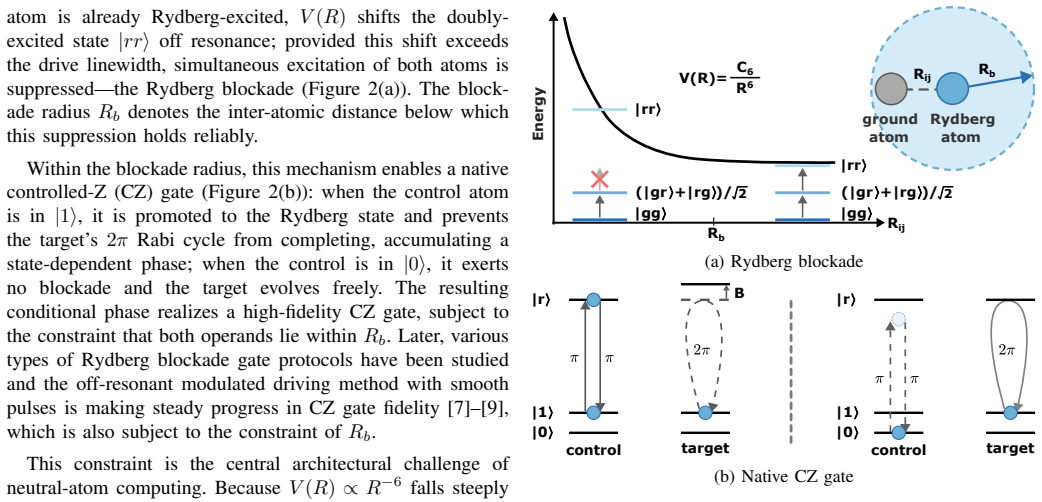
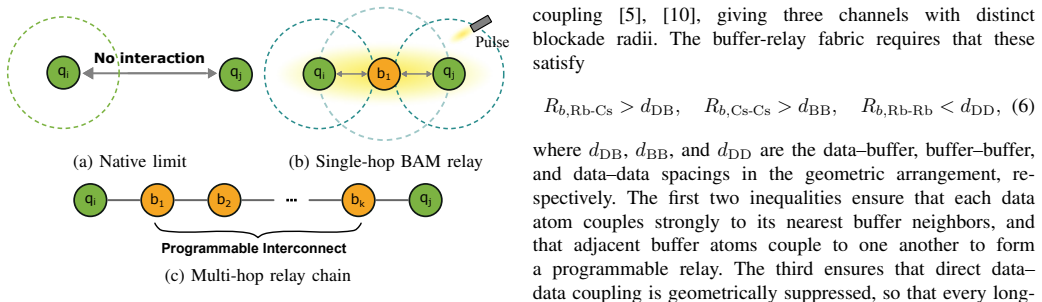
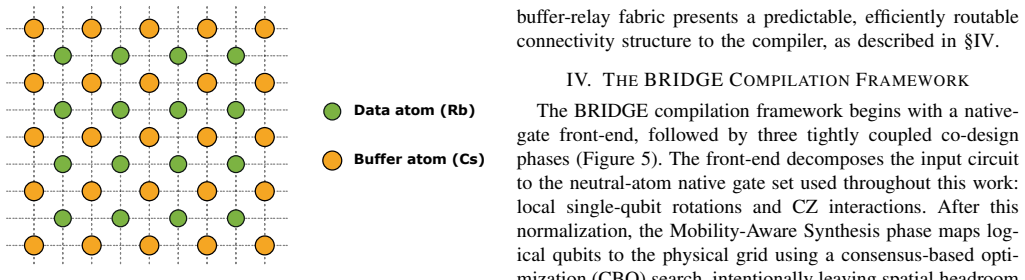
BRIDGE co-designs a static, compiler-managed buffer-relay fabric with a lazy-move compiler on an optimized dual-species 2D interleaved atom array; non-encoding buffer atoms mediate long-range interactions through heteronuclear and homonuclear Rydberg channels, enabling data-buffer and buffer-buffer couplings while residual data-data crosstalk is suppressed, so that data atoms remain in place except at selected hotspots.
Load-bearing premise
A dual-species 2D interleaved atom array with calibrated heteronuclear and homonuclear Rydberg channels can form a static routing backbone that enables data-buffer interactions while suppressing data-data crosstalk.
Editorial extensions
If this is right
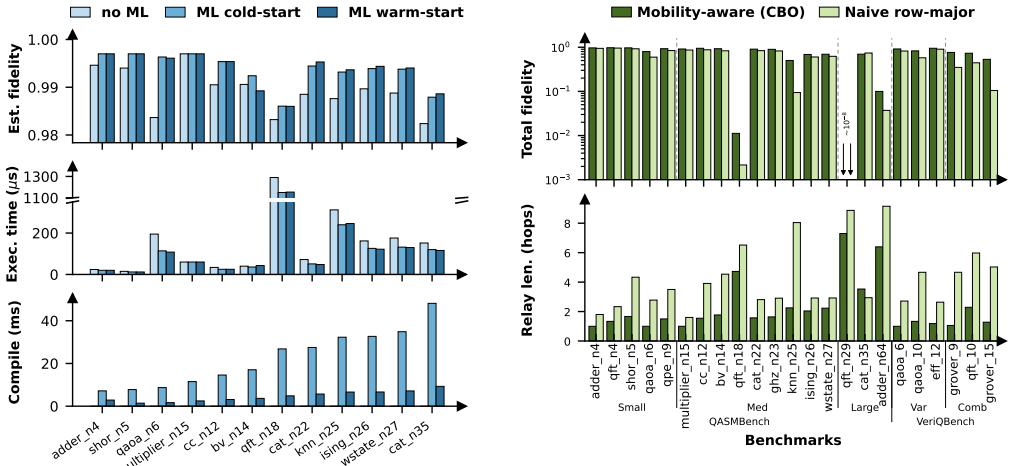
- Data-atom transport events drop from thousands to zero across the benchmark suite.
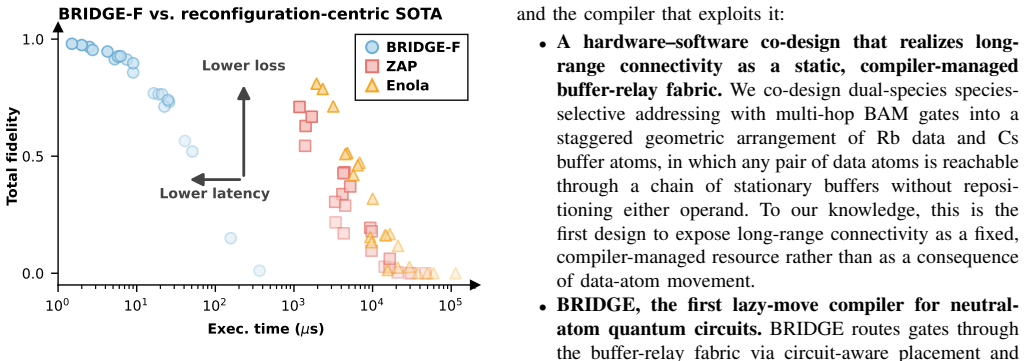
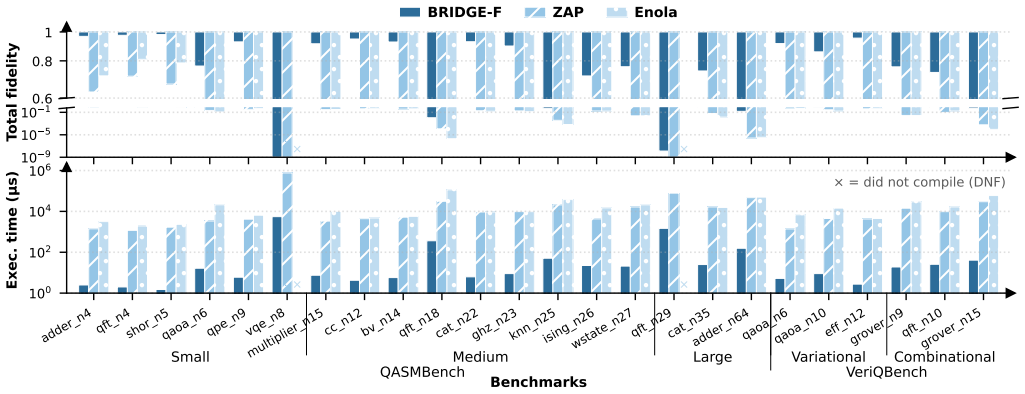
- Geometric-mean total fidelity rises by a factor of approximately 10 relative to ZAP and 16 relative to Enola.
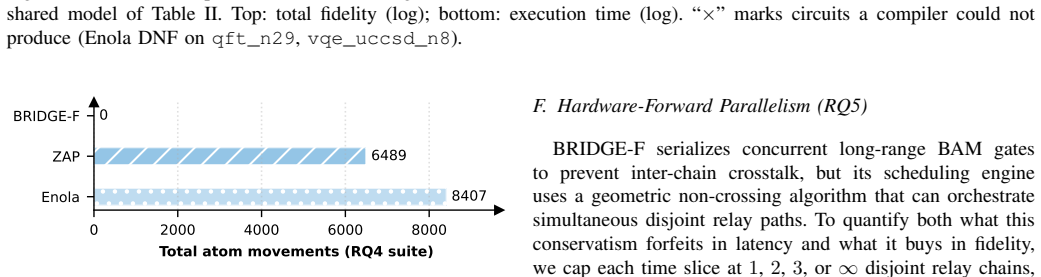
- Circuit execution time falls by factors of roughly 540 relative to ZAP and 1000 relative to Enola.
- The static backbone permits the compiler to schedule most gates without physical atom movement.
Reading between the lines
- The same static-fabric idea could reduce hardware demands for atom-transport actuators in larger arrays.
- Limited data motion at hotspots might combine with existing error-correction codes to further extend coherence.
- If the dual-species calibration generalizes, similar buffer-relay layers could appear in other shuttling-based qubit technologies.
- Compiler passes that assume a fixed backbone may become standard once the crosstalk suppression is demonstrated at scale.
Signed reviews
Editorial analysis
A structured set of objections, weighed in public.
Referee Report
Summary. The paper introduces BRIDGE, a Buffer-Relay Interconnect for Data-stable Gate Execution, that co-designs a static buffer-relay fabric in a dual-species 2D interleaved neutral-atom array with a lazy-move compiler. It claims that, under a single shared error model, BRIDGE delivers geometric-mean ~10× higher total fidelity than ZAP and ~16× higher than Enola across a 22-circuit benchmark suite, together with ~540× and ~1000× lower execution time, while eliminating data-atom transport events.
Significance. If the underlying error model and crosstalk assumptions hold, the result would be significant for neutral-atom quantum computing: it offers a concrete route to avoid movement-induced errors (handoff, heating, loss) that currently limit fidelity in reconfigurable arrays, while preserving flexible connectivity through a compiler-managed static backbone.
major comments (2)
- [Abstract / hardware assumptions] Abstract and hardware-description section: the ~10×/~16× fidelity and zero-movement claims are obtained by re-estimating all 22 circuits under a shared error model that presupposes a static routing backbone; the manuscript supplies neither measured nor calculated interaction matrices (e.g., heteronuclear vs. homonuclear C6 coefficients at the relevant lattice vectors) nor an explicit bound showing residual data-data crosstalk remains below the per-gate error budget used in the fidelity calculation.
- [Benchmark evaluation] Benchmark and error-model section: because the performance numbers rest on a single shared error model whose parameters, assumptions, and validation against device data are not reported, it is impossible to determine whether the reported fidelity and runtime gains are robust or are artifacts of the model’s selectivity assumptions.
minor comments (2)
- [Introduction] Notation for “buffer atoms” and “data atoms” should be introduced with a short table or diagram in the first section that defines their roles and species assignment.
- [Evaluation] The 22-circuit suite is described only as “matched”; a brief table listing circuit names, qubit counts, and gate depths would improve reproducibility.
Simulated Author's Rebuttal
We thank the referee for the constructive comments on the hardware assumptions and error-model transparency. We address both points below and will incorporate the requested details in the revised manuscript.
read point-by-point responses
-
Referee: [Abstract / hardware assumptions] Abstract and hardware-description section: the ~10×/~16× fidelity and zero-movement claims are obtained by re-estimating all 22 circuits under a shared error model that presupposes a static routing backbone; the manuscript supplies neither measured nor calculated interaction matrices (e.g., heteronuclear vs. homonuclear C6 coefficients at the relevant lattice vectors) nor an explicit bound showing residual data-data crosstalk remains below the per-gate error budget used in the fidelity calculation.
Authors: The manuscript states that BRIDGE relies on calibrated heteronuclear and homonuclear Rydberg channels to realize the static backbone while suppressing data-data crosstalk. We agree that explicit interaction matrices and a quantitative crosstalk bound are not included in the current version. In the revision we will add an appendix containing the calculated C6 coefficients for the relevant lattice vectors together with an explicit upper bound on residual data-data crosstalk relative to the per-gate error budget used in the fidelity estimates. revision: yes
-
Referee: [Benchmark evaluation] Benchmark and error-model section: because the performance numbers rest on a single shared error model whose parameters, assumptions, and validation against device data are not reported, it is impossible to determine whether the reported fidelity and runtime gains are robust or are artifacts of the model’s selectivity assumptions.
Authors: The benchmark section re-estimates all 22 circuits under one shared error model, but we acknowledge that the full parameter list, modeling assumptions, and any literature-based validation are not presented in sufficient detail. In the revision we will expand the error-model section to enumerate every parameter and assumption and to cite the device-calibration references used to set those values, thereby allowing readers to assess robustness directly. revision: yes
Circularity Check
No significant circularity; claims rest on external benchmarks
full rationale
The paper presents BRIDGE as a co-designed architecture and compiler, with central claims consisting of geometric-mean fidelity and runtime improvements measured on a 22-circuit benchmark suite re-evaluated under one shared error model. No equations, derivations, or fitted parameters are shown to reduce to the authors' own inputs by construction. The error model incorporates hardware assumptions (dual-species interleaved array, heteronuclear/homonuclear Rydberg selectivity), but these are stated as design premises rather than derived results; the performance numbers are obtained by direct comparison against external compilers (ZAP, Enola) and are therefore falsifiable outside the paper. No self-citation chains, ansatzes smuggled via prior work, or renaming of known results appear as load-bearing steps. This is the normal case of a self-contained empirical comparison.
Assumptions & free parameters
free parameters (1)
- shared error model parameters
assumptions (1)
- domain assumption A dual-species 2D interleaved atom array can be realized such that heteronuclear and homonuclear Rydberg channels enable data-buffer and buffer-buffer interactions while suppressing data-data crosstalk.
invented entities (1)
-
buffer atoms
Cite this review
Pith. "Pith review of Lazy-Move Compilation for Neutral-Atom Quantum Computers via a Buffer-Relay Fabric." pith.science (2026). https://pith.science/paper/O7XMHCY3
@misc{pith2026260631833,
  author       = {Pith},
  title        = {Pith review of: Lazy-Move Compilation for Neutral-Atom Quantum Computers via a Buffer-Relay Fabric},
  year         = {2026},
  howpublished = {\url{https://pith.science/paper/O7XMHCY3}},
  note         = {Machine review of arXiv:2606.31833}
}
abstract
Neutral atom quantum computing offers strong scalability and flexible qubit connectivity, but most existing compilation flows rely on reconfigurable atom arrays that physically shuttle qubit atoms during execution. Although this approach improves connectivity, it also introduces handoff errors, motional heating, and atom-loss risks that can degrade overall fidelity. We present BRIDGE, a Buffer-Relay Interconnect for Data-stable Gate Execution that co-designs a static, compiler-managed buffer-relay fabric with a lazy-move compiler that exploits it. BRIDGE targets an optimized, dual-species 2D interleaved atom array, using non-encoding ``buffer atoms'' to mediate long-range interactions in the fixed baseline and introducing limited data motion only for selected hotspots. By using calibrated heteronuclear and homonuclear Rydberg channels, BRIDGE realizes a static routing backbone in which data-buffer and buffer-buffer interactions are enabled while residual data-data crosstalk is suppressed. Across a 22-circuit matched benchmark suite re-estimated under a single shared error model, BRIDGE attains a geometric-mean $\sim$10$\times$ higher total fidelity than ZAP and $\sim$16$\times$ than Enola, together with $\sim$540$\times$ and $\sim$1000$\times$ lower circuit execution time, respectively, while reducing data-atom movement from thousands of transport events to zero.
Figures
Figures from the paper (12 more)


Forward citations
Cited by 1 Pith paper
-
M\"obius-Guided Diagonal-Gate Compilation with Native Multiqubit Controlled-Phase Gates on Neutral-Atom Processors
Möbius inversion turns diagonal phase layers into phase hypergraphs that a neutral-atom scheduler can execute as native multiqubit controlled-phase gates when routing and error costs favor them.
Reference graph
Works this paper leans on
-
[1]
Quantum computing with neutral atoms,
L. Henriet, L. Beguin, A. Signoles, T. Lahaye, A. Browaeys, G.-O. Reymond, and C. Jurczak, “Quantum computing with neutral atoms,” vol. 4, p. 327
-
[2]
Quantum information with rydberg atoms,
M. Saffman, T. G. Walker, and K. Mølmer, “Quantum information with rydberg atoms,” vol. 82, no. 3, pp. 2313–2363
-
[3]
Superconducting circuits for quan- tum information: An outlook,
M. H. Devoret and R. J. Schoelkopf, “Superconducting circuits for quan- tum information: An outlook,”Science, vol. 339, no. 6124, pp. 1169– 1174, 2013
work page 2013
-
[4]
An atom-by-atom assembler of defect-free arbitrary two-dimensional atomic arrays,
D. Barredo, S. de L ´es´eleuc, V . Lienhard, T. Lahaye, and A. Browaeys, “An atom-by-atom assembler of defect-free arbitrary two-dimensional atomic arrays,”Science, vol. 354, no. 6315, pp. 1021–1023, 2016
work page 2016
-
[5]
P. M. Ireland, D. M. Walker, and J. D. Pritchard, “Interspecies f ¨orster resonances for rb-cs rydbergd-states for enhanced multi-qubit gate fidelities,”Phys. Rev. Res., vol. 6, p. 013293, Mar 2024
work page 2024
-
[6]
Buffer-atom-mediated quantum logic gates with off-resonant modulated driving,
Y . Sun, “Buffer-atom-mediated quantum logic gates with off-resonant modulated driving,” vol. 67, no. 12, p. 120311
-
[7]
Controlled phase gate protocol for neutral atoms via off-resonant modulated driving,
Y . Sun, P. Xu, P.-X. Chen, and L. Liu, “Controlled phase gate protocol for neutral atoms via off-resonant modulated driving,”Physical Review Applied, vol. 13, p. 024059, feb 2020
work page 2020
-
[8]
Z. Fu, P. Xu, Y . Sun, Y .-Y . Liu, X.-D. He, X. Li, M. Liu, R.-B. Li, J. Wang, L. Liu, and M.-S. Zhan, “High-fidelity entanglement of neutral atoms via a rydberg-mediated single-modulated-pulse controlled-phase gate,”Physical Review A, vol. 105, p. 042430, apr 2022
work page 2022
Show all 36 references
-
[9]
High-fidelity entangling gates and nonlocal circuits with neutral atoms,
S. J. Evered, M. Xu, S. H. Li, A. A. Geim, J. P. B. Ataides, M. Kali- nowski, D. Bluvstein, N. Maskara, C. Kokail, M. Greiner, V . Vuleti ´c, and M. D. Lukin, “High-fidelity entangling gates and nonlocal circuits with neutral atoms,” apr 2026
2026
-
[10]
A dual-species rydberg array,
S. Anand, C. E. Bradley, R. White, V . Ramesh, K. Singh, and H. Bernien, “A dual-species rydberg array,”Nature Physics, vol. 20, pp. 1744–1750, sep 2024
2024
-
[11]
Speed, retention loss, and motional heating of atoms in an optical conveyor belt,
G. T. Hickman and M. Saffman, “Speed, retention loss, and motional heating of atoms in an optical conveyor belt,”Physical Review A, vol. 101, p. 063411, jun 2020
2020
-
[12]
Optimal control transport of neutral atoms in optical tweezers at finite temperature,
A. Pagano, D. Jaschke, W. Weiss, and S. Montangero, “Optimal control transport of neutral atoms in optical tweezers at finite temperature,” Physical Review Research, vol. 6, p. 033282, sep 2024
2024
-
[13]
A quantum processor based on coherent transport of entangled atom arrays,
D. Bluvstein, H. Levine, G. Semeghini, T. T. Wang, S. Ebadi, M. Kali- nowski, A. Keesling, N. Maskara, H. Pichler, M. Greiner, V . Vuleti ´c, and M. D. Lukin, “A quantum processor based on coherent transport of entangled atom arrays,”Nature, vol. 604, pp. 451–456, apr 2022
2022
-
[14]
Coherent transport of atomic quantum states in a scalable shift register,
A. Lengwenus, J. Kruse, M. Schlosser, S. Tichelmann, and G. Birkl, “Coherent transport of atomic quantum states in a scalable shift register,” Physical Review Letters, vol. 105, p. 170502, oct 2010
2010
-
[15]
Qasmbench: A low- level quantum benchmark suite for nisq evaluation and simulation,
A. Li, S. Stein, S. Krishnamoorthy, and J. Ang, “Qasmbench: A low- level quantum benchmark suite for nisq evaluation and simulation,”ACM Transactions on Quantum Computing, vol. 4, pp. 1–26, feb 2023
2023
-
[16]
Veriqbench: A benchmark for multiple types of quantum circuits,
K. Chen, W. Fang, J. Guan, X. Hong, M. Huang, J. Liu, Q. Wang, and M. Ying, “Veriqbench: A benchmark for multiple types of quantum circuits,” jun 2022
2022
-
[17]
Dual- element, two-dimensional atom array with continuous-mode operation,
K. Singh, S. Anand, A. Pocklington, J. T. Kemp, and H. Bernien, “Dual- element, two-dimensional atom array with continuous-mode operation,” Physical Review X, vol. 12, p. 011040, jan 2022
2022
-
[18]
Consequences of zeeman degeneracy for the van der waals blockade between rydberg atoms,
T. G. Walker and M. Saffman, “Consequences of zeeman degeneracy for the van der waals blockade between rydberg atoms,”Phys. Rev. A, vol. 77, p. 032723, Mar 2008
2008
-
[19]
Rydberg-blockade controlled- not gate and entanglement in a two-dimensional array of neutral-atom qubits,
K. M. Maller, M. T. Lichtman, T. Xia, Y . Sun, M. J. Piotrowicz, A. W. Carr, L. Isenhower, and M. Saffman, “Rydberg-blockade controlled- not gate and entanglement in a two-dimensional array of neutral-atom qubits,”Physical Review A, vol. 92, p. 022336, aug 2015
2015
-
[20]
Parallel implementation of high-fidelity multiqubit gates with neutral atoms,
H. Levine, A. Keesling, G. Semeghini, A. Omran, T. T. Wang, S. Ebadi, H. Bernien, M. Greiner, V . Vuleti´c, H. Pichler, and M. D. Lukin, “Parallel implementation of high-fidelity multiqubit gates with neutral atoms,” Physical Review Letters, vol. 123, p. 170503, oct 2019
2019
-
[21]
Logical quantum processor based on reconfigurable atom arrays,
D. Bluvstein, S. J. Evered, A. A. Geim, S. H. Li, H. Zhou, T. Manovitz, S. Ebadi, M. Cain, M. Kalinowski, D. Hangleiter, J. P. Bonilla Ataides, N. Maskara, I. Cong, X. Gao, P. Sales Rodriguez, T. Karolyshyn, G. Semeghini, M. J. Gullans, M. Greiner, V . Vuleti ´c, and M. D. Luk...
2023
-
[22]
High-fidelity parallel entangling gates on a neutral-atom quantum computer,
S. J. Evered, D. Bluvstein, M. Kalinowski, S. Ebadi, T. Manovitz, H. Zhou, S. H. Li, A. A. Geim, T. T. Wang, N. Maskara, H. Levine, G. Semeghini, M. Greiner, V . Vuleti´c, and M. D. Lukin, “High-fidelity parallel entangling gates on a neutral-atom quantum computer,”Nature, vol...
2023
-
[23]
A tweezer array with 6,100 highly coherent atomic qubits,
H. J. Manetsch, G. Nomura, E. Bataille, X. Lv, K. H. Leung, and M. Endres, “A tweezer array with 6,100 highly coherent atomic qubits,” Nature, vol. 647, pp. 60–67, sep 2025
2025
-
[24]
Zap: Zoned architecture and performant compiler for field programmable atom array,
C. Huang, X. Zhao, H. Xu, W. Zhuang, M.-J. Hu, D. E. Liu, and J. Wang, “Zap: Zoned architecture and performant compiler for field programmable atom array,”IEEE Transactions on Quantum Engineer- ing, vol. PP, pp. 1–19, may 2026
2026
-
[25]
Compilation for dynamically field- programmable qubit arrays with efficient and provably near-optimal scheduling,
D. B. Tan, W.-H. Lin, and J. Cong, “Compilation for dynamically field- programmable qubit arrays with efficient and provably near-optimal scheduling,” inProceedings of the 30th Asia and South Pacific De- sign Automation Conference, pp. 921–929, Association for Computing Machin...
2025
-
[26]
Compiling quantum circuits for dynamically field-programmable neutral atoms array processors,
D. B. Tan, M. Y . Niu, and J. Cong, “Compiling quantum circuits for dynamically field-programmable neutral atoms array processors,” Quantum, vol. 8, p. 1281, 2024
2024
-
[27]
Atomique: A quantum compiler for reconfigurable neutral atom arrays,
H. Wang, P. Liu, D. B. Tan, Y . Liu, J. Gu, D. Z. Pan, J. Cong, U. A. Acar, and S. Han, “Atomique: A quantum compiler for reconfigurable neutral atom arrays,” in2024 ACM/IEEE 51st Annual International Symposium on Computer Architecture (ISCA), pp. 293–309, Institute of Electri...
2024
-
[28]
Parallax: A compiler for neutral atom quantum computers under hardware constraints,
J. Ludmir and T. Patel, “Parallax: A compiler for neutral atom quantum computers under hardware constraints,” inSC24: International Con- ference for High Performance Computing, Networking, Storage and Analysis, pp. 1–17, Institute of Electrical and Electronics Engineers (IEEE)...
2024
-
[29]
Reuse-aware compilation for zoned quantum architectures based on neutral atoms,
W.-H. Lin, D. B. Tan, and J. Cong, “Reuse-aware compilation for zoned quantum architectures based on neutral atoms,” in2025 IEEE 17 International Symposium on High Performance Computer Architecture (HPCA), vol. 00, pp. 127–142, Institute of Electrical and Electronics Engineers...
2025
-
[30]
Pow- ermove: Optimizing compilation for neutral atom quantum computers with zoned architecture,
J. Ruan, X. Fang, H. Zhang, A. Li, T. Humble, and Y . Ding, “Pow- ermove: Optimizing compilation for neutral atom quantum computers with zoned architecture,” inProceedings of the 30th ACM International Conference on Architectural Support for Programming Languages and Operating...
2025
-
[31]
Physics-aware compilation for parallel quantum circuit execution on neutral atom arrays,
G. Chen, G. Yang, W. Sun, L. Yu, G. Deng, D. Zheng, and X. Li, “Physics-aware compilation for parallel quantum circuit execution on neutral atom arrays,” 2025
2025
-
[32]
Q- pilot: Field programmable qubit array compilation with flying ancillas,
H. Wang, D. B. Tan, P. Liu, Y . Liu, J. Gu, J. Cong, and S. Han, “Q- pilot: Field programmable qubit array compilation with flying ancillas,” inProceedings of the 61st ACM/IEEE Design Automation Conference, DAC ’24, (New York, NY , USA), Association for Computing Machinery, 2024
2024
-
[33]
Two-qubit entangling gates between distant atomic qubits in a lattice,
A. Cesa and J. Martin, “Two-qubit entangling gates between distant atomic qubits in a lattice,”Physical Review A, vol. 95, p. 052330, may 2017
2017
-
[34]
Compiler framework for directional transport in zoned neutral atom systems with aod assistance: A hybrid remote cz approach,
L. Kong, C. Huang, Z. Zhang, Y . Zhou, X. Ren, S. Li, and Z. Liang, “Compiler framework for directional transport in zoned neutral atom systems with aod assistance: A hybrid remote cz approach,” in2026 63rd ACM/IEEE Design Automation Conference (DAC), 2026
2026
-
[35]
Tackling the qubit mapping problem for nisq-era quantum devices,
G. Li, Y . Ding, and Y . Xie, “Tackling the qubit mapping problem for nisq-era quantum devices,” inProceedings of the 24th International Conference on Architectural Support for Programming Languages and Operating Systems (ASPLOS), pp. 1001–1014, 2019
2019
-
[36]
t|ket⟩: A retargetable compiler for nisq devices,
S. Sivarajah, S. Dilkes, A. Cowtan, W. Simmons, A. Edgington, and R. Duncan, “t|ket⟩: A retargetable compiler for nisq devices,”Quantum Science and Technology, vol. 6, no. 1, p. 014003, 2020. 18
2020
Reviewed July 1, 2026 · model on record in the stance chip above.
Discussion (0). Continue with ORCID to comment.