Evidence for Millihertz Oscillations in the bright atoll source GX 3+1
Pith reviewed 2026-07-01 04:06 UTC · model grok-4.3
The pith
Millihertz QPOs appear in GX 3+1 at luminosities higher than those seen in other neutron-star binaries.
A machine-rendered reading of the paper's core claim, the machinery that carries it, and where it could break.
Core claim
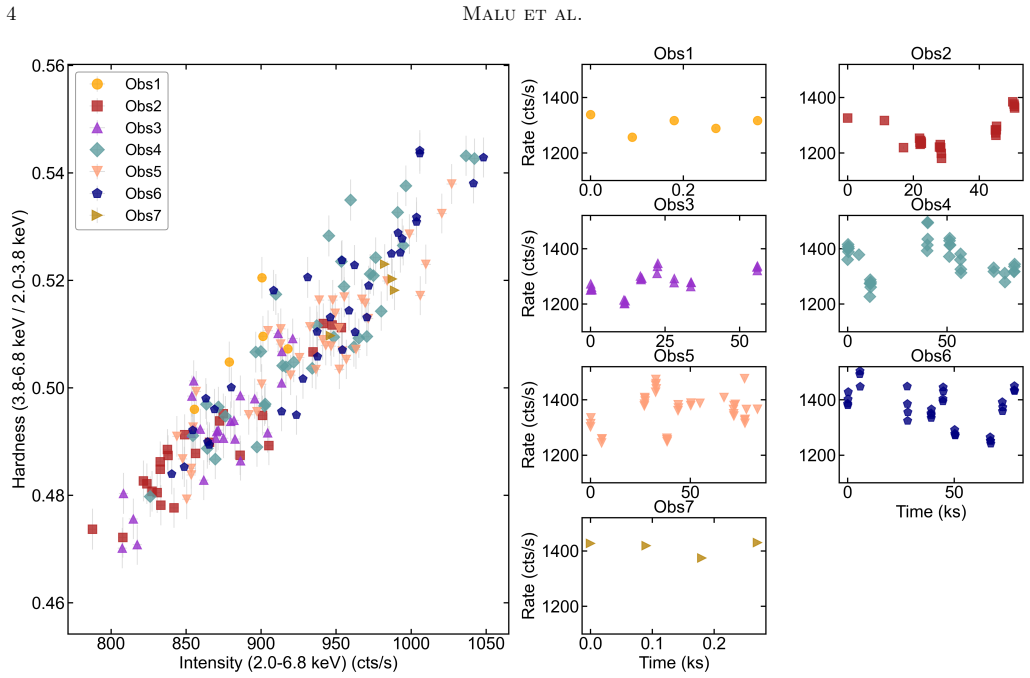
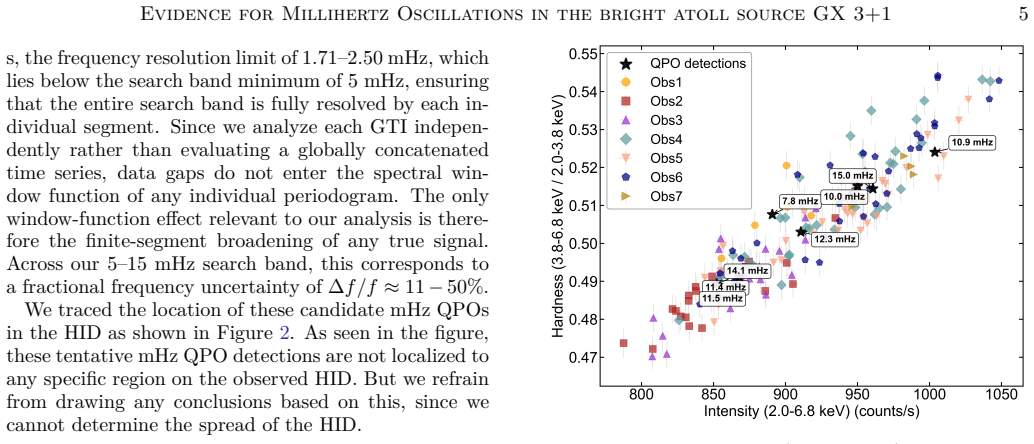
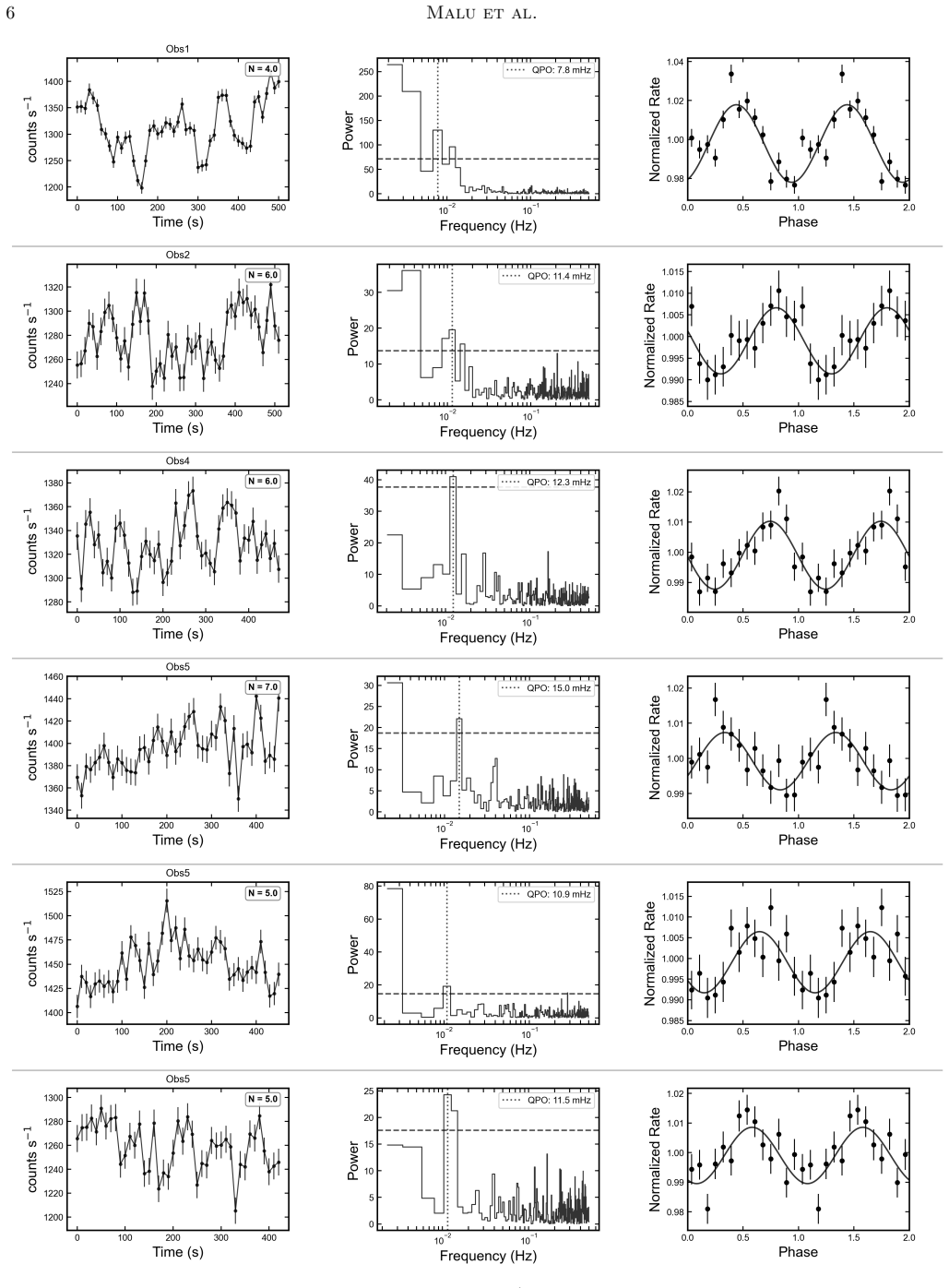
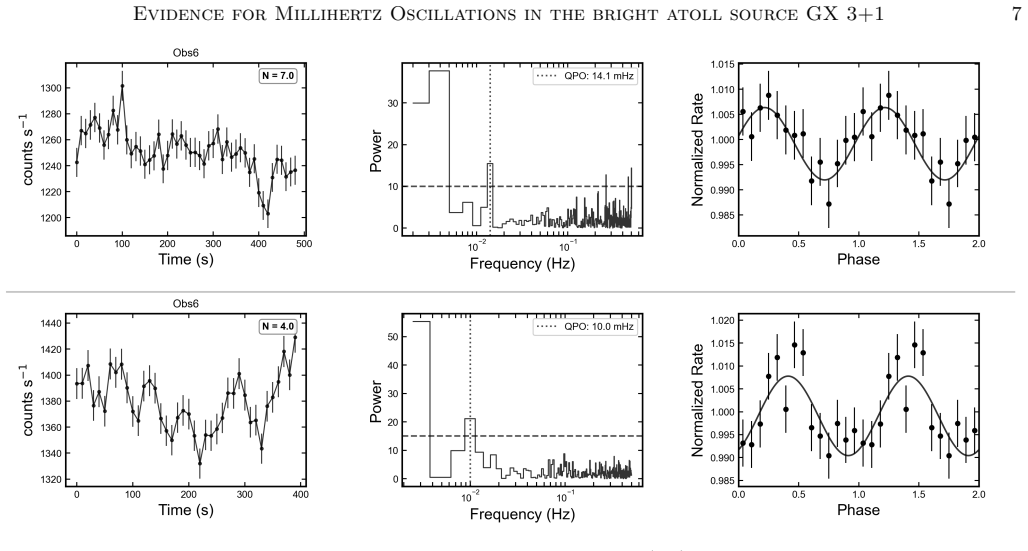
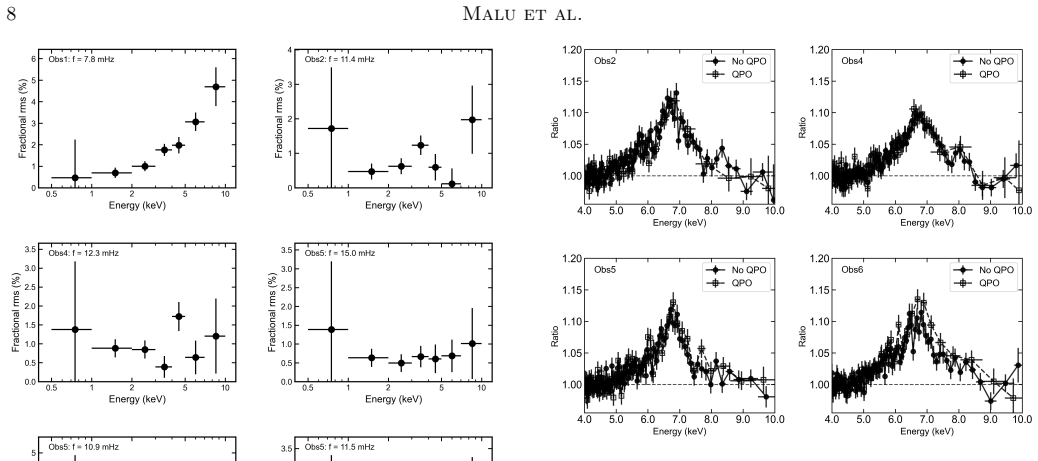
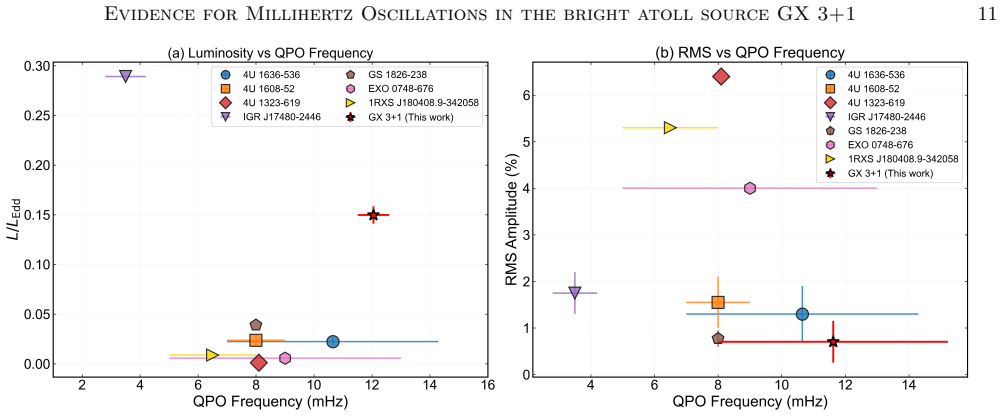
Evidence exists for millihertz QPOs in GX 3+1 in the 7-15 mHz band with rms amplitudes 0.51-1.41 percent. The features were found across seven datasets, with one retaining >95 percent global significance after correction. Their rms-energy behavior is generally increasing but can pivot near 3-4 keV or ~5 keV, and they appear at higher luminosity than in other NS LMXBs. No relation is found between QPO properties and hardness-intensity diagram location. These traits align with literature values for frequency and amplitude yet differ in luminosity and rms-energy pivot, challenging existing considerations of mHz QPO origin.
What carries the argument
Millihertz quasi-periodic oscillations detected in NICER 0.5-10 keV power spectra, whose frequency, rms amplitude, energy dependence, and luminosity context carry the argument about their presence and implications.
If this is right
- mHz QPOs can occur at higher luminosities than previously associated with other NS LMXBs.
- The rms-energy relation can show a pivot near 5 keV in addition to the ~3 keV pivot reported elsewhere.
- QPO properties show no systematic link to the source's location in the hardness-intensity diagram.
- Existing models of mHz QPO production must accommodate both the higher-luminosity regime and the range of observed energy pivots.
Where Pith is reading between the lines
- If the higher-luminosity detections hold, mHz QPOs may arise under a wider range of accretion conditions than current models assume.
- Targeted NICER or future X-ray timing observations at intermediate luminosities could map whether a sharp luminosity threshold separates different QPO behaviors.
- The occasional 5 keV pivot hints that the underlying emission region or scattering geometry may shift with source state in ways not captured by single-pivot models.
Load-bearing premise
The candidate signals are real astrophysical oscillations rather than statistical fluctuations or instrumental effects.
What would settle it
Reprocessing the same seven NICER datasets and finding that none of the eight candidates exceed the 95 percent global significance threshold after trial correction.
Figures
read the original abstract
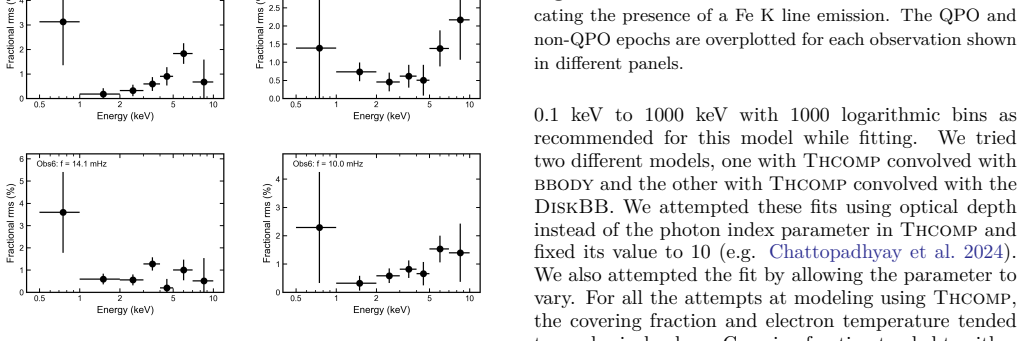
We report evidence for millihertz (mHz) QPOs in the bright atoll neutron star low-mass X-ray binary (NS LMXB) source GX 3+1 using NICER in the 0.5--10 keV energy band. Across 7 observational datasets obtained over 6 days, we made 8 candidate mHz QPO detections with local significance above 95%, one of which remains above 95% global significance after the trial correction. These mHz QPOs were detected in the 7--15 mHz frequency range and had fractional rms amplitudes ranging from 0.51--1.41%. Our studies indicate no association between the hardness intensity diagram location of the candidate QPOs and their rms amplitudes. There appears to be a monotonous increase in rms with energy, except in some observations where there is a pivot around 3--4 keV or at ~ 5 keV. Previous studies of mHz QPOs in other sources in literature indicate a pivot around 3 keV in the rms-energy relation, but in our study some tentative detections suggest a pivot at around ~ 5 keV, though the large uncertainties in most cases prevent a robust statistical claim. Although properties such as the frequency range of detection and fractional rms amplitudes of the mHz QPOs in our study are well in agreement with that in literature for other NS LMXBs, the luminosity at which these candidate QPOs occur are higher than that of other sources. The rms-energy relation of the candidate mHz QPOs and the luminosity at which they occur challenges some of the existing considerations of mHz QPO origin.
Editorial analysis
A structured set of objections, weighed in public.
Referee Report
Summary. The paper reports evidence for millihertz QPOs in the bright atoll NS LMXB GX 3+1 from seven NICER datasets spanning six days. It identifies eight candidate detections in the 7-15 mHz range with local significance >95%, one of which survives >95% global significance after trial correction. Fractional rms amplitudes range from 0.51-1.41%; the work examines rms-energy relations (noting possible pivots near 3-5 keV), lack of correlation with HID position, and occurrence at higher luminosities than prior mHz QPO reports, arguing this challenges existing origin models.
Significance. If the trial-corrected significance holds under full methodological disclosure, the result would be significant: it extends mHz QPO detections to a new source at higher luminosities while providing energy-resolved rms constraints from NICER. This could falsifiably test models linking mHz QPOs to nuclear burning or disk instabilities that were calibrated on lower-luminosity sources. The direct observational approach carries no circularity or free-parameter fitting burden.
major comments (2)
- [Abstract] Abstract: the central claim of one surviving >95% global detection after trial correction is load-bearing, yet the text supplies neither the total number of trials (frequency bins in 7-15 mHz, segments per dataset, energy bands, or additional searches) nor the correction method (analytic or Monte-Carlo), rendering the global significance unverifiable.
- [Abstract / Methods] The manuscript provides no description of power-spectrum computation (normalization convention, segment length, averaging, or red-noise modeling), which directly affects both local significance thresholds and the validity of the trial factor; this omission prevents independent assessment of the eight local >95% candidates.
minor comments (1)
- [Abstract] The rms-energy pivot discussion cites literature values near 3 keV but reports tentative ~5 keV pivots without quantifying uncertainties or performing a statistical test for the difference.
Simulated Author's Rebuttal
We thank the referee for the detailed and constructive report. The two major comments correctly identify omissions in the description of the analysis methods and trial accounting. We will revise the manuscript to supply these details in full, allowing independent verification of both local and global significances.
read point-by-point responses
-
Referee: [Abstract] Abstract: the central claim of one surviving >95% global detection after trial correction is load-bearing, yet the text supplies neither the total number of trials (frequency bins in 7-15 mHz, segments per dataset, energy bands, or additional searches) nor the correction method (analytic or Monte-Carlo), rendering the global significance unverifiable.
Authors: We agree that the total number of trials and the correction procedure must be stated explicitly. In the revised manuscript we will report: (i) the frequency range and binning searched (7–15 mHz), (ii) the number of independent segments per dataset, (iii) the energy bands examined, (iv) any additional searches performed, and (v) the Monte-Carlo procedure used to derive the global significance threshold. These numbers will be placed in both the abstract and the methods section. revision: yes
-
Referee: [Abstract / Methods] The manuscript provides no description of power-spectrum computation (normalization convention, segment length, averaging, or red-noise modeling), which directly affects both local significance thresholds and the validity of the trial factor; this omission prevents independent assessment of the eight local >95% candidates.
Authors: We accept that a complete description of the power-spectrum analysis is required. The revised manuscript will contain a dedicated methods subsection specifying: the normalization convention (Leahy-normalized power spectra converted to fractional rms), the segment length and overlap used, the averaging procedure across segments, and the treatment of red-noise (including any modeling or simulation-based significance estimation). This information will enable readers to reproduce the local >95% thresholds applied to the eight candidates. revision: yes
Circularity Check
No circularity: direct observational timing analysis
full rationale
The paper performs standard power-spectrum analysis on NICER light curves from seven datasets, reports local significances above 95% for eight candidates in the 7-15 mHz band, and applies a trial correction yielding one global detection above 95%. No equations, fitted parameters, or first-principles derivations are present; the result is a statistical claim on raw timing data. No self-citations are load-bearing, no ansatzes are smuggled, and no predictions reduce to inputs by construction. The method is externally verifiable via independent re-analysis of the public NICER data.
Axiom & Free-Parameter Ledger
Reference graph
Works this paper leans on
-
[1]
A., & Shaham, J., 1985, Nature, 316, 239
Alpar, M. A., & Shaham, J., 1985, Nature, 316, 239
1985
-
[2]
Alpar M. A. Hasinger G. Shaham J. Yancopoulos S., 1992, A&A, 257, 627
1992
-
[3]
Altamirano, D., van der Klis, M., M \'e ndez, M., et al.\ 2008, , 685, 1, 436. doi:10.1086/590897
-
[4]
Altamirano, D., van der Klis, M., Wijnands, R., et al.\ 2008, , 673, 1, L35. doi:10.1086/527355
-
[5]
Altamirano, D., Homan, J., Linares, M., et al.\ 2010, The Astronomer's Telegram, 2952, 1
2010
-
[6]
2006, MNRAS, 367, 801
Arevalo, P., Uttley, P. 2006, MNRAS, 367, 801
2006
-
[7]
A.\ 1996, Astronomical Data Analysis Software and Systems V, 101, 17
Arnaud, K. A.\ 1996, Astronomical Data Analysis Software and Systems V, 101, 17
1996
-
[8]
Bussard, R. W., Weisskopf, M. C., Elsner, R. F., et al.\ 1988, , 327, 284. doi:10.1086/166189
-
[9]
Asai, K., Dotani, T., Nagase, F., et al.\ 1993, , 45, 6, 801. doi:10.1093/pasj/45.6.801
-
[10]
Bachetti, M., Huppenkothen, D., Khan, U., et al.\ 2021, Zenodo, v0.3. doi:10.5281/zenodo.4881255
-
[11]
Bachetti, M., Huppenkothen, D., Khan, U., et al.\ 2021, Zenodo
2021
-
[12]
A., Cook, R., et al.\ 2015, , 800, 109
Bachetti, M., Harrison, F. A., Cook, R., et al.\ 2015, , 800, 109. doi:10.1088/0004-637X/800/2/109
-
[13]
& Huppenkothen, D.\ 2018, , 853, L21
Bachetti, M. & Huppenkothen, D.\ 2018, , 853, L21. doi:10.3847/2041-8213/aaa83b
-
[14]
& Vaughan, S.\ 2012, , 746, 131
Barret, D. & Vaughan, S.\ 2012, , 746, 131. doi:10.1088/0004-637X/746/2/131
-
[15]
Bellavita, C., Garc \' a, F., M \'e ndez, M., et al.\ 2022, , 515, 2099. doi:10.1093/mnras/stac1922
-
[16]
& Hasinger, G.\ 1990, , 227, L33
Belloni, T. & Hasinger, G.\ 1990, , 227, L33
1990
-
[17]
Belloni, T. M., Sanna, A., & M \'e ndez, M.\ 2012, , 426, 1701. doi:10.1111/j.1365-2966.2012.21634.x
-
[18]
Thermonuclear Burning on Rapidly Accreting Neutron Stars
Bildsten, L.\ 1998, The Many Faces of Neutron Stars., 515, 419. doi:10.48550/arXiv.astro-ph/9709094
work page internal anchor Pith review Pith/arXiv arXiv doi:10.48550/arxiv.astro-ph/9709094 1998
-
[19]
M., 2016, ApJ, 826, 103
Cackett E. M., 2016, ApJ, 826, 103
2016
-
[20]
M., Miller, J
Cackett, E. M., Miller, J. M., Bhattacharyya, S., et al. 2008, ApJ, 674, 415
2008
-
[21]
Cackett, E. M., Miller, J. M., Raymond, J., et al.\ 2008, , 677, 2, 1233. doi:10.1086/529483
-
[22]
M., Miller, J
Cackett, E. M., Miller, J. M., Ballantyne, D. R. et al. 2010, ApJ, 720, 205
2010
-
[23]
Casella, P., Belloni, T., & Stella, L.\ 2006, , 446, 579
2006
-
[24]
Chattopadhyay, S., Bhulla, Y., Misra, R., et al.\ 2024, , 528, 4, 6167. doi:10.1093/mnras/stae389
-
[25]
A Python Code for the Emmanoulopoulos et al. [arXiv:1305.0304] Light Curve Simulation Algorithm
Connolly, S. D.\ 2015, , arXiv:1503.06676. doi:10.48550/arXiv.1503.06676
work page internal anchor Pith review Pith/arXiv arXiv doi:10.48550/arxiv.1503.06676 2015
-
[26]
Cooper, R. L. & Narayan, R.\ 2007, , 657, 1, L29. doi:10.1086/513077
-
[27]
Dauser, T., Garcia, J., Parker, M. L., et al.\ 2014, , 444, L100. doi:10.1093/mnrasl/slu125
-
[28]
Dieters S. W. et al., 2000, ApJ, 538, 307
2000
-
[29]
M., Wijnands, R., et al.\ 2013, , 767, L37
Degenaar, N., Miller, J. M., Wijnands, R., et al.\ 2013, , 767, L37. doi:10.1088/2041-8205/767/2/L37
-
[30]
T., & Miller-Jones, J
Ding, H., Deller, A. T., & Miller-Jones, J. C. A. 2021, PASA, 38, e048
2021
-
[31]
Done, C., Gierli \'n ski, M., & Kubota, A.\ 2007, , 15, 1. doi:10.1007/s00159-007-0006-1
-
[32]
& Papadakis, I
Epitropakis, A. & Papadakis, I. E.\ 2017, , 468
2017
-
[33]
Fabian, A. C., Rees, M. J., Stella, L., et al.\ 1989, , 238, 729. doi:10.1093/mnras/238.3.729
-
[34]
Fei, Z., Lyu, M., M \'e ndez, M., et al.\ 2021, , 922, 2, 119. doi:10.3847/1538-4357/ac2501
-
[35]
Ferrigno, C., Bozzo, E., Sanna, A., et al.\ 2017, , 466, 3, 3450. doi:10.1093/mnras/stw3344
-
[36]
J.\ 2002, , 398
Frank, J., King, A., & Raine, D. J.\ 2002, , 398
2002
-
[37]
W., Lang, D., et al.\ 2013, , 125, 306
Foreman-Mackey, D., Hogg, D. W., Lang, D., et al.\ 2013, , 125, 306. doi:10.1086/670067
-
[38]
K., Miller G
Fortner B., Lamb F. K., Miller G. S., 1989, Nature, 342, 775
1989
-
[39]
F., Iaria, R., Di Salvo, T., et al.\ 2016, , 589, A34
Gambino, A. F., Iaria, R., Di Salvo, T., et al.\ 2016, , 589, A34. doi:10.1051/0004-6361/201527512
-
[40]
Galloway, D. K., Muno, M. P., Hartman, J. M., et al.\ 2008, , Thermonuclear (Type-I) X-Ray Bursts Observed by the Rossi X-Ray Timing Explorer, 179, 2, 360. doi:10.1086/592044
-
[41]
doi:10.1051/0004-6361/202452642
Gnarini, A., Farinelli, R., Ursini, F., et al.\ 2024, , 692, A123. doi:10.1051/0004-6361/202452642
-
[42]
doi:10.1088/0004-637X/782/2/76
Garc \' a, J., Dauser, T., Lohfink, A., et al.\ 2014, , 782, 2, 76. doi:10.1088/0004-637X/782/2/76
-
[43]
Garc \' a, J. A., Steiner, J. F., Grinberg, V., et al.\ 2018, , 864, 1, 25. doi:10.3847/1538-4357/aad231
-
[44]
Gilfanov M., Revnivtsev M., Molkov S., 2003, A&A, 410, 217
2003
-
[45]
Hasinger G., 1987, A&A, 186, 153
1987
-
[46]
1989, A&A, 225, 79
Hasinger G., & van der Klis, M. 1989, A&A, 225, 79
1989
-
[47]
Heger, A., Cumming, A., & Woosley, S. E.\ 2007, , 665, 2, 1311. doi:10.1086/517491
-
[48]
Huppenkothen, D., Bachetti, M., Stevens, A. L., et al.\ 2019, , 881, 39. doi:10.3847/1538-4357/ab258d
-
[49]
Huppenkothen, D., Bachetti, M., Stevens, A., et al.\ 2019, The Journal of Open Source Software, 4, 1393. doi:10.21105/joss.01393
-
[50]
Homan, J., Fridriksson, J. K., & Remillard, R. A.\ 2015, , 812, 1, 80. doi:10.1088/0004-637X/812/1/80
-
[51]
Homan, J., van der Klis, M., Jonker, P. G. et al. 2002, ApJ, 568, 878
2002
-
[52]
Homan, J., van der, Klis M., Fridriksson, J. K. et al. 2010, ApJ, 719, 201
2010
-
[53]
R., et al.\ 2005, , 439, 2, 575
Iaria, R., di Salvo, T., Robba, N. R., et al.\ 2005, , 439, 2, 575. doi:10.1051/0004-6361:20042231
-
[54]
& van der Klis, M.\ 2013, , 434, 1476
Ingram, A. & van der Klis, M.\ 2013, , 434, 1476. doi:10.1093/mnras/stt1107
-
[55]
Ingram, A. & Done, C.\ 2011, , 415, 2323. doi:10.1111/j.1365-2966.2011.18860.x
-
[57]
G., van der Klis, M., Wijnands, R., et al.\ 2000, , 537, 374
Jonker, P. G., van der Klis, M., Wijnands, R., et al.\ 2000, , 537, 374. doi:10.1086/309029
-
[58]
C., Santangelo A., 1999, ApJ,
Kaaret P., Piraino S., Ford E. C., Santangelo A., 1999, ApJ,
1999
-
[59]
Kallman, T. R., Vrtilek, S. D., & Kahn, S. M.\ 1989, , 345, 498. doi:10.1086/167924
-
[60]
Kallman, T. R.\ 1995, , 455, 603. doi:10.1086/176608
-
[61]
Karpouzas, K., M \'e ndez, M., Ribeiro, E. M., et al.\ 2020, , 492, 1399. doi:10.1093/mnras/stz3502
-
[62]
Jia, S. M., Qu, J. L., Lu, F. J., et al.\ 2023, , 521, 3, 4792. doi:10.1093/mnras/stad876
-
[63]
Keek, L., Langer, N., & in't Zand, J. J. M.\ 2009, , 502, 3, 871. doi:10.1051/0004-6361/200911619
-
[64]
Low-energy line emission from Cygnus X-2 observed with the BeppoSAX LECS
Kuulkers, E., Parmar, A. N., Owens, A., et al.\ 1997, , 323, L29. doi:10.48550/arXiv.astro-ph/9706009
work page internal anchor Pith review Pith/arXiv arXiv doi:10.48550/arxiv.astro-ph/9706009 1997
-
[65]
The first radius-expansion X-ray burst from GX 3+1
Kuulkers, E. & van der Klis, M.\ 2000, , 356, L45. doi:10.48550/arXiv.astro-ph/0003180
work page internal anchor Pith review Pith/arXiv arXiv doi:10.48550/arxiv.astro-ph/0003180 2000
-
[66]
Kuulkers, E., den Hartog, P. R., in't Zand, J. J. M., et al.\ 2003, , 399, 663. doi:10.1051/0004-6361:20021781
-
[67]
N., Owens, A., Oosterbroek, T., & Lammers, U
Kuulkers, E., Parmar, A. N., Owens, A., Oosterbroek, T., & Lammers, U. 1997, A&A, 323, L29
1997
-
[68]
Kuulkers, E., van der Klis, M., & Vaughan, B. A. 1996, A&A, 311, 197
1996
-
[69]
K., 1989, in Hunt J
Lamb F. K., 1989, in Hunt J. Battrick B., 23rd ESLAB Symp., Two Topics in X-ray Astronomy, ESA SP-296. ESA, Noordwijk, p. 215
1989
-
[70]
Lazar, H., Tomsick, J. A., Pike, S. N., et al.\ 2021, , 921, 155. doi:10.3847/1538-4357/ac1bab
-
[71]
Lewin, W. H. G., van Paradijs, J., & Taam, R. E.\ 1993, , 62, 3-4, 223. doi:10.1007/BF00196124
-
[72]
Li, Z. S., Kuiper, L., Pan, Y. Y., et al.\ 2024, , 691, A92. doi:10.1051/0004-6361/202451260
-
[73]
Liedahl, D. A., Kahn, S. M., Osterheld, A. L., et al.\ 1990, , 350, L37. doi:10.1086/185662
-
[74]
A., Osterheld, A
Liedahl, D. A., Osterheld, A. L., & Goldstein, W. H. 1995, ApJ, 438, 115
1995
-
[75]
C., Remillard R
Lin D. C., Remillard R. A. and Homan J. 2009 ApJ 696 1277
2009
-
[76]
J., Qu, J
Lei, Y. J., Qu, J. L., Song, L. M. et al. 2008, ApJ, 677, 461
2008
-
[77]
Lewin, W. H. G., van Paradijs, J., Hasinger, G., et al.\ 1987, , 226, 383. doi:10.1093/mnras/226.2.383
-
[78]
A., Homan, J
Lin, D., Remillard, R. A., Homan, J. 2007, ApJ, 667, 1073
2007
-
[79]
Linares, M., Altamirano, D., Watts, A., et al.\ 2010, The Astronomer's Telegram, 2958, 1
2010
-
[80]
doi:10.1088/0004-637X/748/2/82
Linares, M., Altamirano, D., Chakrabarty, D., et al.\ 2012, , 748, 2, 82. doi:10.1088/0004-637X/748/2/82
-
[81]
Lomb, N. R.\ 1976, , 39, 2, 447. doi:10.1007/BF00648343
discussion (0)
Sign in with ORCID, Apple, or X to comment. Anyone can read and Pith papers without signing in.