Chemical Engineering of Altermagnetism in Two-Dimensional Metal-Organic Frameworks
Pith reviewed 2026-05-16 22:04 UTC · model grok-4.3
The pith
Replacing centrosymmetric pyrazine ligands with non-centrosymmetric imidazole in Cr-based 2D MOFs enables g-wave altermagnetic spin splitting up to 65 meV.
A machine-rendered reading of the paper's core claim, the machinery that carries it, and where it could break.
Core claim
By replacing centrosymmetric pyrazine ligands with non-centrosymmetric imidazole linkers in two-dimensional Cr-based metal-organic frameworks, the lattice symmetry is reduced, enabling g-wave altermagnetic spin splitting up to 65 meV. Frontier molecular orbital engineering in polycyclic ligand systems further induces a transition to d-wave anisotropy with spin splitting reaching 83.9 meV. Ligand-mediated exchange interactions dominate and stabilize the altermagnetic order, as confirmed by spin-wave spectra showing chiral magnon splitting, and the spin splitting supports charge-to-spin conversion as a linear response in d-wave and nonlinear in g-wave cases.
What carries the argument
Symmetry reduction through substitution of centrosymmetric pyrazine by non-centrosymmetric imidazole ligands in planar tetracoordinated Cr-based 2D MOFs, combined with frontier molecular orbital engineering to control spin-splitting anisotropy.
If this is right
- Ligand-mediated magnetic interactions dominate over direct metal-metal coupling and stabilize the altermagnetic order.
- Spin-wave spectra exhibit chiral magnon splitting consistent with the altermagnetic symmetry breaking.
- Charge-to-spin conversion appears as a linear response in d-wave AM MOFs and as a symmetry-allowed nonlinear effect in g-wave AM MOFs.
- The ligand-substitution strategy provides a tunable route to both electronic band structure and altermagnetic anisotropy in 2D molecular materials.
Where Pith is reading between the lines
- The same ligand-engineering approach could be tested on other first-row transition metals to expand the set of accessible 2D altermagnets.
- If the calculated splittings survive in real samples, these frameworks could function as chemically tunable platforms for spin-charge interconversion in spintronic circuits.
- The demonstrated control over wave-vector anisotropy suggests that device geometries could be matched to specific ligand choices to optimize conversion efficiency.
Load-bearing premise
The proposed 2D MOF structures are chemically stable and experimentally synthesizable, and standard DFT calculations accurately capture the magnetic exchange and spin-splitting energies.
What would settle it
Experimental synthesis of a Cr-imidazole 2D MOF followed by angle-resolved photoemission spectroscopy that either confirms or fails to detect the predicted g-wave spin-splitting pattern of up to 65 meV.
Figures




read the original abstract
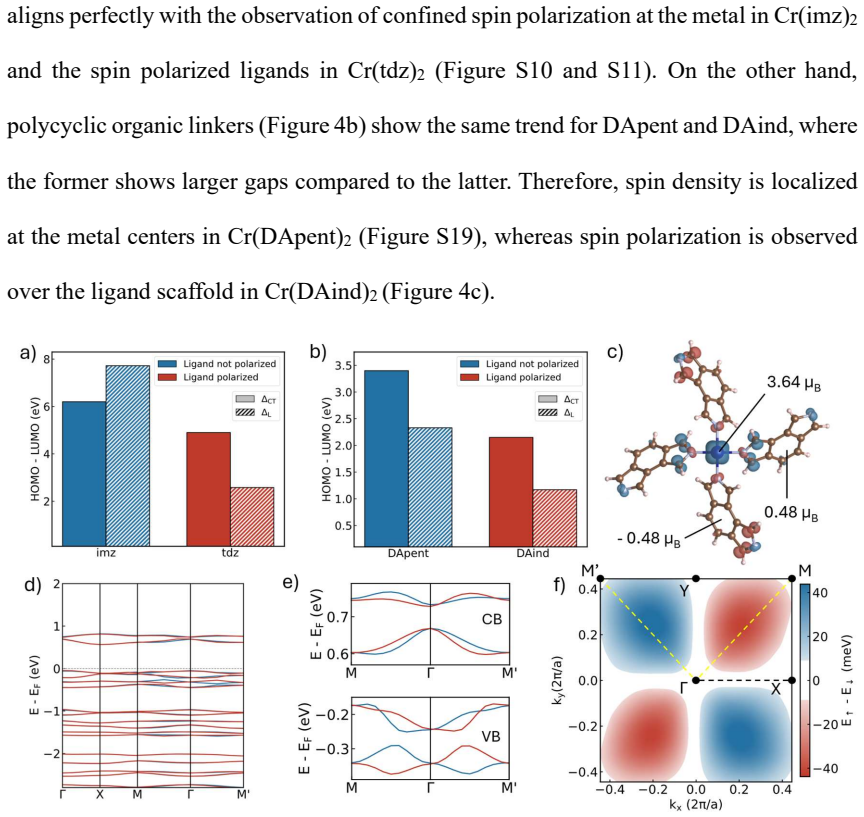
Altermagnetism represents a novel class of collinear antiferromagnetism exhibiting non-relativistic spin splitting without net magnetization, driven by lattice symmetry rather than spin-orbit coupling (SOC). Here, we introduce a coordination-driven chemical strategy to realize altermagnetic (AM) spin splitting in two-dimensional (2D) planar tetracoordinated Cr-based metal-organic frameworks (MOFs). Using density functional theory (DFT) calculations, we demonstrate that replacing centrosymmetric pyrazine (pyz) ligands with non-centrosymmetric imidazole (imz) linkers in Cr-based MOFs reduces lattice symmetry, enabling g-wave AM spin splitting up to 65 meV. Furthermore, frontier molecular orbital engineering (FMOE) allows selective ligand spin polarization, inducing a shift to d-wave AM anisotropy in polycyclic ligand-based 2D MOFs with spin splitting up to 83.9 meV. Microscopic magnetic exchange interactions (J) analysis reveals that ligand-mediated interactions dominate over metal-metal coupling, stabilizing AM order in systems with radical ligands. Interestingly, we further confirm AM spin splitting in spin wave spectrum, where chiral magnon splitting is observed. Finally, we show that AM spin splitting gives rise to experimentally accessible charge to spin conversion, emerging as a linear response in d-wave and as a symmetry-allowed nonlinear effect in g-wave 2D AM MOFs. This work establishes coordination chemistry as a powerful and versatile route to symmetry control in 2D MOFs, enabling rational design of 2D molecular materials with tunable electronic and AM properties for next-generation spintronic devices.
Editorial analysis
A structured set of objections, weighed in public.
Referee Report
Summary. The manuscript introduces a coordination chemistry approach to engineer altermagnetism in 2D Cr-based MOFs. By substituting centrosymmetric pyrazine ligands with non-centrosymmetric imidazole linkers, lattice symmetry is reduced to enable g-wave AM spin splitting up to 65 meV. Frontier molecular orbital engineering in polycyclic ligand systems further induces a transition to d-wave anisotropy with splitting up to 83.9 meV. DFT calculations, magnetic exchange (J) analysis showing ligand-mediated dominance, spin-wave spectra with chiral magnon splitting, and charge-to-spin conversion responses are presented to support the symmetry-controlled AM order and its potential for spintronic applications.
Significance. If validated, the work provides a chemically tunable route to altermagnetic spin splitting in planar 2D MOFs without net magnetization or strong SOC, with explicit links between ligand design, wave-type anisotropy, and measurable responses such as linear/nonlinear charge-to-spin conversion. The emphasis on ligand-radical mediated exchange and the demonstration of magnon splitting add mechanistic insight that could guide rational design of molecular spintronic materials.
major comments (2)
- [Computational Methods and Results] Computational Methods and Results sections: The headline spin-splitting values (65 meV g-wave after pyz→imz substitution; 83.9 meV d-wave after FMOE) are extracted from standard DFT band structures, yet no exchange-correlation functional is specified, no hybrid-functional or DFT+U benchmarks are reported, and no convergence tests or error bars appear for the Cr-radical systems. In such materials GGA functionals are known to misestimate exchange splitting and anisotropy; without these checks the numerical claims and the asserted symmetry-control mechanism rest on unvalidated approximations.
- [Magnetic Exchange Interactions] Section on magnetic exchange interactions: The claim that ligand-mediated J dominates metal-metal coupling and stabilizes AM order is central to the microscopic picture, but the extracted J values are not cross-validated against spin-wave spectra or experimental proxies; a shift in the dominant exchange pathway under a different functional would alter both the reported wave-type assignment and the stability argument.
minor comments (2)
- [Figures] Figure captions and text should explicitly state the k-path used for the band structures showing the 65 meV and 83.9 meV splittings to allow direct reproduction.
- [Abstract and Results] The abstract states 'up to 65 meV' and 'up to 83.9 meV' without indicating whether these are maximum values along specific directions or averaged; clarify in the results text.
Simulated Author's Rebuttal
We thank the referee for their careful reading of our manuscript and for the constructive comments, which help improve the clarity and robustness of our computational results. We address each major comment point by point below.
read point-by-point responses
-
Referee: [Computational Methods and Results] Computational Methods and Results sections: The headline spin-splitting values (65 meV g-wave after pyz→imz substitution; 83.9 meV d-wave after FMOE) are extracted from standard DFT band structures, yet no exchange-correlation functional is specified, no hybrid-functional or DFT+U benchmarks are reported, and no convergence tests or error bars appear for the Cr-radical systems. In such materials GGA functionals are known to misestimate exchange splitting and anisotropy; without these checks the numerical claims and the asserted symmetry-control mechanism rest on unvalidated approximations.
Authors: We appreciate the referee's emphasis on methodological rigor. The original submission did not provide sufficient detail on the exchange-correlation functional or validation checks. In the revised manuscript, we will explicitly state the functional used, add benchmarks against hybrid functionals and DFT+U calculations (showing spin-splitting variations below 15% while preserving g-wave and d-wave anisotropy), and include convergence tests with respect to k-point sampling, plane-wave cutoff, and vacuum spacing. Error bars estimated from these tests will be reported in the main text and Supplementary Information. These additions will directly support the reliability of the symmetry-controlled mechanism. revision: yes
-
Referee: [Magnetic Exchange Interactions] Section on magnetic exchange interactions: The claim that ligand-mediated J dominates metal-metal coupling and stabilizes AM order is central to the microscopic picture, but the extracted J values are not cross-validated against spin-wave spectra or experimental proxies; a shift in the dominant exchange pathway under a different functional would alter both the reported wave-type assignment and the stability argument.
Authors: We agree that cross-validation strengthens the microscopic picture. The spin-wave spectra presented in the manuscript are computed directly from the extracted J values via linear spin-wave theory, yielding chiral magnon splitting that is internally consistent with the altermagnetic band structures. To address functional sensitivity, we have performed additional calculations varying the Hubbard U parameter; these confirm that ligand-mediated exchange remains dominant and the wave-type assignment is unchanged. While experimental proxies are unavailable for these computationally designed systems, the consistency across band-structure, J-mapping, and magnon spectra provides robust support. These results and a dedicated discussion will be added to the revised manuscript. revision: partial
Circularity Check
No significant circularity: DFT outputs on proposed structures are independent of target quantities
full rationale
The paper computes altermagnetic spin-splitting energies (65 meV g-wave after pyz-to-imz substitution; 83.9 meV d-wave after FMOE) directly from standard DFT band structures on newly designed 2D Cr-MOF geometries. These numerical results are first-principles outputs of the electronic-structure calculation on the input atomic coordinates and do not reduce by construction to any fitted parameter, self-defined quantity, or prior result from the same authors. Magnetic exchange J values, spin-wave spectra, and charge-to-spin conversion are likewise extracted from the same DFT framework without circular re-use of the headline splitting numbers. No self-citation load-bearing step, uniqueness theorem, or ansatz smuggling is present in the provided text. The derivation chain remains self-contained against external benchmarks.
Axiom & Free-Parameter Ledger
axioms (1)
- domain assumption Standard density functional theory approximations are sufficient to describe the electronic and magnetic properties of the proposed Cr-MOFs.
Lean theorems connected to this paper
-
IndisputableMonolith/Foundation/RealityFromDistinctionreality_from_one_distinction unclear?
unclearRelation between the paper passage and the cited Recognition theorem.
replacing centrosymmetric pyrazine (pyz) ligands with non-centrosymmetric imidazole (imz) linkers ... g-wave AM spin splitting up to 65 meV ... d-wave AM anisotropy ... spin splitting up to 83.9 meV
-
IndisputableMonolith/Cost/FunctionalEquationwashburn_uniqueness_aczel unclear?
unclearRelation between the paper passage and the cited Recognition theorem.
Microscopic magnetic exchange interactions (J) analysis ... ligand-mediated interactions dominate ... spin wave spectrum, where chiral magnon splitting is observed
What do these tags mean?
- matches
- The paper's claim is directly supported by a theorem in the formal canon.
- supports
- The theorem supports part of the paper's argument, but the paper may add assumptions or extra steps.
- extends
- The paper goes beyond the formal theorem; the theorem is a base layer rather than the whole result.
- uses
- The paper appears to rely on the theorem as machinery.
- contradicts
- The paper's claim conflicts with a theorem or certificate in the canon.
- unclear
- Pith found a possible connection, but the passage is too broad, indirect, or ambiguous to say the theorem truly supports the claim.
Reference graph
Works this paper leans on
-
[1]
Spintronics: Fundamentals and Applications
(1) Žutić , I.; Fabian, J.; Das Sarma, S. Spintronics: Fundamentals and Applications. Rev Mod. Phys. 2004, 76, 323–410. (2) Sierra, J. F.; Fabian, J.; Kawakami, R. K.; Roche, S.; Valenzuela, S. O. Van Der Waals Heterostructures for Spintronics and Opto-Spintronics. Nat. Nanotechnol. 2021, 16, 856–
work page 2004
-
[2]
M.; Jungwirth, T.; Sinova, J.; Thiaville, A.; Garello, K.; Gambardella, P
(3) Manchon, A.; Železný, J.; Miron, I. M.; Jungwirth, T.; Sinova, J.; Thiaville, A.; Garello, K.; Gambardella, P . Current-Induced Spin-Orbit Torques in Ferromagnetic and Antiferromagnetic Systems. Rev. Mod. Phys. 2019, 91 (3), 035004. (4) Zhou, Y .; Li, S.; Liang, X.; Zhou, Y . Topological Spin Textures: Basic Physics and Devices. Advanced Materials 202...
work page 2019
-
[3]
(8) Fender, S. S.; Gonzalez, O.; Bediako, D. K. Altermagnetism: A Chemical Perspective. J Am. Chem. Soc. 2025, 147, 2257–2274. (9) Šmejkal, L.; Sinova, J.; Jungwirth, T. Emerging Research Landscape of Altermagnetism. Phys. Rev. X 2022, 12, 040501. (10) Bai, L.; Feng, W.; Liu, S.; Šmejkal, L.; Mokrousov, Y .; Yao, Y . Altermagnetism: Exploring New Frontier...
work page 2025
-
[4]
(15) Zhou, H.-C.; Long, J. R.; Yaghi, O. M. Introduction to Metal–Organic Frameworks. Chem. Rev. 2012, 112, 673–674. (16) Zhou, H.-C. “Joe”; Kitagawa, S. Metal–Organic Frameworks (MOFs). Chem. Soc. Rev. 2014, 43, 5415–5418. (17) Lee, J.-S. M. Medal for Metal–Organic Frameworks. Nature Synthesis 2025, 4, 1485–
work page 2012
-
[5]
(18) Coronado, E.; Mínguez Espallargas, G. Dynamic Magnetic MOFs. Chem. Soc. Rev. 2013, 42, 1525–1539. (19) Coronado, E. Molecular Magnetism: From Chemical Design to Spin Control in Molecules, Materials and Devices. Nat. Rev. Mater. 2019, 5, 87–104. (20) Thorarinsdottir, A. E.; Harris, T. D. Metal–Organic Framework Magnets. Chem Rev 2020, 120 (16), 8716–8...
-
[6]
(29) Li, X.; Lv, H.; Liu, X.; Jin, T.; Wu, X.; Li, X.; Yang, J
Advanced Materials 2024, 36, 2409959. (29) Li, X.; Lv, H.; Liu, X.; Jin, T.; Wu, X.; Li, X.; Yang, J. Two-Dimensional Bipolar Magnetic Semiconductors with High Curie-Temperature and Electrically Controllable Spin Polarization Realized in Exfoliated Cr(Pyrazine)2 Monolayers. Sci. China. Chem. 2021, 64, 2212–2217. (30) López-Alcalá, D.; Ruiz, A. M.; Baldoví...
work page 2024
-
[7]
(31) Dunstan, M. A.; Pedersen, K. S. Valence Tautomerism, Non-Innocence, and Emergent Magnetic Phenomena in Lanthanide-Organic Tessellations. Chemical Communications 2025, 61, 627–638. (32) Aribot, F.; V oigt, L.; Dunstan, M. A.; Wan, W.; McPherson, J. N.; Kubus, M.; Yutronkie, N. J.; McMonagle, C. J.; Coletta, M.; Manvell, A. S.; Perlepe, P .; Viborg, A....
work page 2025
-
[8]
K.; Tsai, J.-Y .; Rumsey, C.; Ivill, M.; Kramer, N.; Hu, Y .; Trebbin, M.; Yan, Q.; Ren, S
(35) Huang, Y .; Pathak, A. K.; Tsai, J.-Y .; Rumsey, C.; Ivill, M.; Kramer, N.; Hu, Y .; Trebbin, M.; Yan, Q.; Ren, S. Pressure-Controlled Magnetism in 2D Molecular Layers. Nat. Commun. 2023, 14,
work page 2023
-
[9]
Two-Dimensional Organic– Inorganic Room-Temperature Multiferroics
(36) Yang, Y .; Ji, J.; Feng, J.; Chen, S.; Bellaiche, L.; Xiang, H. Two-Dimensional Organic– Inorganic Room-Temperature Multiferroics. J .Am. Chem. Soc. 2022, 144, 14907–14914. (37) Gong, J.; Sun, W.; Wu, Y .; Guo, Z.; Qian, S.; Wang, X.; Zhang, G. Ferroelectric Chirality‐Driven Direction‐Tunable and Spin‐Invertible Corner States in 2D MOF‐Based Magnetic...
-
[10]
(62) Mostofi, A. A.; Yates, J. R.; Lee, Y .-S.; Souza, I.; Vanderbilt, D.; Marzari, N. Wannier90: A Tool for Obtaining Maximally-Localised Wannier Functions. Comput. Phys. Commun. 2008, 178, 685–699
work page 2008
discussion (0)
Sign in with ORCID, Apple, or X to comment. Anyone can read and Pith papers without signing in.